Redline: First Class Support for Interactivity in Commodity Operating Systems
Ting Yang
Tongping Liu
Emery D. Berger
Scott F. Kaplan
†J. Eliot B. Moss
[email protected] [email protected] [email protected] [email protected] [email protected]
Dept. of Computer Science
†Dept. of Mathematics and Computer Science
University of Massachusetts Amherst
Amherst College
Amherst, MA 01003-9264
Amherst, MA 01002-5000
Abstract
While modern workloads are increasingly interactive and resource-intensive (e.g., graphical user interfaces, browsers, and multimedia players), current operating sys-tems have not kept up. These operating syssys-tems, which evolved from core designs that date to the 1970s and 1980s, provide good support for batch and command-line appli-cations but do little to ensure responsiveness. Despite of their best-effort priority-based scehdulers that provide no bounds on delays, their resource managers (especially memory managers, disk I/O schedulers) are completely oblivious to response time requirements. Therefore, pres-sure on any of these resources can significantly degrade ap-plication responsiveness.
We present Redline, a system that brings first-class sup-port for interactive applications to commodity operating systems. Redline works with unaltered applications and standard APIs. It uses lightweight specifications to or-chestrate memory and disk I/O management to serve the needs of interactive applications. Unlike real-time systems that treat specifications as strict requirements and thus pes-simistically limit system utilization, Redline dynamically adapts to load to maximize responsiveness and system uti-lization. We show that Redline delivers responsiveness to interactive applications even in the face of extreme work-loads including fork bombs, malloc bombs and bursty large disk I/O requests, reducing application pauses by up to two orders of magnitude.
1 Introduction
The enormous advances in processing power, memory size, storage capacity, and network bandwidth of computers over the past two decades have led to a dramatic change in the richness of desktop environments. Users routinely run highly-graphical user interfaces with resource-intensive ap-plications ranging from video players and photo editors to web browsers, complete with embedded Javascript and Flash applets.
Unfortunately, existing general-purpose operating sys-tems do not provide adequate support for these modern applications. Current operating systems, like Windows, Linux, and Solaris were not designed with interactivity in mind. The memory manager and I/O subsystem of these systems all work independently from the CPU sched-uler, maximizing the overall system throughput but ig-noring application’s response time requirements. Con-sequently, pressure on any one subsystem can significa-tionly degrade application responsiveness. For example, a memory-intensive application can cause the system to evict pages from the graphical user interface, making the system as a whole unresponsive. Similarly, disk-intensive appli-cations can easily saturate I/O bandwidth, making applica-tions like video players unusable. Furthermore, while their best-effort, priority-based schedulers are a good match for batch-style applications, they provide limited support for ensuring responsiveness.
Contributions
We present Redline, a system that integrates resource man-agement (memory manman-agement and disk I/O scheduling) with the CPU scheduler, orchestrating these resource man-agers to maximize the responsiveness of interactive appli-cations.
Redline relies on a lightweight specification-based ap-proach that provides enough information to allow it to meet the response time requirements of interactive applications. Redline’s specifications, which extend Rialto’s CPU spec-ifications [16], give a rough estimate of the amount of re-sources required by an application over any period of time in which they are active. These specifications are concise, consisting of just a few parameters (Section 3), and are straightforward to generate: a graduate student was able to write specifications for a suite of about 100 applications including Linux latency-sensitive daemons in just one day. In an actual deployment, we expect these to be provided by application developers.
inform its decisions. Redline’s memory manager protects the working sets of interactive applications according to their specifications, preferentially evicts pages from non-interactive applications, and further reduces the risk of pag-ing through a rate-controlled memory reserve (Section 4). Redline’s disk I/O manager avoids pauses in interactive ap-plications by dynamically prioritizing these tasks based on their specifications (Section 5). Finally, Redline extends a standard time-sharing CPU scheduler with an earliest dead-line first (EDF)-based scheduler [19] that uses these speci-fications to schedule interactive applications (Section 6).
By contrast with real time systems that sacrifice system utilization in exchange for strict guarantees [16, 17], Red-line provides strong isolation for interactive applications while ensuring high system utilization. Furthermore, Red-line works with standard APIs and does not require any al-terations to existing applications. This combination makes Redline practical for use in commodity operating system environments.
We have implemented Redline as an extension to the Linux kernel (see Section 7 for a full discussion). We present the results of an extensive empirical evaluation comparing Redline with the standard Linux kernel (Sec-tion 8). These results demonstrate Redline’s effectiveness in ensuring the responsiveness of interactive applications even in the face of extreme workloads, including bursty I/O-heavy background processes, fork bombs, and malloc bombs.
2 Redline Overview
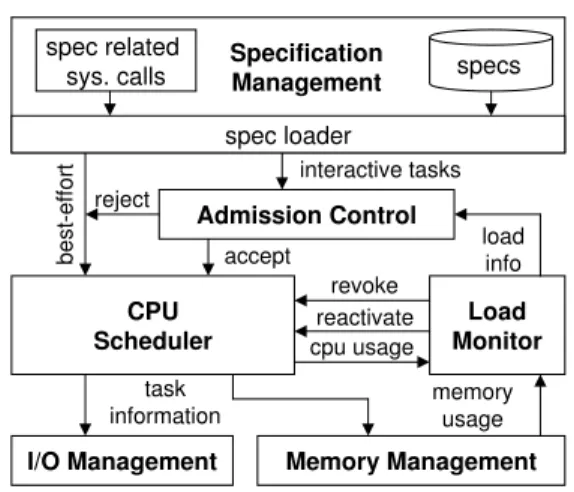
Figure 1 presents an overview of the Redline system. The first component is specification management. It allows the system administrator to pick a set of important applications and give their specifications, which are stored in a special file. Redline loads specifications from that file whenever an application is launched. Redline also exposes a system call interface that allows users to change an application’s specification during execution.
Redline divides tasks into four types based on their pro-cessing requirements:
1. Real-time (RT): time critical tasks for which the con-sequence of missing a deadline is catastrophic to the system;
2. Interactive (Iact): response-time sensitive tasks that provide services in response to external request-s/events. These include not only typical interactive tasks, but also tasks that serve requests from other tasks, such as kernel threads and daemons;
3. Throughput (Tput): tasks that require a certain amount of CPU bandwidth over the long-term, with-out the need for short-term responsiveness; and
Load Monitor CPU Scheduler spec related sys. calls Memory Management I/O Management revoke reactivate memory usage cpu usage Admission Control load info specs task information Specification Management accept interactive tasks b e s t-e ff o rt reject spec loader
Figure 1: The Redline system.
4. Best-effort (BE): tasks whose performance is not crit-ical, such as virus scanners.
This paper focuses on Redline’s support for interactive (Iact) and best-effort (BE) tasks. Redline treats any appli-cation without a specifiappli-cation as a best-effort task.
Whenever a new task is launched, Redline performs ad-missions control to see whether the system can accom-modate it. Instead of solely relying specifications, which would pessimistically reject most tasks, Redline uses an op-timistic admission control mechanism in conjunction with dynamic load control. It monitors the CPU bandwidth con-sumed by interactive tasks, and accepts a new task as long as its requirements (together with current load) do not ex-ceed a certain threshold. When Redline detects an over-load, the load monitor chooses a victim to downgrade. This victim is the task that acts least like an interactive task (i.e., it is the most CPU-intensive). The CPU scheduler then downgrades the victim’s specification, turning it into a best-effort task. This strategy allows other interactive tasks to continue to meet their response-time requirements. When-ever more resources become available, Redline will reacti-vate the specification of a previously-revoked task.
Once the admissions control mechanism accepts a task, the CPU scheduler activates the loaded specification. It also propagates the specification to the other resource managers, so that they can handle each type of tasks accordingly. The memory manager attempts to protect their working sets and allows them to evict pages from best-effort tasks if neces-sary. It also maintains a rate-controlled memory reserve that provides limited isolation among interactive tasks un-der servere memory pressure. The disk I/O management assigns higher priorities to interactive tasks, ensuring that I/O requests from interactive tasks finish as quickly as possible. Finally, Redline’s extended CPU scheduler pro-vides the required CPU resources for the interactive tasks. Redline’s integrated resource management, combined with
appropriate admission and load control, effectively main-tains interactive responsiveness under heavy resource con-tention.
3 Redline Specifications
While Redline executes applications without specifications in best-effort mode, it can use specifications to guarantee their responsiveness. We have defined specifications for a wide class of services. These specifications not only ensure the responsiveness of interactive applications like text edi-tors, movie players, and web browsers. By specifying the requirements of applications that support the graphical user interface, including the X server, window/desktop manager, etc., Redline ensures that the GUI remains responsive. Its specifications for a range of kernel threads and daemons al-lows Redline to ensure that the system as a whole remains stable. Finally, we have generated specifications for a range of administrative tools (e.g.,bash,top,ls, andkill) that al-low users to manage their applications as well as the system even under extreme load.
A specification in Redline is an extension of CPU reservations [16], which allow an interactive task to reserveCmilliseconds of computation time out of everyT millisecond period. A specification consists of following fields:
hpathname:type:C:T:flags:π:ioi
The first field is the path name to the executable, and the second field is its type (usuallyIact, for interactive). Two important flags includeI, whether the specification is inher-ited by a child process, andR, which indicates if the speci-fication may be revoked when the system is overloaded. A specification can also contain two optional fields: πis the memory protection period in seconds (see Section 4) andio is the I/O priority (see Section 5).
For example, here is the specification formplayer, an in-teractive movie player:
h/usr/bin/mplayer:Iact:5:30:IR:-:-i
This specification indicates thatmplayer is an interactive task that reserves 5ms out of every 30ms period, its speci-fication is inheritable and can be revoked if necessary, and its memory protection period and I/O priority are chosen by Redline automatically.
Setting Specifications: We derived specifications for a range of interactive applications by following several sim-ple rules. Most administrative tools are very short-lived, so reserving a few percent of CPU bandwidth out of ev-ery several hundred milliseconds is sufficient to guarantee responsiveness. Most kernel threads and daemons are not CPU intensive, but very response time sensitive, so their reservation period should be in the tens of milliseconds. The reservation period for a movie player should be around 30ms to ensure 30 frames per second, which implies that the X server and window/desktop manager should also use
exec() fork()
copy spec from its parent
call exec() within 1ms? parent has the inheritable flag set? parent has spec?
find a match spec in /etc/spec.tab?
To admission test Launch as BE Y N N N Y Y load spec Y N
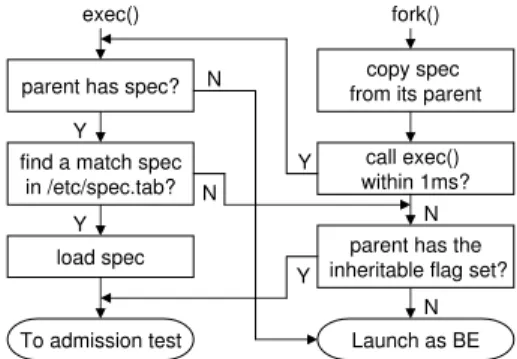
Figure 2: Loading Specifications in Redline
the same reservation period (if not smaller). We found that setting specifications was straightforward. With little work, we were able to manually generate a set of specifi-cations for about 100 applispecifi-cations in a Linux system with the K Desktop Environment (KDE). This specification file is portable and could easily be shipped with a Linux distri-bution.
Loading Specifications: Redline stores its specifica-tions in a file (/etc/spec/spec.tab). An interactive task uses either the specification loaded duringexec()or one inher-ited from its parent. Figure 2 shows how Redline loads the specification for a task.
In practice, most tasks either invoke exec()soon after being forked, or never invoke it. Therefore, duringfork(), Redline copies the parent’s specification and gives the new task 1ms of execution time. If the new task does not invoke exec()within this 1ms window, Redline checks the speci-fication. If the inheritable flag is set, Redline performs an admission test on the inherited specification. Otherwise, the new task is launched in the best-effort category.
If, however, the new task does invokeexec()within the 1ms window, Redline first checks its parent. If the parent is a best-effort task without any specification, then the new task is set to be best-effort. Otherwise, Redline searches the specification table for the new task using its full path name. If it finds a match, Redline loads the specification and performs an admission test. If there is no match and the parent is not marked for inheritance, the new task is set to be best-effort. Notice that, in the absence of specifications, Redline behaves exactly like a normal Linux system .
4 Redline Virtual Memory Management
The goal of existing virtual memory managers (VMM) in commodity operating systems is to maximize overall sys-tem throughput. There is no notion of fairness to tasks, let alone any consideration of the priorities and shares used in the CPU scheduler. Most VMM’s employ “use-it-or-lose-it” policies, under which memory referencing speed deter-mines allocation: the more pages referenced per second, the large a main memory allocation the VMM provides.A task that blocks on I/O—and an interactive task will routinely block on input—is more vulnerable to losing its allocation and then later being forced to page swap when it awakens. Because typical VMM’s do not provide isolation among tasks, a single memory-intensive task can “steal” the allocations of other tasks that are not actively using their pages. Worse, page swapping itself is the kind of block-ing I/O operation that can cause a task to lose more of its allocation to other processes that quickly references their pages.
Failing to supply required memory pages on time can se-riously hurt the responsiveness of interactive tasks, due to the enormous overhead of loading pages from disk. There-fore, the Redline VMM is designed to satisfy the mem-ory requirements of interactive tasks, thus keeping them responsive even after blocking on input. Informed with necessary information from the specifications, the Redline VMM uses three mechanisms to achieve these goals: pro-tecting the working sets of interactive tasks,bookingpages used by best-effort tasks, and arate-controlled memory re-serve.
Protecting working sets:The Linux VMM uses a page replacement algorithm that approximates a global least re-cently used (LRU) policy. Pages are approximately ordered by recency of use and with no consideration of the task to which each page belongs. Pages used longest ago are cleaned and selected for reclamation. The implicit goal of this policy is to minimize the total number of page swaps performed by the system, irrespective of how any one pro-cess performs as a consequence.
For an in interactive task to remain responsive, a VMM must keep itsworking set—those pages that are currently in active use—resident. In the Linux VMM, there is no identi-fication of, nor any attempt to cache, a task’s working set. If the system-wide demand for main memory is large enough, and if a task does not run and reference its pages rapidly enough, then parts of its working set will be replaced. Un-der this memory pressure, interactive tasks quickly become non-responsive.
Under the Redline VMM, each interactive task can spec-ify amemory protection period π. The VMM will evict a page only if it has not been referenced for at least π seconds. Additionally, each page has a timestampc that records the last time the page’s reference bit was cleared. A page isexpiredif(t−c)>π, wheretis the current time. By default,π=30×60, or 30 minutes ifπis not supplied by the specification. This default requires that a user ignore an interactive application for a substantial period of time before some of its working set is evicted and it becomes temporarily unresponsive.
The Redline VMM handles the pages of interactive tasks and best-effort tasks differently. If the faulting process is in the best-effort category, then the VMM reclaims pages us-ing the system’s default VMM mechanism, but with a slight
modification: only pages belonging to best-effort tasks and expired pages belonging to interactive tasks may be re-claimed; unexpired pages are not considered. Note also that this mechanism only considers pages that are not re-cently used. Pages belonging to any process that have been recently used are not examined by this reclamation mecha-nism. Should an insufficient number of pages be reclaimed by this process, it is repeated as many times as necessary.
If an interactive task faults, the VMM first tries to use the rate-controlled memory reserve (described in more de-tail below). If this reserve is insufficient, reclamation pro-ceeds as above for best-effort tasks, reclaiming all not re-cently used pages except the unexpired pages from inter-active tasks. If this attempt at reclamation is also insuffi-cient, an additional pass aggressively reclaims more best-effort pages regardless of how recently they have been used. If even this aggressive approach is insufficient, then Red-line is at risk for failing to meet its deadRed-lines, and thus the VMM revokes the specification of some interactive task, thus demoting it to the best-effort class. Having done so, it starts over, examining the rate-controlled memory reserve and then reclaiming pages as described above.
Booking best-effort pages: Sometimes a best-effort task may dirty (modify) pages faster than the VMM can clean them, thus preventing the VMM from evicting its pages. Such best-effort tasks can hold large amount of memory, preventing interactive tasks from building up their working sets, but contribute no real benefits to improving user experience and system responsiveness. In order to re-claim memory from such tasks, the VMM canbookpages used by best-effort tasks during the aggressive reclamation phase described above. That is, when the VMM finds a page belonging to a best-effort task, it unmaps that page and then marks it. If the best-effort task then references that page, the VMM notices the mark and, before re-mapping the page, it suspends the task briefly (e.g., 100 ms). The VMM therefore slows the task’s memory reference rate, giving the VMM enough time to reclaim more of its pages.
Rate-controlled reserve:The Linux VMM uses water-marksto trigger page reclamation. If the pool of free mem-ory falls below the watermark, page reclamation is trig-gered. This approach is not desirable for interactive tasks because, should such a task fault, it would block during the potentially lengthy reclamation process, even if it needs only a small number of pages. The Redline VMM thus maintains a small memory reserve (about 8MB in our im-plementation) for interactive tasks, and controls their speed of consuming pages in this reserve. Although an interactive task still may block during reclamation, the reserve makes that situation significantly less likely.
The Redline VMM offers each interactive task a reserve budgetb(the default is 256 pages) and records the timetf
when the first page in its budget is consumed. For each reserved page consumed, the Redline VMM reduces the
budget of the consuming task and then triggers a kernel thread to reclaim pages in background if necessary. We do not want a memory demanding task to quickly exhaust the reserve and affect other tasks, so the speed of a task con-suming reserved pages should not be faster than the system can reclaim them. Therefore, the Redline VMM charges each reserved page a costc that is roughly the overhead of one disk access operation (5 ms in Redline). When a task expends its budget, the VMM evaluates the inequality tf+b×c<t, wheretis the current time. If the inequality
is true, then the VMM addsbto the task’s budget. If the in-equality is false, the task is consuming reserved pages too quickly. Thus, the VMM prevents the task from using the reserve untilbpages are reclaimed or the reserve resumes its full capacity. This limited isolation among interactive tasks is very important for system responsiveness as shown in Section 8.
5 Redline Disk I/O Management
Like the VMM, the I/O manager of a general purpose OS’s does not distinguish between interactive and best-effort tasks. The policies that determine when and in what order pages are read from and written to disk are designed to optimize system throughput and are oblivious to CPU scheduler goals. This obliviousness can lead the I/O man-ager to schedule the requests for best-effort tasks before those of interactive tasks in a way that substantially harms response times. We describe the Redline I/O manager, which manages I/O events in a way that allows responsive tasks to meet their deadlines.
Journaling: For Linux,ext3is a journaling file system and the default for most distributions. Like any journaling file system, its updates are commited inatomic transac-tions, each of which writes a group of cached, dirty pages along with their new metadata. Its implementation is de-signed to maximize system-wide throughput, sometimes to the detriment CPU scheduling goals. We describe here a particular problem with this file system’s implementation that Redline fixes. Although this particular problem is spe-cific to Linux’sext3, it is representative of the way in which any OS component that manages system resources can un-dermine interactivity.
Consider two tasks: interactive task Pi and best-effort
taskPbe. Now consider that both tasks use thewrite()
system call to save data to some file on the sameext3file system. These system calls will not immediately initiate disk activity. Instead, the data written with this mechanism will be buffered as a set of dirty pages in the file system cache. Critically, these pages will also be added to a single, global,compoundtransaction byext3. This transaction will contain dirty pages from any file written by any task, and thus will contain the pages written by bothPiandPbe, even
though they were written by different tasks and to different files.
In this example, Pbe writes a large amount of data
through write(), while Pi writes some small amount.
Assume that after both tasks have performed these
write()operations, and thatPiperforms anfsync()
system call to ensure that its updates are committed to disk. Because of the compound transactions used by ext3, Pi
blocks until both its own dirty pages and those of Pbeare
written to disk.
If the OS caches too many of the pages written byPbe,
then thefsync()operation will forcePito be noticeably
unresponsive. This poor interaction between compound transactions andfsync() occurs not only forext3, but also forResierFS[26]. Under Linux, thedirty threshold d is a system-wide parameter that determines what percent-age of main memory may hold dirty ppercent-ages—ppercent-ages that may belong to any task—before a disk transfer is initiated to “clean” those pages. By default,d=10%, making it pos-sible on a typical system for 100 MB to 200 MB of dirty pages to be cached and then written synchronously when
fsync()is called.
Best-effort and interactive tasks should not have the same dirty threshold. Redline assigns different dirty thresh-olds for each type of task (RT:10%, Iact:5%, Tput:2%). Addtionally, Redline further restricts this threshold for best-effort tasks to a constant limit of 2 MB, ensuring that, no matter the size of main memory, best-effort tasks can-not fill the compound transactions of some journaling file systems with large numbers of dirty pages. Finally, Red-line places the kernel task assigned to manage write opera-tions for each file system (in Linux,kjournald) an interac-tive task, ensuring that time-critical transaction operations are not delayed by other demands on the system.
Block device layer: Much like the journaling file sys-tems described above, a block device layer may have uni-fied data structures, thresholds, or policies that are applied irrespective of the tasks involved. These components are typically designed to maximize system-wide throughput. However, the unification performed by these components may harm the responsiveness of interactive tasks. Redline addresses these problems by handling these components of the block device layer on a per-task-type basis.
The Linux block device manager, Complete Fairness Queuing (CFQ), contains a singlerequest queueof I/O re-quests from which actual disk operations are drawn. Al-though this request queue internally organizes I/O requests into classes (real-time, best-effort, the “idle”), it has a fixed, maximum capacity. When a task submits a request for a new I/O operation, thecongestion control mechanism ex-amines only whether the request queue is full—there is no consideration of the requesting task’s class. If the queue is full, the submitting task blocks and is placed in a FIFO-ordered wait-queue. Thus, a best-effort task might rapidly submit a large number of requests, thus congesting the block device and arbitrarily delaying some interactive task
that requests an I/O operation.
To address this problem, Redline uses multiple request queues, one per task class. If one of the queues fills, the congestion control mechanism will only block processes in the class associated with that queue. Therefore, no mat-ter how many requests have been generated by best-effort tasks, those requests alone cannot cause an interactive task requesting I/O to block.
The default request queue for CFQ is well structured for differentiating between various request types, but it still does not provide sufficient isolation for interactive tasks. Specifically, once a request has been accepted into the re-quest queue, it awaits selection by the I/O scheduler to be placed in the dispatch queue, from which it is sched-uled by a typical elevator algorithm on the disk itself. This I/O scheduler not only gives preference to requests based on their class, but also respects the priorities that tasks assign requests within each class. However, each buffered write request—the most typical kind—is placed into the best-effort class, no matter which task submits the request. Therefore, best-effort tasks may still interfere with the buffered write requests of interactive tasks by submit-ting large numbers of buffered write requests.
Redline adds both an Iact and aTput class to the re-quest queue management, thus matching its CPU sched-uler’s classes. All write requests are placed into the appro-priate request queue class based on the type of the submit-ting task. The I/O scheduler prefers requests from theIact class over those in theTputclass, thus ensuring isolation of the requests of Iact tasks from Tput tasks.
Additionally, the specification for a task, as described in Section 3, includes the ability to specify the priority of the task’s I/O requests; if the specification does not explic-itly provide this information, then Redline automatically assigns a higher priority to tasks with shorter deadlines. Finally, Redline creates a per-task queue within the given class, allowing the I/O scheduler provide some isolation be-tween Iact tasks.
Finally, CFQ, by default, does not guard against starva-tion. A task that submits a low-priority I/O request into one of the lesser classes may never have that request ser-viced. Redline modifies the I/O scheduler to ensure that all requests are eventually served, preventing this starvation.
6 Redline CPU Scheduling
Existing commodity operating systems handle interactive and best-effort tasks using the same time-sharing sched-uler. They usually have no admission control to avoid overloading, and do not provide necessary isolation among tasks to prevent them from interfering with each other. To address overloading and interference, Redline extends the Linux kernel with admission control to prevent accepting too many interactive tasks, and with load control for quick recovery from overloads, with a new Earliest Deadline First
(EDF) scheduling class to serve interactive tasks.
6.1 Admission and Load Control
An admission control, ensuring necessary resource is avail-able to the requesting task, is required by any system that needs to provide response time guarantees. While general operating systems have no admission control at all, Real-time systems perform their admission tests based solely on specifications. For example, the total reserved bandwidth must be less then 1.0 when using EDF, and less than 0.69 for RM [19], so that none of the accepted tasks will miss any of their deadlines. This provides overly strong isolation for general purpose systems and prohibits many aperiodic interactive tasks from co-existing in the system and sharing CPUs effectively. In Redline admission and load control is based on a different observation:As long as the CPU band-width consumed by reservations (i.e., by the EDF schedul-ing class) is not too high, the system will be responsive. Most of the time users may not even notice the difference.
Therefore, Redline incorporates the actual CPU con-sumption into its admission control. It attempts to keep the CPU load consumed by reservations within a controlled range. It does so using three policy controls: 1) admission of new EDF-class tasks; 2) revocation of EDF tasks when there is excessively high load; and 3) reactivating tasks for EDF service when the load is low. Each control has an associated load threshold:Rhifor admission,Rmaxfor re-vocation, andRlofor reactivation, whereRmax>Rhi>Rlo. Roughly speaking, if the load exceedsRmax, Redline re-vokes EDF tasks; if the load exceedsRhi, it stops admit-ting new EDF tasks; and if the load falls belowRlo, it tries to reactivate tasks. In addition to using the exponentially smoothed load average, Rload, Redline also keeps a his-tory of recentRloadvalues, to provide information about variation of the load. In particular, it samplesRloadonce a second and keeps the four most recent samples. We chose a four secondobservation windowas being long enough to smooth out short bursts, while limiting the period of time during which Redline’s responsiveness will degrade with-out the system’s taking aggressive action. We now consider the details of the three policy controls.
Admission Test: WhileRloadis a good measure of the actual load presented bypreviously admitted tasks, when admitting anewtask, Redline starts with that task’s band-width specificationBi=Ci/Ti. It maintains a best estimate
of anticipated load, which we callSload. When it admits taski, it incrementsSloadbyBi. However, as newly
admit-ted tasks run, we wish to use their actualload in making future decisions. Therefore, Redline decaysSloadtowards Rload (by a factor of 0.75 each second). Before it admits taskiit comparesmax(Rload,Sload)+Bi againstRhi, and
admits the task only if that new estimated load is less than Rhi. Redline also decrements Sload appropriately when tasks exit. Sloadis helpful in preventing Redline from
ad-mitting too many new tasks before it sees the actual load they present (reducing true overcommitment), whileRload allows Redline to overcommit (compared to theBi
specifi-cations) effectively.
Once Redline accepts a task, the scheduler activates its specification, and also selects the memory protection pe-riod and I/O priority for it (these are discussed in their respective sections of the paper). It propagates necessary information to other resource managers, so that they can handle interactive tasks in a proper manner.
Revocation: Due to Redline’s semi-optimistic admis-sion control, a CPU may become overloaded when some interactive tasks running on it suddenly change their be-havior. Therefore, Redline dynamically revokes tasks if necessary to keep the CPU bandwidth consumed by reser-vations under control. In revoking, Redline uses the thresh-oldRmax>Rhi. Specifically, if the sampled load exceeds Rmax for everysample in the observation window for a CPU, Redline revokes tasks on that CPU untilRloadfalls belowRhi. In choosing tasks to revoke, Redline prefers to revoke a task that exhausted its reservation during the observation window (indicating that the task has become more CPU-bound and less interactive). However, if there are no such tasks, Redline revokes the task with the highest reserved bandwidth. Certain tasks are set to be invulner-able to revocation to preserve overall system responsive-ness, namely kernel threads, daemons,Xorg, and the win-dow/desktop manager.
Reactivation:If all slots in the observation window fall belowRloon a CPU, Redline begins reactivating tasks for EDF scheduling. A task is eligble for reactivation ifboth (a) it passes the usual admission test, and(b) its virtual memory size minus its resident size is less than free mem-ory currently available (i.e., it will not immediately induce excessive swapping). We further constrained Redline to re-activate only one task every period of an observation win-dow to avoid reactivating tasks too aggressively.
6.2 The EDF Scheduling Algorithm
Recently, Linux adopted a new fair queueing proportional share scheduler called CFS [21], which Redline extends. The new EDF scheduler component has its own set of per-CPU run queues just as the CFS scheduler does. Redline inserts interactive tasks into the run queues ofboththe CFS and EDF schedulers, so that inteactive tasks can receive extra CPU allocations after using up their entitled reserva-tion. The EDF scheduling class has precedence over the CFS scheduling class. During a context switch, Redline first invokes the EDF scheduler to pick a task from its run queue. If the EDF scheduler does not select a task, then Redline invokes the CFS scheduler to pick a task to run.
Redline maintains the following information for each in-teractive task: the starttime anddeadline of the current reservation period, and entitled computation time left (
bud-get). As a task executes, the EDF scheduler keeps track of its CPU usage and deducts the amount consumed from bud-get (at every timer interrupt or context switch). The EDF scheduler checks whether to assign a new reservation pe-riod to a task at the following places: when a new task is initialized, after a task’s budget is updated, and when a task wakes up from sleep. If the task has consumed its budget or passes its deadline, the EDF scheduler assigns a new reser-vation period to the task using the algorithm in Listing 1.
Listing 1Assign a new reservation period to taskp
1: /* has budget, deadline not reached */ 2: if (budget>0) && (now<deadline) then 3: return
4: end if
5: /* has budget, deadline is reached */ 6: if (budget>0) && (now≥deadline)then 7: if has no interruptible sleep then
8: return
9: end if
10: end if
11:
12: /* no budget left: assign a new period */ 13: dequeue(p)
14: starttime←max(now,deadline) 15: deadline←starttime+T 16: budget←max(budget+C, C) 17: enqueue(p)
A task may reach its deadline before expending the bud-get (see line 6) for the following reasons: it did not actually have enough computation work to exhaust the budget in the past period; it ran into a CPU overload; or it experienced non-discretionary delays, such as page faults or disk I/O. The EDF scheduler differentiates these cases by checking whether the task voluntarily gave up the CPU during the past period (i.e., had at least one interruptible sleep, see line 7). If so, the EDF scheduler assigns a new period to the task. Otherwise, it considers that the task missed a deadline and pushes its work through as soon as possible.
If a task consumes its budget before reaching the dead-line, it will receive a new reservation period. But the start time of this new period is later than the current time (see line 14). The EDF scheduler considers a taskeligiblefor using reserved CPU time only ifstarttime≤now. There-fore, it will not pick this task for execution until its new reservation period starts. This mechanism prevents a inter-active task from consuming more than its entitlement and thereby interfering with other interactive tasks.
At any context switch, the EDF scheduler always picks for execution the eligible task that has the earliest dead-line. We implemented its run queue using a tagged red-black tree similar to the binary tree structure proposed in EEVDF [29]. The red-black tree is sorted by the start time
of each task. Each node in the tree has a tag recording the earliest deadline in its subtree. The complexity of its enqueue, dequeue, and select operations are allO(logn), wherenis the number of runnable tasks.
6.3 SMP Load Balancing
Load balancing in Redline is quite simple, because the ba-sic CPU bandwidth need of a interactive task will be sat-isfied once it is accepted on a CPU. It is not necessary to move an accepted task unless that CPU is overloaded. The only thing Redline has to do is select a suitable CPU for each new interactive task during calls toexec(). Redline al-ways puts a new task on the CPU that has the lowestRload at the time. Once the task passes the admission test, it stays on the same CPU as long as it remains accepted. If the CPU becomes overloaded, Redline will revoke at least one inter-active task tied to that CPU. Once turned into best-effort tasks, revoked tasks can be moved to other CPUs by the load balancer. When a revoked task wakes up on a new CPU, Redline will attempt to reactivate its specification if there are adequate resources there.
7 Discussion
In this section, we discuss several design choices for Red-line, and we address alternatives that may merit further in-vestigation.
Specification: We believe that using CPU reservations is a good choice because it does not require precise, a pri-ori application information. Because Redline’s admission control takes the current CPU load into account, a user or system administrator can modestly over-specify a task’s resource needs. Specifically, a the only danger of over-specification is that a newly launched task may be rejected by the admission control if the system is sufficiently loaded with interactive tasks. Once admitted, an interactive task is managed according to its real usage.
Because over-specification is reasonably safe, and be-cause the specifications are simple and lightweight, speci-fication management should not be an obstacle. A simple tool could allow a user to experimentally adjust the reser-vations (bothCandT), finding the minimal requirements for acceptable performance. Redline could also be made to track and report actual CPU bandwidth usage over time, allowing fine-tuning of the reservations.
Memory Management: For any task to be responsive, the operating system must cache its working set in main memory. Many real-time systems conservatively pin all pages of a task, preventing their removal from main mem-ory, to ensure that the working set must be cached. In contrast, Redline achieves this goal by protecting any page used by an interactive task within the lastπseconds. The choice ofπis important. If it is too small, then pages still in active use may be evicted, leaving an interactive task un-able to meet its deadlines. Ifπis too large, then the VMM
caches some pages after they have fallen into disuse, thus overestimating the working set size, reducing the number of interactive tasks that Redline will admit, and underuti-lizing the system. It is safer to overestimateπ, but doing so makes Redline behave somewhat more like a conservative real-time system.
This method of identifying the working set works well under many circumstances with reasonable choices of π. However, there are other mechanisms that estimate the working set more accurately. By using such a mechanism, Redline could avoid both dangers outlined above caused by settingπpoorly.
One such alternative is the working set measurement used in CRAMM [33]. This system maintains reference distribution histograms to track each task’s working set on-line with low overhead and high accuracy. While we be-lieve that this approach is likely to work well, it does not guarantee that the working set is always properly identi-fied. Specifically, when a task performs a phase change, altering its reference behavior suddenly and significantly, this mechanism will require a modest period of time to rec-ognize the change. During this period, both of the prob-lems described above caused by under- or over-estimating the working set size would be possible. However, we be-lieve such behavior is likely to be tolerably transitory in the vast majority of cases. We intend to integrate the CRAMM VMM into Redline and evaluate its performance.
8 Experimental Evaluation
In this section, we evaluate the performance of Redline im-plementation by examining its ability to handle various ex-treme workloads.
Platform: We perform all measurements on a sys-tem with a 3.00 GHz Pentium 4 CPU, 1 GB of RAM, a 40GB FUJITSU 5400RPM ATA notebook disk, and an Intel 82865G integrated graphic card. The processor em-ployssymmetric multithreading (SMT)(i.e., Intel’s Hyper-Threading), thus appearing to the system as two processors. For L1 caches, the processor has a 12 KB instruction cache and an 8 KB data cache. The L2 cache is unified and 512 KB. We use a Linux kernel (version 2.6.22.5) patched with the CFS scheduler (version 20.3) as our control. Redline is implemented as a patch to this same Linux version. For all experiments, the screen resolution was set to 1600 x 1200 pixels.
All experiments used all both of the SMT-based virtual CPU except when measuring the context switch overhead. Furthermore, we ran each experiment 30 times, taking both the arithmetic mean and the standard deviation for all tim-ing measurements.
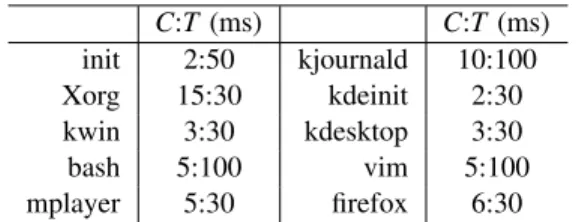
Application Settings and Inputs:Table 1 shows a sub-set of the specifications used in Redline. It includes the initprocess,kjournald, the X11 serverXorg, KDE’s desk-top/window manager, thebashshell, and several typical
in-teractive applications. We left the memory protection pe-riod (π) and I/O priority empty in all the specifications, let-ting Redline choose them automatically.
The movie player,mplayer, plays a 924.3 Kb/sAVI for-mat video at 25 frames per second (f/s) with a resolution of 520 x 274. To give the standard Linux system the great-est opportunity to support these interactive tasks, we set mplayer,firefox, andvimto have a CPU scheduler prior-ity of -20—the highest priorprior-ity possible. Note that a pes-simistic admission test would not accept all of the applica-tions in Table 1 because they would overcommit the sys-tem. Redline, however, accepts these and many other of interactive tasks for these experiments.
C:T(ms) C:T(ms) init 2:50 kjournald 10:100 Xorg 15:30 kdeinit 2:30 kwin 3:30 kdesktop 3:30 bash 5:100 vim 5:100 mplayer 5:30 firefox 6:30
Table 1: A subset of the specifications used in the Redline experiments.
8.1 CPU Scheduling
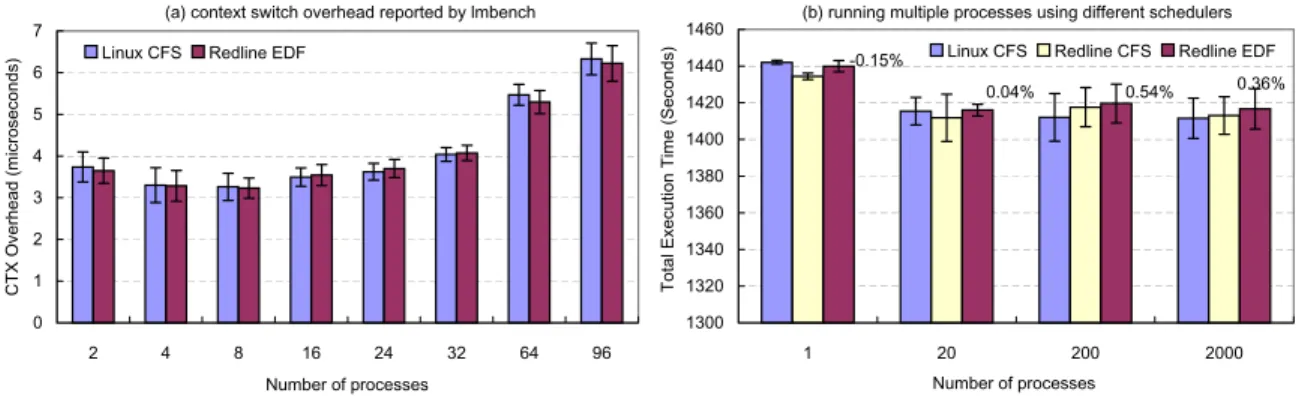
Scheduler Overhead:We compare the performance of the Redline EDF scheduler with the Linux CFS scheduler. Figure 3(a) presents the context switch overhead for each scheduler as reported bylmbench. From 2 to 96 processes, the context switch time for both schedulers is exceedingly comparable.
However, when lmbench measures context switching time, it creates a workload in which exactly one task is un-block and ready to run at any given moment. This charac-teristic oflmbenchmay be unrepresentative of some work-loads, so we further compare these schedulers by running multiple busy-looping tasks, all of which would be ready to run at any moment. We tested workloads of 1, 20, 200, and 2,000 tasks. We perform this test twice for Redline, launching best-effort tasks to test its CFS scheduler, and launching interactive tasks to testi its EDF scheduler. In the latter case, we assigned specification values forC:T as 1:3, 1:30, 1:300 and 1:3000 respectively, thus forcing the Redline EDF scheduler to perform a context switch almost every millisecond. Note that with these specification val-ues, the Redline EDF scheduler is invoked more frequently than a CFS scheduler would be, running roughly once per millisecond (whereas the usual Linux CFS quanta is 3 ms). The number of loops are chosen so that each run takes approximately 1,400 seconds. Figure 3(b) shows the mean total execution time of running these groups of tasks with Linux CFS, Redline CFS, and Redline EDF. In the worst case, the Redline EDF scheduler adds 0.54% to the running time, even when context switching far more frequently than
the CFS schedulers. Note that the total execution time of these experiments was bimodal and, as shown by the error bars, thus making the variance in running times is larger than the difference between the results.
Fork Bombs: We now evaluate the ability of Redline to maintain the responsiveness of interactive tasks. First, we launchmplayeras an interactive task, letting it run for a few seconds. Then, we simulataneously launch many CPU-intensive tasks, thus performing afork bomb. Specifically, a task forks a fixed number of child tasks, each of which ex-ecutes an infinite loop, and then kills them after 30 seconds. We performed two tests for Redline: the first runs the fork bomb tasks as best-effort, and the second runs them as in-teractive. In the latter case, the fork bomb tasks were given CPU bandwidth specifications of 10:100. For the Linux test, the interactive task had the highest possible priority (-20), while the fork bomb tasks were assigned the default priority (0).
Figure 4 shows the number of frames rate of achieved bymplayerduring the test. In Figure 4(a), the fork bomb comprises 50 tasks, while Figure 4(b) shows a 2,000 task fork bomb. In Redline, a fork bomb can be best-effort or in-teractive. Under Linux with 50 tasks,mplayerbegins nor-mally. After approximately 10 seconds, the fork bomb be-gins andmplayerreceives so little CPU bandwidth that its frame rate drops nearly to zero. Amusingly, after the fork bomb terminates at the 40 second mark,mplayer“catches up” by playing frames at more than triple the normal rate. For Linux, the 2,000-task fork bomb has the identical ef-fect on mplayer. The load is so high that even the fork bomb’s parent task is unable to kill all of the children after 30 seconds. In fact, the whole Linux system becomes unre-sponsive, with simple like moving the mouse and switching between windows becoming so slow that human interven-tion is impossible.
In Redline, these fork bombs, whether run as best-effort or interactive tasks, have a negligible impact onmplayer. Only the 2,000 task interactive fork bomb briefly degrades the frame rate to 20 f/s, which is a barely perceptable ef-fect. This brief degradation is caused by the 1 ms period that Redline gives to each newly forked task before per-forming an admission test, leaving the system temporarily overloaded.
Competing Interactive Tasks: In order to see how in-teractive tasks may affect each other, we launchmplayer, and then we have a user to drag a window in a circle for 20 seconds. Figure 5 shows that under Linux, moving a win-dow has substantial impact onmplayer. Because we use a high screen resolution and a weakly powered graphics card, Xorgrequires a good deal of CPU bandwidth to update the screen. However, the CFS scheduler gives the same CPU share to all runnable tasks, allowing the window manager to submit screen update requests faster thanXorgcan pro-cess them. Whenmplayeris awakened, it has to wait until
DFRQWH[WVZLWFKRYHUKHDGUHSRUWHGE\OPEHQFK 1XPEHURISURFHVVHV & 7; 2 YH UK HD G P LF UR VH FR QG V /LQX[&)6 5HGOLQH(') EUXQQLQJPXOWLSOHSURFHVVHVXVLQJGLIIHUHQWVFKHGXOHUV 1XPEHURISURFHVVHV 7R WD O( [H FX WLR Q 7L P H 6 HF RQ GV
/LQX[&)6 5HGOLQH&)6 5HGOLQH(')
Figure 3: An evaluation of CPU scheduling overhead. Figure (a) shows the context switching times as evaluated by lmbench. Figure (b) shows the total running time of varying numbers of CPU intensive tasks.
0 10 20 30 40 50 60 70 80 90 0 10 20 30 40 50 60
Frames per Second (fps)
Elapsed Time (Seconds) (a) Impact of a 50 process fork bomb on mplayer Linux CFS: BE bomb
Redline: BE bomb Redline: Iact bomb
0 10 20 30 40 50 60 70 80 90 0 50 100 150 200
Frames per Second (fps)
Elapsed Time (Seconds)
(b) Impact of a 2000 process fork bomb on mplayer Linux CFS: BE bomb
Redline: BE bomb Redline: Iact bomb
Figure 4: Playing a video and launching fork bombs of (a) 50 or (b) 2,000 (b) tasks.
0 5 10 15 20 25 30 35 40 45 5 10 15 20 25 30 35 40 45
Frames per Second (fps)
Elapsed Time (Seconds) Impact of moving a window on mplayer
Linux CFS Redline
Figure 5: Playing video while dragging around a window.
all other runnable tasks to make enough progress before it is scheduled for execution. Moreover, its requests are in-serted at the end ofXorg’s backlogged service queue. Con-sequently, the frame rate ofmplayerbecomes quite erratic as it falls behind and then tries to catch up by submitting a group of frame updates in rapid succession.
In Redline,mplayerplays the movie smoothly no matter how quickly we move the window, even thoughXorgand all of the tasks comprising the GUI are themselves inter-active tasks. We believe that becauseXorgeffectively gets more bandwidth (50% reserved plus proportional sharing with other tasks), and the EDF scheduler makes mplayer add its requests intoXorg’s service queue earlier.
8.2 Memory Management
Memory Bomb: We simulate a workload that has a high memory demand (memory pressure) by using a mem-ory bomb. This experiment forks four child tasks, each of which allocates 300 MB of heap space and then repeatedly writes to each page in an infinite loop. For Redline, we per-form two experiments where the first launches the memory bomb as best-effort tasks, and the second launches them as interactive ones. In the latter case, we use a specification of 10:100 for the memory bomb tasks.
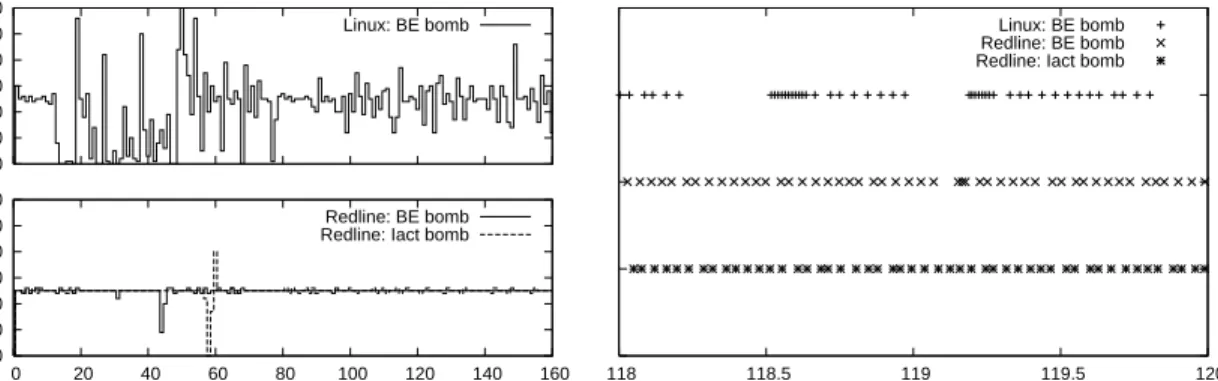
The upper part of Figure 6(a) shows, for Linux, the frame rate for mplayerover time with the memory bomb tasks running. The frame rate is so erratic that movie is unwatch-able. Both video and audio to pause periodically. The memory bomb forces the VMM to swap out many pages
0 10 20 30 40 50 60 0 20 40 60 80 100 120 140 160
Frames per Second
Elapsed Time (Seconds) Redline: BE bomb Redline: Iact bomb 0 10 20 30 40 50 60
Frames per Second
Impact of a 4x300MB memory bomb on mplayer Linux: BE bomb
118 118.5 119 119.5 120
Elapsed Time (Seconds) When each frame is played during (118, 120)
Linux: BE bomb Redline: BE bomb Redline: Iact bomb
Figure 6: Playing video with 4 x 300 MB memory bomb tasks. The frame rate is severely erratic under Linux, but is steady under Redline. 0 10 20 30 40 50 60 0 20 40 60 80 100 120
Frames per Second
Elapsed Time (Seconds) Redline: Iact bomb: run2 0 10 20 30 40 50 60
Frames per Second
Uncontrolled reserve: 4x300MB interactive memory bomb Redline: Iact bomb: run1
Figure 7: Playing a movie with 4 x 300 MB interactive memory bomb tasks on a Redline system without the rate controlled memory reserve.
used by GUI applications, making the system as a whole unresponsive. Although it appears that the erratic frame rate settles somewhat at around the 80 second mark, Fig-ure 6(b) shows the time at which each frame is played dur-ing the period from second 118 to second 120. We see that although the overall frame rate during this period is within a normal range, frames are displayed in bursts, still leaving the user with an undesirable experience.
As shown by the lower part of Figure 6(a), under Red-line,mplayersuccessfully survives both the best-effort and interactive memory bomb. Each of them only leads to one brief distruption of the frame rate (less than 3 seconds), which the user will notice but is likely to tolerate. The sys-tem remains responsive, allowing the user to carry out GUI operations and interact as usual.
The Rate Controlled Reserve:In order to demonstrate the importance of the rate controlled reserve, we remove it from Redline and repeat the interactive memory bomb
0 100 200 300 400 500 600 0 20 40 60 80 100 120 rss (MB)
Elapsed Time (Seconds)
Redline background: BE foreground: Iact (10:100) 0 100 200 300 400 500 600 rss (MB)
Running two 500MB working set processes
Redline
Linux background: BE
foreground: BE (-20)
Figure 8: Competing memory bomb tasks. Under Linux, the lower-priority background task prevents the higher-priority foreground task from caching its working set.
experiment. Figure 7 shows howmplayerbehaves in two different runs. In the first, memory demanding interac-tive tasks quickly exhaust the free memory, forcing others tasks to reclaim pages when allocating memory. Therefore, mplayer is unable to maintain its frame rate. At approxi-mately the 90 second mark, the Redline VMM finally de-motes an interactive task to the best-effort class, and then the frame rate of mplayerstabilizes. Depending on when and which tasks the Redline VMM chooses to revoke, the interactive memory bomb can prevent the system from be-ing responsive for a long period of time. Here, more than one minute passes before responsiveness is restored. Thus, the limited isolation among interactive tasks provided by this small rate controlled reserve is crucial to the system’s responsiveness.
Booking: To examine the effectiveness of Redline’s page booking mechanism, we first start one 500 MB mem-ory bomb task. After a few seconds, we launch a second
500 MB memory bomb. Under Linux, we set this sec-ond task’s priority to be -20. Under Redline, we launch it as an interactive task whose specification is set to 10:100. Figure 8 presents the resident set sizes (RSS)—the actual number of cached pages—for each task over time. Under Linux, the second task, in spite of its high priority, is never allocated its complete working set of 500 MB. Here, the first task dirties pages too fast, preventing the Linux VMM from ever reallocating page frames to the higher priority task. In contrast, under Redline, the second task is quickly allocated space for its full working set, stealing pages from the first, best-effort task.
8.3 Disk I/O Management
Finally, we examine the effectiveness of Redline’s disk I/O management by running disk I/O intensive tasks.
Writing: For disk writing experiments, we launch two background tasks meant to interfere with responsiveness. Specifically, each repeatedly writes to an existing, 200 MB file using buffered writes. Additionally, we usevimto per-form small, sporadic write requests andiowriteto perform large write requests. It is the responsiveness of these two applications in the presence of the two background tasks that we measure.
We modifiedvimto report the elapsed time for invok-ing its write command, and we use it to save a 30 KB file. Additionally,iowritereports the time needed to write 100 MB to a file in buffered write mode. Each of these task is set to the highest priority (-20) under Linux, while each is launched as an interactive task with a specification of 5:100 under Redline.
For Linux, when vim writes using BW, each transac-tion in the journaling file system is heavily loaded with dirty pages from the background tasks. Thus, the call to
fsync()performed byvimcauses it to block a mean of 28 seconds. Under Redline, the reduced dirty threshold for best-effort tasks forces the system to flush the dirtied pages of the background task more frequently. Whenvimcalls fsync(), the transaction commited by the journaling file sys-tem takes much less time because it is much smaller, requir-ing a mean of only 2.5 seconds.
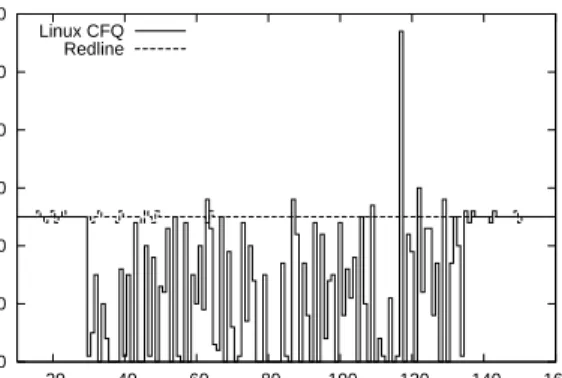
Reading: We play a movie usingmplayerin the fore-ground while nine backfore-ground tasks consume all of the disk bandwidth. Each background task reads 100 MB from disk in 20 MB chunks using direct I/O (bypassing the file system cache). Figure 9 shows the number frame rate ofmplayer over time for both Linux and Redline. Under Linux, the heavy contention for I/O bandwidth the frame rate to be severely degraded and erratic. Here, mplayerblocks fre-quently for data being transferred from disk. Redline solves this problem by automatically assigning higher I/O priori-ties to interactive tasks. Under Redline, the frame rate is not at all degraded.
0 10 20 30 40 50 60 20 40 60 80 100 120 140 160
Frames per Second (fps)
Elapsed Time (Seconds) Impact of large disk reads on mplayer Linux CFQ
Redline
Figure 9: The impact of massive reads onmplayer.
9 Related Work
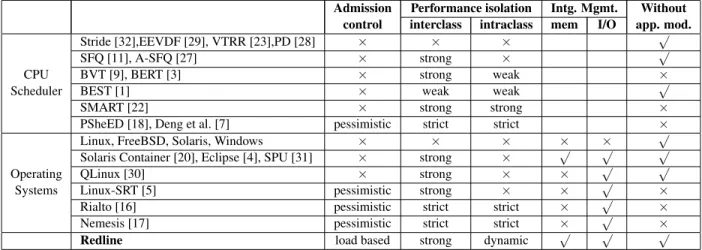
We now briefly discuss the previous efforts in areas that are related with Redline. Table 2 summaries the characteris-tics of several representive CPU schedulers and operating systems, and compares them with Redline.
CPU Scheduling:Neither time-sharing schedulers (e.g. used by Linux, FreeBSD, Solaris, Windows) or propor-tional share schedulers [11, 32, 28, 29, 23] that simulate the ideal GPS model [25] have adequate support for ad-dressing response time reqirements. Heuristics are often applied to handle interactive tasks better, which makes the approaches ad-hoc. For instance, Window Vista boosts the priorities of tasks in its newly introduced MM CLASS into real time region (16–30). Furthermore, the CPU bandwidth received by each task is relative, and thus there is no per-formance isolation among taks. Hierarchical SFQ [11] par-tially solves this problem by dividing tasks into classes. A-SFQ [27] dynamically adjusts the weights to retain stable CPU bandwidth for the class serving soft real-time tasks. BVT [9] and BERT [3] achieve the similar goal by adjust-ing virtual time or deadline. BEST [1] and SMART [22] incorporate EDF algorithm into proportional share sched-ulers.
Real time systems often use pessimistic admission con-trol and enforcement mechanism to ensure strict perfor-mance guarantees. Deng et al. [7] and PSheED [18] pro-vide a uniformly slower processor abstraction using EDF based schedulers. Each real time task is executed as if it is on a slower processor. The schedulers restrict each task to use no more than its assigned bandwidth, and thus are not work conserving. TheCPU reservationsmechanism used by Redline can be implemented in various ways. Neme-sis [17] and CPU service class [6] use EDF, Linux/RK [24] uses RM, the scheduler by Lin et al. [12] is table driven, and Rialto [16] assigns CPU time intervals using a tree-based data structure. Intended to provide strict guarantees, these schedulers perform admission test based on task
specifica-Admission Performance isolation Intg. Mgmt. Without control interclass intraclass mem I/O app. mod. Stride [32],EEVDF [29], VTRR [23],PD [28] × × × √
SFQ [11], A-SFQ [27] × strong × √
CPU BVT [9], BERT [3] × strong weak ×
Scheduler BEST [1] × weak weak √
SMART [22] × strong strong ×
PSheED [18], Deng et al. [7] pessimistic strict strict × Linux, FreeBSD, Solaris, Windows × × × × × √ Solaris Container [20], Eclipse [4], SPU [31] × strong × √ √ √
Operating QLinux [30] × strong × × √ √
Systems Linux-SRT [5] pessimistic strong × × √ × Rialto [16] pessimistic strict strict × √ × Nemesis [17] pessimistic strict strict × √ ×
Redline load based strong dynamic √ √ √
Table 2: A comparison of CPU schedulers and operating sytems to Redline tions, which seriously limits the number of response time
tasks they can simultaneously support. While Redline uses a semi-optimistic admission test combined with a dynamic load control to accommodate as many periodic and aperi-odic tasks as possible.
Memory Management:Windows virtual memory man-ager adopts a per-process working set model. It uses a ker-nel thread to take pages away from a process’s working set either periodically or in the face of memory pressure. In Zhou et al. [34], virutal memory manager maintains a miss ratio curve for each process and evicts pages from the pro-cess that incurs the least penalty. Token-ordered LRU [15] allowsonetask in the system to hold the token for a pe-riod of time and build up its working set. CRAMM [33] and Bookmark GC [13] use operating system support for garbage collected applications to avoid page swapping. However, None of them offer enough protection for the working sets of interactive applications.
Disk I/O Management: Traditional disk I/O subsys-tems are designed to maximize the overall throughput, not response time. The widely used SCAN (Elevator) algo-rithm sorts I/O requests by sector number to avoid unnec-essary seeks. Anticipatory I/O [14] improves throughput even further by delaying I/O service so it can batch a num-ber of I/O requests. I/O schedulers developed for soft real time systems, such as R-SCAN in Nemesis [17], Cello in QLinux [30] and DS-SCAN in IRS [10], have more precise control over I/O bandwidth, and could be incorporated with Redline for better guarantees. But ensuring better respon-sive time involves more than the I/O scheduler.
Integrated Resource Management: Similar to Red-line, Nemesis [17], Rialto [16] and Linux-SRT [5] uses CPU reservationsto provide response time guarantees and have specialized I/O schedulers. But their pessimistic ad-mission tests makes them less capable of handling a large amount of aperiodic tasks with unpredictable workloads. Nemesis allocates a certain amount of physical memory to
each task according to its contract and let task manage them (Self-Paging). Rialto simply locks pages for real time tasks. QLinux [30] divides tasks into classes and uses a hierarchi-cal SFQ scheduler to manage CPU and network bandwidth and Cello as its I/O scheduler. None of them hastruly inte-grated memory management.
Solaris Container [20] is the combination of system re-source control and the boundary seperation provided by zones. Each zone is configured to have dedicated amount of resources and act as a completey isolated virtual server. Eclipse [4] and SPU [31] follow the similar approach. They are desgined for providing high level isolation (e.g., users, application groups) by partitioning resources, not for re-sponsiveness.
Aiming for providing real time service to multiple clients, IRS [10] and Resource Container [2] also provide integrated management of multiple resources (memory is not included in IRS). However, they require all activities in the system to be completely self resource aware, which makes them too restrictive for general purpose operating systems. Furthermore, most of these systems require mod-ifications to existing applications while Redline does not.
10 Conclusion
We present Redline, a system designed to support highly interactive applications in a commodity operating system environment. Redline combines lightweight specifications with an integrated management of memory, disk I/O, and CPU resources that delivers responsiveness to interactive applications even in the face of extreme workloads.
The Redline system (built on Linux) is open-source software and may be downloaded at
http://www.cs.umass.edu/˜tingy/ Projects/Redline/Redline.htm.
11 Acknowledgements
This material is based upon work supported by the Na-tional Science Foundation under CAREER Award CNS-0347339 and CNS-0615211. Any opinions, findings, and conclusions or recommendations expressed in this material are those of the author(s) and do not necessarily reflect the views of the National Science Foundation.
References
[1] S. A. Banachowski and S. A. Brandt. Better real-time response for time-share scheduling. InProc. of the11thWPDRTS, page 124.2, 2003.
[2] G. Banga, P. Druschel, and J. C. Mogul. Resource containers: A new facility for resource management in server systems. InProc. of the3rdOSDI, pages 45–58, 1999.
[3] A. Bavier, L. Peterson, and D. Mosberger. BERT: A scheduler for best effort and realtime tasks. Technical Report TR-587-98, Prince-ton University, 1999.
[4] J. Bruno, E. Gabber, B. ¨Ozden, and A. Silberschatz. The Eclipse operating system: Providing quality of service via reservation do-mains. InProc. of the 1998 USENIX, pages 235–246, 1998. [5] S. Childs and D. Ingram. The Linux-SRT integrated multimedia
operating system: Bringing QoS to the desktop. InProc. of the7th RTAS, pages 135–140, 2001.
[6] H.-H. Chu and K. Nahrstedt. CPU service classes for multimedia applications. InProc. of the6th ICMCS, Vol. 1, pages 296–301, 1999.
[7] Z. Deng, J. Liu, L. Y. Zhang, M. Seri, and A. Frei. An open environ-ment for real-time applications. Real-Time Systems, 16(2-3):155– 185, 1999.
[8] P. J. Denning. The working set model for program behavior. InProc.
of the1stSOSP, pages 15.1–15.12, 1967.
[9] K. J. Duda and D. R. Cheriton. Borrowed-virtual-time (BVT) scheduling: Supporting latency-sensitive threads in a general-purpose schedular. InProc. of the17thSOSP, pages 261–276, 1999. [10] K. Gopalan and T. Chiueh. Multi-resource allocation and scheduing for periodic soft real-time applications. InProc. of the9thMMCN, pages 34–45, Berkeley, CA, 2002.
[11] P. Goyal, X. Guo, and H. M. Vin. A hierarchical CPU scheduler for multimedia operating systems. InProc. of the2ndOSDI, pages 107–121, Seattle, WA, 1996.
[12] C. han Lin, H. hua Chu, and K. Nahrstedt. A soft real-time schedul-ing server on the Windows NT. InProc. of the2ndUSENIX Windows
NT Symposium, pages 149–156, 1998.
[13] M. Hertz, Y. Feng, and E. D. Berger. Garbage collection without paging. InProc. of the 2005 PLDI, pages 143–153, 2005. [14] S. Iyer and P. Druschel. Anticipatory scheduling: A disk scheduling
framework to overcome deceptive idleness in synchronous I/O. In
Proc. of the18thSOSP, pages 117–130, 2001.
[15] S. Jiang and X. Zhang. Token-ordered LRU: an effective page re-placement policy and its implementation in Linux systems.Perform.
Eval., 60(1-4):5–29, 2005.
[16] M. B. Jones, D. L. McCulley, A. Forin, P. J. Leach, D. Rosu, and D. L. Roberts. An overview of the Rialto real-time architecture. In
Proc. of the7thACM SIGOPS European Workshop, pages 249–256,
1996.
[17] I. M. Leslie, D. McAuley, R. Black, T. Roscoe, P. Barham, D. Evers, R. Fairbairns, and E. Hyden. The design and implementation of an operating system to support distributed multimedia applications.
IEEE Journal on Selected Areas in Communications, 14(7):1280–
1297, 1996.
[18] G. Lipari, J. Carpenter, and S. K. Baruah. A framework for achiev-ing inter-application isolation in multiprogrammed hard real-time environments. InProc. of the21stRTSS, pages 217–226, 2000. [19] C. L. Liu and J. W. Layland. Scheduling algorithms for
multi-programming in a hard-real-time environment. Journal of ACM, 20(1):46–61, 1973.
[20] J. Mauro and R. McDougall.Solaris Internal: Core Kernel
Compo-nents. Sum Microsystems Press, A Prentice Hall Title, 2000.
[21] I. Molnar. http://people.redhat.com/mingo/cfs-scheduler/. [22] J. Nieh and M. S. Lam. SMART: A processor scheduler for
multi-media applications. InProc. of the15thSOSP, page 233, 1995. [23] J. Nieh, C. Vaill, and H. Zhong. Virtual-Time Round-Robin: An
O(1) proportional share scheduler. InProc. of the 2001 USENIX, pages 245–259, 2001.
[24] S. Oikawa and R. Rajkumar. Portable RK: A portable resource ker-nel for guaranteed and enforced timing behavior. InProc. of the5th RTAS, pages 111–120, 1999.
[25] A. K. Parekh and R. G. Gallager. A generalized processor sharing approach to flow control in integrated services networks: the single node case. InProc. of IEEE INFOCOM, 1992.
[26] V. Prabhakaran, A. C. Arpaci-Dusseau, and R. H. Arpaci-Dusseau. Analysis and Evolution of Journaling File Systems. InProc. of the
2005USENIX, pages 105–120, 2005.
[27] M. A. Rau and E. Smirni. Adaptive CPU scheduling policies for mixed multimedia and best-effort workloads. InProc. of the7th
MASCOTS, page 252, Washington, DC, 1999.
[28] A. Srinivasan and J. H. Anderson. Fair scheduling of dynamic task systems on multiprocessors.Journal of System Software, 77(1):67– 80, 2005.
[29] I. Stoica and H. Abdel-Wahab. Earliest eligible virtual deadline first : A flexible and accurate mechanism for proportional share resource allocation. Technical Report TR-95-22, Old Dominion University, 1995.
[30] V. Sundaram, A. Chandra, P. Goyal, P. J. Shenoy, J. Sahni, and H. M. Vin. Application performance in the QLinux multimedia operating system. InProc. of the8thACM Multimedia, pages 127–136, 2000. [31] B. Verghese, A. Gupta, and M. Rosenblum. Performance isolation: Sharing and isolation in shared-memory multiprocessors. InProc.
of the8thASPLOS, pages 181–192, 1998.
[32] C. A. Waldspurger and W. E. Weihl. Stride scheduling: Determinis-tic proportional-share resource management. Technical Report TR-528, MIT Laboratory of CS, 1995.
[33] T. Yang, E. D. Berger, S. F. Kaplan, and J. E. B. Moss. CRAMM: Virtual memory support for garbage-collected applications. InProc.
of the7thOSDI, pages 103–116, 2006.
[34] P. Zhou, V. Pandy, J. Sundaresan, A. Raghuraman, Y. Zhou, and S. Kumar. Dynamic tracking of page miss ratio curves for memory management. InProc. of the11thASPLOS, pages 177–188, Boston, MA, Oct. 2004.