Aris Angelis, Panos Kanavos and Gilberto Montibeller
Resource allocation and priority setting in
health care: a multi-criteria decision
analysis problem of value?
Article (Accepted version)
(Refereed)
Original citation:Angelis, Aris, Kanavos, Panos and Montibeller, Gilberto (2016) Resource allocation and priority setting in health care: a multi-criteria decision analysis problem of value? Global Policy . ISSN 1758-5880
DOI: 10.1111/1758-5899.12387
© 2016 University of Durham and John Wiley & Sons, Ltd. This version available at: http://eprints.lse.ac.uk/68702/
Available in LSE Research Online: December 2016
LSE has developed LSE Research Online so that users may access research output of the School. Copyright © and Moral Rights for the papers on this site are retained by the individual authors and/or other copyright owners. Users may download and/or print one copy of any article(s) in LSE Research Online to facilitate their private study or for non-commercial research. You may not engage in further distribution of the material or use it for any profit-making activities or any commercial gain. You may freely distribute the URL (http://eprints.lse.ac.uk) of the LSE Research Online website.
This document is the author’s final accepted version of the journal article. There may be differences between this version and the published version. You are advised to consult the publisher’s version if you wish to cite from it.
1
Resource allocation and priority setting in health care:
A Multi-Criteria Decision Analysis problem of value?
Aris Angelis
1, Panos Kanavos
1and Gilberto Montibeller
21
Medical Technology Research Group – LSE Health, London School of
Economics, London, United Kingdom
2
Management Science and Operations Group, Loughborough University,
Leicestershire, United Kingdom
2
BIOGRAPHIES
Aris Angelis, MSc, is a Research Officer at the Medical Technology Research Group of LSE Health and a PhD candidate with the department of Social Policy. He specialises on the value assessment of new medical technologies.
Email: [email protected]
Panos Kanavos, PhD, is Associate Professor in International Health Policy, Deputy Director at LSE Health and Programme Director of the Medical Technology Research Group (MTRG) at the London School of Economics. He has acted as an advisor to a number of international organizations, including the European Commission, the European Parliament, the World Bank, the World Health Organization and the Organization for Economic Co-operation and Development.
Email: [email protected]
Gilberto Montibeller, DSc, is Full Professor of Management Science at
Loughborough University. Prof Montibeller is an expert on strategic decision and risk analysis, and he has previously advised a number of organizations, including the UK Department for Environment, Food & Rural Affairs (Defra), the UK National Audit Office, the World Health Organisation (WHO), and the Food and Agriculture Organization (FAO).
3
Abstract
There is a need for a methodological approach for allocating health care resources in an efficient and fair way that gives legitimacy to decisions. Currently, most priority setting approaches tend to focus on single or limited benefit dimensions, even though the value of new health care interventions is multi-dimensional. Explicit elicitation of social value trade-offs is usually not possible and decision-makers often adopt intuitive or heuristic modes for simplification purposes given these multi-criteria problems, leading to ad hoc decisions which might diminish the reasonableness and credibility of the decisions.
In this paper, we suggest that multi-criteria decision analysis could provide a more comprehensive and transparent approach to systematically capture decision-makers’ concerns, compare value trade-offs and elicit value preferences. We conclude that such methods could inform the development of a facilitated decision support system for decision-making in health care, contributing towards a more efficient, rational and legitimate resource allocation.
1 Background
One of the foremost challenges health care systems are facing is the scarcity of resources in combination with rising demand for services, putting their sustainability in danger. As a result, decisions relating to the allocation of health care resources has been inevitable, either between different competing services and interventions (i.e. priority setting) or across different patients (i.e. rationing). However, the methodological approach of allocating resources in an efficient and fair way that gives legitimacy to decisions has been far from obvious 1-6. This is in large part due to i) the complexity of the decisions, as a variety of different factors and objectives need to be balanced through the involvement of a range of stakeholders, ii) the importance of the decision outcomes, as they have a dramatic impact on human health, and iii) the ethical and social responsibilities behind the provision of health care which traditionally has been perceived as a government duty, given that health is often regarded as a public good or even a human right.
4
2 Resource Allocation Methods in the British National Health Service
The British National Health Service (NHS) provides an insightful case study of how priority setting in health care evolved through the interplay of scientific advancements, culture changes and politics. As a result, priority setting today takes place across all levels of the organisational hierarchy of the British health care system: the central government sets the overall budget of the NHS, commissioners and providers determine their purchases among alternative services and interventions, and clinicians allocate their time and resources 7.
Already in 1993 in the UK, “micro-decisions about priority setting [were] constrained by macro-decisions about resource allocation taken at superior levels in the organisational hierarchy”8 (p.309), in an almost identical landscape where cabinet decided on the NHS budget, Department of Health decided the priority targets, and purchasers decided on services 8.
In general terms, in a multi-level context of priority setting, rationing can be implemented in various ways: rationing by deterrence, when obstacles to patient access are imbedded; rationing by deflection, when the responsibility of service provision is passed on to another agency; rationing by dilution, when the quality of service declines; rationing by denial, when a particular treatment is refused to get funded; and rationing by selection, when a treatment is only allowed for a particular population sub-group 7,9. In the UK, rationing by deterrence or delay was possibly the first of these models to emerge, with Roy Parker describing this approach in the mid-70s 10. The other rationing instruments have been applied for at least two decades in the country, possibly with the exception of the relatively harsher approaches of rationing by denial and selection which became more abundant in recent years due to increased fiscal pressures 8.
The decision-making tool used for budget distribution has not changed either. The quality adjusted life year (QALY), which is calculated by multiplying the value of each health state by the respective length of time of each state, provides a summary measure of total health improvement. It can be used as a simple tool for resolving complex choices, and it is the most widely used measure of health status for the assessment of health benefits 11-13. However, it had been argued that the QALY is flawed as a way of priority setting in health care 14 and that it only partly reflects an individual’s true preferences 15. Furthermore, it has been claimed that the QALY is “beset by methodological problems about the valuation of different states of health,
5
by lack of data about incomes, and by the problem of patient heterogeneity” 8 (p.310). Klein has therefore claimed that the priority-setting process was not “rational” but instead priorities were “emerging from pluralistic bargaining between different lobbies, modified by shifting political judgements made in the light of changing pressure” 8 (p.310). In doing so though he argued that given the multiplicity of conflicting values in such discussions, the idea of “a machine grinding out priorities” and making decisions for us would be “absurd”, and that the limitation of pluralistic bargaining was that it was not pluralistic enough but instead dominated by some (clinical) voices. As a consequence, he suggested that in order for the process to become more rational the technical characteristics of the decision-making process should be improved, according to an “open dialogue, […], in which arguments can be tested against evidence and the conflicts between different values or preferences can be explored” 8(p.310), a rationality concept that he acknowledged goes back to Aristotle’s work of finding “good reasons” to justify decisions 16.
A consensus has now been reached that emphasis should be placed on the process of decision-making in order to assess the efficiency and fairness of decision outcomes. Daniel and Sabin’s Accountability for Reasonableness ethical framework has been cited by most for this reason 17, which states that for decisions to be fair and legitimate their processes should meet a number of conditions: they should be publicly available, based on relevant reasoning, and revisable in light of new evidence, all three conditions of which could be assured through enforcement mechanisms (i.e. regulation) 18. Given that allocation of resources is also a political process, the application of such an ethical framework is very much needed.
3 Explicit Priority Setting Efforts in Different Countries
Priority setting in many countries was introduced through the form of explicit efforts taking place between late 80s and early 90s but it was only more recently that its necessity was widely acknowledged 19,20, as an insightful review on the priority setting efforts of eight countries has indicated 21.
In the US, the state of Oregon during the late 80s realised that there was no effective and accountable way of allocating resources through the Medicaid programme. As a result, the Health Services Commission was created in 1989 with aim of developing a list of prioritised services that would be entitled to the whole
6
targeted population 22-24. The strategy behind this approach was to ration by excluding services, rather than by excluding people. The cut-off threshold on the list of services would take place following their cost-effectiveness ranking and up to the point that the Medicaid budget allowed for. Due to public dissatisfaction of the emerging services, however, the methodology was modified to include more broadly defined criteria.
In the Netherlands, in 1990, the Committee on Choices in Health Care (also known as the Dunning Committee) was created for the purpose of priority setting and came up with a set of four priority principles: necessity, effectiveness, efficiency and individual responsibility 25,26. Necessity referred to whether the intervention could provide medical benefit, effectiveness related to the evidence base supporting the effect of the intervention, efficiency was a synonym of whether the intervention was value for money, and the last principle was meant to deduce whether it would be acceptable for services to be paid from individuals themselves. These principles should be successively applied in that order (from necessity up to responsibility), essentially acting as a strainer for filtering the priority of the services and therefore eliminating the non-essential services whose provision would be excluded. The final outcome of the so called “Dunning’s funnel” approach was a basic package of services that would be funded.
Similar to the Netherlands, the Parliamentary Priorities Commission was implemented in Sweden in 1992 to define a minimum level of health and medical care services that could be offered to all its citizens therefore acting as a basic measure of “security” 27 and decided that priority setting should take place following a set of three core principles: human dignity, need and solidarity, and cost-efficiency 28. However, the case of the cost-efficiency principle should only be used to compare interventions for the same indication, and measures of effectiveness that incorporate quality of life dimensions such as the Quality Adjusted Life Years (QALYs) should not be applied across diseases. In 1994, a second committee was convened with the aim of eliciting public preferences which up to that time were not reflected at all in the process.
In New Zealand, the National Advisory Committee on Core Health and Disability Support Services was established in 1993 to evaluate through discussions which services should be included in the publicly funded health package 29,30. In addition to projected budget impact for common conditions and to eligibility criteria
7
for the case of specific services, a set of principles was also set out to guide priority setting decisions: equity, efficiency and acceptance. However, further criteria and principles, and therefore priorities, emerged following the continuing engagement of the Committee with clinicians and members of the public. In 1996 the Committee was renamed to National Health Committee (NHC) with the task of meeting annually to re-evaluate services based on new evidence.
It was only following the introduction of explicit efforts in other countries, and particularly the New Zealand experience which by some was perceived to be more suitable for the British environment due to its “pragmatic” rather than “principle” based approach, that the debate in the United Kingdom clearly leaned in favour of priority setting 31-35. The Royal College of Physicians itself recommended that a National Council for Health Care Priorities should be created "to identify all the relevant issues, analyse them publicly and comprehensively, and satisfy all interested parties that their views are being considered" 36,37 (p.767). And although it was clear that the driving power behind such an establishment was the fact that resource allocation decision problems would never cease to exist due to ever ongoing technological advancements and evolving patient expectations, therefore suggesting a continuing debate 32, the operational responsibilities and technical characteristics of such an institution were still unclear 31. Consequently, the National Institute of Clinical Excellence was formed in 1999 (now called the National Institute for Health and Care Excellence) with the overall aims of promoting good health and preventing and treating ill health while ensuring equity in access and resolving uncertainty throughout England and Wales 38. Its responsibilities included the appraisal of new and existing health technologies based on clinical and cost-effectiveness grounds, the development of clinical guidelines, and the development of audit methodologies. In relation to technology appraisals, NICE recommendations are binding to clinical commission groups (primary care trusts) which have to fund the respective technologies.
4 Resource Allocation and Health Technology Assessment: A Decision Analysis Problem
Due to the different levels at which resource allocation needs to take place, and the fact that priority setting is a process focusing on the general population in contrast to
8
the process of rationing which focuses on individual patients, a mix of slightly opposing principles act as objectives for resource allocation 7. On the one hand there is the purely utilitarian principle of maximising the health impact on the whole population 39, and on the other hand there is a set of, usually secondary, ethical objectives relating to the distribution of health that mainly aim to prioritise interventions which target the more vulnerable 40, such as the poor 41, seriously sick 42
, and women and children 43.
In theory these objectives could be operationalised through the application of a plurality of criteria, most of which are characterising either the intervention under consideration or the condition (i.e. disease) it is indicated for. The intervention is usually assessed through the notion of benefit risk-ratio, essentially an evaluation metric reflecting whether the benefits of implementing the intervention outweigh the risks, by accounting both for the impact on health and the impact on resources needed. The condition is assessed through its burden or severity, which is usually approximated through its seriousness (morbidity and mortality related) and the availability of treatments.
As Baltussen and Niessen have described, a number of such rational priority setting approaches have already been developed over the last 20 years, but all of these tend to concentrate on single or limited value dimensions 44. These include the dogma of evidence based medicine for prioritising interventions according to their established effectiveness 45,46, economic evaluation methods (such as cost-effectiveness analysis) for prioritising according to efficiency by accounting both for outcomes and costs 47,48, burden of disease estimates for prioritising diseases according to their burden (through morbidity and mortality)49, budget impact analysis for prioritising interventions according to their impact on resources 50 and equity or ethical analyses for prioritising according to distributional impact 43. However these methodological approaches provide limited support to decision makers given that their findings cannot be combined nor can their value trade-offs be elicited, therefore not allowing to be appraised and compared altogether 44.
Most of the current value assessment approaches adopted as part of Health Technology Assessment (HTA) mainly consider (comparative) clinical efficacy with or without clinical cost-effectiveness, while increasingly incorporating real world evidence, therefore capturing value concerns relating to comparative effectiveness and efficiency 51. Still, although different countries might assess similar types of evidence,
9
the specific evaluation criteria and endpoints used to derive clinical benefit and determine overall value, their level of provision and requirement as well as the way they are incorporated (e.g. explicitly vs. implicitly) varies across countries, with their relative importance remaining generally unknown 52.
The value of new health care interventions is multi-dimensional and not strictly limited to clinical benefit and cost but spans the disease severity and target population size, the nature of the intervention and whether, for example, it is curative or preventive, and economic impact and budgetary constraints, alongside other factors such as the evidence quality 44,52-54. Therefore, these value assessment methodologies are inadequate and at best partial because the evaluation criteria used to assess evidence and determine value are incomplete. Many important social value considerations falling under the burden of disease which the treatment addresses, the treatment’s innovation level and its overall socioeconomic implications are not appropriately incorporated in the evaluation process 55. These value dimensions are not always considered, and if they are, this might be done in an implicit and non-methodical or structured manner, such as through committee deliberation as in the case of life-extending end-of-life (EOL) treatments in England with NICE or orphan drug modifiers in Scotland with the Scottish Medicines Consortium (SMC) 55,56, thus raising important questions about the transparency and consistency of the whole process 57. In addition, there are technical issues in achieving consensus on value, including how to derive and incorporate the relative importance of each criterion and elicit their value trade-offs. Ultimately, an explicit definition of value that relies on a comprehensive set of parameters is missing in HTA 58 and value could be regarded as an elusive concept given that a multitude of evaluation criteria (of varying intensity) are applied differently across settings in a non-systematic or transparent manner 52.
To simplify the complexity of these multi-criteria problems in value assessment and resource allocation, decision-makers might use intuitive or heuristic approaches but as a consequence important information might get lost or under-utilised therefore giving rise to an ad hoc priority setting process 44. It could therefore be suggested that they are not well equipped to make well-informed and rational decisions under these complex conditions which require the elicitation of multiple trade-offs and the construction of value preferences across a range of scientific and societal values, which could diminish the reasonableness of the decisions and their credibility 59,60.
10
5 Multiple Criteria Decision Analysis in Health Care: An Answer to a Multi-Criteria Problem?
The need has arisen for a rational methodological approach that can aid decision-makers to understand, elicit and construct their preferences across a multitude of value concerns in a transparent way. Such an approach could help to improve the efficiency of resource allocation decisions across the field of health care with the ultimate goal of maximising societal welfare.
Decision-makers have shown interest in incorporating additional dimensions of value through the use of multi-criteria methods 61. These include the European Medicines Agency (EMA) for benefit risk assessment 62, the Institute of Medicine in the US for prioritising vaccines 63, the Institute for Quality and Efficiency in Health Care (IQWiG) in Germany for distinguishing between multiple clinical endpoints 64, as well as the National Institute for Health and Care Excellence (NICE) in England for the assessment of ultra-rare therapies 65. As a result, it would be expected that decision-makers and other stakeholders would benefit from clear and comprehensive ways that allow them to assess all critical value dimensions of new health care interventions, in order to make rational decisions about resource allocation and priority setting.
Decision analysis could provide the foundation for an alternative way of measuring and eliciting the value of new therapies as it provides a comprehensive approach for quantitative modelling 66. It was originally defined by Howard as “a logical procedure” for balancing the factors that influence a decision allowing to incorporate values, preferences and uncertainties in a basic structure to model the decision 67. The logic of decision analysis was then described by Raiffa as “divide and conquer: decompose a complex problem into simpler problems, get one’s thinking straight on these simpler problems, paste these analyses together with logical glue, and come out with a program of action for the complex problem” 66 (p.271).
More specifically, multiple criteria decision analysis (MCDA) has been suggested as the most comprehensive approach to quantitative benefit-risk modelling of new medicines 68, enabling all favourable and unfavourable effects to be presented as quantified utilities or values 69 and has been proposed as a pragmatic way to
11
aggregate different elements of value for the purpose of operationalising value-based pricing 70.
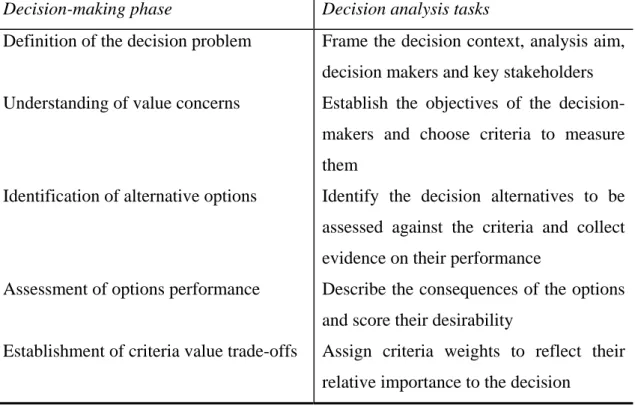
The MCDA methodology acts both as an approach and a set of techniques, ordering a set of alternative options by looking at the degree to which a number of objectives are achieved 71,72. It is a way of eliciting preferences for a sum of options which are characterised by varying levels of performance with respect to a number of, often conflicting, objectives; it does so by disaggregating a complex problem into simpler components or objectives, measuring the performance of options against the objectives, weighting up these objectives according to their relative importance, and re-assembling the components by aggregating scores and weights to show the overall picture 66,71. Although a number of different MCDA methodologies and techniques exist they share a number of common phases involving the definition of the decision problem, understanding of value concerns, identification of alternative options, assessment of options’ performance, establishment of value trade-offs between the criteria and an overall elicitation of aggregated value preferences for the options (Table 1) 71-75.
Table 1: The methodological process of Multiple Criteria Decision Analysis
Decision-making phase Decision analysis tasks
Definition of the decision problem Frame the decision context, analysis aim, decision makers and key stakeholders Understanding of value concerns
Identification of alternative options
Establish the objectives of the decision-makers and choose criteria to measure them
Identify the decision alternatives to be assessed against the criteria and collect evidence on their performance
Assessment of options performance Describe the consequences of the options and score their desirability
Establishment of criteria value trade-offs Assign criteria weights to reflect their relative importance to the decision
12
Elicitation of overall value preferences Aggregate scores and weights together to produce overall weighted value preference scores
One of the key aims of MCDA techniques is to help decision-makers to reach a decision by laying out the problem, objectives, values and options they are faced with in a clear and transparent way. This is achieved by organising, synthesising and summarising information to decision-makers, which is of complex and, often, of conflicting nature 73. It should be noted however that although MCDA can aid the decision-making process, it cannot replace decision-makers’ judgement or experience 73
; instead, it can supply detailed information for a comprehensive set of parameters of interest to decision-makers and help them elicit value trade-offs, while allowing to incorporate the value preferences of other stakeholders. Overall, MCDA acts as an aid to decision-making, seeking to explicitly integrate objective measurement with value judgement in a structured and transparent way.
6 Multiple Criteria Decision Analysis as a Decision-Making Tool
The application of MCDA methods have been proposed for use in the field of health care 44,76,77, including for priority setting of health programmes or interventions 78-81, the regulatory approval of pharmaceuticals 82-84, and more recently for use in HTA 57,85-90
and treatment selection 91-93, recognising its potential value in the evaluation process and arguing that it could be used as an aid to decision-making. However, attention should be paid on the theoretical foundations of decision theory and particularly in the required properties the criteria need to possess in order for the analysis to be robust and results useful to decision-makers 94-96.
Compared to economic evaluation methods such as cost-effectiveness analysis (CEA), an important advantage of MCDA is that it facilitates a decision support system because it enables a structured and transparent process. In CEA, the analysis of costs and health gains takes place first as part of the assessment stage, typically producing an incremental cost effectiveness ratio (ICER) as a value-for-money metric; any value trade-offs (possibly involving other types of benefit gains and stakeholder views) are then usually elicited implicitly on an ad hoc basis as part of the
13
appraisal stage, before a decision recommendation can be ultimately made. In contrast, in MCDA the analysis for all types of benefit gains and their value trade-offs are explicitly incorporated in the overall decision-making process which can be formally informed through engagement with stakeholders; overall weighted preference value (WPV) scores are produced which are more comprehensive value metrics and fully transparent, thus better linking the assessment and appraisal stages and supporting decision-making (Figure 1).
The explicit consideration of decision-makers’ concerns in combination with a more structured approach for the elicitation of value preferences and their trade-offs, while allowing the incorporation of views from all relevant stakeholders, could inform the development of a more comprehensive and reasonable definition of value in health care. Such a methodological approach could be used as a supporting tool for transparent decision-making, being flexible enough for decision-makers to exercise their judgment by enabling them to elicit value trade-offs and their value preferences when pursuing multiple objectives, which could contribute to the debate on more efficient resource allocation.
Figure 1: Differences between cost effectiveness analysis (CEA) and multiple criteria decision analysis (MCDA) in decision-making
Ref 1. 2. 3. ferences Beauch Medica Eddy D vs socie Eddy D vs socie hamp TL. M al Ethics. 20 DM. Clinical ety. Is there DM. Clinical ety. Resolvi Methods and 003;29(5):26 l decision m a conflict? l decision m ing the conf
14 d principles i 69-274. making: from JAMA. 199 making: from flict. JAMA. in biomedic m theory to 91;265(11): m theory to . 1991;265( cal ethics. Jo practice. Th 1446. practice. Th 18):2399. Journal Of he individu he individu ual ual
15
4. Emanuel EJ. Justice and managed care. Four principles for the just allocation of health care resources. The Hastings Center Report. 2000;30(3):8-16. 5. Fleck L. Healthcare justice and rational democratic deliberation. The
American Journal Of Bioethics: AJOB. 2001;1(2):20-21.
6. Rawls J. A Theory of Justice. Belknap Press of Harvard University; 1999. 7. Klein R, Maybin J. Thinking about rationing. The King's Fund;2012. 8. Klein R. Dimensions of rationing: who should do what? BMJ (Clinical
Research Ed). 1993;307(6899):309-311.
9. Klein R. Rationing in the fiscal ice age. HEPL. Vol 52010:389-396.
10. Parker R. Social administration and scarcity. In: Butterworth E, Holman R, eds. Social welfare in modern Britain. London: Fontana; 1975:204-212. 11. Brazier J, Deverill M, Green C. A review of the use of health status measures
in economic evaluation. Journal Of Health Services Research & Policy.
1999;4(3):174-184.
12. Torrance GW, Feeny D. Utilities and quality-adjusted life years. International Journal Of Technology Assessment In Health Care. 1989;5(4):559-575. 13. Wouters OJ, Naci H, Samani NJ. QALYs in cost-effectiveness analysis: an
overview for cardiologists. Heart. 2015;101(23):1868-1873. 14. Harris J. QALYfying the value of life. Journal Of Medical Ethics.
1987;13(3):117-123.
15. Mehrez A, Gafni A. Quality-adjusted life years, utility theory, and healthy-years equivalents. Medical Decision Making: An International Journal Of The Society For Medical Decision Making. 1989;9(2):142-149.
16. Beiner R. Political judgment. Chicago: University of Chicago Press; 1983. 17. Daniels N. Decisions about access to health care and accountability for
reasonableness. Journal Of Urban Health: Bulletin Of The New York Academy Of Medicine. 1999;76(2):176-191.
18. Daniels N, Sabin J. The ethics of accountability in managed care reform.
Health Affairs (Project Hope). 1998;17(5):50-64.
19. Alexander GC, Werner RM, Ubel PA. The costs of denying scarcity. Archives Of Internal Medicine. 2004;164(6):593-596.
20. Bloche MG, Jacobson PD. The Supreme Court and bedside rationing. JAMA.
2000;284(21):2776-2779.
21. Sabik LM, Lie RK. Priority setting in health care: Lessons from the
experiences of eight countries. International Journal For Equity In Health.
2008;7:4-4.
22. Brown LD. The national politics of Oregon's rationing plan. Health Affairs (Project Hope). 1991;10(2):28-51.
23. Fox DM, Leichter HM. Rationing care in Oregon: the new accountability.
Health Affairs (Project Hope). 1991;10(2):7-27.
24. Fox DM, Leichter HM. State model: Oregon. The ups and downs of Oregon's rationing plan. Health Affairs (Project Hope). 1993;12(2):66-70.
25. Veney JE. Reasonable Rationing: International Experience of Priority Setting In Health (Book). Inquiry (00469580). 2004;41(1):108-109.
26. Committee on Choices in Health Care. Choices in Health Care. Rijswijk: Ministry of Welfare HCA; 1992.
27. Swedish Parliamentary Commission. Priorities in Health Care: Ethics, Economy, Implementation. Stockholm: Ministry of Health and Social Affairs; 1995.
16
28. Health Care and Medical Priorities Commission. No Easy Choices: The Difficult Priorities of Healthcare. Stockoholm: Ministry of Health and Social Affairs; 1993.
29. National Advisory Committee on Core Health and Disability Support Services. Core Health and Disability Support Services for 1993/94.
Wellington: National Advisory Committee on Core Health and Disability Support Services; 1992.
30. National Advisory Committee on Core Health and Disability Support Services. Core Services for 1995/96. Wellington: National Advisory Committee on Core Health and Disability Support Services; 1994.
31. Klein R. Puzzling out priorities. Why we must acknowledge that rationing is a political process. BMJ (Clinical Research Ed). 1998;317(7164):959-960. 32. Klein R. Priorities and rationing: pragmatism or principles? BMJ (Clinical
Research Ed). 1995;311(7008):761-762.
33. Ham C. Health care rationing. BMJ (Clinical Research Ed).
1995;310(6993):1483-1484.
34. McKee M, Figueras J. Setting priorities, can Britain learn from Sweden? BMJ (Clinical Research Ed). 1996;312(7032):691-694.
35. Turnberg L, Lessof M, Watkins P. Physicians clarify their proposal for a National Council for Health Care priorities. BMJ (Clinical Research Ed).
1996;312(7046):1604-1605.
36. Royal College of Physicians. Setting priorities in the NHS: a framework for decision-making. 1995.
37. Smith J. Royal college calls for national priorities setting. BMJ.
1995(311):767.
38. Rawlins M. In pursuit of quality: the National Institute for Clinical Excellence.
Lancet. 1999;353(9158):1079-1082.
39. Cooter R, Neve M, Nutton V. History of Medicine 1988–1992. London.
40. Wagstaff A, Van Doorslaer E. Equity in Health Care: concepts and definitions. In: Van Doorslaer E, Wagstaff A, Rutten F, eds. Equity in the finance and delivery of health care: an international perspective. Oxford: Oxford University Press; 1993.
41. Webster J, Lines J, Bruce J, Armstrong Schellenberg JR, Hanson K. Which delivery systems reach the poor? A review of equity of coverage of ever-treated nets, never-ever-treated nets, and immunisation to reduce child mortality in Africa. The Lancet Infectious Diseases. 2005;5(11):709-717.
42. Bennett S, Chanfreau C. Approaches to rationing antiretroviral treatment: ethical and equity implications. Bulletin Of The World Health Organization.
2005;83(7):541-547.
43. Olsen ØE. Bridging the equity gap in maternal and child health: health systems research is needed to improve implementation. BMJ (Clinical Research Ed). 2005;331(7520):844-844.
44. Baltussen R, Niessen L. Priority setting of health interventions: the need for multi-criteria decision analysis. Cost Effectiveness And Resource Allocation: C/E. 2006;4:14-14.
45. Guyatt G. Evidence-Based Medicine: A New Approach to Teaching the Practice of Medicine. JAMA. 1992;268(17).
46. Sackett DL, Rosenberg WM, Gray JA, Haynes RB, Richardson WS. Evidence based medicine: what it is and what it isn't. BMJ (Clinical Research Ed).
17
47. Drummond M, McGuire A. Economic Evaluation in Health Care: Merging theory with practise. USA: Oxford University Press; 2001.
48. Drummond M, Sculpher M, Claxton K, Stoddart G, Torrance G. Methods for the economic evaluation of health care programmes. 4th ed: Oxford
University Press; 2015.
49. Murray C, Lopez A. The Global Burden of Disease: Summary. Harvard School of Public Health on behalf of the World Health Organisation and the World Bank; 1996.
50. Mauskopf JA, Sullivan SD, Annemans L, et al. Principles of good practice for budget impact analysis: report of the ISPOR Task Force on good research practices--budget impact analysis. Value In Health: The Journal Of The International Society For Pharmacoeconomics And Outcomes Research.
2007;10(5):336-347.
51. Kanavos P, Manning J, Taylor D, Schurer W, Checchi K. Implementing value-based pricing for pharmaceuticals in the UK. London March 2010.
52. Angelis A, Lange A, Kanavos P. Measuring the value of new medicines in health technology assessment: a systematic review and expert consultation in Europe. Under Review. 2016.
53. Golan O, Hansen P, Kaplan G, Tal O. Health technology prioritization: Which criteria for prioritizing new technologies and what are their relative weights?
Health policy. 2011;102(2):126-135.
54. Guindo LA, Wagner M, Baltussen R, et al. From efficacy to equity: Literature review of decision criteria for resource allocation and healthcare
decisionmaking. Cost Effectiveness And Resource Allocation: C/E.
2012;10(1):9-9.
55. Nicod E, Kanavos P. SCIENTIFIC AND SOCIAL VALUE JUDGMENTS FOR ORPHAN DRUGS IN HEALTH TECHNOLOGY ASSESSMENT.
International Journal of Technology Assessment in Health Care.
2016;32(4):1-15.
56. Rawlins M, Barnett D, Stevens A. Pharmacoeconomics: NICE's approach to decision making British Journal of Clinical Pharmacology. 2010;70(3):346-349.
57. Devlin NJ, Sussex J. Incorporating Multiple Criteria in HTA: Methods and Processes. Office of Health Economics;2011.
58. Antoñanzas F, Terkola R, Postma M. The Value of Medicines: A Crucial but Vague Concept. Pharmacoeconomics. 2016.
59. McDaniels TL, Gregory RS, Fields D. Democratizing Risk Management: Successful Public Involvement in Local Water Management Decisions. Risk Analysis: An International Journal. 1999;19(3):497-510.
60. Bazerman M. Judgment in Managerial Decision Making. Fourth ed: John Wiley, New York; 1998.
61. Marsh K, Lanitis T, Neasham D, Orfanos P, Caro J. Assessing the Value of Healthcare Interventions Using Multi-Criteria Decision Analysis: A Review of the Literature. PharmacoEconomics. 2014;32(4):345-365.
62. Benefit-risk methodology project. Work package 4 report: Benefit-risk tools and processes. European Medicines Agency; 2012.
http://www.ema.europa.eu/docs/en_GB/document_library/Report/2012/03/W C500123819.pdf. Accessed 26 July 2016.
18
63. Institute of Medicine. Ranking vaccines a prioritization framework phase I: demonstration of concept and a software blueprint. Washington DC: National Academies Press; 2012.
64. Drummond M, Bridges J, Muhlbacher A, Ijzerman M. Identification, weighting and prioritization of multiple endpoints for comparative
effectiveness research: what have we learned from Germany? ISPOR Panel 20112011.
65. Interim Process and Methods of the Highly Specialised Technologies Programme. National Institute for Health and Care Excellence; 2013.
https://www.nice.org.uk/Media/Default/About/what-we-do/NICE- guidance/NICE-highly-specialised-technologies-guidance/Highly-Specialised-Technologies-Interim-methods-and-process-statements.pdf. Accessed 21 May 2015.
66. Raiffa H. Decision analysis: Introductory lectures on choices under uncertainty. . Reading, MA: Addision-Wesley; 1968.
67. Howard R. Decision analysis: applied decision theory. Menlo Park, Calif: Stanford Research Institute; 1966.
68. Mt-Isa S, Hallgreen CE, Wang N, et al. Balancing benefit and risk of
medicines: a systematic review and classification of available methodologies.
Pharmacoepidemiology And Drug Safety. 2014;23(7):667-678.
69. Phillips L, Fasolo B, Zafiropoulos N, Beyer A. Is quantitative benefit-risk modelling of drugs desirable or possible? Drug Discovery Today
Technologies. 2011;8(1):e1-e42.
70. Sussex J, Towse A, Devlin N. Operationalizing Value- Based Pricing of Medicines. PharmacoEconomics. 2013;31(1):1-10.
71. DCLG DfCaLG. Multi-criteria Analysis: A Manual. London2009.
72. Keeney RL, Raiffa H. Decisions with Multiple Objectives: Performances and Value Trade-Offs. New York: Wiley; 1976.
73. Belton V, Stewart T. Multiple criteria decision analysis: an integrated approach. Dordrecht: Kluwer Academic Publishers; 2002.
74. Franco L, Montibeller G. Problem Structuring for Multicriteria Decision Analysis Interventions analysis interventions. Wiley Encyclopedia of Operations Research and Management Science. 2010.
75. Hammond J, Keeney R, Raiffa H. Smart choices: a practical guide to making better decisions. Cambridge: Harvard University Press; 1999.
76. Wilson EC, Peacock SJ, Ruta D. Priority setting in practice: what is the best way to compare costs and benefits? Health Economics. 2009;18(4):467-478. 77. Baltussen R, Youngkong S, Paolucci F, Niessen L. Multi-criteria decision
analysis to prioritize health interventions: Capitalizing on first experiences.
Health Policy. 2010;96(3):262-264.
78. Baltussen R, Stolk E, Chisholm D, Aikins M. Towards a multi-criteria approach for priority setting: an application to Ghana. Health Economics.
2006;15(7):689-696.
79. Baltussen R, ten Asbroek AHA, Koolman X, Shrestha N, Bhattarai P, Niessen LW. Priority setting using multiple criteria: should a lung health programme be implemented in Nepal? Health Policy And Planning. 2007;22(3):178-185. 80. Youngkong S, Teerawattananon Y, Tantivess S, Baltussen R. Multi-criteria
decision analysis for setting priorities on HIV/AIDS interventions in Thailand.
19
81. Youngkong S, Baltussen R, Tantivess S, Mohara A, Teerawattananon Y. Multicriteria decision analysis for including health interventions in the universal health coverage benefit package in Thailand. Value In Health: The Journal Of The International Society For Pharmacoeconomics And Outcomes Research. 2012;15(6):961-970.
82. Phillips LD, Fasolo B, Zafiropoulos N, Beyer A. Is quantitative benefit–risk modelling of drugs desirable or possible? Drug discovery today: technologies.
2011;8(1):e3-e10.
83. Mussen F, Salek S, Walker S. A quantitative approach to benefit-risk assessment of medicines - part 1: the development of a new model using multi-criteria decision analysis. Pharmacoepidemiol Drug Saf. 2007;16(Suppl 1):S2-S15.
84. Walker S, Cone M. Benefit–Risk Assessment: Summary Report of the workshop on The Development of a Model for Benefit–Risk Assessment of Medicines Based on Multi-Criteria Decision Analysis. . CMR International Institute for Regulatory Science;2004.
85. Health England. Prioritising investments in preventative health. 2009. 86. Thokala P. MULTIPLE CRITERIA DECISION ANALYSIS FOR HEALTH
TECHNOLOGY ASSESSMENT: REPORT BY THE DECISION SUPPORT UNIT. School of Health and Related Research, University of Sheffield;2011. 87. Sussex J, Rollet P, Garau M, Schmitt C, Kent A, Hutchings A. Multi-Criteria
Decision Analysis to Value Orphan Medicines. Office of Health Economics;2013.
88. Goetghebeur MM, Wagner M, Khoury H, Levitt RJ, Erickson LJ, Rindress D. Evidence and Value: Impact on DEcisionMaking--the EVIDEM framework and potential applications. BMC Health Services Research. 2008;8:270. 89. Angelis A, Kanavos P. Value-Based Assessment of New Medical
Technologies: Towards a Robust Methodological Framework for the Application of Multiple Criteria Decision Analysis in the Context of Health Technology Assessment. Pharmacoeconomics. 2016;34(5):435-446.
90. Thokala P, Devlin N, Marsh K, et al. Multiple Criteria Decision Analysis for Health Care Decision Making--An Introduction: Report 1 of the ISPOR MCDA Emerging Good Practices Task Force. Value In Health: The Journal Of The International Society For Pharmacoeconomics And Outcomes Research. 2016;19(1):1-13.
91. Felli JC, Noel RA, Cavazzoni PA. A multiattribute model for evaluating the benefit-risk profiles of treatment alternatives. Medical Decision Making: An International Journal Of The Society For Medical Decision Making.
2009;29(1):104-115.
92. Tervonen T, Naci H, van Valkenhoef G, et al. Applying Multiple Criteria Decision Analysis to Comparative Benefit-Risk Assessment: Choosing among Statins in Primary Prevention. Medical Decision Making: An International Journal Of The Society For Medical Decision Making. 2015;35(7):859-871. 93. Naci H. Communication of Treatment Rankings Obtained From Network
Meta-Analysis Using Data Visualization. Circ Cardiovasc Qual Outcomes.
2016.
94. Angelis A, Kanavos P. Critique of the American Society of Clinical Oncology Value Assessment Framework for Cancer Treatments: Putting Methodologic Robustness First. Journal Of Clinical Oncology: Official Journal Of The American Society Of Clinical Oncology. 2016.
20
95. Del Rio Vilas V, Montibeller G, Franco L. Letter to the editor: Prioritisation of infectious diseases in public health: feedback on the prioritisation
methodology, 15 July 2008 to 15 January 2009. Euro Surveillance: Bulletin Européen Sur Les Maladies Transmissibles = European Communicable Disease Bulletin. 2011;16(27).
96. Keeney RL. COMMON MISTAKES IN MAKING VALUE TRADE-OFFS.