The Impact of Information System Implementation to the Integrated
System for Increasing the Performance of Manufacturing Companies
Zeplin Jiwa Husada Tarigan
1, a*,
Hotlan Siagian
1, band
Rick Richard Bua
1, c1Department of Management, Petra Christian University, Surabaya, East Java, Indonesia a[email protected], b[email protected], c[email protected]
*Corresponding author
Keywords: Information system, Process innovation, Product innovation, Supply chain
performance
Abstract. The demand for meat and eggs in Indonesia is highly increasing to fulfill the nutrition need. The farm industry strives to perform the product innovation and process innovation to meet the increasing demand. The producers of meat and eggs are required to implements the information technology to allow the operations of the company run well. The company's information system also makes the company to perform a product and process innovation in the pursuit of improved supply chain performance. This study investigates the relationship between the implementation of a management information system, product innovation, process innovation, and supply chain performance. Data collection is conducted by distributing questionnaires to, and by having direct interviews with the respondents from the department of the information system of 41 companies in Surabaya, Indonesia. The data analysis uses smart PLS software version 3.0. The studyfound that the implementation of a management information system directly affects the process innovationby a positive coefficient of 0.174. The implementation of a management information system also directly influences product innovationby a significant coefficient of 0.649. The implementation of a management information system does not directly affect the supply chain performance as the t-value less than 1.96. The process innovation accelerates product innovation by a significant coefficient of 0.686. Process innovation also provides a direct impact on supply chain performance by a coefficient of 0.177. Product innovation directly gives an impact on the improvement of the supply chain performance by the coefficient of 0.665. In total, the implementation of management information systems affects supply chain performance through the process innovation and product innovation by the coefficient of 0.526. This study contributes to the current research on the supply chain management and paves the way for managers to improve the supply chain performance by implementing the management information system, product innovation, and process innovation.
Introduction
The presence of farm industry constitutes one of the pillars in strengthening the Indonesian economy today. Currently, farm industry has contributed the country's largest domestic product after industry and trade sector which is about 15.38% [1]. The need for farm products is getting higher with the community’s increasing needs for animal protein itself. The fulfillment of meat becomes the priority as listed in the Ministry of Agriculture Strategic Plan 2009-2014 by targeting meat self-sufficiency in 2014. There are factors contributing to the inability of the farm industry to fulfill the increasing demand for meat and eggs in Indonesia [2]. The supply chain is a solution because the material from the supplier is processed into finished products, and then the product is distributed to consumers. Along with the current market development, customer’s needs are getting higher. Thus, it takes the role of suppliers in the management and distribution of products to the final customer [3].
Research done by Tarafdar and Gordon [4] mentions that information systems and information technology will provide innovative processes for business. Information system and technology ensure progress to the process innovation through a system of change for the company's business processes [5]. Information technology can support the innovation process in the company in doing
product design by using software to do the simulation. Information technology can support the innovation process in the company because it can help determine the company's strategy by providing fast data. Research conducted by Ferneley and Bell [6] states that information technology can improve the innovation of corporate processes in terms of doing business rationalization and improving business. Research conducted by Adamides and Karacapilidies [7] states that the information system can provide innovation process in the form of business process improvement related to document understanding, operational standard with the improvement of the business model process in the company to enable the transfer of knowledge among individuals. Roper et al., [8] state that the end of a knowledge process is a representation of transformation in innovation to produce new products and processes. Company’s innovation performance carried out by applying industrial process practices in producing new products or processes. The company’s product innovation makes customers more satisfied, gives better competitive edges than competitors, and increases its market share [9].
Basole et al., [10] suggest that the adoption of information technology is vital in process innovation for transforming organizations to adapt to changes. Product innovation in the company is derived from a new idea by doing an innovation process. Improving product innovation and process innovation requires substantial forward investment in many aspects from the development of specialized resources, new equipment, research and development (R&D), new technology and even new business units [11]. The innovation capability in the manufacturing industry is needed to develop new technology by conducting R & D to produce a new product in fulfilling the customer’s need [12]. The performance of the supply chain is the extent to which the supply chain improves the efficiency and effectiveness of internal business operations. According to Lai et al., [13] supply chain performance is measured in terms of profit, cost, and environmental performance. Cho et al., [14] suggest the supply chain performance measurement is based on industry sector. Supply chain management (SCM) is an essential competitive edge for companies in providing fast service with high product variety and low cost.
The implementation of information technology in the farm's industry is still limited to administration only and its enforcement is still done partially on the company operation. The information technology has not been integrated into all departments, especially in the operational section of the company's farm industry. Meanwhile, the information system plays an important role in the improvement of the supply chain performance. Based on the previous researches, studies that are focused on the impact of information technology implementation on the process and product innovation in the farm industry are still limited.
Relationship Among Concepts
The adoption of information and communication technology that is part of SME (small medium enterprise) contributes to the improvement of the overall level of innovation including product innovation, process innovation and innovation in the overall enterprise system [15]. Innovation process by the company through changes in work procedures, changes in the form and changes in how the work impact on product innovation. Changes made by improving manufacturing processes and using new equipment will produce a new product for the company. Expolrative learning and improvisational creativity carried out by the company correlate with the company's ability to innovate [16]. Process innovation describes changes in the way organizations produce the end products and services of a company. Process innovation is a tool for improving the quality as well as cost saving. Product innovation as a product or service is newly introduced into the market to meet the customer’s needs and market orientation [17]. Lukas & Farel [18] categorize product innovation into three basic types: product line extensions, tailor made products and new products. Product line extensions are relatively new products on the market but not new to the company. Tailor made products are relatively new products for the company, but they are relatively well known in the market. New to the world products are new products both for the company and for the market. The research conducted by Al-Sa'di et al., [19] states that process innovation and product innovation have a positive and significant impact on the company performance. The process
innovation undertaken at the company related to changes in the blueprint, especially on changes in the business processes, standard operating procedures and work instructions to achieve a shorter and faster process transformation. This concept emphasizes the integration of the flow of information and materials through business networks to support the process of corporate innovation to achieve increased corporate capabilities in meeting the needs and desires of the consumers. The company's built-in integration with partners to build collaboration will provide an effective and efficient process for the flow of products, services, and information [20]. Integration of the company's internal business processes in collaboration with providers, suppliers, customers, and supply chain partners will have an impact on supply chain performance [21]. This process involves the interconnection of various function within the organization to provide fast delivery of products to customers [22]. Implementation of ERP as an integrated information system at the company provides innovation to all business areas through business process reengineering in improving organizational performance. To create an effective performance management, a measurement system is required to evaluate supply chain performance holistically. The implementation of ERP system as one of the integrated management information systems starting from material planning, material purchase, production planning and production control improves supply chain performance [21]. The six research hypotheses are:
(H1) The management information system implementation influences process innovation. (H2) The management information system implementation affects product innovation. (H3) There is an influence of process innovation on product innovation.
(H4) There is an influence of process innovation on supply chain performance. (H5) There is an influence of product innovation on supply chain performance.
(H6) There is an influence of management information system on supply chain performance.
Research Method
The unit of analysis of this study is a company from the farm industry, located in the region of East Java, Indonesia. Data collection is done using a questionnaire designed with five-point Likert scale. The respondent is a person working for the company for more than two years, using the information system, and understanding the production process. Data collection in this research was conducted with a census of Farm Company in East Java consisting of 41 companies, 12 farm breeding companies, 17 poultry feed production, 2 egg hatching companies and 10 processed meat companies in East Java. Data collection was done in two stages, firstly, to distribute the questionnaires to be filled by the respondents, and secondly the researcher asked for an interview with respondents who filled in the questionnaires to check their face validity [23]. The measurement uses a five-point Likert scale, with 5:strongly agree, 4: agree, 3:neutral, 2: disagree, and 1: strongly disagree.
In this study, the management information system is defined as the extent to which the company has implemented information system and daily data transaction by means of which, the decision is made [24]. Five indicators are used to measure these variables, i.e., availability of software and hardware, information submitted on time, clear time limits for the information provided, accurate available information, available information according to user requirements and complete presented information. Process innovation is the process of using technology in enhancing the added value to the product. Four indicators used to measure these variables are easier technology upgrades, faster processing time, more precisely applied task specifications, working mechanisms and simpler used information. Product innovation indicates the extent to which the product performs its function better than the one the competitor offers. Three indicators used to measure these variables are new product development, product variety development, and development of product models and standards. Supply chain performance is the company's way to improve company’s performance by adopting supply chain management principles. Supply Chain Performance is a measure of process-oriented company performance, integration of purchasing, production and product delivery to consumers consisting of raw material management, information flow, and finance. This study is adapted to the conditions of SCM performance commonly used in all farm companies including
which are on-time product delivery, product quality improvement, raw material availability, and better time flexibility. Data analysis method used in SEM is based on Partial Least Square (PLS).
Discussion
The result of the analysis indicates that those indicators of the variable are valid in term of convergent and discriminant validity. This validity is shown by the value of factor loading which exceeds the recommended minimum value of 0.5. Similarly, all indicators of the variable are considered valid in term of discriminant validity, since the factor loading of each indicator is higher than the cross loading with another concept. Those indicators of the information system management implementation have the following factor loadings which are: software and hardware availability with factor loading of 0.803; information delivered on time with a factor loading of 0.839; the information provided has time limit with a factor loading of 0.812; accuracy of information with a factor loading of 0880; the available information is matching the requirements with a factor loading of 0.755; the information presented is complete with the factor loading of 0.829.
The process innovation has the following four indicators: technology used is easier to use with a factor loading of 0.916; process cycle time is faster with a factor loading of 0.753; the standard of the task performed is more precise with a factor loading of 0.701; the working mechanism and information used is simpler with a factor loading of 0.841. The product innovation is assessed by using three indicators with the result of outer loading as follows: new product development with a factor loading of 0.928; variation of product developed with a factor loading of 0.815; and the model development and standard product size with a factor weight of 0.864. The last construct is the supply chain performance which is composed of four indicators namely product delivery with a timely factor loading of 0.855; improvement of product quality with a factor loading of 0.672; availability of raw materials with a factor loading of 0.793; and better time flexibility with a factor loading of 0.678. The result of the analysis with a structural equation modeling (SEM) PLS is a follow in Table 1.
Table 1. The Result of Hypotheses Research.
Hypotheses Original Sample Sample Mean Standard Deviation T -Statistics
Information system -> Process Innovation 0.649 0.652 0.044 14.719
Information system -> Product Innovation 0.174 0.167 0.066 2.642
Process Innovation -> Product Innovation 0.686 0.697 0.075 9.175
Process Innovation -> SCP 0.177 0.204 0.132 1.338
Product Innovation -> SCP 0.665 0.640 0.138 4.825
Information system-> SCP -0.021 -0.020 0.093 0.230
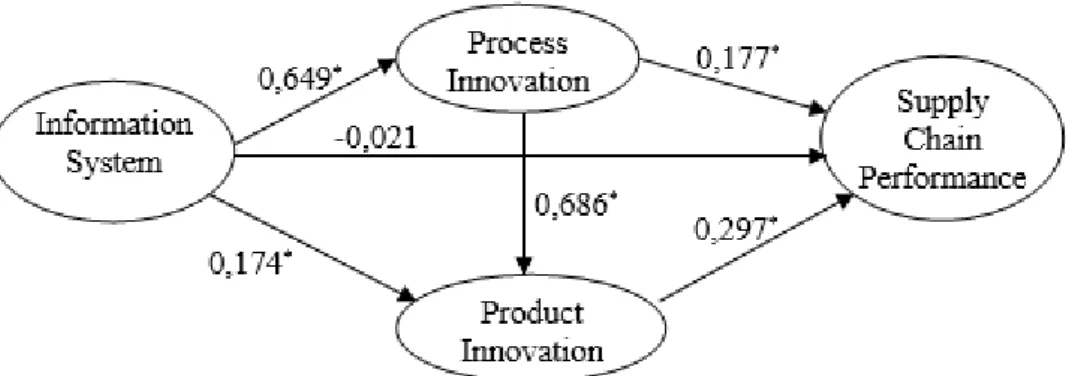
Based on results from Table 1, the analysis of six research hypotheses, it is found that four hypotheses are supported, and the rest two are not supported. These findings are discussed in the following section. The first hypothesis is, the influence of information system management implementation on process innovation. A good management information system, when applied to a company, will improve the quality of information that can give a significant impact on process innovation and product innovation. The innovation of these products and processes can be more effective and efficient, when applied to information systems and technology, and the value of the company will increase, and at the end, will also improve competitiveness. Results of this study showed the value of the influence of management information system on process innovation is 0.649 with t-value of 15.380. This shows that the implementation of management information system has a positive effect on process innovation. The result of the research is consistent with H1 stating that there is a definite influence of management information system implementation on process innovation. This shows that the accuracy of information is strongly influenced by the
renewal of the technology used. Thus, the users will get the information they need more quickly, precisely, and accurately.
The second hypothesis, is about the influence of information system management implementation on product innovation. Implementing a supply chain management enables the farm industry to meet the needs of most communities engaged in this industry to keep improving its competitiveness. The collaboration in a business network is more emphasized on the integration of information and material flow through the business network to support the company’s innovation process which is an important thing to enhance the company’s capability in fulfilling the consumer’s needs and desires. Providing better value to customers is reflected in the form of dependability, proactivity, flexibility, and delivery. Innovation and speed are central to the company and are the impact of the company's labor and information system. The results of data processing show the value of process innovation effect on supply chain performance of 0.172 with a critical ratio (t-value) of 1.229. The results of this study are not in accordance with H4, namely there is a positive influence on process innovation on supply chain performance. In the farm industry itself, technology renewal is done by applying computerization and hi-tech equipments during operational activities. Delivery of the product to the customers is carried out according to their wishes.
The third hypothesis is, the influence of process innovation on product innovation. The main focus of innovation is the creation of new ideas, which will, in turn, be implemented into new products, as well as new processes as well. Process innovation is a suggestion to improve quality as well as cost saving. This reflects that adoption of an innovation process is implemented to improve production efficiency and product quality. Results of data analysis show that the value of innovation process to product innovation is 0.686 with a critical ratio of 10.225. This shows that to be able to develop a new product, it is necessary to update the technology for the process of making the product easier. Given the increasing need for various animal products, the farm industries in Indonesia are continuing to update their existing technologies and to use them to maximize their services to consumers. The renewal of the technology used is expected to develop the attributes used to support their operational activities such as repairing or replacing old production equipment with the new ones.
The fourth hypothesis, is the effect of process innovation on the supply chain performance. Implementing a supply chain in the farm industry can meet the needs of most communities engaged in animal husbandry to keep improving productivity in order to balance the competitive edge. The concept of collaboration in a business network emphasizes the integration of information and material flow through business networks to support the enterprise integration process which is important to achieve the company's capability for improvement in meeting supply chain partners' needs. The results of the value process innovation effect on supply chain performance is 0.172 with the critical ratio of 1.229. The result of this research is not in accordance with H4 that there is a positive influence on process innovation on supply chain performance. As for the delivery of the product to the customers is done according to customer's wishes. If the distance is far away the customers ask to use the aircraft, and if the distance is close, the customer ask to take it themselves by using the customer's vehicle.
The fifth hypothesis, is the influence of product innovation on the supply chain performance. Along with the rapid development of the market, the customers needs for animal products will be higher. Therefore, it is necessary for the suppliers in the management and distribution of products to reach the end customers. This process involves the interconnection of various organizations, such as raw material suppliers, factories, distributors, retailers, and transportation services known as supply chain. In order to be able to raise the value of a company, it is necessary to support the increased efficiency and effectiveness of internal business operations such as supply chain management (SCM). The results of data analysis show that the value of product innovation influence to supply chain performance is 0.672 with a critical ratio of 4,801. The results of this study indicate that product innovation has a positive effect on supply chain performance.
The sixth hypothesis, is the effect of information system management implementation on the supply chain performance. Some of the strategic roles of the existing management information
system in the farm industry are to minimize the company's negative potential, to balance with the compiler, to support business strategy, and to support industry-based competitive value. The business strategy in question is an innovative strategy, a strategy to increase the value of the supply chain, all of which will lead to customer satisfaction. The results data analysis show that the value of the implementation of management information system to supply chain performance is - 0.041 with a critical ratio of 0.459. The results of this study are not in accordance with H6 that there is a positive influence on the implementation of management information systems to supply chain performance. There is no direct influence of the implementation of management information systems on supply chain performance. In the farm industry, the accuracy of data related to operational activities such as production, distribution, and sales activities is crucial to note before being released and used by the users. However, sometimes the inaccuracy of available information often occurs when the sales process takes place. The quantity of product to be purchased or taken does not match the quantity of the product already stated in the DO letter (Delivery Order). This can happen because of the changes in demand made suddenly by the consumers regarding quantity. This makes the sales process a little disturbed because the seller must confirm in advance to the market relating the changes in quantity. Based on result found from table 1 and discussion, so it can be modeled as a Fig. 1.
Fig. 1 Research model Result (* Significant at level 0.01).
Conclusion
Based on the results of data analysis and discussion above, we draw some conclusions as the result of this research: first, the implementation of management information system conducted in the farm industry in East Java has an influence on process innovation. Second, the implementation of management information system conducted by farms industry in East Java has the influence to product innovation. Third, process innovation conducted by farm industry in East Java has an effect on product innovation. Fourth, the process innovations conducted by the farm industry in East Java do not affect the supply chain performance. Fifth, the product innovations conducted by the farm industry in East Java give effect to supply chain performance. Sixth, the implementation of management information system conducted by farm industry in East Java does not give effect to supply chain performance. In refining this research, first suggestion for an improvement to strengthen the result of research is that farm industry needs to make improvements related to the system and sales procedures, which often result in a quantity of the products taken not in accordance with the quantity of products listed on the delivery order. Second, the ongoing renewal process by the farm industry in terms of both management and product by updating the existing SOPs so that they can be easily monitored and audited. Third, the research is limited to the existing farm industry in East Java, so further research is needed on this subject with broader a coverage.
References
[1] Information on https://www.bps.go.id/
[3] M. Ferrary, Specialized organizations and ambidextrous clusters in the open innovation paradigm, European Manage. J. 29 (2011) 181-192.
[4] M. Tarafdar, S. R. Gordon, Understanding the influence of information systems competencies on process innovation: a resource-based view, J. Strat. Inform. Syst. 16 (2007) 353-392.
[5] H. A. Reijers and S. L., Mansar, Best Practices in business process redesign: an overview and qualitative evaluation of successful redesgin heuristics, Omega 33 (2005) 283-306.
[6] E. Ferneley and F. Bell, Using bricolage to integrate business and information technology innovation in SMEs, Technovat. 26(2) (2006) 232-241.
[7] E. D. Adamides and N. Karacapilidis, A knowledge-centered framework for collaborative business process modeling, Bus. Proc. Manag. J. 12(5) (2006) 557-575.
[8] S. Roper, J. Du and J. H. Love, Modeling the innovation value chain, Res. Pol. 37 (2008) 961-977.
[9] B. G. Roxas, Social capital for knowledge management: the case of small and medium-sized enterprises in the Asia-Pacific region, Asian Acad. Manag. J. 13(2) (2008) 57-77.
[10] R. C. Basole, C. D. Seuss and W. B. Rouse, IT innovation adoption by enterprises: knowledge discovery through text analytics, Dec. Sup. Syst. 54 (2013) 1044-1054.
[11] R. Amit and C. Zott, Creating value through business model innovation, MIT Sloan Manag. Rev. 53 (2012) 40-49.
[12] C. Wang and M. I. Kafouros, What factors determine innovation performance in emerging economies? Evidence from China, Int. Bus. Rev. 18 (2009) 606-616.
[13] K. H. Lai, C. W. Y. Wong and J. S. L. Lam, Sharing environmental management information with supply chain partners and the performance contingencies on environmental munificence, Int. J. Prod. Econ. 164 (2015) 445-453.
[14] D. W. Cho, Y. H. Lee, S. H. Ahn and M. K. Hwang, A framework for measuring the performance of service supply chain management, Comp. Ind. Eng. 62 (2012) 801-818.
[15] J. E. M. Peñalba, G. M. Guzmán and E. G. de Mojica, The effect of information and communication technology in innovation level: the Panama SMEs Case, J. Bus. Econ. Pol. 2(2) (2015) 124-131.
[16] N. Valaei, S. Rezaei and M. Emami, Explorative learning strategy and its impact on creativity and innovation: an empirical investigation among ICT-SMEs, Bus. Proc. Manag. J. 23(5) (2017) 957-983.
[17]M. H-Espallardo, E. Delgado-Ballester, Product innovation in small manufacturers, market orientation and the industry's five competitive forces: empirical evidence from Spain, European J. Innovat. Manag. 12(4) (2009) 470-491.
[18] B. A. Lukas and O. C. Ferrel, The effect of market orientation on product innovation, J. Acad. Market. Sci. 28(2) (2000) 239-247.
[19] A. F. Al-Sa’di, A. B. Abdallah, S. E. Dahiyat, The mediating role of product and process innovations on the relationship between knowledge management and operational performance in manufacturing companies in Jordan, Bus. Proc. Manag. J. 23(2) (2017) 349-376.
[20] B. B. Flynn, B. Huo and X. Zhao, The impact of supply chain integration on performance: a contingency and configuration approach, J. Operat. Manag. 28 (2010) 58-71.
[21] A. S. Shatat and Z. M. Udin, The relationship between ERP system and supply chain management performance in Malaysian manufacturing companies, J. Enterprise Inform. Manag. 25(6) (2012) 576-604.
[22] P. Hilletofth and D. Eriksson, Coordinating new product development with supply chain management, Ind. Manag. Data Syst. 111(2) (2011) 264-281.
[23] D. R. Cooper and P. S. Schindler, Business Research Method, tenth ed., McGraw Hill, (2008). [24] W. Suprpato, Z. J. H. Tarigan, and S. R. Basana, The influence of ERP system to the company performance seen through innovation process, information quality, and information sharing as the intervening variables, ICEMT’ 17, July 2017.