Overview
In 2013, the internal policy environment was shaped by the General Assembly which took place in November, and where we saw the endorsement of the revised Principles and Rules for Humanitarian Assistance, a process led by the Programme Services division, and the adoption of the Council of Delegates resolution entitled Strengthening Movement coordination and cooperation which has tasked the Federation and the ICRC to commence a consultation process ensuring the involvement of all components of the Movement.
In operational terms, while the humanitarian impact of major disaster events such as the Syria Crisis and its implications on neighbouring countries, Philippines Typhoon Haiyan and Central Vaiyas Earthquake was very significant, the on-going volume of core disaster management and disaster response work was quite low in 2013 compared to previous years because of the lower number of major disaster events recorded. The volume of DREF-funded operations to respond to small-scale, national level disasters and health emergencies remained high and continues to grow. This has resulted in the provision of technical support and quality assurance for the launch of 18 Emergency Appeals for a total of over CHF 116m for some 1.2m people, the formal revision of 26 Emergency Appeals, and the timely approval of 99 DREF allocations for a total of some CHF 18.7m for some 8,065,968 people.
In 2013, shelter needs arising from disasters and crises continued to reflect the emerging trend towards more frequent small and medium scale natural disasters, compounded by population movements due to conflict and instability in the Middle East due to the crisis in Syria. As convener of the Inter Agency Standing Committee (IASC) Global Shelter Cluster for natural disasters, IFRC coordinated the interagency shelter response to the tropical storm in Bangladesh, the tropical cyclone in Fiji for which funding was secured from ECHO enabling
SC2
30/04/2013
This report covers the
period
01 January to 31
December 2013, and has
links to 7 individual sector
reports.
Pictures: Central Africa Republic conflict
Philippines, Typhoon Syria Crisis Ukraine Floods
continuation of the shelter cluster coordination and the response to various emergencies in the Philippines: typhoons Bopha and Haiyan, as well as the earthquake in Vaiyas.
National Red Cross Red Crescent Societies responded to 81 emergencies requiring a need for shelter assistance to affected populations through the use of IFRC’s Disaster Response Emergency Fund (DREF) and Emergency Appeals. This represents 77% of all IFRC emergency response activities including the distribution of shelter items, shelter related relief items, emergency shelter, provision of shelter materials etc., but excluding health and drought specific DREFs and appeals. More than 7.6 million people affected by disaster in 2013 received shelter assistance in the form of emergency or temporary shelter and shelter-related non-food items through IFRC relief and recovery activities. Total expenditure on shelter-related disaster assistance in 2013 was CHF 108 million.
Inequitable access to health remained one of the biggest causes of vulnerability which excludes people, groups, and communities from a basic human right, and preventing universal health coverage. Other global trends affecting safe and healthy living include the rise in the prevalence of non-communicable diseases, maternal, new-born and child health pressing priorities, increased population displacement with 30 million internally displaced persons and 232 million migrants (some extremely vulnerable with little or no access to health care and suitable shelter), growing urbanization and weak infrastructure causing additional challenges such as inadequate water & sanitation systems, as well as continuing priorities to address HIV, TB, and malaria, despite reduced global level funding, particularly for HIV/AIDS.
According to the FAO, between 2011-2013, there are almost 842 million people chronically undernourished. This represents 12 per cent of the world’s population, or one in eight people, of which nearly 827 million live in developing countries. An estimated 52 million children under five years of age are believed to suffer from acute malnutrition, and 165 million children under the age of five, or 26 per cent, are chronically malnourished. In 2013, food and nutrition insecurity has been reported as alarming in Syria and Philippines. In Syria more than 4 million people require humanitarian assistance and in the Philippines nearly 3 million people require lifesaving food assistance and support to restore agricultural and fishing livelihoods. According to IRIN, over the past two years the number of severely acutely malnourished children in the Sahel has risen, reaching 1.5 million in 2013. Combined with the number of under-fives and pregnant and lactating women who are moderately and acutely malnourished (or experiencing "wasting"), the number of malnourished in the region reaches 5 million. In Southern Africa food security concerns are reported in pockets of Malawi and Zimbabwe. The population in crisis or emergency in Greater Horn of Africa and Central Africa range from 16-19 million of which the number of DRC, Sudan and Ethiopia constituted 70% of the affected population. According to IFPRI`s latest report, countries in Eastern and Central Africa will face food insecurity in 2014 due to consequences of the changing climate.
The global economic instability continued to pose restrictions on humanitarian funding opportunities, creating an imperative for humanitarian activities in risk reduction, disaster preparedness and response to be scrutinized for effectiveness and relevance. The five year strategic plan of Global Logistics Services, Logistics 2015, remained very relevant to address the imperatives of continuing external trends, while the improvement of the supplementary services in-country model now enables National Societies working internationally to integrate into the IFRC legal framework in much easier and more efficient way.
In addition to the Syria and Philippines crises, the external landscape in 2013 was dominated by two critical policy processes - further momentum for the Post 2015 development agenda furthered by the UN General Assembly, and the Climate Change negotiations - as well as the process of consultation on the Post-2015 Framework for DRR. Another significant development was the advancement of plans for the World Humanitarian Summit. Worth highlighting is also the release of the DFID MAR Update, a critical contribution to evolving donor policies and multilateral review approaches.
Working in partnership
Due to the extensive work this business group carries out with operational partners, it is not relevant to use this document to cover them all. Under Business Line 4 some examples of global partnerships that have been developed to support the delivery of our programmes are being provided. Further details can be found in the individual sector annual reports.
Progress towards outcomes
With a lead responsibility to oversee delivery on Aims 1 and 2 of Strategy 2020 while providing substantive support to achieve Aim 3, the business group continued to focus on functions related to community preparedness and disaster risk reduction; disaster and crisis management; shelter and settlement; logistics; health and security. It also covered cross-divisional functions such as migration; policy support; gender and violence prevention, information and knowledge management; global programmes grant management; and supplementary services.
This annual report highlights sector and thematic specific achievements which have concurrently contributed to the achievement of the objectives included in the results matrix annexed to the Secretariat Long-Term Planning Framework 2012-2015.
Sector and/or department annual reports are linked to this document and provide an overview of the operating context that has affected their respective work during the period.
Business Line 1: Raise humanitarian standards
OUTCOME: Uplifted thinking that inspires and underpins our services to maintain their relevance in a changing world, along with increased magnitude, quality and impact.
Measurement
Indicators BL Annual
Target[1]
Year to Date Actual
Percentage of National Societies reporting strengthened professional qualifications and competences of their staff and volunteers.
Not able to collect relevant data on this indicator. It is suggested to refer to the sector plans for more specific measurements.
N/A N/A N/A
Percentage of emergency operations and long-term programmes meeting minimum quality standards.
N/A 100% 100%
Revised Principles and Rules for Disaster Relief
Current version Completed and adopted by GA/COD Revised Principles and Rules for Humanitarian Assistance endorsed at GA
Comments on progress towards outcomes
Development, updating and dissemination of key guidelines and operating frameworks contributed to reinforce minimum quality standards in all sectors. One key achievement has been the work on advancing cash transfer to mainstream and institutionalise appropriate cash based programming as a complement to in kind assistance. As a key member of the Cash learning platform (CaLP) the IFRC has contributed its tools and learning on cash transfer and has built cash learning and knowledge within the humanitarian sector in partnership with the Livelihoods Research Centre, culminating in a successful cash transfer preparedness pilot in 4 countries (Vietnam, Philippines, Senegal and Chile). Based on this preparedness work with the Philippines RC and supported by the global cash team, the IFRC has been able to deliver IFRC’s biggest cash transfer programme in response to Typhoon Haiyan in the Philippines: 45,000 households have been reached in the first four months of the operation. This is a first in the humanitarian sector and proves both within and externally to the RC/RC Movement that the IFRC can be a leader in cash based humanitarian response.
To improve planning and systems we have supported the development and piloting of a new Emergency Plan of Action (EPOA) for DREFs and Appeals and the rolling out of our new Contingency Planning guidelines, supporting NSs to prepare accordingly.
The Principles and Rules for RC/RC Disaster Relief revision and the “Strengthening Movement coordination and cooperation” processes were the major focus of DCM policy efforts throughout 2013. The revised Principles and Rules were endorsed at the November 2013 Statutory Meetings (General Assembly, Council of Delegates) in Sydney as the internal rules governing how the National Societies and their Secretariat ensure their coordination, cooperation and accountability in disaster preparedness, response and recovery in the next two years. The Principles and Rules are applicable to National Societies and the International Federation with immediate effect. For the purpose of relations with Governments, the 1995 version of the P&R remains in force until replaced by a decision of the International Conference in 2015. The Principles and Rules will be widely disseminated in early 2014, with the focus on awareness-raising and promotion of adherence to the principles and rules in the humanitarian response operations. The progress made and any issues identified in the implementation of the revised P&R shall be reported to the General Assembly in 2015.
OUTPUT 1: Strengthened professional qualifications and competences of staff and volunteers at all levels through technical guidance, training and use of best practices on disaster management and development / health work.
PSD continues to provide overall guidance, leadership and tools on vulnerability and disaster reduction, in line with Strategy 2020 direction to strengthen community resilience. This includes four inter-related files which are disaster preparedness (both NS and community preparedness); climate change (both adaptation and mitigation); disaster risk reduction; and food & nutrition security and livelihood. Technical inputs went to all Zones and several NSs through various contributions, including the Africa Food Security Strategy 2013-2017; the Africa and MENA zones contribution to Regional Platforms for DRR; the Africa Zone food and nutrition security and livelihoods training for French speaking NS; the Kenya Red Cross Sustainable Environment and Restoration Programme; Facilitated the food, nutrition and livelihoods session of a field school organized for Central American NS and many others; Community Early Warning Systems field test part B, Integrating Climate change and urban risks into the VCA and the contextualization process of the Key Messages for Public Awareness and Education for DRR.
In disaster management, it is worth mentioning the revision and dissemination of Emergency Plan of Action (EPoA) for DREF and EA operations, procedures, guidance, and formats. In cash transfer programming, a
short video was produced capturing our growing knowledge and experience of using cash transfer programming to meet the needs of people affected by disaster and crises.
The Red Cross Red Crescent Learning Network successfully launched the Disaster Management course in partnership with the Tata Institute of Social Sciences in April 2013. Following the start of the first cohort, the second cohort started in Q4 with over 40 students participating, among them an appropriate proportion from the IFRC.
In terms of standards, the end of the hosting agreement with the Sphere Project was successfully conducted in June 2013 and managed with a smooth transition to their new host, the ICVA.
In Shelter, the IFRC’s Participatory Approach to Safe Shelter Awareness (PASSA) is increasingly being adopted as the industry-leading tool to promote safe shelter at the community level. Regional training of trainers was provided in Asia Pacific and the Americas, complemented by the ongoing rollout of the community level trainings in seven countries. Further work on building professional competences and skills in the sector has happened through the promotion of improved local building technologies at field level, through the collaboration with CRATerre (an agency specialising in appropriate technologies); the finalisation of a tool to quantify sustainability after natural disasters (QSAND) with an initial training for field assessors and pilot testing; the Shelter Programming ToolBox developed to provide concise, summary guidance to generalist decision makers on the approach to shelter following natural disasters; and the promotion of best practice through industry-leading publications including “Shelter Projects” (in collaboration with UN Habitat and UNHCR) and “Post-disaster shelter: Ten designs” (a collaboration with 21 operational National Societies and external and private sector partners).
Key technical frameworks and guidelines were provided in health such as concept notes on community health and emergency health, and on gender and community health; a proposal for an on-boarding programme for health delegates that will include an online course in addition to other approaches; an NCDs module and a module on violence prevention; emergency guidelines utilizing RAMP and the complementary development of digital data gathering tools. In building knowledge for the sector, an e-learning system in Public Health in Emergencies (ongoing development) and the prototype for a digital version of the IFRC and Johns Hopkins Bloomberg School of Public Health publication “Public Health Guide for Emergencies”. Other developments include a generic community based service delivery model to support AIDS treatment expansion as part of the UNAIDS treatment 2015 partnership deliverables; a new IFRC HIV strategy (ongoing development); a performance toolkit for TB grants with a focus on human rights issues, jointly developed with GFATM; and several others.
The Migration Strategic Action Plan 2013-15 was developed with the aim to connect our work across the organization through closely linking with the three aims of Strategy 2020 and to engage in strengthening NSs’ capacities to respond to the increasing global challenges of migration. The documentation has been translated into French and Spanish and circulated to Zones. Migration was featured prominently on the agenda of the Statutory Meetings in Sydney 2013. In terms of building knowledge, two learning tools have been established: (i) Interactive Educational Guide on the Policy framework for addressing humanitarian dimensions of migration launched; (ii) Pilot course on Migration using ‘Scholar’: Operationalizing the IFRC Migration Principles focusing on Urban Vulnerability. Other developments include a legal research on Migrant’s rights to access to international protection, obstacles, challenges and best practices, with a focus on Thailand, China and Bangladesh in partnership with the legal Firm DLA Piper; advisory notes on integration – Europe focus but to be revised with a global emphasis.
Work has also commenced in partnership with Australian Red Cross on the development of Migration guidance on HD with Rights-based approach and a focused Humanitarian Diplomacy Framework, with a global perspective. This will build on current initiatives ARC have developed as part of their Migration Support Programs (MSP). Its purpose is to introduce and build confidence in the theory and practice of Red Cross . The guiding question is not if we undertake advocacy, but how.
Operational Guidelines on the Movements engagement in Return of Migrants has been initiated with the establishment of a Working Group endorsed by the USG and in partnership with Swedish Red Cross. The objective is to develop a comprehensive document on principles and practice on return which will ensure the respect of the fundamental principles in all activities in the field of return; further enhance the quality of activities in the field of return performed by national societies; establish an operational framework for NSs to engage in the field of return in respect of Movement Principles and policies. This substantive area of work will continue through to the end of 2015.
In Nuclear Preparedness and Response, work went into developing an approach on preparedness to respond to the humanitarian consequences of nuclear accidents. The focal point continued to engage strongly in the issue of implementation of the CoD Resolution on the elimination of nuclear weapons. In the 4 year action plan which was approved by the CoD in Sydney, IFRC has a specific role of supporting National societies in their role as Auxiliary to their governments and to promote this resolution in their country. IFRC has as well become a co-sponsor of this resolution along with ICRC and more than 40 National societies. The Strategic Framework on Gender & Diversity Issues 2013 – 2020 was endorsed in 2013 and the position of Senior Officer, Gender & Diversity was finally filled in September 2013. The new Senior Officer has drawn on previous work done under Principles & Values and the consultation process for the development of the Strategic Framework in developing a two-year work-plan for implementation of the three objectives of the Strategic Framework (2014 – 2015).
Finally in terms of policy support, in 2013 the IFRC General Assembly (GA) approved a new Policy Framework to organize and guide IFRC policy development and utilization. With the new Policy Framework, the GA requested that existing policies would be reviewed against the Framework and the development of new policies would be considered according to the Framework. As PSD is the ‘substance holder’ of over 15 of the current policies, the policy review will be a significant project in 2014-2015 requiring coordination from the newly established Policy and Programme Support Unit.
OUTPUT 2: Developed and agreed upon criteria for rating the disaster and development (including health) programmes and services of National Societies, and their impact on the lives of vulnerable people.
This output is removed as found not relevant under this BG framework.
OUTPUT 3: Lessons learned from relevant initiatives such as the IFRC global study on community resilient characteristics, urban sector DRR study, well-prepared National Society self-assessment work or the influenza programme review are provided to facilitate the establishment of a databank of objectively-analysed National Society capacities that creates greater self-awareness of their profile at all levels, services, strengths, gaps, and their future potential for boosting their own development.
This output is removed as found not relevant under this BG framework.
Business Line 2: Grow Red Cross Red Crescent services for vulnerable people
OUTCOME: Increased share of consistent and reliable Red Cross Red Crescent action in support of communities affected by disasters and crises.
Measurement Indicators BL Annual Target[1] Year to Date Actual
Amount in Swiss francs of emergency appeal and DREF operations combined. (income)
326.5 m No target 149.5 m
Percentage of National Societies using or participating in national, regional and international disaster response tools.
65% 75% 88%
Percentage of emergency operations with beneficiary participation/communications built in programmes and services.
N/A 60% 74%
# or percentage of National Societies supported with systematic logistics capacity enhancement.1
0 20 19
Percentage or number of subscribers to the disaster management community of practice.
N/A No target 852
Comments on progress towards outcomes
Annual Emergency Appeal (EA) plus DREF operations funding amounted to CHF 149.5 million in 2013, which vs. an Annual EA / DREF budget of CHF 208 million, gives a coverage of 72%, which compares less favourably than in 2012. While this indicator is showing performance in relation to emergency operations, it is worth taking into account funding against budget of secretariat long term operational (development) plans as well. See indicator tracked under Business Line 4.
The figure reported against the second indicator is calculated on the basis of a sample of 43 NS (DFID-sample) responding that they are either aware or participating in all three of the main DM tools (Regional Disaster Response Teams (RDRT), Field Assessment and Coordination Teams (FACT), Emergency Response Units (ERU).
In the survey carried out to monitor the DFID funding agreement (as part of a wider M&E system for the organisation as a whole), in answer to the question “what % of your disaster response and recovery operations have beneficiary participation built into the programmes & services”, 78% of the 43 NS questioned responded that 25% or more of their operations did indeed have beneficiary participation built in (this is calculated from the addition of the 48% who responded saying 50%-100%, and 30% who responded saying 25%-50%).
To triangulate this information, we also carry out each year a desk review of all Emergency Appeals and reports on those, looking for evidence of elements of beneficiary participation built into programmes. The review showed that 70% of Emergency Appeals (or 13 out of 19 operations for 2013) did include evidence of such participation. These two figures are then compared giving an average of 74%.
GLS has developed a systematic approach to logistics capacity enhancement in NS. The NSLCE (National Society Logistics Capacity Enhancement) is a procedure and tool that supports staff involved in developing the logistics capacity of National Societies. The NSLCE approach is based on three fundamental elements: (i) The NS recognizes the importance of logistics and has the ambition and resources to develop
1
“Supported with capacity enhancement” National Societies are supported in three aspects 1) to evaluate
their logistics requirements; 2) have a development plan to ensure they can access the required capacity;
and 3) have measurement system in place to track performance and make proactive adjustments.
capacity; (ii) The logistics capacity requirement of the NS can be calculated by analysing its national and international role and responsibility; (iii) The capacity calculation, planning and implementation has to be carried out by professional logisticians. The responsibility for identifying priority NS (along with the Zone OD) and making an annual programme is managed by zonal logistics units (ZLU). Throughout 2013, 19 NS were engaged in the project globally. In the Americas, 15 NS (Honduras, Guatemala, Chile, Peru, Columbia, Nicaraguan, Dominican, Haiti, Bahamas, Barbados, Belize, Saint Kitts and Nevis, Saint Vincent and the Grenadines, Trinidad and Tobago) implemented capacity enhancement activities within the framework of the First Response Initiative Project supported by the Canadian Red Cross and the Japanese Red Cross for the Caribbean countries. In Asia Pacific, the NSLCE process was launched in Vietnam; the ongoing logistics capacity development activities in Indonesia were incorporated into the NSLCE framework and an assessment in Nepal was finalized. In Africa, agreement is nearly finalised with Zimbabwe Red Cross for promoting NS logistics capacity building, using the NSLCE tool. The NSLCE is a longer term development project and some of the project activities span beyond the year of initiation.
The Disaster Management Community of Practice has reached a total of 852 active members with 60 new subscriptions mainly on FedNet since beginning 2013. During this period, DMCOP has facilitated discussions and shared documents and announcement on the following topics:
Survey on Migration for reporting to COD during preparations for the statutory meetings in Sydney
National Society Capacity Mapping survey on Chemical, Biological, Radiological or Nuclear Emergency.
Online consultation process on "resilience"
Discussion on how does social media influence resilience in community?
OUTPUT 1: Enhanced Federation-wide Red Cross Red Crescent global disaster management system aimed at ensuring both (a) effectively coordinated and scaled-up Federation-wide mobilization of capacities and resources to assist risk-informed preparedness, relief and recovery efforts of National Societies in tackling major disasters and crises which require collective international assistance; and (b) better management of transition from relief to recovery leading to strengthening of community resilience in the context of sustainable development, taking the impacts of climate change into consideration or phase out. Relevant standardized tools for supporting response, recovery, and DRR interventions are developed, refined and disseminated.
Overall in 2013, operations support was provided for the launch of 18 Emergency Appeals for a total of over CHF 116m for some 1.2m people, the formal revision of 26 Emergency Appeals, and the timely approval of 99 DREF allocations for a total of some CHF 18.7m for some 8,065,968 people.
Among these, it is worth highlighting some very complex ones such as the Syria emergency, which appeal was revised and issued on 18 December 2013 for CHF 106.3m to assist up to 5,460,000 beneficiaries; the Jordan, Lebanon, Iraq, Palestinian Red Crescent Society revised appeal issued December 2013 seeking CHF 27.5m (out of a total budget of CHF 43.5m) to support the National Societies to assist approximately 291,880 people (58,376 families) (116,000 people in Lebanon, 123,900 in Jordan, and 51,980 in Iraq). This operation and revised Appeal included HEOps support and the deployment of a 120-bed ERU hospital at an estimated value of CHF 9,964,048. The revision of this appeal was coordinated with the revision and launch of the emergency appeals for Syria Complex Emergency and for Population Movement in Turkey. GLS conducted a market and logistics assessment mission to MENA region, which produced a supply chain strategy for Syria and neighboring country operations. In November focus went to the Philippines Typhoon Haiyan, which preliminary appeal was launched for CHF 72.3m to assist 100,000 families (500,000 people),including CHF 761,688 to support IFRC’s role in shelter cluster coordination and with the support of CHF 475,495 from DREF, the appeal is currently being revised based on the detailed Plan of Action.
Another key area of work has been the reinforcement of the surge capacity. 2013 and early 2014 saw the deployment of the 3 HEOps to key responses, including all 3 deployed to respond to the Syria Crisis (in
Lebanon and Jordan) and 2 to the Haiyan response in the Philippines. In addition, they supported operations in the Sahel, Nigeria and CAR and DCM is now setting up a group of Developing HEOps, staff and volunteers from NS around the world, to be the response managers of the future.
Additionally we deployed FACTs to DRC, Chad, Mozambique and Philippines and ERUs to Moz (2), Chad (3) and Philippines (13). Work also started on the development of surge information management tools and capacity with the support of American RC.
Recent emergencies have highlighted the major impact on shelter and settlement of climate-related natural disasters and the resulting needs. Under-resourcing of the shelter sector continues (e.g. total funding for shelter in response to Typhoon Haiyan is currently at only 24% of that requested, compared with the average across all sectors of 42%), and the need to scale up the advocacy on and understanding of shelter. Despite the challenge, the IFRC-led Shelter Cluster in the Philippines has reported that 1.7 million people received basic shelter assistance within seven weeks of the disaster, the best performance in terms of scale and speed by the humanitarian shelter sector since the introduction of the cluster approach in 2005. As evidenced by the independent evaluation of IFRC’s shelter role, and feedback by UN, Government and donor representatives, IFRC continues to demonstrate leadership in defining the cluster role through its modalities, partnership base and focus on the provision of dedicated coordination services.
Interagency shelter coordination, saw the IFRC leading the country level shelter clusters in Bangladesh, Fiji, Mozambique, Nepal, and the Philippines. This included the shelter cluster leadership of the L-3 response to typhoon Haiyan, with the largest deployment of a Shelter Coordination Team to date.
There has been continuous need for the IFRC to respond operationally to population displacement issues (internal and cross border) in the past 12 months. In 2013 population movement made up 5% of all DREF operations and 6% of grant allocation. Additionally, 18% of DREF loans to Emergency Appeals went to population movement operations.
In 2013, the global procurement value handled by Global Logistics Service increased by 51%; the number of managed contracts went up by 11%. Procurement worth of 23 million CHF was reviewed to ascertain accountability and quality assurance. The value of services extended to external partners grew from CHF 253,541 (2012) to CHF 8.8 million (2013). Globally in 2013, GLS dispatched nearly 12,000 cubic meters of relief items from our pre-positioned stock to operations. GLS Dubai office implemented a new warehouse model where cargo handling (for restricted volumes) will be performed internally. It helps to cut handling costs by 20% compared to the outsourced service. In America zone, National Societies response standing capacity improved by 50-100% by implementing the pre-positioning project of Federation Owned Stock at the country level. The prepositioning strategy began with Guatemala Red Cross with prepositioned stocks for 500 families, expanding to Nicaragua Red Cross and Honduras Red Cross and expected to continue during 2014 to 8 additional NS within the region.
Also worth highlighting the extensive logistics support provided to Syria and the Philippines operations, including staff deployment, procurement and technical support. For the Philippines only, during the first 4 weeks of the operation 25 logistics staff were deployed and goods worth of CHF 40 million were mobilized, coordinated, delivered and reported.
Since January 2013, Global Logistics Service and the Disaster and Crisis Management Department, in close cooperation with Information Systems, Legal and Finance Departments have embarked on the development of a new integrated institutional system: the Disaster Management Delivery System (DMDS). The project started following a thorough review, scoping and design of a new system architecture, which was conducted in 2012 jointly with National Society and industry experts. The need for a new system was reinforced by findings of an external audit review which highlighted some key risks in the current humanitarian logistics software (HLS) and recommended replacement. When implemented, DMDS will be an integrated institutional system to be used by all IFRC disaster management programmes and support functions. It will modernize the current systems with technological advances and will fill in the existing gaps in the current system, such as beneficiary
registration, distribution planning and cash-based programming. It will provide enhanced reporting and accountability framework, meeting donor requirements. After the system has been deployed and proven stable in supporting the Secretariat operations, it will be explored how to extend its modules to National Societies - depending on specific working environments and functional needs.
OUTPUT 2: National Societies are assisted to build-up robust essential preparedness, response, and recovery capacities that also integrate risk reduction measures and enable them to deal predictably and effectively with anticipated disasters and crises, through (a) agreed operational framework for integrated approach to preparedness, response and recovery that includes relevant aspects related to risk reduction, health and work in rural and urban settings; (b) improved exchange of knowledge and experiences via the online community of practice; and (c) appropriate instruments developed for advocacy purposes.
To continue strengthen professional qualifications in the DM sector, the Red Cross Red Crescent Learning Network successfully launched the Disaster Management course in partnership with the Tata Institute of Social Sciences in April 2013. Following the start of the first cohort, the second cohort started in Q4 with over 40 students participating, among them an appropriate proportion from the IFRC.
Efforts have been made to guide and support the National Societies’ community resilience programming and improve advocacy and financing for such programmes. A process called “Roadmap to Resilience” was initiated to develop a) a revised Framework for Community Resilience (FCR); b) a resilience position paper; and c) longer-term, predictable financing for resilience programming. The draft papers developed based on inputs from regional consultations and feedback from online and virtual consultations, as well as the way forward, were discussed at a workshop on “Strengthening Community Resilience to Address Dynamic Vulnerabilities”, during the 19th IFRC General Assembly in Sydney in November. The three products of the “Roadmap to Resilience” are expected to be finalized and endorsed by National Societies during a Global Community Resilience Forum scheduled in Colombia in 2014.
Following the “Roadmap to Resilience” and working under the Framework for Community Safety and Resilience, numerous guidelines/papers and tools have been developed to support DRR and climate change CCA interventions, including a Guide to Mainstreaming Disaster Risk Reduction and Climate Change Adaptation; Community Early Warning System: Guiding Principles; IFRC Plan of Action on Climate Change 2013-2016; How to engage with National Adaptation Plans; Accessing Climate Finance – An Overview; VCA booklet “Vulnerability, climate change and urban risk, VCA: effective participatory analysis and enhanced action”; Integrating Climate Change and Urban Risks into the VCA: ensure community; Public Awareness and Public Education for DRR Key Messages; Nutrition guidelines for awareness raising, capacity building, and programme implementation; Programming Through a Livelihoods Lens: A Livelihoods Approach for the IFRC; Adapting to Climate Change and Addressing Drought – learning from the RCRC experiences in the Horn of Africa; Draft livestock management training guide; and a concept paper to scale up food and nutrition security and livelihoods programmes to reach 100 million people in eight countries in the coming 10 years. In terms of research and learning, several studies and reviews were commissioned, including: a Latin America and Caribbean study into resilience; a review of the Zambezi River Basin Initiative; a cost benefit analysis of a food security programme implemented by the Ethiopian RC; a carbon footprint assessment for the Geneva Secretariat (pilot case). Additionally, various courses and trainings were developed and/or facilitated including: a climate change workshop for NS in Asia Pacific zone and for Finnish RC HQ staff; a 30-minute e-learning course on climate change in collaboration with the RCCC; a needs assessment document for the nutrition e-learning module; two case studies and DVDs on community-based food security initiatives and the cow rotation programme in Uganda and Rwanda; case studies related to Mauritania experience in small-scale surface irrigation for food security, and the Kazakhstan experience in nutrition. Community Early Warning Systems field test Part B was carried out in Gambia.
In health, we continued to work with academic institutions such as Geneva University on evaluation of Multi-drug resistant TB projects, and engagement with Johns Hopkins and Harvard on emergency health; we initiated a realistic review on the value of volunteers in community health and conducted a technical literature
review on community based disease surveillance, a technical review of community based vector control, and a study on the remuneration of volunteers in emergencies; we conducted operations research activities on the effectiveness of referrals initiated by community-based volunteers (within the Kenya MNCH project) and on the differences in reporting of health data at health facility versus community levels (in Burkina Faso); and in HIV/AIDS, we have engaged in the development of applications to UNITAID to scale-up access to treatment in Nigeria, Malawi, DRC, and Kenya.
National Society capacity building and the professionalization of humanitarian shelter was supported through global level shelter technical & shelter coordination trainings hosted and/or supported by National Societies to maintain surge capacity rosters; regional shelter trainings delivered in Central Africa, the Indian Ocean, the Pacific, South Asia and MENA for the Syrian Arab Red Crescent and external shelter agencies with the support of the Swiss, French, Australian and American Red Cross; IFRC’s global level shelter coordination training formally accredited as a Masters level short course by Oxford Brookes University; and development and delivery of Masters level short courses in humanitarian shelter for “career change” built environment professionals in partnership with select academic institutions including University of Copenhagen, International University of Cataluna, RMIT Melbourne, and Craterre/University of Grenoble.
In logistics, we continued to provide capacity-building support to National Societies through basic and tailor-made logistics workshops and individual staff mentoring. Development of regional logistics capacity was enhanced with a total of 15 workshops (292 participants), targeting the National Societies of Dominican Republic, Honduras, Cuba, Pakistan, China, Regional Disaster Response team of Asia and Pacific, Israel, Cameroon, Nigeria, Kenya, Switzerland and Denmark.
Business Line 3: Strengthen the specific Red Cross Red Crescent contribution to
development
OUTCOME: Appropriate capacities built to address the upheavals created by global economic, social, and demographic transitions that create gaps and vulnerabilities, and challenge the values of our common humanity. Measurement Indicators BL Annual Target[1] Year to Date Actual
Percentage or # of National Societies with community-based risk reduction programmes in high risk communities. 85
(112 - 2012) 120
121
Percentage or # of NS implementing community health programmes using CBHFA approach to strengthen community resilience. (see below explanations)
85
97 in 2012 N/A
97
Comments on progress towards outcomes
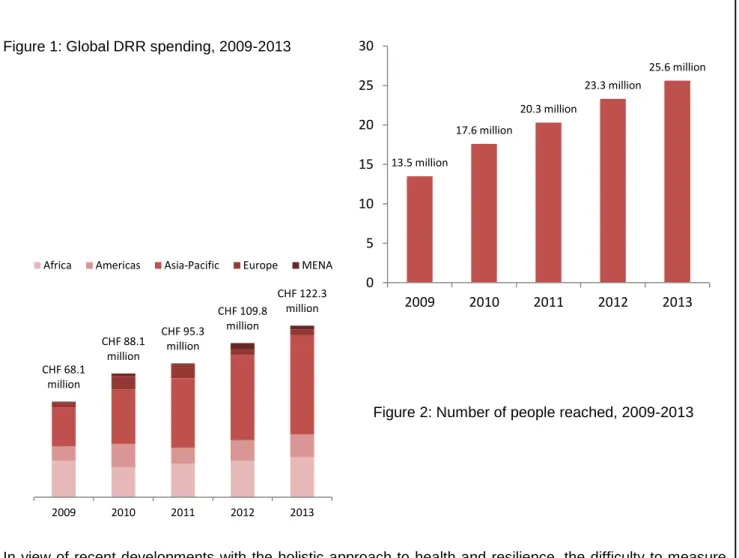
In recent years the IFRC’s DRR activities have steadily increased in terms of the total spending and the number of people reached. In 2013, IFRC spent about CHF 122.3 million, in 121 countries, supporting about 25.6 million most vulnerable. This implies that the DRR investment has almost doubled since 2009 as shown in the Figure 1 and the number of people reached has grown by 2.42 million people per year on
13.5 million 17.6 million 20.3 million 23.3 million 25.6 million 0 5 10 15 20 25 30 2009 2010 2011 2012 2013
average (Figure 2). Future scale up plans include “Tree Planting, Caring and Environmental Sustainability in 12 countries across the globe ”, “Scale Up Hunger Resilience in 9 countries across the globe.
Figure 1: Global DRR spending, 2009-2013
Figure 2: Number of people reached, 2009-2013
In view of recent developments with the holistic approach to health and resilience, the difficulty to measure results and the gradual alignment of the CBHFA approach with the IFRC’s development and resilience agenda, the indicator for health has been changed to: “Percentage of NS implementing community health programmes using CBHFA approach to strengthen community resilience.”
Preliminary results of a mapping of community health programmes using the Community-Based Health and First Aid approach in 2013 revealed that 97 NSs are using CBHFA approach. 2,220 volunteers and staff have registered in the CBHFA e-learnings, with a 42% completion rate. 19,072 volunteers were trained/coached to use the CBHFA PMER toolkit.
OUTPUT 1: Wider understanding, both internally and with external stakeholders, of the Red Cross Red Crescent approach to longer-term sustainable development is promoted through the development of strategies, guidance for policies and position papers, relating to the prevention and reduction of risk and vulnerability and the strengthening of community resilience.
Increased understanding of community safety and resilience was promoted through technical input and reviews
The Latin America and Caribbean study into resilience was undertaken and a final report was submitted in July. The study reconfirmed the findings of the Tsunami DRR study conducted in Asia Pacific in 2010-2011; it enriched the RCRC understanding of the characteristics of a resilient community and provided useful recommendations for developing and implementing successful CBDRR programmes.
CHF 68.1 million CHF 88.1 million CHF 95.3 million CHF 109.8 million CHF 122.3 million 2009 2010 2011 2012 2013
The IFRC repeatedly stressed the importance of environmental and climate change issues, and recognised the responsibility to take action with respect to its own environmental footprint. A pilot study has been undertaken for the assessment of Geneva Secretariat’s carbon footprint.
A concept paper was developed to scale up food and nutrition security and livelihoods activities in Africa, Asia Pacific and the Americas. Identified countries are Bangladesh, Bolivia, Ethiopia, Honduras, India, Kenya, Mauritania, Niger, and Sudan. The implementation of these activities will start as soon as resources will be mobilized – a joint research proposal is being developed with IFPRI to mobilise resource to conduct baseline studies in these targeted countries. These baseline studies will provide the National Societies with accurate data and will help design good quality programs and set clear indicators. These will support them to profile, position and show case the RCRC’s global contribution to the fight against hunger and malnutrition.
Extensive conceptual development work has been carried out in technical health-related areas as well as in cross-sector areas, with tools, guidelines, case studies and conceptual frameworks. More specifically, health team members continued to develop the holistic health approach and this by defining programme integration, particularly between CBHFA and emergency health. IFRC has drafted during 2013 a guidance note on linking community health with emergency health. With the vision of supporting communities and people in building resilience, RCRC community health programme teams strive to address emergency health preparedness and response after a crisis. Around 95 per cent of lives saved after a disaster are by local people, despite the fact that in much of the world, these first responders have little or no access to life-saving information and technologies. CBHFA or community health volunteers are among those who are the most familiar with the landscape in the communities they serve and thus form the critical link between emergency health teams and the affected communities.
The task shifting concept was further developed as a cross-cutting area of work which is being rolled-out across CBHFA, MNCH, and HIV/AIDS. Various policy discussions took place around global Community Health Workers (CHW) initiatives with key National Societies and programmatic implications - e.g. compatibility with resilience programming, CBHFA and MNCH framework. We are following the global initiatives around CHW expansion, integrated community case management and health workforce promotion (of which volunteers are a part). During 2013, this involved a policy meeting on CHW in Panama, and meetings in Geneva around CHW initiative to discuss the specific issues of sustainability, scale, mHealth, systems strengthening and the capacity requirements of National Societies. The operationalization of the MNCH framework will take these issues into account.
Shelter risk reduction has been further mainstreamed through the Participatory Approach for Safe Shelter Awareness (PASSA) tool by the successful running of several PASSA “training of trainers” (ToTs) in the Asia Pacific region during the first half of 2013. PASSA is also being applied as part of response to the emergency operations in the Americas (Hurricane Sandy Operation). As a result of increased cooperation with Habitat for Humanity, a pilot programme on urban risk reduction, urban regeneration, and the upgrading of slums will continue into 2014. The Post-Conflict Recovery Programme (PCRP) in the north of Sri Lanka is another example where the best practice owner-driven approach was implemented. This was documented in a report and video which were highly valued by country and global level teams as it provides insight, recommendations and visibility to a large scale complex reconstruction programme.
OUTPUT 2: Integrated programming mechanisms are adopted through revision of existing tools such as the “Better Programming Initiative,” “Vulnerability and Capacity Assessments” and “CBHFA,” to include cross-cutting issues and with a specific focus to participatory processes that will contribute to healing divisions and promote social integration particularly within marginalized communities and individuals and the rest of societies.
During 2013 CPRR department started the dialogue with interested NS, IFRC departments and ICRC on Better Programing Initiative revitalization process. A working group was established to revitalize a process of the Better Programing Initiative (BPI). It met twice to discuss related issues.
After an extensive review of the IFRC’s main assessment tool, the vulnerability and capacity (VCA) use in relation to climate change and urban risks was developed, in conjunction with the Institute for Development Studies and the International Institute for Environment and Development in the UK, following the recommendations of the review, CPRR department started the development of a complementary booklet for the four existing. A new VCA booklet denominated Integrating climate change and urban risks into the VCA: ensure effective participatory analysis and enhanced community action was developed. The Integrated programing approach is specially highlighted and promoted into this publication. Implementation plans within the zones are being discussing on the validation and rollout process.
The Health team strives to work holistically across the team …and across different sectors, particularly mainstreaming gender into health programming.
In consultation with National Societies, the health department developed in September 2013 a guidance note on integrating gender and diversity into community health. The case studies and practical guidance included in the note will enable Red Cross and Red Crescent programme managers, staff and volunteers, to draw on lessons learned and advocate for integrating gender and diversity in community health programmes. The checklist will aid programme managers and staff to design, implement and evaluate community health programmes that are gender- and diversity-sensitive. Doing so will contribute to reducing health inequities and create healthier and more resilient communities. The document was translated to French, Spanish and Arabic and disseminated to NSs.
Additionally, a new module on violence prevention was developed as part of the CBHFA approach aiming to help NSs adapt, implement, monitor and evaluate activities to prevent interpersonal violence as part of their CBHFA programming. This module is considered to be module number 9 of CBHFA and it followed the same CBHFA structure of having volunteer manual, implementation and facilitator guide and community toolkit. Indicators and questionnaire were developed for violence prevention and added to CBHFA Planning Monitoring, Evaluation and Reporting (PMER) toolkit.
A key component of the 32st International Conference Resolution on Migration recalled previous commitments made by States and the International Red Cross and Red Crescent Movement to engage in the promotion of non-violence, respect for diversity and social inclusion of all migrants; In this regard the Migration Unit has worked closer with Principles and Values department to promote respect for diversity, non-violence and social inclusion of all migrants and enhance cultural awareness between migrant and local communities.
External engagement on this issue has resulted in engagement with UNAOC on the development of a media friendly glossary on migration. Furthermore, contributing to social integration, the work carried out by the migration unit with National Societies has allowed to progress in the identification of projects to prevent human trafficking through our work with UNODC, OSCE Co-ordinator for Combating Trafficking in Human Beings, the Alliance or Experts on Human trafficking (AECT), and the European RC Human Trafficking Network. Finally the area of human rights and combating labour exploitation and human trafficking are key outcomes expected under the EU DEVCO grant approved at the end of 2013.
OUTPUT 3: Consolidated, innovative and fresh ways of social mobilization are effectively developed with and applied to the area of programme services.
Innovative and good practice approaches to DM programming are being developed, piloted and promoted for scale-up where appropriate - with a focus on the expanded use of cash in emergencies, market assessment methodologies, contingency planning, simulation, and use of needs assessment software.
Shelter research and development activities have been enhanced through the formal establishment of the IFRC Shelter Research Unit (IFRC-SRU), supported by the Benelux National Societies and based in Luxembourg. Following detailed research, the IFRC-SRU held a 2-day conference informing a large audience on its findings on comparison of different anchoring systems and their performance in different soil types. A large IFRCSRU collaborative project continuing since 2012 is looking into development of 4 types of
innovative shelter systems. The on-going collaboration between IFRC, ICRC and UNHCR continues to define industry-leading specifications for tents and key shelter relief items, utilised by other humanitarian agencies to inform their own procurement and stock piling and informing the supply and manufacturing sector.
Current and new initiatives within IFRC on behalf of migrants have been supported and brought an integrated migration perspective to our work, especially in heath (TB and HIV), disaster management/ services (climate change task force, ESG and population displacement), principles and values (violence, youth and social inclusion), National Society knowledge development (e-learning and youth engagement strategy) and humanitarian diplomacy (development of Migration guidelines and advocacy documents and statements with Communications). A database of contacts and projects undertaken by migration focal points in National Societies, regions and zones has been established.
Joint National Societies’ activities along migratory trails have been encouraged through the various RCRC networks (PERCO; CCM and Asia Pacific). These included mapping of current activities, production of a MoU template for National Societies exploring partnerships with external agencies (IOM and UNHCR), opportunities to work along migratory trails and compiling lessons learned and best practices from existing RCRC Movement partnerships. Pilot projects have been identified in the Asia Pacific, Europe and Mena Zones. The rapid spread and use of mobile technology throughout the world has offered health programme managers new and exciting means of data collection. Over the past few years the IFRC has worked with partners to develop an innovative approach to designing health surveys and improving the timeliness of the entire data collection cycle. A Rapid Mobile Phone-based (RAMP) survey aims to provide a survey methodology and operations protocol that will enable Red Cross Red Crescent National Societies, governments, non-governmental organizations and other partners to conduct health surveys at reduced costs, in a timely fashion and with limited external technical assistance. During 2013, the health department has development RAMP for project management (RAMP PRO). RAMP PRO combines data collection by SMS and by questionnaire allowing for better project management and data driven decision making. With this system Red Cross and Red Crescent supervisors will complete weekly supervision questionnaires using mobile phones the results from these weekly questionnaires will be combined with on-going data collection by volunteers by SMS. The combination of supervisors and volunteer data will allow project managers to make data driven project management decisions using real time data.
A discussion paper on mobile health (mHealth) for community health was developed to document key brainstorming points related to mHealth solutions needed to improve and support IFRC community health approach. mHealth and technology will help in two ways, first in an evolutionary way to improve what we are doing already (e.g. survey, volunteer supervision and support, etc.) and also in a revolutionary way by allowing us to do things we were not able to do before (e.g. connecting volunteers and beneficiaries online, reaching people which we were not able to reach, crowdsourcing of new techniques in behaviour change etc.).
Business Line 4: Heighten Red Cross Red Crescent influence and support for our work
OUTCOME: Evidence-based humanitarian diplomacy conducted to draw attention to the causes and consequences of vulnerability, giving voice to vulnerable people, and demonstrating the value of Red Cross Red Crescent humanitarian work and leadership.
Measurement
Indicators BL Annual
Target[1]
Year to Date Actual
Percentage of annual growth of income for non-emergency
programmes. 92.26% 2% of growth (97% in 2012) (71% in 2013) a loss of 26%
Percentage of funding against budget for programme services
plans. 90% (for all
secretariat) 95% (96%in 2012) 120% (a growth of 24%)
Percentage or # of new (global) alliances or partnerships that
support programme services plans delivery. N/A N/A
(37 in 2012)
41
Comments on progress towards outcomes
In 2013, annual funding for non-emergency programmes totalled CHF 116 million vs. an annual budget of CHF 164.3 million, for a coverage of 71%. To be noted that this annual funding includes deferred income (not recognised income in a given fiscal year). If we exclude the deferred income we come to an annual funding of CHF 103.6 million vs. an annual budget of CHF 164.3 million which gives a coverage of 63%.
Available funding against budget for Programme services plans totalled as of end of 2013, CHF 26 million vs. a revised annual budget of CHF 21.6 million (coverage of 120%). Available funding included deferred income.
At global level, 4 new global partnerships were developed in 2013:
MoU with World Meteorological Organization: signed in July on the side line of WMO’s first session of the Intergovernmental Board for Climate Services in Geneva (CICG) (at CEO level) The MoU has been ratified by the IFRC Governing Board, as the Constitution requires, and entered into force. National Societies such as Uganda Red Cross and Japanese Red Cross have developed their country level cooperation with their national meteorological agency based on the MoU.
MoU with Food and Agricultural Organization: signed during World Food Day in Rome at FAO Head Quarters (at CEO level). The MoU has been ratified by the IFRC Governing Board, as the Constitution requires, and entered into force. At least eight countries have been identified for the cooperation with FAO and the implementation of the MoU and its plan of action is on-going, with FAO HQ, IFRC HQ, and respective country offices and National Societies’ involvement.
MoU developed with International Federation of Organic Agriculture Movements (IFOAM) The MoU with IFOAM is signed with the aim to advance the food and nutrition security, climate resilience and sustainable household livelihoods agenda through the promotion and realisation of interventions based on the IFOAM “principles of Organic Agriculture” and in particular the agricultural practices of organic agriculture and agro-ecology.
MoU developed with the Kenyan Government and Kenya Red Cross.
OUTPUT 1: Key evidence based messages and positions, as part of on-going advocacy efforts are developed to enhance reach and quality of our programmes and services and better positioning of Red Cross Red Crescent activities.
A tremendous amount of work has gone into coordinating regional and global events, developing position papers, advocacy material, and key messages for enhancing reach and quality of our programmes and services in the various sector and thematic areas. More specifically:
In Health
Health corporate communication package - Health corporate folder, including 13 corporate brochures completed and distributed. The brochures have been complemented by the communication material prepared for the General Assembly (DVDs, USBs, bags and calendar);
‘Equitable access to health’ defined as the overarching communications and advocacy framework, as part of the Universal Health Coverage Global agenda, and validated during the HD Global meeting, as part of the five identified IFRC re-positioning initiatives;
World Volunteer Week (World AIDS + Volunteer Day) campaign was successfully prepared and launched on 29 November, building on the overarching theme of volunteers and access to health. A communications package was created as a joint effort with the Youth and Volunteering Department. Estimated social media reach: 893,289 accounts;
Volunteerism and Universal Health Coverage: Side event, dedicated web page, Op Ed published in the Guardian and 6 CBHFA case studies transformed into web stories;
CBHFA advocacy and institutional videos on Ireland and Timor-Leste have been completed and disseminated, as part of the World Volunteer Week;
World First Aid Day: Prepared a complete package of materials for NSs to use in their markets, including visual identity tools for long-term campaigning on First Aid (video animation, web banners and letterhead), and written tools centred on the main theme for 2013, namely road safety;
In Community Preparedness and Risk Reduction
Public Awareness and Public Education for Disaster Risk Reduction: Key Messages” and initiated an 18-month validation process.
‘Policy Asks’ and ‘Key Messages’ documents for use during the Global Platform for DRR.
IFRC internal briefing paper on Loss & Damage relating to climate change.
Key messages and other key advocacy materials to support CoP19.
Coordinated IFRC participation in global and regional events and meetings including: the Global Platform for DRR in May in Geneva; the CoP19 in Warsaw in November; high-level Consultation on Conflict, Violence and Disaster and the Post-2015 Development Agenda; Global Alliance for DRR and Resilience in the Education Sector; High Level Meeting on National Drought policy with a panel presentation, joint side event and speech by the SG at the High-level Segment; the CFS conference in October in Rome; Meetings of the Global Food Security Cluster and the Global Nutrition Cluster; Meetings of the Urban Food Security and livelihoods working group.
Coordinated the engagement of the zones and National Societies in the consultation for the post-2015 framework for DRR.
Worked as a member of the OECD’s Advisory Group on Assessing and Measuring Resilience to guide and participate in the design and review of the development of a methodology to help donors determine which components of resilience are key in a particular context.
International Day for Disaster Reduction was celebrated, with a dedicated web page promoting IFRC resolutions and events for disabled people and highlighting case studies and media materials. Zones and National Societies also observed the day with various activities and events co-organized with other organizations.
Participated in the Biofach Congress in Nuremberg, 13-16 February, where it shared a panel with the International Federation of Organic Agriculture Movements (IFOAM) on the theme “surprising partnerships for the growth of the organic sector”; the launch of the “Silent disasters campaign” in Brussels, 18-21 February.; Climate change knowledge exchange event hosted by the Institute of Development Studies at Brighton University in March; the Climate Services Adaptation Programme in Africa with WMO and other partners; International Conference on regional Climate – COREDX 2013.
International conference on malnutrition in Paris; the roundtable on maternal nutrition in emergencies in Brussels, 12 November.
Held meetings with FAO departments for food waste, loss reduction and capacity development organizers of the 2nd International Conference on Nutrition, and participated in the High level panel
and luncheon on FAO`s initiative “Save and Grow” and the International Forum on the Great Green Wall Initiative organized by the FAO.
Participated in the Annual Conference of Switzerland’s Humanitarian Aid in Bern, 15 March; European Conference on Sustainable Cities in Geneva, 17-19 April; Child Survival Week in Brussels, 22-26 April; Responding to famine: mobilizations, operations and humanitarian practices Conference in Geneva, 26 April where the assistant Secretary General of the Kenyan Red Cross participated in a nutrition round table;
CPRR together with participants from Kenya, Romania and Italian Red Cross and the Red Cross EU Office participated in the CFS conference in Rome, 7-11 October; Regularly attended meetings of the Global Food Security Cluster and the Global Nutrition Cluster and the Urban Food Security and livelihoods working group meetings. Disaster Preparedness Conference “Implementing Better Emergency Preparedness in a changing global environment” in Berlin in June.
UNISDR’s City Resilience Steering Committee meeting in Bangkok in October.
WFP/NGOs consultative meeting in Rome in October. In Shelter
Regional Housing Forums convened for Europe & Central Asia and for in Asia Pacific in collaboration with Habitat for Humanity, UNECE and UN Habitat.
Support for and establishment of regional and national shelter networks including REDLAC Shelter Working Group in the Americas, the InterAction Shelter & Settlements Working Group in North America, UK Shelter Forum, Australia Shelter Reference Group etc.
Creative partnerships with the private sector to leverage in-kind contributions to key IFRC initiatives, for example the agreement with AMEC (multinational engineering and construction company) to provide technical engineering services.
Continuing collaboration with the UN Special Rapporteur in the Right to Adequate Housing with a focus on security of tenure in the post disaster content and the need to recognise diverse forms of tenure.
Leadership on key sector issues including disability inclusion in emergency shelter response, through a collaboration with Handicap International and CBM
Global level MoUs advanced with key shelter sector agencies and institutions including UNHCR, CRATerre and RMIT University in Melbourne.
In Global Logistics Services
Continuous engagement with logistics forums and stakeholder meetings that bring together experts and practitioners from different sectors (aid and development, commercial, academia) to stimulate a sharing of best practices, cooperation and innovation in humanitarian logistics.
In 2013, GLS organized a stand at the Aid and International Development Forum (AIDF) in Bangkok (January) and at DIHAD in Dubai (March). Both events were good opportunities to interface with aid providers and create meaningful synergies in effectively addressing humanitarian needs of vulnerable communities. Such trade events also provide exposure to promote GLS capacity and services and enlarge its service user network.
Close cooperation with academic institutions involved in researching practices and innovative approaches in the field of humanitarian logistics. Since December 2013, GLS has engaged with BI Norwegian Business School to develop a case study on logistics response to the Philippines operation, which will measure the impact of logistics developments on the efficiency of delivery.
A brief promotional film profiling the IFRC global logistics capacity and services was produced. In Migration
Quarterly Migration Newsletters No. 3, 4 and 5 reflecting work of RCRC movement globally
Background document on the IFRC Perspectives on International Migration and development.