O R I G I N A L A R T I C L E
What Lies Beneath: The Linguistic Traces
of Deception in Online Dating Profiles
Catalina L. Toma1& Jeffrey T. Hancock21 Department of Communication Arts, University of Wisconsin-Madison, Madison, WI 53706, USA 2 Department of Communication, Cornell University, Ithaca, NY 14850, USA
This article investigates whether deceptions in online dating profiles correlate with changes in the way daters write about themselves in the free-text portion of the profile, and whether these changes are detectable by both computerized linguistic analyses and human judges. Computerized analyses (Study 1) found that deceptions manifested themselves through linguistic cues pertaining to (a) liars’ emotions and cognitions and (b) liars’ strategic efforts to manage their self-presentations. Technological affordances (i.e., asynchronicity and editability) affected the production of cognitive cues more than that of emotional cues. Human judges (Study 2) relied on different and nonpredictive linguistic cues to assess daters’ trustworthiness. The findings inform theories concerned with deception, media, and self-presentation, and also expound on how writing style influences perceived trustworthiness.
doi:10.1111/j.1460-2466.2011.01619.x
Concerns about online deception are as old as the Internet itself. These concerns stem from thedisembodiednature of online communication, which allows people to interact in the absence of the physical self and primarily through textual means. This lack of physicality increases opportunities for deception (e.g., lying about physical appearance) and decreases the number of cues people use in detecting deception (e.g., eye gaze, fidgeting). For these reasons, the detection of deception is assumed to be difficult in online environments (see Hancock, 2007).
One online environment for which deception is a salient issue is online dating. Online dating requires users to invest time, money, and high hopes in finding potential mates. Encountering deception in others’ profiles can stall the process and shatter those hopes, which is why many users characterize online dating as taking a leap of faith (Whitty & Joinson, 2009). An important question, then, is whether online dating deception is detectablebeforemeeting potential mates face to face. Does the profile itself provide any indication of its veracity?
We examine this issue by taking a language-based approach to deception in online dating profiles. An emerging body of research (see Buller, Burgoon, Buslig, & Roiger, 1996; Hancock, Curry, Goorha, & Woodworth, 2008; Newman, Pennebaker, Berry, & Richards, 2003; Zhou, Burgoon, Nunamaker, & Twitchell, 2004) has shown that liars often use words differently than truth-tellers. We apply this linguistic approach to deception in online dating profiles in two ways. First, we employ a computerized text analysis procedure to identify linguistic cues related to profile deception. Second, we employ human coders to examine whether they can detect daters’ deceptiveness based on the textual component of the profile, and which linguistic cues they use in making these decisions.
A superordinate goal of this research is to advance theory about the nature of linguistic cues to deception. The texts analyzed in this study are created by people who are motivated to come across as believable, and who are able to exercise control over their self-presentation, thanks to media affordances such as asynchronicity and editability. Additionally, this study examines whether lies told as part of the overall profile self-presentation (e.g., height, weight, and age), rather than lies contained solely in the textual self-description are related to linguistic cues. If linguistic cues to deception emerge under these conditions, we can draw conclusions about their role in deception more generally, such as their reliability and the extent to which they are controllable. Also, by comparing computerized linguistic analyses with analyses performed by humans, we examine which of these cues, if any, is available to perceivers.
Study 1
Study 1 employs computerized linguistic analyses to identify the linguistic cues that correlate with deception in online dating profiles. These profiles are a unique environment for the production of deception. First, they are made up of a variety of components: (a) closed-ended questions that require short, factual answers, (e.g., statements about height, age, and occupation); (b) an open-ended question where users write about themselves ‘‘in my own words’’; and (c) photographs. Although different in nature, these components serve the same overarching goal of creating a flattering self-presentation, and deception in one or several of the components can be used to achieve this goal.
Second, online dating profiles are composed under asynchronous and editable conditions (Walther, 2007). Users have an unlimited amount of time to create their self-presentation and the ability to revise it to make it both flattering and believable—an important goal because the profile is a conduit to future face-to-face meetings, where deception can be spotted. For these reasons, deception should be highly strategic. Indeed, online daters have been shown to lie frequently but subtly and to carefully choose which aspects of themselves to enhance. Men typically exaggerated their height, and women underreported their weight and posted less accurate photographs. Importantly, these deceptions were found to be intentional
and not merely a result of failing to update the profile (Hancock & Toma, 2009; Toma & Hancock, 2010; Toma, Hancock, & Ellison, 2008).
Do these small and frequent deceptions result in changes in the way daters write the textual portion of the profile? Linguistic cues to deception fall into two general categories: those that reflect the psychological processes experienced by liars and those that are strategically used by liars to accomplish the deception. Below we lay out separate rationales for both categories.
Nonstrategic linguistic cues
A robust body of work has argued that deception is accompanied by distinct emotional and cognitive states, which manifest themselves in the liars’ demeanor (for a review, see DePaulo et al., 2003). For instance, the anxiety produced by lying may result in increased fidgeting, while the cognitive demands of fabricating an untruthful account may lead to more speech hesitations and response latencies. These cues are nonstrategic in the sense that liars are either unaware of them or are unable to control them even if they were aware of them.
In this article, we apply this theoretical framework to identify the nonstrategic linguistic cues that reflect liars’ emotional and cognitive states. Previous research shows that these cues most often involvefunction words (i.e., content-free parts of sentence such as pronouns, prepositions, articles, conjunctions, and auxiliary verbs) (Chung & Pennebaker, 2007) and can also includecontentwords, such as emotional terms. These cues are nonstrategic for two reasons. First, they are difficult to control. Function words are generally produced with little conscious awareness and are difficult to control even when people are highly motivated to do so—for example, learners of foreign languages (see Chung & Pennebaker, 2007). By comparison, content words are more controllable, but research shows that many of them are used without much conscious oversight (Levelt, 1989; Newman et al., 2003). Second, research suggests that liars are unaware that these linguistic cues are associated with deception, which means that they would not know which words to control even if they could (Hancock et al., 2008).
Emotional linguistic cues
The act of lying typically results in a range of negative emotions (i.e., nervousness, anxiety, shame, and guilt), because it is associated with a sense of failing moral standards and is punishable by social sanctions (Vrij, 2000). These emotions tend to be reflected at the linguistic level by an increase in negative emotion words (e.g., ‘‘hate,’’ ‘‘sorry,’’ ‘‘worthless’’), a finding documented in both face-to-face and computer-mediated contexts (Knapp & Comadena, 1979; Newman et al., 2003; Zhou et al., 2004).
Additionally, liars’ efforts tomanagethese negative emotions can leak out. One strategy for managing the discomfort caused by lying is psychological distancing from the deception and its possible negative repercussions (DePaulo et al., 2003; Knapp & Comadena, 1979). Linguistically, psychological distancing has been found
to manifest itself through a decrease in self-references (e.g., ‘‘I,’’ ‘‘me,’’ ‘‘myself’’) and an increase in negations (e.g., ‘‘no,’’ ‘‘not,’’ ‘‘never’’), strategies that indicate a lack of commitment toward the deceptive statement (e.g., DePaulo et al., 2003; Hancock et al., 2008; Newman et al., 2003).
Cognitive linguistic cues
In their dual task to accomplish deception and avoid detection, liars must invest cognitive resources into fabricating a story that did not actually take place, without contradicting themselves or otherwise arousing suspicion. For this reason, deception is assumed to be more cognitively demanding than telling the truth (see Vrij, 2000).
Two categories of function words have been specifically identified as markers of cognitive complexity: exclusive words and motion words (Hancock et al., 2008; Newman et al., 2003). Exclusive words are made up of prepositions and conjunctions such as ‘‘but,’’ ‘‘except,’’ and ‘‘without.’’ Conceptually, these words differentiate between what belongs to a category and what does not, a cognitively demanding task for the already cognitively taxed liars. Liars also find it more complicated to invent what wasnotdone versus what was done. Several studies have reported that deceptive accounts contain fewer exclusive words (see Newman et al., 2003).
The cognitive complexity of lying can also manifest itself in an increase in the use of motion words, such as ‘‘walk,’’ ‘‘move,’’ and ‘‘go’’ (Newman et al., 2003). These words represent simple, concrete actions that are easier to string together and hence require fewer cognitive resources than more complex discourse structures.
Finally, the cognitive demands of deception tend to lead liars to produce fewer words than truth-tellers in noninteractive situations (Burgoon, Blair, Qin, & Nunamaker, 2003; DePaulo et al., 2003). The reason for liars’ brevity is twofold. First, it is easier to avoid contradictions and manage information when the deceptive message is short. Second, the cognitive demands of deception are likely to have usurped liars’ mental resources, leaving them tired and less forthcoming.
Effects of media affordances on nonstrategic cues
As previously discussed, online dating profiles are written under conditions of editability and asynchronicity, which allow daters a high degree of control over what they say. How does this increased control affect the leakage of linguistic cues? Emotional cues should be immune to the effect of these affordances because they are nonconscious and difficult to control. Additionally, having more time to reflect on and edit the profile should not decrease the negative emotions elicited by lying. Consistent with this prediction, previous research has documented the leakage of emotional linguistic cues even in asynchronous environments (Newman et al., 2003; Zhou et al., 2004).
H1:Highly deceptive profiles will contain fewer self-references but more negations and negative emotion words than less deceptive profiles.
Similarly, cognitive markers of deception are difficult to control. In fact, previous studies (Newman et al., 2003; Zhou et al., 2004) have found them to emerge even in asynchronous environments, where liars have ample opportunity to control their messages. For this reason, cognitive indicators are expected to emerge in the textual portion of online dating profiles.
H2:Highly deceptive profiles will contain fewer exclusive words, increased motion words, but a lower overall word count than less deceptive profiles.
However, the asynchronicity and editability of profile construction may reduce the cognitive burden of lying. Even though liars may be unaware of these cognitive cues, the fact that they can take longer to write their self-descriptions or write them at a different time than the rest of the profile may decrease cognitive load. If this is the case, the predictive power of some of the markers of cognitive complexity should be attenuated compared with that of emotional markers, which should be immune to the effects of editability and asynchronicity.
H3:Emotionally related linguistic cues to deception should account for more variance in deception scores than cognitively related linguistic cues in online dating profiles.1
Strategic cues associated with deception in online dating profiles
Liars also engage in strategies meant to make their lie believable (see Buller & Burgoon, 1996; DePaulo et al., 2003). At the linguistic level, this involves exercising control over the themes and topics addressed in conversation. According to interpersonal deception theory (Buller & Burgoon, 1996), the strategic choice of topics should depend on liars’ interpersonal goals and on the communication context. In online dating profiles, liars are motivated to come across as attractive and trustworthy, and the open-ended nature of the profile self-description allows them freedom in choosing which aspects of themselves to discuss.
To achieve these goals, online daters should avoid the topics on which they lied in the rest of their profile (to come across as trustworthy) and compensate for profile deceptions by emphasizing other, more truthful aspects of themselves (to come across as attractive). For instance, if daters had lied about their physical appearance, they should avoid related topics (i.e., eating and body size), but they should compensate for this deception by emphasizing other truthful aspects of their profile, such as their job and other achievements.
H4:Online daters will manage their self-descriptions by (a) avoiding deceptive topics and (b) compensating for deceptions by emphasizing accurate aspects of the self.
Method
Participants and recruitment
Participants were 80 online daters (40 men; ageM=30.55,SD=8.46, min=18,
max=53; ethnicity 55% White, 15% Black, 12.5% Asian, 10% mixed race, 5%
American Singles, or Webdate. These services were selected because they allow users to self-present through detailed profiles (including textual self-descriptions) and because they appeal to mainstream rather than niche audiences.
The study was conducted in New York City. Participants were recruited through print and online advertisements for a ‘‘self-presentation’’ study. Deception was not mentioned so that dishonest daters would not be reluctant to participate. Participants signed up through a secure Web site, where they indicated their username and the service they used. This information was used to screen out participants under the age of 18 and homosexual participants, who were excluded to avoid the potential confound of sexual orientation. Two hundred and fifty-one online daters were invited to participate, 80 of whom showed up for their appointments and were included in the study. Two participants were eliminated because they did not write textual self-descriptions in their profiles, reducing the effective sample size to 78.
Procedure overview
The study was conducted in the Psychology lab at the New School University. Before participants’ arrival, a copy of their online dating profiles was printed and archived. At the time of the research appointment, participants were given the profile print-out and asked to rate the accuracy of their responses on each profile element. Then, the accuracy of some of the profile elements was objectively assessed. Finally, participants were debriefed, thanked, and paid $30 (for a more detailed description of the full procedure, see Toma et al., 2008).
Deception measures
Self-report. Participants rated the accuracy of each profile element on a scale from 1 (completely inaccurate) to 5 (completely accurate). Accuracy was defined as ‘‘the extent to which this information reflects the truth about you now.’’ Deception was operationalized as inaccuracy.
An important note is that self-report measures of deception are problematic in several ways, including socially desirable responding (i.e., participants feeling ashamed to admit the true extent of their deceptions) and lack of self-awareness (i.e., participants honestly believing that their self-presentation is accurate when in fact it is not). To offset these potential problems, two objective indicators of deception were collected (see below).
Deception index. Three profile elements lend themselves to direct measurement: height, weight, and age. Daters’ height was measured using a standard measuring tape and their weight was measured using a standard scale. Daters’ age was recorded from their drivers’ licenses. Absolute deviations from participants’ real height, weight, and age were calculated by subtracting observed measurements from profile statements. These absolute deviations were standardized and then averaged to calculate adeception index. This deception index is used as an objectively derived measure of the amount of deception present in participants’ profiles. The deceptions captured by this index were significantly correlated with self-reported accuracy scores on height, weight,
and age, indicating that the lies were intentional rather than simple mistakes. Please refer to the study by Toma et al. (2008) for a detailed description of this index.
Photograph accuracy. The profile photograph serves as an indicator of online daters’ physical attractiveness. Because people tend to hold inflated views of their own attractiveness, independent judges were asked to rate the accuracy of profile photographs. Fifty undergraduate students (20 men) acted as judges. They were shown a side-by-side display of each dater’s lab and profile photograph and were asked to rate the accuracy of the profile photograph by comparing it to the lab photograph on a scale from 1 (completely inaccurate) to 5 (completely accurate). For a more detailed description of this procedure, see the study by Hancock and Toma (2009).
Linguistic measures
The textual self-description of every profile was analyzed using LIWC2007 (Pen-nebaker, Booth, & Francis, 2007). Linguistic inquiry and word count (LIWC) is a text analysis software that gauges the linguistic makeup of transcripts. LIWC compares every word in the transcript with its internal dictionary of 4,500 words and assigns it to one or several of its 76 word categories. These categories include function words (e.g., articles, prepositions), psychological processes (e.g., negative emotions, cognitive processes), and personal concerns (i.e., work, home, religion). For instance, ‘‘with’’ is assigned to both the ‘‘inclusive words’’ category and the ‘‘prepositions’’ category. LIWC has been successfully used to predict numerous psychological outcomes, such as social judgments, personality, health, and deception (for a review, see Chung & Pennebaker, 2007).
Each self-description was converted to a text file and assigned an identification number. LIWC processed each self-description separately, producing an output that indicates the word frequency for each category. Word frequencies are expressed as a percentage of the total number of words used in each file. Table 1 describes the descriptive data produced by LIWC.
Results and discussion
Textual self-descriptions: Descriptive data
The LIWC dictionary captured 87.89% of the words contained in online daters’ textual self-descriptions. No differences between the length of women’s (M=165.51, SD=114.64) and men’s (M=150.05, SD=123.10) self-descriptions emerged, t(76)= −0.57, ns. Overall, the daters rated their self-descriptions as very accurate
(on a scale from 1—extremely inaccurate to 5—extremely accurate, M=4.79,
SD=0.41, min=4.00, max=5.00).
Nonstrategic linguistic cues to deception
Separate regression models were built for each hypothesis. The predictors included in these models were not correlated with each other, eliminating the issue of multicollinearity.
Table 1 Counts and Percentages of Words in the LIWC Categories Used in Studies 1 and 2
Dimension Abbreviation Example
# LIWC
words Mean SD
Word count WC 156.16 118.54
Words per sentence WPS 26.08 34.19
Words captured by LIWC Dic. 87.89 12.09
Total function words Func 464 54.04 6.70
First-person singular pronouns/self-references
I I, my, me, mine 12 7.99 4.07
Second-person pronouns You You, your, thou 20 1.40 3.26
Articles Article A, an, the 3 5.56 2.40
Negations Negate No, never, not 57 1.44 1.36
Negative emotions Negemo Hate, hurt, ugly 399 1.15 1.22
Exclusive words Excl But, without, exclude 17 2.94 1.97
Motion words Motion Walk, move, go 73 1.69 1.55
Ingestion Ingest Dish, eat, pizza 111 0.62 0.98
Quantifiers Quant Few, many, much 89 2.44 1.72
Work Work Job, major 327 1.60 1.68
Achieve Achieve Earn, win, hero 186 1.81 1.93
LIWC=linguistic inquiry and word count.
Note:# LIWC words refers to the number of words per category in the LIWC dictionary. Mean refers to the mean percentage of usage in these studies. Word count and words per sentence are expressed as raw numbers.
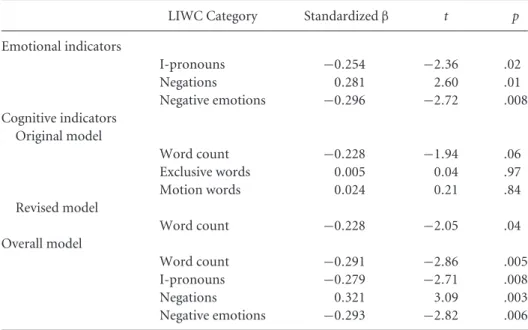
To test the emotional indicators (H1), a regression model with the deception index as the outcome variable and first-person singular pronouns, negations, and negative emotion words as predictors was built. The model was significant,F(3, 74)=5.67, p< .001, and explained 15% of the variance in the deception index,R=0.43,R2 = 0.19, R2adj=0.15. The standardized coefficients for all predictors were significant, although the direction of negative emotion words was opposite than predicted (see first section of Table 2). H1 was then mostly supported.
To test the cognitive indicators (H2), a regression model predicting the deception index with exclusive words, motion words, and word count as predictors was built. The model was not significant, F(3, 74)=1.37, ns. Neither exclusive words nor motion words were significant predictors. The model was revised by eliminating the nonsignificant predictors. This revised model achieved significance,F(1, 76)=4.19, p=.04 and explained 4% of the variance in the deception index,R=0.23,R2 =0.05, R2adj=0.04, suggesting that word count was the only cognitive correlate of deception. The standardized coefficients for the original and revised models are presented in the second section of Table 2. H2 was then only partially supported.
A combined model containing both emotional and cognitive indicators was used to test H3, which predicted that emotional cues would account for more variance in the deception index than cognitive cues. The combined model was significant,
Table 2 Linguistic Predictors of Deception: Multiple Regression Coefficients
LIWC Category Standardizedβ t p
Emotional indicators I-pronouns −0.254 −2.36 .02 Negations 0.281 2.60 .01 Negative emotions −0.296 −2.72 .008 Cognitive indicators Original model Word count −0.228 −1.94 .06 Exclusive words 0.005 0.04 .97 Motion words 0.024 0.21 .84 Revised model Word count −0.228 −2.05 .04 Overall model Word count −0.291 −2.86 .005 I-pronouns −0.279 −2.71 .008 Negations 0.321 3.09 .003 Negative emotions −0.293 −2.82 .006
F(4, 73)=6.72, p< .001, and explained 23% of the variance in the deception index,R=0.52,R2 =0.27,R2
adj=0.23. The pattern of coefficients supports H3: All the emotion cues were significant predictors of the deception index, but the only significant cognitive cue was word count (Table 2).
Strategic linguistic cues to deception
The results support the hypothesis that online daters tended to avoid the topics on which they had lied in their profiles (H4a). The more online daters reported lying about their physical appearance, the fewer eating-related words (e.g., eat, dish) (r= −0.22,p=.05) and quantifiers (e.g., few, much) (r= −0.25, p=.03) they used. Eating words and quantifiers can be associated with body size, and as such they may be related to deception about physical appearance. Similarly, the less accurate profile photographs were (according to judges’ ratings), the fewer eating-related words daters used (r=0.36,p=.04, one-tailed).
The results also support the hypothesis that, to compensate for specific decep-tions, online daters emphasized other, more truthful, aspects of themselves (H4b). Specifically, when they posted less accurate photographs, they tended to use more work-related (r=0.32,p=.02) and achievement-related words (r=0.34,p=.01), presumably as a way to emphasize social status. Means and standard deviations for the LIWC categories included in the above analyses are presented in Table 1.
To summarize, Study 1 examined whether deception in online dating profiles was detectable through linguistic analyses and, if so, which linguistic cues were useful predictors of deception. Consistent with previous research conducted in computer-mediated settings, the emotions typically experienced by liars were found to leak
into the self-descriptions: The more online daters lied in their profiles, the more they distanced themselves psychologically from these deceptions by using fewer self-references and more negations. It was also hypothesized that the negative emotions associated with lying would result in an elevated use of negative emotion words; however, the opposite pattern emerged. One possible explanation for this unexpected result is that deceptive daters usedfewernegative emotion words in a strategic attempt to increase their attractiveness and dateability (rather than to eschew deception detection). Indeed, among emotional linguistic indicators, negative emotion words are the only content words, and as such they are more controllable than function words (first-person pronouns and negations).
Regarding the cognitive aspects of lying, we found that, as expected, liars used fewer words, presumably to avoid contradicting previous deceptions—a finding consistent with prior research conducted in asynchronous environments. However, the markers of cognitive complexity (i.e., exclusive words and motion words) were not significant predictors of profile deception, suggesting that the technological affordances of asynchronicity and editability may have relieved the cognitive burden of deception.
Note that while the distinction between emotional and cognitive behavioral correlates has been theoretically established for some time in the nonverbal domain (see Ekman, 1984), the notion that linguistic behaviors may also reflect an emotional-cognitive distinction is less well-established. Although the current research provides evidence for the usefulness of this distinction, additional empirical work is necessary to increase predictive validity.
When analyzing the topics addressed in online daters’ self-descriptions, we found that, consistent with expectations, online daters acted strategically to hide or distract attention from their deceptions. When lying about physical appearance, online daters used fewer words that can be associated with body size (i.e., eating and quantifiers), but more words related to job success (i.e., work and achievement). Although these data are strictly correlational, the pattern of results supports interpersonal deception theory’s primary assumption that liars are strategic in accomplishing their communicative goals (Buller & Burgoon, 1996).
Study 2
Study 1 used computerized analyses to identify the linguistic traces left by deception in the textual self-description portion of online dating profiles. The goal of the second study is to determine whether human judges are able to identify deception based on the same textual self-descriptions and whether they can capitalize on the linguistic cues identified in Study 1.
A practical consideration in this detection task is that the textual self-descriptions are only one part of the profile. More importantly, daters reported their textual descriptions as generally accurate, although Study 1 showed that these self-reported accurate texts were associated with deception in the overall profile (i.e., height, weight, age, and photograph). In other words, these texts provide information about
the general honesty of the online daters who wrote them. For this reason, judges in this study were asked to rate the trustworthiness of the online dater who wrote the textual self-description, rather than the accuracy of the text per se. Trustworthiness in this context is operationally defined as the extent to which daters can be relied on to tell the truth in their profiles—an admittedly narrow and domain-specific definition. Can perceivers accurately detect online daters’ trustworthiness based solely on how they describe themselves in the textual self-description portion of the profile?
As noted earlier, a robust literature has established that people perform poorly in lie detection tasks—in fact, only slightly better than chance on average (for a review, see Bond & DePaulo, 2008). Several reasons have been offered for this poor performance, including the paucity of reliable cues (DePaulo et al., 2003) and stereotypical but incorrect cultural beliefs about deception (Global Deception Research Team, 2006). Additionally, thetruth bias, or a natural inclination to assume others tell the truth, has been shown to severely skew deception detection judgments (Levine, Park, & McCornack, 1999). We expect the truth bias to operate on people’s judgments of others’ trustworthiness as well, leading them to perform poorly.
The next question of interest concerns the linguistic cues used by perceivers when making trustworthiness judgments. Extant research on this topic has identified complexity, factual consistency, flow, and plausibility as commonly used cues (e.g., Anderson, DePaulo, Ansfield, Tickle, & Green, 1999). However, this research has only considered statements that are either deceptive (e.g., ‘‘I did not take the wallet’’ when in fact they had) or truthful (‘‘I did not take the wallet’’ when they had not) and hence do not generalize well to the present context, in which there is no explicit lie to be judged. Nonetheless, predictions can be derived from several communication theories that address linguistic correlates of trustworthiness.
First, uncertainty reduction theory (Berger & Calabrese, 1975) suggests that people are averse to uncertainty and hence the more information they hold about others, the more they tend to like them. As liking and trust are intrinsically related, perceivers are expected to judge lengthier self-descriptions as more trustworthy than their shorter, less revealing counterparts. In line with these expectations, Flanagin (2007) found that eBay products with longer descriptions received more bids and higher selling prices, and Larrimore et al. (2011) found that lengthier online loan requests on peer-to-peer lending sites were more likely to receive funding. Several studies have also found that the inclusion of details improves credibility (see Vrij, 2000).
H1:Longer self-descriptions will be perceived as more trustworthy.
Second, clarity of speech appears to be essential in forming impressions of trustworthiness (see Elsbach, 2004). Self-descriptions that are written in a convoluted, difficult-to-follow manner are likely to elicit irritation and distrust. We expect that a writing style characterized by shorter sentences will be perceived as more trustworthy.
H2:Self-descriptions that contain fewer words per sentence will be perceived as more trustworthy.
Third, concrete language is expected to engender trust because it is familiar and accessible, as opposed to abstract language, which can be obscure and difficult to follow (Elsbach, 2004). Consistent with this prediction, requests for loans on a peer-to-peer lending site that used more concrete language received more money from lenders (Larrimore et al., 2011), suggesting that lenders placed more trust in more concretely worded loan requests. An important linguistic marker of concreteness is elevated use of articles (‘‘a’’ and ‘‘the’’), which signal an upcoming noun (Tausczik & Pennebaker, 2010). Article frequency should then increase perceptions of trustworthiness.
H3:Self-descriptions that contain more articles will be perceived as more trustworthy.
Finally, an important reason why language may influence perceptions of trust-worthiness is its ability to elicit social categorization (Fiske & Taylor, 1991; Scherer, 1979). Specifically, language choice can make interactants feel like part of an ingroup or an outgroup. The simplest way to achieve this distinction is through pronoun use: first-person plural pronouns (‘‘we’’ and ‘‘ours’’) indicate inclusiveness, whereas second- and third-person pronouns (‘‘you’’ and ‘‘they’’) place the interlocutor in the outgroup. As first- and third-person plural pronouns are unlikely to be used when writing to an unknown audience, we expect that an elevated use of second-person pronouns would decrease perceptions of trustworthiness. Indeed, evidence from psy-cholinguistics suggests that the use of ‘‘you’’ is correlated with negative interpersonal outcomes, such as decreased marital satisfaction (Simmons, Gordon, & Chambless, 2005) and signaling blame and interpersonal distance (Hahlweg et al., 1984). Thus, we hypothesize that:
H4:Self-descriptions that contain fewer second-person pronouns will be perceived as more trustworthy.
Method
Participants
Sixty-two undergraduate students (28 males, 32 females, 2 did not report their gender; ages 18–22) participated in this study in exchange for extra credit in their communication classes.
Procedure and stimuli
Participants were told they would be reading real online daters’ profile self-descriptions. They were seated in small groups in a projection room (but did not interact with each other) and were instructed to carefully read each self-description and then answer two questions about it.
The same 78 self-descriptions used in Study 1 were included here. As reading all the self-descriptions would be a lengthy and tiresome process, participants were only asked to read a subset of 22 self-descriptions. Each subset was rated by at least 15 participants. To avoid order effects, the viewing order of the self-descriptions within each subset was randomized.
The self-descriptions were displayed one at a time on a large projection screen, along with information about the writer’s gender. Judges were allowed sufficient time to read each self-description (30 seconds to 1 minute, depending on its length). Care was taken that the stimuli were clearly visible to all the participants.
Measures
After reading each dater’s self-description, judges used a scale from 1 (strongly disagree) to 7 (strongly agree) to answer the following questions: (a) I would expect this online dater to tell me the truth and (b) this online dater seems trustworthy to me. The scale was reliable (α=0.94). The two items were averaged to create a trustworthiness score for each judge, and then the judges’ scores were averaged to create a trustworthiness score for each dater.
Results and discussion
To be clear in our terminology, we refer to the participants in this study as ‘‘judges’’ and to the participants who provided the online dating self-descriptions as ‘‘daters.’’
Perceptions of trustworthiness: Descriptives
The average perceived trustworthiness of the daters in our sample was 4.48 on the 1 (untrustworthy) to 7 (trustworthy) scale used (SD=0.62, min=2.47, max=5.67). Trustworthiness scores were normally distributed (Kolmogorov-Smirnov’sD=0.07, p=.20).
The accuracy of perceived trustworthiness
Recall from Study 1 that a deception index was calculated for each dater. The judges’ trustworthiness ratings were not correlated with this deception index (r= −0.02, ns), suggesting that their perceptions of the daters’ trustworthiness were not accurate. To calculate the more traditional accuracy rate used in deception detection research, the data were prepared for a 2 (high vs. low trustworthiness)×2 (perceived high vs. perceived low trustworthiness) classification. The deception index was used to classify online daters into high and low trustworthiness categories using a median split (Mdn= −0.16). Then, the judges’ ratings were used to categorize daters into low and high perceived trustworthiness by dichotomizing the 7-point Likert scale used. The midpoint of the scale (i.e., 4) or higher was classified as high perceived trustworthiness and a score below 4 was classified as low. The midpoint rather than the median of the perceived trustworthiness scale was used to assess truth bias (i.e., more daters being perceived as trustworthy than untrustworthy).
Judges’ accuracy rate in categorizing daters as high or low in trustworthiness was 48.7%, not different from chance, suggesting that the judges were unable to classify daters on trustworthiness from their textual self-descriptions. Consistent with previous research on deception detection, an important reason for the low detection rate was the operation of the truth bias: Judges only classified 14 of the 78 daters (18%) as not trustworthy (see Table 3).
Table 3 Classification of Daters as High Versus Low in Trustworthiness by Judges Judge Perception of Dater Trustworthiness
Low High
Dater trustworthiness Low (n=38) 7 33
High (n=40) 7 31
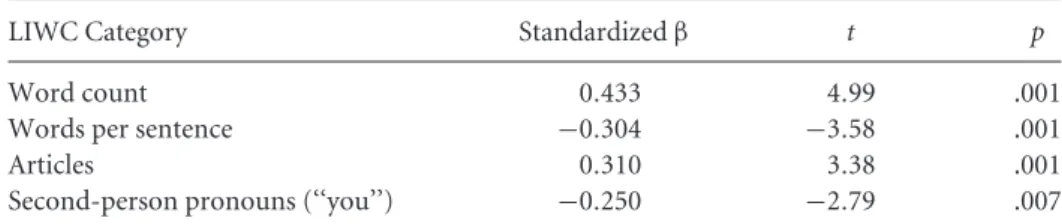
Table 4 Linguistic Predictors of Trustworthiness Perceptions: Multiple Regression Coefficients
LIWC Category Standardizedβ t p
Word count 0.433 4.99 .001
Words per sentence −0.304 −3.58 .001
Articles 0.310 3.38 .001
Second-person pronouns (‘‘you’’) −0.250 −2.79 .007
Note:Trustworthiness was operationalized on a scale from 1 (untrustworthy) to 7 (trustworthy). Linguistic indicators of trustworthiness
It was hypothesized that daters who wrote longer self-descriptions in an easily understandable and concrete manner and who were inclusive of the audience would be perceived as more trustworthy. Results support these hypotheses. A regression model with perceived trustworthiness as the dependent variable and word count, words-per-sentence, articles, and second-person pronouns as predictors was significant,F(4, 72)=18.38,p< .001, and accounted for 48% of the variance in the trustworthiness score,R=0.71,R2 =0.51,R2adj=0.48 (see Table 4).
But are these linguistic cues correlated with daters’ deception? A regression model with the cues that predicted perceived trustworthiness entered as predictors and the deception index (which illustrates daters’ actual deceptive practices) as the outcome variable was not significant,F(4, 73)=1.60, ns. With the exception of word count (β= −2.09,p=.04), none of the cues that the judges used to assess daters’ trustworthiness was a significant predictor of deception. Consistent with this finding, Hancock et al. (2008) showed that the linguistic cues produced by liars do not predict deception detection judgments, suggesting that detectors do not/cannot access those linguistic cues as part of their judgment.
To summarize, Study 2 examined whether readers of the textual self-description portion of online dating profiles can detect profile deceptions, and which linguistic cues influence their decisions. Based on people’s general inability to detect deception, judges were expected to find it difficult to accurately assess daters’ trustworthiness and to rely on faulty linguistic cues. These hypotheses were supported. First, judges performed at chance when trying to classify daters on trustworthiness, consistent with previous research documenting humans’ poor deception detection ability. Second, the only cue used by judges that is in fact related to deception (as established in
Study 1) was word count. The longer a self-description, the more trustworthy its author was considered to be. In general, the pattern of results support theories concerned with interpersonal perception, such as uncertainty reduction theory, and they add to the growing literature about what people find trustworthy in online contexts.
General discussion
The current studies set out to determine whether the language used by online daters in their self-descriptions provides information about the deceptiveness of their profiles. This question was addressed using both computerized linguistic analyses (Study 1) and human coding (Study 2). Although computerized analyses identified several linguistic correlates of profile deception, human judges were unable to detect daters’ trustworthiness based on the written component of the profile, and they relied mostly on linguistic cues unrelated to profile deception. These two studies advance theory along several fronts, including the role of technological affordances in the production of linguistic cues to deception, the relationship between deception and self-presentation, and how individuals make judgments of trustworthiness in online contexts.
Technological affordances and deception cues
The technological affordances of asynchronicity and editability provide online daters with the time and the ability to alter their statements. This increased degree of control appeared to moderate the effect of cognitive linguistic cues (i.e., exclusive and motion words). Although these cues emerged as reliable indicators in previous studies (e.g., Hancock et al., 2008; Newman et al., 2003), they were not related to deception in this context, suggesting that the cognitive burden associated with deception may be alleviated in asynchronous, editable environments.
The only cognitive correlate was word count. More deceptive profiles contained shorter self-descriptions, a finding consistent with prior research on deception produced in asynchronous environments (e.g., Zhou et al., 2004). In contrast, research examining deception in synchronous environments shows that liars use more words in conversation (Hancock et al., 2008), suggesting that the synchronicity of the media context interacts with deception and verbosity.
Unlike cognitive correlates, emotion-related cues were all significant predictors of deception, suggesting that an asynchronous and editable context does not attenuate the emotional aspects of language. The linguistic dimensions associated with psycho-logical distancing, first-person singular pronouns, and negation terms were evident in deceptive profiles. These linguistic manifestations of psychological distancing have now been observed in a wide range of contexts, including deceptive statements by students (Newman et al., 2003), by prisoners (Bond & Lee, 2005), and in synchronous (Hancock et al., 2008) and asynchronous computer-mediated communication (Keila & Skillicorn, 2005; Zhou et al., 2004). The fact that they were also observed in
online dating profiles suggests that psychological distancing is difficult to control, and further solidifies its usefulness as a deception detection cue.
One unexpected finding concerned negative emotion terms. Prior research suggests that these words should be increased in deceptive accounts, as they non-consciously reflect the negative feelings resulting from the act of lying. However, we observed the opposite—more deceptive profiles included fewer negative emotion words. This finding raises questions about the nonstrategic nature of this linguistic indicator. One possibility is that asynchronous media may allow for a more strategic employment of these terms, although more research is needed to elucidate the link between deception and the leakage of negative emotion words.
The daters certainly appeared capable of using language strategically in this media context. First, they tended to avoid using terms related to specific profile deceptions, such as an inaccurate photo or reported height. This strategy, known as reticence (Buller & Burgoon, 1996), may allow daters to avoid drawing attention to the deception or to avoid contradicting themselves. Second, daters compensated for profile deceptions by emphasizing other positiveandaccurate aspects of the self, such as their accomplishments when they posted inaccurate photos. These strategies lend support to the central claim of interpersonal deception theory (Buller & Burgoon, 1996), which holds that liars do more than just leak cues: They also strategically manipulate information, both verbally and nonverbally, to avoid deception detection and accomplish their interpersonal goals.
Detecting deceptive daters
Together, emotional and cognitive linguistic cues (see Table 2), accounted for a substantial amount of variance in the deception index (23%). This effect size is larger than those observed in many other studies using similar computerized text analyses, even though the deceptions that comprised the deception index in this study were small. One possible reason for this larger effect is that the context where the lies were produced was one of high stakes (Frank & Ekman, 1997). Indeed, online dating deception often results in relational termination after the first face-to-face contact (Whitty & Joinson, 2009), and as such it is high in stakes. Consistent with this, research suggests that leakage cues are most prominent under high-stakes conditions.
Given the strength of the linguistic correlates observed in Study 1, is it possible to classify online dating profiles as high or low in deceptiveness? A logistic regression used the linguistic markers identified above as predictors of high versus low deceptive profiles. Profiles were dichotomized into high and low deceptiveness using the same median split from Study 2. The logistic regression was significant,χ2(4)=13.55, p=.009, and correctly classified 63% of the profiles (low deceptiveness: 61.5%; high deceptiveness: 65.8%). This model of linguistic correlates significantly outperforms both chance (p< .01) and the human judges, whose accuracy was 48.7% (p< .01), and is similar to rates observed by previous studies using this approach (Hancock et al., 2008; Newman et al., 2003).
Although the model’s accuracy exceeded chance and human detection, decisions remained flawed. Approximately one third of the profiles were misclassified. These data highlight the difficulty of automatically classifying dating profiles based only on the language of the self-description. One limiting factor is the relatively small number of profiles available for analysis. Because statistical classification is improved with a larger number of cases, an important goal of future research is increasing the number of profiles to analyze.
Constructing a trustworthy profile
A large body of research has established that people are poor deception detectors and that one of the reasons for this deficiency is their reliance on faulty nonverbal cues, such as eye gaze. We extend these findings in two ways. First, we show that human judges are also inaccurate at detecting daters’ trustworthiness. Second, we find that one of the reasons for this lack of skill is a reliance onlinguisticcues that are consistent with credibility assessments, rather than on cues actually associated with deception. In fact, human judges only used one linguistic cue identified in Study 1 as reliable: the length of a textual self-description. Lengthier self-descriptions were perceived as more trustworthy, but it is unclear whether judges used this cue consciously.
Human judges relied on a separate set of cues to determine online daters’ trust-worthiness: (a) increased inclusiveness of the audience (as per social categorization theory), (b) larger amounts of information disclosed (as per uncertainty reduction theory),2 (c) language concreteness, and (d) language conciseness. Although unreli-able in assessing daters’ trustworthiness (with the exception of word count), these cues are consistent with communication theories and empirical research concerned with credibility in online settings.
An exciting finding is that all the linguistic cues to trustworthiness identified here reflect the style rather than the content of the self-presentation and that they are highly influential (i.e., they accounted for approximately half of the variance in perceptions of trustworthiness). A preliminary conclusion, then, is thathowpeople describe themselves may be equally important aswhatthey disclose about themselves in harnessing an audience’s trust.
Implications for deception in self-presentation
Deception is an important resource for self-presentation. The present research advances our understanding of how deception plays a role in self-presentation. Specifically, deceptions in one aspect of the online dating profile, such as about height, weight, age, or photograph, were related to patterns of word use in a separate part of the dating profile, the open-ended self-description. This finding suggests that self-presentations in online profiles are cohesive, with deceptions in one part of the profile influencing self-presentation in other parts, consistent with theories that suggest that self-presentation is a holistic enterprise (see Goffman, 1959).
The fact that deceptions in the profile were evident in the language use of the self-description is particularly striking given that the self-descriptions were rated
by the online daters as highly accurate. Although self-reports of deception should be interpreted with caution, this observation suggests that the linguistic correlates identified in Study 1 are unlikely to be reflecting deception in the self-description itself. Indeed, none of the linguistic features identified in Study 1 were correlated with the reported accuracy of the self-descriptions.
Finally, it is important to note that this deception context is different from those examined in previous studies on the linguistic correlates of deception (e.g., Hancock et al., 2008; Newman et al., 2003; Zhou et al., 2004), in which deceptive and accurate texts were clearly distinguished. The fact that linguistic cues emerge when deceptions are simply part of a more general self-presentation suggests that they are psychologically important and merit future consideration.
Conclusion
Deceptive self-presentations in online dating can leave linguistic traces in the textual portion of the profile. These traces include both nonconsciously leaked cues and strategic cues; however, they are largely unavailable to people trying to detect profile deception, who rely on a separate set of linguistic cues to assess daters’ trustworthiness. These findings have substantial implications for theories concerned with deception and self-presentation and with how writing style influences perceived trustworthiness. Although the practical application of the findings is currently limited, they do point out to the possibility of building a linguistic model that can automatically detect deception in online dating profiles and possibly other kinds of online communication.
Acknowledgments
This research was supported by NSF Grant HSD-0624267. We are grateful to Nicole Ellison for help in developing this project, to Michael Schober for offering his lab at the New School University for data collection, and to Ashley Downs, Peter Thompson, and Jeff Nevins for their help with data collection.
Notes
1 It is not yet clear from the literature what the relative weight of emotional versus cognitive linguistic cues is in deceptive accounts. Here, we expect that the asynchronous, editable environment of online dating should significantly reduce the predictive power of cognitive cues, leading them to account for less variance than emotional cues. However, future research is needed to provide a benchmark of how much variance is explained by each of these types of cues in synchronous, noneditable environments. 2 Norton, Frost, and Ariely (2007) find that in dating situations, people like their partners
lesswhen they find out more information about their personality traits and when they move from online to offline interaction. Although there are important differences between our procedure and Norton et al.’s (e.g., personality traits vs. self-selected information), future research is needed to clarify the boundary conditions of uncertainty reduction theory: What kind of information increases positive impressions (e.g., liking and perceptions of trustworthiness) and in what contexts?
References
Anderson, D. E., DePaulo, B. M., Ansfield, M. E., Tickle, J. J., & Green, E. (1999). Beliefs about cues to deception: Mindless stereotypes or untapped wisdom?Journal of Nonverbal Behavior,23, 67–89.
Berger, C. R., & Calabrese, R. J. (1975). Some exploration in initial interaction and beyond: Toward a developmental theory of communication.Human Communication Research,1, 99–112.
Bond, C. F., & DePaulo, B. M. (2008). Individual differences in judging deception: Accuracy and bias.Psychological Bulletin,92, 134–477.
Bond, G. D., & Lee, A. Y. (2005). Language of lies in prison: Linguistic classification of prisoners’ truthful and deceptive natural language.Applied Cognitive Psychology,19, 313–329.
Buller, D. B., & Burgoon, J. K. (1996). Interpersonal deception theory.Communication Theory,6, 203–242.
Buller, D. B., Burgoon, J. K., Buslig, A., & Roiger, J. (1996). Testing interpersonal deception theory: The language of interpersonal deception.Communication Theory,6, 268–289. Burgoon, J. K., Blair, J. P., Qin, T., & Nunamaker, J. F. (2003) Detecting deception through
linguistic analysis.Intelligence and Security Informatics, 2005, 91–101.
Chung, C. K., & Pennebaker, J. W. (2007). The psychological functions of function words. In K. Fiedler (Ed.),Social communication: Frontiers of social psychology(pp. 343–359). New York, NY: Psychology Press.
DePaulo, B. M., Lindsay, J. J., Malone, B. E., Muhlenbruck, L., Charlton, K., & Cooper, H. (2003). Cues to deception.Psychological Bulletin,129, 74–118.
Ekman, P. (1984). Expression and the nature of emotion. In K. R. Scherer & P. Ekman (Eds.), Approaches to emotion(pp. 319–344). Hillsdale, NJ: Erlbaum.
Elsbach, K. D. (2004). Managing images of trustworthiness in organization. In R. M. Kramer & K. S. Cook (Eds.),Trust and distrust in organizations: Dilemmas and approaches.New York, NY: Russell Sage Foundation.
Fiske, S., & Taylor, S. (1991).Social cognition.New York: McGraw-Hill.
Flanagin, A. J. (2007). Commercial markets as communication markets: Uncertainty reduction through mediated information exchange in online auctions.New Media & Society,9, 401–423.
Frank, M. G., & Ekman, P. (1997). The ability to detect deceit generalizes across different types of high-stake lies.Journal of Personality and Social Psychology,72, 1429–1439. Global Deception Research Team. (2006). A world of lies.Journal of Cross-Cultural
Psychology,37, 60–74.
Goffman, E. (1959).The presentation of self in everyday life.Garden City, NY: Doubleday. Hahlweg, K., Reisner, L., Kohli, G., Vollmer, M., Schindler, L., & Revensdorf, D. (1984).
Development and validity of a new system to analyze interpersonal communications. In K. Hahlweg & N. Jacobson (Eds.),Marital interaction: Analysis and modification (pp. 182–198). New York, NY: Guilford.
Hancock, J. T. (2007). Digital deception: When, where and how people lie online. In K. McKenna, T. Postmes, U. Reips, & A. N. Joinson (Eds.),Oxford handbook of Internet psychology(pp. 287–301). Oxford, England: Oxford University Press.
Hancock, J. T., Curry, L. E., Goorha, S., & Woodworth, M. (2008). On lying and being lied to: A linguistic analysis of deception in computer-mediated communication.Discourse Processes,45, 1–23.
Hancock, J. T., & Toma, C. L. (2009). Putting your best face forward: The accuracy of online dating profile photographs.Journal of Communication,59, 367–386.
Keila, P. S., & Skillicorn, D. B. (2005). Detecting unusual and deceptive communication in email. External technical report, School of Computing, Queen’s University, Kingston, Ontario, Canada.
Knapp, M. L., & Comadena, M. A. (1979). Telling it like it isn’t: A review of theory and research on deceptive communications.Human Communication Research,5, 270–285. Larrimore, L., Jiang, L., Larrimore, J., Markowitz, D. M., & Gorski, S. (2011). Make an offer
they can’t refuse: How borrower language in peer-to-peer lending impacts funding. Journal of Applied Communication Research,39, 19–37.
Levelt, W. J. M. (1989).Speaking: From intention to articulation. Cambridge, MA: MIT Press. Levine, T. R., Park, H. S., & McCornack, S. A. (1999). Accuracy in detecting truths and lies:
Documenting the ‘‘veracity effect.’’Communication Monographs,66, 125–144. Newman, M. L., Pennebaker, J. W., Berry, D. S., & Richards, J. M. (2003) Lying words:
Predicting deception from linguistic styles.Personality and Social Psychology Bulletin,29, 665–675.
Norton, M. I., Frost, J. H., & Ariely, D. (2007). Less is more: When and why familiarity breeds contempt.Journal of Personality and Social Psychology,92, 97–105.
Pennebaker, J. W., Booth, R. J., & Francis, M. E. (2007).Linguistic inquiry and word count: LIWC 2007. Austin, TX: LIWC.
Scherer, K. R. (1979). Voice and speech correlates of perceived social influence in simulated juries. In H. Giles& R. N. St. Clair (Eds.),Language and social psychology(pp. 89–120). Baltimore, MD: University Park Press.
Simmons, R. A., Gordon, P. C., & Chambless, D. L. (2005). Pronouns in marital interaction: What do ‘‘You’’ and ‘‘I’’ say about marital health?Psychological Science,16, 932–936. Tausczik, Y., & Pennebaker, J. W. (2010). The psychological meaning of words: LIWC and
computerized text analysis methods.Journal of Language and Social Psychology,29, 24–54. Toma, C. L., & Hancock, J. T. (2010). Looks and lies: Self–presentation in online dating
profiles.Communication Research,37, 335–531.
Toma, C. L., Hancock, J. T., & Ellison, N. B. (2008). Separating fact from fiction: An examination of deceptive self-presentation in online dating profiles.Personality and Social Psychology Bulletin,34, 1023–1036.
Vrij, A. (2000)Detecting lies and deceit: The psychology of lying and the implications for professional practice. Chichester, England: Wiley.
Walther, J. B. (2007). Selective self-presentation in computer-mediated communication: Hyperpersonal dimensions of technology, language, and cognition.Computers in Human Behavior,23, 2538–2557.
Whitty, M. T., & Joinson, A. (2009).Truth, lies and trust on the Internet.New York, NY: Psychology Press.
Zhou, L., Burgoon, J. K., Nunamaker, J. F., & Twitchell, D. (2004). Automating linguistics-based cues for detecting deception in asynchronous computer-mediated communications.Group Decision and Negotiation,13, 81–106.
거짓말의
배경은
무엇인가
온라인
데이트
프로파일에서의에서의
거짓말
추적에
관한
연구
요약
본
연구는
온라인
데이트
프로파일에서의
거짓말들이
프로파일의
자유텍스트
부분에서
데이트
당사자들이
그들
자신에
관하여
쓰는
방식에
변화와
상호연계가
있는지를
,
그리고
이러한
변화들이
컴퓨터화된
언어적
분석과
인간적
판단에
의해
발견될
수
있는지를
연구하였다
.
컴퓨터화된
분석
(
연구
1)
은
거짓말들은
그들
자신들이
거짓말을
하는
사람들의
감정과
인지들에
대한
언어적
단초들을
통하여
명백화
하였으며
,
그리고
거짓말을
하는
사람들이
그들
자신의
과시를
관리하기
위한
전략적인
노력인
것으로
나타났다
.
기술적인
제공들은
감정적인
단초보다
인지적인
단초의
생산에
더
많은
영향을
주었다
.
인간적인
판단
(
연구
2)
은
데이트
당사자들의
신뢰성을
평가할
수
있는
다양하고
예측
불가능한
단초들에
의존하였다
.
발견들은 사기, 미디어와 자기 표현에 관련된
이론들을 제공하였으며, 어떻게 작문 스타일이 인지된 신뢰도에 영향을 주었는지를
해석하게 해 주었다.
de rencontre
Catalina L. Toma & Jeffrey T. Hancock
Cet article étudie si les mensonges dans les profils sur les sites de rencontre sont en
corrélation avec des changements dans les manières de se décrire dans la portion de texte
libre du profil. L’article étudie également si ces changements sont décelables par des
analyses linguistiques par ordinateur et par des juges humains. Des analyses par
ordinateur (étude 1) ont révélé que les mensonges se manifestaient par des indices
linguistiques liés (1) aux émotions et à la cognition des menteurs et (2) aux efforts
stratégiques des menteurs à gérer la présentation de soi. Les affordances technologiques
(p. ex. l’asynchronicité et l’altérabilité) influençaient la production d’indices cognitifs
plus que la production d’indices émotionnels. Les juges humains (étude 2) s’appuyaient
sur des indices linguistiques différents et non prédictifs pour évaluer la fiabilité des
membres. Les résultats éclairent les théories traitant du mensonge, des médias et de la
présentation de soi, en plus d’exposer les manières par lesquelles le style d’écriture
influence la perception de fiabilité.
Mots clés : indices linguistiques du mensonge, mensonge, présentation de soi, fiabilité,
rencontres en ligne, communication par ordinateur
In dieser Studie untersuchen wir, ob Täuschungen in Online-Dating Profilen mit Veränderungen der Art und Weise korrelieren, wie die Profilinhaber über sich selbst im Freitext-Teil ihres Profils schreiben und ob diese Veränderungen durch computergestützte linguistische Analysen und menschliche Beurteilung erfassbar sind. Mittels computergestützter Analysen (Studie 1) fanden wir heraus, dass sich Täuschungen durch linguistische Hinweise manifestieren , die bezogen sind auf (1) die Emotionen und Kognitionen des Lügners und (2) die strategischen Bemühungen, die eigene Selbstdarstellung zu lenken. Die technologische Ausgestaltung (z.B. Asynchronität, Bearbeitbarkeit) beeinflussten die Produktion von kognitiven Hinweisen stärker als die von emotionalen Hinweisen. Hingegen beruhte die Beurteilung durch den Menschen (Studie 2) auf anderen und nicht
vorhersagbaren linguistischen Hinweisen, mittels derer die Glaubwürdigkeit des Profilinhabers bewertet wurde. Die Ergebnisse erweitern die Erkenntnisse zu Theorien über Täuschung, Medien und Selbstdarstellung und erklären, wie Schreibstile die wahrgenommene Glaubwürdigkeit beeinflussen. Schlüsselbegriffe: linguistische Hinweise auf Täuschung, Täuschung, Selbstdarstellung,