The Development and Validation of a Scale
to Measure Self-Compassion
KRISTIN D. NEFF
University of Texas at Austin, Austin, Texas, USA
This article defines the construct of self-compassion and describes the development of the Self-Compassion Scale. Self-compassion entails being kind and understanding toward oneself in instances of pain or failure rather than being harshly self-critical; perceiving one’s experiences as part of the larger human experience rather than seeing them as isolating; and holding painful thoughts and feelings in mindful awareness rather than over-identifying with them. Evidence for the validity and reliability of the scale is presented in a series of studies. Results indicate that self-compassion is significantly correlated with positive mental health outcomes such as less depression and anxiety and greater life satisfaction. Evidence is also provided for the discriminant validity of the scale, including with regard to self-esteem measures.
Recent years have seen an increasing dialogue between Eastern philosophical thought—Buddhism in particular—and Western psychology (Epstein, 1995; Molino, 1998; Rubin, 1996; Watson, Batchelor, & Claxton, 1999), leading to new ways of understanding and engendering mental well-being (e.g., Kabat-Zinn’s mindfulness-based stress-reduction programs; Zinn & Chapman-Waldrop, 1988; Kabat-Zinn, Massion, Kristeller, & Peterson, 1992). Because Buddhist psychology is largely focused on analyzing and understanding the nature of the self, many of its ideas have proved especially useful for researchers interested in self processes (e.g., Gallagher & Shear, 1999). One important Buddhist concept that is little known in Western psy-chological circles, but that is relevant to those interested in concepts and self-attitudes, is the construct ofself-compassion(Bennett-Goleman, 2001; Brown, 1999; Hahn, 1997; Kornfield, 1993; Salzberg, 1997). Previous work by the author (Neff, 2003) has attempted to define self-compassion and consider its relationship to other aspects of psychological functioning. The current article describes the development and validation of a scale to measure self-compassion, and also presents research that examines the link between self-compassion, psychological health, and other constructs such as self-esteem.
Received 5 February 2002; accepted 22 November 2002.
The author gratefully acknowledges Tasha Beretvas for her excellent help in statistical analyses. Thanks are also due to Stephen Kinney, Kristie Kirkpatrick, Lisa Terry Schmitt, Ya-Ping Hsieh, Wan-Chen Wan-Chen, Kullaya Dejitthirat, Mary Knill, Ray Allrich, and Amy Holte for their invaluable help in developing and pilot testing the self-compassion items, collecting the study data, and providing insightful ideas and comments on the topics addressed in this article.
Address correspondence to Kristin Neff, Department of Educational Psychology, George Sanchez Building 504, University of Texas, Austin, TX 78712-1296. E-mail: [email protected] ISSN: 1529-8868 print/1529-8876 online
DOI: 10.1080/15298860390209035
In the West, compassion is usually conceptualized in terms of compassion for others, but in Buddhist psychology, it is believed that it is as essential to feel com-passion for oneself as it is for others. The definition of self-comcom-passion, moreover, is not distinguished from the more general definition of ‘‘compassion.’’ Compassion involves being open to and moved by the suffering of others, so that one desires to ease their suffering. It also involves offering others patience, kindness and non-judgmental understanding, recognizing that all humans are imperfect and make mistakes. Similarly, self-compassion involves being open to and moved by one’s own suffering, experiencing feelings of caring and kindness toward oneself, taking an understanding, nonjudgmental attitude toward one’s inadequacies and failures, and recognizing that one’s own experience is part of the common human experience (Neff, 2003).
Because self-compassion is directly related to feelings of compassion and con-cern for others, being compassionate does not entail being selfish or self-centered, nor does it mean that one prioritizes personal needs over those of others. Instead, self-compassion entails acknowledging that suffering, failure, and inade-quacies are part of the human condition, and that all people—oneself included—are worthy of compassion. Self-compassion is also distinct from self-pity (Goldstein & Kornfield, 1987). When individuals feel self-pity they typically feel highly dis-connected from others. They become engrossed by their own problems and forget that others in the world are experiencing similar (or perhaps worse) difficulties. Because individuals become carried away by their feelings, self-pity also tends to exaggerate the extent of personal suffering. This process can be termed ‘‘over-identification,’’ in that one’s sense of self becomes so immersed in one’s subjective emotional reactions that it becomes difficult to distance oneself from the situation and adopt a more objective perspective (Bennett-Goleman, 2001). The process of self-compassion, in contrast, requires that one engage in metacognitive activity that allows for recognition of the related experiences of self and other. This process tends to break the cycle of self-absorption and over-identification, thus decreasing ego-centric feelings of separation while increasing feelings of interconnectedness. It also tends to put one’s personal experiences into greater perspective, so that the extent of one’s suffering is seen with greater clarity.
For this reason, a compassionate attitude toward oneself can be said to entail the equilibrated mental perspective known as mindfulness (Goldstein & Kornfield, 1987; Gunaratana, 1993; Hahn, 1976; Kabat-Zinn, 1994; Langer, 1989). Mindfulness is a nonjudgmental, receptive mind state in which individuals observe their thoughts and feelings as they arise without trying to change them or push them away, but without running away with them either (Hayes, Strosahl, & Wilson, 1999; Martin, 1997; Teasdale et al., 2000). In order for individuals to fully experience self-compassion, they must adopt a mindful perspective: They must not avoid or repress their painful feelings, as it is necessary to acknowledge one’s feelings in order to feel compassion for them, but they must not become overidentified with their feelings either, as a certain amount of ‘‘mental space’’ (Scheff, 1981) is necessary to extend oneself kindness and recognize the broader human context of one’s experience.
Self-compassion, therefore, entails three basic components: 1) extending kind-ness and understanding to oneself rather than harsh self-criticism and judgment; 2) seeing one’s experiences as part of the larger human experience rather than as separating and isolating; and 3) holding one’s painful thoughts and feelings in balanced awareness rather than over-identifying with them. These aspects of self-compassion are experienced differently and are conceptually distinct, but they also
tend to engender one another. For instance, the accepting, detached stance of mindfulness lessens self-judgment. Conversely, if one stops judging and berating oneself long enough to experience a degree of self-kindness, the impact of negative emotional experiences will be lessened, making it easier to maintain balanced awareness of one’s thoughts and emotions. Similarly, realizing that suffering and personal failures are shared with others lessens the degree of blame and harsh judgment placed on oneself, just as a lessening of self-judgment can soften feelings of uniqueness and isolation.
Although it is possible that individuals sometimes adopt a self-compassionate attitude as a pretext for being complacent, passive, or to avoid taking responsibility for one’s harmful actions, this is unlikely to occur when feelings of self-compassion are complete and genuine. Although self-compassion requires that one not be harshly judgmental toward oneself, the mindfulness component of self-compassion suggests that one’s failings are seen clearly rather than being ignored or disregarded.1 Moreover, truly having compassion for oneself entails desiring health and well-being for oneself, which means gently encouraging change where needed and rectifying harmful or unproductive patterns of behavior. Thus, self-compassion should coun-teract complacency as long as mindfulness is present.
In many ways, self-compassion can be viewed as a useful emotional regulation strategy, in which painful or distressing feelings are not avoided but are instead held in awareness with kindness, understanding, and a sense of shared humanity. Thus, negative emotions are transformed into a more positive feeling state, allowing for the clearer apprehension of one’s immediate situation and the adoption of actions that change oneself and=or the environment in appropriate and effective ways (Folkman & Moskowitz, 2000; Isen, 2000). For this reason, self-compassion may be an important aspect of emotional intelligence, which involves the ability to monitor one’s own emotions and to skillfully use this information to guide one’s thinking and actions (Salovey & Mayer, 1990). Self-compassionate individuals should evidence better mental health outcomes than those who lack self-compassion, such as a lower incidence of anxiety and depression, because their experiences of pain and failure are not amplified and perpetuated through harsh self-condemnation (Blatt, Quinlan, Chevron, McDonald, & Zuroff, 1982), feelings of isolation (Wood, Saltzberg, Neale, & Stone, 1990), or over-identification with thoughts and emotions (Nolen-Hoeksema, 1991). Also, having compassion for oneself implies that individuals will try to prevent the experience of suffering in the first place, giving rise to proactive behaviors aimed at promoting or maintaining well-being (e.g., taking time off from work before becoming overly stressed).
Because self-compassion transforms negative self-affect (i.e., feeling bad about one’s inadequacies or failures) into positive self-affect (i.e., feeling kindness and understanding toward oneself), self-compassion may entail many of the psycholo-gical benefits that have been associated with high self-esteem, but with fewer of its negative corollaries. Many psychologists have argued that an over-emphasis on evaluating and liking oneself may lead to narcissism, self-absorption, self-centered-ness, and a lack of concern for others (Damon, 1995; Finn, 1990; Seligman, 1995). Others have claimed that it leads to distortions in self-knowledge (Sedikkides, 1993; Taylor & Brown, 1988), increased prejudice toward out-groups (Aberson, Healy, & Romero, 2000), and violence and aggression against those perceived to threaten the ego (Baumeister, Smart, & Boden, 1996). With self-compassion, however, one can experience positive emotions toward oneself without having to protect or bolster one’s self-concept. This is because self-compassion is notbased on the performance
evaluations of self and others, or on congruence with ideal standards. In fact, self-compassion circumvents the entire evaluation process altogether (positive or nega-tive), focusing instead on feelings of kindness and understanding toward oneself and the recognition of one’s common humanity. Thus, self-compassion should not be associated with the tendencies toward narcissism and self-centeredness that have been associated with high self-esteem (Baumeister, Bushman, & Campbell, 2000; Raskin, Novacek, & Hogan, 1991; Watson & Hickman, 1995).
While there are good theoretical reasons to believe that having compassion for oneself promotes mental well-being, the construct has not yet been examined empirically. The remainder of this article, therefore, reports the results of an attempt to create a scale that measures self-compassion. The research has two main goals: 1) to create a valid and reliable scale that accurately assesses levels of self-compassion as conceptualized in Buddhist psychology, and 2) to empirically examine the psy-chological outcomes associated with different levels of self-compassion. The scale was designed to measure the three main components of self-compassion on separate subscales (self-kindness versus self-judgment, common humanity versus isolation, and mindfulness versus over-identification), with the intention of summing the subscale scores to create a total score that would represent a participant’s overall level of self-compassion. The inclusion of subscales in the measure was theoretically motivated, so that the constituent components of self-compassion would be reflected in the scale design. However, the subscales were expected to be highly inter-correlated, and the main object of the scale was to measure self-compassion as a single overarching construct.
Pilot Testing of Items for the Self-Compassion Scale
The first step taken to begin constructing the Self-Compassion Scale was to pilot test potential items for the scale. Pilot testing was conducted among undergraduate students at a large southwestern university, and included two separate phases. The initial phase of pilot testing involved 68 participants (30 males, 38 females; M
age¼21.7 years;SD¼2.32) who met in small focus groups of three to five persons. Participants answered a series of open-ended questions about processes relevant to self-compassion, tailored to explore each of the main components of the construct. The purpose of the sessions was to identify how people naturally spoke about their reactions to experiences of pain or failure so that scale items could be generated that would be relevant and easily understood by the average person. Toward the end of the session we explained the idea of self-compassion to participants, asked if they thought they had it, and what its potential benefits and drawbacks might be. Very few had heard of the term self-compassion or said that they explicitly tried to practice it (and those few had typically been involved in therapy). However, most were intrigued by the idea and thought it would be much more productive than ‘‘beating yourself up.’’ A commonly expressed fear was that ‘‘too much’’ self-compassion could lead to ‘‘letting yourself get away with anything.’’ Next, partici-pants were asked to fill out a brief questionnaire containing a number of potential scale items (designed to represent both the positive and negative aspects of each subscale) previously generated by the researchers. Participants then gave feedback about the items in terms of their comprehensibility and relevance to the topics just discussed in the group. Every week the set of potential scale items was modified and expanded, so that by the end of eight weeks of testing, a large pool of potential scale items had been generated.
In order to determine the comprehensibility of the potential items among indi-viduals who had not previously discussed the topic of self-compassion in focus groups, and who therefore would not be primed to understand their meaning, a second phase of pilot testing involved adminstering the items to an additional group of 71 participants (24 males, 47 females; M age¼21.3 years;SD¼2.03) who were only told that they were taking a survey on self-attitudes. Participants were asked to check any items that seemed unclear or confusing, and items checked more than once were subsequently deleted from the pool. In addition, participants were given a brief set of items corresponding to values and beliefs that more self-compassionate indi-viduals should tend to endorse, to provide additional assurance that the self-compassion items were measuring the construct as it had been theoretically defined. Results supported our expectations. Significant correlations were found between participants’ ‘‘rough’’ self-compassion score (as measured by averaging their responses to all the potential scale items) and convictions such as: ‘‘I believe it is important for me to be as kind and caring toward myself as I am to other people’’ and ‘‘In order to be truly alive, I believe it’s important to accept and be in touch with all of my feelings—positive or negative.’’
Study 1
The next phase of scale construction, Study 1, involved administering the pool of potential self-compassion items to a larger group of participants, so that final scale items could be selected depending on their reliability and factor loadings on intended subscale scores. One way that the content validity of the scale was assessed was by asking participants whether or not they tended to be kinder to themselves or others, expecting that those high in self-compassion would tend to say that they were equally kind to self and others, while those low in self-compassion would tend to say that they were kinder to others than to themselves. The convergent validity of the Self-Compassion Scale was assessed by including other, more established scales that tap into related constructs. Given that self-compassion entails extending oneself kind-ness rather than harsh self-judgment, it was expected that scores on the Self-Compassion Scale would have a negative correlation with scores on a measure of self-criticism. It was expected that the scale would have a positive correlation with a measure of social connectedness, given that self-compassion entails seeing one’s suffering in light of common human experience. Finally, since self-compassion entails mindfulness of one’s emotions, it was expected that the Self-Compassion Scale would show a positive correlation with measures of emotional intelligence. However, it was expected that correlations between the Self-Compassion Scale and these other three measures would not be so high as to suggest that they were actually measuring the same construct, and thus it was anticipated that the comparisons could also provide some evidence supporting the discriminant validity of the scale. To ensure that responses to the scale were not merely reflecting the need for social approval, a social desirability scale was also included.
Other measures were included to help determine if self-compassion would be predictive of mental well-being. It was expected that individuals who are self-compassionate would evidence greater psychological health than those with low levels of self-compassion, due to their relative lack of harsh self-judgment, feelings of separation, and over-identification with negative thoughts and emotions. In past research, these behaviors have been shown to be highly associated with maladaptive outcomes (Blatt et al., 1982; Nolen-Hoeksema, 1991; Wood et al., 1990). Thus, it was
expected that participants with higher levels of self-compassion would have lower levels of depression and anxiety, and higher levels of life satisfaction.
Moreover, it was predicted that self-compassion would be negatively related to neurotic perfectionism. Blatt (1995) has argued that some individuals set unattainable goals of perfection for themselves because they are driven by the need to continually escape feelings of inferiority. This type of striving he labels neurotic, distinguishing it from adaptive or normal perfectionism associated with high personal standards and achievement goals. Those who are more accepting of themselves and their own human fallibility should be less likely to evidence neurotic perfectionism. However, it was hypothesized that self-compassionate individuals wouldnotevidence lower levels of ‘‘adaptive’’ perfectionism. In contrast to the assumption that ‘‘too much’’ self-compassion leads to complacency or a lowering of personal standards and achieve-ment goals, the compassionate desire for one’s own well-being should mean that one is still motivated to achieve (though perhaps without the excessive drive that may stem from attempts bolster one’s self-image). Thus, self-compassion was not expected to be significantly associated with levels of personal standards.
The study also explored sex differences in self-compassion. Because females are often said to have a more interdependent sense of self (Cross & Madson, 1997; Gilligan, 1988) and to be more empathetic than males (Eisenberg & Lennon, 1983; Zahn-Waxler, Cole, & Barrett, 1991), one might expect women to be more self-compassionate than men. On the other hand, there is research evidence to suggest that females tend to be more self-critical and to have more of ruminative coping style than males (Leadbeater, Kuperminc, Blatt, & Hertzog, 1999; Nolen-Hoeksema, Larson, & Grayson, 1999), suggesting that females may have lower levels of self-compassion. Because of these conflicting expectations, no hypotheses regarding sex differences in self-compassion were advanced.
Method
Participants and Procedures
Participants included 391 undergraduate students (166 men; 225 women;Mage 20.91 years;SD¼2.27) who were randomly selected from an educational-psychology subject pool at a large southwestern university. The ethnic breakdown of the sample was 58% White, 21% Asian, 11% Hispanic, 4% Black, and 6% Other. Participants filled out a self-report questionnaire while meeting in groups of no more than 30.
Measures
Self-compassion scale items. Participants were administered the set of 71 self-compassion items that had been previously generated in pilot testing. Approximately one-third of the items were intended to tap into the kindness versus self-judgment component of self-compassion, another third the common humanity versus isolation component, and the remaining third the mindfulness versus over-identification component. Items were worded so that they represented the positive and negative aspect of each component in roughly equal proportions. Participants were instructed to indicate how often they acted in the manner stated in each of the items on a scale of 1 (almost never) to 5 (almost always).
Responses to items assessing the three components of self-compassion were analyzed separately using exploratory factor analysis (EFA). Items with loadings lower than 0.40 were omitted from final versions of the subscales. The final versions were then analyzed using confirmatory factor analysis (CFA) to assess the goodness
of fit of the model to the data. A second model including a single higher-order self-compassion factor explaining the inter-correlations between the six subscale factors was also assessed using CFA.
Kindness toward self and other. A single item asked if participants tended to be kinder to themselves or others. Possible responses were given on a five-point scale ranging from ‘‘I’m a lot kinder to myself than I am to others’’ (score of 2), ‘‘I’m a little kinder to myself than I am to others’’ (score of 1), ‘‘I’m kind to myself and others the same amount’’ (score of 0), ‘‘I’m a little kinder to others than I am to myself’’ (score of1), ‘‘I’m a lot kinder to others than I am to myself’’ (score of2).
Social desirability. A short form (10 items) of the Marlowe-Crowne Social Desirability scale developed by Strahan and Gerbasi (1972) was given to partici-pants. This version of the Marlowe-Crowne scale has been found to have better psychometric properties than others (Fischer & Fick, 1993), including the original 33-item form (Crowne & Marlowe, 1960).
Self-criticism. Participants were given the Self-Criticism subscale of Blatt, D’Afflitti, and Quinlan’s (1976) Depressive Experiences Questionnaire (DEQ). The scale measures the degree of agreement with statements such as ‘‘I tend to be very critical of myself’’ and ‘‘I have a difficult time accepting weaknesses in myself.’’ The scale has been shown to have high internal reliability and test-retest reliability in prior research (Blatt et al., 1982).
Connectedness. The Social Connectedness Scale (Lee & Robbins, 1995) mea-sures the degree of interpersonal closeness that individuals feel between themselves and other people, both friends and society. Sample items include: ‘‘I feel dis-connected from the world around me’’ and ‘‘I don’t feel related to anyone.’’ Higher scores represent a stronger sense of belonging. The scale has been shown to have good internal and test-retest reliability in past research (Lee & Robbins, 1995, 1998).
Emotional intelligence. The Trait Meta-Mood Scale (Salovey, Mayer, Goldman, Turvey, & Palfai, 1995) was developed to measure individual differences in the ability to reflect upon and manage one’s emotions. The scale contains three subscales intended to capture different aspects of emotional intelligence: 1) Attention—the degree of attention that individuals devote to their feelings; 2) Clarity—the clarity of individuals’ experience of their feelings; and 3) Repair—individuals’ ability to reg-ulate their mood states. Sample items from the Attention, Clarity, and Repair subscales are, respectively: ‘‘I often think about my feelings’’; ‘‘I almost always know exactly how I feel’’; and ‘‘When I become upset I remind myself of all the pleasures in life.’’ The scale has been shown to have good reliability in past research (McCarthy, Moller, & Fouladi, 2001; Salovey et al., 1995).
Perfectionism. Participants were given the Almost Perfect Scale—Revised (Slaney, Mobley, Trippi, Ashby, & Johnson, 1996). This is one of the few measures of perfectionism that distinguishes between neurotic perfectionism and adaptive perfectionism. The 7-item Standards subscale measures level of personal standards (i.e., adaptive perfectionism) with items such as ‘‘I have high standards for my performance at work or at school.’’ The 12-item Discrepancy subscale measures distress caused by the discrepancy between performance and standards (i.e., neurotic perfectionism) with items such as ‘‘My best just never seems to be good enough for me.’’ The validity and reliability of the scale has been demonstrated in past research (Slaney et al., 1996; Slaney, Rice, & Ashby, in press).
Anxiety. The study employed the Speilberger State-Trait Anxiety Inventory– Trait form (Speilberger, Gorsuch, & Lushene, 1970), a commonly used 20-item anxiety questionnaire that has been found to have good psychometric properties.
Depression. The Beck Depression Inventory (Beck, Ward, Mendelson, Mock, & Erbaugh, 1961), a well-known 21-item questionnaire that assesses cognitive, affec-tive, motivational, and somatic symptoms of depression, was given to participants. Test–retest reliability of the BDI is adequate, as is its internal consistency and validity with both clinical and nonclinical samples (Beck, Steer, & Garbin, 1988).
Life satisfaction. Participants received the Diener’s Satisfaction with Life Scale (Diener, Emmons, Larsen, & Griffin, 1985), a commonly used 5-item measure of global life satisfaction that has been found to have good internal reliability, test– retest reliability and validity.
Results
Factor Structure of the Self-Compassion Scale (SCS)
Self-kindness versus self-judgment. Ten of the original 18 items designed to assess the self-kindness versus self-judgment component of self-compassion were selected for the final version of the subscale. A CFA was conducted investigating the fit of a one-factor model to responses on these ten items. It was found that a one factor model did not fit the data sufficiently well (NNFI¼.80; CFI¼.84). It was hypothes-ized that the self-kindness items (e.g., ‘‘I try to be understanding and patient towards those aspects of my personality I don’t like’’) and self-judgment items (e.g., ‘‘When I see aspects of myself that I don’t like, I get down on myself’’) might be forming two separate factors. Therefore, the five self-kindness items were modeled to load on one factor while the remaining five self-judgment items were modeled to load on a second, correlated factor. This two-factor model proved to demonstrate adequate fit to the data (NNFI¼.88; CFI¼.91). Internal consistency reliability was .78 for the five-item Self-Kindness subscale and .77 for the five-five-item self-judgment subscale.
Common humanity versus isolation. A similar pattern was found for the set of items designed to assess the common humanity versus isolation component of self-compassion. A one-factor model did not fit the responses to the final eight items selected (NNFI¼.43; CFI¼.59). However, a two-factor model with four ‘‘common humanity’’ items (e.g., ‘‘I try to see my failings as part of the human condition’’) and four ‘‘isolation’’ items (e.g., ‘‘When I fail at something that’s important to me, I tend to feel alone in my failure’’) was found to fit the data well (NNFI¼.99; CFI¼.99). Internal consistency reliability was .80 for the four-item Common Humanity sub-scale and .79 for the four-item isolation subsub-scale.
Mindfulness versus over-identification. Once again, a one-factor model did not fit (NNFI¼.76; CFI¼.83) the responses to the eight items selected for the mindfulness versus overidentification component. However, a two-factor model with the mind-fulness items (e.g., ‘‘When something upsets me I try to keep my emotions in bal-ance’’) loading on a separate factor from the negatively worded over-identification items (e.g., ‘‘When something painful happens I tend to blow the incident out of proportion’’) fit the data well (NNFI¼.94; CFI¼.96). Internal consistency relia-bility was .75 for the four-item Mindfulness subscale and .81 for the four-item Overidentification subscale.
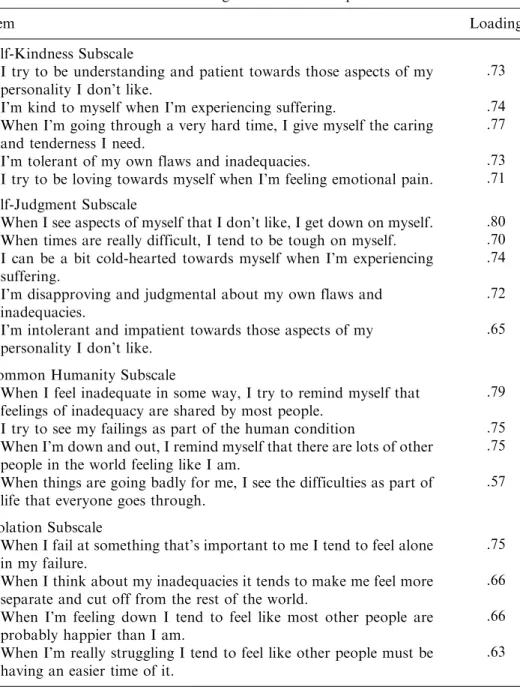
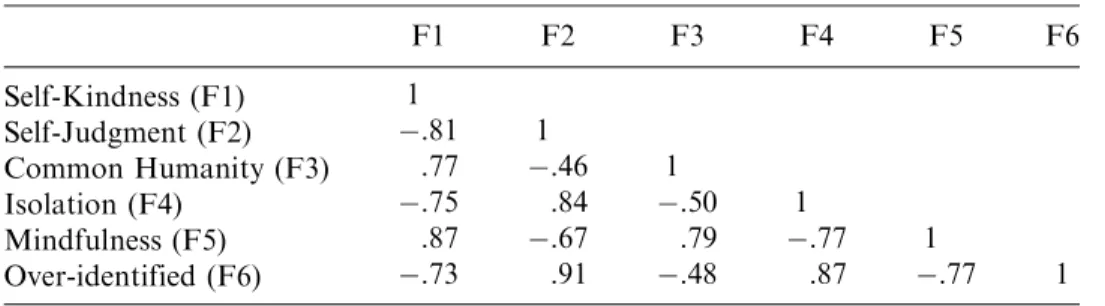
Final six-factor model. An overall model CFA was conducted to assess the fit of the six intercorrelated factors to the 26 items selected for the final version of the Self-Compassion Scale (SCS). The model was found to fit the data adequately well (NNFI¼.90; CFI¼.91), with each factor loading significantly different from zero (p<.001). The standardized loadings are contained in Table 1. The estimated cor-relations between the factors are contained in Table 2. As can be seen, several of these intercorrelations between factors were quite strong. In addition, a higher-order
TABLE 1 Items and Factor Loadings for Six Self-Compassion Subscale Factors
Item Loading
Self-Kindness Subscale
I try to be understanding and patient towards those aspects of my personality I don’t like.
.73
I’m kind to myself when I’m experiencing suffering. .74
When I’m going through a very hard time, I give myself the caring and tenderness I need.
.77
I’m tolerant of my own flaws and inadequacies. .73
I try to be loving towards myself when I’m feeling emotional pain. .71 Self-Judgment Subscale
When I see aspects of myself that I don’t like, I get down on myself. .80 When times are really difficult, I tend to be tough on myself. .70 I can be a bit cold-hearted towards myself when I’m experiencing
suffering.
.74 I’m disapproving and judgmental about my own flaws and
inadequacies.
.72 I’m intolerant and impatient towards those aspects of my
personality I don’t like.
.65 Common Humanity Subscale
When I feel inadequate in some way, I try to remind myself that feelings of inadequacy are shared by most people.
.79
I try to see my failings as part of the human condition .75
When I’m down and out, I remind myself that there are lots of other people in the world feeling like I am.
.75 When things are going badly for me, I see the difficulties as part of
life that everyone goes through.
.57 Isolation Subscale
When I fail at something that’s important to me I tend to feel alone in my failure.
.75 When I think about my inadequacies it tends to make me feel more
separate and cut off from the rest of the world.
.66 When I’m feeling down I tend to feel like most other people are
probably happier than I am.
.66 When I’m really struggling I tend to feel like other people must be
having an easier time of it.
.63
CFA was conducted to determine if a single higher-order factor of self-compassion would explain the inter-correlations between the six factors. This model was found to fit the data marginally well (NNFI¼.88; CFI¼.90). An overall self-compassion score was calculated for each participant by reverse coding responses to the nega-tively worded items comprising the self-judgment, isolation, and over-Identification subscales, then calculating the means for each of the six subscales, and finally summing the means to create a total self-compassion score. Internal consistency for the 26-item SCS was .92.
Validity. First, in order to ensure that the SCS was not tainted by social de-sirability bias, a Pearson’s correlation coefficient was calculated between the SCS and the Marlowe-Crowne Social Desirability scale, and a nonsignificant correlation was found:r¼.05,p¼.34.
It was hypothesized that individuals with higher levels of self-compassion would be more likely to report that they were as kind to themselves as they were to others. Remember that responses to the self=other kindness question were given on a five-point scale ranging from2 (‘‘I’m a lot kinder to others than I am to myself’’) to
TABLE 1 Continued.
Item Loading
Mindfulness Subscale
When something upsets me I try to keep my emotions in balance. .68 When I’m feeling down I try to approach my feelings with curiosity
and openness.
.62 When something painful happens I try to take a balanced view of
the situation.
.75 When I fail at something important to me I try to keep things in
perspective.
.80 Over-Identification Subscale
When something upsets me I get carried away with my feelings. .65 When I’m feeling down I tend to obsess and fixate on everything
that’s wrong.
.78 When something painful happens I tend to blow the incident out of
proportion.
.67 When I fail at something important to me I become consumed by
feelings of inadequacy.
.71
TABLE 2 Inter-Correlations Between Factors
F1 F2 F3 F4 F5 F6 Self-Kindness (F1) 1 Self-Judgment (F2) .81 1 Common Humanity (F3) .77 .46 1 Isolation (F4) .75 .84 .50 1 Mindfulness (F5) .87 .67 .79 .77 1 Over-identified (F6) .73 .91 .48 .87 .77 1
2 (‘‘I’m a lot kinder to myself than I am to others’’), with zero at the midpoint (‘‘I’m kind to myself and others the same amount’’). Because those highest in self-compassion were expected to have middle range response scores to this question, statistics that assess a linear relationships between variables (e.g., correlations) could not be used to test the hypothesis. Therefore, participants were evenly divided into quartiles based on their overall SCS scores, and their mean response scores to the self=other kindness question were compared. As expected, those highest in self-compassion had middle-range scores: the bottom quartile’s response to the self=other kindness item was M¼ 1.13, SD¼0.90; the next quartile’s response was
M¼ 0.60, SD¼1.21; the next quartile’s response wasM¼ 0.43, SD¼1.07; and the top quartile’s response was M¼0.00, SD¼0.97. Mean differences between groups were found to be significant at F(3, 386)¼19.67,p<.001.
To test construct validity, Pearson’s correlation coefficients were calculated between the SCS and other scales measuring similar constructs. As expected, the SCS was found to have a significant negative correlation with the Self-Criticism subscale of the DEQ, r¼ .65, p<.01, a significant positive correlation with the Social Connectedness scale, r¼.41, p<.01, and significant positive correlations with all three subscales of the Trait-Meta Mood Scale: Attention, r¼.11, p<.05, Clarity,
r¼.43,p<.01, and Repair,r¼.55,p<.01.
Predictions of mental health. As expected, the SCS significantly predicted mental health outcomes (see Table 3). The SCS was found to have a significant negative correlation with the Beck Depression Inventory and the Speilberger Trait Anxiety Inventory, and a significant positive correlation with the Life Satisfaction Scale. Also as expected, the SCS was found to have a significant negative correlation with neurotic perfectionism as measured by the Discrepancy subscale of the Almost Perfect Scale, but a nonsignificant correlation with the Standards subscale (which measures level of personal standards). Because the correlation between self-compassion and self-criticism reported above was fairly high, however, partial cor-relation coefficients were also calculated that controlled for the variance in mental health outcomes due to self-criticism (as measured by the DEQ) to ensure that the SCS was making an independent contribution to outcomes. It was found that the SCS significantly predicted mental health outcomes even when self-criticism was partialled out (see Table 3).
Sex differences. Men and women’s overall self-compassion scores, as well as their scores on the six subscales, are presented in Table 4. Women had significantly
TABLE 3 Total and Partial Correlations (Controlling for Self-Criticism) Between the Self-Compassion Scale and Mental Health Measures
Measure r Partialr
Beck Depression Inventory .51* 21*
Speilberger Trait Anxiety Inventory .65* .33*
Satisfaction with Life Scale .45* .20*
Almost Perfect Scale
Discrepancy Subscale .57* 20*
Standards Subscale .07 .01
lower overall self-compassion scores than men: F(1, 389)¼10.83, p<.001. More-over, it was found that women reported significantly higher levels of self-judgment,
F(1, 389)¼9.06,p<.005, isolation,F(1, 389)¼4.05,p<.05, and over-identification,
F(1, 389)¼9.06, p<.005, and significantly lower levels of mindfulness, F(1, 389)¼23.96,p<.0005 than men.
Discussion
The finding that the positively and negatively worded items intended to tap into the three main components of self-compassion (self-kindness versus self-judgment, common humanity versus isolation, and mindfulness versus over-identification) loaded on six factors rather than three was unexpected. However, it is not uncom-mon for positive and negative items in self-report measures to load on separate factors (Enos, 2001; Finney, 2001), and it is understandable why items did so in the present case. For instance, self-kindness and self-judgment are not mutually exclu-sive, so that having low levels of one behavior necessarily means having high levels of the other. A person may tend not to judge himself, but that doesn’t necessarily mean that he typically takes proactive steps to be kind to himself either. Likewise, an individual may rarely feel isolated in instances of failure, but that doesn’t necessarily mean she always puts her failure in the light of common human experience. In the same vein, just because one doesn’t tend to over-identify and run away with negative thoughts and emotions, it doesn’t necessarily mean that thoughts and emotions are held in mindful awareness (perhaps they are just ignored or repressed). Therefore, it makes sense theoretically that the positive and negative aspects of the three com-ponents of self-compassion should form six separate but correlated factors. It was also found that a single higher-order factor of self-compassion explained the inter-correlations between factors. In other words, self-compassion appears to be an overarching factor emerging out of the combination of subscale components rather than an underlying factor.
Findings also suggest that the Self-Compassion Scale demonstrates good construct validity. First, note that the Self-Compassion Scale did not significantly correlate with the social desirability measure, indicating that responses to the scale
TABLE 4 Means for the Overall Self-Compassion Scale (out of 30 points) and Six Subscales (out of 5 points), Sorted by Sex
Males Females Total Sample
M SD M SD M SD Self-Compassiona 18.96 3.64 17.72 3.74 18.25 3.75 Self-Kindness 3.12 0.75 3.00 0.75 3.05 0.75 Self-Judgment 3.00 0.81 3.24 0.77 3.14 0.79 Common Humanity 2.95 0.83 3.03 0.76 2.99 0.79 Isolation 2.90 0.94 3.09 0.90 3.01 0.92 Mindfulness 3.57 0.72 3.27 0.76 3.39 0.76 Over-identification 2.78 0.97 3.25 0.90 3.05 0.96 a
Overall self-compassion scores were calculated by reverse coding the self-judgment, isolation, and over-identification items then summing all six subscale means.
are not merely representing a bias toward presenting oneself in a socially advanta-geous light. In terms of content validity, it was found that individuals with the highest levels of self-compassion reported that they tended to be equally kind to self and others, whereas those with lower levels of self-compassion tended to report that they were kinder to others than to themselves. Recognition that the self, as a member of humankind, deserves to be treated with the same patience and respect as others is an important feature of self-compassion. Convergent validity for the scale was also obtained. Self-compassion scores had a significant negative correlation with self-criticism ( .65) and a significant positive correlation with a sense of social connectedness zz(.41), as had been predicted. As for associations with emotional intelligence, significant positive correlations were found with the Repair (.55) and Clarity (.43) subscales of the Trait Meta-Mood Scale. These findings were expected given that one should be able to regulate one’s negative emotions and see them with clarity through the processes involved in giving oneself compassion. A weak but significant correlation was also found with the Attention subscale (.11). This smaller correlation is explainable by the fact that giving attention to one’s negative emotions does not really differentiate between a ruminative, over-identified focus and a spa-cious, mindful focus, and therefore a larger correlation between self-compassion and attention should not be expected. Also note that the correlations with the self-criticism, social connectedness, and emotional intelligence scales were all in the moderate range, indicating that the scales are measuring different constructs.
It was found that self-compassion had a significant negative correlation with anxiety and depression, and a significant positive correlation with life satisfaction. This suggests that self-compassion may be an adaptive process that increases psy-chological resiliency and well-being. Self-compassion also had a significant negative correlation with neurotic perfectionism, but a significant link was not found between compassion and high personal standards. This finding indicates that self-compassionate individuals are more accepting and experience less distress when they fail to meet their personal standards, but that self-compassion does not lead to pas-sivity in the sense that lower standards for oneself are adopted. Note that this set of results was also found when partial correlations were calculated that controlled for self-criticism, indicating that the Self-Compassion Scale predicts mental health out-comes independently of self-criticism. Of course, a lack of harsh self-judgment is a central feature of self-compassion, so the more accurate representation of the asso-ciation between self-compassion and mental well-being would include the impact of self-criticism.
The study found that women reported having significantly less self-compassion than men. Differences on the self-compassion subscales indicated that in particular, women were more likely than men to engage in self-judgment, to feel isolated when confronted with painful situations, and to be more over-identified and less mindful of their negative emotions. These results are consistent with past findings that females tend to be more critical of themselves and tend to ruminate on their negative feelings more than males do (Leadbeater et al., 1999; Nolen-Hoeksema et al., 1999). Unfortunately, this tendency on the part of women has also been associated with a higher incidence of depression among females (Nolen-Hoeksema, 1987) Interest-ingly, women werenotless likely than men to be kind and gentle to themselves or to see their experiences as part of common humanity. Given social norms requiring males to be tough and independent (Deaux & Kite, 1993), perhaps it is not surprising that males do not evidence a greater sense of kindness and connectedness in their self-attitudes than women.
Study 2
Results of Study 1 suggest that self-compassion is a valid and useful way to con-ceptualize and measure healthy self-attitudes. However, it was also necessary to determine how this particular self-attitude construct differs from the more popular yet problematic construct of self-esteem. This was one of the main goals of Study 2. It was expected that self-compassion and self-esteem would be moderately related. Individuals who have lower levels of self-compassion should have less self-esteem given their harsh self-judgment, sense of isolation, and over-identification with negative thoughts and feelings. Conversely, those high in self-compassion should have more self-esteem given their kinder treatment of themselves and mindful remembrance that inadequacies are part of the human condition. An association between self-compassion and self-esteem was also expected because both constructs tap into positive affectivity toward oneself. However, because the positive self-affect experienced by self-compassionate individuals does not stem from downward comparisons with others, compassion should not be associated with self-aggrandizement in the way that high self-esteem appears to be. Rosenberg (1965) writes that ‘‘when speaking of high self-esteem, it shall mean that the individual respects himself, considers himself worthy; he does not necessarily consider himself better than others, but he definitely does not consider himself worse’’ (p. 31). Nonetheless, most self-esteem measures do not distinguish between high-esteem individuals who feel superior to others and those who do not, and researchers such as Roy Baumeister and colleagues (Baumeister et al., 2000; Baumeister et al., 1996) argue that a significant subset of high self-esteem individuals are also narcissistic. Thus, Study 2 participants were administered the Self-Compassion Scale, two dif-ferent measures of self-esteem, and a measure of narcissism. It was expected that self-compassion and self-esteem would be correlated, but not so highly correlated as to indicate they were measuring the same construct. In addition, it was hypothe-sized that self-esteem would be significantly and positively correlated with narcis-sism but that self-compassion wouldnotbe significantly correlated with narcissism. (It should be noted that a significant negative correlation between self-compassion and narcissism was not anticipated because there was no reason to believe that those low in self-compassion should necessarily be high in narcissism, therefore variation in self-compassion levels was not expected to predict variation in nar-cissism levels.)
Deci and Ryan (1995) have made a distinction between true self-esteem, which stems from autonomous, self-determined actions that reflect one’s authentic self, and contingent self-esteem, which is based on external standards and comparisons with others. True self-esteem is said to emerge from an ‘‘integrated sense of self [that] develops as one acts agentically within a context that allows satisfaction of the three fundamental psychological needs for autonomy, competence, and relat-edness,’’ whereas contingent self-esteem is described as ‘‘a kind of aggrandizement of oneself associated with being ego-involved in some types of outcomes’’ (Deci & Ryan, 1995, p. 32). In theory, individuals high in self-compassion should also tend to have true self-esteem, since their self-attitudes are not contingent on set stan-dards or comparisons with others. However, the two constructs are still theore-tically distinct. Self-compassion emphasizes feelings of self-kindness, common humanity and mindfulness whereas Deci and Ryan’s conceptualization of true self-esteem emphasizes autonomy and self-determination. Unfortunately, Deci and Ryan do not have a scale that specifically measures ‘‘true self-esteem,’’ but they do
have a scale that measures self-determination, and also one that measures the associates of true self-esteem: satisfaction of needs for autonomy, competence, and relatedness. Thus, these scales were included to serve as proxy measures of ‘‘true self-esteem.’’ It was hypothesized that self-compassion and the ‘‘true self-esteem’’ measures would be moderately correlated. Because of the emphasis on autonomy in the proxy measures, moreover, it was also hypothesized that they would have a higher correlation with narcissism than would the self-compassion scale. It should be noted that Deci and Ryan (1995), stress that autonomy and self-determination are not the same as individualism or self-centeredness, and that narcissism is not a facet of true self-esteem. However, the proxy measures of true self-esteem used in this study were not designed to differentiate between self-determined individuals who are narcissistic and those who are not, and so a correlation with narcissism was still expected.
Because self-compassion is theorized to function as an emotional regulation strategy, Study 2 explored the link between self-compassion and various emo-tional patterns. Rumination involves repetitively focusing on one’s experience of distress (Nolen-Hoeksema & Morrow, 1991), while thought suppression involves attempts to avoid or repress unwanted thoughts, especially those involving negative affect (Wegner & Zanakos, 1994). Both patterns have been found to lead to maladaptive outcomes such as anxiety and depression (Nolen-Hoeksema & Morrow, 1991; Wegner & Zanakos, 1994). It was expected that self-compa-ssion would have a negative correlation with both rumination and thought suppression, since self-compassion requires that one take a balanced approach to one’s emotional experience—that one neither run away with or run away from one’s feelings. In addition, the association between self-compassion and emo-tional coping was examined. Although emotion-focused coping has tradiemo-tionally been viewed in terms of emotional avoidance of one’s problems (Lazarus, 1993), Stanton and colleagues (Stanton, Kirk, Cameron, & Danoff-Burg, 2000) have argued that ‘‘emotional approach’’ coping is a productive, proactive form of emotion-focused coping that is associated with positive psychological adjustment. They have identified two different emotional approach coping mechanisms: ‘‘emotional processing,’’ in which one attempts to understand one’s emotions, and ‘‘emotional expression,’’ in which one feels free to express one’s emotions. Because self-compassion entails mindful awareness of one’s emotions, it was expected that it would have a positive correlation with emotional processing, though it was less clear if self-compassion would be associated with emotional expression since self-compassion does not necessarily involve expressing one’s emotions in an outward fashion.
Measures of depression and anxiety were also included in Study 2 so that the association between self-compassion and mental health could be reconfirmed. In addition, this allowed us to calculate partial correlations between self-compassion, depression, and anxiety while controlling for the variance in outcomes due to self-esteem, to determine whether or not self-compassion was making an independent contribution to mental health (thus helping to further establish the discriminant validity of the self-compassion scale). Another goal of Study 2 was to determine the stability of the self-compassion scale over time, so we administered the scale to participants twice over a three-week interval to check the test–retest reliability of the scale. Study 2 also allowed us to cross-validate the factor structure of the scale found in Study 1, and to determine if the sex differences found in Study 1 would be replicated in Study 2.
Method
Participants and Procedures
Participants included 232 undergraduate students (87 men; 145 women;Mage 21.31 years;SD¼3.17) who were randomly selected from an educational-psychology subject pool at a large southwestern university. The ethnic breakdown of the sample was 58% White, 22% Asian, 14% Hispanic, 3% Black, and 3% Other. While meeting in groups of no more than 30, participants filled out a self-report ques-tionnaire containing the Self-Compassion Scale plus other measures (Time 1). All participants were given a second administration of the Self-Compassion Scale after an interval of approximately three weeks (Time 2).
Measures
Self-compassion scale. The 26-item Self-Compassion Scale finalized in Study 1 was administered at Time 1 and Time 2 of the current study. The factor structure underlying responses to this final version of the scale was cross-validated using CFA, as was the model of a single higher-order self-compassion factor explaining the in-tercorrelations between the six subscale factors.
Self-esteem. Participants received the 10-item Rosenberg self-esteem scale (Rosenberg, 1965). This scale is the most commonly used measure of global self-esteem, and has demonstrated good reliability and construct validity in past studies (Crandall, 1973). Participants were also given the 36-item Berger (1952) self-acceptance scale, which measures feelings of confidence, self-worth, competence, and other indicators of self esteem. The scale has also been shown to have high reliability and validity in past research (Berger, 1952).
True-self esteem. Because Deci and Ryan do not have a single scale that spe-cifically measures the concept of true self-esteem, two measures that should ap-proximate true-self esteem according to their theory (Deci & Ryan, 1995) were employed. The 10-item Self-Determination Scale measures individual differences in the extent to which people tend to function in a self-determined way, including in-creased self-awareness and a sense of choice with respect to behavior (e.g., ‘‘I feel like I am always completely myself’’ or ‘‘I do what I do because it interests me’’). This scale has been used successfully in previous research (Sheldon, 1995; Sheldon, Ryan, & Reis, 1996). The 21-item Basic Psychological Needs Scale includes separate sub-scales measuring the satisfaction of needs for autonomy, competence, and related-ness in life. Examples of the items from the three subscales are: Autonomy: ‘‘I feel like I can pretty much be myself in my daily situations’’; Competence: ‘‘Most days I feel a sense of accomplishment from what I do’’; and Relatedness: ‘‘I consider the people I regularly interact with to be my friends.’’ The scale has been shown to have adequate reliability in past research (Ilardi, Leone, Kasser, & Ryan, 1993; Kasser, Davey, & Ryan, 1992).
Narcissism. Participants were given the widely used 40-item Narcissistic Per-sonality Inventory (Raskin & Hall, 1979). Although construction of the NPI was based on DSM-III criteria for the Narcissistic Personality Disorder, it was designed to measure narcissism as a normal personality trait. The scale asks respondent to en-dorse one of two items within a pair, one of which is narcissistic. For example, one pair reads: ‘‘I am more capable than other people’’ and ‘‘There is a lot that I can learn from other people.’’ The number of narcissistic items that are endorsed determines the
final narcissism score. The scale has been shown to have adequate internal consistency and test–retest reliability in past research (Raskin & Terry, 1988).
Depression. Depression was assessed with the 20-item Zung (1965) Self-Rating Depression Scale (SDS). The instrument, rated along a four-point scale, has been shown to effectively differentiate between clinically depressed and control samples (Zung, 1965).
Anxiety. This study employed the Speilberger State-Trait Anxiety Inventory– Trait form (Speilberger et al., 1970), a commonly used 20-item anxiety questionnaire that has been found to have good psychometric properties.
Rumination. The 22-item Ruminative Responses Scale (Nolen-Hoeksema & Morrow, 1991) was used to assess rumination. Participants were instructed to think about how they typically reacted to personal loss, and to indicate how often they engaged in particular behaviors such as ‘‘Think about what happened, wishing it would not have happened that way’’ on a scale of 1 (almost never) to 5 (almost always). The RRS has demonstrated good reliability and validity in past research. Previous studies have reported acceptable convergent and predictive validity for the scale (Butler & Nolen-Hoeksema, 1994; Nolen-Hoeksema & Morrow, 1991).
Thought suppression. Thought suppression was measured with the White Bear Suppression Inventory (Wegner & Zanakos, 1994), a 15-item instrument that assesses efforts to avoid unwanted thoughts and ideas. The scale has been shown to have adequate reliability and validity (Muris, Merckelbach, & Horselenberg, 1996).
Emotional approach coping. The study utilized the two 4-item Emotional Approach coping scales developed by Stanton and colleagues (2000)—Emotional Processing (e.g., ‘‘I take time to figure out what I’m really feeling’’; ‘‘I delve into my feelings to get a thorough understanding of them’’) and Emotional Expression (e.g., ‘‘I take time to express my emotions’’; ‘‘I feel free to express my emotions’’). The scale has demonstrated sound internal consistency and predictive validity (Stanton et al., 2000).
Results
Cross-Validation of the Self-Compassion Scale’s Factor Structure
As found in Study 1, a six-factor model was found to fit the data well (NNFI¼.92; CFI¼.93) using the responses of the second sample. In addition, a higher-order CFA confirmed that a single higher-order factor of self-compassion explained the inter-correlations between these six factors (NNFI¼90; CFI¼.92).
Test–Retest Reliability
Good test–retest reliability was obtained when participants’ responses to the Self-Compassion Scale were compared across Time 1 and Time 2. Test–retest cor-relations were as follows: Self-Compassion Scale (overall score): .93; Kindness subscale: .88; Self-Judgment subscale: .88; Common Humanity subscale: .80; Isola-tion subscale: .85; Mindfulness Subscale: .85; and Over-IdentificaIsola-tion subscale: .88.
Discriminant Validity with Other Self-Attitude Scales
Hypotheses that self-compassion would have a moderate correlation with var-ious measures of self-esteem, and that the self-esteem measures would have a
stronger association with narcissism than did the SCS, were confirmed. Table 5 presents the Pearson’s correlation coefficients and significance levels that were calculated to examine these hypotheses. It was found that the SCS had a significant moderate correlation with the Rosenberg self-esteem scale, the Berger Self-Accep-tance Scale, the Self-Determination Scale, and the three subscales of the Basic Psychological Needs Scale. It was also found that whereas all the other scales evi-denced a significant positive correlation with the Narcissistic Personality Inventory, the SCS had a nonsignificant positive correlation with narcissism. When a partial correlation between self-compassion and the NPI was calculated that controlled for the variance due to self-esteem (as measured by the Rosenberg Scale), it was found that the SCS had a nonsignificant negative correlation with narcissism, r¼ .08,
p¼.23.
Self-Compassion and Mental Health
As in Study 1, it was found that the SCS has a significantly negative correlation with depression, r¼ .55, p<.01, and with anxiety, r¼ .66, p<.01. Moreover, when partial correlations were calculated that controlled for the variation in out-comes due to variation in self-esteem levels (as measured by the Rosenberg Self-Esteem Scale), it was found that self-compassion was still a significant predictor of depression,r¼ .34,p<.01, and anxiety,r¼ .42,p<.01.
Self-Compassion and Emotional Patterns
As expected, it was found that the SCS had a significantly negative correlation with the Rumination scale, r¼ .50, p<.01, and with the White Bear Thought Suppression Inventory, r¼ .37, p<.01. In addition, the SCS had a significantly positive correlation with the Emotional Processing subscale of the Emotional Coping Scale,r¼.39,p<.01, as expected, though it had a nonsignificant correlation with the Emotional Expression subscale,r¼.07,p¼.28.
Sex Differences
The sex differences found in Study 2 closely paralleled those found in Study 1. Women had significantly lower overall self-compassion scores than men: F[1, 230]¼5.12, p<.05. Women also reported significantly higher levels of isolation (F[1, 230]¼4.02, p<.05), over-identification (F[1, 230]¼10.13, p<.005), and
TABLE 5 Correlations Between the Self-Compassion Scale (SCS), the Narcissistic Personality Inventory (NPI), and Scores on Self-Esteem Measures
Measure SCS NPI
Narcissistic Personality Inventory .11 –
Rosenberg Self-Esteem Scale .59** .29**
Berger’s Self-Acceptance Scale .62** .28**
Self-Determination Scale .43** .25**
Basic Psychological Needs Scale
Autonomy Subscale .42** .26**
Competence Subscale .52** .31**
Relatedness Subscale .25** .15*
self-judgment (marginal) (F[1, 230]¼3.08, p¼.08), and significantly lower levels of mindfulness (F[1, 230]¼5.69, p<.05) than men.
Discussion
The results of Study 2 reconfirmed the factor structure of the Self-Compassion Scale. Results also demonstrated that the Self-Compassion Scale has good test–retest reliability. Thus, the psychometric properties of the scale appear sound.
Results also indicate that, as hypothesized, self-compassion was moderately correlated with self-esteem as measured by the Rosenberg Self-Esteem Scale (.59) and the Berger Self-Acceptance Scale (.62). Self-compassionate participants were more likely to have high self-esteem than those who lacked self-compassion. This relationship was expected, as those individuals who are kind to themselves, recognize their common humanity, and can take a balanced emotional perspective on them-selves should also be likely to have a higher sense of self-worth than those who are harshly critical of themselves, feel isolated in their failure or inadequacy, and who are over-identified with their feelings. However, note that the correlations between self-compassion and self-esteem were low enough to indicate that the two constructs were measuring different psychological phenomena. What was found to differ between the two attitude constructs, moreover, was their association with self-aggrandizement. As expected, the Self-Compassion Scale didnot have a significant correlation with narcissism, whereas the two self-esteem scales did evidence a sig-nificant correlation with narcissism.
Moreover, the hypothesis that self-compassion would be moderately correlated with ‘‘true self-esteem,’’ or at least with factors that Deci and Ryan have proposed are related to ‘‘true self-esteem’’ (Deci & Ryan, 1995)—self-determination and ful-fillment of needs for autonomy, competence, and relatedness—was also borne out. This suggests that self-compassionate individuals are likely to have a sense of true self-worth that is not contingent on meeting set standards but is based simply on being one’s authentic self. Again, however, correlations with the Self-Determination Scale and also the Autonomy, Competence, and Relatedness subscales of the Basic Psychological Needs Scale were not so high (ranging from .25 to .52) as to suggest that the scales were measuring the same underlying construct. In addition, whereas self-compassion did not correlate significantly with narcissism, the Self-Determina-tion Scale and Basic Psychological Needs subscales did show significant correlaSelf-Determina-tions with narcissism.2
Overall, these results indicate that the Self-Compassion Scale can be dis-criminated from self-esteem measures. They also support the proposition that the positive self-affect of self-compassion does not require feeling superior to others, whereas some individuals with high self-esteem do appear to have narcissistic tendencies.
The results of Study 2 also indicated that individuals high in self-compassion display different emotional patterns than those low in self-compassion. It was found that self-compassion had a significant negative correlation with both rumination and thought suppression, confirming that an important aspect of self-compassion is neither becoming carried away with nor trying to suppress one’s emotions. In addition, self-compassion was found to have a significant positive correlation with the emotional processing subscale of the Emotional Approach Scale, suggesting that self-compassionate individuals attempt to better understand and gain clarity about their emotions. However, self-compassion did not significantly correlate with the
Emotional Expression subscale. This is probably due to the fact that emotional expression entails outward communication of one’s emotions, whereas self-com-passion is an internal process that does not necessarily entail the expression of one’s emotions to others.
Also note that results confirmed the finding that women have lower levels of self-compassion than men—specifically in terms of self-judgment, isolation, mindfulness, and over-identification. This suggests that the presence or absence of self-compassion might play an especially strong role in the mental well-being of women.
Study 3
In order to further examine the construct validity of the Self-Compassion Scale, the scale scores of two groups which should theoretically have different levels of self-compassion were compared. Since self-self-compassion is a construct derived from Buddhist psychology, practicing Buddhists should tend to report higher levels of self-compassion than other groups such as college undergraduates who, unlike Bud-dhists, are typically unfamiliar with the concept of self-compassion and unlikely to intentionally cultivate it. To determine if the scale appropriately differentiated between groups in this manner, a number of practicing Buddhists were recruited as a comparison sample. Buddhist participants were given the Self-Compassion Scale, and were also given a measure of esteem to ensure that differences in self-compassion scores between groups would not be attributable to different levels of self-esteem. It was hypothesized that the Buddhist sample would report higher levels of self-compassion—both in terms of their overall self-compassion score and scores on all six subscales—than a sample of undergraduates, even when controlling for levels of self-esteem. Of course, the two samples were different in other respects besides Buddhist affiliation. The undergraduates were younger, for instance, and in the midst of the college experience. Still, these distinctions merely served to buttress the expectation that the two groups would have different scores on the Self-Com-passion Scale: the relative immaturity and stress experienced by college under-graduates also suggesting that they should have less self-compassion than the Buddhists. Finally, Buddhists who have practiced for longer periods of time should tend to be more self-compassionate than newer practitioners who have had less time to cultivate the quality of compassion. Thus, it was hypothesized that self-compassion scores would be correlated with years of practice within the Buddhist sample.
Method
Participants and Procedures
Forty-three Buddhist participants were recruited from a Buddhist e-mail list-serve whose subscribers included Buddhist practioners from various regions of the country. These individuals practice a type of Buddhist meditation known as
Vipassanathat intentionally cultivates mindfulness, insight into the interdependence of all beings, and compassion for self and others. The sample was comprised of 16 men and 27 women (Mage 47.00 years;SD¼9.71). The ethnic breakdown of the sample was 91% White, 5% Asian, and 2% Other. The number of years that par-ticipants reported they had been practicing Buddhist meditation ranged from 1 to 40 years (M¼7.72 years; SD¼7.64). Participants were contacted by e-mail and asked to fill out two self-attitude scales—the Self-Compassion Scale and also a self-esteem
scale—which were then returned by e-mail. The comparison group used for this study was the sample of 232 undergraduate students described in Study 2.
Measures
Participants were given the 26-item Self-Compassion Scale finalized in Study 1. They were also given the 10-item Rosenberg Self-Esteem Scale (Rosenberg, 1965).
Results and Discussion
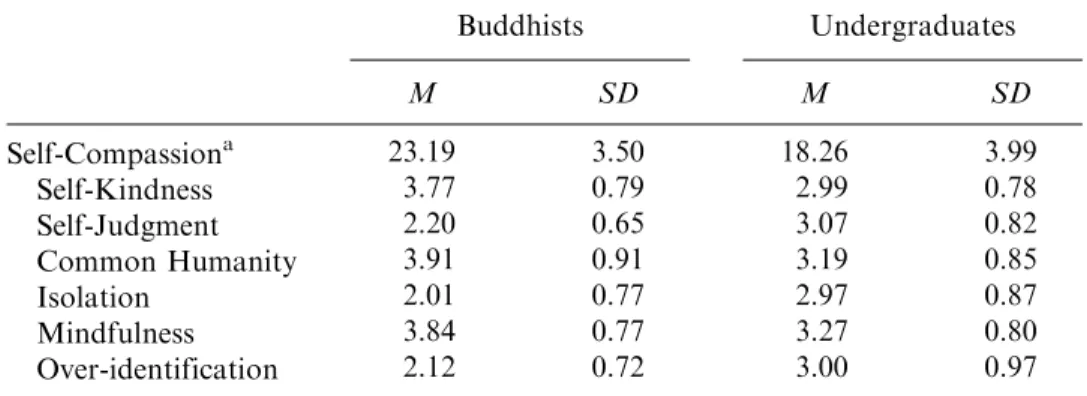
The overall self-compassion scores and six subscale scores of the two groups are presented in Table 6. ANACOVAs that controlled for self-esteem were conducted in order to compare the scores of the two groups. As expected, the Buddhists had significantly higher total self-compassion scores than the undergraduates: F(1, 271)¼62.03, p<.0005. Buddhists also had significantly higher scores on the three ‘‘positive’’ self-compassion subscales: Self-kindness, F(1, 271)¼32.00, p<.001; Common Humanity,F(1, 271)¼21.99,p<.001; and Mindfulness,F(1, 271)¼16.30,
p<.001, and significantly lower scores on the three ‘‘negative’’ subscales: Self-judgment, F(1, 271)¼40.41, p<.001; Isolation, F(1, 271)¼43.78, p<.001; and Over-identification, F(1, 271)¼44.88, p<.001. The mean self-esteem scores of Buddhists (M¼3.40,SD¼.34) and Undergraduates (M¼3.26,SD¼.51) were also compared, and the difference was marginally significant, F(1, 271)¼3.01, p¼.08. Note, however, that the effect size for group differences in self-compassion levels (R2¼.46) was much greater than the effect size for self-esteem levels (R2¼.01), suggesting that Buddhist practice has a much larger impact on self-compassion than it does on self-esteem. This finding also serves to further establish that self-com-passion and self-esteem are independent constructs. Moreover, there was a sig-nificant correlation between self-compassion scores and number of years of practice within the Buddhist sample (r¼.35, p<.05), as expected. Overall, the findings indicate that the Self-Compassion Scale has the ability to differentiate between groups in a theoretically consistent manner, suggesting that the scale is measuring what it intends to measure.
Interestingly, unlike the previous two studies with undergraduates in which women tended to report having less self-compassion than men (including the Study 2
TABLE 6 Means for the Overall Self-Compassion Scale (out of 30 Points) and Six Subscales (out of 5 points) for the Buddhist and Undergraduate Samples
Buddhists Undergraduates M SD M SD Self-Compassiona 23.19 3.50 18.26 3.99 Self-Kindness 3.77 0.79 2.99 0.78 Self-Judgment 2.20 0.65 3.07 0.82 Common Humanity 3.91 0.91 3.19 0.85 Isolation 2.01 0.77 2.97 0.87 Mindfulness 3.84 0.77 3.27 0.80 Over-identification 2.12 0.72 3.00 0.97 a
Overall self-compassion scores were calculated by reverse coding the self-judgment, isolation, and over-identification items then summing all six subscale means.
participants used as the comparison sample for the current study), no significant sex differences were found on any of the subscales or in total self-compassion scores among the Buddhist participants in Study 3. This suggests that meditation practice and=or exposure to Buddhist teachings might be a useful means of achieving greater mental health for women (and men) who are suffering from a lack of self-compassion.
General Discussion
In summary, the results of these studies suggest that the Self-Compassion Scale is a psychometrically sound and theoretically valid measure of self-compassion. Results also indicate that having high levels of self-compassion is linked to psychological well-being, without being associated with narcissistic tendencies in the way that high self-esteem appears to be. It is hoped that the development of the Self-Compassion Scale will help initiate a new line of research that explores the relationship between self-compassion and other important psychological processes. Several research directions could be pursued. For instance, many educational psychologists have contrasted mastery-based academic goals that are motivated by curiosity and interest in learning, with performance-based goals that are driven by the desire to enhance or defend self-esteem (Ames, 1992; Covington, 1992). Because individuals with high levels of self-compassion have an emotionally positive self-attitude that is not con-tingent on performance evaluations, they should tend to display mastery rather than performance goals in academic situations. Another way in which self-compassion may be related to psychological functioning has to do with the clarity and accuracy of self-appraisals. Unlike high self-esteem, which has been associated with egoistic illusions and self-regulation failure (e.g., adopting inappropriate goals that are beyond performance capabilities; Baumeister, Heatherton, & Tice, 1993), self-compassion should be linked to greater knowledge and clarity about one’s own limitations because individuals do not have to hide their shortcomings from them-selves in order to maintain a positive self-image.
Although the Self-Compassion Scale should be valuable in pursuing these and other research questions, it should be mentioned that a self-report scale will neces-sarily be limited in its ability to accurately assess individual levels of self-compassion. This is because many people may not be aware enough of their own emotional experiences to realize the extent to which they lack self-compassion. Those who repress or avoid their negative emotions will be especially difficult to accurately assess with a self-report format, since repression is not a conscious behavior. In future research, therefore, other ways of measuring individuals’ levels of self-compassion (e.g., through clinical assessment) should be developed. In addition, future studies should employ other research methodologies to examine the process and functioning of self-compassion—an experimental design that manipulated levels of self-compassion through a set of instructions might yield useful insights, for instance. It would also be helpful to develop a self-compassion intervention for individuals suffering from negative self-attitudes, since a full understanding of the subtleties of self-compassion is likely to require explicit instruction and practice. Despite these limitations, a self-report scale that measures stable individual differ-ences in self-compassion is an important first step that will help to empirically examine a construct that has so far existed mainly in the realm of theory.
Perhaps the most promising aspect of the self-compassion construct can be found in its potential as a remediation tool for individuals who suffer from negative