Fredrik Abbors, Tanwir Ahmad, Dragos Truscan and Ivan Porres
Department of Information Technologies, ˚Abo Akademi University, Joukahaisenkatu 3-5 A, Turku, Finland
Keywords: Performance Testing, Performance Monitoring, Load Generation, Probabilistic Timed Automata.
Abstract: In this paper, we present an approach for performance testing of web services in which we use abstract models, specified using Probabilistic Timed Automata, to describe how users interact with the system. The models are used in the load generation process to generate load against the system. The abstract actions from the model are sent in real-time to the system via an adapter. Different performance indicators are monitored during the test session and reported at the end of the process. We exemplify with an auction web service case study on which we have run several experiments.
1
INTRODUCTION
Today, we see advancements in cloud computing and more and more software applications being adapted to a cloud environment. Applications deployed in the cloud are delivered to users as a service, without the need for the users to install anything. This means that most of the processing is done on the server side and this puts a frightful amount of stress on the back-end of the system. Performance characteristics such as throughput, response times, and resource utilization are crucial quality attributes of such applications and systems.
The purpose of performance testing is to deter-mine how well the system performs in terms of re-sponsiveness, stability, and resource utilization under a particular synthetic workload in a controlled en-vironment. The synthetic workload (Ferrari, 1984) should mimic the expected workload (Shaw, 2000) as closely as possible, once the system is in operational use, otherwise it is not possible to draw any reliable conclusions from the test results.
Performance tests are typically implemented as usage scenarios that are either manually scripted (e.g., usinghttperf orJMeter) or pre-recorded (e.g., using Selenium (SeleniumHQ, 2012) in the case of web ap-plications). The usage scenarios are then executed concurrently against the system under test. A ma-jor drawback with this approach is that the manually coded scripts and pre-recorded scenarios seldom rep-resent real-life traffic and that certain combinations of user inputs may remain untested. Repeating the same
script over and over may lead to unrealistic results because of caching and other operating system opti-mization mechanisms. Performance testing is done efficiently when it is executed in an iterative man-ner and uses techniques that simulate real life work load as closely as possible (Menasce, 2002). This means that load is incrementally increased until a cer-tain threshold (saturation) is reached, beyond which the performance of the system begins to degrade.
In this paper, we propose a model-based approach to evaluate the performance of a system by incremen-tally exercising different kinds of loads on the system. The main contributions of this work are:
• we use abstract models, specified as Probabilistic Timed Automata (PTA) to model the user profiles, including theactionsorsequences of actionsthe user can send, the probabilistic distribution of the actions, and individualthink timefor each action,
• the load is generated in real-time from these mod-els and sent to the system under test (SUT) via an adapter which converts abstract actions into con-crete interactions with the SUT and manages data dependencies between different actions;
The rest of the paper is structured as follows: In Section 2 we give an overview of the work related to our approach. Section 3 presents our model-based testing process, while Section 4 presents an auction web service case study and an experiment using our approach. Finally, in Section 5, we present our con-clusions and we discuss future work.
2
RELATED WORK
There is already a large body of work on workload characterization and a more limited one on load gen-eration from performance models. In the following, we briefly enumerate several works that are closer to our approach.
Barna et al., (Barna et al., 2011) present a model-based testing approach to test the performance of a transactional system. The authors make use of an it-erative approach to find the workload stress vectors of a system. An adaptive framework will then drive the system along these stress vectors until a performance stress goal is reached. They use a system model, rep-resented as a two-layered queuing network, and they use analytical techniques to find a workload mix that will saturate a specific system resource. Their ap-proach differs from ours in the sense that they use a model of the system instead of testing against a real implementation of a system.
Other related approaches can be found in (Shams et al., 2006) and (Ruffo et al., 2004). In the former, the authors have focused on generating valid traces or a synthetic workload for inter-dependent requests typically found in sessions when using web applica-tions. They describe an application model that cap-tures the dependencies for such systems by using Ex-tended Finite State Machines (EFSMs). Combined with a workload model that describes session inter-arrival rates and parameter distributions, their tool
SWAT outputs valid session traces that are executed using a modified version ofhttperf (Mosberger and Jin, 1998). The main use of the tool is to perform a sensitivity analysis on the system when different pa-rameters in the workload are changed, e.g., session length, distribution, think time, etc. In the latter, the authors suggest a tool that generates representative user behavior traces from a set of Customer Behav-ior Model Graphs (CBMG). The CBMG are obtained from execution logs of the system and they use a mod-ified version of thehttperfutility to generate the traf-fic from their traces. The methods differ from our approach in the sense they both focus on the trace generation and let other tools take care of generating the load/traffic for the system, while we do on-the-fly load generation from our models.
(Denaro et al., 2004) propose an approach for early performance testing of distributed software when the software is built using middleware compo-nents technologies, such as J2EE or CORBA. Most of the overall performance of such a system is deter-mined by the use and configuration of the middleware (e.g. databases). They also note that the coupling be-tween the middleware and the application architecture
determines the actual performance. Based on archi-tectural designs of an application the authors can de-rive application-specific performance tests that can be executed on the early available middleware platform that is used to build the application with. This ap-proach differs from ours in that the authors mainly target distributed systems and testing of the perfor-mance of middleware components.
3
PERFORMANCE TESTING
PROCESS
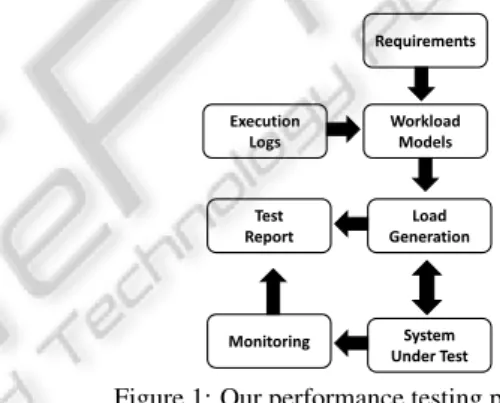
Our performance testing process is depicted in Figure 1. In brief, we build a workload model of the system by analyzing different sources of information, and subsequently we generate load in on-the-fly against the system. During the process, different performance indicators are measured and a test report is created at the end. Requirements Execution Logs Test Report Workload Models Load Generation System Under Test Monitoring
Figure 1: Our performance testing process.
In our work, we have used variousKey
Perfor-mance Indicators(KPIs) to provide quantifiable
mea-surements for our performance goals. For instance, we specify the target KPIsbefore the testing proce-dure is started and later on we compare them against the actualmeasured KPIs.
3.1
Workload Characterization
The first step in our process is characterizing the workload of the system. According to (Menasce and Almeida, 2001), the workload of a system can be de-fined as the set of all inputs the system receives from the environment during any given period of time.
Traditionally, performance analysis starts first with identifying key performance scenarios, based on the idea that certain scenarios are more frequent than others or certain scenarios impact more on the mance of the system than other scenarios. A perfor-mance scenario is a sequence of actions performed by an identified group of users (Petriu and Shen, 2002).
In order to build the workload model, we start by looking and analyzing the requirements and the sys-tem specifications, respectively. During this phase we try to form an understanding of how the system is used, what are the different types of users, and what are the key performance scenarios that will impact most on the performance of the system. A user type is characterized by the distribution and the types of actions if performs.
The main sources of information for work-load characterization are: Service Level Agreements (SLAs), system specifications, and standards.
By using these sources we identify the inputs of the system with respect to types of transactions (actions), transferred files, file sizes, arrival rates, etc. following the generic guidelines discussed in (Calzarossa et al., 2000). In addition, we extract in-formation regarding the KPI’s, such as the number of concurrent users the system should support, expected throughput, response times, expected resource utiliza-tion demands etc. for different acutiliza-tions under a given load. We would like to point out that this is a man-ual step in the process. However, automating this step could be achieved analyzing log files of the system and using various clustering algorithms for determin-ing e.g., different user types, which is subject for fu-ture work.
The following steps are used for analyzing the workload:
1. Identify the actions that can be executed against the system.
(a) Determine the required input data for each ac-tion. For instance, the request type and the pa-rameters.
(b) Identify dependencies between actions. For ex-ample, a user can not execute a logout action before a login action.
2. Identify the most relevant user types, based for in-stance on the amount of interactions with the sys-tem.
3. Define the distribution of actions that are per-formed by each user type.
4. Estimate an averagethink timeper action.
Withthink timewe refer to the time between two
consecutive actions. In our approach, the think time for the same action can vary from one user to another, or from one test scenario to another.
3.2
Workload Models
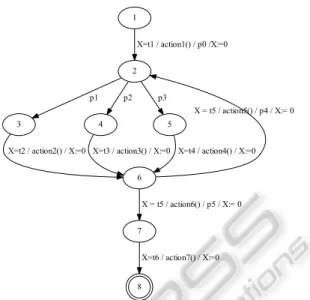
The results of the workload characterization are ag-gregated in a workload model based on Probabilistic Timed Automata. 1 2 X=t1 / action1() / p0 /X:=0 3 p1 4 p2 5 p3 6
X=t2 / action2() / X:=0 X=t3 / action3() / X:=0 X=t4 / action4() / X:=0 X = t5 / action5() / p4 / X:= 0
7
X = t5 / action6() / p5 / X:= 0
8
X=t6 / action7() / X:=0
Figure 2: Example of a probabilistic timed automaton.
We take the definition of aprobabilistic timed
au-tomaton (PTA) as defined by (Kwiatkowska et al.,
2006). A (PTA) P = (L,l, X, ∑,inv, prob) is a tu-ple consisting of a finite set L of locations with the initial location l ∈ L; a finite set X of clocks; a fi-nite set of∑of actions; a functioninv: L→CC(X) associating an invariant condition with each location, where CC(X) is a set of clock constraints over X; a finite set prob⊆L×CC(X) ×∑×Dist(2X ×L) of probabilistic transitions, such that, for each l∈L, there exists at least one (l, , , )∈prob; and a label-ing functionδ: L→2AP, where AP denote a set of atomic propositions.
A probabilistic transition (l,g,p,a) ∈ prob is a quadruple containing (1) a source location l, (2) a clock constraint g, calledguard or invariant condi-tion, (3) aprobability p, and (4) anaction. The
prob-ability indicates the chance of that transition being
taken. Theactiondescribes what action to take when the transition is used, and theclockindicates how long to wait before firing the transition. The behavior of a PTA is similar to that of a timed automaton (Alur and Dill, 1994): in any location, time can advance as long as the invariant holds, and a probabilistic transition can be taken if its guard is satisfied by the current val-ues of the clocks. Every automaton has anend loca-tion, depicted with a double circle, which will even-tually be reached. It is possible to specify loops in the automaton. We note that not all transitions have both aguardand aprobability. For simplicity, we do not explicitly specify location invariants, but they im-plicitly evaluate totrue. One such workload model is created for each identified user type.
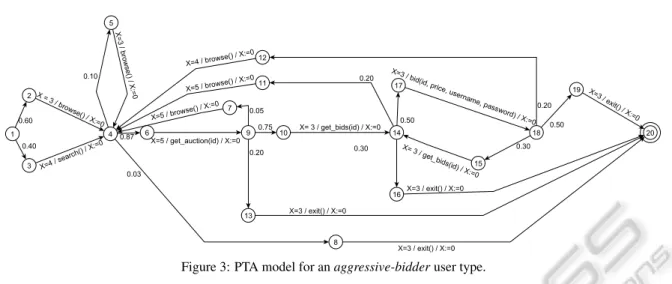
Figure 3: PTA model for anaggressive-bidderuser type.
3.3
Load Generation
The resulting workload models are used for generat-ing load in real-time against the system under test, by creating traces from the corresponding PTA. The user types are selected based on their reciprocal distribu-tion. The PTA of each user type will be executed con-currently by selecting the corresponding actions and sending them to the system. By executing the PTA of a given user, in each step an action is chosen based on the probabilistic values in the automaton.
The load generation is based on a deterministic choice with a probabilistic policy. This introduces certain randomness into the test process and that can be useful for uncovering certain sequences of ac-tions which may have a negative impact of the perfor-mance. Such sequences would be difficult or maybe impossible to discover if static test scripts are used, where a fixed order of the actions is specified, and re-peated over and over again. Every PTA has anexit
location which will eventually be reached. By modi-fying the probability for theexitaction, it is also pos-sible to adjust the average length of the generated se-quences.
3.4
Performance Monitoring
During the load generation, we constantly monitor target KPIs for the entire test duration. At the end, we collect all the gathered data and compute descrip-tive statistics, like the mean and peak response times for different actions, number of concurrent users, the amount of transferred data, the error rate, etc. All the gathered information is presented in a test report. The resource utilization of the system under test is also monitored and reported. Besides computing different kinds of statistical values from the raw data we have, the test report also contains graphs such as how the
response time varied over time with the number of concurrent users. The test report also shows the CPU, disk, network and memory usage on the target system. Tool support for load generation is provided via the MBPeT tool (Abbors et al., 2012). Due to space limitations we defer more details about the approach and support to (Ahmad et al., 2013)
4
CASE STUDY AND
EXPERIMENTS
In this section, we demonstrate our approach by us-ing it to evaluate the performance of anauction web
service, generically called YAAS. The YAAS
applica-tion was developed as a stand-alone applicaapplica-tion and is used for the evaluation of our approach. The YAAS has aRESTful(Richardson and Ruby, 2007) interface based on the HTTP protocol and allows registered users to create, change, search, browse, and bid on auctions that other users have created. The applica-tion maintains a database of the created aucapplica-tions and the bids that other users have placed on the auctioned objects. The YAAS application is implemented us-ing Python (Python, 2012) and the Django (Django, 2012) framework.
Test Architecture. The test architecture is shown in Figure 4. The MBPeT tool has a scalable architec-ture where a master node controls several slave nodes. The SUT runs an instance of the YAAS application on top of the Apache web server. All nodes (master, slaves, and the server) feature an 8-core CPU, 16 GB of memory, 1Gb Ethernet, 7200 rpm hard drive, and Fedora 16 operating system. The nodes were con-nected via a 1Gb Ethernet.
Apopulator script is used to generate input data
(i.e., populate the test databases) on both the client and server side, before each test session. This ensures
1 GB Slave Node 1 Slave Node 2 Master Node Slave Node N . . Monitoring tools Apache YAAS DB DB Populator Ethernet Server Dstat Figure 4: A caption of the test architecture.
that the test data on either side is consistent and easy to rebuild after each test session.
Workload Modeling.We analyzed the workload fol-lowing the steps described in Section 3. Based on this analysis, three user types were identified:
aggres-sive bidders,passive bidders, andnon-bidders. From
this information, we constructed a PTA model for each user type. Figure 3 shows the PTA for a
aggres-sive bidder.
Figure 3 shows that each action has a think time parameter, modeled as a clock variable associated with it, that specifies how much time should elapse before firing a transition. This variable is denoted with the symbol X and it is reset to 0 after the tran-sition is fired. Upon firing the trantran-sition, the action associated with that transition is sent to the SUT. Adapter. An adapter is used to translate abstract ac-tions generated from the model into concrete HTTP requests by adding the necessary HTTP parameters and encapsulation to the SUT. All slaves run identi-cal adapters. The models as such are system inde-pendent, but an adapter module need to be written for every system that one chooses to interface with. Since YAAS is based on the HTTP protocol, it will under-stand the basic HTTP commands like GET, POST, PUT, etc. Whenever a new action is selected from the model, the corresponding HTTP request is created and, when needed, the associated data is automati-cally attached to the request from the local database. Experiments. In the case study, an experiment was conducted to find out how the YAAS application per-forms under load. As a rule of thumb for ensuring accurate results, the experiment was run three times.
In the experiment, we set out to testhow many concurrent users the host node can support without
exceeding the specified target response time values.
Table 1 shows the average and max response time limits (see columnTarget Response Time) that were selected for each type of action. For instance, the av-erage response time limit for actionbrowse()was set to 4.0 seconds, while the max response time was set to 8.0 seconds. If any of the set limits (average and max) are breached during the test run, the tool will mark the time of the breach and the number of concurrent users
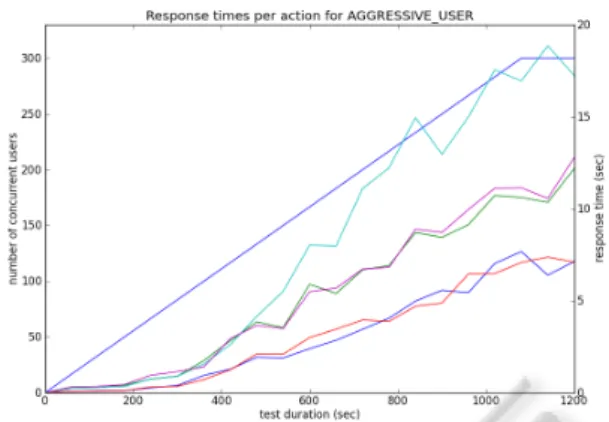
Figure 5: Average response times for get auction and
get bids (bottom), search and browse (middle), and bid
(top) when ramping up from 0 to 300 users.
at that time (see Table 1 -Time of breach). The length of the test run was 20 minutes (1200 seconds). Fig-ure 5 shows how the response times of different ac-tions increase over time for the aggressive usertype as the number of concurrent users are ramped up from 0 to 300. In this experiment the tool generated a total of 1504 unique test sequences form the models. Sev-eral of the unique test sequences were executed more than 100 times and the variance on the test sequence length was from 1 up to 50 actions.
Table 1 also shows the time when a target response time (average and/or max) value was exceeded and the number of concurrent users at that time. For ex-ample, the average response time for thesearch() ac-tion was exceeded at 229 seconds into the test run by
theaggressive usertype. The tool was when running
64 concurrent users. Form this table we concluded that the current configuration of the server can sup-port a maximum of 64 concurrent users before ex-ceeding the threshold value of 3 seconds set for action
search(). A closer inspection of the monitored values
of the server showed that the database was the bottle-neck, due to the fact asqlite databasewas used and the application locked the whole database for write operations.
Additional experiments, including a comparison of our approach against JMeter can be found in (Ah-mad et al., 2013). The experiment showed that out tool has similar capabilities as JMeter for instance when comparing the throughput (actions/sec) against the SUT.
5
CONCLUSIONS AND FUTURE
WORK
In this paper, we have presented a model-based performance testing approach that uses probabilistic
Table 1: Response time measurements for user actions when ramping up from 0 to 300 users.
Target Response Time Non-Bidders (22 %) Passive Users (33 %) Aggressive users 45 % Verdict
Actions Average Max Time of Time of Time of Time of Time of Time of Pass/fail
(sec) (sec) breach (sec) breach (sec) breach (sec) breach (sec) breach (sec) breach (sec) browse() 4.0 8.0 279 (78 users) 394 (110 users) 323 (90 users) 394 (110 users) 279 (78 users) 394 (110 users) Failed search(string) 3.0 6.0 279 (78 users) 394 (110 users) 279 (78 users) 394 (110 users) 229 (64 users) 327 (92 users) Failed get action(id) 2.0 4.0 280 (79 users) 325 (91 users) 279 (78 users) 279 (78 users) 276 (77 users) 325 (91 users) Failed get bids(id) 3.0 6.0 279 (78 users) 446 (130 users) 325 (91 users) 394 (110 users) 327 (92 users) 394 (110 users) Failed bid(id,price, username, password) 5.0 10.0 —- —– 327 (92 users) 474 (132 users) 328 (92 users) 468 (131 users) Failed
models to generate synthetic load in real-time. The models are based on the Probabilistic Timed Au-tomata, and include statistical information that de-scribes the distribution between different actions and corresponding think times. With the help of probabil-ity values, we can make it so that a certain action is more likely to be chosen over another action, when-ever the virtual user encounters a choice in the PTA. We believe that the PTA models are well suited for performance testing and that the probability aspect that the PTA holds is good for describing dynamic user behavior, allowing us to include a certain level of randomness in the load generation process. This is important because we wanted the virtual users to be able to mimic real user behavior as closely as possi-ble, and minimize the effect of caches on the perfor-mance evaluation.
The approach is supported by a set of tools, in-cluding the MBPeT load generator. MBPeT has a scalable distributed architecture which can be easily deployed to cloud environments. The tool has a ramp-ing feature which describes at what rate new users are added to the system and also supports the ability to specify a think time. When the test duration has ended the MBPeT tool will gather measured data, process it and create a test report.
In the future we will look into if parts of the model creation can be automated. At the moment it is done manually. There are indications that certain parts of creating the models can be automated e.g. by auto-matically analyzing the log data and using different clustering algorithms.
REFERENCES
Abbors, F., Ahmad, T., Truscan, D., and Porres, I. (2012). MBPeT: A Model-Based Performance Testing Tool.
2012 Fourth International Conference on Advances in System Testing and Validation Lifecycle.
Ahmad, T., Abbors, F., Truscan, D., and Porres, I. (2013). Model-Based Performance Testing Using the MBPeT Tool. Technical Report 1066, Turku Centre for Com-puter Science (TUCS).
Alur, R. and Dill, D. L. (1994). A theory of timed automata.
Theor. Comput. Sci., 126(2):183–235.
Barna, C., Litoiu, M., and Ghanbari, H. (2011). Model-based performance testing (NIER track). In
Proceed-ings of the 33rd International Conference on Software Engineering, ICSE ’11, pages 872–875, New York, NY, USA. ACM.
Calzarossa, M., Massari, L., and Tessera, D. (2000). Work-load Characterization Issues and Methodologies. In
Performance Evaluation: Origins and Directions, pages 459–481, London, UK, UK. Springer-Verlag. Denaro, G., Polini, A., and Emmerich, W. (2004). Early
performance testing of distributed software applica-tions. InProceedings of the 4th international work-shop on Software and performance, WOSP ’04, pages 94–103, New York, NY, USA. ACM.
Django (2012). Online at https://www.djangoproject.com/. Ferrari, D. (1984). On the foundations of artificial
work-load design. InProceedings of the 1984 ACM
SIG-METRICS conference on Measurement and modeling of computer systems, SIGMETRICS ’84, pages 8–14, New York, NY, USA. ACM.
Kwiatkowska, M., Norman, G., Parker, D., and Sproston, J. (2006). Performance analysis of probabilistic timed automata using digital clocks.Formal Methods in Sys-tem Design, 29:33–78.
Menasce, D. A. (2002). Load Testing of Web Sites. IEEE Internet Computing, 6:70–74.
Menasce, D. A. and Almeida, V. (2001). Capacity
Plan-ning for Web Services: metrics, models, and methods. Prentice Hall PTR, Upper Saddle River, NJ, USA, 1st edition.
Mosberger, D. and Jin, T. (1998). httperfa tool for
measur-ing web server performance. SIGMETRICS Perform.
Eval. Rev., 26(3):31–37.
Petriu, D. C. and Shen, H. (2002). Applying the UML
Performance Profile: Graph Grammar-based Deriva-tion of LQN Models from UML SpecificaDeriva-tions. pages 159–177. Springer-Verlag.
Python (2012). Python programming language. Online at http://www.python.org/.
Richardson, L. and Ruby, S. (2007). Restful web services. O’Reilly, first edition.
Ruffo, G., Schifanella, R., Sereno, M., and Politi, R. (2004). WALTy: A User Behavior Tailored Tool for
Evaluat-ing Web Application Performance.Network
Comput-ing and Applications, IEEE International Symposium on, 0:77–86.
SeleniumHQ (2012). Online at http://seleniumhq.org/.
Shams, M., Krishnamurthy, D., and Far, B. (2006). A
model-based approach for testing the performance of web applications. InSOQUA ’06: Proceedings of the 3rd international workshop on Software quality
assur-ance, pages 54–61, New York, NY, USA. ACM.
Shaw, J. (2000). Web Application Performance Testing – a Case Study of an On-line Learning Application. BT Technology Journal, 18(2):79–86.