R E S E A R C H
RootNav 2.0: Deep learning for automatic navigation
of complex plant root architectures
Robail Yasrab
1
, Jonathan A. Atkinson
2
, Darren M. Wells
2
,
Andrew P. French
1
,
2
, Tony P. Pridmore
1
and Michael P. Pound
1
,
*
1
School of Computer Science, University of Nottingham, Jubilee Campus, Wollaton Road, Nottingham NG8
1BB, UK and
2School of Biosciences, Sutton Bonington Campus, University of Nottingham, Nottingham LE12
5RD, UK
∗Correspondence address.Michael P. Pound, School of Computer Science, University of Nottingham, Jubilee Campus, Wollaton Road, Nottingham NG8
1BB, UK. Email:[email protected] http://orcid.org/0000-0002-5016-1078
Abstract
Background:In recent years quantitative analysis of root growth has become increasingly important as a way to explore the influence of abiotic stress such as high temperature and drought on a plant’s ability to take up water and nutrients. Segmentation and feature extraction of plant roots from images presents a significant computer vision challenge. Root images contain complicated structures, variations in size, background, occlusion, clutter and variation in lighting conditions. We present a new image analysis approach that provides fully automatic extraction of complex root system architectures from a range of plant species in varied imaging set-ups. Driven by modern deep-learning approaches, RootNav 2.0 replaces previously manual and semi-automatic feature extraction with an extremely deep multi-task convolutional neural network architecture. The network also locates seeds, first order and second order root tips to drive a search algorithm seeking optimal paths throughout the image, extracting accurate architectures without user interaction. Results: We develop and train a novel deep network architecture to explicitly combine local pixel information with global scene information in order to accurately segment small root features across high-resolution images. The proposed method was evaluated on images of wheat (Triticum aestivumL.) from a seedling assay. Compared with semi-automatic analysis via the original RootNav tool, the proposed method demonstrated comparable accuracy, with a 10-fold increase in speed. The network was able to adapt to different plant species via transfer learning, offering similar accuracy when transferred to an Arabidopsis thalianaplate assay. A final instance of transfer learning, to images ofBrassica napusfrom a hydroponic assay, still demonstrated good accuracy despite many fewer training images.Conclusions: We present RootNav 2.0, a new approach to root image analysis driven by a deep neural network. The tool can be adapted to new image domains with a reduced number of images, and offers substantial speed improvements over semi-automatic and manual approaches. The tool outputs root architectures in the widely accepted RSML standard, for which numerous analysis packages exist
(http://rootsystemml.github.io/), as well as segmentation masks compatible with other automated measurement tools. The tool will provide researchers with the ability to analyse root systems at larget scales than ever before, at a time when large scale genomic studies have made this more important than ever.
Keywords:convolutional neural network (CNN); plant phenotyping; computer vision; encoder-decoder; root system
Received:19 July 2019;Revised:23 August 2019;Accepted:22 September 2019
C
The Author(s) 2019. Published by Oxford University Press. This is an Open Access article distributed under the terms of the Creative Commons Attribution License (http://creativecommons.org/licenses/by/4.0/), which permits unrestricted reuse, distribution, and reproduction in any medium, provided the original work is properly cited.
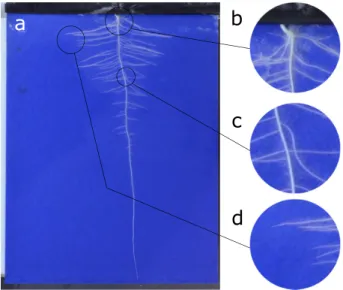
Figure 1:An example of the challenge root phenotyping presents for computer vision. a) A sample input image of aBrassica napusseedling grown on germina-tion paper. This plant phenotype exhibits a single primary root and numerous lateral roots. b) Cluttered scenes make segmentation challenging. c) Complex oc-clusion and intersection makes extracting root topology difficult. d) Many small image features, such as root tips, occur in close proximity, making identification difficult.
Background
Plant phenotyping plays a key role in plant science research, underpinning large-scale genetic discovery and the breeding of more resilient traits [1]. This innovation makes a fundamental contribution to the push for global food security. In recent years quantitative analysis of root growth has become increasingly important as a way to explore the influence of abiotic stresses such as high temperate and drought on a plant’s ability to take up water and nutrients [2]. Segmentation and feature extrac-tion of plant roots from images presents a significant computer vision challenge. Root images contain complicated structures, variations in size, background, occlusion, clutter, and variation in lighting conditions. Fig.1shows an exemplar root image cap-tured on germination paper. Even a straightforward imaging as-say presents numerous challenges to a classic computer vision pipeline.
In recent years machine learning has driven advances throughout many computer vision domains [3]. Indeed, much of the recent progress in plant phenotyping has also been driven by new and so-called deep learning techniques, a branch of ar-tificial intelligence, often centring around convolutional neural networks (CNNs) [4–6]. The sharp increase in the availability of performant techniques in image analysis has coincided with an increase in the availability of genomic information in plant biol-ogy, providing an opportunity for robust and high-throughput solutions. The scale of the data challenge seen within plant science means that now, all but the truly fully automatic ap-proaches will quickly become bottlenecks that hinder progress [7].
Analysis of root system architectures
In this article, we focus on the analysis of root systems where improvements promise increases to water and nutrient use effi-ciency [8]. Historically, automated root phenotyping has proven challenging, owing partly to the concealed nature of roots in the soil, but also to the architectural complexity and variability of
root systems between species, and even individuals. Progress has been made through a combination of innovative approaches and tools [9,10], and new imaging technologies such as X-ray and magnetic resonance imaging [11,12].
The prevailing methodologies in root image analysis can be broadly categorized on the basis of the level of automation they provide. Fully automated tools attempt to quantify the traits of a root system without human guidance, often through a process of image segmentation followed by post-processing. These are what might be termed ”bottom-up” approaches, which perform successive filtering over images in order to best distinguish be-tween the foreground root material, and the background. Tools such as DIRT, GiA Roots, IJ Rhizo, and EZ-Rhizo [13–16] offer a familiar pipeline in which an image is first segmented into 2 classes, root system and background, before noise removal (such as image filters and morphology [17]) and skeletonization tech-niques [18] are used to clean the image. These tools then quan-tify the distribution of root mass within an image, providing summary statistics such as root system width, height, and more complex measures such as density. Some tools, e.g., EZ-Rhizo, will measure root width at each location, providing more de-tailed analysis of the distribution of roots of different sizes.
A limitation of automated systems such as these is that er-rors propagate from early processing stages through to measure-ment. Noisy images or unexpected phenotypes will lead to er-rors in thresholding, which are challenging to remove and may lead to incorrect measurement of the root system. For this rea-son, most automated tools have placed heavy focus on cruder organ-scale measurements such as the total width of the root system because these are most robust to small errors in im-age segmentation. Owing to the challenge of reliably segment-ing and analyssegment-ing root systems automatically, many tools place strict requirements on the type of image they will analyse. Rhi-zoScan [19], for example, offers an automatic pipeline similar to the above, based on the OpenAlea platform [20], but supports only root systems grown on Petri plates.
Beyond the problem of low-level image analysis, by framing the problem as one of identifying root pixels at a low level, these tools struggle to extract high-level root architectural informa-tion. More detailed phenotypic traits such as the number of lat-eral roots are out of reach of many existing tools simply because disambiguating the category of a root within a system may prove impossible in the presence of noise, especially once growth is at a mature stage where roots begin to overlap. Semantically un-tangling such a root system requires a higher-level understand-ing of the image than pixel-based processunderstand-ing methods provide.
Manual root analysis tools such as ImageJ’s polyline func-tion [21] and DART [22] offer an entirely different approach. They place reliance on an expert human annotator to successfully identify the structure of the root system by asking the expert to label each root by hand. The advantage here is that if suffi-ciently well trained, an annotator could conceivably reconstruct an entire root system, using their advanced knowledge to clear up disambiguation in cluttered areas of the image. The obvi-ous drawback to this approach is that this is an extremely time-consuming process. In practice, many experiments will there-fore have to severely limit the number of measurements cap-tured per image, such as by focusing on primary root length, to bring the time required into a reasonable range. Some tools, e.g., RootScape [23], have been designed with this in mind, requiring that a user highlight only 20 key landmarks on a root system. These landmarks are then used to explore phenotypic differ-ences between genotypes via principal component analysis. In those instances where detailed analysis is required, the burden
a selection of widely used semi-automatic tools have been re-leased. These approaches aim to bridge the gap between speed and accuracy, offering a compromise acceptable for many use cases. Tools such as RootReader [26] perform a similar auto-matic function to the tools above but provide the user with the ability to manipulate some of the output to correct mistakes. Most of the tools in this category are not bottom up, and in-stead model the root system in some way, guided by the user, in order to better understand the image on which they are run. Smartroot [10], a plugin for the popular ImageJ tool [21], oper-ates by tracing along each root in a guided way, at each step searching for the optimal direction in which to travel based on the current orientation of the root at that point. Smartroot is semi-automatic, with initiation of roots and correction of errors often requiring human intervention. Nevertheless, with some user effort Smartroot can potentially be used to reconstruct full root system architectures. RootNav [9], a precursor to the work presented here, offers a point-to-point path search between la-belled seed locations and root tips. Images are first segmented into background/foreground classes, before a user is required to label root tip and seed locations. Shortest path search is used to trace between key organ landmarks, resulting in a complete reconstruction of the root system. However, RootNav does not include a reliable method fordetectingseeds and root tips (the user must perform this step), nor is the segmentation step ro-bust to image noise. This means that significant user interaction is still required to guide the software, but as with Smartroot, the output is a full and architecturally correct root system ture. Many tools that are able to output root system architec-tures have been adapted to provide output in the popular RSML format [10]. RSML is an XML-based standard for the sharing of root system architectures, including information on geometry, and relative position within the system. Numerous tools exist to read and write RSML files, allowing customized pipelines be-tween tools, and the ability to decouple the image analysis from the ultimate measurement of traits, as well as view the final ar-chitecture labelling.
Deep learning for root systems
The prevailing methodology when working with images in deep learning is the CNN. CNNs improve upon traditional machine learning via their ability to learn not only solutions to prob-lems but also the most effective way in which to transform data to make this goal easier. This representation learning pro-vides CNNs with unparalleled discriminative power and has seen them quickly move into a dominant position within the field of computer vision [3]. A CNN is a layered structure that per-forms successive image-filtering operations that transform an image from a traditional RGB input into a new feature represen-tation. This transformation is learned during training and pro-vides the final layers of the CNN with the best possible view of those data from which to base decisions. The deeper into a CNN data flows, the more abstracted and powerful the representation becomes. While the initial layers may compute simple primi-tives such as edges and corners, deeper into the network
fea-to regression problems; i.e., of directly predicting values [28]. For root systems, Pound et al. [29] used a deep classification network to scan an image for probable root tip locations in 32×32 pixel tiles. Despite promising results, the drawback of this approach is that using a small field of view, customarily called a ”receptive field” within the machine learning literature, is computationally less efficient and may produce additional false-positive results where the small field of view is not sufficient to distinguish true roots from image noise. This system also only currently detects root tips, which means more complex traits involving other or-gans cannot be computed.
Image segmentation and feature localization
The measurement of complex phenotypic traits requires anal-ysis at a finer scale than that of whole-root-system traits but sensitive to more than only a small selection of plant features such as just root tips. To address this, the research community has begun to move towards networks that output a richer ar-ray of information. Recent work has been based around newer CNN designs in what we term an encoder-decoder configura-tion, aimed at segmentation of images, or the location of key feature points. Traditional CNNs perform spatial downsampling such that by the end of the network, features spatially corre-spond to the entire image, i.e., they have lost location resolution. This is ideal for classification tasks, where a decision must be made on an image scale. This is not appropriate, however, for sit-uations in which a 2D segmentation result is required. Encoder-decoders therefore upsample again from the feature space, back into a spatially high-resolution image (Fig.2). This process can be thought of as combining a CNN with a second, reversed CNN that learns to produce images once again; these images might be trained to predict the locations of objects, or to segment pix-els into background and foreground classes. Encoder-decoders are being used in plant science to, among other tasks, segment plant shoots [30,31], other plant organs [32], and fill gaps in rhi-zotron images of root systems [33]. Pound et al. [5] first intro-duced the concept of heat map regression to the plant pheno-typing domain, in which a segmentation output is replaced by a heat map showing likely target locations. Our development in this article combines both of these approaches, simultaneously segmenting a root system and predicting the likely locations of root tips and seeds.
Automated root phenotyping
We present here a new tool for the automatic analysis of root systems that is designed to work across a wide variety of plants and imaging conditions. Our pipeline is driven by a deep encoder-decoder network, similar to that presented by Pound et al. [5] but adapted to handle higher-resolution images. The net-work is trained to simultaneously segment root material, clas-sify root type, and locate key features from which root geome-try can be derived. To our knowledge this is the first use of deep learning to perform multi-task segmentation and localization in plant phenotyping. The output of the network is refined using an
Figure 2:A simplified example illustrating the major components of a CNN in an encoder-decoder configuration. The encoder performs a combination of filtering operations including convolutional filters, spatial downsampling, and normalization. These layers convert the original image into a high-dimensional feature space but with very low spatial resolution. The decoding network performs similar layer operations but replaces downsampling with upsampling to return the feature representation back into a spatially high-resolution image.
A∗shortest path algorithm to determine the most likely path of each root, connecting located second-order roots to appropriate first-order roots, and first-order roots back to the seed location. Full root geometry is extracted per plant and is robust to multi-ple plants and highly varied architectures. The tool outputs the standard RSML format [34], widely supported by the community, from which root system architecture (RSA) traits can be derived. The tool also outputs the underlying segmentation masks for first- and second-order roots, from which global traits can be de-rived. An overview of the tool can be seen in Fig.3. The system first performs pixel-wise segmentation of the image and heat map regression to locate key features; it next extracts the root topology via a series of guided shortest-path searches before fi-nally extracting the entire root architecture into a portable RSML format.
We first demonstrate the performance of the tool on a large wheat dataset grown on germination paper. We perform a quan-titative comparison with traits measured using the original semi-automatic RootNav tool [9], hereby referred to as RootNav 1.0, in which an expert performed detailed manual intervention to ensure accuracy. We next demonstrate the ability of RootNav 2.0 to adapt to new image types with a much smaller training set. We retrained the network on 200 images ofArabidopsis thaliana grown on agar plates, in which up to 5 plants appear per im-age. We again compare quantitatively against human-labelled images generated using RootNav 1.0. Finally, we transfer learn once more using an even smaller, rapeseed dataset, comprising only 91 training images. Beyond accuracy measures, we have as-sessed our system’s performance in terms of inference time and resource efficiency to provide a comparative analysis of user bur-den for root architecture analysis. The trained networks, tool, and all training datasets have been made publicly available.
Data description
Primary dataset
Our primary dataset is composed of images of wheat (Triticum aestivumL.) seedlings totalling 3,630 images of 1,900×2,000 pixel resolution. Images include those released by Pound et al. [5], plus additional images captured using the same methodology. Images were captured as per Atkinson et al. [35]; seeds were sieved to uniform size, sterilized, and pre-germinated before transfer to growth pouches in a controlled environment cham-ber (12-hour photoperiod: 20◦C day, 15◦C night, with a light in-tensity of 400μmol m−2 s−1 photosynthetically active
radia-tion). After 9 days (with plants at the 2-leaf stage), individual pouches were transferred to a copy stand for imaging using a Nikon D5100 DSLR camera controlled using NKRemote software (Breeze Systems Ltd, Camberley, UK). Ground truth annotations
for all plants were obtained using the original RootNav 1.0 soft-ware [9] and stored in RSML format [34]. Each annotation was provided by an expert user, and because we intended to use RootNav 1.0 as a quantitative baseline for accuracy, emphasis was placed on accuracy over speed during this process.
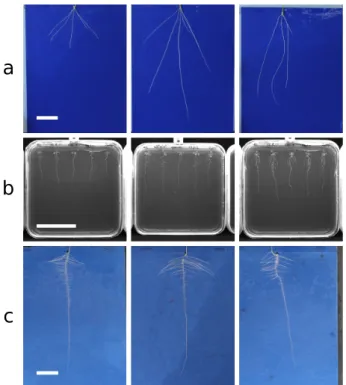
Ground truth images for network training and validation were generated from these RSML files by rendering appropriate segmentation masks and heat maps. The dataset was split into training and validation sets totalling 2,864 and 716 images, re-spectively. An additional 50 images were held back as a final testing set. More details on this methodology can be found in the Methods section. Example images can be found in Fig.4a. Transfer learning datasets
Our second dataset is composed of images ofArabidopsis thaliana grown on agar plates as detailed by Wilson et al. [36]. Images of individual plates were acquired using near-infrared imaging utilizing the system described by Wells et al. [37]. In this sys-tem, multiple seeds are sown on each plate, and thus, unlike the primary dataset, each image typically contained up to 5 plants (Fig.4b). This dataset is considerably smaller, totalling 277 im-ages, and is used as a demonstration of transfer learning with our approach despite limited annotated data. The dataset was split into training and validation sets of 200 and 27 images, re-spectively, and as with the primary dataset, 50 holdout test im-ages were used for final quantitative evaluation.
Our final dataset is composed of images of rapeseed ( Bras-sica napus) seedlings, grown in the same system as used in the primary dataset above. This dataset is small, containing only 120 images of individual plants. Our hypothesis was that despite the reduced size, transfer learning from a network trained on both the wheat (similar image background) andArabidopsis(similar root system organization) datasets would lead to sufficient ac-curacy. The dataset was split into training and validation sets of 91 and 14 images, respectively. We used 15 holdout test images for the final quantitative evaluation. Example images for the 2 transfer learning datasets can be found in Fig.4b and c.
Analyses
This section will present a comprehensive performance anal-ysis of RootNav 2.0, including a quantitative evaluation of both the underlying segmentation approach and the root ar-chitecture extraction. We evaluate segmentation accuracy via 3 common metrics, mean average pixel classification accuracy (both global and class averages) and mean intersection over union (mIoU). We compare the segmentation performance of our approach against the well-known benchmark architectures VGG [38], FCN [39], SegNet [40], UNet [41], and DeepLab [42]. We
Figure 3:An overview of RootNav 2.0. The input enters a CNN that performs both segmentation of the root structure and localization of key points. These are post-processed to extract information for a path-finding algorithm. A∗search then extracts likely paths taken by each root, generating an entire architecture for an arbitrary number of plants in an image. All roots are resampled as smooth splines, before all topology and geometry are output into an RSML file. Segmentation masks for first-and second-order roots are also saved.
Figure 4:Example images from each of the 3 datasets used during this work. (a) Wheat (Triticum aestivumL.). (b)Arabidopsis(Arabidopsis thaliana). (c) Rapeseed (Brassica napus). Scale bars are 50 mm long.
then evaluate the automatic reconstruction of root systems us-ing a comparison of common root phenotypic traits such as the dimensions of the root system, and root counts. For ground truth, we use semi-automatic measurements obtained through expert annotation using RootNav 1.0. Finally, we perform the same experiments to outline the accuracy on the 2 additional datasets, which contain fewer training images, to demonstrate the efficacy of transfer learning to new species and imaging modalities.
Table 1:Quantitative comparison: a quantitative analysis of train-able parameters and memory requirements of different benchmark architectures used during experiments
CNN model Trainable parameters, input (3×256×256 pixels) GPU memory requirements (bytes) VGG-16 [38] 138,357,544 1,253,048,320 FCN [39] 134,815,994 1,766,850,560 SegNet [40] 29,572,256 1,603,272,704 UNet [41] 13,395,329 1,276,116,992 Stacked Hourglass [43] 6,720,132 6,309,281,792 LinkNet [44] 11,546,148 533,725,184 PSPNet [45] 65,589,332 1,934,622,720 DeepLab-V3 [42] 59,344,309 596,639,744 RootNav 2.0 1,595,782 892,338,176
The input size was set at a constant 3×256×256 pixel size for this comparison. Root image segmentation
RootNav 2.0 is driven by a deep network that segments images of root systems into classes: background, first-order roots, and second-order roots. Crucial to the accuracy of any subsequent path-finding approach is a reliable segmentation. Segmenting whole-root images is important in order to provide sufficient context when distinguishing first- or second-order roots. Split-ting images into efficient tiles reduces memory consumption but makes distinguishing root type problematic. With this in mind, we designed the network to be efficient by reducing the num-ber of trainable parameters, intermediate feature sizes, and thus overall memory requirements. This allows larger 1,024×1,024 resolution input. Table1shows a comparison of the memory re-quirements and parameter sizes of commonly used segmenta-tion networks, and our own architecture.
We trained each network on the wheat dataset as described in the Methods. To provide a fair comparison of each network, we allocated 2 Nvidia GPUs with>11 GB onboard memory each for training each network, then trained using consistent hyper-parameters such as learning rates, and equal batch sizes. Image
Table 2:A quantitative comparison of the segmentation performance on root images of RootNav 2.0 against other commonly used CNN architectures CNN architecture Global average Class average mIoU VGG [38] 37.32 38.5 31.11 FCN [39] 43.78 48.56 39.47 SegNet [40] 68.68 70.23 47.05 UNet [41] 70.47 69.65 51.88 DeepLab-V3 [42] 87.7 85.90 54.0 RootNav.2.0 99.6 95.1 66.1
Performance is measured using global average accuracy, class average accuracy, and mean intersection over union. The classes evaluated are background (no root), first-order, and second-order roots.
resolution was maximized for each network depending on its resource requirements. Accuracy was measured using 3 stan-dard metrics: Global average accuracy, class average accuracy, and mIoU. Global average accuracy measures the performance of segmentation over all pixels in the validation set. High val-ues indicate that the majority of pixels have been classified cor-rectly. Because most pixels are background in root images, high values indicate few false-positive results but do not necessar-ily demonstrate good root segmentation. Class average accuracy measures the performance of each class separately, before com-puting a final average. High values here represent good perfor-mance across all classes. Finally, mIoU represents the percent-age of overlap between each class and the ground truth. Higher values indicate predictions closer to that of the ground truth la-belling.
Example image output from each network can be found in Fig.5, with quantitative results for all tested networks across the validation set shown in Table2. The larger networks con-tain more features, which while in some cases may improve per-formance of a deep network, here hinders the ability of each network to resolve finer detail because they cannot operate at 1-megapixel image resolution. The strong performance of Root-Nav 2.0 in this experiment can be attributed to its efficient use of features throughout the network, lower memory requirements, and thus larger 1-megapixel input sizes.
Extraction of root system architecture
After segmentation and feature localization, segmentation masks are converted into a weighted graph structure amenable to traversal with a shortest-path algorithm. RootNav 2.0 ex-tracts a full root architecture by performing a series of heuris-tic searches across the image. First, shortest paths are found between all first-order root tips and the most appropriate seed location (defined as the seed first reached during a heuristic search). This generates a series of first-order roots, to which second-order root paths are found from all second-order root tips. The output of this process is a complete root architec-ture description, stored in RSML format, from which phenotypic traits can be derived. We compare the output of RootNav 2.0 against ground truth measurements captured using RootNav 1.0 in collaboration with an expert user. Quantitative traits were measured directly using the RSML output by both tools; results are presented in Fig.6.
We chose a range of root traits that are both representative of the measurements commonly used in the root phenotyping lit-erature but also ones that exercise various aspects of our
partic-ular approach. For example, we include traits that measure the accuracy of feature detection (e.g., total root count) and those that also measure the accuracy of the shortest-path approach (e.g., total root length). In Fig.6it can be seen that there is strong agreement between the results of RootNav 2.0 and the ground truth measurements. Measurements based on the extremities of the root system (maximum depth, maximum width, and con-vex hull area) produced values very close to those in the ground truth, withr2values>0.99. Traits that summarize the entire root
system, such as centroid depth, providedr2values in the range
0.64–0.72.
The prediction of first- and second-order root counts achievedr2values of 0.641 and 0.724, respectively. For first-order
roots, we observed that the majority of incorrect predictions were either 1 count higher or 1 count lower than the ground truth and that these confusions often occurred near the seed position, where a seminal root may visually appear similar to a second-order root that emerges near the seed, or vice versa. Other failures were produced by roots leaving the field of view of the camera, but that had been annotated by the expert, or where 2 root tips grew in very close proximity (within a few pix-els). Second-order roots were typically much shorter and often in close proximity. Some missed root tips would be caused by non-maximal suppression, when the R-Tree data structure is used to remove possible duplicates. We also found that the contrast on second-order roots was lower because they were usually thinner, which might account for some missed tips in this class. Errors in the detection of root tips will also propagate errors into the total root length measurements because these roots will not be de-tected. For second-order roots, we found that most of the error in root length can be attributed to missed roots rather than er-rors in path finding. For primary roots, path finding was usually robust, except in cases where 2 roots grow side by side. RootNav 1.0 handled these errors by allowing a user to intervene and cor-rect any mistakes; in RootNav 2.0 we wish the process to remain fully automatic, so we do not explicitly correct for this. However, the occurrence of this type of growth is in the minority, in our experience. Centroid depth is measured as the mean position of all roots and so is influenced by the detection and path finding of every root.
An understanding of where and how RootNav 2.0 may pro-duce errors provides insight into these results. An accurate mea-surement of maximum depth depends on only 2 variables: the location of the seed, and the location of the first-order root tip that is lowest (in terms ofy-position) in the image. The graph of maximum depth in Fig.6reflects the fact that these 2 fea-tures were successfully found in every case. Similarly, maximum width depends only on the left- and right-most roots, and con-vex hull only on the outermost roots throughout the architec-ture. A missed second-order root within a root system will not affect these traits, so these results are robust even where some roots have been missed. This tells us that for the majority of im-ages, the locations of the seeds, lowest tips, and outermost roots are detected successfully and that these traits that measure the extremities of the root system are robust.
Transfer learning to new species and images
To demonstrate the adaptability of our approach to different species and imaging modalities, we retrained the network first on anArabidopsisdataset, comprising∼277 images ofA. thaliana grown on agar plates. We then trained once more from the wheat dataset to the rapeseed dataset, comprising 120 images ofB. napuson germination paper. In both cases we extracted RSML
Figure 5:Example image output from each trained network architecture. (a) An example hydroponic wheat image. (b) VGG [38]. (c) FCN [39]. (d) SegNet [40]. (e) UNet [41]. (f) DeepLab-V3 [42]. (g) RootNav 2.0.
Figure 6:Numerical results showing a range of root system traits measured in RootNav 2.0 against ground truth measurements on the wheat test set. For each trait we also fit a linear regression model and report ther2value.
root descriptions and quantified these in the same way as the wheat dataset. We also trained both networks from randomly initialized weights, rather than transfer learning, and found that the datasets were too small to train effectively (Supplementary Figs6and7).
Arabidopsis thaliana
TheArabidopsisdataset contains marked differences from the wheat data. The dataset contains many fewer images, which makes transfer learning essential to reduce overfitting. This species has a taproot structure that contains a single primary root, from which lateral roots emerge, rather than multiple first-order roots in the form of a primary and multiple semi-nal roots. This dataset is also imaged under infrared illumina-tion and so contains no colour informaillumina-tion, and a very different background arrangement consisting of a plastic plate contain-ing semi-transparent growth medium instead of blue germina-tion paper. Finally, each plate typically contains 5 plants rather than a single plant. We found that the network and heuris-tic searches adapted well to this new domain. We made minor modifications to the path-finding approach to support multiple plants, which are discussed further in the Methods.
Quantita-tive results are shown in Fig.7, with full results found in Sup-plementary Fig.1and example image output in Supplementary Fig.4.
Despite the smaller number of images available for training, the results show a good performance after transfer learning to the new data. Overfitting on the smaller dataset led to nois-ier segmentation and feature detection on some instances of the test data, examples of which can be found in Supplemen-tary Fig.8. Not every plant was successfully detected; a missing or additional primary root tip or seed location would mean that the number of plants was under- or overestimated. In 60% of images examined, the tool correctly identified the same num-ber of plants as were marked in the ground truth. In 6% of the images, a single plant was missed, usually owing to the plant being extremely underdeveloped but having been annotated by the user anyway. We found only a single instance in 1 image that contained a well-established plant that had not been iden-tified by our network. Overcounting of plants was more com-mon, with 20% of images identifying an additional plant and 14% identifying more beyond this. In the majority of cases we found that these errors were caused by unusual angles in the leaves and germinated seeds at the top of the plant, producing false-positive detections. This is something that would likely be
Figure 7:Numerical results showing a sample of root system traits measured in RootNav 2.0 against ground truth measurements on theArabidopsistest set. Each image contains up to 5 plants, and results are presented per plant. For each trait we also fit a linear regression model and report ther2value.
Figure 8:Numerical results showing a sample of root system traits measured in RootNav 2.0 against ground truth measurements on theBrassica napustest set. For each trait we also fit a linear regression model and report ther2value.
corrected with additional training data; remember, we are us-ing a very small amount of trainus-ing data for this image class, versus the wheat images. Where duplicate plants were found, they were often extremely close to, or even above, an existing plant location. These duplicates could be removed easily via
post-processing; this is something we do not address in this ar-ticle.
Of the plants that were successfully identified, the traits cap-tured by the tool offer a good agreement with the ground truth. As with the wheat dataset, measures of the extremities of the root system such as maximum depth performed with the high-est accuracy, but we also found that total first-order root length was very close to the ground truth in the majority of cases. Er-rors here usually indicated a second primary root incorrectly de-tected alongside an existing one, a feature that we do not yet re-move in post-processing as with duplicate plants, although this would be possible. The detection of second-order roots was also highly correlated with the ground truth measurements, and the total length of all second-order roots (measured per plant) cor-related with the ground truth with anr2of 0.91.
Brassica napus
This dataset uses the imaging format of blue germination pa-per with single plants (like the wheat dataset) but contains the same species root structure asArabidopsis(a single taproot from which all other roots derive). This dataset contains the fewest images, with only 90 images used for training. We use this small dataset as a demonstration of the efficacy of transfer learning, but we also note that training over a slightly larger dataset in practice would be worthwhile for improving robustness. Results can be found in Fig.8, and in full in Supplementary Fig.2. As with theArabidopsisdataset, the low number of training images produces some overfitting that results in noisier output than the wheat dataset on some of the test data. Examples can be seen in Supplementary Fig.9.
It can be seen that the correlation between RootNav 2.0 and ground truth ranges fromr2of 0.539 (first-order root length) to
0.941 (convex hull area). Because this is such a small dataset, the test set contains only 15 images, meaning that there is inevitably more noise in the results than in the previous ex-periments. Nevertheless, the results are promising, particularly given the tiny size of this dataset compared with typical stan-dards for deep learning. As with both previous datasets, convex hull and other extremity-based measures provided the most re-liable results. Accuracy of the total length and root count met-rics had a lowerr2than the other datasets, caused we believe by
the smaller training set, meaning that the approach is slightly less robust to noise. We found that in a few images the longest lateral tips were incorrectly classified as first order, causing er-roneously high measures of first-order root length. We believe that this occurred where these laterals are mistaken for wheat seminal roots, on which the network was originally trained. This occurred on the minority of test images and is a prob-lem that we are confident would be resolved with more training data. It would be possible to use prior domain knowledge, e.g., the knowledge that rapeseed has a single taproot, to clean the output during post-processing; as with theArabidopsisdataset, we did not perform any post-processing of this kind in this work.
After segmentation, the structure of these root systems was quite amenable to traversal using a shortest-path approach. In many cases the longest roots grow close together, which causes errors where a search may travel along the same path as another root. We found that this did not substantially increase the error in total root length because many of these roots grew in close proximity and were of similar length. Nevertheless, dealing with root overlap in an efficient and automatic way is a topic worth exploring in future work.
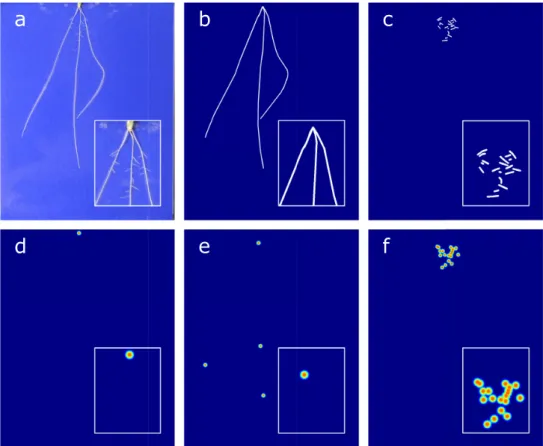
Figure 9:Sample training image and ground truth, zoomed sections and colour added for clarity. (a) An example wheat image. (b) Segmentation mask for first-order roots. (c) Segmentation mask for second-order roots. (d–f) Heat maps for seed, first-, and second-order tip locations.
Performance analyses
We measured the time taken for both tools to complete the full pipeline, from image to RSML output. We timed RootNav 1.0 by annotating random images from each test set from scratch; the total time taken to annotate 10 images of wheat and Arabidop-sisand 5 of rapeseed was recorded, and averages computed. The annotation was performed by an expert user who ha many years of familiarity with the tool. For RootNav 2.0, we processed each test set and then calculated the average inference time per im-age. For all tests each image was annotated in sufficient detail to measure the traits seen in Figs6–8. Results can be found in Table3.
In both systems a more complex root architecture typically leads to a longer analysis time. In RootNav 1.0 this is due to the human input required; with RootNav 2.0 the path finding takes longer if there are more lateral roots or roots are longer. On some images such as those in the rapeseed dataset, RootNav 1.0 would take less time to process each image if only course traits such as first-order root length were required because significant user time is taken in annotating and correcting second-order root po-sitions. We anticipate that RootNav 2.0 will be used to measure as many traits as possible automatically and so present here a like-for-like comparison where both tools are used to mea-sure the same features of each root architecture. In this com-parison, RootNav 2.0 offers a substantial speed advantage over the original tool on each dataset. It should also be noted that the time presented here for RootNav 1.0 requires that the user engage with the software continuously. Because RootNav 2.0 is fully automatic, the human time cost is essentially zero be-cause images could be batch-processed overnight. This test was also run on a single CPU and GPU, where additional
computa-tional resource would linearly scale the speed of the system. If performance were a serious consideration, a dedicated paral-lel hardware set-up could streamline RootNav 2.0 performance considerably.
Discussion
In this article we have introduced RootNav 2.0, a state-of-the-art, fully automated root-phenotyping tool. It is powered by a deep CNN in an encoder-decoder configuration, designed to perform segmentation efficiently in high-resolution images. The network segments root from background and can distinguish first- and second-order roots. This deep learned root segmentation pro-vides a strong foundation upon which users can derive common architectural traits, such as those based on RSA skeletonization. We have adapted the network, however, to simultaneously pre-dict the location of key root architectural features: the seed loca-tion, and first- and second-order root tips. This knowledge then drives a heuristic search that reconstructs the entire root sys-tem. This topology is represented as spline curves, and output in RSML format.
A quantitative analysis of RootNav 2.0 shows that it offers comparable accuracy against the original RootNav on large train-ing sets. Over a range of standard trait measurements the new tool produced highly correlated results against the ground truth, with r2 values ranging from 0.64 to 1. Performance on traits
representing the bounds of the root system yielded among the highestr2 values. On smaller datasets, we have demonstrated
that transfer learning produces accurate results despite many fewer training examples. This adaptability is a key advantage for those within the research community looking to use
Root-Table 3:Performance comparison of RootNav 1.0 against RootNav 2.0
Dataset
Average processing time (s)
RootNav 1.0 RootNav 2.0
Wheat 68.8 8.2
Arabidposis 109.8 7.5
Brassica 132.4 14.0
The time to process a random sample of images from each test set was measured, and an average time per image calculated.
Nav 2.0; those who use different growth conditions, image cap-ture approaches, or require the analysis of different species can adapt one of our existing trained models with a minimum of ef-fort using transfer learning.
While the accuracy of the fully automatic approach here does not yet match a human-annotated approach across all traits, we believe that this system still offers a benefit over all existing ap-proaches for forward genetic screens on root system architec-ture, such as quantitative trait locus (QTL) analysis or genome-wide association studies (GWAS). RootNav 2.0 is substantially more convenient to use than previous semi-automated tools, with no human interaction required at any point during the pipeline. The entire process requires <15 seconds processing time per image. The output can be analysed using the Root-Nav viewer tool or any compatible RSML analysis pipeline. Train-ing the original network took a few days on suitable hardware, with transfer learning to a new dataset typically taking about half a day. The speed of the system allows many more images to be processed, images that may represent additional species or more replicates. Previous work has shown that larger sam-ple sizes have a positive effect on the performance of both QTL analysis and GWAS [46,47] and that good results can be obtained on even simple automatic measures compared with existing semi-automatic approaches [29]. We believe that RootNav 2.0 will prove to be a key milestone in root phenotyping, further en-couraging the uptake of machine learning in addressing these important challenges.
In future work, we will continue to adapt this approach to new and varied datasets, maximizing the potential for use in the research community. We will also explore the use of more ro-bust heuristic searches, combined with appropriate segmenta-tion output from the network, to address the challenge of cross-ing and intersectcross-ing root systems. We will also continue to ex-plore deep network developments at the core of the tool, with a view to closing the gap between automatic and semi-automatic approaches on the most challenging traits. To encourage com-munity uptake and engagement, we will also develop mecha-nisms to ease the sharing of network models, and indeed the retraining process required to adapt them to specific scenarios.
Potential implications
We believe that RootNav 2.0 offers a substantial increase in accu-racy over bottom-up approaches to root image analysis. It also offers an increase in throughput over existing semi-automatic tools. Importantly, results on theArabidopisisdataset suggest that the approach will be applicable to images obtained with other phenotyping systems such as rhizotrons. With continued community support, RootNav 2.0 has the potential to be the first true species—and platform—agnostic analysis tool in the plant sciences. This will provide researchers with the ability to analyse root systems at larger scales than ever before, at a time
when large-scale genomic studies have made this more impor-tant than ever.
Methods
Training, validation, and test image preparation For each image we obtained ground truth annotations using the original RootNav 1.0 software. This software is semi-automatic and allows users to manually intervene to correct errors in either segmentation or RSA extraction. We used these data as ground truth, rather than to evaluate the accuracy of RootNav 1.0, and as such annotators were instructed to spend sufficient time on each image to correct all mistakes that they could identify. This semi-automatic process often requires a large amount of human interaction and is time consuming, but the approach has pro-vided very reliable ground truth annotations. All ground truth was stored in RSML format.
RSML data for each image were converted into a series of segmentation masks and feature heat maps for use in training. Segmentation masks were created separately for both first- and second-order roots by rendering them as polylines over a blank image. RootNav 1.0 does not measure diameter information for root systems, but the seedlines are sufUbbficiently young that root diameter is quite consistent across species and images. We rendered each root with a width of 8 pixels. For heat map out-put, the seed location and first- and second-order root tip loca-tions were rendered as in Pound et al. [5], as separate images of blurred Gaussian points of standard deviation 1.0 pixels. The re-sult of these processes is that for each input image there were 5 associated output images, 2 segmentation masks for first- and second-order roots, and 3 heat maps for seed position and first-and second-order root tips (Fig.9).
At this point, we have constructed 3 suitable training sets of images based on manual annotations. The next task is to con-struct a suitable encoder-decoder architecture capable of seg-menting these images and locating root features.
CNN Design
Input and output resolution
We used the PyTorch [48] framework to develop the network, training, and validation code that drives our segmentation ap-proach. The network is based around an encoder-decoder ar-chitecture (Fig.2) but has been adapted to handle the higher-resolution images seen in the datasets. Encoder-decoder CNNs are memory intensive, particularly at points towards the start and end of the network where the spatial resolution is high. Each layer calculates many features, each of which exists as an image stored in memory. Over many layers, the computational cost becomes prohibitive. Previous work, such as that by Pound et al. [5], used small input and output sizes of 256×256 pixels. Other commonly used networks such as VGG-FCN [39] and
Maximum pooling 128×128 128 Residual plock 3 128×128 256 Hourglass (Block=1) 128×128 256 Transposed convolution 256×256 256 ResNet block 4 256×256 256 Transposed convolution 512×512 256 ResNet block 5 512×512 128 Convolution (1×1) 512×512 128 Network split Convolution (1×1) Convolution (1×1) 512×512 3 Softmax Convolution (1×1) 512×512 3
Batch normalization layers and ReLU activation functions are used between lay-ers and within residual blocks. The hourglass used is equivalent to a single stack of the type used by Pound et al. [5].
Net [41] use similar input sizes. Root images pose a challenge in this situation because roots may be only a few pixels in diame-ter but exist as part of a large, connected architecture covering many megapixels. Shrinking the image to a convenient size will make processing simpler but also badly degrade the quality of these small features. In scenarios such as this, where shrinking the input this far may represent a significant loss in quality, it is common to tile the input into small cropped sections and run the network repeatedly. This is the approach taken by Pound et al. [5], in which wheat images are tiled, processed, and then re-constructed. The drawback of tiling images is that each tile is then considered in isolation, removing vital context on its posi-tion in the wider image. In the root datasets, for example, first-and second-order roots often appear identical when not viewed as part of a larger architecture.
In this work, we limit the size of input images to 1,024×
1,024 pixels. For the wheat and rapeseed datasets, this neces-sitated downsampling of the input and output images, but only by a moderate amount, in which fine root detail is preserved. For theArabidopsisplate images, no downsampling was required be-cause they were already of a suitable size. Upon completion of the deep learning, images are returned to native resolution to ensure that the output measurement scale is preserved.
Network architecture
Our complete network operates on input images of 1,024×1,024 pixels and outputs segmentation masks and regression maps of 512×512 pixels. A diagrammatic overview of the network can be found in Fig.10, with a description of the layers in Table4. The core of the network is an hourglass architecture similar to those used by Pound et al. [5] and Newell et al. [43], but here we use a restricted number of features throughout and do not use stacked structure (repeated encoder-decoders after one another). These alterations to the network allow it to successfully process the 1-megapixel input size without reaching the limit of available memory. We also perform additional downsampling and upsam-pling at either end of the network. Initial strided convolutional layers with large filter sizes of 7×7 are used to extract
fea-return to a 512×512 pixel spatial resolution. Finally, 2 paths are used to separately predict segmentation masks and feature heat maps. Each branch comprises 1×1 convolutional layers for prediction, with the segmentation output also passed through a sigmoid output, as required by the binary cross entropy loss function.
Loss functions
The output of our network is divided into 2 paths with differ-ent objectives. The first outputs segmdiffer-entation masks contain-ing locations for first- and second-order roots. Each of these is a 2D binary output and is trained using a cross-entropy loss. It is common in root images that the number of background pix-els heavily outweigh the foreground. Calculating a loss over an unbalanced dataset such as this is likely to cause a bias towards background pixels, causing error and undersegmentation of the foreground. We apply a class-balancing approach to the stan-dard cross-entropy loss, based on median frequency balancing [49]. Weights are assigned to each class inversely proportional to the median frequency in which that class appears throughout the entire training set. This reduces the weight for classes that appear more often, in this case background, and increases the weight of foreground classes such as first-order roots. The accu-racy of classes with higher weights is prioritized during training. The proposed lossL1is given in Equation (1).
L1=αc N N n=1 W x=1 H y=1 gn xylog ˆ gn xy +1−gn xy log1−gˆn xy , (1) where forNfeatures, ˆgn
xyis the predicted class output at
loca-tion (x,y) andgn
xyis the ground truth prediction at that location.
The weight of each class is scaled by its frequency relative to the median frequency of all classes byαc, given by
αc=median freq
freq(c) , (2)
where freq(c) is the frequency of occurrences of pixels of class cdivided by the number of pixels in any image containing that class and median freq is the median of these frequencies over all classes.
The second path is responsible for predicting key feature lo-cations on the root system, specifically, the seed location, first-order root tips, and second-first-order root tips. The output is three 2D outputs, trained using a mean squared error loss, predicting likely locations for root features, represented by 2D Gaussians centred at each feature location. The proposed lossL2is depicted
in Equation (3). L2=αc N N n=1 W x=1 H y=1 pn xy−pˆnxy 2, (3)
Figure 10:The network used is an extended encoder-decoder architecture. The input is filtered and downsampled into an efficient size, before an hourglass network [43] performs the remaining encoding and some decoding. Finally, a series of learned deconvolutional layers upsample back to 50% of the original input size. The network is split into 2 fully convolutional branches at the output, which are responsible for learning the segmentation and heat map regression outputs separately.
where for each ofNfeatures, ˆpn
xyis the predicted feature
likeli-hood at pixel (x,y) and pn
xyis the expected ground truth at the
same location.
The final lossL=L1+L2trains the network end to end,
bal-ancing the objectives of both paths. We found that additional scaling factors applied to the loss of either path were not neces-sary for accurate training.
Training
Beginning with the wheat dataset, the network was trained end to end from scratch using the rmsprop optimizer. The initial learning rate was set to 1e−4 and reduced by a factor of 10
af-ter 50,000 iaf-terations. The network was trained using a batch size of 6 for 500,000 iterations, although we found that performance plateaued after approximately 400,000–450,000 iterations. Dur-ing trainDur-ing, we selected the best-performDur-ing model from the validation set.
We applied random augmentation to the training set to re-duce potential overfitting. We added random horizontal flipping with a 50% probability during training, as well as random ro-tation in the range [−30◦, 30◦]. We experimented with random cropping as in Pound et al. [5] but found that cropping often caused the removal of parts of the root system, sacrificing con-text crucial, e.g., in distinguishing first- and second-order roots. For this reason we did not use random cropping during these experiments.
Transfer learning
Transfer learning is the process of training on new data by begin-ning with an existing trained network’s parameters, rather than randomly initialized weights. We began by training the wheat network to completion. This is a large dataset, with more than sufficient images to train a network reliably from scratch. As noted in the above section, successful training simply means ac-ceptable performance on the validation images. We began with the existing wheat network and retrained on the A. thaliana dataset. This is a smaller dataset, but the use of pre-trained weights allows a network to make use of any useful image fil-ters learned during the initial training. We experimented with training from scratch on the smaller dataset but found that we were unable to train a network that performed reliably on the validation set (Supplementary Figs6and7). The same pro-cess of training and validation was used to complete training on the new dataset, except that we limited training duration to 120,000 iterations. Normally minor modifications of the
un-derlying deep network would be required to support single-channel near-infrared images rather than RGB. However, to en-sure compatibility between models, in particular to simplify transfer learning between images that may move between RGB and single channel, we chose to fix the network and use 3 in-put channels in all cases. For theArabidopsisdataset, we dupli-cate the grayscale channel into 3 RGB channels prior to use. The computational overhead of this only affects the weights in the first layer of a very deep network and is marginal. The result is that theArabidopsismodel does not make use of the additional channel information in the first layer but remains structurally identical to the other 2 models.
Finally, we repeated transfer learning from the wheat dataset to the B. napus data, which have the fewest images of the datasets we use. We explored training from scratch, as well as using pre-trained weights from either the wheat or arabidopsis datasets, and found that the wheat network offered the most reliable starting point, a fact we attribute to the similar back-ground and foreback-ground colours, and scales for both datasets. As above, we trained for 120,000 iterations and selected the model with highest validation performance.
Post-processing
Dense CRF
Each segmentation mask was passed to a dense conditional ran-dom field (CRF) to improve smoothness and maximize agree-ment between similar neighbouring pixels. We found that this approach had a subtle but helpful effect on the separation be-tween roots growing in close proximity, and the smoothness of the boundaries of segmented roots. We used the dense CRF pro-posed by Kr ¨ahenb ¨uhl and Koltun [50], in which each pair of ran-dom variables (pixels) are connected by an edge [51], weighted using a Gaussian pairwise potential. The effect was a smoothing of conflicting regions of pixels where the image was cluttered; but where segmentation was already successful, the approach had no notable negative effect on the results.
Feature localization and non-maximal suppression
The heat map regression output contains the probable loca-tions of the seed, as well as first- and second-order root tips. These are represented as 2D Gaussian distributions, the cen-tre of which lies on likely feature locations. We obtain a dis-crete location for each feature via a non-maximal suppression (NMS) approach [52], which suppresses all predicted pixels ex-cept those that are greater than their surrounding neighbours.
For the majority of root tips in isolation, NMS will success-fully return a single location for each true root tip. This re-lies on the heat map regression layers of the network return-ing well-formed Gaussian distributions in all instances, which while likely, may not occur in the presence of image clutter, confusing root hairs, or multiple tips in close proximity. To avoid 2 positions being returned for a single underlying root feature, we identify and suppress neighbouring features. We use an R-Tree data structure to efficiently query for neigh-bours within close proximity. When NMS returns a new posi-tion on the image, the R-Tree is searched for nearby features that have already been added and prevents locations from be-ing added twice. In our experiments, we considered a new po-sition a duplicate if it fell within 8 pixels radius of an exist-ing feature, which is derived from the scale of the roots in our datasets.
Root architecture reconstruction
After successful pixel-wise segmentation of the complete root system architecture and extraction of the tips and seed loca-tions, we are now able to reconstruct the whole root skeleton. This procedure is similar to the original RootNav 1.0 tool [9], ex-cept it is now driven by more accurate class-aware segmenta-tion, rather than error-prone root likelihood estimations. Root-Nav 2.0 can place more reliance on the accuracy of the segmen-tation and make use of each segmensegmen-tation map separately to ensure that roots are not traversed over the wrong material, e.g., that first-order roots prioritize image locations of that class. We establish an 8-way connected graph structure throughout the image, where the weights travelling to neighbouring pix-els are calculated as a function of their class, the path we are trying to find, and the distance between them. Each segmenta-tion mask is converted into a distance map of values [0, 1] in-dicating the distance from any background pixel. We then con-vert this distance into a weighting that prioritizes paths along root centres; the maximum weight we assign to any root pixel is 0.1, for pixels near the root edge. The weight decreases towards the centre of the root, to a minimum of 0.01. Because the graph includes diagonal connections, these are weighted by an addi-tional cost of√2 to account for the longer distance. Finally, any pixel that does not belong to the specific class being traversed, e.g., first-order root only, is assigned a weight of 10.0, represent-ing a much stronger penalty for traversrepresent-ing these pixels. Unlike RootNav 1.0, we use separate graphs and searches for first- and second-order roots. A value of 10.0 was chosen simply as a very large increase in weight when compared to the minimum cost for any segmented root material. Different weight values are ef-fective, as long as they are large enough relative to root material to avoid the shortest path taking shortcuts across background pixels where this is unnecessary. In practice, these weights are only traversed if there is a gap in the segmentation for true root material.
A∗search [54] is a path-finding algorithm that in our imple-mentation seeks to find a path of minimal cost between loca-tions on a root system. It is an extension of Dijkstra’s
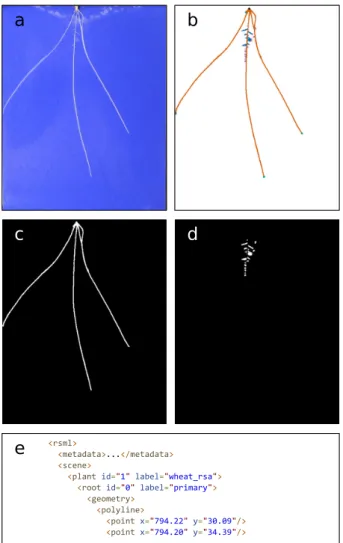
shortest-Figure 11:Example output from RootNav 2.0. (a) Input image. (b) Colour-coded segmentation mask. (c, d) Binary segmentation masks for first- and second-order roots. (e) A sample of the RSML file representing the entire architecture.
path algorithm [55], and along with distance travelled also con-siders a heuristic measure of the remaining distance to the goal. Pixels are explored based on the lowest cost first, in order to min-imize the function
f(p)=g(p)+h(p), (4) whereg(p) is the sum of all weights top, andh(p) is the remaining distance, which we calculate as the Manhattan distance, orL1
-norm.
In the case of RSA traversal, minimal cost paths between key features such as first-order root tips and seeds represent recon-structed roots. A∗searches are initialized from all first-order root tips, travelling along segmented roots until they reach any seed point. Upon reaching a seed location, the entire path is recorded as a first-order root. Once all first-order roots have been tra-versed, a new series of searches are begun from second-order root tip locations, ending at any encountered first-order root. The second-order root searches use Dijkstra’s algorithm by not including a remaining distance heuristich(p), which would be inefficient to calculate over many possible goal locations. The output of each search is a list of pixel coordinates representing the individual roots within the RSA.
TheArabidopsisdataset contains multiple plants per image, which can be handled through minor modifications to the path-finding approach. Where the deep network detects multiple seed locations, these are used to initialize multiple candidate plants. We use Dijkstra’s algorithm rather than A∗as with second-order root searches with multiple candidate goal locations. First-order root searches proceed as above but now terminate upon encoun-tering the first seed, which in a Dijkstra search represents the shortest possible path between that tip and any of the seeds. This root path is then assigned to the corresponding plant, and the process is repeated for each first-order tip location. Once the process is complete, any remaining plants whose seed lo-cations did not result in a connection with a first-order root are removed.
Spline fitting
The use of a distance map that prioritizes the centre lines of roots generally acts to smooth the paths found throughout the root system. This may not be the case where there is noise in the segmentation output, or roots cross, and the distance map is less reliable. We smooth each root path using a spline curve rep-resentation. Control points are sampled at equal spacing along each path, before the path is resampled using cubic splines. Each spline includes a tension parameter that we set at a constant of 0.5 for our experiments. Both the spline and a polyline represen-tation are output into the final RSML file to ensure maximum compatibility with other tools.
RSML and output
The RSA reconstruction approach in RootNav 2.0 does not perform phenotypic measurements itself; rather it extracts a root topology along with segmented images from which traits can be derived. The entire root system for each plant in an image is exported using the RSML format [34], providing a standard and interoperable format. RSML is an XML docu-ment specifically designed to store 2D and 3D root architec-tures. It also stores metadata and plant properties and is com-patible with numerous analysis tools. Some existing plant-phenotyping tools offer RSML import support, meaning that they may also load root systems created automatically us-ing RootNav 2.0. Our approach also outputs first- and second-order root segmentation images, representing an alternative source of quantitative data. Many tools such as Ez-Rhizo op-erate on such images, but the segmentation masks gener-ated here contain very little image noise, making them more amenable to further automated analysis. An example output can be seen in Fig.11. For this work we performed quantifica-tion entirely using the RSML output. Phenotypic measurements were calculated from each RSML file using the existing Root-Nav Viewer tool, which has been extended and updated for this publication.
Availability of Source Code and Requirements
Project name: RootNav 2.0
Project home page: https://github.com/robail-yasrab/RootNav-2.0
SciCrunchRRID:SCR 015584
biotoolsID: biotools:Rootnav 2.0
Operating system(s): Platform independent
Programming language: Python, C# (RootNav Viewer) Other requirements: Python 3.6, PyTorch 1.0.1 License: GNU GPL
Any restrictions to use by non-academics: None
Availability of Supporting Data and Materials
Datasets will be made available athttps://plantimages.nottingh am.ac.uk. Snapshots of our code and other supporting data are available in the GigaScience repository, GigaDB [56].
Additional Files
Additional Figure S1: Extended plots showing quantitative re-sults on theArabidopsis thaliana dataset.
Additional Figure S2: Extended plots showing quantitative re-sults on the Brassical napus dataset.
Additional Figure S3: Example output of RootNav 2.0 on the wheat (Triticum aestivum L.) dataset.
Additional Figure S4: Example output of RootNav 2.0 on the Ara-bidopsis thaliana dataset.
Additional Figure S5: Example output of RootNav 2.0 on the Bras-sica napus dataset.
Additional Figure S6: Example output on the Arabidopsis dataset showing the results of transfer learning vs. the results when the network is trained from scratch (randomly initialised weights).
Additional Figure S7: Example output on the Brassica napus dataset showing the results of transfer learning vs. the results when the network is trained from scratch (randomly initialised weights).
Additional Figure S8: Examples of incorrect segmentation and root system extraction on theArabidopsis dataset.
Additional Figure S9: Examples of incorrect segmenta-tion and root system extracsegmenta-tion on the Brassica napus dataset.
Abbreviations
CNN: convolutional neural network; CRF: conditional random field; DART: Data Analysis of Root Tracings; DIRT: Digital Imag-ing of Root Traits; DSLR: digital sImag-ingle-lens reflex; FCN: fully convolutional network; GPU: graphical processing unit; GWAS: genome-wide association study; mIoU: mean Intersection over Union; NMS: non-maximal suppression; QTL: quantitative trait locus; RSA: root system architecture; RSML: Root System Markup Language;
Competing Interests
The authors declare that they have no competing interests.
Funding
This work was supported by the Biotechnology and Biologi-cal Sciences Research Council [grant numbers BB/P026834/1, BB/M019837/1].
Authors’ Contributions
M.P.P., A.P.F. and T.P.P. designed the project; R.Y. implemented the software and trained the deep networks under the supervision of M.P.P. with support from A.P.F. and T.P.P.; M.P.P. wrote addi-tional code for release; J.A.A. and D.M.W. designed the protocols for and carried out the collection of the datasets. R.Y. and M.P.P. wrote the manuscript. All authors contributed to and approved the final manuscript.

![Table 2: A quantitative comparison of the segmentation performance on root images of RootNav 2.0 against other commonly used CNN architectures CNN architecture Global average Class average mIoU VGG [38] 37.32 38.5 31.11 FCN [39] 43.78 48.56 39.47 SegNet [4](https://thumb-us.123doks.com/thumbv2/123dok_us/9919548.2484946/6.892.87.433.137.279/quantitative-comparison-segmentation-performance-rootnav-commonly-architectures-architecture.webp)



![Figure 10: The network used is an extended encoder-decoder architecture. The input is filtered and downsampled into an efficient size, before an hourglass network [43]](https://thumb-us.123doks.com/thumbv2/123dok_us/9919548.2484946/12.892.94.806.85.293/figure-network-extended-architecture-filtered-downsampled-efficient-hourglass.webp)