Singapore Management University
Institutional Knowledge at Singapore Management University
Research Collection School Of Information Systems
School of Information Systems
12-2012
Cost-Sensitive Online Classification
Jialei WANG
Nanyang Technological University
Peilin ZHAO
Nanyang Technological University
Steven C. H. HOI
Singapore Management University, [email protected]
DOI:
https://doi.org/10.1109/ICDM.2012.116
Follow this and additional works at:
https://ink.library.smu.edu.sg/sis_research
Part of the
Databases and Information Systems Commons
, and the
Numerical Analysis and
Scientific Computing Commons
This Conference Proceeding Article is brought to you for free and open access by the School of Information Systems at Institutional Knowledge at Singapore Management University. It has been accepted for inclusion in Research Collection School Of Information Systems by an authorized administrator of Institutional Knowledge at Singapore Management University. For more information, please [email protected].
Citation
WANG, Jialei; ZHAO, Peilin; and HOI, Steven C. H.. Cost-Sensitive Online Classification. (2012).IEEE 12th International Conference on Data Mining ICDM 2012: 10-13 December, Brussels, Belgium: Proceedings. 1140-1145. Research Collection School Of Information Systems.
Cost-Sensitive Online Classification
Jialei Wang, Peilin Zhao, Steven C.H. Hoi
School of Computer Engineering, Nanyang Technological University, Singapore 639798 Email:{jl.wang, zhao0106, chhoi}@ntu.edu.sg
Abstract—Both cost-sensitive classification and online learning
have been studied extensively in data mining and machine learning communities, respectively. It is a bit surprising that there was very limited comprehensive study for addressing an important intersecting problem, that is, cost-sensitive online classification. In this paper, we formally study this problem, and propose a new framework for cost-sensitive online classification by exploiting the idea of online gradient descent techniques. Based on the framework, we propose a family of cost-sensitive online classification algorithms, which are designed to directly optimize two well-known cost-sensitive measures: (i) maximiza-tion of weighted sum of sensitivity and specificity, and (ii) minimization of weighted misclassification cost. We analyze the theoretical bounds of the cost-sensitive measures made by the proposed algorithms, and extensively examine their empirical performance on a variety of cost-sensitive online classification tasks.
Keywords-cost-sensitive learning, online learning,
classifica-tion
I. INTRODUCTION
Online learning represents a family of efficient and scal-able machine learning methods, which has been extensively studied in machine learning and data mining literature [5], [15], [21], [25], [27], [29]. In general, the goal of online learning is to incrementally learn some prediction models to make correct predictions on a stream of examples that arrive sequentially. Online learning is advantageous for its high efficiency and scalability for large-scale applications, and has been applied to solve online classification tasks in a variety of real-world data mining applications.
Despite being studied extensively in machine learning, most existing online learning techniques are unsuitable and potentially would not be effective enough to solve a cost-sensitive classification task, an important data mining problem which takes the misclassification costs into con-sideration [10], [7]. This is because most existing online learning studies often concern the performance of an online classification algorithm in terms of prediction mistake rate or accuracy, which is obviously cost-insensitive and thus inappropriate for many real applications in data mining, es-pecially for cost-sensitive classification tasks where datasets are often class-imbalanced and the misclassification costs of instances from different classes can be very different [24], [4], [9], [20].
To address the above challenge of cost-sensitive classifi-cation, researchers especially in data mining literature have
proposed more meaningful metrics, such as the weighted sum of sensitivity and specificity [13], [3] and the weighted misclassification cost [10], [1]. Over the past decades, sub-stantial research efforts have been devoted to developing batch classification algorithms to improve the cost-sensitive measures, including the weighted sum of sensitivity and specificity and the weighted misclassification cost met-rics [10], [1]. However, these batch classification algorithms often suffer from low efficiency and poor scalability when solving large-scale problems, making them unsuitable for online classification applications.
Although both cost-sensitive classification and online learning have been studied extensively in data mining and machine learning communities, respectively, there were very few comprehensive studies on cost-sensitive online classifi-cation in both data mining and machine learning literature. In this paper, we formally investigate this problem by attempt-ing to develop cost-sensitive algorithms for solvattempt-ing an online cost-sensitive classification task. As the first comprehensive study, in this paper, we propose a new framework of Cost-Sensitive Online Classification to resolve this challenging open problem. The key challenge of our framework is how to develop an effective cost-sensitive online algorithm which can directly optimize a predefined cost-sensitive measure (e.g., balanced accuracy or weighted misclassification cost) for an online classification task, and further offer theoretical guarantee of the proposed algorithm.
To this end, we summarize the major contributions in this work as follows: (i) we propose a family of cost-sensitive online algorithms using online gradient descent learning technique to tackle the online optimization task of maximizing the weighted sum or minimizing the weighted misclassification cost; (ii) we theoretically analyze the cost-sensitive measure bounds of the proposed algorithms, and extensively examine their empirical performance of cost-sensitive online classification tasks.
The rest of the paper is organized as follows. Section II briefs the related works. Section III formulates the problem and presents the proposed algorithms. Section IV theo-retically analyzes the bounds of the proposed algorithms. Section V discusses our experimental results, and finally Section VI concludes this work.
II. RELATEDWORK
Our work is mainly related to two groups of research in data mining and machine learning: (i) cost-sensitive classi-fication in data mining literature, and (ii) online learning in machine learning literature.
Cost-sensitive classification has been extensively studied in data mining and machine learning [18], [26], [30]. To address this problem, researchers have proposed a variety of cost-sensitive metrics. The well-known examples include the weighted sum of sensitivity and specificity [13], [3], and the weighted misclassification cost that takes cost into consider-ation when measuring classificconsider-ation performance [10], [1]. As a special case, when the weights are both equal to 0.5, the weighted sum of sensitivity and specificity is reduced to the well-known balanced accuracy [3]. Over the past decades, various batch learning algorithms have been proposed for cost-sensitive classification in literature [22], [23], [7], [10], [19], [17], [20].
Online learning has been extensively studied in machine learning community. Various online learning methods have been actively proposed in literature [21], [15], [5]. Examples include the well-known Perceptron algorithm [21], [11], the recent Passive-aggressive (PA) learning [5], and many other recently proposed algorithms, many of which usually follow the principle of large margin learning [6], [12], [14], [8]. Most online learning algorithms are cost-insensitive, except the prediction-based PA algorithm (’CPAP B’) [5] and the
perceptron algorithm with uneven margin (’PAUM’) [16]. However, to the best of our knowledge, no existing work in this area had attempted to directly optimize the two cost-sensitive metrics in an online learning setting. Finally, we note that our work is very different from another recent online learning study [28], which aims to optimize AUC, but cannot be guaranteed to optimize the cost-sensitive measures in our study.
III. COST-SENSITIVEONLINECLASSIFICATION
A. Problem Formulation
Without loss of generality, let us consider an online binary classification problem. At each learning round, the learner receives an instance and predicts its class label as “+1” or “-1”. After making the prediction, the learner receives the true label of the instance and suffers a loss if the prediction is incorrect. At the end of each round, the learner makes use of the received training example and it class label to update the prediction model.
Formally, let us denote byxt∈Rn the instance received
at the t-th learning step, and wt ∈ Rn a linear prediction
model learned from the previous t−1 training examples. We also denote the prediction for the t-th instance as
ˆ
yt = sign(wt·xt), while the value |wt·xt|, known as
the “margin”, is used as the confidence of the learner on the prediction. The true label for instance xtis denoted as
yt ∈ {−1,+1}. If yˆt 6= yt, the learner made a mistake;
otherwise it made a correct prediction.
For binary classification, the result of each prediction for an instance can be classified into four cases: (1) True Positive (TP) if yˆt =yt= +1; (2) False Positive (FP) if yˆt = +1
andyt=−1; (3) True Negative (TN) ifyˆt=yt=−1; and
(4) False Negative (FN) if yˆt=−1 andyt= +1.
We now consider a sequence of training examples
(x1, y1), . . . ,(xT, yT)for online learning. Then, for conve-nience, we denote byM the set of indexes that correspond to the trials of misclassification:
M={t|yt6= sign(wt·xt), ∀t∈[T]}
where [T] = {1, . . . , T}. Similarly, we denote by Mp =
{t |t ∈ M and yt = +1} the set of indexes for false
negatives, and Mn = {t |t ∈ M and yt = −1} the set
of indexes for false positives.
Further, we introduce notation M =|M| to denote the number of mistakes, Mp =|Mp| to denote the number of
false negatives, and Mn =|Mn| to denote the number of
false positives. Also we use notation ITp = {i ∈ [T]|yi =
+1} to denote the set of indexes of the positive examples, In
T = {i ∈ [T]|yi = −1} to denote the set of indexes
of negative examples, Tp =|ITp| to denote the number of
positive examples, andTn =|ITn| to denote the number of
negative examples.
For performance metrics, sensitivity is defined as the ratio between the number of true positives Tp −Mp and the
number of positive examples; specificity is defined as the ratio betweenTn−Mnand the number of negative examples;
and accuracy is defined as the ratio between the number of correctly classified examples and the total number of examples. These can be summarized as:
sensitivity = Tp−Mp Tp , specif icity = Tn−Mn Tn , accuracy = T−M T
Consider an online binary classification task, without loss of generality, we assume positive class is the rare class, i.e., Tp ≤ Tn, the number of positive examples is smaller
than the number of negative examples. For simplicity, we also assume that kxtk ≤1. For traditional online learning, the performance is measured by the prediction accuracy (or mistake rate equivalently) over the sequence of examples. This is inappropriate for imbalanced data because a trivial learner that simply classifies any example as negative could achieve a quite high accuracy for a highly imbalanced dataset. Thus, a more appropriate metric is to measure the sum of weighted sensitivity and specificity, i.e.,
whereηp+ηn= 1 and0≤ηp, ηn ≤1 are two parameters
to trade off between sensitivity and specificity. Notably, when ηp = ηn = 0.5, the corresponding sum is the well
known balanced accuracy. In general, the higher the sum value, the better the classification performance. Besides, another approach is to measure the total misclassification cost suffered by the algorithm, which is defined as:
cost=cp×Mp+cn×Mn (2)
where cp + cn = 1 and 0 ≤ cp, cn ≤ 1 are the
misclassification cost parameters for positive and negative classes, respectively. The lower the cost value, the better the classification performance.
B. Algorithms
In this section, we propose a framework of Cost-Sensitive Online Classification for cost-sensitive classification by op-timizing two cost-sensitive measures. Before presenting our algorithms, we first prove the following important proposi-tion that motivates our soluproposi-tion.
Proposition 1: Consider a cost-sensitive classification problem, the goal of maximizing the weighted sum in (1) or minimizing the weighted cost in (2) is equivalent to minimizing the following objective:
X yt=+1 ρI(ytw·xt<0)+ X yt=−1 I(ytw·xt<0) (3) where ρ = ηpTn
ηnTp for the maximization of the weighted
sum, and ρ = cp
cn for the minimization of the weighted
misclassification cost.
Proposition 1 gives the explicit objective function for optimization, but the indicator function is not convex. To facilitate the online optimization task, we replace the indi-cator function by its convex surrogate, i.e., either one of the following modified hinge loss functions:
ℓI(w; (x, y)) = max(0,(ρ∗I(
y=1)+ I(y=−1))−y(w·x)) (4)
ℓII(w; (x, y)) = (ρ∗I(
y=1)+I(y=−1))∗max(0,1−y(
w·x)) (5) As a result, we can formulate the optimization problem for cost-sensitive classification as follows:
F∗ T(w) = 1 2kwk 2+C T X t=1 ℓ∗ (w; (xt, yt)) ∗ ∈ {I, II} (6)
wherekwk2is introduced to regularize the complexity of the linear classifier and C is a positive penalty parameter of the cumulative loss. The idea of the above formulation is somewhat similar to the biased formulation of batch SVM for learning with imbalanced datasets [1].
Now our goal is to find an online learning solution to tackle the above convex optimization (6). To this end, we propose to solve the problem using the online gradient descent approach [31], [2], that is,
wt+1=wt−λ∇ℓt(wt)
where λ is a learning rate parameter and ℓt(w) =
ℓ∗
(w; (xt, yt)), ∀∗ ∈ {I, II}. Specifically, when using the
loss function (4), the update rule can be expressed as:
wt+1=
w
t+λytxt ifℓt(wt)>0
wt otherwise
We refer to the above resulting cost-sensitive online classi-fication algorithm as “CSOGD-I” for short.
When using the loss function (5), the update rule can be expressed as:
wt+1=
w
t+λρtytxt if ℓt(wt)>0
wt otherwise
where ρt =ρ∗I(yt=1)+ I(yt=−1). We refer to the above
resulting algorithm as “CSOGD-II” for short.
Finally, Algorithm 1 summarizes the two proposed CSOGD algorithms.
Algorithm 1 The proposed CSOGD algorithms. INPUT: learning rate λ; bias parameter ρ = ηpTn
ηnTp for “sum” and ρ= cp cn for “cost” INITIALIZATION: w1= 0. fort= 1, . . . , T do receive instance: xt∈Rn; predict:yˆt=sign(wt·xt);
receive correct label:yt∈ {−1,+1};
suffer loss ℓt(wt) =ℓ∗(wt; (xt, yt));∗ ∈ {I, II} if (ℓt(wt)>0) update classifier: wt+1=wt−λ∇ℓt(wt); end if end for OUTPUT: wT+1.
Remark. In Algorithm 1, one practical concern is about setting the value of ρ when the goal is to optimize the weighted sum performance. In the algorithm, ρis formally defined as ρ = ηpTn
ηnTp. However, the values of Tn and Tp
might be unknown in a real-world online learning task. In practice, one could try to approximate the ratio Tn
Tp according
to the distribution of online received training data instances over the past sequence, and adaptively update this ratio during the online learning process.
IV. ANALYSIS OFCOST-SENSITIVEMEASUREBOUNDS
Although the above proposed algorithm is simple, very limited existing study has formally investigated it for online learning tasks. Below we theoretically analyze its perfor-mance for classification tasks in terms of two types of cost-sensitive measures.
To ease our discussion, we denote by S the set of indexes that correspond to the trials when a margin error happens, S = {t |ℓt(wt) > 0}. Similarly, we denote by
Sp ={t |ℓt(wt)>0 and yt= +1},Sn ={t |ℓt(wt)>0
Firstly, we will prove the following lemma, which gives the loss regret bound achieved by the online learning algo-rithm, and will facilitate later theoretical analysis.
Lemma 1: Let (x1, y1), . . . ,(xT, yT) be a sequence of
examples, wherext∈Rn,y
t∈ {−1,+1}andkxtk ≤1for
allt. Then for anyw∈Rn, for CSOGD-I: T X t=1 ℓt(wt)≤ T X t=1 ℓt(w) +kwk p Sp+Sn
and for CSOGD-II:
T X t=1 ℓt(wt)≤ T X t=1 ℓt(w) +kwk q ρ2S p+Sn
Thus, by our proposed method, we can guarantee the following bound on the sum of ηp ×sensitive+ηn ×
specif icity, whereηp+ηn= 1 andηp, ηn>0.
Theorem 1: Let(x1, y1), . . . ,(xT, yT) be a sequence of examples, wherext∈Rn,y
t∈ {−1,+1}andkxtk ≤1for
all t. By setting ρ= ηpTn
ηnTp, for any
w ∈Rn, we then have
the bounds of the proposed algorithms:
sum of CSOGDI ≥ 1−ηn Tn ( T X t=1 ℓt(w) +kwk p Sp+Sn) sum of CSOGDII ≥ 1− ηn Tn ( T X t=1 ℓt(w) +kwk q ρ2S p+Sn)
One limitation of the above algorithm is that for a real online learning task, we may not know the ratio Tn
Tp in
ad-vance. To address this issue, an alternative way is to consider the cost of the algorithm for performance evaluation, which does not need to know the ratio Tn
Tp in advance. Specifically,
instead of setting ρ = ηpTn
ηnTp, we propose to set ρ =
cp
cn,
wherecp andcn are the cost of false negative and the cost
of false positive, respectively. We assumecp+cn = 1, and
cn, cp > 0. Finally, the following theorem gives the cost
bound of the proposed cost based algorithm.
Theorem 2: Let(x1, y1), . . . ,(xT, yT) be a sequence of examples, wherext∈Rn,yt∈ {−1,+1}andkxtk ≤1for
allt. By settingρ= cp
cn, for anyw∈R
n, we then have the
bounds of the proposed algorithms:
cost of CSOGDI ≤ cn hXT t=1 ℓt(w) +kwk p Sp+Sn i cost of CSOGDII ≤ cn hXT t=1 ℓt(w) +kwk q ρ2S p+Sn i
V. EXPERIMENTS OFCOST-SENSITIVEONLINE
CLASSIFICATION
This section is to evaluate the empirical performance of the two proposed algorithms (CSOGD-I and CSOGD-II). To ease our discussions, we denote by CSOLsum the proposed
CSOL algorithm that aims to maximize the weighted sum of sensitivity and specificity, and CSOLcosthe proposed CSOL
algorithm that aims to minimize the overall misclassification cost.
A. Experimental Testbed and Setup
We compare two CSOGD algorithms with a number of state-of-the-art online learning algorithms, including Percep-tron, “ROMMA” and its aggressive version “agg-ROMMA”, and two versions of the Passive-Aggressive algorithms (“PA”) [5], i.e., PA-I and PA-II. Besides, we also compare with the existing cost-sensitive online algorithms: prediction-based PA algorithm (’CPAP B’) [5] and the perceptron
algorithm with uneven margin (’PAUM’) [16].
To examine the performance, we test all the algorithms on a number of benchmark datasets from web machine learning repositories. All of them can be downloaded from LIBSVM website 1. For space limitation, we randomly choose some of them for our following discussions, which are listed in Table 1.
Table I
LIST OF BINARY DATASETS IN OUR EXPERIMENTS.
dataset #Examples #Features #Pos:#Neg covtype 581012 54 1:1 german 1000 24 1:2.3 w8a 64700 300 1:32.5
To make a fair comparison, all algorithms adopt the same experimental setup. In particular, for all the compared algorithms, the penalty parameter C was set to 10; for the proposed CSOLsum algorithms, we set ηp = ηn = 1/2
for all cases, while for CSOLcos, we set cp = 0.95 and
cn = 0.05; for PAUM, the uneven margin was set to ρ;
for PB-CPA, ρ(−1,1) was set to 1 and ρ(1,−1) was set to ρ. The learning rateλ of CSOGD-I was set to 0.2, and the learning rate λof CSOGD-II was set to 0.1. The value of ρ was set to cp
cn for CSOLcos and
ηpTn
ηnTp for CSOLsum,
respectively. We also evaluate the parameter sensitivity about the cost-sensitive weights in our experiments.
All the experiments were conducted over 20 random permutations for each dataset. The results are reported by averaging over these 20 runs. We evaluate the online classification performance by several metrics: sensitivity, specificity, the weighted sum of sensitivity and specificity, and the weighted cost.
B. Evaluation of Weighted Sum Performance
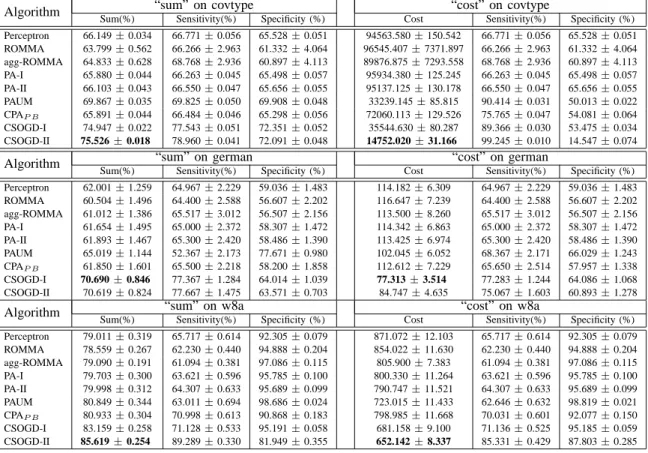
We first evaluate the weighted sum performance. The first three columns of Table 2 summarize the results of the algorithms. Some observations can be drawn below.
First of all, by examining the sum results, we found that CSOGD always achieves the best among all the datasets, which significantly outperforms all the online algorithms,
Table II
EVALUATION OF THE COST-SENSITIVE CLASSIFICATION PERFORMANCE OFCSOGDAND OTHER EXISTING ALGORITHMS. Algorithm Sum(%) “sum” on covtypeSensitivity(%) Specificity (%) Cost “cost” on covtypeSensitivity(%) Specificity (%)
Perceptron 66.149±0.034 66.771±0.056 65.528±0.051 94563.580±150.542 66.771±0.056 65.528±0.051 ROMMA 63.799±0.562 66.266±2.963 61.332±4.064 96545.407±7371.897 66.266±2.963 61.332±4.064 agg-ROMMA 64.833±0.628 68.768±2.936 60.897±4.113 89876.875±7293.558 68.768±2.936 60.897±4.113 PA-I 65.880±0.044 66.263±0.045 65.498±0.057 95934.380±125.245 66.263±0.045 65.498±0.057 PA-II 66.103±0.043 66.550±0.047 65.656±0.055 95137.125±130.178 66.550±0.047 65.656±0.055 PAUM 69.867±0.035 69.825±0.050 69.908±0.048 33239.145±85.815 90.414±0.031 50.013±0.022 CPAP B 65.891±0.044 66.484±0.046 65.298±0.056 72060.113±129.526 75.765±0.047 54.081±0.064 CSOGD-I 74.947±0.022 77.543±0.051 72.351±0.052 35544.630±80.287 89.366±0.030 53.475±0.034 CSOGD-II 75.526±0.018 78.960±0.041 72.091±0.048 14752.020±31.166 99.245±0.010 14.547±0.074
Algorithm Sum(%) “sum” on germanSensitivity(%) Specificity (%) Cost “cost” on germanSensitivity(%) Specificity (%)
Perceptron 62.001±1.259 64.967±2.229 59.036±1.483 114.182±6.309 64.967±2.229 59.036±1.483 ROMMA 60.504±1.496 64.400±2.588 56.607±2.202 116.647±7.239 64.400±2.588 56.607±2.202 agg-ROMMA 61.012±1.386 65.517±3.012 56.507±2.156 113.500±8.260 65.517±3.012 56.507±2.156 PA-I 61.654±1.495 65.000±2.372 58.307±1.472 114.342±6.863 65.000±2.372 58.307±1.472 PA-II 61.893±1.467 65.300±2.420 58.486±1.390 113.425±6.974 65.300±2.420 58.486±1.390 PAUM 65.019±1.144 52.367±2.173 77.671±0.980 102.045±6.052 68.367±2.171 66.029±1.243 CPAP B 61.850±1.601 65.500±2.218 58.200±1.858 112.612±7.229 65.650±2.514 57.957±1.338 CSOGD-I 70.690±0.846 77.367±1.284 64.014±1.039 77.313±3.514 77.283±1.244 64.086±1.068 CSOGD-II 70.619±0.824 77.667±1.475 63.571±0.703 84.747±4.635 75.067±1.603 60.893±1.278
Algorithm Sum(%) “sum” on w8aSensitivity(%) Specificity (%) Cost “cost” on w8aSensitivity(%) Specificity (%)
Perceptron 79.011±0.319 65.717±0.614 92.305±0.079 871.072±12.103 65.717±0.614 92.305±0.079 ROMMA 78.559±0.267 62.230±0.440 94.888±0.204 854.022±11.630 62.230±0.440 94.888±0.204 agg-ROMMA 79.090±0.191 61.094±0.381 97.086±0.115 805.900±7.383 61.094±0.381 97.086±0.115 PA-I 79.703±0.300 63.621±0.596 95.785±0.100 800.330±11.264 63.621±0.596 95.785±0.100 PA-II 79.998±0.312 64.307±0.633 95.689±0.099 790.747±11.521 64.307±0.633 95.689±0.099 PAUM 80.849±0.344 63.011±0.694 98.686±0.024 723.015±11.433 62.646±0.632 98.819±0.021 CPAP B 80.933±0.304 70.998±0.613 90.868±0.183 798.985±11.668 70.031±0.601 92.077±0.150 CSOGD-I 83.159±0.258 71.128±0.533 95.191±0.058 681.158±9.100 71.136±0.525 95.185±0.059 CSOGD-II 85.619±0.254 89.289±0.330 81.949±0.355 652.142±8.337 85.331±0.429 87.803±0.285
including two cost-sensitive online algorithms (PAUM and CPA). This shows that it is important to study effective cost-sensitive algorithms.
Second, by examining both sensitivity and specificity metrics, we found that CSOGD is not only guaranteed to achieve the best sensitivity for all cases, but also can produce a fairly good specificity performance for most cases. This shows that the proposed approach for CSOGD is effective in improving the accuracy of predicting the examples from the rare class.
Third, similar to the previous results, the two CSOGD al-gorithms in general achieved comparable sum performance, in which CSOGD-I tends to perform slightly better than CSOGD-II.
C. Evaluation of Weighted Cost Performance
We further evaluate the performance of the CSOLcos
algorithm in terms of the cost metric. The last three columns of Table 2 summarize the results of total cost evaluation. From the experimental results, we can also draw several observations.
First of all, we found that the two existing cost-sensitive algorithms (PAUM and CPAP B) usually outperform the
other cost-insensitive algorithms, in which PAUM seems to be more effective than CPAP B for most cases.
Second, among all the algorithms, we found that the proposed CSOGD algorithms achieve significantly less total misclassification cost than the other algorithms for most cases. For example, on the dataset “w8a”, the total mis-classification cost of CSOGD-II is about 20% less than that of PA algorithms, and about 10% less than that of PAUM.
Further, by examining both sensitivity and specificity metrics, we found that CSOGD often achieves the best sensitivity result, but does not always guarantee the best results for specificity. Finally, by examining the two CSOGD algorithms themselves, we found that CSOGD-II tends to perform sightly better than CSOGD-I (except on the dataset “german”).
VI. CONCLUSION
As an attempt to fill the gap between cost-sensitive classification and online learning in machine learning and data mining, this paper investigated a new framework of Cost-Sensitive Online Classification, which aims to directly optimize cost-sensitive measures for online classification tasks. We proposed a family of effective algorithms based on online gradient descent, theoretically analyzed their cost-sensitive bounds, and finally examined their empirical per-formance extensively. Our encouraging results show that
the proposed algorithms considerably outperform the tradi-tional online learning algorithms for cost-sensitive online classification tasks. Through this study, we hope to inspire researchers in both data mining and machine learning to further explore in-depth theory of cost-sensitive online clas-sification and the application of new cost-sensitive online learning techniques to tackle a variety of emerging chal-lenges in real-world data mining applications.
ACKNOWLEDGMENTS
This work was supported by Singapore MOE tier 1 project (RG33/11) and Microsoft Research project (M4060936).
REFERENCES
[1] R. Akbani, S. Kwek, and N. Japkowicz. Applying support vector machines to imbalanced datasets. In ECML, pages 39–50, 2004.
[2] P. L. Bartlett, E. Hazan, and A. Rakhlin. Adaptive online gradient descent. In NIPS, 2007.
[3] K. H. Brodersen, C. S. Ong, K. E. Stephan, and J. M. Buh-mann. The balanced accuracy and its posterior distribution. In ICPR, pages 3121–3124, 2010.
[4] N. V. Chawla, K. W. Bowyer, L. O. Hall, and W. P. Kegelmeyer. Smote: Synthetic minority over-sampling tech-nique. JAIR, 16:321–357, 2002.
[5] K. Crammer, O. Dekel, J. Keshet, S. Shalev-Shwartz, and Y. Singer. Online passive-aggressive algorithms. JMLR, 7:551–585, 2006.
[6] K. Crammer and Y. Singer. Ultraconservative online algo-rithms for multiclass problems. JMLR, 3:951–991, 2003. [7] P. Domingos. Metacost: a general method for making
classi-fiers cost-sensitive. In KDD’99, pages 155–164, San Diego, CA, USA, 1999. ACM.
[8] M. Dredze, K. Crammer, and F. Pereira. Confidence-weighted linear classification. In ICML, pages 264–271, 2008. [9] C. Drummond and R. C. Holte. C4.5, class imbalance, and
cost sensitivity: Why under-sampling beats over-sampling. In ICML’03 Workshop on Learning from Imbalanced Data Sets, pages 1–8, 2003.
[10] C. Elkan. The foundations of cost-sensitive learning. In IJCAI, pages 973–978, 2001.
[11] Y. Freund and R. E. Schapire. Large margin classification using the perceptron algorithm. Mach. Learn., 37(3):277– 296, 1999.
[12] C. Gentile. A new approximate maximal margin classification algorithm. JMLR, 2:213–242, 2001.
[13] J. Han and M. Kamber. Data Mining: Concepts and Tech-niques. Morgan Kaufmann, 2000.
[14] J. Kivinen, A. J. Smola, and R. C. Williamson. Online learning with kernels. In NIPS, pages 785–792, 2001.
[15] Y. Li and P. M. Long. The relaxed online maximum margin algorithm. In NIPS, pages 498–504, 1999.
[16] Y. Li, H. Zaragoza, R. Herbrich, J. Shawe-Taylor, and J. S. Kandola. The perceptron algorithm with uneven margins. In ICML, pages 379–386, 2002.
[17] Y.-F. Li, J. T. Kwok, and Z.-H. Zhou. Cost-sensitive semi-supervised support vector machine. In AAAI, 2010. [18] X.-Y. Liu and Z.-H. Zhou. The influence of class imbalance
on cost-sensitive learning: An empirical study. In Proceed-ings of the Sixth International Conference on Data Mining (ICDM’06), pages 970–974. IEEE Computer Society, 2006.
[19] A. C. Lozano and N. Abe. Multi-class cost-sensitive boosting with p-norm loss functions. In KDD’08, pages 506–514, Las Vegas, Nevada, USA, 2008. ACM.
[20] H. Masnadi-Shirazi and N. Vasconcelos. Risk minimization, probability elicitation, and cost-sensitive svms. In ICML, pages 759–766, 2010.
[21] F. Rosenblatt. The perceptron: A probabilistic model for in-formation storage and organization in the brain. Psychological Review, 65:386–407, 1958.
[22] M. Tan. Cost-sensitive learning of classification knowledge and its applications in robotics. Mach. Learn., 13(1):7–33, Oct. 1993.
[23] P. D. Turney. Cost-sensitive classification: Empirical evalu-ation of a hybrid genetic decision tree induction algorithm. JAIR, 2:369–409, 1995.
[24] K. Veropoulos, C. Campbell, and N. Cristianini. Controlling the sensitivity of support vector machines. In IJCAI, pages 55–60, 1999.
[25] J. Wang, P. Zhao, and S. C. Hoi. Exact soft confidence-weighted learning. In ICML, 2012.
[26] B. Zadrozny, J. Langford, and N. Abe. Cost-sensitive learning by cost-proportionate example weighting. In Proceedings of the Third IEEE International Conference on Data Mining (ICDM’03), pages 435–, Washington, DC, USA, 2003.
[27] P. Zhao, S. C. H. Hoi, and R. Jin. Double updating online learning. Journal of Machine Learning Research, 12:1587– 1615, 2011.
[28] P. Zhao, S. C. H. Hoi, R. Jin, and T. Yang. Online auc maximization. In ICML, pages 233–240, 2011.
[29] P. Zhao, J. Wang, P. Wu, R. Jin, and S. C. Hoi. Fast bounded online gradient descent algorithms for scalable kernel-based online learning. In ICML, 2012.
[30] X. Zhu and X. Wu. Class noise handling for effective cost-sensitive learning by cost-guided iterative classification filtering. IEEE Trans. on Knowl. and Data Eng., 18(10):1435– 1440, Oct. 2006.
[31] M. Zinkevich. Online convex programming and generalized infinitesimal gradient ascent. In T. Fawcett and N. Mishra, editors, ICML, volume 20, 2003.