ABOUT THE BCO
The British Council for Offi ces’ (BCO) mission is to research, develop and communicate best practice in all aspects of the offi ce sector. It delivers this by providing a forum for the discussion and debate of relevant issues.
ABOUT THE AUTHORS
The research team for this project included Michael Bedford, Rob Harris and Annetta King from Ramidus Consulting Limited, and Andrew Hawkeswood of IPD. We would like to acknowledge and express our deep gratitude for the contributions made to our research by a large number of people. Their invaluable help with time and data have contributed to creating a very robust report and set of fi ndings.
ACKNOWLEDGEMENTS
The Steering Group, listed below, provided valuable guidance throughout the study and we would like to thank the Group’s members for their contributions. Peter Williams, Aecom
Jenny Mac Donnell, British Council for Offi ces Richard Graham, Government Property Unit Mark Leeson, McBains Cooper
Chris Richmond, PricewaterhouseCoopers Melvin Rose, KPMG
Rick Wheal, Arup
IMAGES
COVER and PAGE 25 NBC Universal, London Courtesy of tp bennett PAGES 5 and 27 ITV, Manchester Courtesy of ID:SR/Overbury PAGE 10
Generation IM, London
Courtesy of Pringle Brandon Perkins + Will
PAGES 9 and 35
Microsoft, Project Edison, Reading
Courtesy of Pringle Brandon Perkins + Will
COPYRIGHT © BRITISH COUNCIL FOR OFFICES 2013
All rights reserved by British Council for Offi ces. No part of this publication may be reproduced, stored or transmitted in any form or by any means without prior written permission from the British Council for Offi ces. The BCO warrants that reasonable skill and care has been used in preparing this report. Notwithstanding this warranty the BCO shall not be under liability for any loss of profi t, business, revenues or any special indirect or consequential damage of any nature whatsoever or loss of anticipated saving or for any increased costs sustained by the client or his or her servants or agents arising in any way whether directly or indirectly as a result of reliance on this publication or of any error or defect in this publication. The BCO makes no warranty, either express or implied, as to the accuracy of any data used by the BCO in preparing this report nor as to any projections contained in this report which are necessarily of any subjective nature and subject to uncertainty and which constitute only the BCO’s opinion as to likely future trends or events based on information known to the BCO at the date of this publication. The BCO shall not in any circumstances be under any liability whatsoever to any other person for any loss or damage arising in any way as a result of reliance on this publication.
Conclusions 27
Headline results 27
Trends and data 28
Occupier characteristics 28
Specifi cation 30
The future 30
References 32 Contributors 33 Appendix 1 – The 2009 BCO occupation
densities study 34
Appendix 2 – Technical notes and defi nitions 36
CONTENTS
Executive summary 4
Headline results 4
Density increases slowing 5
Market diversity 5
The lessons of effective density 6 Local density and building density 6
Unintended consequences 6
A change to guidance? 7
Disclaimer 7
Introduction 8
Brief and objectives 8
Approach 8
Occupation density 10
The nature of intensifi cation 10
Measuring density 11
Effective density 12
Density and BCO guidance 13
Data analysis 14
Whole building analysis 14
Sector analysis 16
Regional analysis 19
Floor-by-fl oor analysis 20
Density and size of property 22
Effective densities 22
OCCUPIER DENSITY STUDY 2013
EXECUTIVE SUMMARY
HEADLINE RESULTS
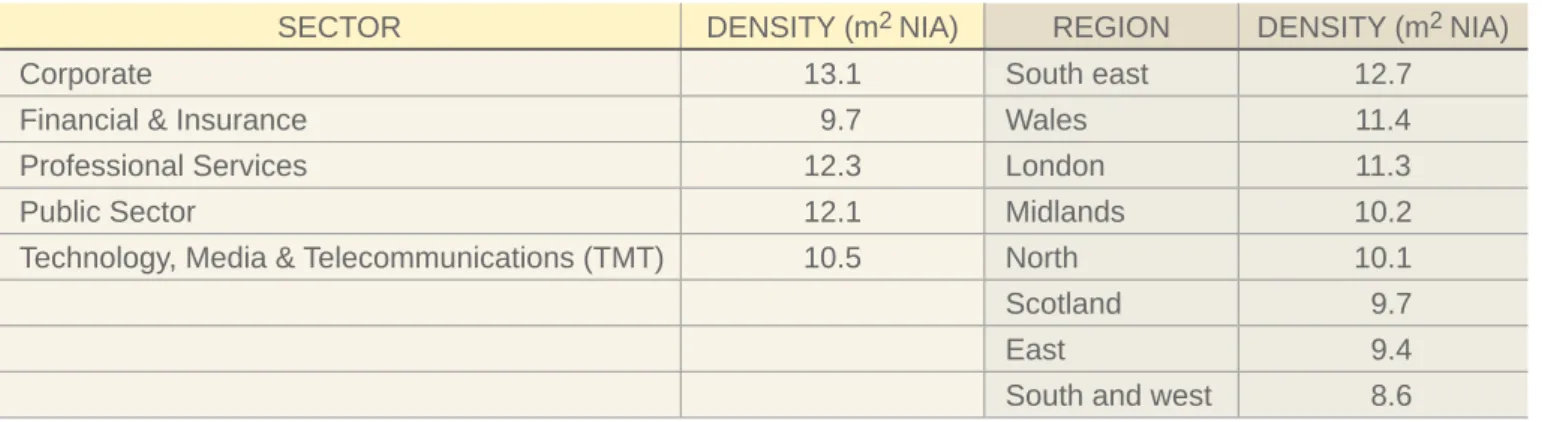
The overall fi nding is a mean density of one workplace per 10.9 m2 net internal area (NIA). Of the sample properties 38% fall within the range 8–10 m2, while
58% fall within the wider range of 8–12 m2.
A breakdown by sector (Table 1) shows that the lowest and highest densities are in the Corporate (13.1 m2)
and Financial & Insurance (9.7 m2) sectors, respectively.
The high densities in the Financial & Insurance sector are often pushed up by particularly high densities in parts of buildings. The regional breakdown (Table 1) shows that the south and west region has the highest density, at 8.6 m2. London and the south east have lower densities
than all but one of the other regions, a result partly
explained by the fact that London buildings typically have a greater proportion of their space allocated to lower density uses such as client entertainment and meeting space. As well as the main data exercise, we undertook an analysis of data held by IPD, from 2008 to 2012, including whole building, sector and location, and in time series. We examined 4.37 million m2 (47 million ft2)
in 823 properties from the private sector data set and 4.08 million m2 (44 million ft2) from the central
government dataset. We calibrated the IPD data to correspond with the sector breakdown from the main study to allow direct comparison and validation between the two data sets.
Table 1 Breakdown of results by sector and region.
SECTOR DENSITY (m2 NIA) REGION DENSITY (m2 NIA)
Corporate 13.1 South east 12.7
Financial & Insurance 9.7 Wales 11.4
Professional Services 12.3 London 11.3
Public Sector 12.1 Midlands 10.2
Technology, Media & Telecommunications (TMT) 10.5 North 10.1
Scotland 9.7
East 9.4
South and west 8.6
This study was commissioned by the BCO, in January 2013. The key objective was to gather and analyse a representative sample of occupation density data with which to inform the forthcoming 2014 Guide to Offi ce Specifi cation.
A key aspect of the BCO Guide to Specifi cation is the set of guidelines on design features such as means of escape, sanitation, lifts and air handling. Robust
guidance in these areas is dependent on strong evidence of occupation densities. Such evidence is also critical for occupiers planning accommodation to meet their operational requirements.
The main data set comprised 2,485,484 m2 (26,753,753 ft2)
of offi ce space, spread across 381 properties and 1331 individual fl oors.
DENSITY INCREASES SLOWING?
MARKET DIVERSITY
Evidence presented here (see Density Over Time, p. 25), and a host of anecdotal evidence, suggests that densities have risen over recent years as economic pressure and technology enablement have combined to encourage changes in workstyles. However, it is to be expected that this increase in densities should level out at some point – densities can only increase so far. Our data suggest that this might be happening now and, if true, this has important implications for guidance on specifi cation. Such a trend suggests a reducing need to increase building specifi cation to future-proof against higher densities.
Despite the evidence that density averages might be levelling out, it was reported during our stakeholder interviews that there is a perception among some advisors that density levels are continuing to rise.
There is little doubt that, in a diverse market (see below), there will be instances where this is true. There might even appear to be a pattern of instances. But caution needs to be exercised in extrapolating from the particular to the general. There are implications attached to allowing the specifi c and perceived needs of a small (albeit important) segment of the demand market to determine the supply response across the whole market. A further enhancement in design standards would be a signifi cant step, not least due to the implications for construction costs, net-to-gross ratios and environmental considerations.
It is imperative, therefore, that the perception of change is borne out by reality and is demonstrable across a broad cross-section of the occupier market in different locations.
One of the key issues here is the extent to which a potential shift in design guidance might be driven by the specifi c needs of a small sector of demand. This subset of demand is typifi ed by large occupiers of (often) central London buildings, who have specifi c demands in terms of trading fl oors and other high-use areas within buildings. Yet, demand is highly diverse, and in the years since the credit crunch a reduction in leasing activity by the Financial and Professional
services sector has been balanced by a rise in the activity of other sectors, particularly Technology, Media & Telecommunications (TMT).
What this highlights is the diversity of the demand market, and the fact that the occupancy styles of large sections of that market make very different demands on buildings to those in the Financial and Professional services sectors.
OCCUPIER DENSITY STUDY 2013
As fl exible workstyles continue to spread, typical space budgets within buildings are changing. While at one time, a typical space budget might have comprised 80% fi xed workplaces, 15% meeting space and 5% other support space (post rooms, computer rooms etc.), today’s typical offi ce is far more dynamic. An offi ce today is likely to have a greater variety of workstation settings, but in a smaller proportion of the overall space budget. The main factor causing the shift is a growth in meeting space – client entertainment, formal meeting rooms, collaborative space and other forms of space to cater for mobile working.
This has the effect of introducing variable densities in buildings. For example, while workplaces on a purely work fl oor might be planned to a high density (say, 8 m2),
other areas of the same building might be allocated to meeting and client entertainment space, reducing workplace densities there signifi cantly (say 18 m2). Overall, there might be a mean density of, say, 10 m2.
The response within the development sector is a tendency to cater for the highest densities across the whole space: providing for the worst-case scenario, everywhere, from day one. The question is whether we should be more accepting of buildings responding to changing occupier needs over time, by enabling them to adapt to specifi c increased demands on building services. Most, if not all, buildings should have the potential to increase densities locally. Support fl oors with few workplaces are not necessarily low density, and therefore also require the potential for enhancement.
If the market continues to enhance the specifi cation of buildings in the belief that more intensive use will continue to increase demands on their services, then costs will be added to construction, usable fl oorspace will be lost, and there will be environmental consequences.
Of course, occupiers require fl exibility, to be able to change layouts and use profi les as business changes dictate. It might be argued that a higher specifi cation building can be ‘turned down’ in performance terms if it is not occupied to the optimum level, and that this will
extend the life of the plant etc. But is this what happens in practice? Will occupiers really adjust systems to suit differing densities over time?
Does the optimum fl exibility afforded by high specifi cation, and required by a relatively small segment of the demand market, justify its blanket provision? There is no evidence that we are aware of which suggests that any buildings constructed in the past, say, 15 years have been unable to cope with higher densities due to their design standard of 1:10 (or even 1:12).
LOCAL DENSITY AND BUILDING DENSITY
UNINTENDED CONSEQUENCES
THE LESSONS OF EFFECTIVE DENSITY
It is clear from a wide range of empirical work that the densities to which buildings are designed, the densities to which they are then laid out, and the densities at which they are in fact occupied (both peak and mean), are all very different. We are aware, for example, of many organisations that have introduced fl exible working styles, in the expectation that utilisation rates would increase substantially, but where occupation levels very rarely exceed 80%.The implication here is that this study’s headline mean density of 10.9 m2 should be clearly understood as a headline workplace density, not a headline occupation density, due to almost constant levels of underutilisation. Effective density is a more reliable guide to actual occupation density than relying on a simple workstation density.
A CHANGE TO GUIDANCE?
DISCLAIMER
While showing an increase in densities from the previous survey in 2009, the fi ndings of this study remain broadly in line with current BCO guidance on densities. However, the study has emphasised the
need to design for diversity, allowing densities to be raised locally in all buildings (not just those for users, such as banks, with trading functions).
We would like to stress at this point that the views expressed in this report are entirely those of the principal authors, and should not be taken in any
way to refl ect the views of any of those individuals or organisations acknowledged here.
OCCUPIER DENSITY STUDY 2013
The context for this study is the BCO Guide to Offi ce Specifi cation. Last published in 2009, this document provides guidance for best practice in all aspects of offi ce design. The Guide has become the accepted industry standard, providing authoritative guidance to developers, occupiers and property professionals. A fundamental aspect of the Guide is occupation density, because it determines critical design features such as means of escape, sanitation, lifts and air handling. In order to be able to provide robust guidance in these areas, it is necessary to have good evidence
of occupation densities. Such evidence is also critical for occupiers in selecting and planning accommodation so that it meets their specifi c operational requirements. To meet this need, the 2009 Guide was underpinned by a major study of occupation densities.1
The present study was commissioned by the BCO, in January 2013. The key objective was to gather and analyse a representative sample of occupation density data with which to inform a revised BCO guide, due to be published in 2014. In addition, the aim was to compare the 2013 data with the evidence base of the 2009 Guide.
Stage 1 – Main data exercise
The main data collection and analysis for this study involved working with the BCO membership. Occupiers contributed data from their own occupied portfolios, while developers, designers and owners contributed data from projects in which they had recently been involved. The sample size in this phase of the work comprised 2,485,484 m2 (26,753,753 ft2), spread across 381
properties and 1331 individual fl oors.2 This sample provides a very robust data set, which was broken down into location, sector, age and size, and analysed. All buildings in the sample contained the net internal area for all fl oors, the number of workplaces by fl oor, and density measures for all fl oors.
Stage 2 – IPD data
In addition to the main data exercise we compared our data set with the IPD database. IPD is a well-known and respected organisation specialising in property
market benchmarking. Data collected by IPD is validated with occupiers to ensure accuracy. The data set is categorised and classifi ed within the internationally recognised Global Estate Management Standards, which cover space, cost and environment. Our analysis of the IPD data included 4.37 million m2
(47 million ft2) in 823 properties from the private sector
data set, and 4.08 million m2 (44 million ft2) from
the central government dataset. One of the critically important aspects of the IPD data set is its annual refresh and validation, which allows for time-series analysis. We therefore analysed the data from 2008 to 2012. We also calibrated the IPD data to correspond with the sectoral breakdown in the main study, to allow direct comparison between the two data sets.
Stage 3 – Perception study
The third workstream comprised a series of discussions with developers and advisors. The purpose here was
BRIEF AND OBJECTIVES
APPROACH
INTRODUCTION
1. Occupier Density Study: Summary Report, June 2009. A brief summary is included as Appendix 1. While the report was published in 2009, the data were collected in 2008.
2. In the equivalent survey for the 2009 study, the sample comprised 2,005,268 m2 (21,584,703 ft2), across 249 properties and
to gain a market perspective from those involved in the day-to-day supply of new buildings, and whether they thought that changes to BCO guidance was required. These interviews followed a semi-structured format,
and drew out a number of issues that have helped inform the wider analysis of the data for this study and the conclusions which we have drawn.
BCO OFFICE OCCUPATION DENSITY STUDY 2013
It is estimated that around half of the near 30 million workers in the UK work in offi ces. Commercial offi ces continue to be a major building type, representing 29% of all non-domestic stock. At £224 billion, the total value of offi ces represents 31% of the total value of all UK commercial stock.3
The manner in which offi ces are occupied is important from two conceptual perspectives: planning and management. Planning (policy, design and delivery) must understand how offi ces are occupied in order to ensure that the provision of offi ce stock broadly matches demand. Management (occupation) must ensure that the cost of offi ce space is aligned with commercial priorities through effi cient occupation of space. At each stage the density measure supports decision-making as a proxy measure of business activity.
At the planning stage the density fi gure allows planners to understand the economic activity that might be generated through potential employment, and therefore the approximate amount of space that needs to be built. In design, density provides a means
of sizing the core (including lifts, fi re egress, stairs and toilets), mechanical and electrical services, and other building and facility management support services (e.g. cleaning, waste management, catering and security). The density fi gure in occupation provides management with information on occupancy costs, statutory design capacities and the ability to estimate the practical building capacity for business planning.
THE NATURE OF INTENSIFICATION
OCCUPATION DENSITY
The twin forces of economics and technology have encouraged occupiers in recent years to assess their occupation of space and seek to make effi ciency savings. In terms of economics, public and private sector
organisations have been under severe pressure to reduce accommodation costs. Rents and rates, which are driven by demand for space, represent about 60% of occupancy costs, and, if demand for space can be managed downwards, then signifi cant savings can be made. The second driving force has been the proliferation of information technology, which has enabled
mobility, networking and collaboration, and has led to organisational transformations, with growing numbers of organisations introducing fl exible working styles.
The economic pressures and technological enablement have transformed the effi ciency and effectiveness with which real estate can now be managed. Expensive property is now being used far more intensively than in the past, and new standards for best practice in space management are emerging.
There are two principal means of achieving more intensive use of space. First, space allocations per workplace are reduced, typically through more open plan and fewer enclosed offi ces, and space being dedicated to circulation and unnecessary ancillary uses.4
The second step to intensify the use of space is to manage the work environment more dynamically by introducing 3. Property Industry Alliance (2012) Property Data Report 2012.
Figure 1 Intensifi cation of space use.
fl exible working. It is well known that traditional offi ce layouts are underutilised most of the time due to people being out of the offi ce, and many organisations have introduced fl exible working styles and desk sharing as a means of improving their use of space. More dynamic use of space allows a building to support more people in the same amount of space: spaceless growth. The impact can be dramatic, often reducing an organisation’s need for space by around 20–30%. Figure 1 provides a simple model of these dynamics.
In terms of workplace optimisation, many organisations are now working towards targets for increased
workplace density and higher utilisation.
The picture is further complicated by the introduction of hot desks, drop-in desks and so on. It is thus important
to recognise that space use is not homogenous, and that there has been a shift in the balance between workspace, ancillary space and support space in offi ce buildings. It is necessary to distinguish between the most densely occupied parts of buildings and the overall building density.
The ability to increase occupation density is a key element of fl exibility for an occupier. In this sense, higher specifi cation to support higher density is demand driven. However, the higher the specifi cation of building infrastructure, the more expensive the overall product, in terms of both construction and life-cycle costs. A key issue for developers (and the property industry more widely), therefore, is what the appropriate response might be from the supply side. 1050 workstations in 14,000 m2 1300 workstations in 14,000 m2
1050 assigned @ 1:1 None shared 850 assigned @ 1:1 450 shared @ 1:6
1050 people
1050 people supported at a density of 13.3 m2/person/workstation
1570 people supported at a density of 10.7 m2/workstation
and an average utilisation rate of 1.2 person/workstation
N/A 850 people 720 people
Scenario 1 Traditional layout
Scenario 2 Flexible workstyles
Occupational density is commonly calculated using the net internal area (NIA), and it is usual to calculate density for whole buildings, i.e. to express density as
the total NIA divided by the total number of workplaces in the building. NIA is unambiguous, and is defi ned in the Royal Institution of Chartered Surveyors (RICS)
MEASURING DENSITY
OCCUPIER DENSITY STUDY 2013
Code of Measuring Practice. It is the usable space within a building measured to the internal fi nish of structural, external or party walls, but excluding toilets, lift and plant rooms, stairs and lift wells, common entrance halls, lobbies and corridors, internal structural walls and car-parking areas.
However, the appropriate population of a building can be more problematic to measure than the area. There are three relevant measures of population:
I The notional population defi ned by the number of workplaces planned in the property. In other words, the maximum population which the interior of the property has been designed to support.
I The total number of people for whom the property is their normal base. This might be less than the notional population where the property is underoccupied for any reason. In organisations in which fl exible working styles are adopted, the total number of people can be greater than the notional population.
I The number of workplaces being used at any one time. Studies regularly show that this number is less than the notional population, consistently running at between 50% and 60% of the notional population.
It is thus possible to take these measures of population to distinguish three types of occupation density:
I Work place density (square metres per workplace) NIA divided by the number of workplaces the property contains or has been designed to support. This is the most useful measure of density for assessing requirements for building infrastructure, or identifying the maximum number of people that a known building can accommodate at any one time. I Population density (square metres per worker/FTE)
NIA divided by the number of people that the property supports. It is not uncommon for the population to be higher than the workplace density, i.e. the property supports more people than the number of workplaces it contains, and functions on the basis of fl exible working styles.
I Effective density As noted, buildings, or the
workplaces and other spaces within them, are rarely, if ever, occupied to maximum capacity. For many organisations the maximum number of workplaces in use is signifi cantly below the number planned.
EFFECTIVE DENSITY
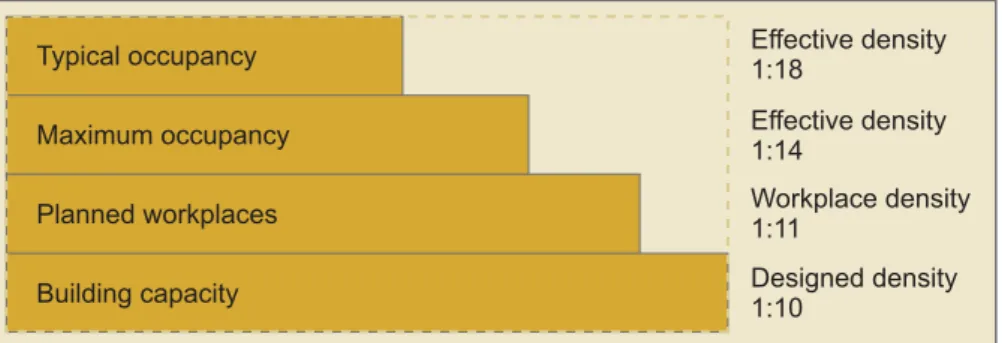
The dynamics of effective density are shown in the model in Figure 2. It is people, not workplaces, that create the demand for building services, stairs and other vertical circulation. Considering workplace density alone can overstate the actual demands placed on building infrastructure. The fi gures used to illustrate effective density here are hypothetical, although not untypical for many organisations.
Effective density is thus a function of workplace density and utilisation (workplace density divided by
the maximum utilisation of workplaces, expressed as a percentage). At 100% utilisation, workplace density equates to effective density.
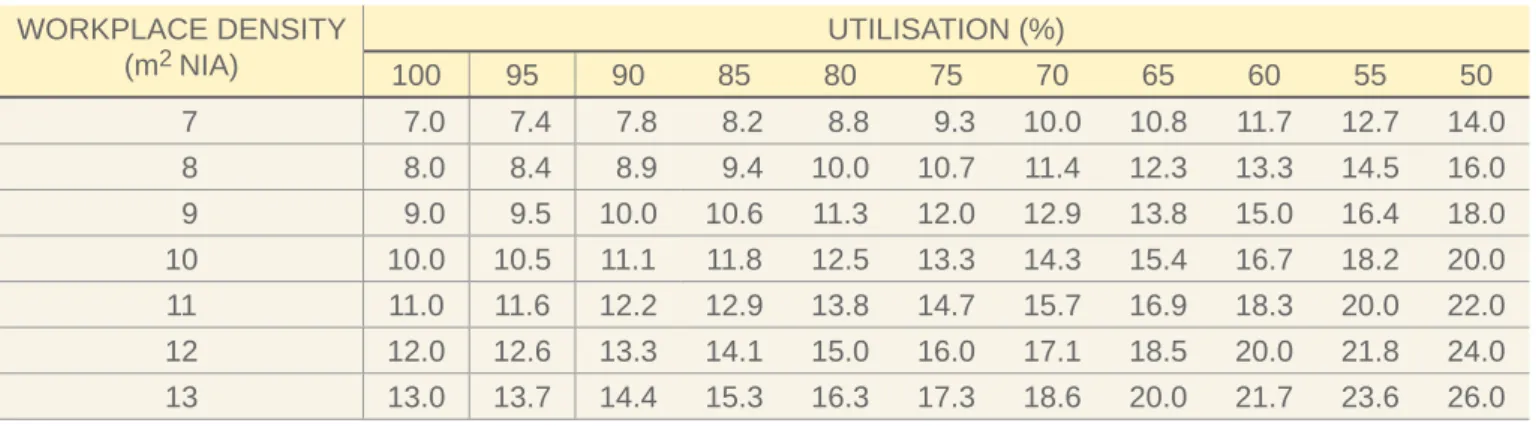
The impact of applying utilisation rates is shown in Table 2 (reproduced from the 2009 study). As noted above, effective density is expressed as NIA per person (per occupied workplace), and is a better guide to actual demands on building infrastructure.
Figure 2 Effective density.
Typical occupancy Effective density1:18 Effective density 1:14 Workplace density 1:11 Designed density 1:10 Maximum occupancy Planned workplaces Building capacity
DENSITY AND BCO GUIDANCE
Table 2 Utilisation and effective density.WORKPLACE DENSITY (m2 NIA) UTILISATION (%) 100 95 90 85 80 75 70 65 60 55 50 7 7.0 7.4 7.8 8.2 8.8 9.3 10.0 10.8 11.7 12.7 14.0 8 8.0 8.4 8.9 9.4 10.0 10.7 11.4 12.3 13.3 14.5 16.0 9 9.0 9.5 10.0 10.6 11.3 12.0 12.9 13.8 15.0 16.4 18.0 10 10.0 10.5 11.1 11.8 12.5 13.3 14.3 15.4 16.7 18.2 20.0 11 11.0 11.6 12.2 12.9 13.8 14.7 15.7 16.9 18.3 20.0 22.0 12 12.0 12.6 13.3 14.1 15.0 16.0 17.1 18.5 20.0 21.8 24.0 13 13.0 13.7 14.4 15.3 16.3 17.3 18.6 20.0 21.7 23.6 26.0
The evidence presented in this report is aimed at informing the forthcoming BCO Guide to Specifi cation, particularly in areas of specifi cation such as means of escape, sanitation and air handling. At this level, it is concerned with the maximum capacity of a building at any one point in time. Because of this focus, we have not addressed fl exible working styles (beyond the brief
discussion in this section and in Effective Densities on page 22, where we show the impact of effective densities on our sample), because they do not change the ‘at any one point in time’ discussion. Consequently, occupation density in this report is defi ned in terms of square metres per workplace, as the key indicator of potential capacity.
OCCUPIER DENSITY STUDY 2013
In this section we present the fi ndings of the main data exercise. As stated in the introduction, the sample size from this phase of work was 2,485,484 m2 (26,753,753 ft2). The sample was spread across 381 properties and
1331 individual fl oors. Our 2013 sample is larger than the one in the 2009 study, but it has a similar sectoral and spatial spread.
WHOLE BUILDING ANALYSIS
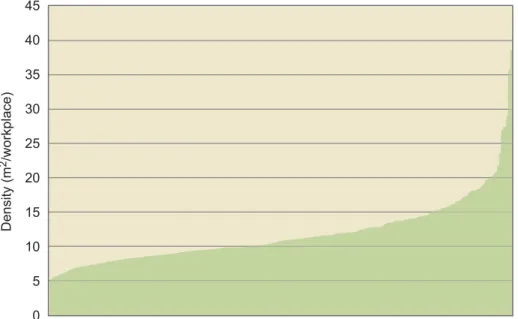
Figure 3 shows the full sample of 381 properties. The overall mean density across the sample is 10.9 m2/
workplace. The median value is 10.8 m2/workplace,
demonstrating a good normal distribution. The mean value of 10.9 m2 compares with 11.8 m2 in the 2009
study. This represents a signifi cant shift, but one that could be in line with a longer term trend that suggests a possible slowing down of the rate of increase in densities. This question is returned to in Density Over Time on page 25.
At the high density end we have predominantly Insurance and other Financial companies, including
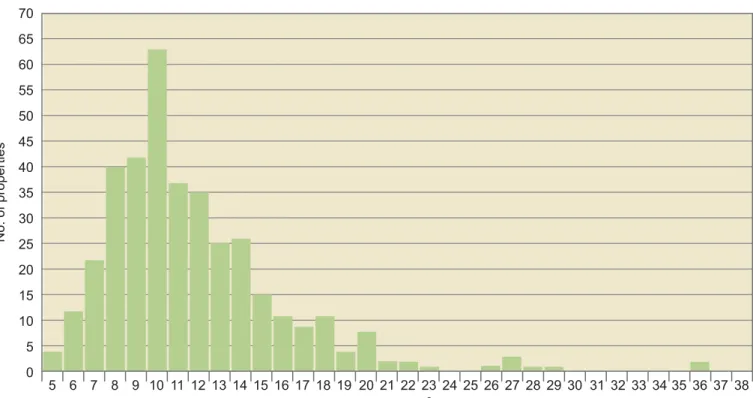
contact-centre-related functions. The lower density end is typifi ed by Corporate headquarters, some legal fi rms, and occupiers with a high proportion of support space. Figure 4 shows the whole sample data set again, but by the number of properties in each density band. Of the total sample, 38% of the properties fall within the 8–10 m2
range, while 58% fall within the wider 8–12 m2 range.
Figure 4 shows 38 properties at 7 m2 or less. This partly
refl ects the presence of contact-centre-type activity within the sample, but it also points to back-offi ce activity and process-oriented environments.
DATA ANALYSIS
Figure 3 Whole-sample building densities.
Properties ordered from highest (left) to lowest (right) density
Density (m 2/workplace) 0 5 10 15 20 25 30 35 40 45
By contrast, there are also a number of properties which exceed 25 m2. This latter group is statistically
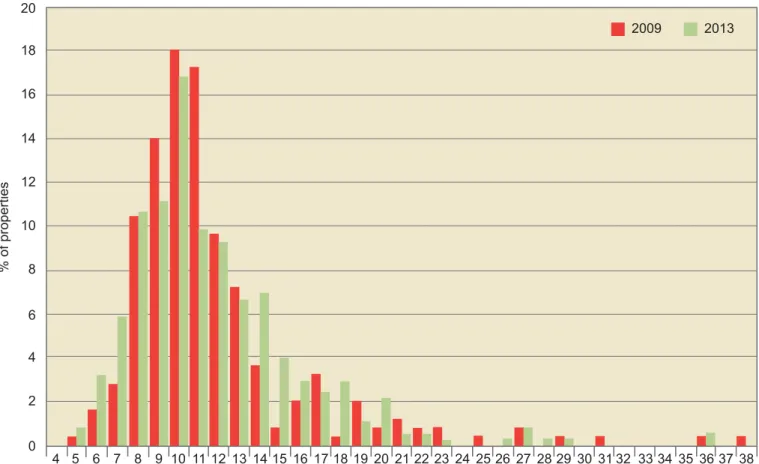
insignifi cant in terms of the overall result, and we have excluded it from the analysis in certain charts in this report simply for clarity of presentation purposes. Figure 5 compares the 2013 data set with that from the 2009 study in terms of size bands. The graph shows some interesting dynamics:
I an increase in the proportion of properties occupied in the higher 6–7 m2 range
I an increase in the proportion of properties occupied in the lower 14–16 m2 range
I a reduction in the proportion of properties occupied in the 9–11 m2 range.
One possible explanation for this is that Financial & Insurance fi rms (the largest sector in the sample) have moved more quickly than other sectors towards higher densities, reducing the mid-range representation, with a knock-on effect on the lower density ranges.
It is interesting to compare these results with those of the 2009 study (Table 3). It can be seen that the proportion of both higher densities and lower densities
has increased relative to a decrease in the proportion of properties in the middle size band.
At the denser end of the spectrum the differences between 2009 and 2013 are possibly explained by a combination of the following:
I a higher proportion of insurance sector properties in the sample
I continued increases in occupation density in the intervening period as some sectors (e.g. insurance and fi nance generally) continue to intensify use. At the other end of the spectrum the larger sample appears to be more balanced, with a smoother tail. Figure 4 Whole-sample building densities by density band.
Table 3 Comparison of the 2009 and 2013 data sets
by size band.
STUDY PROPORTION OF PROPERTIES (%) <8 m2 NIA 8–13 m2 NIA >13 m2 NIA
2009 5 77 18
2013 10 64 26
Density bands (±0.5 m2/workplace)
No. of properties 0 5 6 7 8 9 10 11 12 13 14 15 16 17 18 19 20 21 22 23 24 25 26 27 28 29 30 31 32 33 34 35 36 37 38 5 10 15 20 25 30 35 40 45 50 55 60 65 70
OCCUPIER DENSITY STUDY 2013
Figure 5 Density bands, 2013 and 2009 compared.
SECTOR ANALYSIS
All the companies in the sample were grouped into fi ve key sectors:
I Financial & Insurance I Professional Services
I Technology, Media & Telecoms (TMT) I Corporate
I Public Sector.
The Professional Services sector includes lawyers, accountants, management consultants and property companies. The Corporate category includes energy, engineering, food, manufacturing, mining, property and retail companies. The Public Sector category includes central government, local authorities and the third sector. Figure 6 shows the sector breakdown of the sample, and compares the current fi ndings with those of the
2009 study. The 2013 breakdown shows 40% of the sample in the Financial & Insurance sector, and a further 26% in Professional Services. The TMT and Corporate categories contribute 15% and 13%, respectively, to the sample, while the Public Sector comprises 6%.
The comparison with the 2009 study shows that the most recent data include a larger representation by TMT and Corporate occupiers, and less from Public Sector and Professional Services.
As part of our study we compared the 2013 BCO sample data with the IPD data set. The BCO mean density of 10.9 m2 was lower than the IPD mean
of 9.9 m2 . However, the IPD data set contained a
signifi cantly higher representation from the Financial & Insurance sector. In order to compare the two data sets we ‘recalibrated’ the IPD data set to refl ect a similar sector breakdown. Once this exercise was completed, Density bands (±0.5 m2/workplace)
% of properties 0 5 4 6 7 8 9 10 11 12 13 14 15 16 17 18 19 20 21 22 23 24 25 26 2009 2013 27 28 29 30 31 32 33 34 35 36 37 38 2 4 6 8 10 12 14 16 18 20
the IPD mean moved much closer to the value in the BCO sample, averaging out at 10.8 m2.
The results of the sector analysis are shown in Table 4. It can be seen that the sector spread is wide, refl ecting different prevailing workstyles within the sectors. The fi gure of 13.1 for the Corporate sector refl ects a predominance of headquarters’ functions and a high proportion of client entertainment and meeting space. The Financial & Insurance sector shows the highest overall density, and this refl ects a large representation of back-offi ce and contact-centre functions, as well a generally more aggressive approach to densities in general offi ce areas. This is particularly the case in the insurance sector.
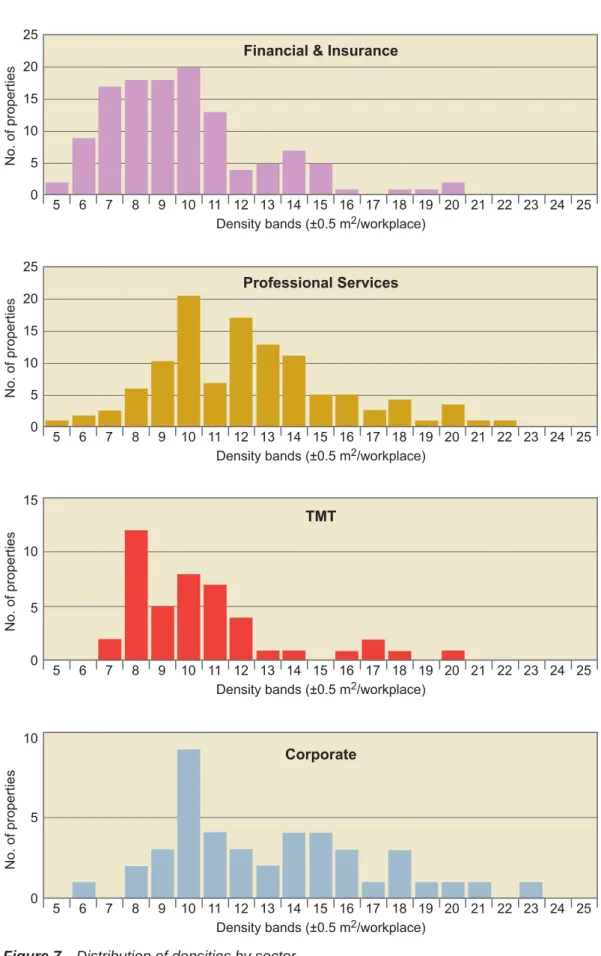
Figure 7 shows results for a number of sectors to illustrate the diversity between the various industry groupings. The mean density for the Financial & Insurance sector is 9.7 m2. This is the highest density
sector across the sample, which is no surprise. Many banks and insurance companies have tightly packed
areas, such as trading fl oors, but they also tend to occupy general offi ce space at higher densities. The sector also shows a relatively tight distribution, with a large number of cases in the 7–11 m2 range.
The mean density for Professional Services, including lawyers, accountants, management consultants and property companies, is 12.3 m2. This sector shows a
wider distribution than the other sectors, and this is explained by a couple of key occupancy characteristics. Management consultants have a greater propensity for fl exible working styles, and they provide many of the higher density results. By contrast, lawyers typically retain a higher proportion of cellular and allocated space, thus providing more of the lower density results. It is thus quite a divergent sector in density terms. The data show that the mean density for accountancy organisations is 11.1 m2/workplace while the equivalent
fi gure for legal fi rms is 17.3 m2/workplace.
The mean density in the TMT sector is 10.5 m2. The
graph illustrates quite a tight bunching of results, with by far the greatest number of cases lying between 8 m2 and 11 m2. The TMT sector is a very diverse one, including
large corporate environments with tightly planned layouts, as well as more creative, looser layouts. The mean value for this sector should thus be treated with caution. The mean density among Corporate occupiers is
13.1 m2. This sector includes energy, engineering, food,
manufacturing, mining, property and retail. Many of the occupations were headquarters functions. The data show a wider distribution than the other sectors shown here, with much weaker concentration around certain densities. Figure 6 Sector breakdown, 2013 and 2009.
Corporate
Financial and insurance Professional services Public sector TMT
2009
2013
8.3% 8.9% 10.2% 31.9% 40.6% 13% 15% 6% 26% 40%Table 4 Overall sector analysis.
SECTOR m2 NIA
Corporate 13.1
Professional Services 12.3
Public Sector 12.1
TMT 10.5
OCCUPIER DENSITY STUDY 2013
Figure 7 Distribution of densities by sector.
Financial & Insurance
5 5 6 7 8 9 10 10 0 11 12 13 14 15 15
Density bands (±0.5 m2/workplace)
No. of properties 21 22 23 24 25 25 16 17 18 19 20 20 Professional Services 5 5 6 7 8 9 10 10 0 11 12 13 14 15 15
Density bands (±0.5 m2/workplace)
No. of properties 21 22 23 24 25 25 16 17 18 19 20 20 TMT 5 5 6 7 8 9 10 10 0 11 12 13 14 15
Density bands (±0.5 m2/workplace)
No. of properties 21 22 23 24 25 15 16 17 18 19 20 Corporate 5 5 6 7 8 9 10 0 11 12 13 14 15
Density bands (±0.5 m2/workplace)
No. of properties
21 22 23 24 25 10
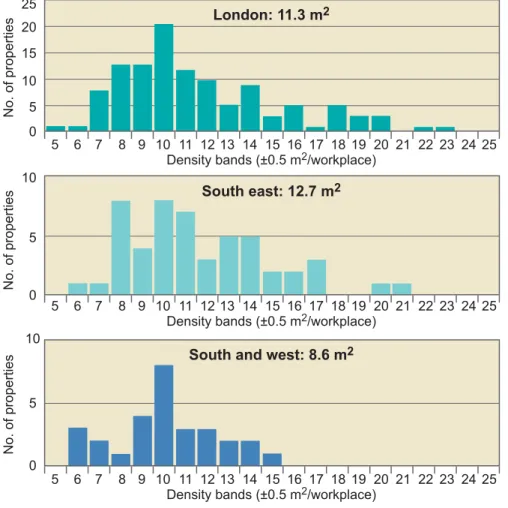
We analysed the sample in terms of eight broad regional categories. Table 5 shows the density from the lowest to the highest. It is perhaps a little surprising to record that London and the south east have lower densities than all but one of the other regions, as it is generally perceived that London densities are higher due to the higher land costs (rent).
There are possibly two, at least partial, explanations for this. First, a relatively high proportion of new buildings in the regions have been built for call centres, contact centres and back offi ces, and are therefore used more intensively. Secondly, London buildings typically have a greater proportion of space allocated to lower density uses such as client entertainment and meeting space. Neither of these traits is verifi able in this study, but they might help explain at least some of the difference. Figure 8 shows density bands by region for three example regions. The charts illustrate well why the
south east mean density (12.7 m2), for example, is
signifi cantly lower than that for London (11.3 m2), with
a wider spread of values. Similarly, the high density recorded in the south and west (8.6 m2) can be seen in
the chart, with a tighter bunching of results.
REGIONAL ANALYSIS
Table 5 Regional densities.
REGION m2 NIA South east 12.7 Wales 11.4 London 11.3 Midlands 10.2 North 10.1 Scotland 9.7 East 9.4
South and west 8.6
Figure 8 Density bands by region.
London: 11.3 m2 5 5 6 7 8 9 10 10 0 11 12 13 14 15 15
Density bands (±0.5 m2/workplace)
No. of properties
21 22 23 24 25 25
16 17 18 19 20
5 6 7 8 9 10 11 12 13 14 15
Density bands (±0.5 m2/workplace)
21 22 23 24 25 16 17 18 19 20
5 6 7 8 9 10 11 12 13 14 15
Density bands (±0.5 m2/workplace)
21 22 23 24 25 16 17 18 19 20 20 South east: 12.7 m2 5 10 0 No. of properties
South and west: 8.6 m2
5 10
0
OCCUPIER DENSITY STUDY 2013
Mention has already been made in Occupation Density (see p. 10)of the signifi cance of density diversity across buildings – some parts of buildings are occupied at far greater densities than other parts. The most obvious example is the contrast between client entertainment and meeting fl oors and general offi ce areas.
We analysed our sample on this basis to understand the level of diversity, and the overall results are captured in Figure 9. The graph shows those fl oors populated with workplaces arranged in order of
decreasing density. More than 50% of these fl oors have a density of 1 workplace per 10 m2.
Figure 10 develops the chart in Figure 9, showing more detail of the proportion of fl oor density bands by number of fl oors and total area studied. In terms of fl oors, 26% of fl oors fall into the less than 8 m2 band, while a further 21% fall into the 8–10 m2 band and 16% in the 10–13 m2 band. It will also be seen, importantly, that 14% of the fl oors studied are dedicated to support functions and have no workplaces. While not accommodating workplaces, these might be densely occupied at various times, as conference fl oors or cafeteria, for instance. The potential effective density of a fl oor dedicated to conference use is likely to be equivalent to the most densely occupied offi ce fl oors. It is worth noting in passing that a meeting seat on a conference fl oor is
likely to be occupied by someone who has vacated a workplace in this or another offi ce building. A tightly scheduled world of work where all workplaces and all meeting seats (not to mention other workplace settings) are occupied at any one time is likely to remain illusory. In terms of area studied, 27% of the total area falls into less than 8 m2 band, and a further 25% falls into the 8–10 m2 band. As a proportion of total area studied, space dedicated to support functions falls to 6%. Finally in this fl oor-by-fl oor analysis, Figure 11 shows a breakdown of fl oor densities comparing data from this study with that of the 2009 study. The main points to extract from this chart are the contrasting results either side of the mean. Thus, the proportion of fl oors falling into the tighter size bands of 6–7 m2 has risen very signifi cantly, while in the lower density bands of 10 m2 and 12 m2, the proportion has fallen, albeit to a lesser degree.
The explanation for these trends is not clear in the context of the overall change in the headline density fi gure, from 11.8 m2 to 10.9 m2. The simple explanation, given that all bands above 10 m2 in 2013 (with the exceptions of 13 m2 and 15 m2) have fallen, is that there has been a general tightening of densities. The result suggests that the recession has not led directly to a fall in density levels.
FLOOR-BY-FLOOR ANALYSIS
Figure 9 Floor-by-fl oor analysis. Individual floors Density (m 2/workplace) 0 5 10 15 20 25 30 35 40 45
Figure 10 Distribution of densities by fl oors and by area.
Figure 11 Comparison of fl oor densities, 2009 and 2013.
<8 8–10 10–13 13–16 >16
Pure support floor (no workplaces) 16% 16% 14% 26% 21% 17% 18% 6% 27% 25% Total area Number of floors
Density bands (±0.5 m2/workplace)
% of floors 0 4 5 6 7 8 9 10 11 12 13 14 2009 2013 15 16 17 18 19 20 2 4 6 8 10 12 14 16 18
OCCUPIER DENSITY STUDY 2013
OCCUPIER DENSITY STUDY 2013
Figure 12 shows a scatter graph of the relationship between density and size of property, highlighting the overall sample mean line of 10.9 m2. The chart shows,
in fact, that there is a very weak relationship between the two variables.
On page 12 we discussed the concept of effective densities. Here we examine the impact of this concept on our sample. Figure 13 shows effective densities in buildings by density band, assuming four different utilisation rates (the orange bars show values of 10 m2
or less, i.e. refl ecting current BCO guidance). The
same results are summarised in the Table 6.5 It can be
clearly seen that, as the building utilisation rate falls, so does the proportion of properties with higher densities, and the proportion with lower densities rises. Thus at 100%, 64% of properties have densities between 8 m2
and 13 m2. By the time-utilisation rates reach 70%,
DENSITY AND SIZE OF PROPERTY
EFFECTIVE DENSITIES
Figure 12 Scatter graph of density by size of property.
Table 6 Effective density for four utilisation rates.
EFFECTIVE DENSITY (m2 NIA) BUILDINGS (%)
Utilisation 100% Utilisation 90% Utilisation 80% Utilisation 70%
<8 10 5 2 0
8–13 64 61 48 31
>13 26 33 50 69
Net internal area (m2)
Density (m 2/workplace) 0 0 2,000 4,000 6,000 8,000 10,000 12,000 14,000 16,000 18,000 20,000 5 10 15 20 25 30 35 40 45
Figure 13 All buildings, effective
density bands at different utilisation rates. Utilisation 100% 2 4 0 6 % of properties 10 12 14 16 18 8 2 4 0 6 % of properties 10 12 14 16 18 8 2 4 0 6 % of properties 10 12 14 16 8 2 4 0 6 % of properties 10 12 14 8 Utilisation 90% Utilisation 80% Utilisation 70% 4 6 8 10 12 14 16 18 20 22 24
Density bands (±0.5 m2/workplace)
36 38 26 28 30 32 34
OCCUPIER DENSITY STUDY 2013
Figure 14 All fl oors, effective density bands at different utilisation rates.
Utilisation 100% Utilisation 90% Utilisation 80% Utilisation 70% 2 4 0 6 % of floors 10 12 14 16 18 20 8 2 4 0 6 % of floors 10 12 14 16 8 2 4 0 6 % of floors 10 12 14 16 8 2 4 0 6 % of floors 10 12 14 16 8 4 5 6 7 8 9 10 11 12 13 14
Density bands (±0.5 m2/workplace)
20 >20
Support
which in practice is common, this number has fallen dramatically. The graphs clearly show the importance of considering effective densities alongside the more traditional measures of density.
There is a particular reason why we have chosen to illustrate the effective density with these utilisation ratios. While there are many examples of organisations measuring utilisation as part of the briefi ng investigation for major workplace transformation, true utilisation rates are only measured on a regular basis by a small number of organisations, principally in the technology and management consultancy sectors, where sophisticated workplace-sharing regimens (leading to higher occupancy rates) have been common practice for many years. It would appear that, in these surveys, mean utilisation rates of 60–70% are commonly observed: utilisation rates of 80% are typically a target rather than a reality in most instances. Mean and peak utilisation rates may have different implications for planning building infrastructure. For example, means of escape would need to be designed around occasional peaks.
Having undertaken the analysis of effective densities on a building-by-building basis, we ran the same analysis by fl oor. Figure 14 shows the results. Again, it can be clearly seen that, as the utilisation rate falls, so does the proportion of fl oors with higher densities, and the proportion with lower densities rises. Thus at 100% utilisation, around 42% of properties have densities of 9 m2 or less; and by the point at which utilisation rates reach 70%, this proportion has fallen dramatically to around 12%. While this is happening, the number of fl oors with much lower densities increases.
DENSITY OVER TIME
The point was made in Occupation Density (see p. 10) that occupation densities have been rising over recent years. There is much anecdotal evidence to support this contention, as well as a number of different studies (albeit studies using different methodologies and sampling approaches). As part of this study we analysed the IPD data set to look for evidence of change over the relatively brief period of 2009 to 2012. Figure 15 shows the
overall mean density over this period, taking the data from the whole data set at each time point. The graph shows very little change in occupation density; indeed, there is a slight increase during the latest time period. In Figure 16 we present the data representing only those buildings that appeared in each of the fi ve data points. This subsample measured some 0.3 million m2.
Figure 15 IPD data: overall mean
density over time.
2008 2009 2010 2011 2012 9 10 11.7 10.9 10.8 10.5 10.8 8 11 Year Density (m 2/workplace) 13 12 15 14
OCCUPIER DENSITY STUDY 2013
Figure 16 IPD data: overall mean
density for the same buildings over time.
2008 2009 2010 2011 2012 9 10 12.5 11.9 9.7 9.8 9.6 8 11 Year Density (m 2/workplace) 13 12 15 14
In contrast to Figure 15, there is a clear trend towards higher densities, falling from almost 13 m2 to under
10 m2. The implication is that the rate of increase in
occupation densities has begun to slow as the market reaches a ‘level’, beyond which perhaps the benefi ts of increased effi ciency diminish.
CONCLUSIONS
HEADLINE RESULTS
The sections Occupation Density (see p. 10) and Data Analysis (see p. 14) in this report have set out the main statistical fi ndings of our survey work. In this section we add to this quantitative analysis with a more discursive section in which we outline some of the key issues
surrounding the current debate about occupation densities. We have included in this discussion the feedback that we have received from the market practitioners who we interviewed for this project.
This study has analysed the largest sample ever assembled to investigate occupation densities. The data set comprised 2,485,484 m2 (26,753,753 ft2), spread across 381 properties and 1331 individual fl oors. It is, therefore, a very robust sample.
The overall analysis produces a mean density of 10.9 m2
NIA. This compares with 11.8 m2 in the 2009 study,
representing a signifi cant shift, but one which is in line with a longer term trend that suggests a potential slowing down of the rate of increase in densities. Of the total sample, 38% of the properties fall within the 8–10 m2
range, while 58% fall within a wider 8–12 m2 range.
When the 2013 data set is compared with the one in the 2009 study in terms of size bands, some interesting dynamics emerge with increasing proportions of some higher and lower density bands, and an increased proportion in the 9–11 m2 density demand. One possible explanation for this is that Financial & Insurance fi rms (the largest sector in the sample) have moved more quickly than other sectors towards higher densities, reducing the mid-range density representation, with a knock-on effect on the lower density ranges.
A breakdown by sector shows that 40% of the sample is in the Financial & Insurance sector, 26% is in Professional Services, 15% is in TMT, 13% is in Corporate and 6% is in the Public Sector. The lowest density is in the Corporate sector (13.1 m2), while the highest is in the
Financial & Insurance sector (9.7 m2). Between these,
Professional Services average 12.3 m2, TMT averages
10.5 m2 and Public Sector averages 12.1 m2.
A breakdown by region shows that the south and west region has the highest density, at 8.6 m2. London and the south east have lower densities than all but one of the other regions, with 11.3 m2 and 12.7 m2, respectively. This is partly explained by the fact that London buildings typically have a greater proportion of their space allocated to lower density uses such as client entertainment and meeting space.
OCCUPIER DENSITY STUDY 2013
OCCUPIER CHARACTERISTICS
A reverse hockey stick?
Evidence presented here (see Density Over Time, p. 25), and a host of anecdotal evidence, suggests that densities have risen over recent years as demand has responded to the need to reduce property costs, and as technology has enabled fl exible working styles. Evidence from the 1990s (Roger Tym & Partners, 1997; Arup Economics and Planning, 2001; Gerald Eve, 2001) suggests that densities were then, on average, around 15–17 m2/
workplace. This is around half as dense as many offi ces are being planned today (Figure 17).
It is to be expected that this increasing density will level out at some point. If nothing else, personal comfort will be a limiting factor. We have presented some tentative evidence here, based on IPD time-series data (see Density Over Time, p. 25), to support the view that densities are levelling out.
The question therefore arises: is the occupier market reaching a point at which mean densities overall will cease to increase further, or is there perhaps a further increase yet to unfold? The answer has important implications for future guidance on specifi cation. If the relatively steep fall in mean occupation densities over recent years is levelling out, this suggests a lessening need to enhance specifi cation of buildings in order to address higher densities.
From the particular to the general
Despite the evidence that density averages might be levelling out, it was reported during our stakeholder
interviews that there is a perception among some advisors that density levels are continuing to rise. Furthermore, it was found that this perception is largely informed by recent leasing activity in the City of London. While certain leasing deals might well be anticipating high densities, caution needs to be exercised in extrapolating from the particular to the general. A further enhancement in design specifi cation would be a signifi cant step, not least because of the implications for construction costs, net-to-gross ratios and environmental considerations. It is imperative, therefore, that the perception of change is borne out by reality and is demonstrable across a broad cross-section of the occupier market in different locations. Figure 17 Schematic of increasing densities.
1995 2000 2005 2010 2015 10 12 8 14 Year A v erage density (m 2) 18 16
Market diversity
One of the key issues here is the extent to which design guidance is determined by the specifi c needs of a small sector of demand. This subset of demand is typifi ed by large occupiers of (often) central London buildings, who have specifi c demands in terms of trading fl oors and other specifi c high-use areas within buildings. In other words, does the guidance refl ect a narrow segment of demand, perhaps encouraging a ‘one size
fi ts all’ approach to specifi cation? Should, for example, an offi ce building on a regional business park be built to the same exacting standards as a large building in the City of London? Or should a building targeted at the fi nancial sector in the core of the City be designed in the same way as one built in the West End for a media business?
Demand is highly diverse. For example, in the City of London, while there are 85 occupied units of over
TRENDS AND DATA
100,000 ft2, there are almost 3500 units of less than 50,000 ft2. Figure 18 shows a breakdown by size band.
Clearly the demands of such a diverse market will vary widely. For example, in a generally weak letting market through 2012 and 2013, the insurance sector has been very active in the City of London, and a number of large transactions have taken place. The work-style characteristics of this sector are typifi ed by high densities and regimented layouts, which contrast with another active sector – TMT companies – which are typically smaller occupiers, with a more ‘loose fi t’ approach to workstyles.
The lessons of effective density
In this report we have examined effective densities. It is clear from a wide range of empirical work that the densities to which buildings are designed, the densities to which they are then planned, and the densities at which they are in fact occupied (both peak and mean), are all very different. Furthermore, as workstyles continue to change, with greater mobility, a greater emphasis on collaborative work and more interaction between organisations, so patterns of occupation are changing.
The same empirical work also shows that, even in organisations that have introduced fl exible working styles, in the expectation that utilisation rates would increase substantially, occupancy levels very rarely exceed 80%, and more typically run at 60–70%. Effective density is a more reliable guide to actual occupation density than relying on a simple workstation density.
Local density and building density
As workstyles continue to change, with greater mobility, a greater emphasis on collaborative work and more interaction between organisations, so patterns of occupation are changing. While at one time a typical space budget might have comprised 80% fi xed desks, 15% meeting space and 5% other support space (post rooms, computer rooms etc.), today’s typical offi ce is more dynamic.
A space budget today is more likely to have a wider variety of workstation settings, but these making up a smaller proportion of the overall space budget (Figure 19). The main factor causing the shift is a growth in meeting space – formal meeting rooms as well as more break-out space, collaborative space and other forms of space to cater for mobile working. The typical response is to plan the allocated workplaces to a high density (say, 8 m2 NIA), while allocating
discrete areas of buildings to meeting and shared Figure 18 Breakdown of occupied units in the City, by
size band.
Source: Ramidus Consulting (2013) Taking Stock: The Relationship between Businesses and Offi ce Provision in the City. Corporation of London.
100,000 ft2 2% 50,000–100,000 ft2 3% 20,000–50,000 ft2 9% 10,000–20,000 ft2 14% 5,000–10,000 ft2 20% <5,000 ft2 52%
Figure 19 Model of contrasting space budgets, 1995
and 2015. 1995 100% 75% 50% 25% 2015 Other support Meeting space Allocated desks Drop-in desks Shared desks
OCCUPIER DENSITY STUDY 2013
space, where workplace densities will be lower (say, 18 m2 NIA). Overall there might be a density of 10 m2.
The question here is whether the whole building should be designed to cope with the higher densities, or
whether there should be local provision to cope with high local loads. Most, if not all, buildings should have the potential to increase densities locally. Support fl oors with few workplaces are not necessarily low density, and therefore require the potential for enhancement.
The cost of overspecifying
The fl ip side of enhancing building specifi cation to cope with higher densities is that it leads to overspecifi cation, and this in turn adds cost to construction, adds cost to life cycle and is environmentally unsound.
Of course, occupiers require fl exibility, to be able to change layouts and use profi les as business changes dictate. The issue is whether blanket provision is the answer.
It might be argued that a higher specifi cation building can be ‘turned down’ in performance terms if it is not occupied to the optimum level, and that this will extend the life of the plant etc. But is this what happens in
practice? Will occupiers really adjust systems to suit differing densities over time?
Adaptable buildings
The point about future proofi ng (see above) can be answered to a large extent by enabling buildings to adapt over time to local increased demands on building services. Our discussions with developers and advisors underlined that many buildings are already designed at, say, 1:10 across the majority of space with, say, 1:7 in a minority of the space. Buildings that are designed to adapt over time, responding to higher and lower utilisation rates over a building’s life cycle, will be more fl exible in occupier terms.
SPECIFICATION
THE FUTURE
Future proofi ng or overproviding? If we are indeed reaching a long-term baseline in densities (see A Reverse Hockey Stick? on page 28), then why should design specifi cation standards be enhanced further? The answer lies in uncertainty and risk management, expressed by some advisors as ‘future proofi ng’. According to the future proofi ng argument, densities have been rising, and we do not know for sure what the future holds. These are both reasonable stances, certainly in the absence of hard data on trends, which are then built into risk management, or future proofi ng, by assuming the trend to higher densities continues. However, there is no evidence we are aware of which suggests that any buildings constructed in the past, say, 15 years have been unable to cope with higher densities due to their design standard of 1:10 (or even 1:12). Should the optimum fl exibility afforded by high specifi cation, and required by a relatively small
segment of the demand market, justify its blanket provision? The results of this study do not suggest a need to raise specifi cation further to accommodate higher densities.
Guideline or standard?
The BCO Guide to Specifi cation of Offi ces has become accepted across the property industry, and is widely referred to and adopted by advisors, designers, developers and investors.
We are aware, for example, that institutional purchasers of offi ce buildings benchmark against similar properties, and that, irrespective of occupier needs, they compare specifi cation, favouring buildings with higher specifi cation. The resulting higher value reinforces the cycle towards generally higher specifi cation. The relevant issue here is whether the densities part of the Guide has become, in reality, more of a prescriptive standard than a guide.
A change to guidance?
While showing an increase in densities from the previous survey in 2009, the fi ndings of this study remain broadly in line with current BCO guidance on densities. However, the study has emphasised the need to design for diversity, allowing densities to be
raised locally in all buildings (not just those for users such as banks with trading functions). Post-occupancy studies should be encouraged, particularly in those sectors deemed to require a higher density, such as insurance, to test whether actual occupation is really driving enhanced specifi cation.
OCCUPIER DENSITY STUDY 2013
REFERENCES
Arup Economics and Planning (2001) Employment Densities: A Full Guide. AEP, London. BCO (2009) Occupier Density Study Summary Report. British Council for Offi ces, London. Gerald Eve (2001) Overcrowded, Underutilised or Just Right? Gerald Eve, London.
Ramidus Consulting (2013) Taking Stock: The Relationship between Businesses and Offi ce Provision in the City. Corporation of London.
Roger Tym & Partners (1997) The Use of Business Space: Employment Densities and Working Practices in South East England. Serplan, London.
Data contributors
We acknowledge and thank the BCO members – occupiers, owners and advisors – who gave their time and energy to the collation of data covering nearly 2.5 million m2 of occupied stock. This is a very large
sample, and will provide a strong evidence base for the forthcoming 2014 BCO Guide to Specifi cation of Offi ces. The organisations that contributed data are listed in the box on the right of this page. It should be noted that a number of organisations that contributed data preferred not to be acknowledged.
Particular mention should be made of our design consultancy peer group, composed of leading design consultancy organisations, who shared with us both data and intelligence over the course of the study. They were HAA, MCM Architecture, Strategy Plus Aecom and TP Bennett.
Perception study
Finally, we would like to thank all those who took part in our perception interviews. These were held with: British Land (Paul Burgess), Bruntwood (Chris Oglesby), Cushman & Wakefi eld (Digby Flower), Derwent London (Benjamin Lesser and Simon Taylor), DTZ (John Forrester and Richard Golding), Jones Lang LaSalle (Neil Prime) and Stanhope Properties (Ron German, Jason Margrave, Rob Watts and Henry Williams).
Aviva
British Telecom Buro Four
Credit Suisse First Boston Deloitte Deutsche Bank Dorrington Properties Gleeds Grosvenor GVA HAA Helical Bar
Hurley Palmer Flatt Ian Simpson Architects ING
Johnson Controls Jones Lang LaSalle KPMG
Leslie Clark
London Borough of Brent Manchester City Council MCM Architecture Nomura
Northern Trust Paddington Central Rider Levett Bucknall Strategy Plus Aecom Thornton Firkin TP Bennett UBS Unilever Vodafone
CONTRIBUTORS
OCCUPIER DENSITY STUDY 2013
Density bands (±0.5 m2NIA/workplace)
No. of properties in density band
5 5 1 0 10 10 15 15 20 20 25 25 30 30 35 35 40 50 45
The 2009 BCO Occupier Density Study reported on the largest and most thorough density study undertaken to that point. The report refl ected a sample of 88 organisations, detailing occupancy levels in 249 UK properties. The buildings totalled 2,005,268 m2 NIA (21,584,703 ft2), accommodating 173,000 workstations.
The report emphasised that ,while density is a useful measure within the property industry, it also needs to be understood in the context of the functions being performed within the space, the technology applied, the manner in which organisations choose to plan and utilise space, and the work culture of the occupant organisations.
The report noted that, while the most typical measure of occupation density is workstation density – the NIA divided by the number of workstations – this is often wrongly reported as NIA per person. The report
also noted that studies of utilisation of workstations in buildings consistently reveal this to be signifi cantly less than 100%, and often as low as 50%.
Over the whole sample, the mean overall density was 11.8 m2 NIA/workstation. The median value was 10.6 m2 NIA, with a wide range and a standard deviation of 4.6. The distribution of the sample shown in Figure A1 indicates that 77% of the sampled properties have an occupation density of 8–13 m2 NIA/workstation, and 5% have a density in the range 5–7 m2 NIA (a total of 82% at less than 13 m2). 18% of the sampled properties lie within the 14–38 m2/workstation band.
The higher densities are closely grouped around the mean. Two properties were occupied more densely than 6.0 m2 NIA/workstation. The next nearest was 7.7 m2 NIA/workstation. Overall, 25% of properties were occupied more densely than 9.2 m2 NIA.
APPENDIX 1
THE 2009 BCO OCCUPIER DENSITY STUDY
Figure A1 Distribution of densities across 2 million m2
The lowest density recorded was 37.8 m2 NIA. The lower densities are less closely grouped around the mean – the graph has a long tail. 25% of properties were occupied less densely than 12.6 m2 NIA/workstation.
The report also revealed how different sectors occupied their buildings (Table A1). It showed that the legal and manufacturing sectors occupied far less densely than the norm. This is largely explained by the high provision of meeting facilities and by a particular style of space planning.
The table clearly shows that the Public Sector has also begun to improve the effi ciency of its use of space. The data show central government averaging 11.9 sq m and local government achieving 10.1 sq m.
Table A1 Occupation densities by sector.
SECTOR Mean density
(m2 NIA) Financial 11.0 Insurance 13.0 Manufacturing 16.0 Accountancy/management consulting 11.1 Legal 20.9
Other professional services 10.5
Real estate 9.9
Central government 11.9
Local government 10.1
Media 11.0
OCCUPIER DENSITY STUDY 2013
I Area measurement. Unless otherwise stated, all area measurements in this report refer to Net Internal Area (NIA), the most commonly used value when describing densities.
I Building regulations. These typically defi ne requirements in relation to populations within buildings (or parts thereof), rather than stipulating occupational densities to which buildings must conform. The regulation that comes closest to specifying occupational density is The Workplace (Health, Safety and Welfare) Regulations 1992, which state that the number of persons employed at a time in any workroom shall not be such that the amount of cubic space allowed for each is less than 11 m3. In most offi ces this would be equivalent to a workplace density of between 4.0 and 4.2 m2.
Densities of this magnitude are unlikely to be experienced in reality, particularly in open-plan offi ces where the ‘workroom’ might be expected to include circulation routes and break-out areas in addition to workplaces.
I Cellular offi ces. Areas of enclosed workspace, both for individuals and small groups, where the means of enclosure is full-height partitioning.
I Density and utilisation. This report is aimed at informing the forthcoming Guide to Specifi cation, and so is concerned with the maximum capacity of a building at any one point in time. In this sense, we have not addressed fl exible working styles and higher levels of utilisation, beyond a brief discussion in the section ‘Occupation Density’ (see Occupation Density, p. 10), because they do not change the ‘at any one point in time’ discussion.
I Flexible working styles. A generic term to describe those offi ce environments where there is at least a proportion of desk sharing. Such environments recognise the increased mobility of workers and the need for more collaborative work. The increased utilisation of workplaces (more than one person per workplace) is normally balanced by the provision of
spaces and support services to cope with a more itinerant workforce.
I Mean. In describing the data set we frequently refer to the ‘mean density’. To be clear, this refers to the weighted mean (i.e. the total area in question divided by the number of workplaces) rather than the simple mean (i.e. adding all the observations together and dividing the total by the number of observations). I Open-plan workspace. This includes workstations,
local storage associated with open-plan groups, local (open-plan) meeting facilities, and secondary circulation associated with these elements.
I Primary circulation. Those horizontal routes that are required for general movement of workers around offi ce fl oors, and which must be maintained for safe evacuation of buildings during an emergency. Primary circulation includes enclosed corridors, and also routes through open-plan areas that are maintained to comply with means-of-escape requirements.
I Support space. This includes those shared spatial elements that accommodate facilities for an individual offi ce fl oor (e.g. reprographics areas, meeting rooms, fi ling rooms) and those that are used by the whole organisation (e.g. reception areas, conference rooms, dining, stores, amenity facilities).
I Work place. The defi nition of a workplace is blurring as organisations introduce fl exible working styles, along with facilities to support the needs of mobile workers, including shared desks, hot desks, drop-in desks and so on. The standard workplace accommodates a range of functions and is used to support employee work activities for sustained periods of time (>2 hours). This would normally include enclosed offi ces, dedicated workspaces and shared workspaces that meet health and safety or other recognised standards, i.e. Ergonomics of Human–System Interaction (BS EN ISO 9241). The standard workplace is the main unit of analysis in this report.