Perceptions and Practices in Learning and Teaching Second Language
Writing in English: Influences of Backgrounds and Language Skills
Mohammad Shamsuzzaman
A thesis submitted in fulfilment of the requirements for the Degree of
Doctor of Philosophy University of Canterbury Christchurch, New Zealand
DISCLAIMER
The material presented in this thesis is the original work of the candidate except as
acknowledged in the text, and has not been previously submitted, either in part or in whole, for a degree at this or any other University.
ABSTRACT
This thesis reports the findings of three studies designed to investigate the influences of backgrounds on learners and instructors in learning and teaching second language (L2) writing in English. The participants, thus, were learners and instructors of L2 writing in English. The studies took place in the ESL context of New Zealand and in the EFL context of Bangladesh. The first two studies focused on how learners from various linguistic, academic, and cultural backgrounds learned to write in English. The third study demonstrated how instructors’ academic training and the context of teaching influenced their modes of teaching L2 writing in English in Bangladesh.
In the first study, 30 participants were recruited from an English Language College in New Zealand. All participants were honing their English language skills in order to embark on undergraduate or graduate studies in New Zealand. Their proficiency in the English language was similar given the results of a placement test. The age of participants ranged from 16-40 years, and they came from such countries as China, Thailand, Indonesia, Japan, and Colombia. Participants were divided based on Chinese (N=20) and non-Chinese (N=10) backgrounds. All participants completed background questionnaires, grammaticality
judgement tests, vocabulary tests, and writing tasks. A critical finding of this study was that for the non-Chinese participants both vocabulary and grammar tests’ scores correlated with the scores of the writing test; however, for the Chinese learners, scores in the vocabulary test did not correlate with those of the writing and grammar tests. This suggested that the L2 writers across cultures and languages did not learn to write in English exactly alike, though participants of this study also demonstrated some similar areas of L2 writing development. The study reinforced the caution about generalizing L2 writers across languages, cultures, and academic backgrounds.
The second study included 70 undergraduate students from a private university in the capital city of Bangladesh, Dhaka. The age of the participants ranged from 17-24 years, and their native language was Bangla. English language development was similar across
participants given the results of an admission test and the mandatory pre-requisite English courses taken. Participants completed background questionnaires, vocabulary tests,
grammaticality judgement tests, and writing tasks in English and Bangla. Participants also completed a questionnaire that gleaned information about their perceptions of writing in English and Bangla. One of the critical findings of the study was the cross-language
correlations between essays, implying that a strong or a weak writer in a first language would show similar ability levels in an L2. This study suggested that the teaching of L2 writing in English should be based on an appreciation of how the development of writing in an L1 can help or hinder the development of writing in an L2.
The third study focused on L2 writing instructors at different public and private universities in Bangladesh. This study included 46 participants who completed background questionnaires, provided feedback on a piece of writing and completed questionnaires that gleaned information regarding their styles and strategies of providing feedback. The study revealed that the areas of specialization in English studies between the junior and senior instructors significantly varied--senior instructors specialized mostly in literature, whereas the junior instructors mostly specialized in language-related areas. Despite this, their practice and perceptions of teaching L2 writing across the universities in Bangladesh did not vary
significantly. This may change over time as instructors with language -area specializations become the majority in the future.
The three studies of this thesis shifted the focus from learning to teaching L2 writing across contexts and languages. The findings should inform explanation of why learners from different linguistic and cultural backgrounds, and with differing language abilities, learned or failed to learn to write in English. Furthermore, empirical data were presented to appreciate influences on instruction which in turn would influence the ways learners learn L2 writing in English. Such findings should support the development of theories and practices in the teaching and learning of L2 writing.
DEDICATION
Had some people not co-operated, perhaps suffered, my academic pursuit would not have succeeded. I wish I could live up to their expectations. Things turned difficult and different as I encountered pot-holes enroute to earning my Ph.D. While I stayed focused, I knew that it was taking a little longer to reach the finish-line of this Ph.D. journey. I may have annoyed and frustrated them all. I may have fractured their fortitude. I, nonetheless, know that their love for me endures all along. I’m talking about my parents. I’m talking about my wife, Israt Mannan. And, I’m talking about neurosurgeon Dr. Rashiduddin Ahmad. I owe them both apologies and gratitude. But how do I let my father know, who already passed away? I know, Abba, that you know, wherever you are. Love transcends spatial and temporal barriers to connect souls. Nothing severs a true bond of love. We are connected despite your
ACKNOWLEDGEMENTS
They say in the U.S. that tough times do not stay, but tough people do. I am not coaxed into believing that I am one of those tough people. I, nonetheless, stayed on the right track when my academic goal looked indeed afar and unattainable. Pitfalls stalked. Hassle, hardship, and humiliation beset me. I felt panicked and perplexed. When I discovered that my academic dream turned into a nightmare, my optimism, resilience, and intellectual
romanticism already dwindled. I needed a break, perhaps an escape hatch, to begin
everything anew. In order for that to happen, I had to severe my connection with some people and places. I traversed continents, from North American to Oceania. Meanwhile, times went by apace as usual. I came across people who witnessed my academic journey with interest and optimism; who encouraged me to pursue my academic journey; and who co-operated me in many ways to reach my academic goal. I owe them all a debt of gratitude. While all of them merit acknowledgment as my Ph.D. journey comes to an end, I leave some names out because of space constraint, privacy, and amnesia.
The North American phase of my Ph.D. journey started at California State University, San Bernardino, where I had been pursuing an M.A. in TESOL back in 2005. I had the privilege to have Dr. Lynne T. Diaz-Rico there as my teacher. She embodies all the qualities of a perfect teacher: hardworking, knowledgeable, and curious and caring about students. I learned writing from Dr. Diaz-Rico, who is a prolific and a compelling writer herself. A teacher as well as a personality of her stature is rare. She would continue to influence me as I move ahead in my academic journey. I also have fond memories with Drs. Bonnie C. Piller and Enrique G. Murillo Jr. there. They helped me the best way possible to advance my academic goal. I sincerely thank both of them. I never signed up for a class with another teacher at California State- -Dr. Diane Brantley. We, nonetheless, developed a teacher-student rapport at California State. We exchanged pleasantries. I always believe that her personality befits an inspirational teacher. In sum, my engagement with California State was intellectually enlightening and personally fulfilling. I treasure the fact that I attended
California State University, San Bernardino.
However, no fact would I ever treasure more than the fact that I attended the Ph.D. program in English/Composition and TESOL, at Indiana University of Pennsylvania (IUP). I studied there with some of the best and the brightest minds that I have ever come across thus far in my life. They loved and cared about me. Yet, I shocked and surprized them as I
sneaked out of the program. I do not regret such an extremely unlucky decision. A Ph.D. must not appear larger-than-life, but mine did. No one should pawn his life for a Ph.D., but I seemed to have been doing that. Extenuating circumstances were bogging me down, when I felt that my academic as well as personal life was inevitably endangered. I declined to give up, but my hunch was that I could not move ahead had I stayed there. I severed such a strong bond of love, as such. Only a creep and a crackpot would decide that way. I know I am none. But how do I prove to my teachers at IUP that I have ethical and rational spine, when my decision sabotaged both? Does my mourning of remorse reach you Drs. Rafoth, Hurlbert, Bizzaro, Resa, Nienkemp, Hanuer, Pagnucci, Park, and Fontaine? Would you forgive me, please? I know these questions hover around and dissolve. But love and respect endure despite distance and detachment. I would like the world to know that I love and respect them all. All of them exist in my life the way they did when I was in Indiana.
Some other people both from California and Indiana exist in my life, too. Mohamed Ahmed, Diana Marie, Eric Meljac, Albert Sabate, Andre Castillo, Lindsey Lucenta, Benjamin Welderrufael, Sean Korb, Zahid Hussain and his wife, Sumaya Abdul-Qadir, Wasif Atta, Muktadir Chowdhury Tarun, Mohamed Hassan, Robin Kabir, Dr. Mohamed A. Khasru and his wife, Arteur Aslalian, and Dinna Omar touched me with their friendship and generosity. Drs. Sanwar Ali (Sanwar uncle), Muhammad Numan, Nazmul Ula, Sabir Majumder, and Mohamed Rafiquzzaman stood by me, when I struggled to survive my academic aspiration. Had my life not taken a U-turn, I perhaps would have never discovered that compassion and altruism were innate to humans. They all presented to me a more humane version of life. I remember them all, always.
However fulfilling my academic and person life was in the U.S., it was perhaps not as smooth and rewarding as it is in Christchurch, New Zealand. It is being one of the most scenic and serene places on earth, which is not too big and busy. Peace prevails here, which, I believe, presupposes personal and intellectual fulfilment. I have pursued my intellectual goal here mentally very composed. Were place an alive entity (I am tempted to endorse the Gaya theory), I definitely would thank Christchurch. But some people personify Christchurch---for example, Sue Thomson from the Interloan Department of the UC library. I may have
borrowed the maximum number of books and articles from the Interloan during my Ph.D. tenure. She never looked annoyed or overwhelmed. She never failed to help me out. Likewise, statistics was not my forte. But Pat Coope helped me explore and appreciate statistics to facilitate my research. As well, Kathryn Andrews made my Ph.D. journey way
easier by patiently teaching me the EndNote. And, of course, I am indebted to Dr. Janinka Greenwood for her support and guidance that have positively affected my personal and academic life in Christchurch. She embodies wisdom and empathy to make others around her happy and hopeful. I am one of her beneficiaries. I earnestly thank her.
But how do I thank two my supervisors, Drs. John Everatt and Brigid McNeill, whose commitment and interest never waver in me as well as in my Ph.D. project? I have charted a tough terrain of quantitative research. But I have never felt daunted or deserted. They have always clarified what those facts and figures meant, and why and how these are relevant (or irrelevant) to my research. They have exploited all their experience and expertise to help me investigate my areas of interest the way I wanted. They have never imposed anything on me, but they have always provided me with options for further improvement. They have always cajoled me to reach my goal, but they have never compelled to rush to my goal. While I claim that I accomplish this Ph.D., I do know that it does come along independent of two of my supervisors. We have complemented each other, and we have come away from this project more enlightened. We, however, have discovered a myriad of unexplored terrains implicated in our project. We are humbled by the limitations of our project. That is what mentors do. They provide their mentee with an experience of extension and a sense of qualification. These are the two attributes that combine an intellectual capital with a personal inclination for research to emerge in the times ahead. I apparently have the wherewithal as a potential
researcher. They equip me with that. I thank both Drs. Everatt and McNeill with an absolute passion.
Table of Contents
Disclaimer ... ii ABSTRACT ... iii Dedication ... v Acknowledgements ... vi Chapter 1 ... 1 INTRODUCTION ... 1 1.1. Overview ... 1 1.2 Introduction to Literature ... 11.3 The Context of L2 Writing in Bangladesh ... 10
1.4 Significance of the Project ... 15
1.5 THE THREE EMPIRICAL STUDIES ... 17
1.5.1 Study One ... 20 1.5.2 Study Two... 21 1.5.3 Study three ... 22 Chapter 2 ... 22 LITERATURE REVIEW ... 23 2.1 Overview ... 23
2.2 L2 writing: A Brief Overview ... 23
2.3 L2 Writing and Learners’ Backgrounds ... 25
2.4 Grammar and L2 Writing ... 28
2.5 Vocabulary and L2 Writing ... 33
2.6 Instructors’ Backgrounds and L2 Writing ... 36
2.7 Errors and Feedback in L2 Writing ... 38
2.8 L2 Writing and Process Pedagogy ... 42
2.9 Conclusion ... 45
Chapter 3 ... 45
Effects of Vocabulary and Grammar on English L2 Writing by Learners from Chinese and Non-Chinese Backgrounds ... 46
3.2 Introduction ... 46
3.3 Literature Review ... Error! Bookmark not defined. 3.4 Research Questions... 52 3.5 Method ... 52 3.5.1 Participants ... 53 3.5.2 Instruments ... 54 3.7 Discussion ... 62 3.8 Conclusion ... 66 Chapter 4 ... 67
Similarities and Differences between Writing in a First and a Second Language: The Case of Bangladesh ... 67 4.1 Overview ... 67 4.2 Introduction ... 68 4.3 Literature Review ... 69 4.4 Research Questions... 74 4.5 METHOD ... 74 4.5.1 Participants ... 74 4.6 Results ... 76 4.7 Discussion ... 98 4.8 Conclusion ... 106 Chapter 5 ... 107
An Investigation of the Relationship between Instructors’ Background and the Teaching of Second Language Writing in Bangladesh ... 107
5.1 Overview ... 107 5.2 Introduction ... 108 5.3 Literature Review ... 110 5.4 Research Questions... 115 5.5 Method ... 116 5.5.1 Participants ... 116
5.5.2 Data Collection Method... 116
5.5.3 Data Analysis ... 117
5.6 Result ... 117
5.7 Discussion ... 121
Chapter 6 ... 128
General Discussion ... 128
6.1 Overview ... 128
6.2 Summary of Findings ... 128
6.3 Comparison between Study One and Study Two... 133
6.4 Contrasting the First Two Studies ... 140
6.5 An Exploration of the Third Study ... 142
6.6 Implications ... 145
6.6.1 Implications for Teaching ... 145
6.6.2 Implications of L2 Theory Formulation ... 149
6.7 A Critique of the Proposals and a Final Model of L2 Writing ... 154
6.8 Directions for Future Studies ... 159
6.9 Limitations of the study... 162
6.10 Conclusion ... 163 References ... 166 Appendix A ... 183 Appendix B ... 186 Appendix C ... 189 Appendix D ... 194 Appendix E ... 197 Appendix F ... 199 Appendix G ... 201 Appendix H ... 204 Appendix I ... 207 Appendix J... 208 Appendix K ... 209 Appendix L ... 211 Appendix M... 213 Appendix N ... 214 Appendix O ... 216
List of Figures
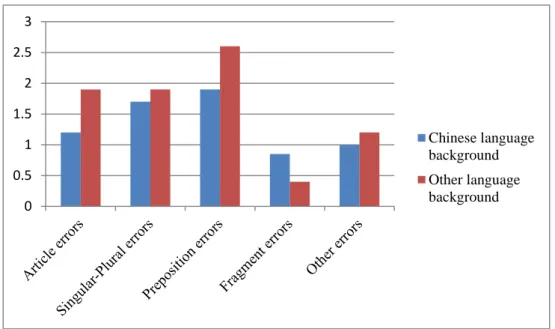
Figure 1: Frequencies of errors based on the SALT analyses of essays of Chinese and
non-Chinese learners ... 61
Figure 2: The frequencies of errors in the Grammaticality Judgment Test across Chinese and non-Chinese learners ... 61
Figure 3: Number of Participants by Age and Background in Areas of Specialization. ... 118
Figure 4: Number of Participants by Type of Feedback Provided. ... 120
Figure 5: Writing Model ... 139
Figure 6: Writing process diagram, Rohman (1965) ... 150
Figure 7: L2 writing process ... 151
List of Tables
Table 1: Summary of the Three Studies ... 20
Table 2 Background Information about the Two Groups of Students ... 53
Table 3 Means, Standard Deviations, and Minimum-Maximum Scores: ... 57
Table 4: First-order and Partial Correlations (controlling for years of English exposure): Chinese ... 58
Table 5: First-order and Partial Correlations (controlling for years of English exposure):Non-Chinese... 59
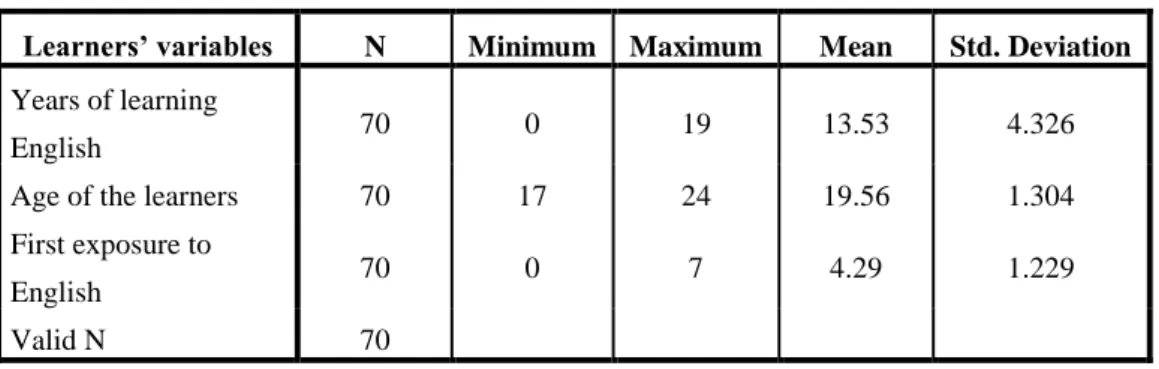
Table 6: Participants’ Age, exposure to and Duration of Learning English ... 76
Table 7: Scores in Grammar, Vocabulary, and Essay Tests in English and Bangla ... 76
Table 8: Most Difficult Areas in Writing in English ... 77
Table 9: Reasons for Learning English ... 77
Table 10: Engagement with English besides Academic Training ... 78
Table 11: Engagement with Writing in English besides Academic Activities ... 78
Table 12 : Areas of English Needed to Practice more to Support the Current Studies ... 78
Table 13: Writer in Bangla ... 79
Table 14: Writer in English... 79
Table 15: Planning before Writing in English ... 80
Table 16 : Planning before Writing in Bangla ... 80
Table 17: Time of Revising the Essay in English ... 80
Table 18 : Time of Revising the Essay in Bangla ... 81
Table 19 : Aspects of Writing Revised in the English Essay: Grammar ... 81
Table 20 : Aspects of Writing Revised in the Bangla Essay: Grammar ... 81
Table 21: Aspects of Writing Revised in the English Essay: Spelling. ... 82
Table 22: Aspects of Writing Revised in the Bangla Essay: Spelling ... 82
Table 23 : Aspects of Writing Revised in the English Essays: Punctuation ... 82
Table 24 : Aspects of Writing Revised in the Bangla Essays: Punctuation... 83
Table 25: Aspects of Writing Revised in the English Essays: Vocabulary ... 83
Table 26 : Aspects of Writing Revised in the Bangla Essays: Vocabulary ... 83
Table 27 : Aspects of Writing Revised in the English Essays: Organization ... 84
Table 28: Aspects of Writing Revised in the Bangla Essays: Organization ... 84
Table 29 : Aspects of Writing Revised in the English Essays: Clarity ... 84
Table 30 : Different aspects of Writing Revised in the Bangla Essays: Clarity ... 85
Table 31: Focus of Thinking during Writing in English: Audience ... 85
Table 32 : Focus of Thinking during Writing in the Bangla: Audience ... 85
Table 33 : Focus of Thinking during Writing in English: Clarifying Ideas... 86
Table 34 : Focus of Thinking during Writing in Bangla: Clarifying Ideas ... 86
Table 35 : Focus of Thinking during Writing in English: Discovering New Ideas ... 86
Table 36 : Focus of Thinking during Writing in Bangla: Discovering New Ideas ... 87
Table 37: Few Drafts to Improve Writing in English ... 87
Table 39 : Correlation between variables controlling for years of learning English –
significant correlations in bold... 89
Table 40 : Differences between Those Learning in Urban versus Non-urban Environment ... 90
Table 41: T-test of Languages Spoken by the Participants (bold indicates significant t-test) ... 91
Table 42: Cross-tabulation: Planning before writing –English and Bangla ... 92
Table 43: Relationship between variables controlling for years of learning English – significant correlations in bold... 93
Table 44: Relationship between Writing in English and Planning Strategy-Significant Correlation is Bold. ... 95
Table 45: Scores and Planning Strategy in English: T-test ... 96
Table 46 : Scores and planning strategy in Bangla: T-test ... 96
Table 47: Correlation between Writing Scores and Revision Strategy in English ... 97
Table 48: Correlation between Writing Scores and Revision Strategy in Bangla ... 97
Chapter 1
INTRODUCTION
1.1. Overview
This thesis reports three studies, each study constituting an independent chapter. Two of the studies were conducted in Bangladesh, and one in New Zealand. In this chapter, the three studies will be introduced together with a brief background to the research conducted. The research is situated in the field of second language (L2) writing in English, which is a subfield of both composition studies and applied linguistics. The literature that this chapter introduces draws upon such intellectual formations as L2 writing, composition studies, and applied linguistics. The studies aimed at discovering the characteristics and constraints of learning as well as teaching L2 writing both in English as a foreign language (EFL) and English as a second language (ESL) contexts. In order to glean the information germane to the foci of the thesis, the measures of investigation of the studies included questionnaires detailing learners’ and instructors’ backgrounds and attitudes, as well as vocabulary, grammar, feedback, and writing tasks. The introduction to literature, then, touches upon all these areas of writing pedagogy. Because much of the research was performed in Bangladesh, the context of teaching and learning L2 writing in English in Bangladesh merited discussion. Therefore, a section of this chapter abridges the history of English studies in the EFL context of Bangladesh, which embodies the origin story of L2 writing in English in the landscape of English studies in Bangladesh. On top of all these sections, this chapter also explains the rationale of this thesis.
1.2 Introduction to Literature
The origin stories of an intellectual formation as hybrid as composition studies, which includes L2 writing, abound (Ritter & Matsuda, 2012). As such, it is unlikely for anyone to present an objective, unbiased, and complete history of the field of L2 writing. However, the history of the field of L2 writing emerges from, and is implicated with, the histories of its feeder disciplines of composition studies and applied linguistics (Silva & Leki, 2004). The history of L2 writing also needs to be appreciated with reference to the development of these feeder disciplines in North America, given that L2 writing is a North American phenomenon (Bazerman, 2013; Silva & Leki, 2004). Matsuda (2011) contends that the history of North
America-based applied linguistics commenced with the establishment of the English Language Institute (ELI) in 1941 at the University of Michigan. Composition studies most likely commenced at Harvard in the 1890s with the introduction of first-year writing courses (Ritter & Matsuda, 2012). The field of L2 writing emerged, through the development of symbiotic relationships with its feeder disciplines, as an independent field in the 1990s (Matsuda, 2013) to cater to the peculiar needs of L2 writers. Silva (2006) claims that the field is already so developed that it does not have to borrow uncritically from its feeder disciplines to ascertain its independent existence.
Matsuda (2012a), however, claims that the field of L2 writing does not have its own site of praxis, which accounts for why the field is open to the influences of other disciplines, such as foreign language education and Teaching English to Speakers of Other Languages (TESOL), in addition to the feeder disciplines, for instruction, assessment, research, and program administration. Indeed, because all writing teachers are already L2 writing teachers (Matsuda, 2012a) in the Anglophone countries because of the presence of L2 writers, as an intellectual formation, the field of L2 writing is already ubiquitous. It continues to evolve because of the diversity of the student populations it serves as well as the globalization of education. As such, the field of L2 writing operates with some protean pragmatics, rather than informed pedagogical options. The field of L2 writing apparently has been going through theoretical mood swings (Silva, 1992), making the teaching of L2 writing arbitrary and site-driven. An intellectual formation so complex, multimodal, and evolving as L2 writing is unlikely to be integrated “into the consciousness of every writing instructor who comes into contact with second language writers in the classroom” (Matsuda, 2012a, p. 43). The nature of the field of L2 writing implies that at least an academic account of how L2 writing emerged is apparently possible. But how it will evolve in future is more of a matter of observation than prediction, for it is susceptible to the influences of many factors.
One of the most critical factors is, of course, instructors’ background training. Teacher professional development (TPD) is fundamental, since effective teaching comes from a teacher who actively constructs his or her knowledge and skills through different means and is reflectively engaged in exploring his or her own teaching development (Richards, 2002). However, the professional development of a writing instructor is a
complex, ongoing, and evolving process in that writing pedagogy education is still a diffuse, emerging area of inquiry (Estrem & Reid, 2012). This accounts for why the educators and experts in the field of writing cannot develop the intellectual infrastructure and an esprit de
corps to teach writing with optimum output. Writing instructors apparently cannot draw on an established knowledge base, which most of its contributing fields such as psychology and literacy studies can. As such, the teaching of writing is more intuitive than informed. While this phenomenon characterizes the teaching of L1 writing in English, the instructors of L2 writing are not immune to it. The potential pitfalls for L2 writing instructors are more daunting.
Matsuda (2012a), for example, contends that the binary opposition between a first and a second language, and between native-born and foreign-born populations, created a
disciplinary division of labour in the 1990s, which severed the field of composition from the field of L2 writing. This division of labour is problematic, even counterproductive, for the field of L2 writing as far as the background training of the L2 writing instructors is
concerned. Estrem and Reid (2012) claim that writing pedagogy education scholarship is unusually positioned in relationship to composition studies. Composition studies, essentially, leans more toward the teaching of a first language (in this case, English) than that of a second language. The characteristics of first language writers are not the same as those of the second language writers, for the ESL composition process seems generally more laborious than that of the first language (Silva, 1992). Because the matrix of the field of L2 writing is
composition studies, and the field of L2 writing caters to the peculiar writing needs of a different breed of learners, the pedagogical situation of the field is hardly suitable to provide the potential instructors with sound background training. L2 writing teacher education has not been adequately addressed in the field of English language teaching (Yi, 2013) to provide instructors with insights, information, and empirical evidence for effective pedagogical approaches to optimizing learning outcome.
Certainly, effective teaching is contingent upon, among other things, an appreciation of diversities and differences of the student populations that the L2 writing instructors teach. Generally, L2 writing instructors consider an L2 writer as “a perpetual English language learner” (Ortmeier-Hooper, 2013, p. 23) despite diverse linguistic, cognitive, affective, and cultural orientations and experiences. These attributes significantly determine the styles and strategies that L2 writers employ to foster their writing skills. The objectives of academic writing are hardly responsive to these attributes of L2 writers. Academic writing is perceived to be remote, distant, and imponderable (Sommers, 1993). However, Murray (1991) claims that every piece of writing is essentially autobiographical. By ‘autobiographical’ he does not mean personal; he means that a writer must have familiarity with and fondness for the subject
written about. Perl (1980) also believes that a writer must have a “felt-sense” (p.365) with the topic that he would write about. Unfortunately, this is rarely the case for L2 writers. L2 writing pedagogy is more responsive to the culture of North American academic writing, and is not responsive to L2 writers’ culture-specific modes of writing.
This dimension of the pedagogy of L2 writing may have prompted Athanases, Bennett and Wahleithner (2013) to urge writing instructors to “learn to uncover the nuances of students’ individual writing processes as well as trends across students and classes” (p. 162). Because the processes as well as the trends of L2 writing vary across students and classes, L2 writing instructors should determine what and how they teach on the basis of who they teach. For example, Kaplan (1966) demonstrated that an L2 learner’s rhetorical style of argument development in writing varies because of cultural perceptions about, and practices in, writing. Leki (1991a) similarly contends that ESL students come to the U.S. having learned to learn in certain ways. Zamel (1997) argues that the Japanese style of writing is subtle and indirect, in contrast to writing styles in North America. All these examples propose the deduction that a generic curriculum or “one-size-fits-all” (Ortmeier-Hooper, 2013, p. 24) approach to teaching L2 writing is unlikely to succeed. Ortmeier-Hooper (2013) claims that L2 writing instructors must understand the range of experiences, histories, and literacies that L2 writers bring into the writing classrooms to teach L2 writing effectively. While teaching L2 writing, it is critical to be cognizant that instructors’ ignorance of learners’ backgrounds might get the learners caught between their pasts and futures so as not to realize their potential of learning to write.
As well as learners’ backgrounds, the identification and the classification of errors in L2 writers’ writings by instructors may also influence the outcome of writing instruction, potentially negatively. Errors demonstrate incomplete knowledge about the structure, mechanics, and rhetoric of a language. Ideally, the identification and the classification of errors should be uniform across times and contexts to facilitate the teaching of writing. However, Conners and Lunsford (1988) contend that error-marking is value-driven, and that teachers’ idea of error-definition and classification have always been the absolute product of their times and cultures. However relative and subjective the identification and classification of errors is in general, when it comes to the teaching of L2 writing, the identification and the classification of errors are almost alike, in that ESL teachers are more concerned with
language-specific errors (Zamel, 1985). ESL errors, then, are more linguistic and mechanical in nature than rhetorical and conceptual. This conceptualization of error identification and
classification perpetuates the impression that all students need to do is patch and polish their writing (Sommers, 1982). Therefore, ESL errors are not as complex and multidimensional as errors in general are.
Williams (1981) has problematized the concept of errors in general, which has implications for the teaching of L2 writing as well. He claims that instructors find errors in students’ writing because they look for errors. If they had not looked for errors, they would not have discovered them. He proved this hypothesis with an illustration in the same essay. He inserted a hundred errors in the essay, but made the essay linguistically refined and conceptually sophisticated so that the readers would not look for errors until they were dramatically declared in the last paragraph. Writing is thinking (Murray, 1978), and profound thinking itself is a powerful tool to devolving into a different kind of language that is hardly affected by errors. As is, the identification and the classification of errors should not be the main foci of writing instruction. A few errors will not spoil a fine piece of writing
(Briedenback, 2006). Given that writing in an l2 is not completely different from writing in the first language, since they face the similar categories of challenges in developing rhetorical expertise and discursive repertoire in particular rhetorical situations (Matsuda, 2012a). Thus, with regard to error identification and classification, the field of L2 writing must stop looking at “students through a deficit lens” (Athanases, Bennett, & Wahleithner, 2013, p.162).
The identification and the classification of errors inevitably lead to the attempts to eliminate them by means of feedback. Responding to students writing by means of providing feedback is a thorny issue (Raimes, 1991). The provision of feedback is still arbitrary and value-driven than consistent and empirical. Empirical evidence, for example, is not conclusive enough yet as to whether feedback should be provided comprehensively or selectively, whether feedback should be given on form or content, whether feedback should be given at the beginning or at the end of a draft. Perhaps given all these unresolved
complexities implicit in feedback, Truscott (1996) claims that feedback is essentially harmful, and it should be abandoned altogether. While Krashen (1984), Zamel (1976) Brannon and Knoblauch (1981), Arapoff (1969), and Greenberg (1985) are not as cynical as Truscott (1996) regarding the usefulness of feedback, they have yielded compelling empirical evidence to contend that the potential of feedback to teach students writing is qualified. However controversial the area of feedback is, it is at once ubiquitous and inevitable, especially for the teaching of L2 writing. L2 writers expect feedback from their instructors; therefore, not providing feedback might work against students’ motivation (Leki, 1991a).
Leki (1991a), nonetheless, cautions that students’ expectation regarding feedback need to be modified if they want to profit from instructors’ feedback on their composition. Feedback on writing generally focuses on or discovers the shortcomings of a product. It generally does not critique or intervene in the process of accomplishing that product. Writing, essentially, is such a personal and complex process that a teacher cannot assume all the responsibilities of teaching writing (Draper, 1969). The responsibility of learning to write significantly rests on students themselves. In order for that to happen, students must explore and exploit other options of feedback. Elbow’s (1981) classification of feedback such as criterion-based feedback and reader-based feedback is germane in this context. A teacher apparently provides criterion-based feedback, which measures a piece of writing up to certain criteria. This kind of feedback does not tell what a piece of writing does to particular readers, but reader-based feedback does. Feedback, then, needs to come from genuine and interested readers, not from “a slave reader” (Elbow, 1981, p.224), that is, a teacher. As such, an uncritical submission to and dependence on feedback is problematic.
While feedback is integral to teaching writing, the provision of feedback changes given the approach to teaching writing. The product approach to teaching writing revolves mainly around mechanical feedback. Mechanical feedback does not address the rhetorical aspects of writing. The influential works both by Peter Elbow and Janet Emig in the early 1970s shifted the paradigm of L1 composition from product to process. The basic difference between these two approaches to teaching writing is that while the product approach aims at producing correct writing by means of mechanical precision at the end, the process approach emphasizes revision all along to create good writers through reflection (Silva & Leki, 2004). Process approach shifts the focus from writing to writer. Although there are three different categories of process approaches to teaching writing such as expressivist, cognitivist, and social constructionist (Faigley, 1986; Santos, 1992), the proponent of all these schools concur that writing is recursive and that writing process is a series of overlapping and interacting processes ( Emig, 1971). Silva (2006) contends that in the 1980s the process approach to teaching L2 writing gained substantial ground, for process approach more than any other seems to be providing unifying theoretical and methodological principles to teaching writing (Raimes, 1991).
Among the second language educators, Zamel (1982, 1983) was the first researcher to yield empirical evidence to claim that the process of writing in a first and a second language is essentially similar. Subsequently, L2 writing scholars such as Silva (1992), Cumming
(1989), and Matsuda (2013) endorsed the conclusion proposed by Zamel (1982, 1983). Matsuda (2013), nonetheless, mentions that the features of texts written by basic L1 and L2 writers are not always distinguishable. Literature in composition studies informs that “basic” and “remedial” writers are the terms restricted to those native writers of English, who are apparently underprepared to undertake works in English for academic purposes. The problem with the basic writers is more linguistic and mechanical than conceptual and stylistic. As much as Raimes (1991) claims that ESL students are not one or at the most two groups of students, initially perhaps all L2 writers are almost alike, as Matsuda (2013) implies. The process of writing, then, may have been identical both for L1 and L2 writers, but, because L2 writers are initially linguistically underprepared, they lack the ability to enact the process. This may account for why the L2 instructors, both in ESL and EFL contexts, are finicky about the linguistic aspects or “cosmetic process” (Perl, 1979, p.22) of writing, despite their endorsement of and knowledge about the process approach to teaching writing.
Grammar as such occupies a peculiar position in the landscape of L2 writing pedagogy and scholarship. Scholars are polarized as to the potential of grammar to help L2 writers learn writing. Williams (2003) might sound blunt to the proponents of grammar – based instruction, when he claims, “despite all the concern and attention devoted to it, grammar has not had any positive effect on writing performance” (p.314). Consistent and uniform empirical evidence gleaned both from cross-sectional and longitudinal studies spanning over a few decades prove that there exists no positive relation between grammar instruction and the acquisition of writing skills. For example, White (1965), Bateman and Zidonis (1966), Crowley (1989), and Noguchi (1991) yield compelling evidence to contend that grammar instruction essentially does not raise writing performance. Summarizing the contemporary research on the relation between grammar and writing, Braddock, Lloyd-Jones, and Schoer (1963) contend that grammar instruction even has harmful effect on the
improvement of writing, echoing Truscott (1996). The reasons are aptly identified by the participants of Elley, Barham, Lamb, and Wyllie’s (1976) study who stated that grammar is repetitive, difficult, boring, and useless. The case would not be different in any way for L2 writers.
Nonetheless, L2 writers are generally considered a monolithic group of learners, whose texts are characterized by “accidents of discourse” (Sommers, 1982, p.150). As much as instructors endeavor to eliminate those accidents of discourse by means of grammar instruction, it might not help learners write, in that “grammar instruction is not transferable to
writing” (Williams, 2003, p. 327). Williams (2003) contends further that, although grammar is the building block of sentences, grammar provides a limited number of sentence patterns. Writing, however, is not as constrictive or formulaic as grammar is. Writing is essentially generative, recursive, and habitual. Ideally, writing instruction directs students toward the “extraordinary generative power of language” (Raimes, 1985, p.248) by engaging them with the “complexity of composing” (Raimes, 1991, p.422). Being knowledgeable about grammar is not akin to being good at writing. Williams (2003), for example, mentions that Japanese students come to the U.S. with a solid knowledge of English grammar, but they are poor writers. “Grammar is writing’s surface” (Elbow, 1981, p. 168). It is not the substance of writing. Because the process of writing for both L1 and L2 writers does not apparently vary, the approach toward teaching and learning to write should not vary. Grammar occupies an insignificant position in the landscape of L1 writing; it, then, should do the same in the landscape of L2 writing.
Despite all these anecdotal and empirical evidences against grammar, the centrality of grammar is undeniable for both L1 and L2 writing in English. Pinker (2014), for example, claims that grammar is our spices’ solution to the problems of getting complicated thoughts from one head into another. He further claims that an awareness of syntax can help writers avoid ambiguous, confusing, and convoluted sentences to make writing transparent, elegant, and graceful. Because grammar appears critical for L1 writing in English, its importance for teaching L2 writing in English is acknowledged uncontested by L2 writing scholars,
especially after the 1990s. This may have been the reason that prompted Ferris (1999) to claim that Truscott (1996) is “premature and overly strong” (p. 1) as he claims that instruction in grammar is harmful, and it should be abandoned altogether. However, the controversy that Truscott’s (1996) observation involving grammar sparked spawned a substantial body of scholarship for the field of L2 writing in English. While instruction in grammar is not anathema for teaching L2 writing in English, L2 writing scholars (e.g., Ferris, 1999; Matsuda, 2013; Zhang, 2013) claim that the long-term effect of ‘written corrective feedback’ (WCF) to help L2 writers learn write is unknown and contested. Ferris (1999), nonetheless, claims that instruction in grammar definitely brings off short-term improvement, which is a prerequisite for long-term improvement. Long-term improvement in grammar is non-linear and recursive, which may take even months or years for writers to master a target grammatical feature (Liu & Brown, 2015). Because most studies in L2 writing in English are
not longitudinal to discover the long-term effect of grammar instruction (Liu & Brown, 2015), the debate that Truscott (1996) started remains unresolved.
Surprisingly, for more than 2000 years the study of a foreign language primarily entailed grammatical analysis (Hinkel & Fotos, 2002). Wilkins (1972) contends “While without grammar very little can be accomplished, without vocabulary nothing can be accomplished” (p. 111). This considered, vocabulary may be considered the most critical component for learning a foreign language. Vocabulary both creates and conveys meanings and messages, which are the core objectives of learning a foreign language. The problem posed by an inadequate acquisition of vocabulary cannot be overcome by an advanced knowledge in grammar and mechanics. L2 learners see the acquisition of vocabulary as their greatest source of problems (Green & Meara, 1995; Meara, 1980). However, despite the obvious importance of vocabulary, most courses and curricula tend to be based on grammar or combination of grammar and communication strategies rather than vocabulary (Folse, 2004, 2008). The ease and elegance of a sentence is contingent upon how the lexical options and restrictions are managed and maneuvered in that sentence, not how grammar and
mechanics underpin that sentence. For L2 writers, unfortunately, a sentence is primarily syntactic, not semantic.
However unacceptable this dimension of L2 writing appears, this is understandable. Folse (2004) contends that learning vocabulary in a foreign language is not akin to learning the meaning of a word. It is, in fact, “a multiple task” (Folse, 2004, p. 18). Learning
vocabulary in a foreign language is contingent upon the awareness of the polysemic aspect of words, their collocation, connotation, idiomatic expression, part of speech, frequency,
spelling and pronunciation, as well as usage (Folse, 2004). These aspects of vocabulary learning are not amenable to instant instruction the way grammar and mechanics are. Neither can the L2 learners come up with strategies themselves to deal with these essential difficulties or dimensions of vocabulary learning. This may explain why L2 learners are not generally word-wise compared to their native counterparts. L2 texts generally are less sophisticated and less expressive of the writers’ thoughts and intensions, in that L2 writers lack the ability to manipulate lexical nuances and connotations (Silva, 1992). Their application of words is both bland and basic. Basic or remedial L2 writers, therefore, may depend on a “thesaurus
philosophy of writing”, when they make only lexical changes, not semantic changes (Sommers, 1980, p.381). Certainly, then, L2 writers are vulnerable to the dimensions and difficulties of L2 vocabulary.
1.3 The Context of L2 Writing in Bangladesh
Hardly can anyone contextualize the teaching of L2 writing in the landscape of English studies in Bangladesh, in that the history of English studies has emerged independent of instruction on writing up to the point when the first private university was launched in 1993 (Shamsuzzaman & Everatt, 2013). The institutionalization of composition in English studies in Bangladesh, then, is a very recent development. Contrary to that, the English language in the Indian subcontinent has been an inseparable component of academic and intellectual activities for about two centuries. Initially, English had been a colonial imposition on the Indian subcontinent by the British. Post- colonially, it had to be adopted in the nation building project given its intellectual, economic, and cross-cultural potential. As such, the origin story of English studies in the Indian subcontinent pits the language against its colonial heritage vis-à-vis its contemporary status as a lingua franca. This considered, “English holds a paradoxical position” (Shamsuzzaman, 2014, p. 220) in the Indian subcontinent, including Bangladesh, in that the language is essentially controversial but immediately convenient. Situating composition in these conflicting undercurrents of English studies in Bangladesh warrants some information regarding the historical development of the field in the Indian subcontinent.
The British officially colonized the Indian subcontinent in 1757 A.D. They had to leave the Indian subcontinent in 1947. During most of these two centuries of occupation, they changed the geographic, economic, political, cultural, and linguistic landscape of the Indian subcontinent so irreducibly that following their departure, it had never been the same.
However apparent and acute the fallout of the British occupation was, it complied with Said’s (1976) observation of colonization. Referring to the occupation of Egypt by Napoleon in 1798, Said (1976) contends that in the colonial dispensation, political subjugation is
innocuous, in that it is a precondition to producing knowledge and civilizing the natives. It is not clear whether the British occupation of the Indian subcontinent was provoked by this grotesque excuse of knowledge production. But the most pronounced raison d’etre of British occupation of the Indian subcontinent was, of course, civilizing the natives. The way the British wanted to civilize the natives had been responsible for setting up the paradigm of education in general, and English studies in particular, in the Indian subcontinent. Macaulay’s “Minute on Indian Education” was critically instrumental toward that direction.
Thomas Babington Macaulay joined the British raj in India in 1834 as the first law commissioner and member of the supreme council in Bengal (Cutts, 1953). He proposed the “Minute” in 1835, which “was the decisive and final piece in a long series of propaganda articles written over a period of more than half a century in the formation of British
educational policy in India” (Cutts, 1953, p. 824). Having collapsed some of the finer details of this document into a summary statement, one can claim that Macaulay proposed to
supplant vernaculars such as Sanskrit and Arabic with English “to educate a people who cannot at present be educated by means of their mother-tongue” (Macaulay & Young, 1979, p. 349). He overtly touted the intrinsic superiority of the English language to the indigenous languages of the Indian subcontinent. However, his concept of the English language
education was discursive in nature, not linguistic or disembodied, in that he wanted British literature to be the portal of the English language. He claims, “The literature of England is now more valuable than that of classical antiquity” (Macaulay & Young, 1979, p. 351). Even though he claimed that he had no knowledge either about Arabic or Sanskrit, he was
politically so influential and intellectually so persuasive that British literature gained a strong foothold in the Indian subcontinent because of his activism or advocacy. This may have accounted for why English studies in the Indian subcontinent leaned toward literature, not language.
Post-colonially, English studies have evolved in the Indian subcontinent, including Bangladesh. It is worth mentioning in this context that Bangladesh is a post, post-colonial country because of British and Pakistani subjugations. Since the British left in 1947, Bangladesh was a part of Pakistan until 1971. Pakistan had two parts, east and west. Erstwhile East Pakistan, which is now Bangladesh, was virtually a monolinguistic region, since around 98% of the population used to speak Bangla (Chowdhury & Ha, 2008). Bangla, the native language of the Bangladeshi, pit the West Pakistan against East Pakistan, when the latter had to sacrifice lives in 1952 to defend its native language, since the former threatened to proscribe and replace it with Urdu, the dominant language of West Pakistan. 1952, known as the year of language movement, was believed to be the nucleus to spur the war of
independence in 1971 against Pakistan. Bangla, then, already emerged as a critical factor in defining and determining identity of a potential nation. Following its independence in 1971, linguistic nationalism set in. Consequently, “English thus lost its status as a medium of educational instruction, which it had had until 1971, and was now replaced by Bangla at all levels of education” (Hamid & Baldauf, 2008, p.20). But the events that unfolded
subsequently were not monolithic and conclusive. They were, instead, tentative, even regressive.
The influence and importance of the English language waned simultaneously from the academic and administrative undertakings of the government of Bangladesh. In 1980, English was withdrawn as a compulsory subject of study for tertiary level students (Rahman, 1999). In 1987, the government passed the ‘Bengali Introduction Law’, which mandated that “Bengali was to be used in all spheres and at all levels of government purposes” (Banu & Sussex, 2001, p. 126). Notwithstanding these policies, the possession of English was critical for academic success and economic mobility in Bangladesh. The deterioration of the teaching and learning of English was already conspicuous, and its attendant consequences were
already felt. A survey conducted by the National Curriculum and Textbook Board,
Bangladesh, (NCTB), in 1990 discovered the dismal state of English proficiency of school learners (as cited in Hamid & Baldauf, 2008). This swung the government into action. It re-introduced English from the first grade to tertiary level in 1991 (Rahman, 2007). While these shifts in policy regarding English studies in Bangladesh have bearings for L2 writing, they do not explicitly inform much about it. The scopes of these changes are confined mainly to secondary and higher secondly levels of English studies in Bangladesh.
Alam (2011) has situated these transformations of English studies in the context of tertiary education in Bangladesh, when he also renews the ontological tensions between composition studies and literature. He considers these transformations poised toward the “commodification of English studies in Bangladesh” which contributes to declining of interest “in the study of English literature” (p. 251). The shift toward Communicative Language Teaching (CLT) at both secondary and higher secondary levels in Bangladesh since the 1990s has been responsible for effecting and establishing English Language Teaching (ELT) at the tertiary level in Bangladesh, he implies. He contends that these changes in English studies in Bangladesh are more political, because of the influence or involvement of some foreign forces (the British Council, for example), than informed and principled. He claims as such that ELT pedagogy in the context of Bangladesh has been “on the whole, a waste of money and resources” (p. 268,), so its potential to facilitate the teaching and learning of English is severely qualified. Sceptics might find Alam (2011) too assertive and can accuse him of “trained incapacity” (Burke, 1984, p. 8) for critiquing the
He, of course, deplores that “less and less literature courses are being taught, and that “ELT is all the rage” (p. 266).
However, Alam (2011), in the same token, has criticised the ubiquity of literature in English studies in Bangladesh, in that it has been responsible for unexamined, even
ineffective, teaching when instructors have “ preferred to lecture to them as if from a pulpit” (p. 270,). In this dispensation, he claims, teaching of literature appears to be a civilizing mission, when the instructors “do nothing about the teaching of reading and writing of the English language” (p. 270). English studies at the tertiary level in Bangladesh, he claims, has so irreversibly immersed “in a seemingly perpetual embrace” (p.252) with literature, that the disjuncture between composition and literature appeared congruous with the culture of English studies. Alam (2014) continues,
Even now I marvel at the obtuseness with which I was taught English literature at the University of Dhaka; nobody has bothered to teach us how to read intensively or write purposefully then; my teachers and their teachers must have assumed that one could write since one can read; what was there to teach here? (p.252)
Alam’s (2011) observation in this context proposes the deduction that composition studies in Bangladesh is stuck in the rut of a chronic crisis, since it is intergenerational. Instruction in writing in such a context is redundant. Exposure to literature is the only and absolute prerequisite to learning to write.
Bangladesh, nonetheless, presents no unique context of composition instruction as far as the history of composition studies is concerned. Traditionally, hardly was there any
symbiotic relation between composition studies and literature, in that the former has been “the weak spouse, the new kid” (Elbow, 2002, p.533) of the latter. Elbow (2002) claims that writing programs were originally housed in the English departments, and writing teachers were usually less paid to work under poorer conditions in order to help literature professors, who were teaching less under better working conditions to get paid more. Composition did not have any disciplinary identity and an intellectual agenda the way literature did, for composition started out “nothing but a motley collection of people historically thrown together” (Elbow, 2002, p.543). As such, writing pedagogy educators were working in primarily reactive modes and were frequently under pressure to follow others’ lead (Estrem & Reid, 2012). The ‘others’ in this context are instructors of literature. As far as the mode and focus of instruction are concerned, these two streams of intellectual formations
significantly vary. Elbow (2002) claims that while lecturing in literature classes is extremely common, it is rare or absent from writing classes. As well, while the focus of literature classes is the analysis and appreciation of an existent text, the focus of composition classes is the conception and creation a new text. When these differences between literature and
composition are considered, Bangladesh presents no unique or exceptional context of composition instruction.
As far as the local nomenclature is concerned, the essential differences between composition and L2 writing blur, in that as a denomination, L2 writing has not gained currency in English studies in Bangladesh yet. Instruction in writing in English is called composition. While English studies in the Indian subcontinent, Bangladesh included, has a history of about two centuries, the term composition did not permeate the terrain of English studies until 1993, when the first private university was launched in Bangladesh
(Shamsuzzaman & Everatt, 2013). Since then, different universities have been using the term in different English courses they offer, which are compulsory for all students enroute to earning a Bachelor’s. Matsuda (2012a) contends that L2 writing is writing in any language that the writer did not grow up with. Composition, then, is a misnomer in the context of Bangladesh, It is, in fact, L2 writing. Alam (2011) repeatedly used the term composition. It could be a deliberate option, as Matsuda (2012a) claims that composition is a
non-stigmatizing or stigma-resistant term compared to L2 writing. Or, L2 writing apparently smacks of applied linguistics/TESOL, which a literature-steeped culture like Bangladesh hardly acknowledges. Whatever the case, no university in Bangladesh offers any programs- B.A. or M.A. or Ph.D. - in composition yet, though they offer all these programs in literature and language-related areas.
The context of composition studies, then, in Bangladesh is a complex one. The landscape of English studies has been changing apace (Alam 2011; Chowdhury & Ha, 2008; Hamid & Baldauf, 2008) in Bangladesh, but how that swings toward the direction of
composition studies is yet uncertain because of two potential pitfalls. For one, the Bengali culture as a whole believes that the process of writing is so inductive and idiosyncratic that it is not open to external intervention or exploration (Shamsuzzaman, 2014). Instruction in writing is not culturally compatible as such. Secondly, effective instruction on L2 writing is contingent upon undergoing training in North America since composition studies has emerged from and revolved around North America (Silva, 2006). Besides North America, opportunities for training in composition studies are hardly available and authentic. North
America is a tough option to avail for the potential composition instructors from Bangladesh for various reasons. As far as the cultural disposition and the development of the intellectual infrastructure are concerned, the field of composition, including L2 writing, in Bangladesh is apparently in an inconvenient position at the moment to pass into professional common sense like literature and language-related fields.
1.4 Significance of the Project
This project is situated in the field of L2 writing, but L2 writing is an interdisciplinary and catch-all term (Matsuda, 2013). This project as such is not specifically pegged to a particular topic or aspect of L2 writing. It transcends contexts, and it incorporates several aspects of the teaching and learning of L2 writing across contexts. The teaching and learning of English is a global phenomenon, but because the field of L2 writing originated in and evolved around North American (Bazerman, 2013; Silva, 1996), the field critically lacks information as to how L2 writing is taught and learned in the periphery. This may have prompted Silva (2006) to urge to look at L2 writing contexts other than North American. This project is a modest attempt to fill this lacuna in that it looks at L2 writing in a relatively sparsely researched EFL context like Bangladesh. This project intends to discover the practices and perceptions of teaching L2 writing in Bangladesh, where English studies is synonymous to the study of British literature (Shamsuzzaman & Everatt, 2013). Hence, Bangladesh is a somewhat unique context for L2 writing instruction and, as such, merits investigation to determine how it may differ from or conforms to the core principles of L2 writing pedagogy. The work, therefore, aims to inform and expand the scope of L2 research as well as to help the professionals in the field to appreciate it in a more nuanced way.
Along with the aspects of teaching L2 writing in an unfamiliar context like Bangladesh, it also intends to discover factors influencing the learning of L2 writing in Bangladesh. This project did not essentialize the perspectives of instructors as to how L2 learners learn to write. It, instead, employed multiple measures, as such background
questionnaires, grammaticality judgement tests, vocabulary and writing tests, to discover how these variables correlate with each other, or function independently, and identify the possible developmental trajectories of L2 writing in the EFL context of Bangladesh. The acquisition of writing skill is not contingent upon the demonstration of a single attribute. Writing skill is indicated by syntactic and mechanical precision, linguistic sophistication, and conceptual clarity. Ideally, a project that explores the development of writing skill includes component in
all these areas of subskills. Surprisingly, research in writing is not holistic. It is, instead, specific to such areas as grammar, vocabulary, and styles of argumentation in written
discourse as an influence of learners’ native cultures or languages. This project is set against this backdrop of writing research, in that it is based on the “collection and analysis of a wide range of data about students’ writing development” (Athanases, Bennett, & Wahleithner, 2013, p.162). This considered, this project is original in its design to add new information to the knowledge-base of L2 writing research.
Learning a language where it is spoken is unlike where it is not spoken. Folse (2004) implies that an ESL context provides learners with the opportunity of “incidental learning”, while in an EFL context; learners only have the opportunity for “intentional learning.” It is claimed that incidental learning is more conducive to learning a language than intentional learning (Krashen, 1985), though research findings are inconclusive with this regard. This implies that the qualitative difference between ESL and EFL contexts to influence learning is irreducible. However rich the data from the L2 writing learners from Bangladesh are, their potential to propose a credible conclusion is qualified given that they are collected from an EFL context. To offset the methodological limitation of this project, data have been collected from the ESL context of New Zealand, too. They are also the L2 writers of English, but they come to study in New Zealand from different parts of the world. They are approximately of the same age group like their EFL counterparts from Bangladesh, and they have completed the same tests. The data from these participants allow the researchers of this project to propose more authentic conclusions regarding the trajectories of L2 writing development of learners from different linguistic and rhetorical orientations. These data themselves provide an appreciation of the field of L2 writing, but when they are compared and contrasted with those from Bangladesh, they allow an even more critical consideration of the development of L2 writing.
Most importantly, it is a project that investigates issues within the field of L2 writing through contexts, texts, learners, and instructors. These factors are integral to the teaching and learning of L2 writing. However, these factors are not constant across contexts. Texts vary because of learners’ cultural and linguistic orientations (Kaplan, 1966); no two contexts are identical and no context is static (Zhu, 2010), and no two L2 instructors teach alike in that teachers’ theories are personal in nature, are not always articulated but reflected in practice. L2 writing instruction, then, is multi-dimensional and multifaceted (Zhu, 2010). This project embodies this essential multiplicity in the field of L2 writing in terms of texts, contexts, and
learners. Therefore, the findings of this project merit critical consideration of all stakeholders to appreciate as well as to advance the field of L2 writing.
1.5 THE THREE EMPIRICAL STUDIES
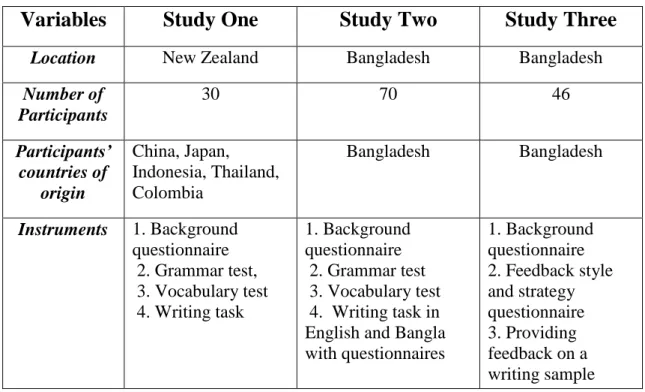
The research performed as part of this thesis included three empirical studies. The studies were conducted both in ESL (New Zealand) and EFL (Bangladesh) contexts. The first two studies aimed to understand how the pre-university or first year university students learned writing in English both in ESL and EFL contexts. The third study endeavored to understand how writing in English was taught in the EFL context of Bangladesh. Summaries of the three studies are provided below.
Each of the studies considered the context of learning and how this might influence L2 writing in English. As discussed above (and something that will be covered further in the rest of the thesis), the background of the learners may lead to differences in the way they learned to write in English. In study one, this was considered in the ESL context of New Zealand. The focus of the study mostly revolved around the Chinese learners, for,
incidentally, most of the participants of this study were of Chinese origin. The first study chapter (i.e., chapter three) demonstrated that individuals from Chinese educational background will have experienced a somewhat different way of learning from their
counterparts from other Oriental and Western backgrounds. ‘Oriental’ in this context means most Asian countries, where English is taught and learned as a foreign language. ‘Western’ is used in this context to refer to English dominant educational contexts mostly associated with Europe and North America.
The focus of the first empirical study, therefore, was to determine whether or not different learning contexts influenced the learning of L2 writing in English. The findings of this study determined that learners’ backgrounds influenced learning, which provided the basis to investigate the potential influence of background on learners in the EFL context of Bangladesh. This context was the subject of study two and three, which, respectively, constituted chapter four and five of the thesis. However, these two studies were not identical in scope and design-- study two (2) focused on the learners, whereas study three (3)
considered the instructors. Hence, the first main factor considered in the thesis was the L2 writers’ contexts of learning, and how contexts may have interacted with their styles and strategies of learning to write in English. If the behavior of L2 writers were altogether
consistent across contexts and backgrounds, the findings of these studies would not add any new insight and information to the field of L2 writing. Because L2 writers seemed not to write in English exactly the same way across contexts and backgrounds, the strategies of learning discovered and models of learning proposed in the studies were critical contributions to the field of L2 writing for Bangladesh and beyond.
In both studies one and two, the learners were considered in terms of their English written output. Therefore, in both studies, learners were assessed on their written output. In study one, only English written output was considered given the range of first languages spoken by participants. However, the focus of study two, situated in Bangladesh, provided the opportunity to study first language writing (i.e., Bangla) as well. As far as the designs of study one and two were concerned, the inclusion of Bangla written output critically
distinguished study two from study one. The first two studies, given written outputs, were designed to contrast L1 and L2 in order to discover commonalities and differences in writing behaviour. L1 is assumed to influence the ways L2 writers in English perceive and produce writing (Zamel, 1982). This thesis attempted to investigate this dimension of L2 writing to glean empirical evidence in order to facilitate the teaching and learning of L2 writing in English.
Also as discussed above in the introduction to literature section of this chapter, the teaching of grammar has often been a focus of teaching English as a second language. Grammar is critical to the teaching of L2 writing in English as well. However, this surface feature of language may not be as influential on writing behaviour as more meaning aspects of language, such as vocabulary. The contrast between grammar as a surface feature and vocabulary as a basis for understanding will be covered in further detail in the thesis. Given the potential importance of contrasting these two areas of learners’ abilities in terms of models of second language learning and their influence on teaching practice, both study one and two would assess these skills of the learners and contrast these with writing output. The third general factor considered in the research, then, was the potential differential importance of grammar versus vocabulary on L2 writing output.
The contrast between more surface features of writing versus deeper aspects of meaning and understanding in written output was the main focus of the third study in the thesis. The third study considered L2 writing from the perspective of the instructors, in particular their views about teaching L2 writing as they marked errors in the EFL context of
Bangladesh. Instructors’ performance as implicated in the teaching of L2 writing was
discussed briefly in the introduction to literature section of this chapter, but this aspect of L2 writing would be considered in more detail in chapter five, devoted to study three.
Perceptions of errors and error marking behavior were considered to gain insights into how L2 writing instructors in Bangladesh approached and appreciated more surface features of writing versus the potentially deeper meaning of what was written. The third study gleaned data to discover whether or not instructors’ perceptions about teaching L2 writing
corresponded with their practices of teaching L2 writing in the EFL context of Bangladesh. Instructors seemed not to have practiced the teaching of L2 writing the way they perceived the teaching of L2 writing. Their perceptions and the marking of mechanical versus
conceptual errors also differed with one another.
The first two studies examined the backgrounds of the learners to discover how they learned to write in English. Likewise, in the third study instructors’ backgrounds were considered to determine whether and how instructors’ backgrounds influenced their teaching practice or ethos of teaching L2 writing in the EFL context of Bangladesh. The context of Bangladesh provided an interesting focus itself with reference to L2 writing. As discussed above, the unique history of the teaching and learning of English, together with current efforts to revamp English studies in Bangladesh, makes this an interesting context to study. L2 writing is implicated in the landscape of English studies in Bangladesh. Measuring instructors’ performance as well as discovering their perceptions of teaching L2 writing critically predicts the current situations and the future directions of L2 writing in Bangladesh. While the third study was specific to Bangladesh, the findings of this might add new
information and insights to appreciate the field of L2 writing more critically and comprehensively.
The following table summarizes the three studies of the thesis. The section that follows that table describes briefly such variables of the studies as locations, number of participants, participants’ countries of origin, and instruments along with highlighting some of the key findings of the studies.