International Journal of Evidence Based Coaching and Mentoring Special Issue No.8, June 2014
Page 67 The current issue and full text archive of this journal is available at: http://ijebcm.brookes.ac.uk
Decisions along the dissertation journey:
reflections of a coach-researcher
Fiona Williams, inspiration365 Ltd, London Road, Oxford. OX3 9FN
Email: [email protected]
Abstract
When designing, undertaking and presenting research, there are many decisions to be taken by a researcher. This paper explores the author’s experiences and reflections in respect of some of those decision points. The paper is based on a central narrative thread in the author’s dissertation for their Master’s degree - an action research study to develop and use a new perception-themed coaching approach. These practitioner-researcher insights, which shed light on the dissertation process, could be considered useful for fellow coaches and mentors when planning, undertaking and presenting their own research, as well as for tutors supporting dissertation students.
Key words: Coaching research, mentoring research, writing a dissertation, planning a dissertation, action research
Introduction
There are many decision points when designing, undertaking and presenting research and this paper focuses on my experiences and reflections relating to some of these decision points. They are based on a central narrative thread in my coach-researcher dissertation entitled “use of perception in coaching to help managers/leaders achieve their goals and be more perceptive” (Williams, 2014;
2013), which was submitted in partial fulfilment of my Master’s degree in Coaching and Mentoring Practice at Oxford Brookes University. It was an action research study designed to develop and use a new perception-themed coaching approach. I fulfilled the roles of both coach and researcher. These practitioner-researcher insights, which shed light on the dissertation process, could be considered useful for fellow coaches and mentors when planning, undertaking and presenting their own research as well, as for tutors supporting dissertation students.
There were three reasons why I decided to develop a narrative on the process of the process of my ‘decision-making’ for this paper. Firstly, reflection on experience can help the reader to gain insight into the researcher and their approach (Creswell, 2010). The reflexive narrative was a critical aspect of my research, forming a central thread of my dissertation and one which highlighted the ‘messy’ nature of action research (Herr & Anderson, 2005). Secondly, I argued that my study contributed to the literature on perception for leaders, managers and coaches, as well as highlighting the value of action research as a method for researching coaching; both are areas where there seems to be a paucity of evidence-based literature. Thirdly, when discussing my completed dissertation research, I found that fellow coaches, mentors and researchers were interested in the ‘what’ and the ‘why’ of my research design, as well as the findings and implications. It is with this audience in mind that I have focused on some of the decisions that I made on my research journey, primarily relating to choice of methodology and how to present the study.
International Journal of Evidence Based Coaching and Mentoring Special Issue No.8, June 2014
Page 68 The current issue and full text archive of this journal is available at: http://ijebcm.brookes.ac.uk
I suggest that by opening up how I went about defining my research problem in this paper, I give the reader the opportunity to scrutinise and understand how my experience and motivations have informed my research. I also hope that by demonstrating how such critical reflexive practice (Etherington, 2004) has influenced the design of my study, that fellow coach-mentors may find this a useful starting point when thinking about their own research. The paper comprises six sections which are presented as follows:
Defining the research problem Literature review
Choosing to present an applied chapter Methodology
Findings
Summary and conclusion
Defining the research problem
Like most dissertation students, I started with deciding what problem I wanted to research (Fisher, 2010). The research question arose from curiosity and months of incubating questions. Some of these questions were inspired by my reading and conference attendance and included: “how could I use Bachkirova’s (2011) book and course notes?” and “how could I, if at all, use ideas sparked by Professor Chater’s talk on organisational behaviour and marketing at Warwick Business School’s Mentoring Best Practice day 2012, where I also presented?”. Chater’s (Chater & Vlaev, 2012; Chater,
2011) work on decision-making was also interesting, but the puzzle of what I could do with it remained. My questions did not stop there. I was interested in “how might I draw all of this together for the benefit of my clients who are mostly managers/leaders?” and “what could be my dissertation topic?”, as well as “how might any research illuminate these topics for wider use by the coaching-mentoring profession?”. For me, there was a strand linking all of these questions together. It was
perception. My studies and curiosity had led me to my research topic.
For initial ideas, I drew on my coaching practitioner experience as well as relevant literature, such as Bachkirova (2011) who argues for improving quality of perception, in part, as a mechanism for change. I also like joining together disparate topics/information and doing something new. Based on a first-cut literature review, this was possible with perception, although it was a large topic with no obvious starting point. So I shifted ideas in my head, reviewed more literature and discussed early thoughts with friends before defining my research question. I was now uncertain as to the next stages of my research process. I was aware of interest in finding better ways to help managers/leaders develop (Buckingham, 2012) as well as better ways of coaching (Passmore & Fillery-Travis, 2011). I wanted to explore both areas and discover how I might go about this. Specifically, I was interested in how I might help manager/leader clients be more perceptive and use perception in coaching. It was early days and the idea of a developing and using a new perception-themed coaching approach came to mind. I did not know it at the time but I was laying the foundations for an action research study (Herr & Anderson, 2005).
It took me a while to decide on my research paradigm and these deliberations added to the time taken to synthesise my research question; I am glad that I started early and I recommend fellow researchers to do the same. I developed an interpretevist-constructivist approach that would allow for research participants to make meaning from their own experiences (Bryman, 2008). Eventually, I decided on my research question, which was: “how might themed coaching help managers/leaders improve their quality of perception?”, in other words I aimed to create a new approach to coaching. I
International Journal of Evidence Based Coaching and Mentoring Special Issue No.8, June 2014
Page 69 The current issue and full text archive of this journal is available at: http://ijebcm.brookes.ac.uk
improved alongside the usual focus on clients’ goals. I had four research objectives related to: (a) gaining insight into managers/leaders’ experiences and meaning-making around perceiving ‘stuff’, and (b) similarly for myself, alongside (c) developing a new perception-themed coaching approach, and also (d) making a contribution to knowledge for the benefit of the wider coaching-mentoring profession.
Literature review
As is common with dissertation study, I reviewed the literature and identified research gaps which informed my research question; involved deciding where to start my review and how to present the literature.
Given that one aspect of Bachkirova’s (2011) developmental coaching theory relates to improving quality of perception, in part, as a mechanism for change, I drew on her work for potential starting points. These starting points were not taken at face value but were critiqued and augmented. I also searched key databases for academic, business and practitioner literature which potentially fitted my purpose (Fisher, 2010). I decided to use “Academic search complete”, “Business source complete”,
and “PsycINFO” databases alongside “Google Scholar”. First, I searched abstracts using keywords
like “coaching”, “perception”, “manager”, “leader” and “improve” before widening my search to
visit references in articles from my early searches. Journals listed in the Academic Journal Quality Guide (The Association of Business Schools, 2010) were preferred.
Yet, early searches yielded little literature relating to how perception quality might be improved in a coaching context and there is little direct mention of perception in the coaching literature (Bachkirova, 2011). So I decided to broaden my literature search to allied disciplines, such as psychology, philosophy and neuroscience; the latter drawing on my scientific education. This broadening led me to another difficulty. By now, I discovered a wealth of complex and much debated literature relating to perception. However, I discovered that there was little bridging material to help coaches and mentors, like me, grasp that material. Identifying gaps in the literature and placing my research question in them was fairly straight-forward. The difficulty I had was how I was going to capture, and present, my analysis of this literature.
My literature remit was broad and so was its presentation. Whilst research gaps and constructs may be clear to the researcher, I suggest that presenting them is a challenge which involves thought and careful decision-making (Fisher, 2010). I wanted to provide a framework of perception in order to highlight key constructs, show its relevance to coaching and highlight what needed to be researched. Given the complexity of concepts under review, a better approach might have been to go for depth rather than for breadth. That said, it was appreciated that there would be difficulties with either approach. I therefore decided to structure the presentation of my literature review around answers to questions that I considered key, namely: “what is perception?”, “why might we be interested in it?”
and “how might we improve it?”, and ended with a summary.
Choosing to present an applied chapter
Whilst my research process was non-linear, which was common based on dissertation guides (Fisher, 2010; Berman-Brown, 2006), there was little guidance on how to present the applied aspects that started the action research (Herr & Anderson, 2005). In my dissertation, I had ‘Literature review’ and ‘Methodology’ chapters yet these did not seem the right place to describe what I meant by a new perception-themed coaching approach. Describing the new perception-themed coaching approach, and its starting blocks, is outside the scope of this paper. However, it is relevant to explain how I
International Journal of Evidence Based Coaching and Mentoring Special Issue No.8, June 2014
Page 70 The current issue and full text archive of this journal is available at: http://ijebcm.brookes.ac.uk
developed a framework of perception to develop and use in the research and how I set about deciding to include an ‘applied’ chapter in my dissertation.
One of my critical decision-points was how to capture the different purposes of my literature review. Primarily my literature review provided context and relevancy to perception. It informed my research question through identification of gaps in the literature. My literature review also had an overlapping secondary purpose. It was used to inform my thinking on how perception might be used in coaching, which led to the consideration of a new perception-themed coaching approach. Arguably this secondary purpose did not fall within the scope of a ‘traditional’ literature review chapter (Fisher, 2010) and so I was left to the question of its placement. I also wanted to include a short literature review on themed coaching; in its simplest form, I suggest themed coaching is a tool which can be used to frame coaching sessions. Yet, I was uncertain as to the placement of such material. These were decisions which I wrestled with when writing up the research.
In my dissertation, there was also the question of where to describe the development of an initial perception-themed coaching approach. This was coaching material as opposed to research design/process content and, as such, seemed to sit outside the usual ‘Methodology’ chapter framework. Further, these starting blocks for a new coaching approach were part of my first action research cycle and yet also linked to my literature review. So I decided to write a short applied chapter in my dissertation which sat between my ‘Literature review’ and ‘Methodology’ chapters. In this applied chapter, I discussed themed coaching, alongside development of an initial perception-themed coaching approach and an example of how it might work in action.
Herr and Anderson (2005) suggest that action research presentations tend to have a strong process element and my dissertation was no exception. Deciding on a new dissertation chapter, which outlined the practical aspects, did fill me with a sense of uncertainty. These decisions regarding development of a new coaching approach alongside its presentation were somewhat daunting and I felt slightly anxious; the latter fitting with Herr and Anderson’s (2005) comment that students often feel vulnerable as to what is required from an action research dissertation. Decisions need to be taken in terms of the applied aspects of action research and, given that there is little guidance for practitioner-researchers to draw upon here, I suggest that these decisions are not easy.
Methodology
The chosen methodology of my study was action research. During three action research cycles conducted over four months, seven managers/leaders were coached by me using an evolving new perception-themed coaching approach. As well as being coached, these seven managers/leaders were also asked to feedback on the new perception-themed coaching approach in order to inform its development. Given these two roles, these managers/leaders were referred to as ‘co-researchers’ which is common in action research (Herr & Anderson, 2005). Thematic analysis was used to interpret data from the coaching sessions, feedback and semi-structured interviews. Critical friends are common in action research (Herr & Anderson, 2005) and I drew upon three critical friends - dissertation supervisor, study buddy and coaching supervisor throughout my research to aid my decision-making. As this overview skims over the many decision-points taken in respect of the design and appropriateness of my research methodology, I will hone in on four areas of choice that influenced the design of my research:
Research paradigm Methodological approach Action Research
International Journal of Evidence Based Coaching and Mentoring Special Issue No.8, June 2014
Page 71 The current issue and full text archive of this journal is available at: http://ijebcm.brookes.ac.uk
Research paradigm
Determining one’s research paradigm early on in terms of dissertation planning is considered a crucial decision-point (Fisher, 2010). Linking my research paradigm to perception, which was central to my research question, was hard and I found that deciding on my research paradigm was unsettling and I explored several options. For me, researching perception threw-up unanswered questions regarding the nature of knowledge. This is unsurprising given that paradigms are much debated. I write from an interpretivist-constructivist stance but also rate positivist aspects. I had reviewed All Quadrants All Levels (AQAL) (Wilber, 2006), whose method integrates epistemology and ontology (Wilber, 2013). However, its scope was beyond my study’s timeframe and resources. I also considered critical realism (Fisher, 2010), yet I felt it placed emphasis on social constructs and power relations (Coghlan & Brannick, 2005). I was not interested in social change, reviewing organisational structures, or the causal powers and liabilities of co-researchers (Easton, 2010).
Epistemologically, my orientation is interpretivist (Bryman, 2008). Ontologically, I recognise constructivism (Bryman, 2008). As such I seek to make sense of co-researchers’ (and my own) subjective reality in a way that gives meaning (Bryman, 2008). This is reflected in my research aims, mainly gaining insight into both co-researchers’ and my own experiences and meaning-making. My literature review also informed my thinking; for example Bachkirova’s (2011) work is from a developmental-constructivist stance. As I draw heavily on her work, it made sense to me to ensure our paradigms were aligned. My values and beliefs (axiology) also shaped my research (Herr & Anderson, 2005), which is unsurprising given they inform my coaching-mentoring practice’s purpose and limits (Drake, 2008). In my coaching-mentoring practice, I draw upon coaching interventions and tools from different disciplines in a coherent integrated manner (Megginson & Clutterbuck, 2009) and I value this approach. In this research, I was comfortable with the possibility of integrating material from different disciplines in a managed manner. My overall research philosophy also aligns with my research question, “how might themed coaching help managers/leaders improve their quality of perception?”. Thus I decided that an interpretivist-constructivist paradigm was the right choice for
me and for my study.
Overall, my research paradigm favours qualitative research strategies (Saunders et al., 2012; Bryman, 2008) and so this was a criterion for selecting my methodological approach. I also favoured inductive and deductive research (Bryman, 2008), for I started with an initial perception-themed coaching approach which I sought to use and build upon. This dual dynamic fits with an action research approach (Cox, 2010).
Methodological approach
Choice of methodological approach was another vital decision-point, and one which is expected to be clearly argued in one’s dissertation presentation (Fisher, 2010). I was aware of resourcing constraints and so wanted a mono-method. I drew on my research question and aims to guide me. With a focus on sharing experiences, phenomenology and case study (Creswell, 2012) seemed likely choices. In terms of experimenting with themed coaching, action research was potentially suitable (Herr & Anderson, 2005).
Phenomenology opens up first-person reports of lived experiences of a phenomenon (Creswell, 2012; Moustakas, 1994). So at face value, it seemed a relevant approach. However drawing on Moustakas (1994), phenomenology also involves bracketing-off the researcher’s role and experience (Creswell, 2012). Yet, such bracketing arguably conflicted with my research aims, in which I seek to draw on my involvement as coach and researcher. Further, this methodology seemed to lack any form of experimentation (Creswell, 2012) to develop a new coaching approach. So a tension presented - do I adapt my research question and exclude any experimentation, or find an alternative approach? I decided to look at alternatives.
International Journal of Evidence Based Coaching and Mentoring Special Issue No.8, June 2014
Page 72 The current issue and full text archive of this journal is available at: http://ijebcm.brookes.ac.uk
A case study approach focused on managers/leaders’ perceptions could provide in-depth insights (Creswell, 2012). It also suited research questions starting with ‘how’ (Yin, 2008) like mine. Case study research begins with finding a case (Creswell, 2012). I wondered if this could be a case of a manager/leader who had undergone the new perception-themed coaching approach which I was thinking of exploring. However, drawing on my literature review, such coaching had seemingly not been done before. I could broaden my study scope (Creswell, 2012) to find an alternate case study, but decided that this was outside my dissertation’s time constraints. Further, I wanted to be directly involved in using themed coaching and so looked for another approach. At this point, I decided to supplement my literature review of methodological approaches with experimentation.
I noted that action research arguably involves experimentation and collaboration (Herr & Anderson, 2005). So I experimented with my research proposal presentation and gained insights into fellow students’ perceptual experiences of eating mini-Easter eggs. I concluded that in my research study I wanted to coach managers/leaders in a way that might (a) help them improve their perception alongside (b) the usual focus on whatever goals managers/leaders may bring to coaching, and (c) for these managers/leaders to provide some feedback on the new perception-themed coaching approach as to aid its development. Additionally, I decided that my experience was crucial and an action research approach was appropriate given its congruence with all my research aims. Action research also seemed akin to coaching as it promoted actionable knowledge though collaboration (Herr & Anderson, 2005). For me, my decision-making was aided by both a literature review of methodological approaches and a ‘mini-pilot’ of my chosen approach. This combined approach is, seemingly, not always mentioned in dissertation guides (Fisher, 2010; Berman-Brown, 2006) yet could be valuable to practitioner-researchers who value collaboration and actionable knowledge (Herr & Anderson, 2005).
Action research
Action research is a generic term for different traditions (McNiff & Whitehead, 2002)and I wanted to select one action research tradition based on context rather than integrating styles (Herr & Anderson, 2005). Whilst action research has been used in some coaching research, it seems that the approach is currently under-utilised. As such, sharing on my decision process here could be considered valuable for fellow coach-mentor researchers who intend conducting an action research study.
Action research places action at the centre of the research (Herr & Anderson, 2005) and “proceeds in a spiral of steps each of which is composed of a circle of planning, action and fact-finding about the result of the action” (Lewin, 1946, p.38). Each action cycle is intended to increase understanding
leading to some form of answer, with researcher and co-researchers developing actionable knowledge (Herr & Anderson, 2005) built on reflection ( Kemmis and McTaggart, 1988). I considered this and reflexivity as critical elements (McIntosh, 2010; Somekh, 2006).
Relevant to my selection criteria were three levels of inquiry: i) my understanding of the problem - an ‘I’ level; ii) developing my own practice - an ‘it’ level; iii) action research with the purpose of improving group understanding and practices - a ‘we’ level the study co-researchers and I (Cox & Cook, 2010). The ‘we’ level of inquiry seemed most relevant given my research question. As such, business and educational traditions were reviewed (Herr & Anderson, 2005). Action Science (Argyris et al., 1985) draws on familiar works of Dewey, Lewin and Schön (Herr & Anderson, 2005) and so seemed relevant. With roots in developmental theories, action inquiry (Torbert et al., 2010) was also studied. However, Torbert et al’s ( 2010) multiple inquiries exceeded my resourcing and time constraints. Further, as both approaches stress organisational learning, which were not included in my research question, they were discounted. Action research in education has a practitioner research emphasis (Herr & Anderson, 2005) and seemed relevant to a coach-mentor practitioner undertaking
International Journal of Evidence Based Coaching and Mentoring Special Issue No.8, June 2014
Page 73 The current issue and full text archive of this journal is available at: http://ijebcm.brookes.ac.uk
research. This tradition is also congruent with my practical knowledge, interest and interpretative orientation (Cox & Cook, 2010). This selection of action research tradition did not yield a template which I could adapt, so there were more methodological decisions to follow, including the ways in which to analyse the data.
Data analysis
In this section I discuss some of the decisions that I needed to make when analysing and interpreting the data. Three master themes emerged from the data and were discussed in the dissertation alongside the research question, literature, findings and the new perception-themed coaching approach. The journey of analysing and interpreting data had many decision points and was tough. This section explores three decision points. First, I discuss the changes that I made to the methods that I used to analyse and interpret the data. Then, I share on some of the options for the ‘master themes’, before discussing the decisions that I made which helped me to discuss and present the findings in the dissertation.
Although the ways in which I revised the process of data analysis and interpretation were articulated in the methodology of my dissertation, changes made to it were arguably also part of my findings as an action researcher and thus are highlighted here.
As action research has no set method for data reduction or interpretation (Herr & Anderson, 2005), I had chosen thematic analysis (Braun & Clarke, 2006, which is common in qualitative research (Bryman, 2008) and in keeping with my research aims. Template analysis (Brooks & King, 2012; King, 2012; 2004) was initiated. It offered a structured, yet flexible way to approach thematic analysis (King, 2004), which was arguably quicker compared to that of grounded theory and interpretative phenomenology methods (Flick, 2009). From my ‘first-cut’ exploratory interpretations after each action research cycle, I started to spot potential themes and codes, as well as to understand the significance of some patterns. Yet, in the last stage of the third action research cycle, when embarking on a fuller ‘second-cut’ interpretation of data, I struggled to go to a deeper level of interpretation using template analysis (King, 2012). Whilst I wanted to keep with template analysis which was timely and in my original plan, I was also cognisant that template analysis may not facilitate rich findings (Waring & Wainwright, 2008)and I aspired to richer and more inductive findings. I therefore decided to change plan. At dissertation proposal stage, I did not predict that I would be making such a change at this point and it felt somewhat chaotic.
I now understood what Braun and Clarke (2006) meant by their different levels of theme identification. If data was represented as a jelly pudding, then I was stuck at “describe[ing] the surface of the jelly, its form and meaning” (Braun & Clarke, 2006, p.13), whilst wanting to “identify the features that gave it that particular form and meaning” (Braun & Clarke, 2006, p.13). I used
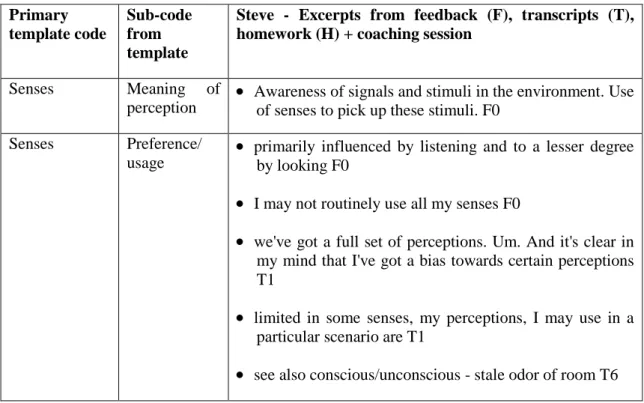
template analysis to interpret data from the first action cycle and all data relating to one co-researcher (“Steve”). Table 1 shows some coding examples relating to use of senses in external perception:
International Journal of Evidence Based Coaching and Mentoring Special Issue No.8, June 2014
Page 74 The current issue and full text archive of this journal is available at: http://ijebcm.brookes.ac.uk
Primary template code
Sub-code from template
Steve - Excerpts from feedback (F), transcripts (T), homework (H) + coaching session
Senses Meaning of
perception
Awareness of signals and stimuli in the environment. Use of senses to pick up these stimuli. F0Senses Preference/ usage
primarily influenced by listening and to a lesser degree by looking F0
I may not routinely use all my senses F0
we've got a full set of perceptions. Um. And it's clear in my mind that I've got a bias towards certain perceptions T1
limited in some senses, my perceptions, I may use in a particular scenario are T1
see also conscious/unconscious - stale odor of room T6 Table I: Extract of coding from coaching co-researcher “Steve” (Williams, 2013)Then, I changed to Braun and Clarke’s (2006) general thematic approach alongside cognitive mapping (McDonald et al., 2004; Huff & Jenkins, 2002) and pattern coding (Miles & Huberman, 1994) to interpret the remaining data. There is no single method for cognitive mapping and/or pattern coding and I used my own variation drawing on the literature. Figure 1 shows an extract from an early cognitive map which relates to co-researcher “Lynn” in which her perception of herself linked to how other people potentially perceived her:
International Journal of Evidence Based Coaching and Mentoring Special Issue No.8, June 2014
Page 75 The current issue and full text archive of this journal is available at: http://ijebcm.brookes.ac.uk
Alt-Text description of Figure 1
Title: Extract of coding from coaching co-researcher "Lynn"
Description: A mind-map type diagram. The text 'Lynn' in a circle (12 o'clock position) is linked to a dashed circle, with the text 'how others influence us' (3 o'clock position), which links to a circle with text 'identity' (6 o'clock position) which links back to the text 'Lynn'. There is a box in the centre of the diagram with the text 'value of self' which links both to 'Lynn' and 'identity'. There is an
unconnected circle (1 o'clock position) with the text 'being perceived by others'.
For me, the process of putting together the maps for all the co-researchers aided my thinking and exploration of co-researchers’ meaning-making and experiences. In terms of what I considered to be a theme, a theme had to illuminate something significant in relation to my research question. Cognitive mapping and pattern coding enabled me to draw richer interpretations, and themes, from the data compared to template analysis. This was possibly due to its fit with my visual, non-linear way of thinking. Overall, changes to research design are likely in action research (Herr & Anderson, 2005) and can feel somewhat unpredictable.
Findings
All co-researchers stated that their quality of perception had improved to varying degrees in the last action research cycle and this seemed to indicate that the perception-themed coaching approach did help co-researchers improve their perception quality. I now present the three ‘master themes’ that emerged from the analysis and interpretation of the data and discuss in detail one of the master themes from data analysis and interpretation entitled “flying by the seat of one’s pants”, and an accompanying sub-theme, which relate to key learning from developing the perception-themed coaching approach and some of ‘behind the scene’ changes during the action research cycles.
Deciding on three master themes
Many potential themes evolved from the analysis and interpretation of the data and I decided on three master themes. These met my criteria of being significant to the research question and also described the full data set in broad terms. I felt the latter was important given that the perception-themed coaching approach crossed all action research cycles. This holistic approach is also useful for exploring an under-researched area (Braun & Clarke, 2006), such as with coaching and perception. The three master themes in my dissertation were:
I. There’s more to perception than I thought… II. Joining the dots
III. Flying by the seat of one’s pants.
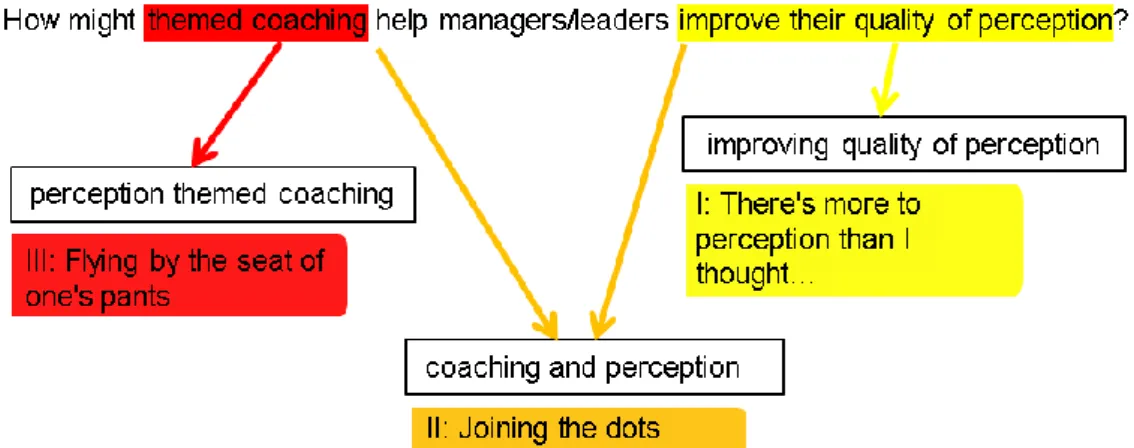
Whilst all master themes connect to my research question, each master theme emphasised a different aspect of my research question and this is shown in Figure 2:
International Journal of Evidence Based Coaching and Mentoring Special Issue No.8, June 2014
Page 76 The current issue and full text archive of this journal is available at: http://ijebcm.brookes.ac.uk
Figure 2: How my research question connects to master themes from data analysis and interpretation (Williams, 2013)
Alt-Text description of Figure 2
Title: How my research question connects to master themes from data analysis and interpretation Description: At the top of the diagram is the question: how might themed coaching help
managers/leaders improve their quality of perception? Under the words 'improve their quality of perception', there is an arrow to the words' improving quality of perception' and underneath these, 'I: There's more to perception than I thought'. Under the words 'themed coaching' and 'improve their quality of perception', there are two arrows to the words 'coaching and perception' and underneath 'II: Joining the dots'. Lastly, under the words 'themed coaching' there is another arrow to the words 'perception themed coaching', and underneath 'III: Flying by the seat of one's pants'.
The first master theme (“there’s more to perception than I thought”) illustrates how co-researchers recognised a shift in their perception, as evidenced by changes in their meaning-making and experience. The second master theme (“joining the dots”) provided insights into how the perception-themed coaching approach not only helped co-researchers improve their quality of perception, but also helped them to achieve their goals and/or synthesise their learning. The third master theme (“flying by the seat of one’s pants”) concerns key learning from developing the perception-themed coaching approach and some ‘behind the scene’ changes made during the action research cycles. These master themes were identified after coaching was completed, so arguably from the perspective of a researcher. That said, I recognise that there was some overlap with some of the content and themes which were discussed in the coaching sessions. All master themes emerged from the analysis and interpretation of the data and as recurrent strands throughout the action research cycles. Arguably it is in this third theme (“flying by the seat of one’s pants”) that the whole idea of action research comes to life. In the next section, my decisions regarding how to present the master themes are explored.
Presentation of master themes and sub-themes
I spent much time reflecting on and present the research in my dissertation. I wanted to draw on the themes that emerged from the analysis and interpretation of the data and share the story of the action research. My initial plan, formed in the second action research cycle, was to present findings by action research cycle to emphasise changes against time in co-researchers’ meaning-making and refinements to the perception-themed coaching approach. However, by the last action cycle, I was aware that many themes from data interpretation crossed the action research cycles. So I decided on a thematic presentation structure.
International Journal of Evidence Based Coaching and Mentoring Special Issue No.8, June 2014
Page 77 The current issue and full text archive of this journal is available at: http://ijebcm.brookes.ac.uk
Drawing on Pollock and Bono (2013), I shared quotes from the co-researchers and my own as coach and researcher. These quotes underpin the main findings but also tell the participants’ story. I chose informative theme titles to help create a sense of the story, plus used figures and reflexive engagement to vary the pace of my writing (Pollock & Bono, 2013). I decided on a combined findings and discussion chapter to enable interconnections between themes to be made.
In summary, I faced many choices on my journey through the analysis and interpretation of the data and other researchers will be faced with similar decision points (Fisher, 2010). I suggest that the extent to which a researcher highlights such decision points will depend, in part, on the researcher’s values, beliefs, and choice of study design. I consider myself a reflective practitioner (Schön, 1994) and so aiming to be a reflexive researcher (Cunliffe, 2004) seemed a natural next step, which Herr and Anderson (2005) argue is critical for action researchers; I would encourage other researchers to be reflexive about their studies too.
Flying by the seat of one’s pants
This paper focuses primarily on the decisions that I made when choosing a research methodology and how to present the research. However, I will expand on the findings from one of the master themes – that of “flying by the seat of one’s pants”. In my view, this theme illustrates my experiences – as coach, as researcher and as coach-researcher, and some of the decision-making challenges that I encountered in developing and presenting a new perception-themed coaching approach. There is a strong inter-relationship between these perspectives (coach, researcher and coach-researcher) and it was difficult to separate them.
This master theme carried out at the end of coaching concerned my key learning as a researcher and related to the changes made during the action research cycles. It also highlights how these took place rapidly, and mainly organically, in the absence of formal guidelines on how to conduct the research. The sub-themes from data interpretation of this master theme were as follows, and the first of these is described in further detail below:
i. Being messy – the changes that were made during the action research cycles, which could seem somewhat chaotic at times
ii. Clearing the smog - how the co-researchers reduced their perceptual filters and the coaching interventions which helped them to do this
iii. Never stopping – the on-going development of a coaching framework, using the perception-themed coaching approach
The ‘being messy’ sub-theme from data interpretation relates to my experiences and meaning-making as a researcher and coach experimenting with the perception-themed coaching approach and refining the action research cycles. In keeping with action research literature (Herr & Anderson, 2005), what was happening in the action cycles had unpredictable elements and felt somewhat messy. As researcher, I had developed an initial perception-themed coaching approach to use and refine during the research, and which is described in the section on choosing to present an applied chapter earlier in this paper. As coach, I had an inkling as to overall coaching process and direction whilst being responsive to co-researchers’ needs when they were being coached. So from this perspective I felt comfortable with refining the perception-themed coaching approach in the first action research cycle. I wrote in my journal: “this is exciting. All different yet I think similar. Surprising” (me,
journal, post-coaching sessions 1). Yet, I felt initially rigid as a researcher, for part of me wanted to resist lots of changes. There was a tension between being what I was experiencing as a coach and what I felt as a researcher. There was an element of self-doubt as to how I would be able to justify my
International Journal of Evidence Based Coaching and Mentoring Special Issue No.8, June 2014
Page 78 The current issue and full text archive of this journal is available at: http://ijebcm.brookes.ac.uk
decision-making process from an academic point of view. As a coach-researcher, I wanted to do well in my dissertation. This feeling of self-doubt soon passed as I embraced being messy. I was now also more open to instigating change.
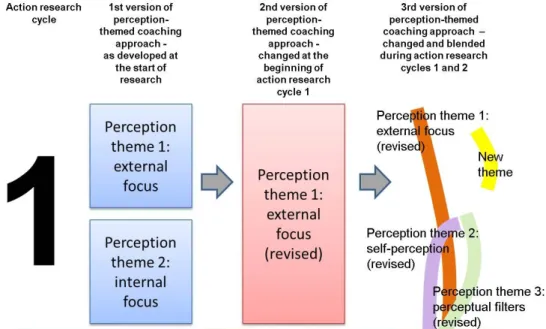
Three main versions of the perception-themed coaching approach were used with each version building on the previous version. Details of the changes made are arguably not critical for this paper. However, so that the reader may gain a sense of the actionable knowledge that was emerging through collaboration, a conceptual overview of the changes made in the first action research cycle are presented in Figure 3.
Figure 3: Changes to the perception-themed coaching approach
Alt-Text description of Figure 3
Title: Changes to the perception-themed coaching approach
Description: The diagram is divided into four columns from left to right. First column header is 'action research cycle' with '1' underneath. Second column header is '1st version of perception-themed coaching approach - as developed at the start of research' with 'perception theme 1: external focus' and 'perception theme 2: internal focus' underneath. Third column header is '2nd version of perception-themed coaching approach - changed at the beginning of action research cycle 1' with 'perception theme 1: external focus (revised)' underneath. The final column header is '3rd version of perception-themed coaching approach - changed and blended during action research cycles 1 and 2' with four perception themes mentioned underneath.
The first version of the perception-themed coaching approach was developed at the beginning of the first action research cycle. I had planned to use two perception themes (“perception theme 1:
external focus” and “perception theme 2: internal focus”) in the first action research cycle. My approach was changed during middle of the first action cycle. I changed the content and names of the perception themes, in my coaching approach, to make them simpler to grasp based on feedback from the co-researchers and my own experiences as coach-researcher. I also decided to use one perception theme in the first action research cycle, rather than two, based on co-researcher feedback and my review of the data as researcher. This resulted in a second version of the perception-themed coaching
International Journal of Evidence Based Coaching and Mentoring Special Issue No.8, June 2014
Page 79 The current issue and full text archive of this journal is available at: http://ijebcm.brookes.ac.uk
approach as shown in Figure 3. However, part of my perception-themed coaching approach - my initial premise of one perception theme per coaching session - was challenged, so I responded with a third version of the perception-themed coaching approach by being creative, whilst remaining conscious of the underpinning literature. I noted in my journal: “it’s messy. A bit here. A bit there. Yet it all hangs together” (me, journal, post-coaching sessions 2). A blended approach was adopted and a
new perception theme was also introduced. For me, developing the perception-themed coaching approach was fast-paced and intense, with many threads intertwining in a somewhat messy way, which have been difficult to distil. On reflection, whilst I expected to refine the perception-themed coaching approach through coaching/collaboration with co-researchers, indeed, that was one of the main reasons for choosing an action research methodology, the intensity and messiness of it took me by surprise.
In summary, this sub-theme, derived from analysing and interpreting the data highlights some of the insights into me ‘being messy’ in my researcher role. It also refers to refinements in the perception-themed coaching approach and to the different versions that were developed and used in the coaching. The findings and discussion under this sub-theme shed light on action research as a method for researching coaching and its somewhat unpredictable dynamic. In order to respect individual differences, I consider such ‘behind the scenes’ reflection and exploration by me as researcher could also valuable for other coach-mentor researchers, given that it is seemingly an area where the evidence-based literature is sparse.
Summary and Conclusion
When it comes to designing, undertaking and presenting a research-based dissertation, there are many decisions to be made by a researcher. This paper adds to the coaching-mentoring literature by sharing some practitioner-researcher insights on the dissertation process; in particular, some of the decisions I made when considering the options available for undertaking, analysing and presenting the research. In doing so, this paper draws upon a central decision-making narrative thread in my dissertation of an action research study designed to develop and use a new perception-themed coaching approach.
In terms of the implications of all the study’s findings for clients, coaches and wider stakeholders, some were in relation to the perception-themed coaching approach and are outside the scope of this paper. However, all of the co-researchers stated that their quality of perception had improved to varying degrees in the last action research cycle, and this seemed to indicate that the perception-themed coaching approach did help co-researchers to improve the quality of their perception. Overall, this research was significant to me as coach, as researcher, as coach-researcher and as someone who is curious about other people. I have a new perception-themed coaching approach to add to my repertoire and the knowledge that this themed coaching, arguably, helped the co-researchers achieve their coaching goals/synthesise learning and be more perceptive. I anticipate that I will use this approach in my coaching and mentoring to the betterment of my practice. The main consequences of this research are that I have gained a deeper understanding of perception and sense that I am more perceptive. I think this comes from being a coach-researcher, noting that there is a strong inter-relationship between my roles as coach, as researcher and as coach-researcher in this study. Despite moments of self-doubt, anxiety and uncertainty, as an action researcher I shook things up in terms of my thinking and my actions as I ‘flew by the seat of my pants’. Following this study I find that I am less driven to comprehend. I am more consciously aware and I am content to hold this awareness ‘in the moment’ without wanting to move forward to comprehension. It is difficult to put into words this aspect of my coach-researcher journey. I wonder if a part of me is beginning to push on the doors of a reformed ego (Bachkirova, 2011).
International Journal of Evidence Based Coaching and Mentoring Special Issue No.8, June 2014
Page 80 The current issue and full text archive of this journal is available at: http://ijebcm.brookes.ac.uk
The other implications of this study relate to action research. One of the master themes, “flying
by the seat of one’s pants”, that emerged from data analysis and interpretation as part of this research arguably illuminated some of the dynamics of this particular action research study. Changes were made to the perception-themed coaching approach and could seem somewhat chaotic at times. Indeed, in keeping with action research literature (Herr & Anderson, 2005), what was happening in the action cycles had unpredictable elements and felt somewhat messy. For me, this messiness also extended to changes in the way that the data was analysed and presented. For coaches who are interested in being practitioner-researchers, I suggest that action research seemed a suitable and useful design choice for answering the research question “how might themed coaching help managers/leaders improve their quality of perception?”. Its collaborative nature, alongside the potential to change and test ideas, could
be considered valuable by coach-mentor practitioner-researchers. That said, this action research study was intensive in terms of resources, particularly time, and emotionally for me as a coach and researcher. As such, I suggest it may not have universal appeal or application.
In this paper, I set out discuss some of the decisions in my coach-researcher dissertation journey. In doing so, I have shared some of the challenges which I encountered. I experienced much ‘messiness’ and it has not been easy to distil this into structured prose for the purposes of sharing. My practitioner-researcher examples and insights may provide useful starting points for fellow coaches and mentors when planning, undertaking and presenting their own research, as well as for tutors supporting dissertation students.
References
Argyris, C., Putnam, R.& Smith, D.M. (1985). Action science: concepts, methods and skills for research and intervention. San Francisco, CA: Jossey Bass.
Bachkirova, T. (2011). Developmental coaching: working with the self. (e-book.) Maidenhead: Open University.
Berman-Brown, R. (2006). Doing your dissertation in business and management. (e-book.) London: Sage.
Braun, V. and Clarke, V. (2006). Using thematic analysis in psychology, Qualitative Research in Psychology. 3(2), 77–101.
Brooks, J. and King, N. (2012). Qualitative psychology in the real world: The utility of template analysis. Paper presented at British Psychological Society Annual Conference, 18th - 20th April, London, UK. Full text download at http://eprints.hud.ac.uk/16600/
Bryman, A. (2008). Social Research Methods. (3rd ed.) Oxford: Oxford University Press. Buckingham, M. (2012) Leadership development in the age of the algorithm, Harvard Business
Review. 90(6), 86–94.
Chater, N. (2011). ‘The mind is flat: The illusion of depth in human behaviour’, Market Leader. Vol. 3, p. 14.
Chater, N. and Vlaev, I. (2012). Social projection without evidential reasoning, Psychological Inquiry. 23(1). 35–38.
Coghlan, D. and Brannick, T. (2005). Doing action research in your own organization. (e-book.) London: Sage.
Cox, E. (2010).Innovative ways to research coaching. Paper presented at Coaching Meets Research Conference (für die Praxis der Zukunft), Internationaler Forschungskongress, Olten, June. Cox, E. & Cook, J, (2010). Action research as a strategy for researching coaching practice.Paper
presented at 4th Annual EMCC UK Coaching and Mentoring Conference, London, May. Creswell, J.W. (2012). Qualitative inquiry & research design: Choosing among five approaches. (3rd
International Journal of Evidence Based Coaching and Mentoring Special Issue No.8, June 2014
Page 81 The current issue and full text archive of this journal is available at: http://ijebcm.brookes.ac.uk
Cunliffe, A.L. (2004). On becoming a critically reflexive practitioner, Journal of Management Education.28(4), 407–426.
Drake, D.B. (2008). Reflections on foundations for coaching. In: D. B. Drake, D. Brennan and K. Gortz (eds.) The philosophy and practice of coaching: Insights and issues for a new era. pp. 107–109. Chichester: John Wiley.
Easton, G. (2010). Critical realism in case study research, Industrial Marketing Management. 39(1), 118–128.
Etherington, K. (2004). Becoming a reflexive researcher: Using our selves in research. London: Jessica Kingsley.
Fisher, C.M. (2010). Researching and writing a dissertation: An essential guide for business students. (e-book.) Harlow: Pearson.
Flick, U. (2009). An introduction to qualitative research. (4th ed.) London: Sage.
Herr, K.G. & Anderson, G.L. (2005) The action research dissertation: A guide for students and faculty. (e-book.) London: Sage.
Huff, A.S. & Jenkins, M. (eds.) (2002). Mapping strategic knowledge. London: Sage.
Kemmis, S. & McTaggart, R. (eds.) (1988). The action research planner. (3rd ed.) Burwood, Victoria: Deakin University.
King, N. (2012). Template analysis. Huddersfield: University of Huddersfield. Retrieved from:
http://hhs.hud.ac.uk/w2/research/template_analysis/index.htm
King, N. (2004). Using templates in the thematic analysis of text. In: G. Symon and C. Cassell (eds.)
Essential guide to qualitative methods in organizational research. pp. 256–270. London: Sage.
Lewin, K. (1946). Action research and minority problems, Journal of Social Issues. 2(4), 34–46. McDonald, S., Daniels, K. & Harris, C. (2004). Cognitive mapping in organizational research’. In: G.
Symon & C. Cassell (eds.) Essential guide to qualitative methods in organizational research. pp. 73–85. London: Sage.
McIntosh, P. (2010). Action research and reflective practice: Creative and visual methods to facilitate reflection and learning. Abingdon: Routledge.
McNiff, J. and Whitehead, J. (2002). Action research: Principles and practice. (e-book.) London: Routledge Falmer.
Megginson, D. & Clutterbuck, D. (2009). Further techniques for coaching and mentoring. (e-book.) Oxford: Butterworth-Heinemann.
Miles, M.B. and Huberman, A.M. (1994). Qualitative data analysis: An expanded sourcebook. (2nd ed.) London: Sage.
Moustakas, C. (1994). Phenomenological research methods. (e-book.) London: Sage.
Passmore, J. and Fillery-Travis, A. (2011). A critical review of executive coaching research: A decade of progress and what’s to come, Coaching: An International Journal of Theory, Research & Practice. 4(2), 70–88.
Pollock, T.G. and Bono, J.E. (2013). Being Scheherazade: The importance of storytelling in academic writing, Academy of Management Journal. 56(3) 629–634.
Saunders, M., Lewis, P. and Thornhill, A. (2012). Research Methods for Business Students. (e-book.) Harlow: Pearson.
Schön, D.A. (1994). The reflective practitioner: How professionals think in action. Farnham: Ashgate.
Somekh, B. (2006). Action research: A methodology for change and development. (e-book.) Maidenhead: Open University.
The Association of Business Schools (2010) Academic Journal Quality Guide Version 4. Retrieved 29 October 2012 from:
http://www.associationofbusinessschools.org/sites/default/files/Combined%20Journal%20Gui de.pdf
International Journal of Evidence Based Coaching and Mentoring Special Issue No.8, June 2014
Page 82 The current issue and full text archive of this journal is available at: http://ijebcm.brookes.ac.uk
Torbert, W.R., Livne-Tarandach, R., McCallum, D., Nicolaides, A. & Herdman-Barker, E. (2010) Developmental action inquiry: A distinct integral theory that actually integrates
developmental theory, practice, and research. In: S. Esbjörn-Hargens (ed.) Integral theory in action: applied, theoretical, and constructive perspectives on the AQAL Model. pp. 413–430. Albany, N.Y: State University of New York Press.
Waring, T. & Wainwright, D. (2008) Issues and challenges in the use of template analysis: Two comparative case studies from the field, The Electronic Journal of Business Research Methods. 6(1), 85 – 94.
Wilber, K. (2006) Integral spirituality: A startling new role for religion in the modern and postmodern world. (e-book.) Boston, MA: Shambhala.
Williams, F. (2014) Use of Perception in Coaching to Help Managers/Leaders Achieve Their Goals and Be More Perceptive. Presentation given at Oxford Brookes University 10th Annual Coaching and Mentoring Research Conference, Oxford, January. Retrieved from:
http://business.brookes.ac.uk/assets/research/iccld/coaching-mentoring-conference-2014/fiona-williams.ppt .
Williams, F. (2013). Use of perception in coaching to help managers/leaders achieve their goals and be more perceptive - How might themed coaching help managers/leaders improve their quality of perception? MA Dissertation (Unpublished). Oxford: Oxford Brookes University. Yin, R.K. (2008). Case study research: Design and methods. (4th edn.) London: Sage.
Fiona Williams helps private/organisational clients experience differentTM and resolve questions on themes of career, performance, leadership and balance. Her coaching and mentoring are underpinned by strong business and leadership experience plus qualifications (MA: Coaching and Mentoring Practice (Distinction), MBA (Distinction) and MChem (2:1)). Based at inspiration365 Ltd, Fiona also has niche expertise in coaching and mentoring clients with disabilities and changes in health.