Conceptualizing Business Value Creation
through Human Resource Analytics
Full Paper
John A. Werkhoven
Nyenrode Business Universiteit
[email protected]
Abstract
Interest in HR Analytics has grown substantially recently, leading to a need in research and practice for a better understanding of what Business Analytics (BA) Capabilities an organization needs to build for Human Resource Analytics (HR Analytics) and how value is created using these capabilities. The purpose of this paper is to address this need through a conceptualization of what organizational capabilities are used for value creation through HR Analytics and how value is created using these capabilities. Recent academic literature on HR Analytics is reviewed on the existence of models or frameworks that conceptualize value creation through HR Analytics. As no such model was found in the selected HR Analytics literature, general BA literature was examined. A recent model from BA literature was used as a basis and refined using recent advancements in literature. These refinements lead to a proposed HR Analytics Process Model. A first preliminary evaluation of the refinements indicates that the concepts of the refinements of the model can be observed in most descriptions of a selection of academic case studies on HR Analytics. Further (primary) research is needed to further develop and validate the model.
Keywords
Business Analytics, Human Resource Management, Capabilities, Value Creation, Process Model
Introduction
The exponential increase in Information Communication and Technology (ICT) abilities enlarged companies capacities to collect, analyze and report people and work related data. New developments like social media, mobile devices, sensor-generated data, internet and cloud technology give access to new categories of (un) structured data in high volumes (‘Big data’) and have created new opportunities for the Human Resource Management (HRM) domain which aims to create business value using HRM related work practices and policies in areas like recruitment, workforce engagement, workforce planning, learning and retention. Through HR Analytics new internal and external data categories are accessed and analyzed using established and new analytical methods like innovative algorithms and machine learning. This area of Business Analytics in HRM is known under various terms, e.g. HR Analytics, Talent Analytics, Workforce Analytics or People Analytics. HR Analytics seems to be the most frequently used term although agreement on a commonly accepted term is still emerging (Marler & Boudreau, 2017). In this study the term HR Analytics will be used. HR Analytics has received much attention in practitioners’ literature and conferences highlighting case studies using specific analytic practices (e.g. models, techniques, approaches or metrics) to create business value and the lessons learned when doing so. In academic HR research attention to HR Analytics is growing (e.g. Dulebohn & Johnson, 2013; Faletta, 2014) but in IS research little attention is given to this subject. Marler & Boudreau (2017) reviewed academic literature on HR Analytics and concluded that research and evidence on HR Analytics and its linkages to organizational performance is sparse. These authors argue that academic research on HR Analytics is in its early stages and that there is great potential to develop theories to help explain how HR Analytics works. Johnson et al. (2016) underpin this potential by stating that there is “a great opportunity for HR and IS scholars to work together to develop a systematic program of research on the DSS in the
context of HRM decisions”. Marler & Boudreau (2017) noticed that only a few studies used theoretical frameworks from strategic management theories, in particular the Resource Based View (RBV) that argues that internal capabilities and resources create value. These authors conclude that there is a clear need for more scientific research on HR Analytics, both empirically and theoretically (e.g. more unifying nomological frameworks).
In practice, many organizations still struggle to move from reporting to ‘real’ analytics and many organizations evaluate their BA capabilities in HRM as ‘weak’ (Bennett & Collins, 2015). A better understanding what capabilities are needed and how value is created when using HR Analytics can assist practitioners in the further targeted development and improvement of HR Analytics capabilities and value creation initiatives.
To contribute to this academic and practitioners need for a better understanding of the phenomenon of HR Analytics, this paper aims to conceptualize what organizational capabilities are needed for value creation through HR Analytics and how value is created through the use of these capabilities (the mechanisms). This conceptualization aims to inform practice on what BA capabilities are needed and how to leverage them to improve HRM practices and policies through HR Analytics. It also aims to contribute to theory development on HR Analytics.
Definition of HR Analytics
Holsapple et al. (2014) reviewed recent literature from business scholars addressing BA and identified the main perceptions and definitions of BA in literature. Despite notable differences, the authors noted a common theme from the definitions: whatever definition is adopted, it involves the notion of fact-based decision-making. Because ‘evidence-based’ is more fully developed and encompassing more than ‘data-based’ or ‘fact-‘data-based’, the authors propose to use ‘evidence-‘data-based’ which includes “hard facts, reliable measurements, justified estimates, well-reasoned approximations, unbiased observations, credible explanations, authoritative advice, and the like”. For decision-making, the authors propose to broaden this to include ‘problem recognition’ and ‘problem solving’ as these are richer and more flexible terms and recognize problems that are not decisional. Based on their synthesis, Holsapple et al. (2014) adopt a general, broader working definition of BA as “evidence-based problem recognition and solving that happen within the context of business situations”.
Marler & Boudreau (2017) conducted an evidence-based review of academic literature on HR Analytics and, based on the various definitions in literature, propose the following definition of HR Analytics: “A HR practice enabled by information technology that uses descriptive, visual, and statistical analyses of data related to HR processes, human capital, organizational performance, and external economic benchmarks to establish business impact and enable data-driven decision-making.”
For the purpose of this paper, with its focus on HR Analytics capabilities, Holsapple’s et al. (2014) broader definition is taken as a basis and extended with a definition of BA Capabilities (Cosic, 2015; Seddon et al., 2016) and the HRM specific wording in the definition of Marler & Boudreau (2017). The following definition of HR Analytics is proposed and used in this paper: HR Analytics is the evidence-based problem recognition and solving practice related to HRM processes, Human Capital and organizational performance, using the BA Capabilities of an organization within the context of business situations. The BA Capabilities of an organization encompass the people, processes, practices, culture, governance and technologies involved in the gathering, analysis and transformation of data.
Conceptual models in HR Analytics literature
For the purpose of this study, a database of an appropriate body of research featuring HR Analytics was composed to capture recent research in refereed academic journals and conferences. For the development of the database, relevant search terms were identified in which HR (or workforce, talent, HR, people) were used together with analytics terms (e.g. analytics, data mining, data warehousing, business intelligence). Primary business and psychology databases were searched for peer-reviewed papers published since 2000, using EBSCO online databases. This first selection resulted in 319 papers. The abstracts of these papers were examined to select papers that fit into the concept of using HR Analytics for value creation in an organizational setting. This resulted in 137 papers. The content varied considerably,
e.g. case studies on the design and implementation of balanced scorecards, case studies with lessons learned, results of surveys on HR Analytics and correlational studies using specific (in) dependent variables.
As the objective of this paper is to conceptualize the use of HR Analytics Capabilities for value creation, the 137 papers were analyzed to select papers that contain conceptual models or frameworks. This resulted in 23 papers. The majority of the conceptual models in these papers (n=18) were models depicting an approach to identify and develop certain metrics or scorecards, either conceptually or in a specific case study. Some (n=2) papers listed certain BA Capabilities like the required skills for HR Analytics (e.g. Levenson, 2011) and some described a classification of metrics (n=3) or BA maturity (n=1). None of the selected papers contained an integrated conceptual model of value creation through the use of BA Capabilities.
As such a conceptual model, seems not to be prevalent in HR Analytics literature, general BA literature was examined. Using common concepts of BA can be useful when studying BA in a specific domain as this can help to create new insights and understanding (Holsapple et al., 2014). The advancements in general BA literature provide a body of research that is further developed on the subject of the use of capabilities for value creation, than HR Analytics research. Insights from general BA literature are examined to identify or synthesize conceptual models on value creation using BA Capabilities that can be used to explain value creation through BA Capabilities in HRM.
Conceptual models in BA literature
In literature many different models of factors driving benefits from BA can be found but because of this diversity, an emerging consensus is hard to identify (Seddon et al., 2016). In their effort to consolidate what is known, Seddon et al. (2016) created a conceptual model to capture many of the key insights from BA literature. Their ‘Business Analytics Success Model (BASM)’ was synthesized and abducted from literature and experience. The authors regard this as a first major contribution to the fundamental knowledge on the realization of benefits from BA. The authors did a preliminary ‘test’ of the model using data from customer-success stories from vendors and concluded (whilst realizing the limitations using vendor success stories) that the model is a useful basis for further research.
The BASM model of Seddon et al. (2016) was synthesized as an integrated theoretical model -based on the RBV- for the relation between BA and business value. The model contains two complimentary views on how the use of BA can create business value: a Process Model and a Variance Model. The Process Model is a process-oriented view on how organizations (or subunits of the organization) use BA to generate business value (as perceived by senior management) through the use of BA Capabilities by generating insights leading to decisions and actions. The actions either use the organization’s set of existing organizational capabilities and/or undertake actions that change the organization’s capabilities. The enabling Analytical Capabilities consist of Enabling Technology (divided by the authors in High-quality data and an Integrated BI platform) and Analytic People (Analytic executives, Analytical professionals and Analytical employees). In the Process Model three paths of how benefits are realized through the use of BA Capabilities are depicted: 1) leading to insights, decisions and actions; 2) leading to actions that change the organization’s capabilities and 3) through changes in BA Capabilities (e.g. learning).
The Variance Model is a different view on how organizations use BA to create value. The model represents (on going) BA improvement initiatives or projects and the factors that determine the short-term Organizational Benefits from these improvement initiatives on the one hand, and on the other hand the main factors that appear to drive benefits from BA in the long term. Variance views are focused on predicting levels of outcomes from levels of predictor variables, whilst process views are focused on explaining how outcomes develop over time (Markus & Robey, 1988). Both views are useful and are complementary to each other.
The BASM model is a comprehensive framework based on literature synthesis that accommodates a broad understanding of the BA phenomenon in an organization. It uses a broad logical structure that makes multiple explanations of the studied phenomenon possible. Process models can provide more insight into the causal mechanisms between concepts in a model through its focus on activities (use). Seddon et al. (2016) view their model as a solid basis for further development and encourage other researchers to extend their ideas and conduct further tests of their model.
For the purpose of this paper, the Process Model of Seddon et al. (2016) is taken as a basis for the conceptualization of value creation through HR Analytics as this model captures and synthesizes what is known on factors driving benefits through BA and can provide insight into the causal mechanisms through its focus on activities (use). On the topics BA capabilities and BA Use, more granularity and refinement into the model is sought to address the need of a better understanding of the required capabilities for HR Analytics and how they are used. For this, propositions derived from literature are developed.
Propositions derived from literature
This paper aims to conceptualize what organizational capabilities are needed for value creation through HR Analytics and how value is created through the use of these capabilities.
For this conceptualization a number of propositions are developed from literature. The subjects of these propositions are chosen based on the ‘what’ and ‘how’ questions related to the objective of this paper. The ‘what’ question concerns the BA Capabilities, the Use of BA and why BA is used in HRM: to develop and or execute Business Strategy and HR Strategy and to create Business Value. The ‘how’ question concerns the Users of BA and through what mechanisms value is created through BA use: pathways to value and turning data into insights, decisions and actions.
Business Analytics Capabilities
Davenport et al. (2010) described their DELTA model depicting their view on the main capabilities for BA: Data, Enterprise, Leadership, Targets and Analysts. Cosic et al. (2012) defined a BA Capability as the ability to utilize resources to perform a BA task, based on the interaction between ICT assets and other firm resources. Seddon et al. (2012) used a broader definition: the organization’s combination of people, technology, and data-analysis processes that enable it to make more evidence-based decisions. BA Capabilities can be regarded as a subset of the overall capabilities of an organization.
Based on a review and thematic content analysis of IS literature, Cosic et al. (2012) identified sixteen BA Capabilities and grouped them into a framework with four BA Capability Areas. In a later study, the framework was revised and confirmed through a Delphi study (Cosic, 2015). The four main capability areas were: the Technology BA Capability Area (including Data Management, System Integration, Reporting & Visualization BA Technology and Discovery BA Technology), the Governance BA Capability Area (including Decision Rights & Responsibilities, Strategic Alignment, Dynamic BA Capabilities and Impact & Change Management), the People, Skills & Knowledge Capability Area (including Technology, Business and Management Skills and Knowledge and Entrepreneurship & Innovation) and the Culture BA Capability Area (including Evidence-based Management, Embeddedness, Executive Leadership & Support and Communication).
In the definitions of the BA Capabilities of Cosic et al. (2012; 2015), analytic processes and practices are not clearly captured. Several authors have pointed out though, that analytical processes and practices are important components and enablers of BA (e.g. Davenport, 2010; Wixom et al., 2013). Examples of analytical BA practices and processes are the various linkage models explaining the relationships between variables and output measures, analytical techniques and ways-of-working (processes).
Gibbons & Woock (2007) argue that Evidence-based HRM (EB HR) rests on two key characteristics: Focus on Strategy and Standards of Evidence. With Standards of Evidence the authors mean that EB HR pays attention to the rigors and methodologies required to evaluate information and to examine causal relationships and/or correlations between factors. Huselid (2015) extends this into four competency dimensions: critical causal thinking, understanding the principles of good measurement, estimating causal relationship and communicating results to senior managers.
This leads to the following proposition:
Proposition 1: The ‘Analytical Processes & Practices BA Capability Area’ is a cluster of BA Capabilities that enables value creation through BA. Stronger and more developed Analytical Process & Practices have a positive impact on the Insights created from BA Use.
The Analytical Processes & Practices BA Capability Area includes: the ‘Practices to maximize value from BA’ identified by Wixom et al. (2013) containing ‘Speed to Insight’ (automation using data standards,
rapid identification of business requirements and reuse practices) and ‘Pervasive Use’ (graphics, mobility and user engagement); Standards of Evidence: criteria for showing a causal or correlational relationship (Cook & Campbell, 1979; Wright et al., 2005); Analytical Processes & Techniques: the various models, algorithms and analytical techniques.
Business Strategy and HR Strategy
The relationship between Business Strategy and BA in organizations is two-sided. On the one hand does Business Strategy guide and direct BA initiatives to generate insights to execute strategy and to measure the outcomes. On the other hand, BA is used to guide and inform Business Strategy (Kiron & Shockley, 2011). Shanks & Bekmamedova (2012) argued that BA Capabilities lead to organizational benefits and that Business Strategy moderates the degree of influence of BA Capabilities on the benefits achieved. The authors used a two-case study in the CRM domain to exemplify this influence.
In the HRM domain Evidence-based HRM, the development in HRM that has stimulated the development of HR Analytics, is focused on aligning HRM targets and actions (the HR Strategy) with the Business Strategy and to make this measurable (Gibbons & Woock, 2007). Business Strategy provides input and guidance for the HR Strategy and both guide, when articulated clearly, the use of BA (Boudreau & Ramstad, 2007; Ulrich & Dulebohn, 2015).
This leads to the following proposition:
Proposition 2: The Business Strategy and HR Strategy of an organization provide input, guidance and justification for the use of HR Analytics. HR Analytics is also used to guide and inform Business Strategy and HR Strategy. A well articulated Strategy and HR Strategy have a positive impact on the effectiveness of the Insights created from BA Use.
Value creation through Business Analytics
Several authors argue that value should be measured from the perspective of the customer (Ambrosini & Bowman, 2000; Priem & Butler, 2001) and distinguish between exchange value and the use value. Exchange value is the monetary amount that customers pay, and the use value is the subjective evaluation of the benefits received (Ambrosini & Bowman, 2000). Seddon et al. (2010) argue that costs are usually driven by factors different from those that drive benefits and that exchange value is more difficult to measure and validate. Use value allows a focus on the perceived benefits and the factors that affect them. Sprongl (2013) examined the perceived value of BA in an empirical study and found that various concrete expectations about analytical activities and purposeful interaction of people, processes and systems leads to advantages. In this paper value creation is limited to the use value that is created: the perception of the value received in relation to the needs of the customer of a HR Analytics initiative.
Based on literature review, Mirani & Lederer (1998) identified thirty-three potential benefits organizations may gain from IS, clustered into three dimensions: Strategic Benefits, Transactional Benefits and Informational Benefits (containing Information Access, Information Quality and Information Flexibility). Based on the benefits described by Mirani & Lederer (1998), Strategic Benefits and Transactional Benefits can be regarded as tangible business benefits or results that can be measured in e.g. savings, productivity, market share or innovation. Informational Benefits are intangible benefits that are more difficult to measure, e.g. ‘enable, improve, present or increasing’. Asadi Someh & Shanks (2015) argue that Informational Benefits are the intangible benefits organizations achieve from the use of BA systems. The means by which Informational Benefits are created, their measurement and how they contribute to business value creation has not been addressed in IS literature yet (Asadi Someh & Shanks, 2015). Wixom et al. (2013) described from a case study the Informational Benefits organizations can achieve from the use of BA, e.g. factual decisions, real-time decisions, a ‘single version of the truth’ for data, (business) pattern discovery and more collaboration. Taking the arguments and descriptions of Wixom et al. (2013) and Asadi Someh & Shanks (2015) further, it can be argued that Informational Benefits can be regarded as intermediate results that facilitate and enable the creation of strategic and transactional benefits. Informational benefits appear to play an intermediating role in the mechanisms of value creation through BA.
Proposition 3: Informational Benefits play a facilitating and enabling role in the mechanisms of value creation through BA usage and impact decision-making based on BA Use. Stronger and more developed Informational Benefits have a positive impact on the effectiveness and efficiency of decisions taken based on BA Use.
Users of Business Analytics
Tamm et al. (2013) further developed the concept of using BA Capabilities of Seddon et al. (2012; 2016) by focusing on the users of BA. These authors recognize that BA use, per se, is not a source of organizational benefits but only when insights from BA use result in decisions and actions, that benefits can be created. Tamm et al. (2013) argue that the use of BA is key to realizing benefits and that different types of BA use and different type of BA users contribute to organizational benefits in different ways. These authors did a user-based study and classification of BA usage and argue that BA tools and capabilities only produce value if they are used. They identified the following two main types of BA users, being the actors who engage in analytical activities and not being the customers of BA: Analytics Professionals (providing advice on unstructured and semi-structured problems, supervising development and implementation of BA Capabilities into operational systems and processes) and Analytics End-Users (self-directed BA use, using analytics in routine organizational processes and participating in BA development initiatives).
Pathways to value: How people are using Business Analytics
Building on the identified roles and activities of Analytics Professionals and Analytics End-users, Tamm et al. (2013) defined three ‘Pathways to value’ from BA use, based on an understanding of how people use BA in organizations and what roles are associated with BA use. The three Pathways are: Advisory Service, Practice & Tool Creation and End-User Analytics. Advisory Services comprises Analytic Professionals that create value by providing consulting services in which findings, conclusions and recommendations are developed and that are presented to decision makers for consideration and decision-making. Practice & Tool Creation happens when Analytic Professionals create value by creating and improving analytics Practices and Tools and embedding analytic capabilities in operational systems, processes and practices. Practices are the actual application or use of methods, techniques, ideas and processes. Tools can consist of e.g. software applications, algorithms and models. End-User Analytics occurs when non-analytic professionals create value by using analytic tools, practices and processes for evidence-based decision-making.
The authors did a preliminary empirical assessment of the validity of the three pathways by interviewing senior managers with a wide range of interest in BA. Results from these interviews confirmed the existence of the three pathways and their importance as sources of business value from BA (Tamm et al., 2013).
This leads to the following propositions:
Proposition 4: BA ‘Advisory Services’ develop findings, conclusions and recommendations through BA to decision makers in an organization. Stronger and more developed BA ‘Advisory Services’ has a positive impact on the Insights created from BA Use.
Proposition 5: BA ‘Practice & Tool Creation’ creates and improves analytic practices & tools. Stronger and more developed BA ‘Practices & Tools Creation’ capacity has a positive impact on the Insights created from BA Use.
Proposition 6: End-User Analytics is the use of analytic tools, practices and processes by non-professional BA users. Stronger and more developed BA ‘End-User Analytics’ has a positive impact on the Insights created from BA Use.
Turning data into insights, decisions and actions
Gaining insight (or sensemaking) from data, converting these insights into value-creating decisions and actions within an organizational context are complex phenomena. A better understanding of how existing organizational structures, routines and decision-making processes affects the ability of analysts and managers to generate insights from BA and transforming these insights into actions is an important area that needs further attention in BA research (Sharma et al., 2014). These authors argue that there is almost
an axiomatic belief in BA literature that good insights lead to better decisions. The conditions under which the use of BA leads to better insights and decisions, needs further research though, e.g. the impact of organizational decision-making processes on the conversion of BA-based insights into good decisions. This subject is not further addressed in this paper.
Refining the Process Model towards a HR Analytics Process Model
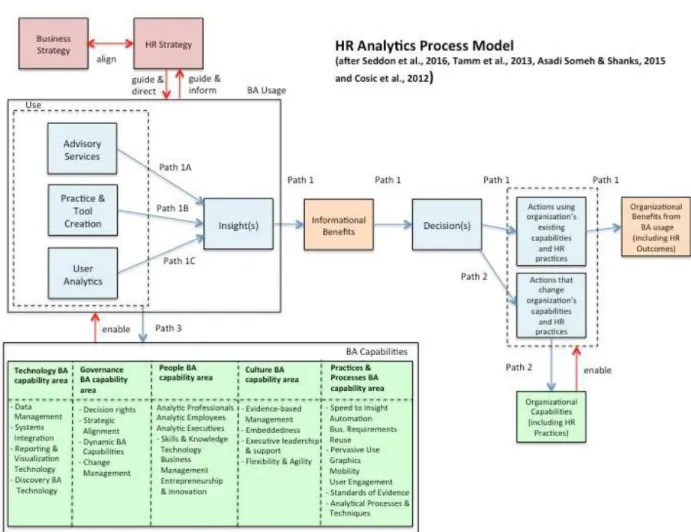
Based on the argumentation and derived propositions above, the Process Model of Seddon et al. (2016) is refined on the topics BA capabilities and BA Use. The enabling BA Capabilities are differentiated into five BA Capability Areas and the Pathways to Value for the use of BA are further differentiated into Advisory Services, Practice & Tool Creation and End-User Analytics. The concept of Informational Benefits is added to the Process Model to represent the facilitating role of the intangible benefits from BA usage leading to insights for decision-making and actions. To make the model more specific for the HRM domain, Business Strategy and HR Strategy are added, providing input, guidance and direction for BA use, ‘HR Practices’ (of HRM activities) are included as a subset of the Actions and Capabilities and ‘HR Outcomes’ are included as a subset of the benefits. HR Outcomes are the targets and results of HR Practices.
The proposed HR Analytics Process Model is depicted in figure 1.
Value through HR Analytics is captured in three main ways (or ‘paths’) and three sub-ways in the model. Three paths (numbered 1, 2 and 3) and three sub-paths (numbered 1A, 1B and 1C) of value creation are distinguished. The paths 1, 2 and 3 are from the Process Model of Seddon et al. (2016) and described above. The sub-paths 1A, 1B and 1C have been defined based on the work of Tamm et al. (2013) and are differentiations of the use of BA, by BA users. Sub-path 1A represents Advisory Services by Analytical Professionals. Sub-path 1B represents the creation of BA Practices & Tools by Analytical Professionals and Sub-path 1C represents the use of BA by Analytical End-Users (not being Analytical Professionals). The Analytic Resources in the Seddon et al. (2016) model, have been refined into five BA Capability Areas (after Cosic, 2012 with the addition of the Practices & Processes BA Capability Area). Informational Benefits are positioned between Insights and Decisions because of the facilitating role they play in the mechanisms between BA Use, insight creation and decision-making. The two key components of EB HR (Focus on Strategy and Standards of Evidence, Gibbons & Woock, 2007) have conceptually been incorporated in the model: Business Strategy and HR Strategy (in alignment) provide guidance and direction to the Usage of BA Capabilities and vice versa Business Strategy and HR Strategy are guided and informed by BA Usage. Standard of Evidence is part of the Practices & Processes BA Capability Area.
Preliminary evaluation
The HR Analytics Process Model is a comprehensive model and empirical testing is needed to test the validity, just like Seddon et al. (2016) argue for their model. For this study, a preliminary evaluation was done to determine whether the identified BA Capability Areas (the ‘what’) and the BA Use mechanisms (the ‘how’) from the HR Analytics Process Model can be observed in descriptions of practical situations. This was done using a selection of empirical case studies as data for the evaluation from the sample of 137 academic peer reviewed papers described above.
From this sample, papers with empirical case descriptions of organizations that used HR Analytics to generate business value, were selected (n=28). These case descriptions were examined on the occurrence of concepts that were added to the original Process Model of Seddon et al. (2016): the five BA Capability Areas, the three BA Use concepts (Advisory Services, Practice & Tool Creation and User Analytics) and Informational Benefits. It was evaluated whether elements of these concepts are mentioned or are recognizable in a consistent manner with the model and its definitions1in the case descriptions of the
articles. Informational Benefits was included in the evaluation as the concept has had limited attention in IS literature (Asadi Someh & Shanks, 2015). Business Strategy and HR Strategy were not included in the evaluation as these concepts were evidently present in all the cases.
Two coders independently examined the articles on the occurrence of the concepts and their elements mentioned above. Differences in coding were discussed, reconciled and an agreed coding was noted or remaining different codes were noted when agreement was not possible. Agreement between the two coders before discussion and reconciliation was 94.4% and 98.2% after discussion for the articles. Totals for each column were used to calculate the percentage of articles that mention a concept consistent with the model and the inter-rater agreement (after discussion and reconciliation) was calculated. The percentages that were found were: Advisory Services 82%, Practice & Tool Creation 89%, User Analytics 18%, Technology BA Capability Area 57%, Governance BA Capability Area 93%, People, Skills & Knowledge BA Capability Area 82%, Culture BA Capability Area 43%, Practices & Processes BA Capability Area 96% and Informational Benefits 96%.
The lower percentage of User Analytics (21%) may be because in the cases more attention was given to analytic specialists and project members (Advisory Services 86%) for a particular initiative or issue and less attention was given to analytics activities by end users (employees or managers). Also User Analytics facilitating technology like Mobile were still in the early stages of proliferation in HRM in the period that most cases were documented (between 2000 and 2014). Mobile adoption in HRM is growing though: a 50% adoption in 2017 is expected, a significant increase from 13% in 2014 (Harris & Spencer, 2016).
This preliminary evaluation indicates that the concepts added to the Process Model of Seddon et al. (2016), can be observed in most descriptions of the evaluated cases of HR Analytics and can be a useful contribution to the knowledge on BA and HR Analytics. Further (primary) research is needed to further develop and evaluate the model using qualitative cases studies and experiments and quantitative studies including contextual control factors like organization size and industry.
Concluding remarks
The purpose of this article is to conceptualize value creation through the use of HR Analytics enabled by BA capabilities. A conceptual HR Analytics Process Model is developed based on a model from BA literature that aims to capture what is known on value creation through BA in literature. The model is refined on the concepts of BA capabilities and BA Use and HRM specific additions are made.
The contribution of the proposed HR Analytics Process Model is threefold. First, it contributes to the field of IS research in which HR Analytics has received little attention so far. Second, it contributes to HRM research in which more scientific theoretical (and empirical) research is needed on HR Analytics. Third, it contributes to practice by providing a better understanding of what capabilities enable HR Analytics and how organizations create value using HR Analytics. Further (primary) research is needed to further develop and empirically validate the model and its mechanisms.
REFERENCES
Ambrosini, V., & Bowman, C. 2000. "Value creation versus value capture : towards a coherent definition of value in strategy - an exploratory study." British Journal of Management (11), pp. 1–15.
Asadi Someh, I., & Shanks, G. 2015. "How Business Analytics Systems provide Benefits and contribute to Firm Performance." In: Twenty-Third European Conference on Information Systems (ECIS), Münster, Germany, pp. 1–16.
Bennett, C. & Collins, L., 2015. “HR and People Analytics: Stuck in neutral.” In: Global Human Capital Trends 2015, Deloitte University Press.
Boudreau, J. W., & Ramstad, P. M. 2007. "Beyond HR: The New Science of Human Capital." Boston: Harvard Business School Press.
Cook, T. D., & Campbell, D. T. 1979. "Quasi-Experimentation: Design & Analysis for Field Settings." Boston MA: Houghton Mifflin Company.
Cosic, R., Shanks, G., & Maynard, S. 2012. "Towards a business analytics capability maturity model." In: Proceedings of the 23rd Australasian Conference on Information Systems, pp. 1–11.
Cosic, R., Shanks, G., & Maynard, S. 2015. "A business analytics capability framework." Australasian
Journal of Information Systems (19), pp. S5–S19.
Davenport, T. H., Harris, J. G., & Morison, R. 2010. "Analytics at Work: Smarter Decisions, Better Results." Harvard Business School Press Books.
Dulebohn, J. H., & Johnson, R. D. 2013. "Human resource metrics and decision support: A classification framework." Human Resource Management Review (23:1), pp. 71–83.
Falletta, B. S. 2014. "In Search of HR Intelligence: Evidence-Based HR Analytics Practices in High Performing Companies." People & Strategy (364), pp. 28–37.
Gibbons, J., & Woock, C. 2007. "Evidence-based human resources: A primer and summary of current literature." Excerpt from "Evidence-based HR in Action", The Conference Board. (R-1427-08- CS), pp. 1-21.
Harris, S. & Spencer, E. 2016. "Sierra-Cedar 2016–2017 HR Systems Survey White Paper, 19th Annual Edition". Sierra-Cedar.
Holsapple, C., Lee-Post, A., & Pakath, R. 2014. "A unified foundation for business analytics." Decision Support Systems (64), pp. 130–141.
Huselid, M. 2015. "Workforce Analytics for Strategy Execution." In: "The Rise of HR", D. Ulrich, B. Schiemann, & L. Sartain (Eds.) pp. 309–316. Alexandria, VA: HR Certification Institute.
Johnson, R. D., Lukaszewski, K. M., & Stone, D. L. 2016. "The evolution of the field of human resource information systems: Co-Evolution of technology and HR processes." In: Communications of the Association for Information Systems (38), pp. 533–553.
Kiron, D. & Shockley, R. 2011. "Creating Business Value with Analytics". MIT Sloan Management Review (53:1), pp. 57-63.
Levenson, A. (2011). "Using Targeted Analytics to Improve Talent Decisions." People & Strategy (34:2), pp. 34–43.
Markus, M. L., & Robey, D. 1988. "Information technology and organizational change: causal structure in theory and research." Management Science (29:4), pp. 803-838.
Marler, J. H., & Boudreau, J. W. 2017. "An evidence-based review of HR Analytics." The International Journal of Human Resource Management (28:1), pp. 3–26.
Mirani, R., & Lederer, A. 1998. "An instrument for assessing the organizational benefits of IS projects."
Decision Sciences (29:4), pp. 803–838.
Priem, R. L., & Butler, J. E. 2001. "Is the RBV a Useful Perspective for Strategic Management Research?" Academy of Management Review (26:1), pp. 22–40.
Seddon, P. B., Constantinidis, D., & Dod, H. 2012. "How Does Business Analytics Contribute to Business Value." In: Proceedings of the Thirty-Third International Conference on Information Systems, pp. 1–17.
Seddon, P. B., Constantinidis, D., Tamm, T., & Dod, H. 2016. "How does business analytics contribute to business value?" Information Systems Journal (2016).
Seddon, P., Calvert, C., & Yang, S. 2010. "A Multi-Project Model of Key Factors Affecting Organization Benefits from Enterprise Systems." MIS Quarterly (34:2), pp. 305–328.
Shanks, G., & Bekmamedova, N. 2012. "The Impact of Strategy on Business Analytics Success." In: ACIS 2012 Proceedings of the 23rd Australasian Conference on Information Systems, pp. 1–11.
Sharma, R., Mithas, S., & Kankanhalli, A. 2014. "Transforming decision-making processes: a research agenda for understanding the impact of business analytics on organisations." European Journal of Information Systems (23:4), pp. 433–441.
Sprongl, P. 2013. "Gaining competitive advantage through business analytics". Acta Universitatis Agriculturae et Silviculturae Mendelianae Brunensis (61:7), pp. 2779-2785.
Tamm, T., Seddon, P., & Shanks, G. 2013. "Pathways to Value from Business Analytics." In: ICIS 2013 Proceedings, pp. 1–16.
Ulrich, D., & Dulebohn, J. H. 2015. "Are we there yet? What’s next for HR?" Human Resource Management Review (25), pp. 188–204.
Wixom, B. H., Yen, B., & Relich, M. 2013. "Maximizing Value from Business Analytics." MIS Quarterly Executive (12:2), pp. 61–71.
Wright, P. M., Gardner, T. M., Moynihan, L. M., & Allen, M. R. 2005. "The Relationship between HR Practices and Firm Performance: Examining Causal Order." Personnel Psychology (58), pp. 409– 446.