Dynamic Hardware-Assisted Software-Controlled Page Placement to Manage
Capacity Allocation and Sharing within Large Caches
∗Manu Awasthi, Kshitij Sudan, Rajeev Balasubramonian, John Carter
School of Computing, University of Utah
Abstract
In future multi-cores, large amounts of delay and power will be spent accessing data in large L2/L3 caches. It has been recently shown that OS-based page coloring allows a non-uniform cache architecture (NUCA) to provide low la-tencies and not be hindered by complex data search mech-anisms. In this work, we extend that concept with mecha-nisms that dynamically move data within caches. The key innovation is the use of a shadow address space to allow hardware control of data placement in the L2 cache while being largely transparent to the user application and off-chip world. These mechanisms allow the hardware and OS to dynamically manage cache capacity per thread as well as optimize placement of data shared by multiple threads. We show an average IPC improvement of 10-20% for multi-programmed workloads with capacity allocation policies and an average IPC improvement of 8% for multi-threaded workloads with policies for shared page placement.
Keywords: page coloring, shadow-memory addresses, cache capacity allocation, data/page migration, last level caches, non-uniform cache architectures (NUCA).
1. Introduction
Future high-performance processors will implement hundreds of processing cores. The data requirements of these many cores will be fulfilled by many megabytes of shared L2 or L3 caches. These large caches will likely be heavily banked and distributed on chip: perhaps, each core will be associated with one bank of the L2 cache, thus forming a tiled architecture as in [37, 42]. An on-chip net-work connects the many cores and cache banks (or tiles). Such caches represent a non-uniform cache architecture (NUCA) as the latency for each cache access is a func-tion of the distance traveled on the on-chip network. The design of large last-level caches continues to remain a chal-lenging problem for the following reasons: (i) Long wires and routers in the on-chip network have to be traversed to access cached data. The on-chip network can contribute up to 36% of total chip power [23, 40] and incur delays of nearly a hundred cycles [28]. It is therefore critical for performance and power that a core’s data be placed in a physically nearby cache bank. (ii) On-chip cache space is now shared by multiple threads and multiple applications, leading to possibly high (destructive) interference. Poor ∗This work was supported in parts by NSF grants 0430063,
CCF-0811249, CCF-0702799, NSF CAREER award CCF-0545959, Intel, and the University of Utah.
allocation of cache space among threads can lead to sub-optimal cache hit rates and poor throughput.
Both of the above two problems have been actively stud-ied in recent years. To improve the proximity of data and computation, dynamic-NUCA policies have been pro-posed [1–3, 9, 10, 18, 20, 22]. In these policies, the ways of the cache are distributed among the various banks and a data block is allowed to migrate from a way in one bank to another way in a different bank that is hopefully closer to the core accessing this data block. The problem with these approaches is the need for a complex search mecha-nism. Since the block could reside in one of many possi-ble ways, the banks (or a complex tag structure) must be systematically searched before a cache hit/miss can be de-clared. As the number of cores is scaled up, the number of ways will have to also likely be scaled up, further increas-ing the power and complexity of the search mechanism.
The problem of cache space allocation among threads has also been addressed by recent papers [19, 29, 35, 38]. Many of these papers attempt to distribute ways of a cache among threads by estimating the marginal utility of an additional way for each thread. Again, this way-centric approach is not scalable as a many-core architecture will have to support a highly set-associative cache and its cor-responding power overheads. These way-partitioning ap-proaches also assume uniform cache architectures (UCA) and are hence only applicable for medium-sized caches.
Recent work by Cho and Jin [11] puts forth an approach that is inherently scalable, applicable to NUCA architec-tures, and amenable to several optimizations. Their work adopts a static-NUCA architecture where all ways of a cache set are localized to a single bank. A given address thus maps to a unique bank and a complex search mech-anism is avoided. The placement of a data block within the cache is determined by the physical memory address assigned to that block. That work therefore proposes OS-based page coloring as the key mechanism to dictate place-ment of data blocks within the cache. Cho and Jin focus on the problem of capacity allocation among cores and show that intelligent page coloring can allow a core to place its data in neighboring banks if its own bank is heavily pres-sured. This software control of cache block placement has also been explored in other recent papers [25, 30]. Note that the page-coloring approach attempts to split sets (not ways) among cores. It is therefore more scalable and ap-plies seamlessly to static-NUCA designs.
But several issues still need to be addressed with the page coloring approach described in recent papers [11, 25, 36]: (i) Non-trivial changes to the OS are required. (ii) A
page is appropriately colored on first touch, but this may not be reflective of behavior over many phases of a long-running application, especially if threads/programs migrate between cores or if the page is subsequently shared by many cores. (iii) If we do decide to migrate pages in re-sponse to changing application behavior, how can efficient policies and mechanisms be designed, while eliminating the high cost of DRAM page copies?
This paper attempts to address the above issues. We use the concept of shadow address spaces to introduce another level of indirection before looking up the L2 cache. This allows the hardware to dynamically change page color and page placement without actually copying the page in phys-ical memory or impacting the OS physphys-ical memory man-agement policies. We then describe robust mechanisms to implement page migration with two primary applications: (i) controlling the cache capacity assigned to each thread, (ii) moving a shared page to a location that optimizes its average access time from all cores.
This work therefore bridges advances in several related areas in recent years. It attempts to provide the benefits of D-NUCA policies while retaining a static-NUCA architec-ture and avoiding complex searches. It implements cache partitioning on a scalable NUCA architecture with limited associativity. It employs on-chip hardware supported by OS policies for on-chip data movement to minimize the impact on physical memory management and eliminate ex-pensive page copies in DRAM.
The rest of the paper is organized as follows. Section 2 sets this work in the context of related work. Section 3 describes the proposed mechanisms. These are evaluated in Section 4 and we conclude in Section 5.
2. Related Work
In recent years, a large body of work has been dedicated to intelligently managing shared caches in CMPs, both at finer (cache line, e.g., [2, 3, 7, 18, 22]) and coarser (page based,e.g., [11, 13, 25, 30]) granularities. Given the vast body of literature, we focus our discussion below to only the most related pieces of work.
Cache partitioning has been widely studied of late [19, 29, 35, 38]. Almost all of these mechanisms focus on way-partitioning, which we believe is inherently non-scalable. These mechanisms are primarily restricted to UCA caches. The use of way-partitioning in a NUCA cache would re-quire ways to be distributed among banks (to allow low-latency access for each core’s private data), thus requiring a complex search mechanism. This work focuses on set partitioning with page coloring and allows lower complex-ity and fine-grained capaccomplex-ity allocation.
A number of papers attempt to guide data placement within a collection of private caches [7, 14, 34]. This work focuses on a shared cache and relies on completely differ-ent mechanisms (page coloring, shadow addresses, etc.) to handle capacity and sharing. It is worth noting that a pri-vate cache organization is a special case of a shared cache
augmented with intelligent page coloring (that places all private data in the local cache slice).
A number of papers propose data block movement in a dynamic-NUCA cache [1–3, 9, 10, 18, 20, 22]. Most of these mechanisms require complex search to locate data [1, 3, 18, 20, 22] or per-core private tag arrays that must be kept coherent [9, 10]. We eliminate these complexities by em-ploying a static-NUCA architecture and allowing blocks to move between sets, not ways. Further, we manage data at the granularity of pages, not blocks. Our policies attempt to migrate a page close to the center of gravity of its requests from various cores: this is an approach borrowed from the dynamic-NUCA policy for block movement in [3].
The most related body of work is that by Cho and Jin [11], where they propose the use of page coloring as a means to dictate block placement in a static-NUCA archi-tecture. That work shows results for a multi-programmed workload and evaluates the effect of allowing a single pro-gram to borrow cache space from its neighboring cores if its own cache bank is pressured. Cho and Jin employ static thresholds to determine the fraction of the working set size that spills into neighboring cores. They also color a page once at first touch and do not attempt page migra-tion (the copying of pages in DRAM physical memory), which is clearly an expensive operation. They also do not attempt intelligent placement of pages within the banks shared by a single multi-threaded application. Concurrent to our work, Chaudhuri [8] also evaluates page-grain move-ment of pages in a NUCA cache. That work advocates that page granularity is superior to block granularity because of high locality in most applications. Among other things, our work differs in the mechanism for page migration and in our focus on capacity allocation among threads.
Lin et al. [25] extend the proposals by Cho and Jin and apply it to a real system. The Linux kernel is modified to implement page coloring and partition cache space be-tween two competing threads. A re-mapped page suffers from the cost of copying pages in DRAM physical mem-ory. Lin et al. acknowledge that their policies incur high overheads and the focus of that work is not to reduce these overheads, but understand the impact of dynamic OS-based cache partitioning on a real system. In a simulation-based study such as ours, we are at liberty to introduce new hard-ware to support better cache partitioning mechanisms that do not suffer from the above overheads and that do not re-quire significant OS alterations. We also consider move-ment of shared pages for multi-threaded applications.
Ding et al. [13] employ page re-coloring to decrease conflict misses in the last level cache by remapping pages from frequently used colors to least used colors. Their work deals exclusively with reducing conflicts for a single thread in a single-core UCA cache environment. Rafique et al. [30] leverage OS support to specify cache space quo-tas for each thread in an effort to maximize throughput and fairness. That work does not take advantage of page color-ing and ultimately resorts to way-partitioncolor-ing at the block
level while meeting the quota restrictions.
A key innovation in our work is the use of shadow ad-dress spaces and another level of indirection within the L2 cache to manage page re-mapping at low overheads. This is not a feature of any of the related work listed thus far. Shadow address spaces have been previously employed in the Impulse memory controller [5] to efficiently implement superpages and scatter-gather operations. The use of an-other level of indirection before accessing the L2 has been previously employed by Min and Hu [27] to reduce conflict misses for a single-thread UCA cache platform.
Page coloring for data placement within the cache was extensively studied by Kessler and Hill [21]. Several com-mercial systems have implemented page migration for dis-tributed memory systems, most notably SGI’s implemen-tation of page-migration mechanisms in their IRIX oper-ating system [12]. LaRowe et al. [24, 31, 32] devised OS support mechanisms to allow page placement policies in NUMA systems. Another body of work [6, 39] explored the problem from multiprocessor compute server perspec-tive and dealt with similar mechanisms as LaRowe et al. to schedule and migrate pages to improve data locality in cc-NUMA machines. The basic ideas in this paper also bear some similarities to S-COMA [33] and its derivatives (R-NUMA [15] and Wildfire [16]). But note that there are no replicated pages within our L2 cache (and hence no intra-L2 cache coherence). Key differences between our work and the cc-NUMA work is our use of shadow addresses to rename pages elegantly, the need to be cognizant of bank capacities, and the focus on space allocation among com-peting threads. There are also several differences between the platforms of the 90s and multi-cores of the future (sizes of caches, latencies, power constraints, on-chip bandwidth, transistors for hardware mechanisms, etc.).
In summary, while we clearly stand on the shoulders of many, the key novel contributions of this work are:
• We introduce a hardware-centric mechanism that is based on shadow addresses and a level of indirection within the L2 cache to allow pages to migrate at low overheads within a static-NUCA cache.
• The presence of a low-overhead page migration mech-anism allows us to devise dynamic OS policies for page movement. Pages are not merely colored at first touch and our schemes can adapt to varying program behavior or even process/thread migration.
• The proposed novel dynamic policies can allocate cache space at a fine granularity and move shared pages to the center of gravity of its accesses, while being cognizant of cache bank pressure, distances in a NUCA cache, and time-varying requirements of pro-grams. The policies do not rely on a-priori knowledge of the program, but rely on hardware counters. • The proposed design has low complexity, high
per-formance, low power, and policy flexibility. It rep-resents the state-of-the-art in large shared cache de-sign, providing the desirable features of static-NUCA
Shadow bits (SB) Physical Tag (PT) Original Page
Color (OPC) Page Offset (PO) L2 index bits L1 and L2 Cache Offrchip (Main Memory) VPN PPN New Page Color Physical page number
TLB
Virtual Address
SB PT OPC PO + Æ OPC PT NPC PO
Original Physical Address
NPC
New Physical Address
SB PT OPC PO
L2 miss
Coherence Request from Offrchip Translation Table L1 index bits
Figure 1. Address structure and address modifica-tions required to access migrated pages.
(simple data look-up), dynamic-NUCA (proximity of data and computation), set-partitioning (high scalabil-ity and adaptabilscalabil-ity to NUCA), hardware-controlled page movement/placement (low-cost migration and fine-grained allocation of space among threads), and OS policies (flexibility).
3. Proposed Mechanisms
We first describe the mechanisms required to support efficient page migration. We avoid DRAM page copies and simply change the physical address that is used inter-nally within the processor for that page. We then discuss the policies to implement capacity allocation and sharing. The discussion below pertains to a multi-core system where each core has private L1-D/I caches and a large shared L2. Each L2 block maintains a directory to keep track of L1 cached copies and implement a MESI coherence protocol.
3.1 Page Re-Coloring
Baseline Design
In a conventional cache hierarchy, the CPU provides a virtual address that is used to index into the L1 cache and TLB. The TLB converts thevirtual page number (VPN)to aphysical page number (PPN). Most L1 caches are virtu-ally indexed and physicvirtu-ally tagged and the output of the TLB is required before performing the tag comparison.
The top of Figure 1 shows the structure of a typical physical address. The intersection of the physical page number bits and thecache indexbits are often referred to as thepage color bits. These are the bits that the OS has control over, thereby also exercising control over where the block gets placed in cache. Without loss of general-ity, we focus on a subset of these bits that will be modified by our mechanisms to alter where the page gets placed in L2 cache. This subset of bits is referred to as theOriginal Page Color (OPC)bits in Figure 1.
Modern hardware usually assumes 64-bit wide memory addresses, but in practice only employs a subset of these 64 bits. For example, SUN’s UltraSPARC-III architec-ture [17] has 64-bit wide memory addresses but uses only
44 and 41 bits for virtual and physical addresses, respec-tively. The most significant 23 bits that are unused are re-ferred to asShadow Bits (SB). Since these bits are unused throughout the system, they can be used for internal ma-nipulations within the processor.
Page Re-Naming
The goal of our page migration mechanism is to pre-serve the original location of the page in physical memory, but refer to it by a new name within the processor. When the virtual address (V A) indexes into the TLB, instead of producing the original true physical address (P A), the TLB produces a new physical address (P A0). This new address is used to index into the L1 and L2 caches. If there is an L2 cache miss and the request must travel off-chip,P A0 is converted back toP Abefore leaving the processor. In order for these translations to happen efficiently and cor-rectly, we must make sure that (i) complex table look-ups are not required and (ii) the new nameP A0does not over-write another existing valid physical address. This is where the shadow bits can be leveraged.
Unique Addresses
When a page is migrated (renamed within the proces-sor), we change the OPC bits of the original address to a set ofNew Page Color (NPC) bits to generate a new ad-dress. We then place the OPC bits into the most significant shadow bits of this new address. We are thus creating a new and unique address as every other existing physical address has its shadow bits set to zero. The address can also not match an existing migrated address: if twoP A0s are equal, the correspondingP As must also be equal. If the originalP Ais swapped out of physical memory, the TLB entries forP A0are invalidated (more on TLB organization shortly); so it is not possible for the nameP A0to represent two distinct pages that were both assigned to addressP A in physical memory at different times.
TLB Modifications
To effect the name change, the TLBs of every core on chip must be updated (similar to the well-known process of TLB shootdown). Each TLB entry now has a new field that stores the NPC bits if that page has undergone migration. This is a relatively minor change to the TLB structure. Es-timates with CACTI 6.0 [28] show that the addition of six bits to each entry of a 128-entry TLB does not affect access time and slightly increases its energy per access from5.74
to5.99pJ (at 65 nm technology). It is therefore
straight-forward to produce the new address.
Off-Chip Access
If the request must travel off-chip,P A0 must be con-verted back toP A. This process is trivial as it simply re-quires that the NPC bits inP A0 be replaced by the OPC bits currently residing in shadow space and the shadow bits are all reset (see Figure 1). Thus, no table look-ups are required for this common case.
Translation Table (TT)
In addition to updating TLB entries, every page re-color must also be tracked in a separate structure (co-located with
the L2 cache controller) referred to as theTranslation Ta-ble (TT). This structure is required in case a TLB entry is evicted, but the corresponding blocks still reside with their new name in L1 or L2. This structure keeps track of process-id, VPN, PPN, and NPC. It must be looked up on a TLB miss before looking up page tables. It must also be looked up when the processor receives a coherence request from off-chip as the off-chip nameP Amust be translated to the on-chip nameP A0. This structure must be somewhat large as it has to keep track of every recent page migration that may still have blocks in cache. If an entry is evicted from this structure, it must invalidate any cached blocks for that entry and its instances in various TLBs.
Our simulations assume a fully-associative LRU struc-ture with 10K entries and this leads to minimal evictions. We believe that set-associative implementations will also work well, although, we haven’t yet focused on optimiz-ing the design of the TT. Such a structure has a storage requirement of roughly 160KB, which may represent a minor overhead for today’s billion-transistor architectures. The TT is admittedly the biggest overhead of the proposed mechanisms, but it is accessed relatively infrequently. In fact, it serves as a second-level large TLB and may be more efficient to access than walking through the page tables that may not be cache-resident; it may therefore be a structure worth considering even for a conventional processor de-sign. The inefficiency of this structure will be a problem if the processor is inundated with external coherence re-quests (not a consideration in our simulations). One way to resolve this problem is to not move individual pages, but entire colored regions at a time,i.e., all pages colored red are re-colored to yellow.
Cache Flushes
When a page is migrated within the processor, the TLB entries are updated and the existing dirty lines of that page in L2 cache must be flushed (written back). If the direc-tory for that L2 cache line indicates that the most recent copy of that line is in an L1 cache, then that L1 entry must also be flushed. All non-dirty lines in L1 and L2 need not be explicitly flushed. They will never be accessed again as the old tags will never match a subsequent request and they will be naturally replaced by the LRU replacement policy. Thus, every page migration will result in a number of L1 and L2 cache misses that serve to re-load the page into its new locations in cache. Our results later show that these “compulsory” misses are not severe if the data is accessed frequently enough after its migration. These overheads can be further reduced if we maintain a small writeback buffer that can help re-load the data on subsequent reads before it is written back to memory. For our simulations, we pes-simistically assume that every first read of a block after its page migration requires a re-load from memory. The L1 misses can be potentially avoided if the L1 caches continue to use the original address while the L2 cache uses the new address (note that page migration is being done to improve placement in the L2 and does not help L1 behavior in any
way). But this would lead to a situation where data blocks reside in L1, but do not necessarily have a back-up copy in L2, thus violating inclusivity. We do not consider this optimization here in order to retain strict inclusivity within the L1-L2 hierarchy.
Cache Tags and Indexing
Most cache tag structures do not store the most signif-icant shadow bits that are always zero. In the proposed scheme, the tag structures are made larger as they must also accommodate the OPC bits for a migrated page. Our CACTI 6.0 estimates show that this results in a 5% in-crease in area/storage, a 2.64% inin-crease in access time, and a 9.3% increase in energy per access for our 16 KB/4-way L1 cache at 65 nm technology (the impact is even lower on the L2 cache). We continue to index into the L1 cache with the virtual address, so the TLB look-up is not on the L1 critical path just as in the baseline. The color bits that we modify must therefore not be part of the L1 index bits (as shown at the top of Figure 1).
3.2 Managing Capacity Allocation and Sharing
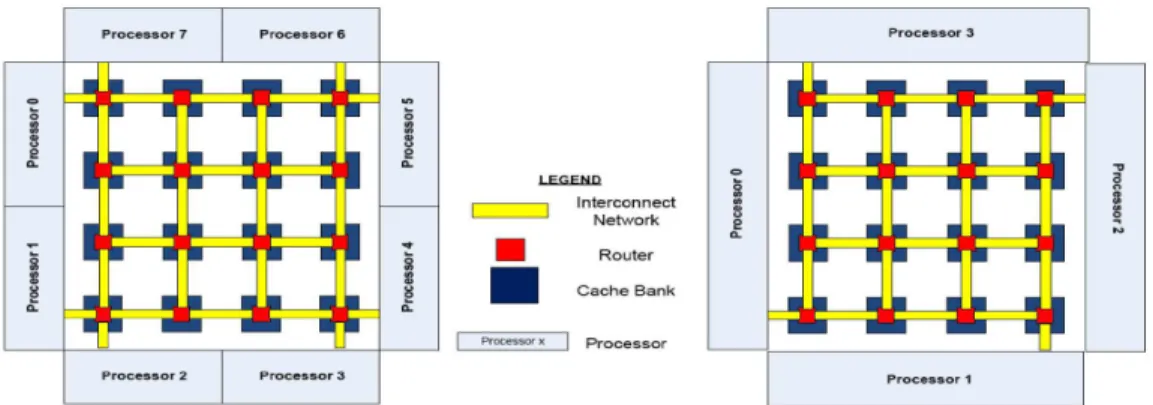
In our study, we focus our evaluations on 4- and 8-core systems as shown in Figure 2. The L2 cache is shared by all the cores and located centrally on chip. The L2 cache capacity is assumed to be 2 MB for the 4-core case and 4 MB for the 8-core case. Our solutions also apply to a tiled architecture where a slice of the shared L2 cache is co-located with each core. The L2 cache is partitioned into 16 banks and connected to the cores with an on-chip network with a grid topology. The L2 cache is organized as a static-NUCA architecture. In our study, we use 64 colors for the 4-core case and 128 colors for the 8-core case.
When handling multi-programmed workloads, our pro-posed policy attempts to spread the working set of a sin-gle program across many colors if it has high capacity needs. Conversely, a program with low working-set needs is forced to share its colors with other programs. When handling a multi-threaded workload, our policies attempt to move a page closer to the center-of-gravity of its accesses, while being cognizant of cache capacity constraints. The policies need not be aware of whether the workload is multi-programmed or multi-threaded. Both sets of policies run simultaneously, trying to balance capacity allocations as well as proximity of computation to data. Each policy is discussed separately in the next two sub-sections.
3.2.1 Capacity Allocation Across Cores
Every time a core touches a page for the first time, the OS maps the page to some region in physical memory. We make no change to the OS’ default memory management and alter the page number within the processor. Every core is assigned a set of colors that it can use for its pages and this is stored in a small hardware register. At start-up time, colors are equally distributed among all cores such that each core is assigned colors in close proximity. When a page is brought in for the first time, does not have an en-try in the TT, and has an original page color (OPC) that is
not in the assigned set of colors for that core, it is migrated to one of the assigned colors (in round-robin fashion). Ev-ery time a page re-coloring happens, it is tracked in the TT, every other TLB is informed, and the corresponding dirty blocks in L2 are flushed. The last step can be time-consuming as the tags of a number of sets in L2 must be examined, but this is not necessarily on the critical path. In our simulations, we assume that every page re-color is accompanied by a 200 cycle stall to perform the above op-erations. A core must also stall on every read to a cache line that was flushed. We confirmed that our results are not very sensitive to the 200 cycle stall penalty as it is incurred infrequently and mostly during the start of the application. There are two key steps in allocating capacity across cores. The first is to determine the set of colors assigned to each core and the second is to move pages out of banks that happen to be heavily pressured. Both of these steps are performed periodically by the OS. Every 10 million cy-cle time interval is referred to as anepochand at the end of every epoch, the OS executes a routine that examines various hardware counters. For each color, these hardware
counters specify number of misses andusage(how many
unique lines yield cache hits in that epoch). If a color has a high miss rate, it is deemed to be in need of more cache space and referred to as an“Acceptor”. If a color has low usage, it is deemed to be a“Donor”,i.e., this color can be shared by more programs. Note that a color could suffer from high miss rate and low usage, which hints at a stream-ing workload, and the color is then deemed to be a Donor. For all cores that have an assigned color that is an Acceptor, we attempt to assign one more color to that core from the list of Donor colors. For each coloriin the list of Donor colors, we compute the following cost function:
color suitabilityi=αA×distancei+αB×usagei
αAandαBare weights that model the relative importance of usage and the distance between that color and the core in question. The weights were chosen such that the distance and usage quantities were roughly equal in magnitude in the common case. The color that minimizes the above cost function is taken out of the list of Donors and placed in the set of colors assigned to that core. At this point, that color is potentially shared by multiple cores. The OS rou-tine then handles the next core. The order in which we examine cores is a function of the number of Acceptors in each core’s set of colors and the miss rates within those Acceptors. This mechanism is referred to as PROPOSED-COLOR-STEAL in the results section.
If a given color is shared by multiple cores and its miss rate exceeds a high threshold for a series of epochs, it sig-nals the fact that some potentially harmful re-coloring de-cisions have been made. At this point, one of the cores takes that color out of its assigned set and chooses to mi-grate a number of its pages elsewhere to another Donor color (computed with the same cost function above). The pages that are migrated are the ones in the TLB of that
Figure 2. Arrangement of processors, NUCA cache banks, and the on-chip interconnect.
core with the offending color. This process is repeated for a series of epochs until that core has migrated most of its frequently used pages from the offending color to the new Donor color. With this policy included, the mechanism is referred to as PROPOSED-COLOR-STEAL-MIGRATE.
Minimal hardware overhead is introduced by the pro-posed policies. Each core requires a register to keep track of assigned colors. Cache banks require a few counters to track misses per color. Each L2 cache line requires a bit to indicate if the line is touched in this epoch and these bits must be counted at the end of the epoch (sampling could also be employed, although, we have not evaluated that approximation). The OS routine is executed once ev-ery epoch and will incur overheads of less than 1% even if it executes for as many as 100,000 cycles. An update of the color set for each core does not incur additional overheads, although, the migration of a core’s pages to a new donor color will incur TLB shootdown and cache flush overheads. Fortunately, the latter is exercised infrequently in our sim-ulations. Also note that while the OS routine is performing its operations, a core is stalled only if it makes a request to a page that is currently in the process of migrating1.
3.2.2 Migration for Shared Pages
The previous sub-section describes a periodic OS routine that allocates cache capacity among cores. We adopt a similar approach to also move pages that are shared by the threads of a multi-threaded application. Based on the ca-pacity heuristics just described, pages of a multi-threaded application are initially placed with a focus on minimizing miss rates. Over time, it may become clear that a page hap-pens to be placed far from the cores that make the most frequent accesses to that page, thus yielding high average access times for L2 cache hits. As the access patterns for a page become clear, it is important to move the page to theCenter-of-Gravity (CoG)of its requests in an attempt to minimize delays on the on-chip network.
Just as in the previous sub-section, an OS routine exe-cutes at the end of every epoch and examines various hard-ware counters. Hardhard-ware counters associated with every TLB entry keep track of the number of accesses made to 1This is indicated by a bit in the TLB. This bit is set at the start of the
TLB shootdown process and reset at the very end of the migration.
L1 I-cache 16KB 4-way 1-cycle L1 D-cache 16KB 4-way 1-cycle
Page Size 4 KB
Memory latency 200 cycles for the first block L2 unified cache 2MB (4-core) / 4MB (8-core) 8-way
DRAM Size 4 GB
NUCA Parameters
Network 4×4 grid Bank access time 3 cycles Hop Access time 2 cycles Router Overhead 3 cycles (Vertical & Horizontal)
Table 1. Simics simulator parameters.
that page by that core. The OS collects these statistics for the 10 most highly-accessed pages in each TLB. For each of these pages, we then compute the following cost func-tion for each colori:
color suitabilityi=αA×total latencyi+αB×usagei
wheretotal latencyiis the total delay on the network ex-perienced by all cores when accessing this page, assum-ing the frequency of accesses measured in the last epoch. The page is then moved to the color that minimizes the above cost function, thus attempting to reduce latency for this page and cache pressure in a balanced manner. Page migrations go through the same process as before and can be relatively time consuming as TLB entries are updated and dirty cache lines are flushed. A core’s execution will be stalled if it attempts to access a page that is undergoing migration. For our workloads, page access frequencies are stable across epochs and the benefits of low-latency access over the entire application execution outweigh the high ini-tial cost of moving a page to its optimal location.
This policy introduces hardware counters for each TLB entry in every core. Again, it may be possible to sam-ple a fraction of all TLB entries and arrive at a better performance-cost design point. This paper focuses on eval-uating the performance potential of the proposed policies and we leave such approximations for future work.
4. Results
4.1 Methodology
Our simulation infrastructure uses Virtutech’s Simics platform [26]. We build our own cache and network mod-els upon Simics’g-cachemodule. Table 1 summarizes the configuration of the simulated system. All delay calcula-tions are for a 65 nm process and a clock frequency of
Acceptor Applications bzip2∗, gobmk∗, hmmer∗, h264ref∗, omnetpp∗, xalancbmk∗, soplex∗, mummer•, tigr•, fasta-dna•
Donor Applications namd∗, libquantum∗, sjeng∗, milc∗,povray∗,swaptions?
Table 2. Workload Characteristics.∗- SpecCpu2006,•- BioBench,?- PARSEC 5 GHz and a large 16 MB cache. The delay values are
calculated using CACTI 6.0 [28] and remain the same ir-respective of cache size being modeled. For all of our sim-ulations, we shrink the cache size (while retaining the same bank and network delays), because our simulated work-loads are being shrunk (in terms of number of cores and input size) to accommodate slow simulation speeds. Ordi-narily, a 16 MB L2 cache would support numerous cores, but we restrict ourselves to 4 and 8 core simulations and shrink the cache size to offer 512 KB per core (more L2 capacity per core than many modern commercial designs). The cache and core layouts for the 4 and 8 core CMP sys-tems are shown in Figure 2. Most of our results focus on the 4-core system and we show the most salient results for the 8-core system as a sensitivity analysis. The NUCA L2 is arranged as a 4x4 grid with a bank access time of 3 cycles and a network hop (link plus router) delay of five cycles. We accurately model network and bank access contention. An epoch length of 10 million instructions is employed.
Our simulations have a warm-up period of 25 million instructions. The capacity allocation policies described in Section 3.2.1 are tested on multi-programmed workloads from SPEC, BioBench, and PARSEC [4], described in Ta-ble 2. As described shortly, these specific programs were selected to have a good mix of small and large working sets. SPEC and BioBench programs are fast forwarded by 2 bil-lion instructions to get past the initialization phase while the PARSEC programs are observed over their defined re-gions of interest. After warm-up, the workloads are run until each core executes for two billion instructions.
The shared-page migration policies described in Sec-tion 3.2.2 are tested on multi-threaded benchmarks from SPLASH-2 [41] and PARSEC described in Table 5. All these applications were fast forwarded to the beginning of parallel section or the region of interest (for SPLASH-2 and PARSEC, respectively) and then executed for 25 million instructions to warm up the caches. Results were collected over the next 1 billion instruction execution, or, end of par-allel section/region-of-interest, whichever occurs first.
Just as we use the termsAcceptorsandDonorsfor col-ors in Section 3.2.1, we also similarly dub programs de-pending on whether they benefit from caches larger than 512 KB. Figure 3(a) shows IPC results for a subset of pro-grams from the benchmark suites, as we provide them with varying sizes of L2 cache while keeping the L2 (UCA) ac-cess time fixed at 15 cycles. This experiment gives us a good idea about capacity requirements of various applica-tions and the 10 applicaapplica-tions on the left of Figure 3(a) are termedAcceptorsand the other 6 are termedDonors.
4.2 Baseline Configurations
We employ the following baseline configurations to un-derstand the roles played by capacity, access times, and
Application Pages Mapped to Stolen Colors Total Pages Touched
bzip2 200 3140 gobmk 256 4010 hmmer 124 2315 h264ref 189 2272 omnetpp 376 8529 xalancbmk 300 6751 soplex 552 9632 mimmer 9073 29261 tigr 6930 17820 fasta-dna 740 1634
Table 3. Behavior of PROPOSED-COLOR-STEAL.
data mapping in S-NUCA caches:
1. BASE-UCA: Even though the benefits of NUCA are well understood, we provide results for a 2 MB UCA baseline as well for reference. Similar to our NUCA estimates, the UCA delay of 15 cycles is based on CACTI estimates for a 16 MB cache.
2. BASE-SNUCA: This baseline does not employ any intelligent assignment of colors to pages (they are ef-fectively random). Each color maps to a unique bank (the least significant color bits identify the bank). The data accessed by a core in this baseline are somewhat uniformly distributed across all banks.
3. BASE-PRIVATE: All pages are colored once on first touch and placed in one of the four banks (in round-robin order) closest to the core touching this data. As a result, each of the four cores is statically assigned a quarter of the 2 MB cache space (resembling a base-line that offers a collection of private caches). This baseline does not allow spilling data into other colors even if some color is heavily pressured.
The behavior of these baselines, when handling a single program, is contrasted by the three left bars in Figure 3(b). This figure only shows results for the Acceptor applica-tions. The UCA cache is clearly the most inferior across the board. Only two applications (gobmk, hmmer) show better performance with BASE-PRIVATE than BASE-SHARED – even though these programs have large working sets, they benefit more from having data placed nearby than from having larger capacity. This is also of course trivially true for all the Donor applications (not shown in figure).
4.3 Multi-Programmed Results
Before diving into the multi-programmed results, we first highlight the behavior of our proposed mechanisms when executing a single program, while the other three cores remain idle. This is demonstrated by the rightmost bar in Figure 3(b). The proposed mechanisms (refered to as PROPOSED-COLOR-STEAL) initially color pages to place them in the four banks around the requesting core. Over time, as bank pressure builds, the OS routine alters the set of colors assigned to each core, allowing the core to steal colors (capacity) from nearby banks. Since these are
4 Cores
{gobmk, tigr, libquantum, namd}M1,
{mummer, bzip2, milc, povray}M2,
{mummer, mummer, milc, libquantum}M3, {mummer, omnetpp, swaptions, swaptions}M4,
{soplex, hmmer, sjeng, milc}M5,
{soplex, h264ref, swaptions, swaptions}M6
2 Acceptors {bzip2, soplex, swaptions, povray}M7
,{fasta-dna, hmmer, swaptions, libquantum}M8
,{hmmer, omnetpp, swaptions, milc}M9
,
{xalancbmk, hmmer, namd, swaptions}M10,
{tigr, hmmer, povray, libquantum}M11,
{tigr, mummer, milc, namd}M12, {tigr, tigr,povray, sjeng}M13,
{xalancbmk, h264ref, milc, sjeng}M14, {h264ref, xalancbmk, hmmer, sjeng}M15,
{mummer, bzip2, gobmk, milc}M16,
3 Acceptors {fasta-dna, tigr, mummer, namd}M17
,{omnetpp, xalancbmk, fasta-dna, povray}M18
,
{gobmk, soplex, tigr, swaptions}M19,
{bzip2, omnetpp, soplex, libquantum}M20 {bzip2, soplex, xalancbmk, omnetpp}M21
,{fasta-dna, mummer, mummer, soplex}M22
, 4 Acceptors {gobmk, soplex, xalancbmk, h264ref}M23,
{soplex, h264ref,mummer, omnetpp}M24, {bzip2, tigr, xalancbmk, mummer}M25
8 -cores
4 Acceptors {mummer,hmmer,bzip2,xalancbmk,swaptions,namd,sjeng,povray}M26, {omnetpp,h264ref,tigr,soplex,libquantum,milc, swaptions,namd}M27
6 Acceptors {h264ref,bzip2,tigr,omnetpp,fasta-dna,soplex,swaptions,namd}M28 {mummer,tigr,fasta-dna,gobmk,hmmer,bzip2,milc,namd}M29
8 Acceptors {bzip2, gobmk,hmmer,h264ref,omnetpp,soplex,mummer,tigr}M30 {fasta-dna,mummer,h264ref,soplex,bzip2,omnetpp,bzip2,gobmk}M31
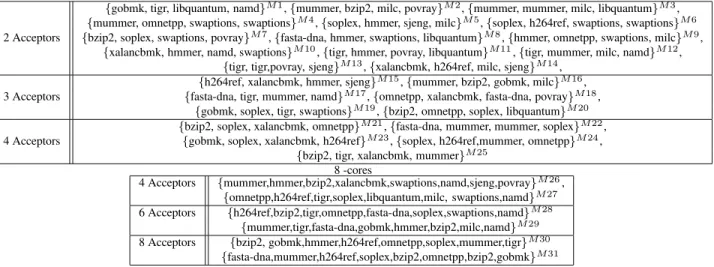
Table 4. Workload Mixes - 4 and 8 cores. Each workload will be referred to by its superscript name.
single-program results, the program does not experience competition for space in any of the banks. The proposed mechanisms show a clear improvement over all baselines (an average improvement of 15% over BASE-SNUCA and 21% over BASE-PRIVATE). They not only provide high data locality by placing most initial (and possibly most crit-ical) data in nearby banks, but also allow selective spillage into nearby banks as pressure builds. Our statistics show that compared to BASE-PRIVATE, the miss rate reduces by an average of 15.8%. The number of pages mapped to stolen colors is summarized in Table 3. Not surprisingly, the applications that benefit most are the ones that touch (and spill) a large number of pages.
4.3.1 Multicore Workloads
We next present our simulation models that execute four programs on the four cores. A number of workload mixes are constructed (described in Table 4). We vary the number of acceptors to evaluate the effect of greater competition for limited cache space. In all workloads, we attempted to maintain a good mix of applications not only from dif-ferent suites, but also with difdif-ferent runtime behaviors. For all experiments, the epoch lengths are assumed to be 10 million instructions for PROPOSED-COLOR-STEAL. Decision to migrate already recolored pages (PROPOSED-COLOR-STEAL-MIGRATE) are made every 50 million cycles. Having smaller epoch lengths results in frequent movement of recolored pages.
The same cache organizations as described before are compared again; there is simply more competition for the space from multiple programs. To demonstrate the im-pact of migrating pages away from over-subscribed colors, we show results for two versions of our proposed mecha-nism. The first (PROPOSED-COLOR-STEAL) never mi-grates pages once they have been assigned an initial color; the second (PROPOSED-COLOR-STEAL-MIGRATE) re-acts to poor initial decisions by migrating pages. The PROPOSED-COLOR-STEAL policy, to some extent, ap-proximates the behavior of policies proposed by Cho and
Jin [11]. Note that there are several other differences be-tween our approach and theirs, most notably, the mecha-nism by which a page is re-colored within the hardware.
To determine the effectiveness of our policies, we use weighted system throughputs as the metric. This is com-puted as follows:
weighted throughput=
N U M CORESX −1
i=0
{IP Ci/IP Ci BASE P RI V AT E}
Here,IP Cirefers to the application IPC for that exper-iment andIP Ci BASE P RI V AT Erefers to the IPC of that application when it is assigned a quarter of the cache space as in the BASE-PRIVATE case. The weighted throughput of the BASE-PRIVATE model will therefore be very close to 4.0 for the 4-core system.
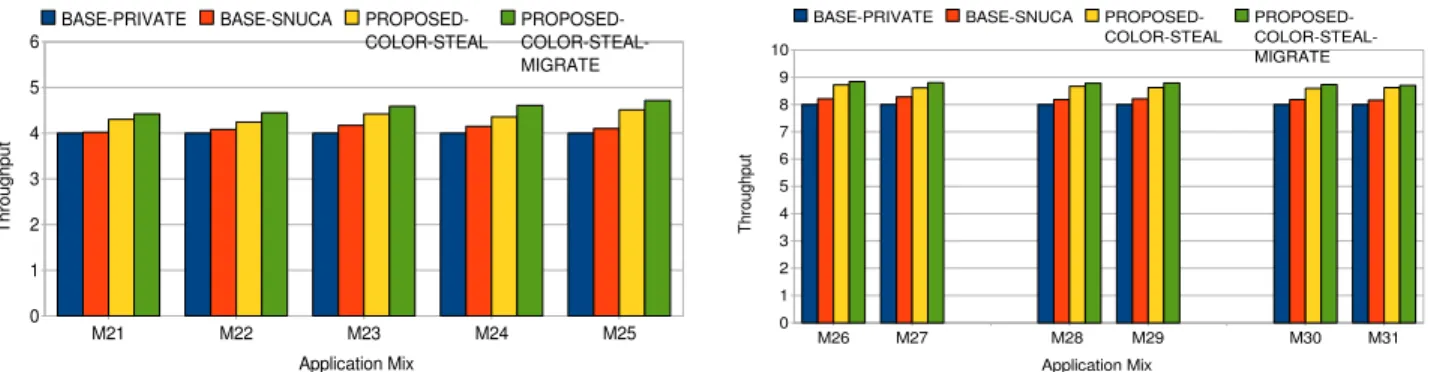
The results in Figures 4 and 5 are organized based on the number of acceptor programs in the workload mix. For 2, 3, and 4 acceptor cases, the maximum/average im-provements in weighted throughput with the PROPOSED-COLOR-STEAL-MIGRATE policy, compared to the best baseline (BASE-SNUCA) are 25%/20%, 16%/13%, and
14%/10%, respectively. With only the
PROPOSED-COLOR-STEAL policy, the corresponding improvements are 21%/14%, 14%/10%, and 10%/6%. This demonstrates the importance of being able to adapt to changes in working set behaviors and inaccuracies in initial page coloring deci-sions. This is especially important for real systems where programs terminate/sleep and are replaced by other pro-grams with potentially different working set needs. The ability to seamlessly move pages with little overhead with our proposed mechanisms is important in these real-world settings, an artifact that is hard to measure for simulator studies. For the 1, 2, 3, and 4-acceptor cases, an average 18% reduction in cache miss rates and 21% reduction in average access times were observed.
Not surprisingly, improvements are lower as the number of acceptor applications increases because of higher com-petition for available colors. Even for the 4-acceptor case,
256 KB 512 KB 1 MB 2 MB 4 MB 8 MB 0 0.2 0.4 0.6 0.8 1 bzip2 gobmk hmmer h264ref omnetpp
xalancbmk soplex mummer tigr fasta_dna − namd libquantum sjeng milc povray swaptions IPC Benchmark
a. IPC improvements with increasing L2 capacities.
BASE−UCA BASE−SNUCA BASE−PRIVATE PROPOSED−COLOR−STEAL 0 0.2 0.4 0.6 0.8 1
bzip2 gobmk hmmer h264ref omnetpp xalancbmk soplex mummer tigr fasta_dna average IPC Benchmark
b. Relative IPC improvements for single core with color stealing.
Figure 3. (a) Experiments to determine workloads (b) Relative IPC improvements of proposed color stealing approach.
a. Weighted Throughput of system with 2 acceptors and 2 donors. b. Weighted Throughput of system with 3 acceptors and 1 donor. Figure 4. System throughputs. Results for workloads with 2 acceptors are shown in (a) and with 3 acceptors in (b).
non-trivial improvements are seen over the static baselines because colors are adaptively assigned to applications to balance out miss rates for each color. A maximum slow-down of 4% was observed for any of the donor applica-tions, while much higher improvements are observed for many of the co-scheduled acceptor applications.
As a sensitivity analysis, we show a limited set of exper-iments for the 8-core system. Figure 5(b) shows the behav-ior of the two baselines and the two proposed mechanisms for a few 4-acceptor, 6-acceptor, and 8-acceptor workloads. The average improvements with PROPOSED-COLOR-STEAL and PROPOSED-COLOR-PROPOSED-COLOR-STEAL-MIGRATE are 8.8% and 12%, respectively.
4.4 Results for Multi-threaded workloads
In this section, we evaluate the page migration poli-cies described in Section 3.2.2. We implement a MESI directory-based coherence protocol at the L1-L2 boundary with a writeback L2. The benchmarks and their properties are summarized in Table 5. We restrict most of our analy-sis to the 4 SPLASH-2 and 2 PARSEC programs in Table 5 that have a large percentage of pages that are frequently accessed by multiple cores. Not surprisingly, the other ap-plications do not benefit much from intelligent migration of shared pages and are not discussed in the rest of the paper. Since all these benchmarks must be executed with smaller working sets to allow for acceptable simulation times (for example, PARSEC programs can only be
sim-ulated withlargeinput sets, not thenativeinput sets), we must correspondingly also model a smaller cache size [41]. If this is not done, there is almost no cache capacity pres-sure and it is difficult to test if page migration is not neg-atively impacting pressure in some cache banks. Preserv-ing the NUCA access times in Table 1, we shrink the total L2 cache size to 64 KB. Correspondingly, we use a scaled down page size of 512B. The L1 caches are 2-way 4KB.
We present results below, first for a 4-core CMP, and finally for an 8-core CMP as a sensitivity analysis. We ex-perimented with two schemes for migrating shared pages. Proposed-CoG migrates pages to their CoG, without regard for the destination bank pressure. Proposed-CoG-Pressure, on the other hand, also incorporates bank pressure into the cost metric while deciding the destination bank. We also evaluate two other schemes to compare our results. First, we implemented an Oracle placement scheme which directly places the pages at their CoG (with and without consideration for bank pressure - called Oracle-CoG and Oracle-CoG-Pressure, respectively). These optimal loca-tions are determined based on a previous identical simu-lation of the baseline case. Second, we shrink the page size to merely 64 bytes. Such a migration policy attempts to mimic the state-of-the-art in D-NUCA fine-grain migra-tion policies that move a single block at a time to its CoG. Comparison against this baseline gives us confidence that we are not severely degrading performance by performing
a. Weighted Throughput of system with 4 Cores and 4 Acceptors. b. Weighted throughputs for 8 core workloads.
Figure 5. Normalized system throughputs as compared to BASE-PRIVATE. Results for workloads with 4 Cores/4 acceptors are shown in (a) and all 8 Core mixes in (b).
Application Percentage of RW-shared pages Application Percentage of RW-shared pages
fft(ref) 62.4% water-nsq(ref) 22% cholesky(ref) 30.6% water-spa(ref) 22.2% fmm(ref) 31% blackscholes(simlarge) 24.5% barnes(ref) 67.7% freqmine(simlarge) 16% lu-nonc(ref) 61% bodytrack(simlarge) 19.7% lu-cont(ref) 62% swaptions(simlarge) 20% ocean-cont(ref) 50.3% streamcluster(simlarge) 10.5% ocean-nonc(ref) 67.2% x264(simlarge) 30% radix(ref) 40.5%
Table 5. SPLASH-2 and PARSEC programs with their inputs and percentage of RW-shared pages.
Migrating 64B Blocks−CoG Proposed−CoG Oracle−CoG Migrating 64B Blocks−CoG−Pressure ProposedCoG−Pressure Oracle−CoG−Pressure 0% 5% 10% 15% 20% ocean−nonc lu−cont fft barnes blackscholes swaptions
Percentage Improvement in Throughput
a. Percentage improvement in throughput. b. Improvement in throughput and percentage accesses to moved pages Figure 6. (a). Percentage improvement in throughput (b). Percentage improvement in throughput overlaid with percentage accesses to moved pages
Proposed−CoG Proposed−CoG−Pressure −2% −1% 0% 1% 2% 3% 4% ocean−nonc lu−cont fft barnes blackscholes swaptions
Percent Change in Network Contention Over Baseline
a. Percentage change in network contention due to proposed schemes.
From L2−$(Proposed−CoG) From L1−$(Proposed−CoG) From L2−$(ProposedCoG−Pressure) From L1−$(ProposedCoG−Pressure) 0 5,000 10,000 15,000 20,000 25,000 ocean−nonc lu−cont fft barnes blackscholes swaptions
Number of Data Lines Flushed Due to Page Migration
b. Number of cache lines flushed due to migration of RW-shared pages. Figure 7. (a). Network contention behavior. (b). Cache flushes.
migrations at the coarse granularity of a page. The baseline in all these experiments is BASE-SNUCA.
Figure 6(a) presents the percentage improvement in throughput for the six models, relative to the baseline. The CoG-Pressure model outperforms the Proposed-CoG model by 3.1% on average and demonstrates the im-portance of taking bank pressure into account during mi-gration. This feature was notably absent from prior D-NUCA policies (and is admittedly less important if capac-ity pressures are non-existent). By taking bank pressure into account, the number of L2 misses is reduced by 5.31% on average, relative to Proposed-CoG. The proposed mod-els also perform within 2.5% and 5.2%, on average, of the corresponding oracle scheme. It is difficult to bridge this gap because the simulations take fairly long to deter-mine the optimal location and react. This gap will natu-rally shrink if the simulations are allowed to execute much longer and amortize the initial inefficiencies. Our policies are within 1% on average to the model that migrates 64B pages. While a larger page size may make sub-optimal CoG decisions for each block, it does help prefetch a num-ber of data blocks into a close-to-optimal location.
To interpret the performance improvements, we plot the percentage of requests arriving at L2 for data in migrated pages. Figure 6(b) overlays this percentage with percent-age improvement in throughput. The Y-axis represents per-centage improvement in throughput and perper-centage of ac-cesses to moved pages. The curves plot acceses to moved pages and the bars show improvement in throughput. As can be seen, the curves closely track the improvements as expected, except forbarnes. This is clarified by Figure 7(a) that shows that moving pages towards central banks can lead to higher network contention in some cases (barnes), and slightly negate the performance improvements. By re-ducing capacity pressures on a bank, the Proposed-CoG-Pressure also has the side effect of lowering network con-tention. At the outset, it might appear that migrating pages to central locations may increase network contention. In most cases however, network contention is lowered as net-work messages have to travel shorter distances on average, thus reducing network utilization.
Figure 7(b) plots the number of lines flushed due to migration decisions. The amount of data flushed is rela-tively small for nearly 1 billion or longer instruction exe-cutions. barnesagain is an outlier with highest amount of data flushed. This also contributes to its lower performance improvement. The reason for this high amount of data flush is that the sharing pattern exhibited by barnesis not uni-form. The accesses by cores to RW-shared data keeps vary-ing (due to possibly variable producer-consumer relation-ship) among executing threads. This leads to continuous corrections in CoG which further leads to large amount of data flushes.
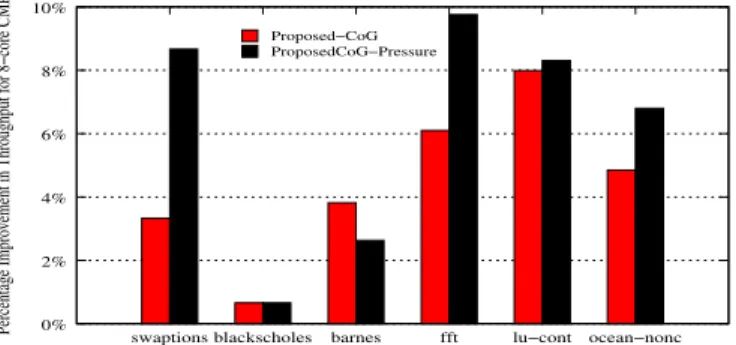
As a sensitivity analysis of our scheme, for an 8-core CMP we only present percentage improvement in through-put in Figure 8. The proposed policies show an average
Proposed−CoG ProposedCoG−Pressure 0% 2% 4% 6% 8% 10% ocean−nonc lu−cont fft barnes blackscholes swaptions
Percentage Improvement in Throughput for 8−core CMP
Figure 8. Throughput improvement for 8-core CMP.
improvement of 6.4%.
5. Conclusions
In this paper, we attempt to combine the desirable fea-tures of a number of state-of-the-art proposals in large cache design. We show that hardware mechanisms based on shadow address bits are effective in migrating pages within the processor at low cost. This allows us to design policies to allocate cache space among competing threads and migrate shared pages to optimal locations. The result-ing architecture allows for high cache hit rates, low cache access latencies on average, and yields overall improve-ments of 10-20% with capacity allocation, and 8% with shared page migration. The design also entails low plexity for the most part, for example, by eliminating com-plex search mechanisms that are commonly seen in way-partitioned NUCA designs. The primary complexity in-troduced by the proposed scheme is the Translation Table (TT) and its management. Addressing this problem is im-portant future work. We also plan to leverage the page col-oring techniques proposed here to design mechanisms for page replication while being cognizant of bank pressures.
References
[1] S. Akioka, F. Li, M. Kandemir, and M. J. Irwin. Ring Pre-diction for Non-Uniform Cache Architectures . In Proceed-ings of PACT-2007, September 2007.
[2] B. Beckmann, M. Marty, and D. Wood. ASR: Adaptive Selective Replication for CMP Caches. InProceedings of MICRO-39, December 2006.
[3] B. Beckmann and D. Wood. Managing Wire Delay in Large Chip-Multiprocessor Caches. InProceedings of MICRO-37, December 2004.
[4] C. Benia, S. Kumar, J. P. Singh, and K. Li. The PARSEC Benchmark Suite: Characterization and Architectural Im-plications. Technical report, 2008.
[5] J. Carter, W. Hsieh, L. Stroller, M. Swanson, L. Zhang, E. Brunvand, A. Davis, C.-C. Kuo, R. Kuramkote, M. Parker, L. Schaelicke, and T. Tateyama. Impulse: Building a Smarter Memory Controller. InProceedings of HPCA-5, January 1999.
[6] R. Chandra, S. Devine, B. Verghese, A. Gupta, and M. Rosenblum. Scheduling and page migration for multi-processor compute servers. InProceedings of ASPLOS-VI, 1994.
[7] J. Chang and G. Sohi. Co-Operative Caching for Chip Mul-tiprocessors. InProceedings of ISCA-33, June 2006. [8] M. Chaudhuri. PageNUCA: Selected Policies for
Page-grain Locality Management in Large Shared Chip-Multiprocessor Caches. InProceedings of HPCA-15, 2009. [9] Z. Chishti, M. Powell, and T. Vijaykumar. Distance As-sociativity for High-Performance Energy-Efficient Non-Uniform Cache Architectures. InProceedings of MICRO-36, December 2003.
[10] Z. Chishti, M. Powell, and T. Vijaykumar. Optimizing Replication, Communication, and Capacity Allocation in CMPs. InProceedings of ISCA-32, June 2005.
[11] S. Cho and L. Jin. Managing Distributed, Shared L2 Caches through OS-Level Page Allocation. InProceedings of MICRO-39, December 2006.
[12] J. Corbalan, X. Martorell, and J. Labarta. Page Migra-tion with Dynamic Space-Sharing Scheduling Policies: The case of SGIO200. International Journal of Parallel Pro-gramming, 32(4), 2004.
[13] X. Ding, D. S. Nikopoulosi, S. Jiang, and X. Zhang. MESA: Reducing Cache Conflicts by Integrating Static and Run-Time Methods . InProceedings of ISPASS-2006, 2006. [14] H. Dybdahl and P. Stenstrom. An Adaptive Shared/Private
NUCA Cache Partitioning Scheme for Chip Multiproces-sors. InProceedings of HPCA-13, February 2007. [15] B. Falsafi and D. Wood. Reactive NUMA: A Design for
Unifying S-COMA and cc-NUMA. In Proceedings of ISCA-24, 1997.
[16] E. Hagersten and M. Koster. WildFire: A Scalable Path for SMPs. InProceedings of HPCA, 1999.
[17] T. Horel and G. Lauterbach. UltraSPARC III: Designing Third Generation 64-Bit Performance. IEEE Micro, 19(3), May/June 1999.
[18] J. Huh, C. Kim, H. Shafi, L. Zhang, D. Burger, and S. Keck-ler. A NUCA Substrate for Flexible CMP Cache Sharing. InProceedings of ICS-19, June 2005.
[19] R. Iyer, L. Zhao, F. Guo, R. Illikkal, D. Newell, Y. Solihin, L. Hsu, and S. Reinhardt. QoS Policies and Architecture for Cache/Memory in CMP Platforms. InProceedings of SIGMETRICS, June 2007.
[20] Y. Jin, E. J. Kim, and K. H. Yum. A Domain-Specific On-Chip Network Design for Large Scale Cache Systems. In
Proceedings of HPCA-13, February 2007.
[21] R. E. Kessler and M. D. Hill. Page Placement Algorithms for Large Real-Indexed Caches.ACM Trans. Comput. Syst., 10(4):338–359, 1992.
[22] C. Kim, D. Burger, and S. Keckler. An Adaptive, Non-Uniform Cache Structure for Wire-Dominated On-Chip Caches. InProceedings of ASPLOS-X, October 2002. [23] P. Kundu. On-Die Interconnects for Next Generation
CMPs. InWorkshop on On- and Off-Chip Interconnection Networks for Multicore Systems (OCIN), December 2006. [24] P. R. LaRowe and S. C. Ellis. Experimental comparison
of memory management policies for numa multiprocessors. Technical report, Durham, NC, USA, 1990.
[25] J. Lin, Q. Lu, X. Ding, Z. Zhang, X. Zhang, and P. Sadayap-pan. Gaining Insights into Multicore Cache Partitioning: Bridging the Gap between Simulation and Real Systems. InProceedings of HPCA-14, February 2008.
[26] P. Magnusson, M. Christensson, J. Eskilson, D. Forsgren, G. Hallberg, J. Hogberg, F. Larsson, A. Moestedt, and B. Werner. Simics: A Full System Simulation Platform.
IEEE Computer, 35(2):50–58, February 2002.
[27] R. Min and Y. Hu. Improving Performance of Large Physically Indexed Caches by Decoupling Memory Ad-dresses from Cache AdAd-dresses. IEEE Trans. Comput., 50(11):1191–1201, 2001.
[28] N. Muralimanohar, R. Balasubramonian, and N. Jouppi. Optimizing NUCA Organizations and Wiring Alternatives for Large Caches with CACTI 6.0. In Proceedings of the 40th International Symposium on Microarchitecture (MICRO-40), December 2007.
[29] M. Qureshi and Y. Patt. Utility-Based Cache Partitioning: A Low-Overhead, High-Performance, Runtime Mechanism to Partition Shared Caches. InProceedings of MICRO-39, December 2006.
[30] N. Rafique, W. Lim, and M. Thottethodi. Architectural sup-port for operating system-driven CMP cache management. InProceedings of PACT-2006, September 2006.
[31] J. Richard P. LaRowe and C. S. Ellis. Page placement poli-cies for numa multiprocessors.J. Parallel Distrib. Comput., 11(2):112–129, 1991.
[32] J. Richard P. LaRowe, J. T. Wilkes, and C. S. Ellis. Exploit-ing operatExploit-ing system support for dynamic page placement on a numa shared memory multiprocessor. InProceedings of PPOPP, 1991.
[33] A. Saulsbury, T. Wilkinson, J. Carter, and A. Landin. An Argument for Simple COMA. In Proceedings of HPCA, 1995.
[34] E. Speight, H. Shafi, L. Zhang, and R. Rajamony. Adaptive Mechanisms and Policies for Managing Cache Hierarchies in Chip Multiprocessors. InProceedings of ISCA-32, 2005. [35] G. E. Suh, L. Rudolph, and S. Devadas. Dynamic Partition-ing of Shared Cache Memory.J. Supercomput., 28(1):7–26, 2004.
[36] D. Tam, R. Azimi, L. Soares, and M. Stumm. Managing L2 Caches in Multicore Systems. InProceedings of CMPMSI, June 2007.
[37] S. Vangal, J. Howard, G. Ruhl, S. Dighe, H. Wilson, J. Tschanz, D. Finan, P. Iyer, A. Singh, T. Jacob, S. Jain, S. Venkataraman, Y. Hoskote, and N. Borkar. An 80-Tile 1.28TFLOPS Network-on-Chip in 65nm CMOS. In Pro-ceedings of ISSCC, February 2007.
[38] K. Varadarajan, S. Nandy, V. Sharda, A. Bharadwaj, R. Iyer, S. Makineni, and D. Newell. Molecular Caches: A Caching Structure for Dynamic Creation of Application-Specific Heterogeneous Cache Regions. InProceedings of MICRO-39, December 2006.
[39] B. Verghese, S. Devine, A. Gupta, and M. Rosenblum. Op-erating System Support for Improving Data Locality on CC-NUMA Compute Servers. SIGPLAN Not., 31(9):279– 289, 1996.
[40] H. S. Wang, L. S. Peh, and S. Malik. A Power Model for Routers: Modeling Alpha 21364 and InfiniBand Routers. InIEEE Micro, Vol 24, No 1, January 2003.
[41] S. Woo, M. Ohara, E. Torrie, J. Singh, and A. Gupta. The SPLASH-2 Programs: Characterization and Methodologi-cal Considerations. InProceedings of ISCA-22, pages 24– 36, June 1995.
[42] M. Zhang and K. Asanovic. Victim Replication: Maximiz-ing Capacity while HidMaximiz-ing Wire Delay in Tiled Chip Multi-processors. InProceedings of ISCA-32, June 2005.