CONSTRUCTIVE AND DESTRUCTIVE WORKPLACE DEVIANCE: A REVIEW Ng Lei Voon1, Mohamad Hashim Othman2 & Chan Siaw Leng3
1 School of Educational Studies, Universiti Sains Malaysia
2 School of Educational Studies, Universiti Sains Malaysia, Penang, Malaysia 3 Universiti Putra Malaysia Bintulu Sarawak Campus, Bintulu, Sarawak, Malaysia
ABSTRACT
Workplace deviance receives increasing research due to its remarkable impact on the well-being of organization and employees. Constructive deviance appears to bring about both positive and negative consequences when putting together its outcomes. Despite the negative consequences of workplace deviance in most organizations, little to no interest has been shown in managing minor destructive deviant behaviours which may escalate to major drawbacks on both the organization’s entire output as well as the individual employee’s moral and motivation. The authors reviewed the distinctive yet interrelated definitions, types, contributing factors, and consequences of both constructive and destructive workplace deviance that should not be underestimated. This paper included a sample of cognitive behavioural theory-based counselling and coaching intervention for narcissistic organizational leaders.
Key terms: Workplace Deviance; Constructive Deviance; Destructive Deviance; Counselling; Coaching
INTRODUCTION
Workplace deviance has become one of the most important research topics, considering the noticeable impacts on the well-being of organization and its members (Yıldız, Alpkan, Ateş, & Sezen, 2015a). Workplace deviant behavior is viewed as destructive in most organizations and hence, little to no interest has been shown in managing these minor deviant behaviors which may expand into high profile scandals that impact more negatively at workplace (Chirasha & Mahapa, 2012). Deviants are common in the workplace and such employees are tended to be categorized as “bad apples” or violators by their coworkers (Markova & Folger, 2012). Either overt or implicit negative deviant workplace behavior brings about negative consequences (Appelbaum, Iaconi, & Matousek, 2007). Workplace deviant behavior was also found to be negatively related to job satisfaction but positively related to job stress (Omar, Halim, Zainah, Farhadi, Nasir, & Khairudin, 2011). Considering the negative impact on both the organization’s entire output and the individual employee’s moral and motivation, workplace deviance should not be underestimated (Chirasha & Mahapa, 2012).
TYPES OF WORKPLACE DEVIANCE
Workplace deviance literally encompasses two opposite dimensions: constructive and destructive (Yıldız, Alpkan, Sezen, & Yıldız, 2015b; Bennet & Stamper, 2001; Yıldız et al., 2015a; Galperin, 2012). Despite the fact that deviance has been generally conceptualized as destructive in the literature on workplace deviance (i.e., destructive deviance), the construct and definition of deviance has been expanded on the behaviors that deviate the organizational norms positively (i.e., constructive deviance) (Galperin, 2012).
Constructive Deviance
Definitions of Constructive Deviance
The prosocial norm-violating behaviors are introduced as “positive” or “constructive deviance,” which places a focus on behaviors that are attempted to bring advantage to the organization (Galperin, 2012). Constructive deviance is referred to as the “breakdowns in the organization’s control systems where employees use discrepant behaviors to advance organization’s interests” (Dehler, & Welsh, 1998, p. 263) that “can be beneficial to the organization” (Galperin, 2002, p. 14; Yıldız et al., 2015a). Vadera, Pratt, and Mishra (2013) adapted and modified Warren’s (2003) definition to conceptualize constructive deviance as behaviors that: 1) deviate from the norms of the reference group, 2) benefit the reference group, and 3) conform to hyper-norms (i.e., globally held beliefs and values (Donaldson & Dunfee, 1999). Constructive Deviant Behaviors
Innovative role behaviors, noncompliance with dysfunctional directives, and criticizing incompetent superiors are examples of constructive deviant behaviors that serve as unauthorized yet facilitating whistle-blowers of the organization (Ashforth & Mael, 1998; Galperin, 2012). An organization’s potential can be enhanced by constructive deviance because the roots of successful innovations may be due to employees who fail to comply with the organizational norms (Galperin, 2012).
According to the review by Vadera et al. (2013), constructive deviance was described as an umbrella term that consisted a wide range of behaviors, involving: 1) taking charge (i.e., individual employees’ intentional, voluntary and constructive efforts with respect to how work is executed within the context of their jobs, work units, or organization to bring about organizationally functional change); 2) creative performance (i.e., novel and useful ideas or solutions generated to overcome organizational problems); 3) expressing voice (i.e., intention to improve rather than merely criticize the organization by expressing constructive challenge); 4) whistle-blowing (i.e., disclosure of illegal, immoral, or illegitimate practices under the control of their employers, by current or former organizational members, to individuals or organizations that may be able to take action); 5) extra-role behaviors (i.e., discretionary behaviors beyond existing role expectations that benefit the organization and/or is intended to benefit the organization); 6) prosocial behaviors (i.e., an organizational member’s behavior that is directed toward an individual, group, or organization with whom he or she interacts while executing his or her organizational role, that helps foster the individual, group, or organization’s welfare toward which it is directed); 7) prosocial rule breaking (i.e., violation of a formal organizational policy, regulation, or prohibition to promote the organization or one of its stakeholders’ welfare); 8) counter-role behaviors (i.e., neither a formal job description nor management’s preferable conception of the ideal employee’s behaviors); and 9) issue
selling (i.e., organizational members’ voluntary behaviors to affect the organizational agenda in order to get the superiors’ attention to an issue).
Contributing Factors of Constructive Deviance
Vadera et al. (2013) suggested an emergent model on the antecedents of constructive deviance through its three common underlying mechanisms: 1) intrinsic motivation, 2) felt obligation, and 3) psychological empowerment. The intrinsic motivation mechanism is postulated directly or indirectly by two sets of antecedents: innovative cognitive style (i.e., tendency of employees to seek and integrate various information, to reformulate problems, and to produce ideas deviated from the norm) and transformational leadership (i.e., leaders stimulate and motivate their subordinates by questioning assumptions, challenging status quo, articulating a compelling vision, and focusing on their development) (Vadera et al., 2013).
Besides, in terms of the felt obligation mechanism, individuals may feel obligated to reciprocate the positive, friendly, and productive contribution perceived from either the job, their supervisors, their groups, and/or the organization by positively contributing back to the reference group and its members through engagement in constructive behaviors that are deviated from the norms (Vadera et al., 2013). For instance, constructive deviance mediated by felt obligation mechanism has been connected with: 1) job perceptions (i.e., positive job attitudes), 2) supervisor characteristics (i.e., supervisor support, non-controlling supervisor, leader-member exchange), 3) group characteristics (i.e., attachment to group, group culture and norms, coworker support), and 4) organizational characteristics (i.e., organizational culture and climate, organizational support, procedural justice at the organizational level) (Vadera et al., 2013).
Through the psychological empowerment mechanism, constructive deviance is linked with contributing factors such as: 1) employee characteristics (i.e., self-worth, extraversion, risk propensity, and proactive personality) and 2) supervisor characteristics (i.e., transformational leadership) (Vadera et al., 2013). According to Vadera et al. (2013), psychological empowerment serves as fortification that may be induced through self-confidence, competency, self-determination, and psychological security, which resources the employees’ engagement in constructive deviance. It is by fortifying the individual through psychological empowerment that both contradictory variables such as transformational leadership and non-controlling supervision, can result in constructive deviance (Vadera et al., 2013).
Consequences of Constructive Deviance
There is a significant inadequacy and need for systematic studies about whether the individual’s engagement in constructive deviance impacts the organization as a whole or merely the constructively deviant actor (Vadera et al., 2013). From the aspect of constructive workplace deviance, when employees are engaged in nonconforming behavior (e.g., champions of innovation and corporate intrapreneurs), they can contribute in accelerating the organization’s innovation process, boosting competitiveness, and also fostering organizational change (Howell, Shea, & Higgins, 2005; Galperin, 2012).
Constructive deviance appears to bring about both positive and negative consequences when putting together its outcomes. On the one hand, constructive deviant behaviors may benefit one reference group and give positive impact to the entire organization, but on the other hand, constructive deviance that is beneficial at one level of the organization (e.g., employing novel ways by using iPads) may cause
negative, unintended effects at another level (e.g., not compatible with organizational procedures) (Vadera et al., 2013). Hence, whether the consequences of an individual’s constructive deviance are viewed positively or negatively by the others, it depends on the type of interdependence (e.g., sequential vs. pooled) his or her reference group has with others in the organization, and also the individual’s networking ability (Vadera et al., 2013). Before engaging in constructive deviance, individuals with high networking abilities are likely to involve others, build coalitions, and garner support for their ideas, which may therefore be less likely to be seen as troublemakers and more likely to be evaluated positively (Vadera et al., 2013).
Mertens, Recker, Kummer, Kohlborn, and Viaene (2016) revealed that organizational performance can be positively impacted by constructive behaviors that are engaged in with positive intent, deviated from the organizational norms and are not harmful to others. If transformational leaders foster employees’ job autonomy and as long as the employees are satisfied with their current autonomy, the effects of transformational leadership could be effectively translated into favorable subordinates’ prosocial rule breaking behaviors (e.g., breaking organizational rules or policies to complete job more efficiently; disobey organizational policies to help another employee in need; bend organizational rules to best assist customers) (Huang, Lu, & Wang, 2014). In the presence of a deviant coworker or the “bad apple,” there were positive effects in which other employees perceived more positive self-evaluation when they compared themselves to the deviant individual at the workplace (Markova & Folger, 2012). However, only employees with more interdependent jobs with a deviant coworker reported better role clarity as the deviant can be informative about organizational norms (Markova & Folger, 2012).
Destructive Deviance
Definitions of Destructive Deviance
From the perspective of destructive workplace deviance, “employee deviance” or “workplace deviance” are defined as “voluntary behavior that violates significant organizational norms and in so doing threatens the well-being of an organization, its members, or both” (Robinson & Bennett 1995, p. 556; 2000, p. 349). Yıldız et al. (2015b) elaborated that one of the most striking negative behaviors are destructive workplace deviant behaviors, which are excluded from the formal job definitions, apart from the existing role expectations, violate organizational norms, and thus, threatening the overall well-being of organization. As cited in Yıldız et al. (2015b), a few alternative names that carry the same meaning were introduced to represent these behaviors, such as: 1) organizational misbehavior (Vardi & Weiner, 1996), 2) counterproductive workplace behavior (Fox et al., 2001; Gruys & Sacket, 2003), 3) organizational deviance (Robinson & Bennett, 1995; Hollinger, 1986), 4) antisocial behavior (Robinson & O’Leary-Kelly, 1998; Aquino & Douglas 2003) and 5) dysfunctional work behavior (Griffin et al., 1998).
Types of Destructive Deviance
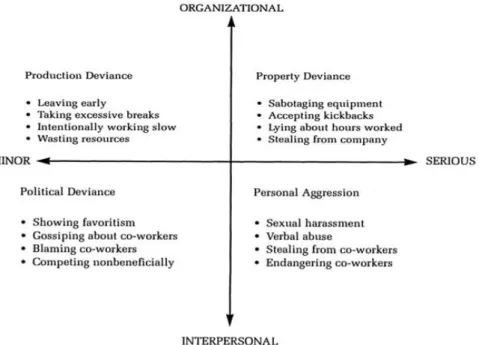
In a four-cell typology of deviant workplace behaviors developed by Robinson and Bennett (1995) using multidimensional scaling techniques, the similarities and differences between deviant behaviors as well as their underlying dimensions were contrasted and developed into a comprehensive classification of deviant behaviors. Deviant workplace behaviors were diversified into two-dimensional configuration: 1) minor versus serious, and 2) interpersonal versus organizational (Robinson & Bennett,
1995). Interpersonal deviance encompasses behaviors that inflict harm on individuals (e.g., verbal harassment, assault, and spreading rumors) while organizational deviance involves behaviors directed against the company (e.g., sabotaging equipment, stealing, and wasting resources) (Stewart, Bing, Davison, Woehr, & McIntyre, 2009).
Grounded in the two dimensions, employees’ workplace deviance seemed to be classified into four distinct but related categories: 1) production deviance (minor-organizational), 2) property deviance (serious-(minor-organizational), 3) political deviance (minor-interpersonal), and 4) personal aggression (serious-interpersonal) (Robinson & Bennett, 1995; Stewart et al., 2009), which was presented in a form of four quadrants (see Figure 1).
Figure 1. Typology of deviant workplace behavior. Adapted from " A typology of deviant workplace behaviors: A multidimensional scaling study," by S. L. Robinson and R. J. Bennett,
1995, Academy of Management Journal, 38(2), p. 565. Destructive Deviant Behaviors
As shown in Figure 1, Robinson and Bennett (1995) listed a set of the most typical destructive deviant behaviors in four respective categories: production deviance, property deviance, political deviance, and personal aggression.
Gruys and Sackett (2003) investigated the dimensionality of counterproductive work behavior (CWB) through 11 categories as follows:
1) Theft and Related Behavior (e.g., give away goods or services for free, take office supplies from the company, and misuse employee discount privileges) 2) Destruction of Property (e.g., deface, damage, or destroy property, equipment, or product belonging to the company, coworker, or customer) 3) Misuse of Information (e.g., lie to employer or supervisor to cover up a
mistake, discuss confidential matters with unauthorized personnel within or outside the organization, intentionally fail to give a supervisor or coworker necessary information)
4) Misuse of Time and Resources (e.g., use email for personal purposes, make personal photocopies at work, and spend time on the internet for reasons unrelated to work.)
5) Unsafe Behavior (e.g., fail to read the manual outlining safety procedures, endanger self, coworkers, or customers by not following safety procedures) 6) Poor Attendance (e.g., use sick leave when not really sick, leave work early
without permission, and intentionally come to work late.)
7) Poor Quality Work (e.g., intentionally perform job below acceptable standards, intentionally do work badly or incorrectly, intentionally do slow or sloppy work.)
8) Alcohol Use (e.g., come to work under the influence of alcohol, performance affected due to a hangover from alcohol, engage in alcohol consumption on the job)
9) Drug Use (e.g., engage in drug use on the job, come to work under the influence of drugs, possess or sell drugs on company property)
10)Inappropriate Verbal Actions (e.g., verbally abuse, argue or fight with a coworker, supervisor or customer) and
11)Inappropriate Physical Actions (e.g., physically attack or make unwanted sexual advances toward a coworker, supervisor or customer).
Contributing Factors of Destructive Deviance
There is a tendency for an employee to exhibit negative organizational behavior and attitude if there is a breach of psychological contract on the part of the employer (Hussain, 2014). When what employees perceive was promised by their firm has failed to be pledged or vice versa, Psychological Contract Breach (PCB) may take place. PCB often reduces loyalty, organizational commitment and organizational citizenship behavior, and heightens workplace deviant behavior (Hussain, 2014). The employee’s performance will be affected, thus impacting the organization’s overall productivity, lowering job satisfaction and organizational commitment, and also contributing to higher intention to turnover (Hussain, 2014).
Appelbaum et al. (2007) highlighted several causes of negative deviant behaviors:
1) Some toxic organizations characterized by a history of poor performance, poor decision-making, high levels of employee dissatisfaction and employee stress well beyond normal workload issues (Coccia, 1998), depend on dishonest and deceitful employees in order to be successful (Sims, 1992). Workers in toxic organizations are encouraged to practice “bottom-line mentality” that cultivates unethical practices and views workplace ethics as an obstacle to financial gains (Sims, 1992; Appelbaum, Deguire, & Lay, 2005);
2) The influence of deviant role models cause employees to engage in negative workplace deviance (Appelbaum et al., 2005). Deviant role models in an organization will influence others to commit deviance as well, according to social learning theory (Appelbaum et al., 2005);
3) Workplace environment characteristics (e.g., the employee’s contact with the public, working with firearms, carrying out security functions, serving alcohol, supervising others, disciplining others, etc.) predict employees’ engagement in negative workplace deviant behaviors rather than individual personality characteristics (Appelbaum et al., 2005). Workers may be predisposed to engage in deviant behavior due to strong organizational influence, despite an individual may uphold the highest moral standards (Appelbaum et al., 2007).
4) Situation-based behaviors that are deviant acts conducted by employees depending on the organizational factors, irrespective of their personal characteristics, such as job stressors, organizational frustration, lack of control over the work environment, weak sanctions for rule violations and organizational changes like downsizing (Henle, 2005).
5) Person-based behaviors in which an individual’s personality dictates his or her behavior, not the working environment (Henle, Giacalone, & Jurkiewicz, 2005). Employees with risk-taking trait, Type A personality, and negative affectivity will likely to engage in negative deviance (Henle et al., 2005). Consequences of Destructive Deviance
Being a detriment to the organization’s interests, an obstacle to attain organizational overall goals, a violator of organizational norms, destructive workplace deviance which is also known as counterproductive work behavior (CWB) has been the focus of extensive recent studies due to its pervasive and costly consequences affecting both the organizations and their employees’ well-being (Chang & Smithikrai, 2010). Such behaviors share the common theme: harmful to the organization, either by directly impacting its property or functional ability, or by reducing its employees’ effectiveness (Chang & Smithikrai, 2010). According to Coffin (2003), CWBs cost businesses in the United States of America approximately $50 billion annually, and may account for as many as 20% of failed businesses (Chang & Smithikrai, 2010).
Workplace deviant behavior (WDB) affects an organization at levels that are not considered as the direct ‘monetary’ costs of WDB (e.g., stealing and fraud) (Dunlop & Lee, 2004). In the presence of WDB, business units in organizations are not operating at peak efficiency which then incur a considerable amount of ‘hidden’ costs (Dunlop & Lee, 2004). In a new product development team, team members’ interpersonal counterproductive work behaviors impact team performance through lower levels of emotional integration, less sharing and less acquiring of new knowledge within the team (Qiu & Peschek, 2012). Apart from the detriments to effective team collaboration process, interpersonal misbehaviors also have direct impact on the success of new product development projects (Qiu & Peschek, 2012).
The growing research interest regarding workplace deviant behavior has been limited to business or for profit organizations but non-profit organizations have received rather sparse attention (Nair & Bhatnagar, 2011). Hence, Nair and Bhatnagar (2011) developed the general model of workplace deviance to ease an exploration of workplace deviance in non-profit organizations by highlighting the main characteristics of nonprofits: 1) the prominence of values and ideologies, 2) the presence of loose structure, 3) few controls, 4) little punitive action, 5) high autonomy, 6) lack of role clarity, 7) high ambiguity, and 8) high organizational commitment, which may lead to negative consequences such as: 1) cost to the company, 2) poor performance, 3) poor productivity, and also 4) organization’s reputation damage.
COUNSELLING AND COACHING INTERVENTION FOR WORKPLACE DEVIANCE
Application of Cognitive Behavioral Theory
Both organizational citizenship behavior (OCB; i.e., helpful behaviors that go beyond expected job tasks and are directed toward organizations or organizational members) and counterproductive work behavior (CWB; i.e., harmful behaviors
directed toward organizations or organizational members) are associated with narcissism personality which is primarily based on the individual’s interpretation of self, world, and the future through distorted, self-referent cognitive schema (Fox & Freeman, 2011). Narcissistic individuals often seem unable or unwilling to see the consequences of their behaviors on others. Fox and Freeman (2011) proposed cognitive behavioral theory (CBT) as a basis for counseling and coaching intervention or ‘‘prescriptive executive coaching’’ (PEC) for narcissistic organizational leaders by redirecting their dysfunctional, counterproductive, emotionally abusive cognitions and behaviors (CWBs) of their narcissism to give way to the positive, creative, engaged behaviors of their narcissism (OCBs).
Applied to the case of Bill Miner.
In the study of Fox and Freeman (2011), Bill Miner, who was a narcissistic manager, gained great success in navigating the politics of his competitive, aggressive organizational culture and possesses some recognizable accomplishments, status, and achievements. However, his magnificent self-importance; exaggerated concern with success, power, status, and admiration; sense of entitlement; and relationships with peers and subordinates characterized by exploitation, envy, arrogance, and bullying, were all threatening the future of the organization. Alternatively, Bill might be perceived as a highly effective results-oriented producer (high OCB) or as a workplace bully (high CWB).
Bill was referred by his new superior, Diana for what she called “coaching.” Bill’s initial reaction was to call any referral a sham and joke but after realizing it was a requirement of his continued employment, Bill agreed to see the “coach.” The therapist recommended 10 sessions to help Bill on a weekly basis. Initially, Bill’s anxiety about being attacked, insulted, demeaned, or denigrated were reduced. Bill was assigned with homework to plan a behavior of him that was unexpected by others and then to evaluate the others’ reactions. Bill reported at the fifth session that Diana had complimented him after seeing a particular interaction of him. Bill replaced his “old” behavior and was willing to continue his “new” reinforced behavior despite there were times that the incompetence of the worker had made Bill unable to control anger. However, Bill spoke to the person with great effort on the next day and mentioned that he was aware that he lost his temper without apologizing, but Bill’s improvement was acknowledged and it had become office gossip for a week.
Termination began at the eighth session which included a review of basic skills and strategies. Bill created a list of specific coworkers with their likely annoying behaviors, and the ways how he could deal with these individuals. In the final session, considering that his coping skills might have slipped, Bill asked if he could contact the coach/therapist after termination. Diana was pleased with the therapy/coaching outcomes and agreed that Bill could come as often as he thought necessary, besides referring several other executives for coaching.
CONCLUSION
In a conclusion, this paper discussed about workplace deviance which was shown to have noteworthy impact on the well-being of organization and its employees. Workplace deviance consists of two opposite dimensions: constructive and destructive. Constructive deviance are behaviors deviated from the norms of the reference group that benefit the reference group and conform to hyper-norms while destructive
workplace deviance are voluntary behaviors that violate significant norms of the organization and hence, threaten the well-being of an organization, its members, or both. Both constructive and destructive deviance seemed to have distinctive yet interrelated contributing factors and consequences. This paper also included a sample of counseling and coaching intervention or ‘‘prescriptive executive coaching’’ (PEC) based on cognitive behavioral theory (CBT) for narcissistic organizational leaders in order to replace CWB with OCB.
REFERENCES
Appelbaum, S. H., Deguire, K. J., & Lay, M. (2005). The relationship of ethical climate to deviant workplace behaviour. Corporate Governance: The International Journal of Business in Society, 5 (4), 43-55. doi: 10.1108/14720700510616587 Appelbaum, S. H., Iaconi, G. D., & Matousek, A. (2007). Positive and negative deviant
workplace behaviors: Causes, impacts, and solutions. Corporate Governance:
The International Journal of Business in Society, 7 (5), 586-598. doi: 10.1108/14720700710827176
Ashforth, B. E., & Mael, F. A. (1998). The power of resistance: Sustaining valued identities. In R. M. Kramer & M. A. Neale (Eds.), Power and influence in organizations (pp. 89-119). Thousand Oaks, CA: Sage.
Bennett, R. J., & Robinson, S. L. (2000). Development of a Measure of Workplace Deviance. Journal of Applied Psychology, 85 (3), 349-360. doi: 10.1037/0021-9010.85.3.349
Bennett, R., & Stamper, C. L. (2001). Corporate citizenship and deviancy: A study of discretionary work behavior. International Research in the Business Disciplines, 3, 265-284. doi: 10.1016/S1074-7877(02)03015-5
Chang, K., & Smithikrai, C. (2010). Counterproductive behaviour at work: an investigation into reduction strategies. The International Journal of Human
Resource Management, 21 (8), 1272-1288. doi:
10.1080/09585192.2010.483852
Chirasha, V., & Mahapa, M. (2012). An analysis of the causes and impact of deviant behaviour in the workplace. The case of secretaries in state universities. Journal of Emerging Trends in Economics and Management Sciences, 3 (5), 415-421.
Retrieved from
http://citeseerx.ist.psu.edu/viewdoc/download?doi=10.1.1.300.4561&rep=rep 1&type=pdf
Coccia, C. (1998). Avoiding a" toxic" organization. Nursing Management, 29 (5), 32-34. doi: 10.1097/00006247-199805000-00008
Coffin, B. (2003). Breaking the silence on white collar crime. Risk Management, 50 (9), 8-9. (ISSN: 0035-5593)
Dehler, G. E., & Welsh, M. A. (1998). Problematizing deviance in contemporary organizations: A critical perspective. In R. W. Griffin, A. O’Leary-Kelly & J. M. Collins (Eds.), Dysfunctional behavior in organizations: Violent and deviant behavior (pp. 241-269). Stamford, CT: JAI Press.
Donaldson, T., & Dunfee, T. W. (1999). Ties that bind: A social contracts approach to business ethics. Boston: Harvard Business School Press.
Dunlop, P. D., & Lee, K. (2004). Workplace deviance, organizational citizenship behavior, and business unit performance: The bad apples do spoil the whole barrel. Journal of Organizational Behavior, 25 (1), 67-80. doi: 10.1002/job.243
Fox, S., & Freeman, A. (2011). Narcissism and the deviant citizen: A common thread in CWB and OCB. In P. L. Perrewé & D. C. Ganster (Eds.), The Role of Individual Differences in Occupational Stress and Well Being (pp. 151-196). Bingley, UK: Emerald Group Publishing Limited.
Galperin, B. L. (2002). Determinants of deviance in the workplace: An empirical examination of Canada and Mexico (Unpublished doctoral dissertation). Concordia University, Montreal, Canada.
Galperin, B. L. (2012). Exploring the nomological network of workplace deviance: Developing and validating a measure of constructive deviance. Journal of Applied Social Psychology, 42 (12), 2988-3025. doi: 10.1111/j.1559-1816.2012.00971.x
Galperin, B. L., & Burke, R. J. (2006). Uncovering the relationship between workaholism and workplace destructive and constructive deviance: An exploratory study. The International Journal of Human Resource Management, 17 (2), 331-347. doi: 10.1080/09585190500404853
Gruys, M. L., & Sackett, P. R. (2003). Investigating the dimensionality of
counterproductive work behavior. International Journal of Selection and
Assessment, 11 (1), 30-42. doi: 10.1111/1468-2389.00224
Henle, C. A. (2005). Predicting workplace deviance from the interaction between organizational justice and personality. Journal of Managerial Issues, 247-263. (Accession No. 17493910)
Henle, C. A., Giacalone, R. A., & Jurkiewicz, C. L. (2005). The role of ethical ideology in workplace deviance. Journal of Business Ethics, 56 (3), 219-230. doi: 10.1007/s10551-004-2779-8
Howell, J. M., Shea, C. M., & Higgins, C. A. (2005). Champions of product innovations: defining, developing, and validating a measure of champion behavior. Journal
of Business Venturing, 20(5), 641-661. doi: 10.1016/j.jbusvent.2004.06.001
Huang, Y., Lu, X. X., & Wang, X. (2014). The effects of transformational leadership on employee’s pro-social rule breaking. Canadian Social Science, 10 (1), 128-134. doi: 10.3968/j.css.1923669720141001.4286
Hussain, A. (2014). The relationship between breach of psychological contract and workplace deviant behavior. IUP Journal of Organizational Behavior, 13 (2), 25-37. (Accession No. 96588563)
Markova, G., & Folger, R. (2012). Every cloud has a silver lining: positive effects of deviant coworkers. The Journal of Social Psychology, 152 (5), 586-612. doi: 10.1080/00224545.2012.671201
Mertens, W., Recker, J., Kummer, T. F., Kohlborn, T., & Viaene, S. (2016). Constructive deviance as a driver for performance in retail. Journal of Retailing and Consumer Services, 30, 193-203. doi: 10.1016/j.jretconser.2016.01.021 Nair, N., & Bhatnagar, D. (2011). Understanding workplace deviant behavior in
nonprofit organizations. Nonprofit Management and Leadership, 21 (3), 289-309. doi: 10.1002/nml.20026
Omar, F., Halim, F. W., Zainah, A. Z., Farhadi, H., Nasir, R., & Khairudin, R. (2011). Stress and job satisfaction as antecedents of workplace deviant behavior. World Applied Sciences Journal, 12 (SPL ISS.), 46-51. Available from https://www.researchgate.net/profile/Fatimah_Halim/publication/282217629_ Stress_and_job_satisfaction_as_antecedents_of_work_place_deviant_behavio r/links/5607f6de08ae5e8e3f3a86d3.pdf
Qiu, T., & Peschek, B. S. (2012). The effect of interpersonal counterproductive workplace behaviors on the performance of new product development teams. American Journal of Management, 12 (1), 21-33. (ProQuest ID. 1355442320) Robinson, S. L., & Bennett, R. J. (1995). A typology of deviant workplace behaviors:
A multidimensional scaling study. Academy of Management Journal, 38 (2),
555-572. doi:10.2307/256693
Sims, R. L. (2002). Ethical rule breaking by employees: A test of social bonding theory. Journal of Business Ethics, 40 (2), 101-109. doi: 10.1023/A:1020330801847 Stewart, S. M., Bing, M. N., Davison, H. K., Woehr, D. J., & McIntyre, M. D. (2009).
In the eyes of the beholder: A non-self-report measure of workplace deviance. The Journal of Applied Psychology, 94 (1), 207-215. doi: 10.1037/a0012605
Vadera, A. K., Pratt, M. G., & Mishra, P. (2013). Constructive deviance in organizations integrating and moving forward. Journal of Management, 39 (5), 1221-1276. doi: 10.1177/0149206313475816
Warren, D. E. (2003). Constructive and destructive deviance in organizations. Academy of Management Review, 28 (4), 622-632. doi: 10.5465/AMR.2003.10899440
Yıldız, B., Alpkan, L., Ateş, H. & Sezen, B. (2015a). Determinants of Constructive Deviance: The Mediator Role of Psychological Ownership. International Business Research, 8 (4), 107-121. doi: 10.5539/ibr.v8n4p107
Yıldız, B., Alpkan, L., Sezen, B., & Yıldız, H. (2015b). A Proposed Conceptual Model of Destructive Deviance: The Mediator Role of Moral Disengagement.
Procedia-Social and Behavioral Sciences, 207, 414-423. doi: