DEVELOPING COOPERATION: DISCOVERING SUPPORTIVE LEGAL FRAMEWORKS AND POLICIES FOR WORKER OWNED COOPERATIVES
By: Robert Teuton
A Thesis Submitted in Partial Fulfillment of the Requirements for the Degree of
Master of Arts in Sustainable Communities
Northern Arizona University May 2018
Peter Friederici, M.S., Co-Chair Ronald Hubert, M.B.A., M.S., Co-Chair
ii
Abstract
Worker cooperatives are an important economic development tool and way of conducting business that takes human well being into account, beyond mere profit. In the United States, however, there are relatively few worker cooperatives. Some authors have suggested that institutional factors, such as laws and financial practices, may not adequately suit worker cooperatives and hinder their growth. This paper attempts to discover and address these challenges through semi-structured interviews with members from nine worker cooperatives and respondents from seven support agencies across the United States. This paper also presents solutions to these problems, via success factors, discovered in interviews and through literature. Challenges and success factors are then codified in components of a state statute, legal policies, and legal actions. Three Nevada state legislators were then interviewed to discover which legal policies, actions, or components of a state statute were politically viable for the 2019 Nevada state legislature. Many challenges were discovered, including institutional challenges. All challenges had some way of being addressed. All three Nevada legislators thought a state statute could likely be passed in 2019, if no fiscal note was attached.
iii
Dedication
To Las Vegas, where anything is possible; and to all who have ever lived there. Especially:
Mom- thank you for pursuing your dreams of a better future, which allowed you to do impossible things.
Dad- thank you for being a role model. I have never met anyone who works harder or with as much integrity as you.
Grandma and Grandpa- thank you for showing me I was no different than anyone else. Juan y Yolanda- gracias por cuidarme y enseñarme las angustias de los inmigrantes. Nicole- thank you for your support over the past two years.
iv
Acknowledgements
I would like to acknowledge the Sustainable Communities and Business Certificate programs at the Northern Arizona University. In particular, I would like to thank Peter Friederici, Ron Hubert, and Brian Peterson for their guidance throughout the thesis process. I also want to thank Julie Mueller at the WA Franke College of Business, for her willingness to support me and this research.
I am especially grateful for my father, Bob Teuton, and to Nicole Bundy, both of whom helped me edit this paper within the six weeks it took to write it. I would also like to thank George Cheney who also helped me edit a part of this paper, and who gave me critical guidance before this research began.
This thesis would not have been possible without input from the respondents interviewed for this research. Thank you to every single one of you for your cooperation. I hope I can honor your input in a way that helps many other people, whether it be in this paper or in my future endeavors.
v
Table of Contents
Abstract ...ii
Dedication ... iii
Acknowledgements ... iv
Chapter 1. Why Worker Co-ops ... 1
Structure and Findings ... 8
Literature Review... 10
Research Question ... 12
Methods... 12
Chapter 2. Worker Cooperatives: Structure and Benefits ... 17
A Typical Worker Cooperative ... 19
Benefits of Worker Cooperatives: ... 21
Examples from Italy, Spain, and Argentina ... 28
Benefits of Worker Cooperatives... 35
Economic Benefits ... 36
Benefits to the Individual ... 40
Benefits to the Firm ... 43
Community Benefits ... 44
Importance of Legal Policies ... 46
Chapter 3. Challenges for Worker Cooperatives ... 51
Financial Challenges ... 53
Present Value Problem ... 53
Horizon Problem ... 55
General Firm Challenges for Financing ... 56
Unfamiliarity of the Structure ... 57
Conversion-Specific Challenges ... 58
General Firm Challenges ... 60
Structure of Conversions and Tax Incentives ... 61
Promotion and Education ... 64
Education in Schools... 65
Supporting Professionals ... 65
Lack of Unifying Message ... 66
vi
Culture... 68
Democracy ... 69
Adoption of Average Ideas ... 70
Complex and Time Consuming ... 71
“Democracy by Those Who Can Stick Around Long Enough” ... 71
Balancing Mentalities and Clear Roles ... 72
Legal Challenges ... 73 Federal Law ... 74 Employee vs. Owner ... 75 Privacy Laws ... 78 Securities Laws ... 79 Other Laws ... 79
Difficulty in Finding Legal Counsel ... 80
Adverse Effects on Startups ... 81
Challenges in the Context of Nevada ... 82
Chapter Conclusion ... 83
Chapter 4. Challenges Addressed ... 85
Not Addressed in this Chapter ... 86
Financial Challenges Addressed ... 86
Future Earnings and Loss Based Compensation ... 86
The “Horizon Problem” Addressed ... 88
Ideological and Legal Implications ... 91
Addressing General Firm Challenges for Financing ... 93
Legal Actions and Implications ... 95
Support Organizations, Federations, and Associations Abroad... 98
Support Organizations, Federations, and Associations in the U.S. ... 101
Legal Implications ... 107
General Firm Challenges in Promotion and Education Addressed ... 113
Conversion-Specific Challenges Addressed and Success Factors ... 116
Success Factors for Worker Co-ops ... 118
Success Factors Related to Cooperative Principles ... 122
Chapter Conclusion ... 125
vii
General Legal Conditions for Appropriate Laws ... 128
Strategic aspects of a State Statute... 132
Components of a State Statute ... 135
Supportive Legal Policies, and Actions ... 142
Political Findings ... 146
Recommendations ... 149
Concluding Thoughts ... 149
viii
Figure 1. Planetary economic graph ... 5
Table 1. Challenges for Worker-Owned Cooperatives. ... 8
Table 2. Challenges addressed and success factors. ... 9
Table 3. Summary of political findings. ... 9
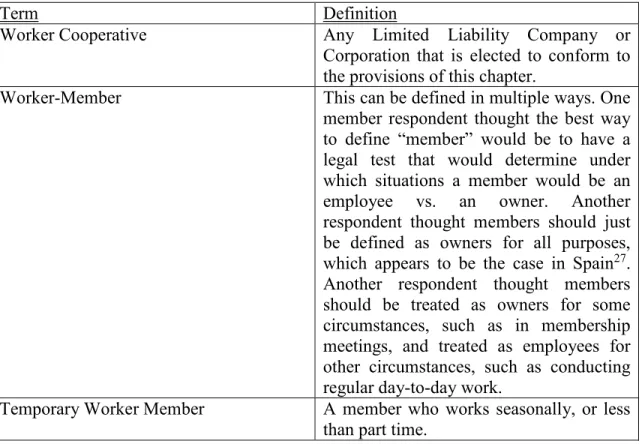
Table 4. Terms and definitions for state statutes. ... 136
Table 5. Cooperative principles in legislation. ... 138
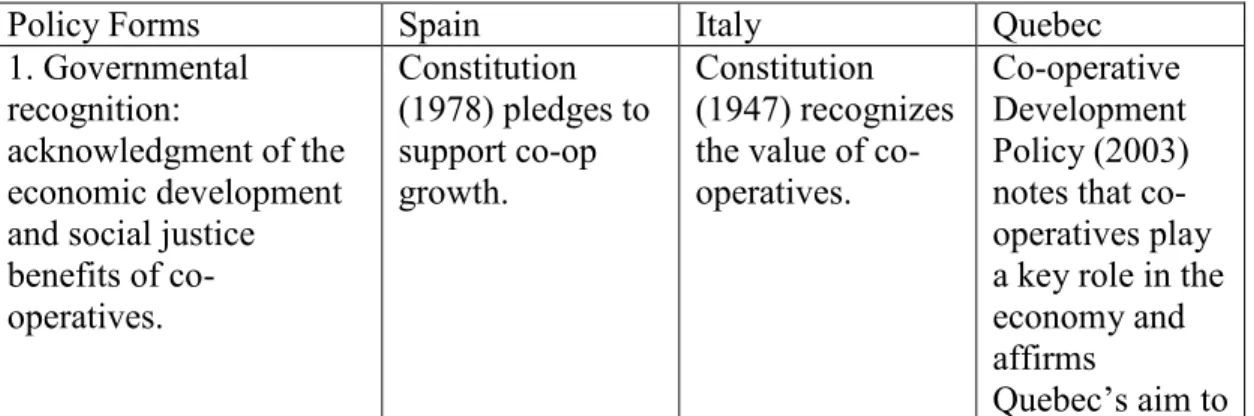
Table 6. International policies supporting worker co-ops. ... 142
1
Chapter 1. Why Worker Co-ops
David, 2016
The above picture is “Prophecy Rock,” a Hopi petroglyph in Arizona believed to be a visual representation of future events to come. There are many interpretations of what this petroglyph tries to express, but there is some consensus about the general meaning. According to Native American elders, this petroglyph is a visual representation of two divergent life paths humans can take: the true path which signifies being one with our true human nature or the “zig zag path” filled with illusion leading to ultimate destruction (David, 2016). Other Native American tribes, and peoples from around the world, have similar prophecies and/or stories that forewarn the implications of conflicting human tendencies.
To me, it is unimportant if these narratives were trying to accurately describe the future or not. The dynamic inherent in these narratives is of upmost importance to me: living a “right way,”- true to human nature, or “wrong way,”- which is illusory. Many of
2
these prophecies, such as the “Prophecy Rock” of the Hopi, were written in a time when humans did not have the technological capabilities of destroying the earth. Despite this, these prophecies imply the fate of the earth is at stake. We are now in a time where human beings do have this capability.
I am not claiming to know of this “right way” to live. I do know the status quo of the West is unsustainable on many levels. Rates of depression are on the rise (Hari, 2018). Inequality is rampant (EPI, 2018; Raworth, 2017). Ninety-seven percent of scientists believe the fate of the planet is in jeopardy due to human-caused Earth changes (IPCC, 2014). These challenges are human made and, as hinted at in the prophecies of many of our ancestors, are not inherent to the human condition and can be changed.
I believe the root cause of our actions having led to these catastrophes lies in our thoughts, values, and belief systems. These thoughts can be summarized in lines of thinking such as “might is right”, “survival of the fittest”, and even the recent “trickle down economics” or the “greed is good” maxim. Such belief systems have been around since our ancestors were able to describe them in prophecies and stories. The most current iteration of such thoughts and values takes the form of the pursuit of money above all other things. From a top-down, government policy perspective, this value takes the form of Neoliberal ideology. Neoliberalism is the “conversion of every human need or desire into a profitable enterprise” (Brown, 2015, pg. 28). Neoliberalism assumes that the free and unregulated market is the most efficient way of providing all goods and services. The danger in this ideology, however, is that it makes the economic the foundational value for all others. Values such as education, healthcare, the environment, and human rights all become subordinate to the all-important economy. Neoliberal ideology has permeated
3
governments across the world, our culture and society, and the minds and perceptions of individuals (Brown, 2015). In a neoliberal world, forests are worth less than a pile of timber. Pregnancy and childcare become an economic burden. Higher education becomes a profitable enterprise in which universities and businesses are encouraged to take advantage of intellectual and athletic pursuits of those who are often just starting out in life (Brown, 2015). Healthcare becomes a way for pharmaceutical companies to profit off the sick. In these examples, the environment, reproduction and childcare, athletic and intellectual pursuits, and healthcare are stripped of their intrinsic value and are given an economic value.
Neoliberal ideology gives lawmakers a moral justification for cutting regulations in favor of the free market. Regulations that once protected jobs from being outsourced oversees and protected the environment from degradation are justified in being abolished. Neoliberalism also allows politicians to advocate cutting down the size of the government and “social safety nets” in order to save people money on taxes (even if the only people saving money are the rich). Even the former president George W. Bush in 2007 admitted, “Money trumps peace sometimes. In other words, commercial interests are very powerful interests” (Secular Talk, 2014). In sum, neoliberalism acted out results in the deregulation and shrinking of the state which will only result in a “reduction of state welfare provisions and protections for the vulnerable, privatized and outsourced public goods… replacement of progressive with regressive tax and tariff schemes; the end of wealth distribution as an economic or social political policy” (Brown. 2015, pg. 28). Neoliberalism also gives justifications for war and violence.
4
Neoliberalism is rooted in classical liberalism, which emphasizes the idea of individualism. Individualism is still deeply rooted in classical liberalism’s permutation, neoliberalism, in that neoliberalism still presumes that all human activities are motivated by either self-interest or the individual’s avoidance of pain and the pursuit of pleasure (Brown, 2015). Economic success or failure is based on the individual’s strengths and shortcomings. “In times of economic prosperity… individualism [is] a self- sufficient moral and political guide” (Bellah, 1996, pg. xv). In times of economic and “social adversity…it is up to individuals to look out for their own interests” (Bellah, 1996, pg. xv). Yet the effect individualism has had on society has been devastating for individual happiness and self-esteem, engagement in civic society, ability for people to form relationships (Bellah, 1996). Individualistic ideologies have made people trust each other less in the United States, making people more paranoid and fearful of each other (Bellah, 1996). Individualism is so closely tied with neoliberalism (as the former has provided the historical and theoretical foundation for the latter) that the minimization of one of these ideologies means the other will be minimized as well.
We need an economic theory that views economic development in a more holistic point of view. Such an economic theory would have a different set of assumptions from neoliberalism, which assumes that the “free”1 and unregulated market is the most efficient way of providing and distributing goods and services (Raworth, 2014). It would also have a different set of values besides mere monetary growth (Raworth, 2014). Authors such as Kate Raworth (2014) have dubbed this type of economic theory as “planetary economics.” This type of economic theory sets social and environmental limits for the economy to
1 As economist Robert Reich has argued, there is no such thing as a free market because it will always be controlled: http://robertreich.org/post/61406074983
5
function within (Raworth, 2014). Instead of pursuing money for money’s sake, planetary economics values human rights and the environment for their intrinsic values, and pursues money and economic growth to the extent it serves these values (Raworth, 2014).
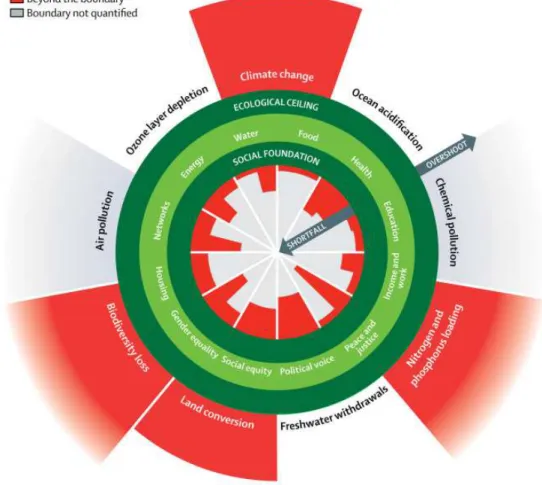
The graph below depicts the problems with our current economic pursuits, and a way of looking at our economy that works with the planet and our human nature, the solution. The outer ring of the doughnut-shaped graph depicts planetary boundaries, and the inner ring depicts human boundaries.
Figure 1. Planetary economic graph (Raworth, 2017)
As the graph shows, humans are overshooting our social and environmental limits on many accounts. Four of the planetary boundaries, including biodiversity loss and climate change, are currently overused by humans. Every social boundary, defined by this
6
graph, is currently not being met. Over-and under-shooting these boundaries presents major challenges, such as loss of coastal cities due to climate change, and political unrest due to inequality. The driving force behind these problems is economic pursuits driven by neoliberal ideologies.
Neoliberalism, which was born from and breeds individualism and liberalism, has become a “common sense” and foundational theory (Brown, 2015). Like a fish swimming in water, it is often hard to see the illusion we are swimming in. This illusory path has been described by our forbearers. Increasingly, however, this illusion does a poor job of hiding itself and alerts some of us to take our heads out of the water and look at the bigger picture. I am not claiming to have seen the entirety of this picture, but I think a good place to start changing our thoughts is in the places we spend most of our time: work.
Worker cooperatives are the most viable avenue in leading us down a better path2. On the surface, they appear to be another business structure working within our current socio-economic system. Under the surface, however, worker cooperatives have different goals and values than traditional business structures. Worker co-ops are a more human way of business, in the sense that they allow people to work and support themselves, in cooperation with others. As a business structure, a worker owned co-op has inherent anti-inequality mechanisms which can stabilize our economy and political systems. Most importantly, however, it is an economic structure that is guided by values and principles other than the maximization of profits (Macpherson, 2012). This way of doing business allows people to realize their connections to the community, the natural world, and their fellow man (Zamagni, 2010).
2 Many cooperative developers, such as Tim Huet, share this sentiment. View his manifesto: http://www.geo.coop/archives/huetman604.htm
7
Throughout my research, I was astounded by the goals and mission statements of the worker cooperatives I studied. Almost every worker cooperative I interviewed included in their definition of success something other than profit, such as job creation or community well-being. Many said the primary function of their business was a community, which was corroborated by other authors (Abrams, 2008). Doing business cooperatively can be a potential antidote to neoliberal policies and agendas, and the intellectual ideologies they promote.
Worker cooperatives are more relevant now more than ever. Apart from the fact that economic development needs to be rethought (and worker cooperatives run on different principles), 12 million Baby Boomer-owned businesses will either be sold or go out of business within the next two decades (CABB, 2018). These businesses can be sold to their employees, many of whom are millennials, who increasingly care more about social and environmental issues that worker cooperatives address through guiding values and principles (Deloitte, 2017).
It is my hope that enough businesses can become worker cooperatives within the next 20 years that changes in public consciousness can take place, thereby changing the way economic development is imagined. At that point in time, significant changes in the structure of the economy will hopefully take place. Until that point, however, alternative business structures, such as worker cooperatives, must work within the current socio-economic framework. This thesis attempts to discover the challenges and success factors for worker cooperative in the United States within the current legal and socio-economic systems.
8 Structure and Findings
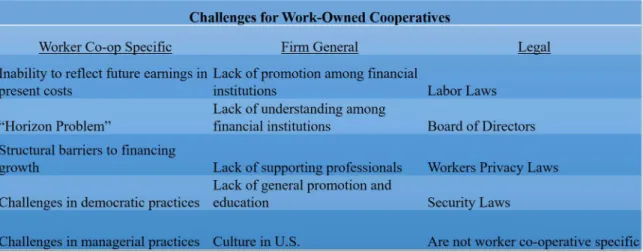
The remainder of this chapter is dedicated to a brief literature review and methods section. The literature is reviewed throughout this paper, therefore the literature review of this chapter is brief. Chapter Two discusses benefits of worker cooperatives and the benefits of supportive legal frameworks and policies. Chapter Three discusses challenges for worker cooperatives. This chapter is broken up, so each challenge can be explained in detail. The following is a chart describing the challenges for worker cooperatives based on the findings of this research:
Table 1. Challenges for Worker-Owned Cooperatives.
Chapter Four discusses challenges addressed and success factors for worker cooperatives based on interviews and the available literature. This chapter is also broken down into smaller sections, so each topic can be easily identified. An overview of topics addressed can be found in this chart:
9 Table 2. Challenges addressed and success factors.
The fifth and final chapter discusses laws, statutes, and political actions states can adopt to support worker cooperatives. It includes political findings based on my interviews with three Nevada state legislators. A brief summary of my political findings can be found in the chart below. The top row indicates the supportiveness of legislators to worker cooperatives. The bottom row indicates how likely it is that a state statute and bill would pass the 2019 Nevada state legislature.
10 Literature Review
Depending on the source, there are anywhere from 223-297 worker cooperatives in the United States, whose products and services range from installing solar panels to selling pharmaceuticals to importing coffee and much more (UMW, 2009; USFWC, 2017). Yet gathering information about worker cooperatives, especially in the United States, is a major challenge in and of itself (Hoyt and Menzani, 2010). This makes it impossible to study historical trends in the U.S. as there is little comprehensive data from 1970-2009 (Hoyt and Menzani, 2010). According to a respondent, “there is no national census [or government mandated federal body] for worker cooperatives” and there is often no mechanism that easily identifies worker cooperatives, making them hard to identify and contact. Identifying worker cooperatives and establishing trends is further complicated by varying state statutes and various ways in which worker cooperatives structure themselves (Hoover, 2012). For example, only 44 percent of worker cooperatives identified in the U.S. were statutory worker cooperatives, meaning 56 percent were incorporated under other statutes (USFWC, 2013). “Lack of standardization” of worker cooperatives means they are often structured differently (Hoover, 2012, pg. 1). For example, a form of worker cooperatives called “collectives” often don’t include membership equity, and many do not have typical boards of directors (Hoover, 2012; USFWC, 2013). One worker cooperative interviewed was a collective, and did not have a mechanism for membership equity such as a buy-in. Furthermore, many businesses, such as family businesses or partnerships, may function as a worker cooperative without identifying as such (Pitegoff, 2004). Because of these reasons, the US Federation of Worker Cooperatives (USFWC) estimates that the number
11
of worker cooperatives identified was undercounted in their survey by 10 to 40 percent (Hoover, 2012).
There are few worker co-ops in the United States despite their potential, especially in regard to increased profitability, productivity, and long-term longevity (Perotin, 2012). Even if we were to round 297 worker cooperatives up to 300 (297 is the number of worker cooperatives identified by the USFWC in 2015), and assume that this number undercounts the total amount of worker cooperatives in the U.S. by 40 percent, this would still leave the total amount at 500 or 0.001689 percent of U.S. businesses (SBA, 2017). Among all cooperative forms in the United States, it is estimated that worker cooperatives make up only 1 percent of total cooperatives in the U.S. (UMW, 2009). Other types of cooperatives, such as agricultural and consumer cooperatives, are much more prominent in the United States.
Despite worker cooperatives being at least as productive as conventional businesses, and superior in some regards, challenges have prevented them from propagating (Perotin, 2012; Tanner, 2007; Artz and Kim, 2011). These challenges are either specific to worker cooperatives, or are “general firm challenges [which] relate more to the firm’s environment” (Tanner, 2007, pg. 27). For example, a problem specific to worker cooperatives would be teaching members how to act quickly in making important decisions for the cooperative. A general firm challenge, or challenge relating to the firm’s environment, would be receiving institutional support such as familiarizing financial institutions with the worker cooperative structure. Both will be addressed in this thesis.
12 Research Question
What are the challenges and success factors for worker-owned cooperatives, and what are components of a state statute and policy that addresses each?
Methods
Apart from there being limited information about worker cooperatives in general, and especially in the United States, there is little information about how policy effects worker cooperatives (Hoyt and Menzani, 2012). Over the course of my research, I have found authors addressing policy in passing, but few papers have been dedicated to this subject. Logue (2006) discusses the political and legal environment in Emilia Romagna Italy. Restakis (2010) does the same, but in a historical context. Corcoran and Wilson (2010) discuss legal policies and actions in Spain, Italy, and France, but in the context of supportive environments in general. Adeler (2009) discusses supportive environments with a policy focus. Tanner (2013) makes policy recommendations for New York, using research from Quebec. Rowe et al (2017) has been one of the only papers I have found that specifically compares policies in other countries as a main focus. Throughout my research, I was unable to find any discussions of state statutes in the United States.
In the case where there were gaps in the available research, I used websites as guiding information. These websites proved especially helpful in searching for provisions within state statutes: co-oplaw.org; workercooplaw.org; http://ncba.coop/our-work/cooperative-statute.
My methodology comprised semi-structured interviews (SSIs), transcribing, and coding. Semi structured interviews (SSI) are a qualitative method of interviewing in which the interviewer has a set of canned questions and a general structure for the interview
13
(Doody and Noonan, 2013). The interviewer has the flexibility of changing the interview based on the direction of the conversation (Doody and Noonan, 2013). SSIs allow the conversation to have a more natural feel and allow the researcher to direct the conversation in a different direction if the interviewee says something more relevant or important (Doody and Noonan, 2013; Rabionet, 2009). On the other hand, SSIs are structured enough to allow the researcher to have a guiding structure. As Doody and Noonan (2013) discuss, SSIs provide enough structure to elicit relevant information responding to the research question, but at the same time, SSIs allow for new information to be discussed.
The mode in which the interview is conducted can affect the results. Opdenakker (2006) summarizes four types of interviews: face to face, virtual messaging, phone, and email. Phone interviews are easier to schedule and allow for the interviewer and interviewee to be in separate locations (Opdenakker, 2006). Although some might argue that phone interviews are less informational than face to face interviews, because of the reduction of social cues one is able to gather, such as body language or eye contact, it can be difficult to schedule these interviews when an interviewee and interviewer live in separate locations (Doody and Noonan, 2013; Opdenakker, 2006).
Coding is a commonly used strategy for analyzing data. A code is a theme found throughout an interview that can be used to organize, classify, and subsequently analyze interview data (University of Washington, 2017). Identifying codes is up to the researcher when analyzing data. This brings the reliability of coding as a method into question, because it is reliant on the bias and organizational skills of the researcher (Campbell et al., 2013).
14
I started my research by reading how worker cooperatives could scale up in numbers through Hilary Abell’s 2014 paper: Worker Cooperatives: Pathways to Scale
(TDC, 2014). This paper led me to read about the networks of worker cooperatives in other countries, especially the history of cooperative movements in Italy and the Basque region of Spain. I was also heavily influenced by papers on institutional momentum theory by Wanjiru Njoya and others. Based on this research, chance happenings in everyday life, and my research questions, I identified three categories of people to interview: Worker cooperative members, those who work in worker cooperative support organizations, and state legislators.
Based on my research and basic understanding of state statutes from Massachusetts, California, Wisconsin, Texas, and Colorado, I identified cooperatives in these states. Additionally, there were worker cooperatives in Washington, Illinois, and New York that I found interesting and to whom I reached out. In total, I identified thirty worker cooperatives and reached out to them via email. I heard back from eleven worker cooperatives, and I interviewed nine worker cooperatives. To clarify, I interviewed ten members total, but two of these members were from the same cooperative and provided complementary information. These interviews were conducted over the phone and lasted between an hour to two hours. Worker members were from the following states: California, Wisconsin, Colorado, and Massachusetts.
There were less support organizations available to reach out to compared to worker cooperatives. I reached out to thirteen support organizations. Support organizations can be classified into technical support organizations and financial support organizations. I discovered there is a lot of overlap with some financial organizations providing technical
15
support (although I did not find the reverse). These support organizations ranged in scale: city-wide, regional, national, and one international. Of the thirteen support organizations contacted, I was able to interview staff at seven. The respondents from these organizations were located in California, Maine, Massachusetts, and New York.
In my home state of Nevada, I contacted five current or former state legislators. I was able to speak with four of these respondents for the purposes of this research. I interviewed three state legislators. Two of these state legislators were assemblymen, and one was a state senator. One assemblyman was a Democrat, and one was a Republican. The state senator was a Democrat. Interviews with state legislators were conducted in person. I took notes during these interviews.
I had permission to record the phone interviews, and I transcribed them after they were complete. Then I began the coding process using the phone transcriptions and the notes taken during the state legislator interviews. I coded phone interviews looking for challenges and success factors. I then coded the challenges and success factors into sub-codes. For success factors, I coded for managerial practices, financial strategies, business strategies, legal factors, education and culture, and structure. For challenges I coded for culture, micro and macro politics, education, legal challenges, business-related challenges, and financing. I coded legislator interviews looking for the feasibility or infeasibility of passing various types of legislation supporting worker cooperatives in Nevada.
16
17
Chapter 2. Worker Cooperatives: Structure and Benefits
Worker cooperatives are a type of cooperative business structure of which there are three main forms: producer, consumer, and worker. The International Cooperative Association (ICA) was formed in 1895 and has become the largest cooperative association in the world (ICA, 2015). The ICA unifies the cooperative movement in many ways, including defining what cooperatives are and what their guiding values should be. According to the ICA a cooperative is “an autonomous association of persons united voluntarily to meet their common economic, social, and cultural needs and aspirations through a jointly owned and democratically-controlled enterprise” (ICA, 2015). The ICA further elaborates on principles that govern cooperatives: “voluntary and open membership, democratic member control, member economic participation, autonomy and independence, access to education, training, information, cooperation among cooperatives, and concern for community” (ICA, 2015).
Despite their relative obscurity in the United States, cooperative associations and businesses are responsible for a significant portion of the world’s economic activity (Battilani and Schroter, 2012). Here are some facts: The largest global 300 cooperatives generated $1.6 trillion in revenues in 2011 (ICA, 2015). One billion people are members of some type of cooperative around the world. Less than a third that number, 328 million, own shares of conventional businesses (GBO, 2012). Cooperatives make up 20 percent of the economies of Switzerland and Sweden (Battilani and Schroter, 2012). In the United States, producer cooperatives in the form of agricultural cooperatives are a dominant force in their industry, with the largest 10 generating $104.23 billion in business volume in 2014 (USDA, 2014).
18
Cooperatives behave much differently from corporations in part because they are structured differently than traditional corporations (Nadeau, 2012; Lappe, 2011). Where corporations are governed by the concept of one-dollar one-vote, cooperatives are governed by one-member one-vote (Lappe, 2011). Where corporations aim to make as much money as possible for their shareholders, cooperatives aim to provide services to their members (Nadeau, 2012). The differences in governing principles and objectives between these business structures have major implications to various stakeholders, including employees, communities, society, and the environment (Nadeau, 2012). The implications of the one-member-one vote convention, and differences in governing principles and objectives, are very important and constitute the main reason why cooperatives are so unlike conventional business structures. To put it simply, a business that is governed by one vote per share (not one vote per person) allows any individual with the most shares (money) to control the business as they see fit. Also, businesses that only have one aim- to create as much money as possible for shareholders (who typically aren’t workers in the business)- legally must do so often in spite of the community, environment, and employees (Nadeau, 2012; Hinkley, 2002).
“A cooperative is a business owned and controlled by the people who use or perform its services” (Nadeau and Thompson, 1997). Those who use or perform a cooperative’s services care enough about profit to keep the cooperative functioning, but they are primarily concerned with the services offered. In a producer cooperative, the primary service rendered to members (who are producers) might be to market products en masse so that all producers can cheaply market products together (Nadeau, 2012). For a consumer cooperative, services rendered to members (who are consumers) would be to
19
benefit members who collectively purchase goods or services for consumption (Nadeau, 2012). In a worker cooperative, the primary service rendered to members (who are workers) is to provide jobs for members (Nadeau, 2012). Thus, in a worker cooperative, the owners, primary shareholders, employees, managers, and decision makers are the members of the cooperative. (As a side note, some cooperatives hire external managers that are not members. Some of the respondents I interviewed considered this practice a critical success factor. These managers must be hired by a majority, supermajority, or consensus by the members.)
A Typical Worker Cooperative
This fictional story will explain how a worker cooperative works:
Jane is a prospective employee of Ac Co-op, a worker cooperative accounting firm. Jane discovers that she is under a probationary period of nine months, called a trial period. During this time, she is assigned a member-mentor who teaches her what it means to be an owner. After Jane successfully completes her trial period, she is recommended to be an owner. The members of the cooperative then vote to hire her as a co-owner by majority decision. Once Jane becomes a co-owner member, she must pay a buy-in fee, so she can receive a class-A membership share. This share allows her to vote in key decisions, in electing a board of directors, and a portion of the profits or losses. Her share gives her all the benefits and risks of an owner of the business. The buy-in fee for her class-A share is $3,000. Jane decides to pay for this share through paycheck deductions.
Let’s say Ac Co-op earns extra money amounting to $110,000 after all expenses have been paid, including investor dividends on non-voting shares for investors. $10,000 of this money was made through the labor of employees, not members. The $10,000 made
20
by employees is called profit, and will not be distributed to members, instead it will be retained by the cooperative. This $10,000 will also be taxed at the corporate rate of 40 percent. The remaining $100,000 will be distributed to members based on their patronage, or hours worked. Because Jane worked 1/10th of the hours, 1/10th of the patronage earnings or $10,000 will be distributed to her. This is Jane’s patronage dividend. In accordance with IRS codes, 20 percent of Jane’s $10,000 patronage dividend must be paid to her in cash. The rest of her dividend, $8,000, will be retained by the cooperative in Jane’s capital account, until she requests it.
Ten years later, Jane decides to start her own worker cooperative restaurant, and retires from Ac Coop. Jane sells her $3,000 class-A share back to the co-op. (Alternatively, Jane could not sell her class-a share, in which case it would turn into a nonvoting class-B share). Over her ten years at Ac Coop, she has saved $80,000 in her capital account, and requests half that amount to be paid to her immediately. The remaining money in her capital account will be converted into preferred non-voting shares, which will receive dividends of 6 percent.
Although Jane’s story is fictional, it is typical, apart from Jane wanting to start her own restaurant. This story also includes key concepts for worker cooperatives that will be useful in the coming sections. Trial periods, buy-ins, patronage earnings, patronage dividends (also called patronage distribution), and capital accounts are common tools used by worker cooperatives and look different depending on the cooperative. For example, trial periods can last anywhere from one day to many years (Artz and Kim, 2011). Buy-ins can range from $1 to hundreds of thousands of dollars (Artz and Kim, 2011; Restakis, 2010). Patronage dividends can be calculated based on hours worked, or percent of wages earned,
21
or through a combination of the two. Some worker co-ops choose to disperse all the patronage dividend as cash, or the bare minimum of 20 percent mandated by IRS codes. Capital accounts can vest or not, accrue dividends or not, or accrue interest or not. These things are determined by the cooperative depending on their unique financial, social, and cultural situation and goals (Artz and Kim, 2011). The principles of one member one vote, member control over decisions of the cooperative, and equal and fair share over the risks and rewards of the business cannot vary between worker cooperatives, however (Artz and Kim, 2011).
Benefits of Worker Cooperatives:
Policy makers are like farmers. A farmer can shape a farm and make it grow however he chooses. If a farmer wants a bigger farm, he plants more seeds. If he wants to grow more tobacco instead of beans, he can simply stop watering the bean plants, rip them out, and plant tobacco. Policy makers shape the society in which we live in much the same way. Through policies and laws, policy makers can expand or shrink our economy, influence the creation or destruction of jobs, create or kill off social programs, influence whether future policy makers will be less or more influenced by large donations, influence what types of things are taught in schools, and influence which types of businesses are created, among many other things.
For example, the idea that employees should have the option of owning the company they work for has been around for a long time. This idea was popular and considered the next logical step for capitalism by many (Rosen et al., 2005). Conservative railroad tycoons, extremely liberal politicians such as Huey Long, and many others in between, considered worker ownership beneficial and in some cases necessary (Rosen et
22
al., 2005). Numerous companies from the 1890s to the 1920s allowed their employees to buy shares of company stock at a discount, which was intended to give employees a path to ownership in the company they worked for and helped the company to succeed (Rosen et al., 2005). Universities and researchers started researching the viability of worker ownership, and experimenting with how it functioned (Rosen et al., 2005). The initial experiment in employee stock programs failed due to the Great Depression, employees selling their stock because of a lack of understanding of what stock meant, problems inherent in the discounted stock system, and because of companies buying back their stock (Rosen et al., 2005). The idea fell back into obscurity until the 1970’s and 80’s when Congress passed multiple pieces of legislation that gave companies significant and heavy tax credits for selling their stock to employees through employee stock ownership plans (ESOP) (Rosen et al., 2005). ESOP companies, as they are now known, went from being virtually non-existent to comprising 10 percent of the U.S. workforce (Nadeau 2012; Rosen et al., 2005). Legislation passed in the 1970’s and ’80s worked like the sowing of seeds. In the subsequent years, ESOPs have grown and propagated across the country.
There are consequences to what types of crops farmers plant. For example, if farmers only plant one crop, let’s say tobacco, the tobacco plant will extract all the nutrients it needs to grow until the soil becomes depleted. If farmers want to keep growing tobacco, they will either have to rotate crops, or inoculate the soil artificially with fertilizer. Like farmers only planting and tending to one type of crop, policy makers in many states have neglected the worker-owned cooperative business structure. Thirteen states have no legal framework at all for worker-owned cooperative businesses (Nadeau, 2012). In states that do have worker owned cooperatives, they have been given little government assistance or
23
support (Nadeau, 2012). Policy and government support for worker cooperatives can take the form of many other things besides simply throwing money at an issue or giving money to business entities in the form of bailouts. It can take the form of education, removing or refining financial regulations so that banks and credit unions can loan to worker cooperatives, and making the worker cooperative model available through forms on state websites as is done with corporations and limited liability companies (LLC’s). The most useful thing the law can do, however, is to legally define terms specific to worker cooperatives so the law doesn’t become a barrier to worker cooperatives. For example, legally defining what constitutes a member vs employee has legal ramifications that could protect worker cooperatives from unnecessary and expensive legal proceedings (Helfman, 1992).
While the current legal environment does little to support worker cooperatives, it does support many other types of business structures such as LLCs, sole proprietorships, partnerships, and corporations. The aforementioned forms of business are heavily supported by government agencies, our educational systems, and the law. Worker cooperatives are not supported nearly to this degree (Cornwell et al., 2014; Hill, 2000). For example, besides the handful of institutions offering one, maybe two, classes about the cooperative business structure, there is only a certificate program at the University of Massachusetts that offers any degree about cooperatives in the United States. Another university in Manitoba, Canada offers a certificate program about employee ownership, but not necessarily about worker cooperatives (Blasi et al., 2013). In the whole of North America, there is only one full degree dedicated to teaching about cooperatives, located in Canada (Cornwell et al., 2014). Cooperatives are largely rendered invisible in most
24
universities in the U.S. and Canada, as they rarely appear in university textbooks despite being dominant in some industries such as in agriculture (Hill, 2000; Cornwell et al., 2013). Government agencies such as small business extension agencies have helped thousands of underprivileged people set up businesses, but most of these extensions don’t mention worker cooperatives, and their staff are not are trained to know how to set them up (Logue and Yates, 2001).
There are consequences to setting up a legal and institutional environment that supports LLCs and corporations more than cooperatives, especially when the maximization of profit is written into law, and when employees have little to no say over their working conditions (Hinkley, 2002; Lindenfeld, 2003). Traditional business structures, such as corporations and most LLCs, “are alienating in that they deprive most ordinary employees of control over their own work as well as the fruits of their labor” (Lindenfeld, 2003). Conventional business structures are not controlled by workers, but by a few managers and CEOs who must legally make as much money for their stockholders as possible (Hinkley, 2002). Managers and boards of directors who do not maximize returns to shareholders can be fired and even sued by the shareholders. In order to legally consider multiple bottom lines, corporations can elect to become a B-corporation, in which they can take “multiple bottom lines” into account besides maximizing returns for shareholders, but in most cases, the root of the problem still exists: lack of meaningful capital ownership by workers, which leads to inequality and a lack of control (Blasi et al., 2013).
A definition of meaningful capital ownership would be enough capital ownership to reduce inequality, and enough to have a say in governance decisions. According to the General Social Survey, a survey of 1,500 adult employees which is conducted in a way to
25
be statistically representative of employees in the U.S., 47 percent of workers have some form of capital stake (Blasi et al., 2013). This stake could come in the form of profit sharing, ownership shares, and stock options. Data shows that the current degree of worker share ownership is not significant enough to reduce inequality (Blasi et al., 2013). In most cases, even among most ESOP companies, there is no mechanism for most share holders to have a voice in governance (Blasi et al., 2013; Logue and Yates 2001; Rosen et al., 2005). Profit sharing does not give one the right to vote in company decisions, and shares of stock only give a stakeholder meaningful voice if they hold a significant portion of the stocks.
Inequality is on the rise globally and in the United States. From 2002 to 2012, economic productivity grew by 30 percent while wages for the bottom 70 percent declined (TUC, 2012). The movement of money from the labor of the many to the pockets of the few is solidified in most business structures. Businesses allocate money in the way they are structured (Bagchi, 2007). Allocation of resources in society is determined by the dominant business structures in that society (Bagchi, 2007). Since the dominant business structures in the United States allocate money upward toward top management and owners, allocation of resources in the U.S. society is also funneled upward (Bagchi, 2007). As of 2015, the average CEO in the United States made 204 times the amount in salary as the average worker (Chamberlain, 2015). This salary does not include bonuses and stock holdings CEOs may be given. From 1983 to 2010 the top 5 percent of wealth holders captured 74.2 percent of wealth growth in the United states, while the bottom 60 percent’s wealth declined (EPI, 2018).
26
Stagnant and declining wages despite increased productivity and economic growth indicate a lack of control for workers. If workers had more control, they would have the power to increase compensations and protect their jobs from downsizing and outsourcing. Collective bargaining once gave workers an avenue to increase their pay, but since the 1980’s, collective bargaining power has declined significantly in the United States (Reich, 2015). Political initiatives, outsourcing, and corporate hostile takeovers were primary reasons why unions declined (Reich, 2015; Nace, 2003). Union membership decreased from 20.1 percent of the workforce in 1983 to 10.7 percent in 2017 (BLS, 2017).
There is a political dimension to inequality as well. One of the hopes and principles of the founders of the United States was that there would not be the concentration of money into the hands of the few, according to historian Gordon S. Wood “it was common knowledge among the founding fathers that a republic could not remain republican if a tiny minority controlled most of the wealth” (Blasi et al., 2013, pg. 8). Many of the founding fathers were at least sympathetic to broad-based property ownership, including Washington, Jefferson, Hamilton, Franklin, Adams, and Madison, because a significant part of the revolution was in response to the inequality produced by royal policies (Blasi et al., 2013). Broad-based capital ownership was primarily about land distribution in those days because that was the primary way people made money, and corporations were still so heavily regulated that they were few and far between (Blasi et al., 2013). It can be argued that the new “land ownership” is ownership of capital property since its ownership brings with it wealth and power over company decisions (Blasi et al., 2013). Also, those who control capital property can benefit from the labor of others and exert control over them, much as land owners could in the days of the revolution (Blasi et al., 2013).
27
Greater wealth gives people the power to have greater control over laws and regulations, which in turn gives them more wealth. This is what is meant by the political dimension to inequality. The main mechanism through which the wealthy accumulate their wealth is through capital property (Mayer, 2016; Picketty, 2014). In 2008, the top 400 taxpayers declared that 60 percent of their income was from capital gains (and capital gains does not include income from dividends, which means that the total income from capital ownership in this report might be much higher than 60 percent) (Mayer, 2016). Capital gains, in this manner, thus becomes a mechanism for rich families to gain political capital to use for the further accumulation of more capital (Mayer, 2016).
For example, the Devos and Koch families spent millions of dollars funding legal proceedings in the early 2000s that would repeal many of the restrictions of the Tillman Act of 1907 (Mayer, 2016). The Tillman Act put restrictions on the ability of corporations to influence elections through the use of large donations (Mayer, 2016). The initiative to repeal the restrictions of the Tillman Act was successful and was written into law through the decision of Citizens United vs. FEC. Benefiting from this decision, the Devoses, Kochs, and other wealthy elite spent millions of dollars in campaign contributions through 501c(4) and 501c(3) nonprofit organizations to help elect candidates in the 2010 elections; their contributions were tax deductible (Mayer, 2016). One of the first things the newly elected candidates did after their election in 2010 was negotiate with the president, on behalf of their donors, to cut taxes on capital gains from 20 percent to 15 percent (Mayer, 2016). The money used to bring about the Citizens United decision, had a literal return on investment. According to Blasi, Freeman, and Kruse (2013), it is important to implement policies that promote broad based capital ownership on the basis that this type of capital
28
ownership reduces inequality and regains balances of democratic power in the United States. It also gives people a means to practice democratic principles on a daily basis at work. The two primary business structures that imbed capital ownership within its structure are ESOP companies and worker owned cooperatives. While ESOP companies and worker cooperatives are similar in that they are both employee owned, there are important differences between the two. Differences between these two structures are explained throughout this paper, but the most important distinction between the two arises from the amount of ownership and control each structure may allow. Worker cooperatives are 100 percent owned and controlled by worker members (although they can and usually do have employees), and ESOP companies can be owned by a percentage of workers ranging from 20 to 100 percent (NCEO, 2017). Thus, in ESOP companies, employees are in charge of 20 to 100 percent of votes governing company decisions. Worker cooperative members are always in complete control of their business.
Examples from Italy, Spain, and Argentina Italy
Through laws, policies, and public support, legislators from other countries have nurtured cooperatives in different ways than in the United States. In these places, we can see the consequences of planting the seeds of cooperative businesses. The best example of government support for cooperatives is in Italy, where the cooperative structure is solidified and recognized in the country’s constitution. Article 45 of the Italian Constitution (1947) states: “The Republic recognizes the social function of cooperation characterized by mutual aid and not private profit. The law promotes and favors the growth of these structures using the most appropriate means and guarantees that their character and purpose
29
will be inspected accordingly” (Logue, 2006). A variety of laws give cooperatives significant advantages, including tax advantages, the ability to form associations amongst themselves for mutual aid and political representation, and mechanisms that insure the availability of capital for them (Logue, 2006; Corcoran and Wilson, 2010; Restakis, 2010).
One such law, the Basevi law, mandates that if cooperatives want to enjoy a 40 percent tax benefit, they must allocate 30 percent of annual net profit into an indivisible reserve (Logue, 2006, Restakis, 2010). This reserve cannot be distributed to members individually or paid to investors through dividends (CWCF, 2015). It also cannot be distributed to members when the cooperative is sold; instead it must either be donated to a co-op development fund or given to a cooperative organization (Corcoran and Wilson, 2010). It can be used as an emergency fund, improve financial statements and ratios, be used in research and development, and provide long term capital (Corcoran and Wilson, 2010; Logue, 2006; Restakis, 2010). This indivisible reserve is a success factor for many cooperatives, and has shown its benefits in areas where it is mandated into law, including Italy, Spain, and France (CWPC, 2015; Corcoran and Wilson, 2010). This law, among others, has helped insure the survival and propagation of worker cooperatives in Italy.
The law, culture, and important role cooperatives played in Italian history has greatly contributed to their success, particularly in the Emilia Romagna region. Forty percent of Emilia Romagna’s GDP is generated by cooperatives, including worker coops (Restakis, 2010). Ten percent of the labor force of the region is employed by cooperatives, and half the population is a member of some kind of cooperative (Logue, 2006). “Most privatized social services are provided by employee co-ops”, through social cooperatives3
3 Social cooperatives are a kind of worker cooperative which are formally supported by multiple stakeholders (Restakis 2010).
30
which are considered by many in the region to combine the efficiency of the private market with the low costs of government services (Logue, 2006, pg. 1; Restakis, 2010). Some of Italy’s largest businesses reside in Emilia Romagna, many of which are worker cooperatives, including five of the nine largest worker cooperatives in the world (Logue, 2006, Co-operative news, 2014).
Emilia Romagna is one of the wealthiest and most successful regions in Italy, in many metrics. Despite accounting for only seven percent of the total Italian population, Emilia Romagna accounts for “nine percent of the Italian GDP, twelve percent of Italy’s exports, and thirty percent of Italy’s patents” (Logue, 2006, pg. 2). Unemployment in the region was three percent before the economic crisis of 2008, which was exceptional (Logue, 2006; EU Commission, 2018). Although unemployment grew to eight percent in 2015, it was still 4.8 percent lower than the Italian national average (EU Commission, 2018). According to Flavio Delbono, economist and former vice president of Emilia Romagna, “the massive presence of cooperative firms is a stabilizing factor in the regional economy” (Logue, 2006). It is important to note that Emilia Romagna was able to achieve this level of economic success since the 1950s, when it was one of the poorest regions in all of Europe due to the devastation of World War Two and fascist suppression of cooperatives by Mussolini (Logue, 2006).
Evidence suggests that the high concentration of worker cooperatives is a major contributing factor to Emilia Romagna’s low inequality index score and quality of life (Logue, 2006). In fact, Emilia Romagna’s inequality index is twice as good as the average for the European Union (Logue, 2006). Research from other places, including the United States, shows that worker-owned cooperatives reduce inequality (Majee and Hoyt, 2011;
31
Logue, 2006; Cocoran and Wilson, 2010; Restakis, 2010; Nadeau, 2012). Low inequality metrics also correspond with metrics of higher quality of life and higher social capital, a metric according to which Emilia Romagna repeatedly scores among the highest in the world (Logue, 2006). According to Robert Putnam, metrics of social capital and social cohesion (social capital is the measure of the degree to which there are networks of people that know each other and do things for and with each other) are extremely high in Emilia Romagna (Putnam, 2000). Social capital has been associated with things like increases in trust within the community, communities’ resiliency in response to natural disasters, decreases in crime rates, and higher rates of happiness (Hari, 2018; Putnam, 2000; Restakis, 2010).
Spain
The Mondragon Cooperative Corporation was born out of post-civil war Spain in the 1950s (Restakis, 2010). The war had devastated the city of Mondragon in the Basque country. Like Emilia Romagna, the Basque region of Spain was particularly persecuted by Franco. Mondragon was a small, poor town with extremely high unemployment when the Mondragon Cooperative Corporation (MCC) was founded (Whyte and Whyte, 1988). The founders of MCC, a Catholic priest and some of his students, viewed their cooperative experiment as more than just a business. It was also an economic development initiative intended to support the Basque community (Whyte and Whyte, 1988). Mondragon has largely been self-regulating and took cooperative principles seriously when creating bylaws and planning how the cooperative would be structured and run (Gibson-Graham, 2006). Founding members of MCC took these values seriously and added other values that guided them in business decisions, including:
32
• Sovereignty over labor: labor is understood as, “the main factor in the transformation of nature, society and human beings, thus there should be a strong emphasis on job creation”
• Instrumental and subordinate nature of capital: “Capital is in the service of people and labor rather than profit and accordingly is managed in participatory manner with standards for transparency and information sharing” (Cornwell et al., 2013, pg. 168).
• Payment solidarity: Payment of individuals should not come at the expense of others in the cooperative or the cooperative itself.
• Social transformation: that worker coops should be dedicated to “growing ever more cooperative to provide more jobs through the reinvestment of surplus; support for community development, to which ten percent of net surplus is devoted; providing a social security system for all members; and economic and social cooperation with other institutions” (Cornwell et al., 2013, pg. 168)
• Universality: helping the co-op movement through promotion, growing and teaching other coops, etc.
(These principles, and the idea to include their definitions, were originally found in Building Cooperative Power by Cornwell, Johnson, and Trott, but were taken from Mondragon’s website.)
Despite there being little history of worker cooperatives in the region (although other cooperatives were prominent before the civil war), and despite there being no legal structure for worker cooperatives, the Mondragon Cooperative Corporation has become an important player in the economic atmosphere of Northern Spain (Whyte and Whyte, 1988).
33
As of 2016 it employs around 31,442 workers in the Basque region alone. Two hundred and sixty-eight companies (102 are cooperatives) employ 73,000 workers (Mondragon, 2018). Over time, the Spanish government has recognized cooperatives as an important economic development tool, and taxes their profits at 10 percent compared to 28 percent for other corporations (Corcoran and Wilson, 2010).
Concern for the community and the wellbeing of its worker members have been strong guiding values of the cooperative. For example, to prevent members from getting too wealthy and becoming a new ruling class that could come into conflict with the rest of Basque society, members used the community as the standard to set wages within Mondragon (Gibson-Graham, 2006). For most jobs in Mondragon, wages are competitive and pay more than industry averages, but aren’t extravagantly higher than average (Corcoran and Wilson, 2010). Managers and CEO’s, however, are paid less than industry averages, which causes the cooperative to hire within and hire new graduates from universities (Corcoran and Wilson, 2010). Managers and CEO’s are paid less because of Mondragon’s commitment to pay solidarity. No one is paid more than 8 times the lowest paid worker (Tremlett, 2013).
When the Spanish government ruled that worker members of the cooperative didn’t qualify for Social Security or medical insurance on the grounds that members were considered to be self-employed, Mondragon pooled resources to create its own insurance cooperative and used its own credit union to help workers save money through profit distributions into individual capital accounts (Graham -Gibson, 2006; Corcoran and Wilson, 2010). Capital accounts proved to be mutually beneficial to the cooperative and its
34
members, as they provided a way for members to save money in an account that accrues interest, and gave the cooperative more liquid capital (Corcoran and Wilson, 2010).
In the event of economic difficulties, the cooperative has gone to great lengths to save jobs (Corcoran and Wilson, 2010). During such events, La Caja Laboral, Mondragon’s central credit union, assesses the economic crises, retrains and redeploys members from failing cooperatives, gives loans to suffering cooperatives, lowers wages within the cooperative to save jobs, or simply pays laid-off members 80 percent of their wages until better economic times creates an opening in another cooperative (Corcoran and Wilson, 2010). For example, when unemployment rates were 25 percent in Spain during the 1980s, Mondragon used the aforementioned measures to save member jobs (Corcoran and Wilson, 2010). During the financial crisis that started in 2008, Mondragon was able to avoid laying off a single member (Guadiana, 2016).
Mondragon has come under some scrutiny in recent years. The argument has been made that Mondragon hasn’t cooperated with non-Mondragon cooperatives (Corcoran and Wilson, 2010). The perceived lack of cooperation could be due to its history of having to survive on its own with little outside support or it could be due to resources being spread thin because of the 268 corporations and cooperatives that it owns worldwide. Mondragon has gone out of its way to promote the cooperative model, even in other countries such as the United States (Guadiana, 2016). Mondragon partnered with the US Steelworkers union on an initiative to spread the cooperative model through union cooperatives (Guadiana, 2016).
Another criticism of Mondragon, which also applies to many of the large worker cooperatives in Italy, is its ownership of non-cooperative corporations, largely in other
35
countries (Corcoran and Wilson, 2010; Restakis, 2010; Gibson-Graham, 2006). Italian law recently permitted cooperatives the ability to own corporate stock and corporations, and it is a concern that cooperatives could use conventional corporate structure in a way that compromises cooperative principles (Restakis, 2010). Mondragon also owns corporations, especially in other countries such as Southeast Asia and Morocco (Corcoran and Wilson, 2010). Mondragon cites the need to be competitive in the global market, and lack of laws enabling cooperative development in countries in which it does business (Gibson-Graham, 2006).
Benefits of Worker Cooperatives
We have just explored some areas of the world in which the government and regulations have come to support worker cooperatives. In Italy, support comes through the government because of the historical benefits to communities, the economy, and individuals. In Spain, the government has come to support cooperatives over time for much the same reasons as in Italy. The Mondragon Corporation has largely been self-regulating, whereas in Italy the government has played a large role in regulations.
In the next section, I will explore the benefits of worker cooperatives to the economy, firm, and individual. It is hard to separate the benefits to each because there is likely a spillover effect from each. For example, a worker cooperative that saves jobs in a recession will be beneficial to the economy as it reduces unemployment, the individual as it has saved someone’s job, and likely the firm in the long run as it was able to retain an already trained and experienced employee. Additionally, evidence suggests that the economic environment in which one lives has health implications (Young, 2018; Marmot, 2015). In a study conducted comparing counties across the United States, individuals in
36
wealthier counties were 64 percent less likely to die of mental health or substance-abuse-related diseases (Young, 2018). Also, poor counties were 26 percent less likely to have healthy food options and 24 percent less likely to have opportunities for exercise (Young, 2018). There are many more connections between the individual, firm, and economic spheres, and there are probably many other benefits from having cooperatives than those subsequently mentioned. This is a brief outline of what the evidence says about worker cooperatives so far. These outlined benefits will be analyzed in the context of Nevada and interviews with politicians in Chapter 5.
Economic Benefits
This section will primarily discuss economic benefits to communities and regions worker cooperatives occupy. There is limited evidence on the effects of worker cooperatives in countries as a whole, besides general data and trends of firm creation, firm extinction, and employment in certain countries. Information on worker cooperatives in general is limited, especially in the United States, according to literature and interviews with cooperative support organizations (Hoyt and Menzani, 2010). The evidence we do have supports the idea that worker cooperatives save jobs during economic crises, are less prone to market booms and busts, pay workers more on average, and may have an economic multiplier effect (Birchall and Ketilson, 2009; Perotin, 2012). Evidence that employee owned firms survive longer is most robust (Schwartz, 2012).
Cooperatives, including worker cooperatives, have historically been a type of self-help, economic development strategy throughout the world and have the potential to lift communities out of poverty as opposed to single individuals (Battilani and Schroter, 2012; Majee and Hoyt 2009). Whether it be post-civil war Spain, post-WWII Italy, or modern
37
day Argentina, worker cooperatives have allowed people to come together to improve their communities, create their own jobs, and increase their standard of living. Even in the United States, during the Great Depression, worker cooperatives were a means of economic revitalization (Curl, 2009). Worker cooperatives are still used as a means of economic development. Cities such as Austin, Texas, New York City, and Cleveland are just a few cities in the United States that have implemented worker cooperative initiatives to reduce inequality, create wealth, and create jobs in inner cities (Morningside Research, 2016). As unemployment rises, people can come together to create their own employment opportunities through the cooperative structure (Artz and Kim, 2011; Smith and Rothbaum, 2013). For example, for every 1 percent increase in unemployment in France, cooperative firm formation increased 10 percent (Perotin, 2012). Economic wellbeing, in the sense of reducing unemployment, is aided by the creation of worker cooperatives.
In the United States, worker cooperatives have been used at least since the 1980s, to convert businesses to save jobs (Pitegoff, 1985). During factory shutdowns of the 1980’s, it was the hope of many that workers would band together to buy the factories they worked for in an effort to prevent their jobs from moving overseas. In fact, Massachusetts passed the nation’s first worker cooperative statute, in part, to promote business conversions for this reason (Ellerman and Pitegoff, 1983). Saving and creating jobs is an important mission of many worker cooperatives and it is common for worker co-ops to include, “jobs for future generations” as part of their mission statement (Artz and Kim, 2011). In the United States today, there are 70 million retiring Baby Boomers nearing retirement who collectively own 12 million private businesses with $10 trillion in assets (CABB, 2018). Considering that most business sales are not successful, and that most