REDESIGN OF DATABASE ALGORITHMS
FOR NEXT GENERATION
NON-VOLATILE MEMORY TECHNOLOGY
Weiwei Hu
Bachelor of Engineering
Tsinghua University, China
A THESIS SUBMITTED
FOR THE DEGREE OF MASTER OF SCIENCE
SCHOOL OF COMPUTING
NATIONAL UNIVERSITY OF SINGAPORE
Acknowledgement
I would like to express my sincere gratitude to my supervisor, Prof. Beng Chin Ooi for his guidance and encouragement throughout the research work. His continuous support led me to the right way. He teaches me the right working attitude which I believe will help me a lot along my whole life. His understanding and guidance provides me a good direction of my thesis.
I would also like to thank Prof. Kian-Lee Tan and Guoliang Li, who help me a lot to edit the paper and give me valuable advice for research.
During this work I have collaborated with many colleagues in the database lab, who have given me lots of valuable comments and ideas. I would like to thank all of them. They are Sai Wu, Su Chen, Vo Hoang Tam, Suraj Pathak, Peng Lu, Yanyan Shen etc. I have really enjoyed the pleasant cooperation and work with these smart and motivated people.
Finally, and most importantly, I would like to thank my parents for their encour-agement and support. All of these have helped me a lot to complete my graduate studies and this research work.
Contents
Acknowledgement i
Summary v
1 Introduction 1
1.1 Our Contributions . . . 3
1.2 Outline of The Thesis . . . 4
2 Next-generation Non-volatile Memory Technology 6 2.1 NVM Technology . . . 6
2.2 Positions in the Memory Hierarchy . . . 9
2.3 Challenges to Algorithms Design . . . 10
2.4 Algorithms Design Considerations . . . 12
2.5 Summary . . . 13
3 Literature Review 15 3.1 Write-optimized Indexing Algorithms . . . 15
3.1.1 HDD-based Indexing . . . 16
3.1.2 SSD-based Indexing . . . 18
3.1.4 PCM-based Indexing . . . 20
3.2 Query Processing Algorithms . . . 21
3.2.1 Adaptive Query Processing . . . 21
3.2.2 SSD-based Query Processing . . . 24
3.3 PCM-based Main Memory System. . . 26
3.4 Prediction Model . . . 27
3.5 Summary . . . 29
4 Predictive B+-Tree 31 4.1 Overview of the
B
p-tree
. . . 314.1.1 Design Principle . . . 32
4.1.2 Basic Idea . . . 33
4.2 Main Components of
B
p-tree
. . . 344.2.1 DRAM Buffer . . . 35
4.2.2 Warm-up Phase . . . 36
4.2.3 Update Phase . . . 37
4.3 Summary . . . 39
5 Predictive Model 41 5.1 Predictive Model for Warm-up . . . 41
5.1.1 Predicting the
B
p-tree
Skeleton . . . 425.1.2
B
p-tree
Construction . . . 435.2 Predictive Model for Updates . . . 48
5.2.1 Search . . . 48
5.2.2 Deletion . . . 49
5.3 Evaluating
B
p-tree
. . . 535.4 Summary . . . 56
6 Experimental Evaluation 57 6.1 Experimental Setup . . . 57
6.1.1 Experimental platform . . . 58
6.1.2 Data sets and workloads . . . 58
6.1.3 Algorithms compared . . . 59
6.2 Results and Analysis . . . 60
6.2.1 Insertion . . . 60
6.2.2 Update . . . 62
6.2.3 Search . . . 63
6.2.4 Node Utilization . . . 65
6.2.5 Sensitivity to Data Distribution Changes . . . 66
6.3 Summary . . . 67
7 Conclusion 70 7.1 Conclusion . . . 70
Summary
In recent years, non-volatile memory like PCM has been considered an attractive alternative to flash memory and DRAM. It has promising features, including non-volatile storage, byte addressability, fast read and write operations, and supports random accesses. Many research scholars are working on designing adaptive sys-tems based on such memory technologies. However, there are also some challenges in designing algorithms for this kind of non-volatile-based memory systems, such as longer write latency and higher energy consumption compared to DRAM. In this thesis, we will talk about our redesign of the indexing technique for traditional database systems for them.
We propose a newpredictive B+-treeindex, called theBp-tree. which is tailored for database systems that make use of PCM. We know that the relative slow-write is one of the major challenges when designing algorithms for the new systems and thus our trivial target is to avoid the writes as many as possible during the execution of our algorithms. For B+-tree, we find that each time a node is full, we need to
split the node and write half of the keys on this node to a new place which is the major source of the more writes during the construction of the tree. OurBp-treecan
reduce the data movements caused by tree node splits and merges that arise from insertions and deletions. This is achieved by pre-allocating space on the memory
for near future data. To ensure the space are allocated where they are needed, we propose a novel predictive model to ascertain future data distribution based on the current data. In addition, as in [6], when keys are inserted into a leaf node, they are packed but need not be in sorted order which can also reduce some writes.
We implemented the Bp-tree in PostgreSQL and evaluated it in an emulated
environment. Since we do not have any PCM product now, we need to simulate the environment in our experiments. We customized the buffer management and calculate the number of writes based on the cache line size. Besides the normal insertion, deletion and search performance, we also did experiments to see how sensitive our Bp-tree is to the changes of the data distribution. Our experimental
results show that the Bp-tree significantly reduces the number of writes, therefore
making it write and energy efficient and suitable for a PCM-like hardware environ-ment. For the future work, besides the indexing technique, we can move on to make the query processing more friendly to the next generation non-volatile memory.
List of Tables
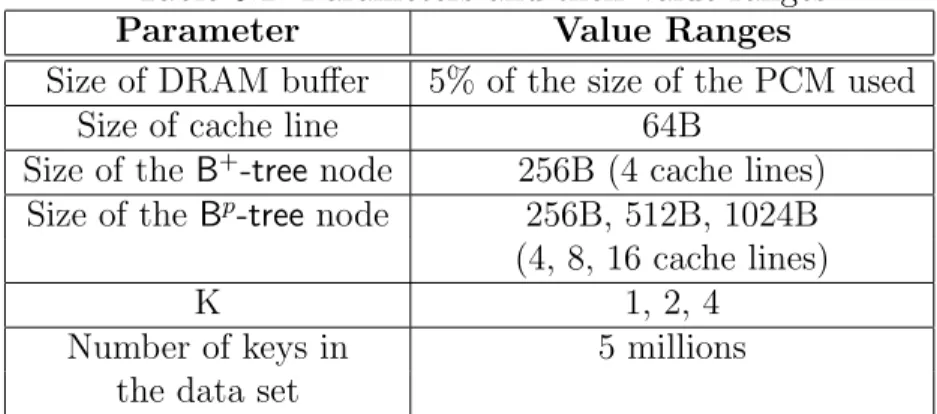
2.1 Comparison of Memory Technologies . . . 8 4.1 Notations . . . 35 6.1 Parameters and their value ranges . . . 59
List of Figures
2.1 PCM Technology . . . 7
2.2 PCM Usage Proposals . . . 10
4.1 Bp-treearchitecture . . . 35
4.2 An example of a warm-up phase . . . 37
4.3 An example for update phase . . . 38
5.1 Warmup Algorithm . . . 47
5.2 Bp-tree: Search Operation . . . . 49
5.3 Bp-tree: Deletion Operation . . . . 50
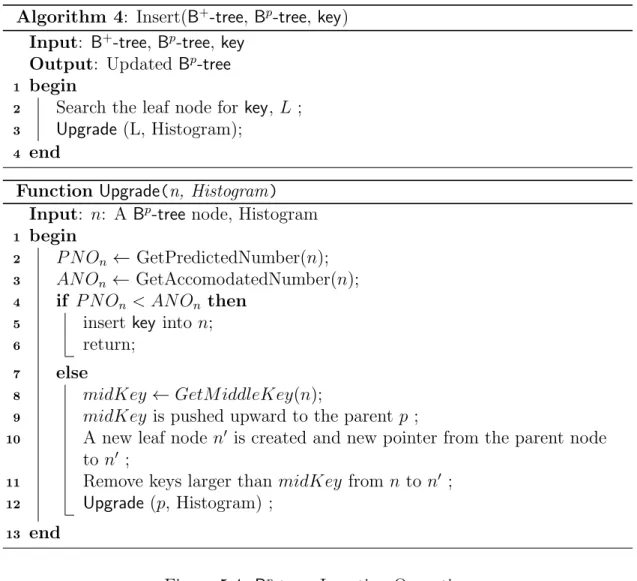
5.4 Bp-tree: Insertion Operation . . . 54
6.1 Insertion performance . . . 61
6.2 Update performance . . . 64
6.3 Search performance . . . 64
6.4 Leaf nodes utilization . . . 66
Chapter 1
Introduction
In the established memory technologies hierarchy, DRAMs and flash memories are two major types that are currently in use, but both of them suffer from vari-ous shortcomings: DRAMs are volatile and flash memories exhibit limited write endurance and low write speed. In recent years, we found that the emerging next-generation non-volatile memory (NVM) is a promising alternative to the traditional flash memory and DRAM as it offers a combination of some of the best features of both types of traditional memory technologies. In the near future NVM is expected to become a common component of the memory and storage technology hierarchy for PCs and servers [8, 14, 27].
In this thesis, we will research on how to make the emerging next-generation non-volatile memory adaptive to the existing memory system hierarchy. In partic-ular, we will focus on how to make the traditional database systems work efficiently on the NVM-based memory systems. The problem becomes how should the tra-ditional database systems be modified to best make use of the NVM? This thesis is an initial research on this topic and we will present our design for the indexing
technique. In the future, we can continue to work on redesigning many other com-ponents in database systems including query processing, buffer management and transaction management etc.
There are some widely pursued NVM technologies: magneto-resistive random access memory (MRAM), ferroelectric random access memories (FeRAM), resis-tive random access memory (RRAM),spin-transfer torque memory (STT-RAM), and phase change memory (PCM)[17] and in this thesis, we will focus on PCM technology since it is at a more advanced stage of development and our algorithms can be adapted to other similar memory technologies. We know that there are some differences among the different kinds of NVM technologies, but in the remainder of this thesis, we will use PCM and NVM interchangeably for simplicity and mainly focus on the PCM technology.
Like DRAM, PCM is byte addressable and supports random accesses. Howev-er, PCM is non-volatile and offers superior density to DRAM and thus provides a much larger capacity within the same budget [27]. Compared to NAND flash, PCM offers better read and write latency, better endurance and lower energy con-sumption. Based on these features, PCM can be seen as a form of middleware between DRAM and NAND flash, and we can expect it to have a big impact on the memory hierarchy. Due to its attractive attributes, PCM has been considered a feasible device for database systems [27, 6]. In this thesis, we focus on designing indexing techniques in PCM-based hybrid main memory systems, since indexing will greatly influence the efficiency of the traditional database systems.
There are several main challenges in designing new algorithms for PCM. First, though PCM is faster than NAND flash, it is still much slower than DRAM, es-pecially the write function, which greatly affects system performance. Second, the
PCM device consumes more energy because of the phase change of the material. We will elaborate on this point in Chapter 2. Third, compared to DRAM, the lifetime of PCM is shorter, which may limit the usefulness of PCM for commercial systems. However, as mentioned in [27, 6], some measures could be taken to reduce write traffic as a means to extend the overall lifetime. This, however, may require substantial redesigning of the whole database system. In general, the longer access latency and the higher energy consumption are the major factors that affect the performance of PCM-based memory systems.
1.1
Our Contributions
In this thesis, we propose the predictive B+-tree (called Bp-tree), an adaptive
in-dexing structure for PCM-based memory. Our main objective is to devise new algorithms to reduce the number of writes without sacrificing the search efficiency. Our Bp-tree is able to achieve much higher overall system performance than the
classical B+-tree in the PCM-based systems. To the best of our knowledge, no
paper has addressed the issue in such detail and thoroughness. To summarize, we make the following contributions:
1. We first look into the technology details of the next generation non-volatile memory technology and then we conduct a comprehensive literature review about the indexing design in the traditional database systems which can con-tribute to our redesign. We also showed the algorithms design consideration for the NVM-based systems.
2. We propose a new predictive B+-tree index, called the Bp-tree, which is
efficiently in PCM-based main memory systems. The Bp-treecan
significant-ly reduce both number of writes and energy consumption.
3. We implemented theBp-treein the open source database system PostgreSQL1,
and run it in an emulated environment. Via these experiments, we will show that our new Bp-tree index significantly outperforms the typical B+-tree in
terms of insertion and search performance and energy consumption.
1.2
Outline of The Thesis
The remainder of the thesis is organized as follows:
• Chapter 2 introduces the next generation non-volatile memory technology. We provides the technical specifications of some NVM technology and do a comparison between the existing memory technologies and NVM. Based on the understanding of the technical specifications, we present our consideration about how to design adaptive algorithms for NVM-based database systems.
• Chapter 3 reviews the existing related work. In this chapter, we did a com-prehensive literature review about the write optimized tree indexing and the existing redesigning work of the NVM-based memory systems. Besides, we also reviewed the existing proposals about the query processing techniques which can be referenced in our future work.
• Chapter 4 presents the Bp-tree. In this chapter, we propose the main design of Bp-tree. We talked about the major structure of the tree and gave the
algorithms about how to insert and search keys on our Bp-tree.
• Chapter 5 presents a predictive model to perform the predicting of future data distribution. In the previous chapter, we have present that we need a predictive model to predict the future data distribution and in this chapter, we present the details of our predictive model and show how to integrate the predictive model into our Bp-tree.
• Chapter 6 presents the experimental evaluation. In this chapter, we did various experiments in our simulation environment and showed that our Bp -tree reduces both execution time and energy consumption.
• Chapter 7 concludes the paper and provide a future research direction. In this chapter, we concluded our work on the indexing technique and gave some direction of the future work. We can continue to work on many other com-ponents of database systems including query processing, buffer management and transaction management etc.
Chapter 2
Next-generation Non-volatile
Memory Technology
Research work on next-generation non-volatile memory technology has grown rapid-ly in recent years. Worldwide research and development effort have been made on the emerging new memory devices [38]. Before we move on to what we have done for the new design, we need to be clear about what exactly this emerging new memory technology is. In this chapter, we will review the technical specifications about the PCM technology. Besides, we will also talk about the challenges we face to design algorithms for such systems and further our design considerations and targets.
2.1
NVM Technology
There are some widely pursued NVM technologies: magneto-resistive random ac-cess memory (MRAM), ferroelectric random acac-cess memories (FeRAM), resistive random access memory (RRAM), spin-transfer torque memory (STT-RAM), and
Figure 2.1: PCM Technology
phase change memory (PCM). As they have relatively similar features, in this work we focus on PCM since it is at a more advanced stage of development and it can be expected to come out earlier.
Generally, NVM technologies share some features in common. Most NVM chips have comparable read latency than DRAM and rather higher write latency. They have lower energy consumption but have limited endurance. Next we will review the technology details of PCM technology. The physical technology of other NVMs may be different, but in this work, this is not our major focus and we will mainly discuss about the PCM technology. Since they share some of the common features, our design for PCM can be reused for other NVMs.
PCM is a non-volatile memory that exploits the property of some phase change materials. The phase change material is one type of chalcogenide glass, such as Ge2Sb2T e5 (GST) and it can be switched between two states, amorphous and
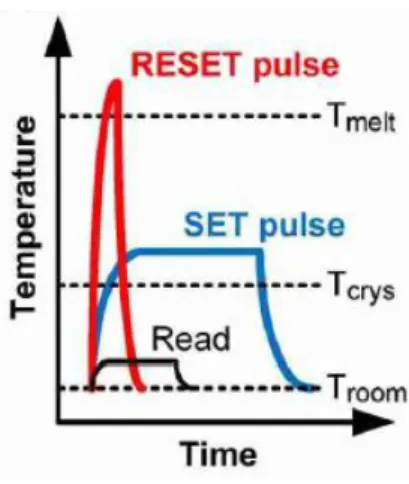
crys-talline by the current injection and the heating element. For a large number of times, the difference in resistivity is typically about five orders of magnitude [31], which can be used to represent the two logical states of binary data. As we can see in Figure 2.1[38], crystallizing the phase change material by heating it above the
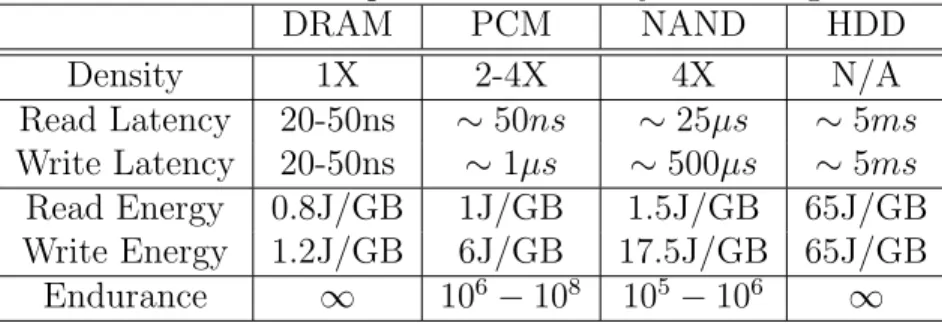
crys-Table 2.1: Comparison of Memory Technologies DRAM PCM NAND HDD Density 1X 2-4X 4X N/A Read Latency 20-50ns ∼50ns ∼25µs ∼5ms Write Latency 20-50ns ∼1µs ∼500µs ∼5ms Read Energy 0.8J/GB 1J/GB 1.5J/GB 65J/GB Write Energy 1.2J/GB 6J/GB 17.5J/GB 65J/GB Endurance ∞ 106 −108 105−106 ∞
tallization temperature (∼ 300◦C) but below the melting temperature (∼ 600◦C) is called the SET operation. The SET operation will turn GST into the crystalline state which corresponds to the logic ‘1’. Then when continuously heated above the melting temperature, GST turns into the amorphous state corresponding to the logic ‘0’, which is called the RESET operation. Writes on phase change material will come down to the states switch, which incurs high operating temperature and further more latency and energy consumption. However, reads on phase change material just need to keep a much lower temperature, which can be faster and more energy saving.
We present a brief comparison on the properties between PCM and other lay-ers in the memory hierarchy, including DRAM, NAND Flash (Solid State Drives, NAND for abbreviation) and HDD (Hard Disk Drives). Table 2.1 summarizes the properties of these different memory technologies, as presented in recent work [6, 27, 5] and the data all corresponds to raw memory chips.
From Table 2.1, we can see that the PCM has promising characteristics. Com-pared to DRAM, PCM has a density advantage over DRAM which means more memory capacity within a same size chip and further a lower price per capacity. This cheaper price can lead to orders of magnitude of capacity larger within the same budget. Then the read and write performance is also very efficient. We can
see that the read latency of PCM is comparable to that of the DRAM. Although writes are almost an order of magnitude slower than that of DRAM, some tech-niques like buffer organization or partial writes could be used in algorithms design to reduce the performance gap. For NAND, the write on NAND should be based on pages and even though only small parts of a page are modified, the whole page need to be rewritten, which is called the erase-before-writes problem. NAND suf-fers from the erase-before-writes problem greatly and this issue caused the slow read and write speed directly compared to DRAM and PCM. Unlike NAND, PCM uses a totally different technology and it does not have the problem of erase-before-writes and thus supports random reads and erase-before-writes more efficiently. We can see that reads and writes on PCM are orders of magnitude faster than those of NAND and the endurance is also higher than that of NAND. In summary, in most aspects, PCM can be seen as a technology in the middle between DRAM and NAND Flash. Even though PCM has its own shortcomings but we believe that it will have a major role to play in the memory hierarchy, impacting system performance, energy consumption and reliability because of its promising features.
2.2
Positions in the Memory Hierarchy
In previous section, we talked about the technical specifications of the PCM nology and we did a comparison between the several commonly used memory tech-nologies. Now in this section, we want to talk about how to best integrate PCM into the existing memory systems, in other words, what is the proper position of PCM in the current memory hierarchy.
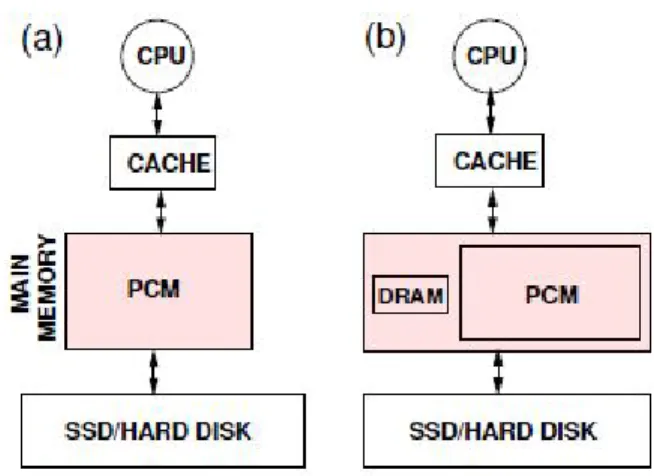
re-Figure 2.2: PCM Usage Proposals
search proposals on how to make use of PCM technology in the current memory systems. Among all of them, there are mainly two schools of thought [14, 27, 6] as shown in Figure 2.2[6]. One is to replace DRAM with PCM directly to achieve larger main memory capacity [14]. Even though PCM is slower than DRAM, Lee et al. [14] have shown that some optimizations like buffer organization and partial writes can be used to improve the system performance while preserving the high density and non-volatile property. The other proposal is to replace the DRAM with a large PCM and a small DRAM (3% - 8% size of the PCM capacity [27, 30]) and use the DRAM as a buffer to keep some frequently accessed data to improve the system performance. In this work, we will adopt the second approach, with the use of PCM as “extended” but slower main memory and we will use a small number of DRAM as a buffer.
2.3
Challenges to Algorithms Design
Now we are clear about the features of PCM. Then before we start to design algorithms, we need to know the major challenges we face and the major target we
want to reach.
From the technologies comparison in previous sections, we can find the following three challenges we need to overcome.
1. Slow writes. Even the read and write speed is much faster than that of the NAND, it is still a bit slower than DRAM which will influence the system efficiency greatly. This challenge is the major one we want to overcome in this thesis. The idea is a bit trivial that since the writes are slow, we want to avoid writes as many as possible.
2. High energy consumption. This challenge is related to the writes. We know that each time we want to write values to the PCM chip, we need to switch its state. Then we need to heat to switch the state of the phase change material which leads to high energy consumption. But for read, since we do not need to switch the state, the energy consumption is much lower.
3. Limited endurance. Existing PCM prototypes have a write endurance ranging from 106 to 108 writes per cell [6]. With some good round robin or write
leveling algorithms, a PCM main memory can last several years working time [26]. However, such kinds of algorithms should be conducted in the memory driver layer, which is not our main focus then.
From these challenges, we can find that actually if we want to make best use of PCM technology in our existing systems, the most important requirement is to figure out the challenge of high write latency. Our basic idea is that since the speed can not be raised physically, can we just avoid the writes as many as possible?
Then The design objective becomes how to reduce the number of writes in our new algorithms which is an widely studied topic, especially the algorithms designed
for NAND in recent years. However, our consideration is different from that of the algorithms design for NAND. For NAND, they want to avoid the erase-before-writes and thus they will mostly use the batch algorithms to convert random accesses to sequential writes. Our design consideration is different that we can support random writes efficiently but we want to reduce the number of writes including both random writes and sequential write as many as possible. Once the number of writes is limited, we can reduce the energy consumption and extend the life time as well.
2.4
Algorithms Design Considerations
Let us go back to our initial problem that we want to make best use of PCM in the existing database systems and we want to integrate PCM into the memory systems. Thus we considering the algorithms design, we need to be careful about the following design goals: (1) CPU time, (2) CPU cache performance and (3) energy consumption. Compared to DRAM, the major shortcoming of PCM is the high write latency. Then for general algorithms, the slow write speed should not influence the cache performance, it can only influence the CPU execution time and energy consumption performance. We also know that the PCM writes incur much higher energy consumption and is much slower than read. Then the major challenge we are facing now is how to reduce the number of writes as many as possible. Actually we have already had this basic direction in mind in previous sections.
Next the problem comes. We need a matric to measure the number of writes on the database algorithms level. In other words, we need to determine what
granularity of writes we need to use in the algorithms analysis using PCM as the main memory. Generally when analyzing algorithms for main memory, we need to consider two granularities including bits and cache lines. For the high level database systems, we have the buffer management and it is easier to count the number of cache line based writes. However, in order to simulate the energy consumption, we need to get the number of writes based on the bits granularity.
Then we can use a mixture of these two metrics. To evaluate the CPU time, we count the number of writes based on the cache line granularity and to evaluate the energy consumption, we first compare the new cache line to the old cache line to get the number of modified bits and get the energy consumption then based on the bits level. Since we have not got any PCM prototype, we need to build a simulated environment to evaluate our algorithms. These should be configured in our simulated environment.
2.5
Summary
In this chapter, we introduced the next-generation non-volatile memory technology. There are many kinds of popular non-volatile memory technologies and in this work, we will mainly focus on the phase change memory (PCM), but our algorithms can also be adaptive to other non-volatile memories having the similar features. We present the technical specification details of PCM and did a comparison among PCM and some commonly used memory technologies like DRAM, NAND and HDD about the major features. We found that PCM has its advantages, but there are also some challenges we need to overcome when designing algorithms for PCM-based database systems. Our main design goal is to avoid the slow writes as
many as possible, which further can reduce the energy consumption and extend the lifetime of PCM chips. Finally, we discussed about some metrics to evaluate our new algorithms.
Chapter 3
Literature Review
Database research community has contributed a lot to the algorithms design of the traditional database systems in the last several decades. Database system is also very complex and there are many components inside each of which can be worthy of lots of effort to work on. In this work, we mainly focus on the indexing technique and query processing algorithms. In this thesis, we have proposed a new design of
B+-treetechnique and we will leave the query processing to the future work.
In this chapter, we did the literature review, including the write-optimized indexing algorithms, traditional query processing algorithms and some recent PCM-based main memory system proposals. Since our indexing design has a prediction model, we also reviewed some works on histograms and how to use histograms to construct the prediction model.
3.1
Write-optimized Indexing Algorithms
In previous chapters we know that our main design goal is to reduce the number of writes, thus we first did a brief survey of the write-optimized indexing techniques.
We want to find out whether these existing techniques can be used to our new PCM-based systems or not and if they can not be used directly, whether we can borrow some ideas from them. Actually write-optimizedB+-treeindex has been an
intensive research topic for more than a decade. In this section, we will review the write-optimized indexing algorithms for HDD, SSD technologies and their design consideration is similar to ours, but there are also some differences. For HDD-based indexing, the proposed solutions are mainly focusing on using some DRAM buffer to convert small random writes into sequential writes. For SSD-based indexing, some of the proposed solutions change the major structure of B+-tree and some
solutions add an inner layer using SSD between DRAM and HDD, but their major design consideration is very similar and they expect to avoid the erase-before-writes as much as possible and they also expect to convert the small random writes into sequential writes in some sense.
3.1.1
HDD-based Indexing
For the B+-tree index on hard disks, there are many proposals to optimize the
efficiency of write operations and logarithmic structures have been widely used. In [21], O’Neil et al. proposed the LSM-tree to maintain a real-time low cost index for the database systems. LSM-tree (Log-Structured Merge-tree) is a disk-based data structure and it was designed to support high update rate over an extended period efficiently. The basic idea of LSM-tree is to use an algorithm to defer and batch the random index changes to reduce the disk arm movements. Some smaller components of LSM-tree will be entirely memory resident and the larger and major components will be disk-based. The smaller components resident in memory will be used as a buffer to keep the frequently referenced page nodes in the
larger components. The insertion to the memory resident component has no I/O cost and the larger component on disk is optimized for sequential disk access with nodes 100% full. This optimization is similar to that used in the SB-tree [22]. Both of them support multi-page reads or writes during a sequential access to any node level below the root, which can offer high-performance sequential disk access for long range retrievals. Each time when the smaller component reaches a threshold size near the maximum allotted, it will be merged into the large components on the disk. A search on the LSM-tree will search both the smaller components in the memory and the larger components on the disk. Then LSM-tree is most useful in applications where index insertion are more than searches, which is just the case for history tables and log files etc.
In [3], Lars Arge proposed the buffer tree for the optimal I/O efficiency. The structure of the buffer tree is very similar to that of the traditional B+-tree. The major difference is that in buffer tree, there is a buffer in the main memory for each node on the hard disk. When we want to update the tree, the buffer tree will construct an entry with the inserted key, a time stamp and an indication of whether the key is to be inserted or deleted and put the entry into the buffer of the root. When the main memory buffer of the root is full, it will insert the elements in the buffer downwards to its children and this buffer-emptying process will be done recursively on internal nodes. The main contribution of the buffer tree is that it is a simple structure with efficient I/O operations and can be applied to other related algorithms.
Graefe proposed a new write optimized B+-treeindex in [10] based on the idea
of the log-structured file systems [32]. Their proposals make the page migration more efficient and retain the fine-granularity locking, full concurrency guarantees
and fast lookup performance at the same time.
Most of the HDD-based write optimized tree indexing follow the following two idea. First, most of them want to convert the many random writes to batch se-quential writes to raise the efficiency; second, a small area of DRAM can be used as the buffer. For our design, we want to support both random and sequential writes efficiently, thus we cannot “hold” the random writes to a sequential write. But the idea of using DRAM as buffer can be used as well. In previous chapters, we have found out that a small area of DRAM buffer can make our system much more efficient.
3.1.2
SSD-based Indexing
Recently, there are some proposals on the write-optimized B+-tree index on SSDs
[1][15][39]. The major bottleneck of the B+-tree index for SSDs to overcome is the
rather slower small random writes because of the erase-before-write requirement. In [39], an efficientB-treelayer (BFTL) was proposed to handle the fine-grained updates of B-tree index efficiently. BFTL is introduced as a layer between file systems and FTL and thus there is no need to modify the existing applications. BFTL is considered as a part of the operating system. BFTL consists of a small reservation buffer and a node translation table. B+-tree index services call from
the upper-level applications are handled and translated from the file system of operation system to BFTL and then a block-based calls are sent from BFTL to FTL to do the operation. When a new record is inserted or updated to the B+
-tree, it will first be temporarily held by the reservation buffer of BFTL and then flushed in batch operation to reduce the writes latency.
for sensor networks using flash SSDs. The self-tuning B+-treeindex in the FlashDB
uses two modes, Log and Disk, to make the small random writes together on consecutive pages. TheB+-tree(Disk) assumes that the storage is a disk-like
block-device. The disadvantage is that updates are expensive. Even if only a small part of the node needs to be updated, the whole block needs to be written. ThusB+-tree
(Disk) is not suitable for write-intensive workload. B+-tree (Log) design is a log-structured-like indexing and it can avoid the high update cost of B+-tree (Disk). The basic idea is to construct the index tree as transaction logs. Updates will be put into buffer first and flushed into SSD when the buffer contains enough data to fill a page.
More recently, Li et al. [15] proposed the FD-tree which consists of two main parts, a head B+-tree in the DRAM and several levels of sorted runs in the SSDs.
Thus the basic idea is to limit the random writes to the small top B+-tree and then merge into the lower runs after they have been transformed into sequential writes. FD-tree modifies the basic structure of a traditionalB+-treeand their major contribution is to limit random writes to a small area and further raise the insertion efficiency.
For the SSD-based indexing, some of them tried to use the same idea of that of the HDD-based indexing. We can adopt the idea of using DRAM as a buffer. FD-tree is also efficient in some sense, but it modified the basic structure of theB+
-tree, which is not what we want. We want that our B+-tree can be easily adapted to the existing traditional database systems and thus we do not want to modify the main structure too much.
3.1.3
WORM-based Indexing
There are also some proposals focusing on the Write-Once-Read-Many (WORM) storage [16][25]. In [16], Mitra, Hsu and Winslett proposed a novel efficient trust-worthy inverted index for keyword-based search and a secure jump index structure for multi-keyword searches. In [25], Pei et al. proposed the TS-Trees and they also built the tree structure based on a probabilistic method. These WORM indexing proposals mainly focused on designing mechanisms to detect adversarial changes to guarantee trustworthy search. Unlike WORM indexing, in PCM-based indexing, we want to reduce the number of writes. Moreover, we can update the index and afford the small penalty of adjustments due to data movement if the prediction is no longer that accurate because of changes in data distributions over time.
3.1.4
PCM-based Indexing
The recent study [6] has outlined new database algorithm design considerations for PCM technology and initiated the research on algorithms for PCM-based database systems. To our best knowledge, this paper is the most relevant to our work until now. In the paper, Chen, Gibbons and Nath described the basic characteristics and the potential impact of PCM on the database system design. They presented analytic metrics for PCM endurance, energy and latency, and proposed techniques to modify the current B+-tree index and Hash Joins for better efficiency on the
PCM-based database system. Their idea is to unsort the keys in the node of B+ -tree which can reduce large number of writes. In our proposal, we will take a step further in this direction and design a PCM-aware B+-tree, called the Bp-tree and and will compare our Bp-tree with theirB+-tree.
3.2
Query Processing Algorithms
Query processing is an important part of the traditional database systems. The aim of query processing is to transform a query in a high-level declarative language (e.g. SQL) into a correct and efficient execution strategy. Different execution strategies can lead to much difference in execution efficiency. The traditional query processing algorithms include two types, one is heuristic-based query optimization and the other is cost-based query optimization. In heuristic-based query optimization, given a query expression, the algorithm will perform selections and projections as early as possible and it will try to eliminate duplicate computations. In cost-based query optimization, the algorithm will estimate the cost of different equivalent query calculator and choose the execution plan with the lowest cost estimation.
In this section, we will review the existing query processing algorithms. We mainly focus on two parts, the adaptive query processing and the recently proposed query processing for SSD-based database systems. This section of review will give us some inspiration about what to do in the future and we will discuss about it in detail in Chapter 7.
3.2.1
Adaptive Query Processing
In traditional query processing, the query optimizer can not have necessary statis-tics during the compile time, thus it may lead to poor performance, especially in long running query evaluations. Adaptive query processing addresses this problem and the idea is to adapt the query plan to changing the environmental conditions at runtime. In [12], adaptive query processing is defined as that if the query process-ing system receives information from its environment and determines its behavior
according to the information in an iterative manner, that means there is a feedback loop between the environment and the behavior of the query processing system. The research on adaptive query processing mainly lies on two main directions. One is to modify the execution plan at runtime according to the changes of the evalu-ation environment, the other is to develop new operators that has more flexibility to deal with unpredictable conditions. Then we will review some of the classical proposals on adaptive query processing.
Memory Adaptive Sorting and Hash Join
Memory shortage is a common design restriction for query processing techniques, especially for sorting and join since they need large amount of excess memory. In [24], Pang et al. introduces new techniques for external sorting to adapt to fluctuations in memory availability. Since memory buffer size can greatly influence the performance of sorting, memory-friendly management strategies need to be taken. [24] introduces a dynamic splitting technique, which adjusts the buffer size to reduce the performance penalty due to the memory shortages. The basic idea is to split the merge step of sorting run into some smaller sub-steps in case of memory shortages and when the memory buffer is larger, it will combine some small sub-steps into larger sub-steps. This adjust is adaptive and is balancing well. For hash join, [23] proposes partially preemptible hash joins (PPHJs) which is one kind of memory adaptive hash joins. The idea is similar to that of [24], they split the original relations and if the memory buffer is not enough, it will flush part of the partition to disk. The most efficient case for PPHJs is when the inner relation can be put in memory but the outer relation can only be scanned and partially put into the buffer. It can reduce both I/O and the total response time. [40] is also a
memory-adaptive sorting which is complementary to [24]. It allows many sorts to run concurrently to improve the throughput, while [24] focuses on improving the query response time.
Operators for Producing Partial Results Quickly
In most database applications, we focus on the total response time of all the results. But in some applications especially in online aggregation, it is important to get some of the results in a very short time and respond earlier while leaving the remaining process running at the same time. To this end, pipelining algorithms are used for the implementation of join and sort operators. Ripple joins [11] are a new family of physical pipelining join operators. They make use of both block nested loops join and hash joins. They target on online processing of multi-table aggregation queries in traditional DBMS. It is designed to minimize the time until an acceptably precise estimate of the query result is available, as measured by the length of a confidence interval. Ripple join comes from the nested loops join since it has an outer relation and an inner relation, the difference is that it adjusts the retrieve rates of tuples from these two input based on the statistical information during the runtime and reduce the response time of important part of the whole results. Xjoin [37] is a variant of Ripple joins. It partitions the input and thus requires less external memory, which makes it more suitable for parallel processing. [29] proposes another pipelining reorder operator for providing user control during long running, data intensive operations to get partial results during the process. The input of this operator is an unordered set of data and it can produce a nearly sorted result according to user preferences which can change during the runtime with an attempt to ensure that interesting items are processed first.
Algorithms that Defer Some Optimization Decisions until Runtime
Sometimes the statistical information gathered in the beginning of the query pro-cessing is not that accurate which can lead to a bad performance. There are some algorithms that defer some optimization decisions until they have collected enough statistics. [13] proposes an algorithm that detects sub-optimality in query plans at runtime, through on-the-fly collection of query statistics. It can improve the total performance by either reallocating resources (e.g. memory) or by reordering the query plan. It introduces a new operator called statistics collector operator which is used for the re-optimization algorithm. The algorithm is heuristics-based and relies heavily on intermediate data materialization. The new operator is inserted into the query plan, ensuring that it does not slow down the query by more than a specific fraction and also assigns a potential inaccuracy level of low, medium or high to the various estimates, which will be used in the following processing.
3.2.2
SSD-based Query Processing
Recently there are some research work on query processing for SSD-based database systems. In previous Section 3.1.2, we have said that the major design goal of SSD-related algorithms is to reduce the influence of the high write latency caused by the erase-before-write restriction. We will then review the following several proposals about query processing algorithms.
In [36], Graefe et al. focus on the impact of SSD characteristics on query processing in relational databases and especially on join processing. They first demonstrate a column-based layout within each page and show that it can reduce the amount of data read during selections and projections. Then they introduce
FlashJoin, which is a general pipelined join algorithm that minimized accesses to base and intermediate relational data. FlashJoin has better performance than a variety of existing binary joins, mainly due to its novel combination of three well-known ideas: using a column-based layout when possible, creating a temporary join index and using late materialization to retrieve the non-join attributes from the fewest possible rows. Then we focus on the details of FlashJoin algorithm. FlashJoin is a multi-way equi-join algorithm, implemented as a pipeline of stylized binary joins, each of which includes a join kernel and a fetch kernel. The join kernel computes the join and outputs a join index, which is used in the fetch kernel to do a late materialization, which only retrieves the needed attributes to compute the next join using RIDs specified in the previous join index. The final fetch kernel retrieves the remaining attributes for the result. The experiments show that FlashJoin significantly reduces memory and I/O requirements for each join in the query and raises the query performance greatly.
[35] propose RARE-join algorithm. They convert traditional sequential I/O algorithms to ones that use a mixture of sequential and random I/O to process less data in less time. To make scans and projection faster, they examine a PAX-based page layout [2], which arranges rows within a page in column-major order. Then they designed the RARE-join (RAndom Read Efficient Join) algorithm for the column-based page layout. RARE-join first constructs a join index and then retrieves only the pages and columns needed for computing the join result. The main idea of RARE-join is very similar to that of the FlashJoin. In [4], the authors show that many of the results from magnetic HDD-based join methods also hold for flash SSDs. Their results show that in many cases the block nested loops join over sort-merge join and grace hash join works well for SSD and they also propose
the idea that simply looking at the I/O costs when designing new flash SSD join algorithms can be problematic, because the CPU cost can be a big part of the total join cost in some cases. Their idea also tells us that we need to do a precise research on the new algorithms design and we need to consider all kinds of costs which can influence the main system performance in different aspects.
3.3
PCM-based Main Memory System.
Several recent studies from the computer architecture community have proposed new memory system designs on PCM. They mainly focused on how to make PCM a replacement or an addition to the DRAM in the main memory system. Al-though these studies mainly focused on the hardware design, they provided us the motivation on the use of PCM in the new memory hierarchy design for database applications.
The major disadvantages of the PCM for a main memory system are the limited PCM endurance, longer access latency and higher dynamic power compared to the DRAM. There are many relevant studies addressing these problems [27, 41, 14, 26]. In [27], Qureshi, Srinivasan and Rivers designed a PCM-based hybrid main memory system consisting of the PCM storage coupled with a small DRAM buffer. Such an architecture has both the latency benefits of DRAM and the capacity benefits of PCM. The techniques of partial writes, row shifting and segment swapping for wear leveling to further extend the lifetime of PCM-based systems have been proposed to reduce redundant bit-writes [41, 14]. Qureshi et al. [26] proposed the Start-Gap wear-leveling technique and analyzed the security vulnerabilities caused by the limited write endurance problems. Their proposal requires less than 8 bytes of
total storage overhead and increased the achievable lifetime of the baseline system from 5% to 50% of the theoretical maximum. Zhou et al. [41] also focused on the energy efficiency and their results indicated that it is feasible to use PCM technology in place of DRAM in the main memory for better energy efficiency. There are other PCM related studies such as, [33] focusing on error corrections, and [34] focusing on malicious wear-outs and durability.
Many of the studies in computer architecture community focus on the lifetime issue of PCM technology which is in a lower level consideration. This is the reason why we do not focus on the wear out problem in our proposal. This issue should be addressed in the PCM driver level and what we want to do is about the upper level database system algorithms.
3.4
Prediction Model
In this section, we will review the traditional prediction model based on the his-togram since we need an accurate prediction model in our proposal for indexing algorithms.
Prediction has always been an extremely important activity and it is an impor-tant research topic in statistical theory and it is a big business. The basic idea of prediction is to predict the future value or distribution of a random variable (RV). The probability distributions of many RVs encountered in practice are subject to changes over time and thus it is well known that the fundamental goal of predict-ing is actually to update the probability distribution based on the present and past information.
vari-able. We divide the observed range of variation of the RV into a number of value intervals and the relative frequency of each interval is defined to be the proportion of observed values of the RV that lie in that interval. We define the relative fre-quency in each value interval Ii is the estimate of the probability pi that the RV
lies in that interval.
Let I1, ..., In be the value intervals with u1, ..., un as their midpoints and p =
(p1, ..., pn) is the probability vector of the distribution of RV. Then we can get µ
and σ as the estimates of expected value µand standard deviation of the RV.
µ= n X i=1 uipi, σ= v u u t n X i=1 pi(ui−u)2 (3.1)
Then we can define the most commonly used probability distribution in deci-sion making, the normal distribution. It is completely specified by the above two parameters. It is symmetric around the mean and the probabilities corresponding to the intervals [µ−σ, µ+σ], [µ−2σ, µ+ 2σ], [µ−3σ, µ+ 3σ] are 0.68, 0.95, 0.997 respectively.
In our prediction model in practice, the probability distributions of RVs may change with time. For example, the distribution of the values inserted into theB+
-tree may change with time. We want to capture all the dynamic changes occurring in the shapes of probability distributions from time to time and the traditional method is not adequate anymore.
In [19], Murty proposes to represent probability distribution by the traditional distributions to make all changes possible. When updating the distribution of RV, we can change the values of any pi which makes it possible to capture any change
distri-bution vector p1, ..., pn, they add the recent histogram f1, ..., fn and the updated
distribution x1, ..., xn.
f = (f1, ..., fn) represents the estimate of the probability vector in the recent
histogram, but it is based on the most recent few observations (for example 50). p= (p1, ..., pn) is the probability vector in the traditional distribution at the previous
updating. x= (x1, ..., xn) is the updated probability vector which can be obtained
by incorporating the changing trend reflected in f into p. In [18], the authors proposed to compute x fromp and f using the following formula.
x=βp+ (1−β)f (3.2)
In equation 3.2, β is a weight between 0 and 1 and they found that β =0.8 or 0.9 works well for the model.
We can find that the basic idea of Murty’s proposal is to combine the latest change trend of the data distribution into the current distribution to better predict the future distribution. Since they will keep updating the trend vector, the pre-diction will keep changing based on the current distribution changing trend which makes the prediction more accurate. Their work may be helpful to our prediction model to predict the future inserted values into the B+-tree.
3.5
Summary
In this chapter, we did a comprehensive literature review on the related topics to our problem. Since we want to design a write-optimized indexing technique, we first reviewed some of the existing write-optimized indexing techniques for other memory technologies based database systems. Then we reviewed the typical query
processing algorithms which can be useful for our future work. After that, we talked about the recent research proposals on the PCM-based memory systems design. We have the similar challenges but we are doing the job on a different level and thus our major focus is a bit different. But some of the basic ideas coming from the computer architecture community can also be used by our design. Lastly, we did a brief review about prediction model since we need to use a prediction model to predict the future database distributions in our design.
Chapter 4
Predictive B
+
-Tree
In previous chapters, we introduced the background information about phase change memory technology and the algorithms design consideration for PCM-based database systems. From this chapter, we are going to present the design of our predictive
B+-tree, the Bp-tree. The purpose of our Bp-tree is to reduce the number of writes of traditional B+-tree while keep the insert and search performance at the same time. Our basic idea is to reduce the number of node splits caused by being full since node splits are a major source of the unnecessary writes of keys. As there are many B+-tree variants in database research community, for simplicity, in our
work, we will use the standard B+-tree and our techniques can be easily extended
to other variants.
4.1
Overview of the
B
p-tree
In this section, we will introduce the basic concept of Bp-tree. We first talk about
the design principle of Bp-tree and then we present the basic idea of Bp-tree. The idea itself is very simple but we need to be very careful to make the tree balance
and stable.
4.1.1
Design Principle
Our goal is to reduce the number of writes for data insertions and updates, without sacrificing the performance of search queries. We have seen that there are many traditional methods to do write optimization and we can borrow the DRAM buffer idea. For our own design, we want to reduce the number of writes in the following two ways. First, we adopt the Unsorted Leaf strategy in [6]. Essentially, newly inserted keys are simply appended to the end of the key entries. As such, they are not necessarily in sorted order which may reduce large amount of writes. Hence, the search cost may incur additional overhead as all entries within a leaf node have to be examined. But since we now consider the main memory algorithms design and we want to set the size of the node to several cache lines’ size, this additional overhead will not be that much. Second, we develop a scheme that minimizes data movement caused by node splits and merges. We have present in the previous sections that the splits and merges are the major source of many additional writes required. If we can reduce the number of splits, the performance can be greatly raised. But in the traditional B+-tree, the algorithm is very stable that only when the node is full, the split happens. Or only when the node becomes “underflow” because of deletion, we merge the sibling nodes. Now we want to reduce these operations, we need to “break” some of the existing rules. For the remainder of this thesis, we shall focus on reducing the number of node splits and merges, which is the main motivation for designing theBp-treeand we will talk about more details
4.1.2
Basic Idea
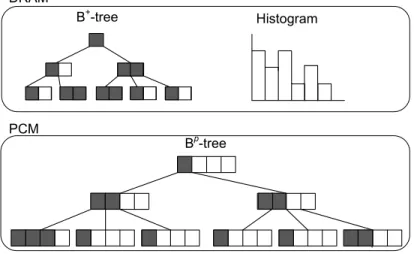
The general idea is to predict the data distribution based on the past insertions and pre-allocate space on PCM for accommodating future tree nodes, which can reduce the key movements caused by node splits and merges. At the same time, it is possible to fail some of the basic balance properties of B+-tree, but we will adopt some strategies to ensure the balance property and make sure that the difference will not influence the performance. Figure 4.1 illustrates the main architecture of a Bp-tree. We use the following techniques to implement a Bp-tree.
DRAM Buffer
We use a small DRAM buffer to maintain a small B+-tree for current insertions. We also record the summary of previously inserted keys in a histogram and use them to predict the structure of the Bp-tree. If the buffer is full, we will merge it
into the Bp-tree on PCM.
Bp-tree on PCM
Like a standardB+-tree, aBp-treeis also a balanced multiway search tree. The key
differences between the Bp-treeand the B+-tree include:
1. The structures and nodes in a Bp-treecan be pre-allocated.
2. Given a branching factor 2M of aBp-tree, the number of children of an internal
node may be smaller than M. and the real number of children is between [0,2M].
4. The tree construction process consists of two phases: (i) warm-up phase: The firstN keys are initially inserted into the tree as a warm-up process; (ii)
update phase: All new keys are first inserted into a DRAM buffer. Each
time the buffer is full, the keys in DRAM would be merged into the main tree on PCM. For a search query, we will find them from both theB+-treein
DRAM and the Bp-treein PCM.
Predictive Model
Predictive model is a very important component in our Bp-tree. Each time we
want to merge the smallB+-treeon DRAM to PCM, we need to use the predictive
model. If the model is too sparse, it may lead to many more nodes and the nodes utilization is very low. If the model is too strict, the influence of the our strategy may be not that obvious and our Bp-tree becomes similar to the traditional B+ -tree. Thus an accurate predictive model is very important to our design and we also proposed some strategies to guard the prediction model in order to make it work properly. Currently in our predictive model, we use the histogram and we can get better predictive model for better performance in the future.
4.2
Main Components of
B
p-tree
In this section, we will describe the details of the construction process of a Bp-tree.
It consists of two phases, namely the warm-up phase and update phase, which will be described in Section 4.2.2 and Section 4.2.3 respectively.
For ease of presentation, we summarize the notations used throughout this paper in Table 4.1.
PCM DRAM
Bp -tree
B+-tree Histogram
Figure 4.1: Bp-treearchitecture
Table 4.1: Notations Parameter Description
h Height of the Bp-treeand B+-tree
2M The branching factor of the Bp-tree
on PCM
2m The branching factor of the B+-tree
on DRAM
K M divided bym(Kis an integer and K ≥1)
Bi The i-th bucket
ni Number of entries in the i-th bucket
4.2.1
DRAM Buffer
As new keys are inserted into the the DRAM buffer continuously, a small standard
B+-treewith branching factor2m is built in the DRAM buffer. If the buffer is full,
we will flush the keys in the B+-tree to the Bp-tree on the PCM.
To capture the data distribution, we also maintain a histogram. Suppose the range of the keys is [L, U]. If we want to partition the keys into buckets B1, B2,· · · , B|B|, the bucket width is U−L|B| . For each bucket Bi, we maintain the
to “forecast” the data distribution (Section 5.1).
The main function of DRAM buffer is to adaptively adjust our predictive model based on the currently inserted keys in a time window. Then we can use the updated predictive model to merge all the keys in the time window in the B+-tree to the
Bp-tree on PCM.
4.2.2
Warm-up Phase
Initially, the Bp-tree on PCM is empty. We use a DRAM buffer for warm-up. We
create a standard B+-tree for supporting insertions, deletions and search. Before the buffer is full, we use the conventionalB+-treefor the initial operations. For the first time that the DRAM buffer is full, all the keys in the buffer will be moved to the PCM, and this step is called the warm-up process. The main function of the warm-up phase is to construct the skeleton of the Bp-treeon PCM.
Suppose the DRAM buffer can accommodate N keys. We first predict the to-tal number of possible keys. Then, for each B+-tree node, we use our predictive
model to decide whether to split it in an eager manner to avoid writes for subse-quent insertions. We will provide the details for constructing the initial Bp-tree in Section 5.1.
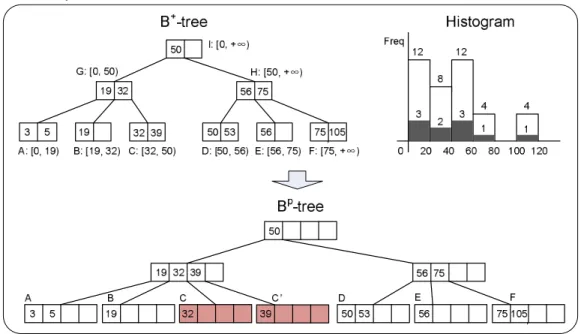
Figure 4.2 shows an example for the warm-up phase. TheB+-treeand histogram
are in the DRAM and Bp-tree is in the PCM. In this example, N is 10 and the
buffer is full and thus we need to flush all the keys in the B+-treeto the PCM. The
black portion of the histogram bar indicates the number of inserted keys in each range so far, while the whole bar indicates the predicted number of keys in each range based on our predictive model. From this figure, we can observe that the structure of the Bp-tree is similar to that of the original B+-tree. However, there
Figure 4.2: An example of a warm-up phase
are two key distinctions. First, the node could be split in an early manner if it meets the requirement of node splits. Second, some of the nodes could underflow
due to either an enlargement of the node size or an early split. These are guided by our predictive model and tree construction strategy. In the example, node C in the B+-tree is split into node C and node C0 when it is moved to the Bp-tree, nodes B and E underflow because of the enlargement of the node size, while node C and node C0 underflow because of the early split. Details about the early split algorithm will be presented in Section 5.1.
4.2.3
Update Phase
After the warm-up phase, we have a Bp-tree structure on the PCM. Then for new
operations, we use both the DRAM buffer and Bp-tree to handle the operations.
Figure 4.3: An example for update phase
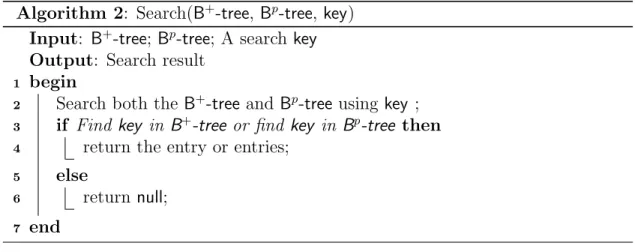
from both the B+-treeon DRAM and the Bp-tree on PCM. If we find it, we return
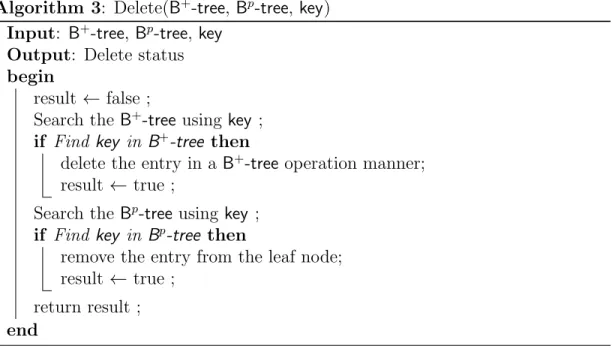
the answer; otherwise we return “null”. (Section 5.2.1). For delete, we search it from both the B+-tree and the Bp-tree. If we find it, we remove it from the B+
-tree and the Bp-tree (Section 5.2.2). However, even if a node “underflows” after
deletions, we do not merge it with its siblings. The reason is that since the read latency of PCM is much less than the write latency, the overhead caused by empty nodes during query processing is negligible. Furthermore, space could be reserved for future insertion keys to reduce subsequent writes. For update operation, like other indexes, we treat it as a deletion operation followed by an insertion. The deletion operation does not need to be buffered, while the following insertion needs to be buffered first like the standard insertion operation on the Bp-tree. Note that
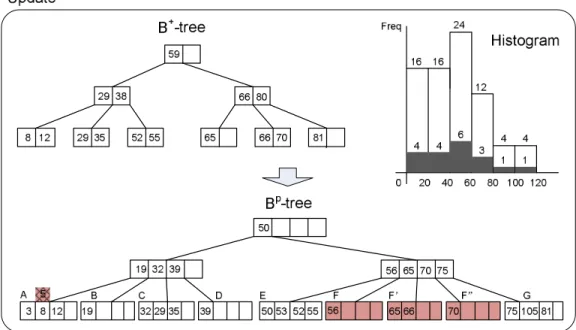
we need to update the histogram for the insertion and deletion operations. If the DRAM buffer is full, we need to merge the B+-treeinto the Bp-tree(Section 5.2.3). Figure 4.3 shows an example for update phase affected on the earlier example
described in Figure 4.2. The case in Figure 4.3 is that the buffer is full for the second time and all the keys in the B+-tree are merged into the Bp-tree described
in Figure 4.2. In this example for the update phase, we want to delete the key 5 in the Bp-tree index from Figure 4.2. First, we search the B+-tree in the buffer
and cannot find it. Then we search the Bp-tree on the PCM and find it in node
A and subsequently remove it from the Bp-tree. As can be seen from the figure, the histogram is updated to reflect the effect of this deletion and the new round of prediction is performed based on all the keys inserted currently including the keys in the buffer. Node F in the Bp-tree is split because of the similar reason as that
of the node C in Figure 4.2. We will describe the details in Section 5.2.
4.3
Summary
In this chapter, we introduced our Bp-tree. We present the design principle and
basic idea of Bp-tree. We know that there are two major parts of Bp-treeincluding
the DRAM buffer and the normal B+-tree on PCM. When new keys are inserted
into the Bp-tree, there are two phases. First, the new key is inserted into the small
B+-treeon the DRAM buffer, when the DRAM buffer is full for the first time, we merge the whole tree to PCM and construct the skeleton of the tree on PCM based on the predictive model. After that each time when the DRAM is full, we will merge the tree to the existing B+-treeon PCM. During the construction, the node
of our Bp-tree may be “underflow” which is different from the traditional B+-tree.
The reason is that sometimes we want to split the node in advance based on the prediction model even the node is not full. In our design, even some nodes may be “underflow”, we will still use some strategy to ensure that the whole tree is in
a good shape. We will talk about the details about the prediction model and the construction process in next chapter.
Chapter 5
Predictive Model
In this chapter, we are going to present the predictive model which is a key part of our design. In the previous chapter, we have known that there are two major phases in our Bp-tree, both of which will be based on this predictive model. Thus in this chapter, we will talk about how we construct the predictive model and use it in these two phases. We also know that the accuracy of the model is critical to the performance of the whole indexing and thus we will present our strategy to evaluate the realtime status of the predictive model and make adjustment to make it work properly. There will be three major parts of this chapter including the predictive model for warm-up phase, predictive model for update phase and evaluating Bp-tree.
5.1
Predictive Model for Warm-up
In this section, we introduce a predictive model to construct a Bp-tree structure
in the warm-up phase. We will present running examples to show what the pre-dictive model is and how it is integrated into our Bp-tree. We first discuss how to
predict a Bp-tree skeleton (Section 5.1.1), and then propose to construct a Bp-tree
(Section 5.1.2).
5.1.1
Predicting the
B
p-tree
Skeleton
Suppose there are N keys in the DRAMB+-tree, the height of theB+-treeish, and
the branching factor is 2m. The Bp-tree has the same height as the B+-tree, but
with a larger branching order 2M =K∗2m, where K is an integer and K ≥1. K can be set by the administrator. We can also predict K as follows.
Let T denote the total number of possible keys in the whole dataset. We estimate T using the numbers of keys in the histogram. Suppose the maximal number of keys in a bucket is A and the bucket width isW = U−L|B| , thus there are at most W keys in a bucket. We use N×W
A to predict the possible key numberT.
As there are T keys in Bp-tree and N keys in B+-tree, we set K = log h
T N.
Obviously, if we overestimateK, the Bp-tree will turn out to be sparse; on the
contrary, if we underestimate the number, we may need to do more splits. We assume that each tree node in the final Bp-treeis expected to be µ% full, i.e., each
leaf node has E =µ%×2M keys. Thus thei-th level is expected to have Ei nodes (the root is the first level, which has only one node).
After we got the number K, we can build the skeleton of the Bp-tree, in other
words, we are going to enlarge the size of each node in the tree byK, in which case, there may be many “underflow” nodes. But we will not worry about this and we will gradually insert keys into these nodes and raise the average node utilization.
5.1.2
B
p-tree
Construction
In this section, we discuss how to construct theBp-treebased on the currentB+-tree
structure. We traverse theB+-treein post-order. For each node, we predict whether we need to split it based on our predictive model (which will be introduced later). If we need to split it, we split it into two (or more) nodes, and insert separators (or keys) into its parent node, which may in turn cause the parent node to be split. Following this approach, the process will continue to spread to the whole tree. As we employ a post-order traversal, we can guarantee that the child splits are before the parent split, and our method can keep a balanced tree structure.
Next we discuss how to split a B+-tree node. For ease of presentation, we first introduce a concept.
Definition 5.1 (Node Extent) Each node n in the index tree is associated with
a key range [nl, nu], where nl and nu are respectively the minimum key and the
maximum key that could fall in this node. We call this range the extent of the node.
The extent of nodeAandB of theB+-treein Figure 4.2, for example, are [0,19) and [19,32) respectively. If a node is not the leftmost or the rightmost child of its parent, we can get its extent from its parent (except for the root node); otherwise we need to determine it from its ancestors. In practice, we need to update this information each time we split or merge nodes and we also need to consider this overhead in the evaluation.
Consider aB+-treenodenon thei-th level. Suppose its extent is [key
min,keymax]
and currently it has |n| keys, key1, key2, · · ·, key|n|. We access the keys in order. Suppose the current key is keyj. We next discuss whether to split the node