Scientific quarterly journal ISNN 1429-7264
Agricultural Engineering
2 014 : 2 (150 ):3 1 -37 Homepage: http://ir.ptir.org
IMPLEMENTATION OF PRECISE FARMING TECHNIQUE
ON THE EXAMPLE OF A MULTI-SURFACE AGRICULTURAL FARM Andrzej Borusiewicza∗, Krzysztof Kapelab
aFaculty of Computer Studies, The Academy of Agrobusiness in Łomża
bDepartment of Agronomy Siedlce University of Natural Sciences and Humanities
∗Contact details: ul. Studencka 19, 18-402 Łomża, e-mail: [email protected] A R T I C L E I N F O A B S T R A C T
Article history:
Received: October 2013 Received in the revised form: December 2013
Accepted: February 2014
An attempt to assess the use of modern technique in multi-surface agricultural farm and an attempt to compare the system of precise farming management with conventional was made. Based on the research, which was carried out, it was determined that the purchase cost of the precise farming devices will bring measurable advantages as soon as in the second year of use. Introduction of the precise
fertilization treatment and application of pesticides brought the hig
h-est savings in a farm. The use of the parallel move system in the investigated farm brings approx. 10% of savings in consumption of production means, that is, sowing material, fertilizers, pesticides and
fuel. Advantages arising from the use of precise farming application are estimated to account to approx. 37 PLN·ha -1 per year.
Keywords: precise farming, GPS, GIS, modern technologies
Introduction
Modern agriculture becomes a field of agriculture which is to a higher extent based on professional knowledge, ability to manage and apply information in the production process. Ability to process bigger amount of information related to implementation of new technol-ogies becomes a key for maintaining profitability of production and meeting requirements of protection of natural environment. The basic assumption of the precise farming system is adjusting production technology to specific conditions of environment including spatial variability of single fields. Precise farming is determined as a farming system which uses highly developed navigation and informatics technologies – satellite positioning systems (GPS – Global Positioning System) and methods of obtaining and processing spatial data (GIS – Geographic Information System), (Gozdowski et al., 2007). The basis for operation in the precise farming is collection of information on the natural variability of a given area, e.g. a field with precision to as much as 1 cm and using them to prepare precise agro-technical treatments e.g. fertilization or using pesticides. Preparing a digital map of re-sourcefulness and variability of soil is a precondition for implementation of precise farm-ing. In the recent years, precise farming is implemented more extensively for agricultural production in many countries, especially in the United States, Australia and other countries
of Western Europe. Significance of precise farming in Poland has been low so far. Howev-er, one may forecast that within several years, this farming system will be gradually popu-larized (Gozdowski et al., 2007; Dreszer, 2005). Implementation of these technologies to farming opened completely new possibilities in agricultural technology, providing basis for use in the field production of the so-called precise farming system (Doruchowski, 2005; 2008). Completely new generation of machines and work technologies with great participa-tion of electronics, computerizaparticipa-tion and satellite connecparticipa-tion systems has been created. It gives high time and energy savings (Narkiewicz, 2007; Turowski and Kapela, 2001). The Polish conditions indicate that there are many factors, which hinder more extensive popu-larization of the precise farming systems, including: high fragmentation of agrarian struc-ture, farmers' reluctance to associate in producer's associations, high prices of satellite navi-gation systems and machines (Minta, 2008).
Objective and methodology of research
The objective of this research was analysis of profitability of implementation of precise agriculture techniques on the example of large farms. Research was carried out in 2011 based on the direct survey and documents obtained from agricultural farm. The list of pur-chased devices was made and SWOT analysis was carried out. Calculations were made with the use of data analysis method. A farm takes a total area of ca. 4,000 ha (with leased land). A 4-year cycle of crop rotation is applied. The structure of crops: potatoes 1000 ha, grains 1850 ha (wheat 1000 ha, barley 700 ha, rye 150 ha), rape 850 ha, grass mixture 200 ha, maize 100 ha. The last two crops are intended for demands of own fodder production used in milk production (a herd of 300 dairy cows). Results obtained from implementation of the precise farming systems were compared with the results of conventional farming.
Research results and discussion
In the investigated farm, various techniques of precise farming are implemented. The first solution introduced in 2003 was collection of soil samples every 4 years in the system of points mesh with resolution of ca. 2 hectares. Simultaneous equipment of the device for collecting soil samples in GPS allows drawing maps of soil pH and phosphorus, potassium and magnesium content. Maps of content created with the use of AgroWin software, are mainly used for "manual" determination of fields with different pH and on this basis for differentiating calcium doses. Savings on this account are estimated to be ca. 15% of lower costs of fertilization consumption. The main reason for implementation of the fertilization system is searching for methods of levelling of potato tubers quality. The system for sup-porting parallel move GPS OUTBACK'S, mounted on tractors aggregated with fertilizer spreaders of Amazone company with a working width 24 and 36 cm has been used for improvement of precision of pre-sow use of fertilizers since 2006. Mineral fertilization is carried out with Amazone spreaders - suspended ZA-M Profis and connected ZG-B Drive. The latter spreads also calcium. All spreaders are equipped with Amatron drivers+, which may cooperate with Trimble devices. This system allows limitation of "underlaps" and spots where fertilizer was double applied and allows precise fertilization at night and at bad 32
weather conditions. Since 2005 a farm has crop meters mounted on Class Lexion 560 equipped with GPS. Maps of yielding of grains and rape are drawn with the use of AGRO-MAP programme. Presently AutoControl system is being tested in a farm, which enables constant analysis and optimization of the use of tractors in a farm. Possible implementation of the AutoControl system depends on possible financial savings, which will follow from its application. The costs of one transmitter/receiver amounts to PLN 3 thousand, a fixed charge for monitoring of one vehicle amounts to PLN 85 monthly. A farm owns 50 tractors, thus their control on the area of 4 thousand is impeded. Since 2001 a farm maintains a rec-ord of all cultivation treatments with the use of PlantPlus application. Such solution allows to quickly find both current and historic cultivation data.
The whole area of potato cultivation is watered with sprinkling machines of Pivot type and reel sprinkling machines Irydelta. Time limit and dose of water is determined based on precise measurements of soil moisture with the use of sonde Diviner 2000 by Sentek Sensor Technologies. At the average, in the vegetation season potatoes are irrigated with a dose of 100-120 litres of water per m2.
Planning works on fields, where potatoes are cultivated shall be started with placing reel and rotational sprinklers on them. In case of the first group, following their placing on a given plot, a direction for planting potatoes shall be determined.
Then, referential lines A-B for each field shall be determined. Thanks to these lines, 3 sets with tractors equipped with the system of automatic parallel move, whose operation is supported by RTK aerial of base station, which measure errors and send by radio the so-called correction to tractors which are in its scope (at the maximum 12-15 km), will be able to plant potatoes.
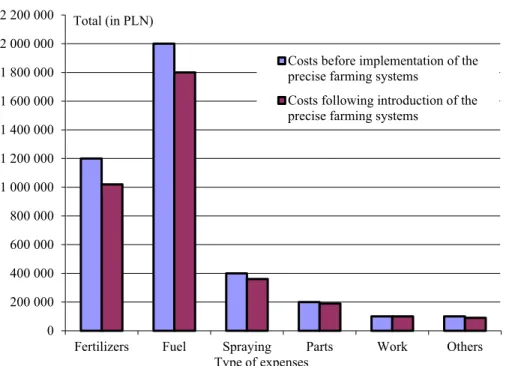
Due to the use of precise devices, a farm decreased annually its treatment costs. Pur-chase of RTK station and equipment for two tractors, which use a precise signal cost ca. PLN 170 thousand. However, according to calculations made by the farm manager, during work with cultivation machines of 6 m width, actual width of cultivation is approx. 5.40 m. With RTK station an effective width of the same equipment is 5.90 m. Calculating this difference by a farm area, average number of cultivation crossings, during operation with-out GPS, area of the so-called covers was approx. 1,000 ha. Due to RTK and elimination of covers during cultivation, a farm decreased annual costs from PLN 102 thousand to PLN 83 thousand. Besides the use of satellite navigation for planting and sowing it is also used for parallel crossing during reaping off the stubble field and sprinkling calcium. Then the trac-tor operatrac-tor, as during sowing, may concentrate on observing a tool and leaves tractrac-tor driv-ing to devices of automatic parallel move.
Trimble Autopilot systems are mounted on three tractors New Holland T7030 and they interfere through solenoid valves in their hydraulic steering systems. Moreover, sensors of turning AutoSense and centrals NavController II with compensation of vehicle tilts in three axes T3, which is formed by three couples of acceleration meters and gyroscopes measur-ing all machine movements 50 times per a second. It is indispensable for precise tractor driving, since an aerial on its roof does not reflect the axis location, which always has to be on the navigation line. Application of the described automatic parallel move for driving three tractors which pull the sets composed of active plough Baselier 4FKC380, a 4-row structural planter Miedema PM40 Structural and a ridge former Miedema AAK 4R allows planting 950 ha of potatoes within three weeks of work 24 hours a day (including approx. 250 ha of seeds plantations).
Table 1
GPS devices used in a farm (3,800 ha of annual plants)
Use
of a device of a device Name Purchase price (PLN) Estimated savings (PLN·year-1) Precise farming,
precise cropping Trimble Autopilot 100, 000 (35 PLN·ha133, 000 -1) Precise fertilization,
Precise use of pesticides Panele CFH, FmX plus VRA firmy Trimble 12, 000 23, 000 (50 PLN·ha190, 000 -1) Precise sowing
Precise farming, EZ –Steer, EZ- Guide 500 plus aerial 45, 000 (25 PLN·ha95, 000 -1) The increase of the quality
of signal RTK station 170, 000 Included above in agro-technical treatments
Total 350, 000 418, 000
Figure 1. Calculation of costs incurred by a farm before and after introduction of naviga-tion systems 0 200 000 400 000 600 000 800 000 1 000 000 1 200 000 1 400 000 1 600 000 1 800 000 2 000 000 2 200 000
Fertilizers Fuel Spraying Parts Work Others
Total (in PLN)
Type of expenses
Costs before implementation of the precise farming systems
Costs following introduction of the precise farming systems
Table 2
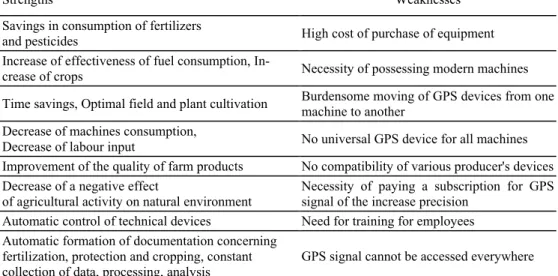
SWOT analysis
Strengths Weaknesses
Savings in consumption of fertilizers
and pesticides High cost of purchase of equipment
Increase of effectiveness of fuel consumption,
In-crease of crops Necessity of possessing modern machines
Time savings, Optimal field and plant cultivation Burdensome moving of GPS devices from one machine to another Decrease of machines consumption,
Decrease of labour input No universal GPS device for all machines Improvement of the quality of farm products No compatibility of various producer's devices Decrease of a negative effect
of agricultural activity on natural environment Necessity of paying a subscription for GPS signal of the increase precision Automatic control of technical devices Need for training for employees
Automatic formation of documentation concerning fertilization, protection and cropping, constant
collection of data, processing, analysis GPS signal cannot be accessed everywhere Table 3
Chances and threats related to implementation of precise farming
Chances Threats
Increase of the demand for services related to collection, management and interpretation of data
Without a good understanding of data interpretation and equipment compatibility, there is a threat that full advantages from GPS use will not be executed
Development of local training institutions No GPS signal within a specific period may lead to delays in a correct execution of agricultural treatments There is a need to create a friendly-user
application for interpretation of various layers of spatial data in agronomic solutions
Relation to GPS signals, loss of some traditional skills at the operation of machines, such as ability to drive mechanical vehicles in a straight line without the use of technology
Increase of income from agricultural production
Spatial technology may help in development of ma-chines, robots, potentially reducing demand for work and costs of human errors, but it also may lead to the loss of human operators of machines in rural societies Size of acreage, in conditions, in which introduction of precise farming is economically justified depends on many factors, such as: applied technologies, cultivated plant species and produce and production mean prices (Gozdowski et al., 2007). In the researched farm, amortization of equipment is assumed for 10 years, whereas, savings from the use of pre-cise farming techniques is estimated at the average of approx. PLN 37 ha-1 per a year (table
1). Godwin et al. (2003), analysed the area from which the use of precise farming technolo-35
36
gy will bring income and they provide 250 ha for a complex equipment in indispensable devices, additionally assuming the increase of crop by 0.25-1.6 t·ha-1. However, these are conditions which differ many times from existing conditions of farming in Poland. The use of the parallel move system brings ca. 8% of savings in consumption of production means, that is seeds, fertilizers, pesticides and fuel, whereas in the researched farm, these savings are at the level of ca. 10%. This difference probably follows from the highest level of preci-sion of the system, applied in this farm and from the possespreci-sion of big-area fields, where effective operation of the set of machines is longer.
Conclusion
Based on the research which was carried out, it was determined that the purchase cost of the precise farming devices, in the investigated farm will bring measurable advantages as soon as in the second year of use. Introduction of the precise fertilization treatment and application of plant protection substances brought the highest savings in a farm.
In Poland there are more and more businesses which render services of precise farming. A farmer before taking up a decision on the selection of the equipment or a service compa-ny, should carry out a precise analysis of the selection of equipment, since savings from implementation of the precise farming systems may be ostensible, which is confirmed by the research of Šařeca et al. (2009).
References
Doruchowski, G. (2005). Elementy rolnictwa precyzyjnego w ochronie roślin. Inżynieria Rolnicza, 6(66), 131-139.
Doruchowski, G. (2008). Postęp i nowe koncepcje w rolnictwie precyzyjnym. Inżynieria Rolnicza,
9(107), 19-31.
Dreszer, K. A. (2005). Globalny system pozycjonowania i możliwości wprowadzenia go w polskim rolnictwie. Inżynieria Rolnicza, 10(70), 57-63.
Godwin, R.J. et al. (2003). An economic analysis of the potential for precision forming in UK cereal production. Biosystems Engineering, 84(4), 533-545.
Gozdowski, D.; Samborski, S.; Sioma, S. (2007). Rolnictwo precyzyjne. Wydawnictwo SGGW, War-szawa.
Hansen, J. G. (1995). Meteorological dataflow and management for potato late blight forecasting in Denmark. SP Report. Danish Institute of Plant and Soil Science, 10, 57- 63.
Minta, S. (2008). Rolnictwo precyzyjne jako nowoczesny sposób podniesienia konkurencyjności gospodarstw rolniczych – aspekty ekonomiczne i środowiskowe. Stowarzyszenie Ekonomistów Rolnictwa i Agrobiznesu, t. X, Z. 3,403-406.
Narkiewicz, J. (2007). GPS i inne satelitarne systemy nawigacyjne. WKiŁ Warszawa.
Šařec P., Šařec O., Klain P. (2009). Monitorowanie wykorzystania ciągnika – bezprzewodowa trans-misja danych. Inżynieria Rolnicza, 9(118), 227-234.
Turowski, J.; Kapela, K. (2001). Możliwość wykorzystywania globalnego systemu pozycjonowania w rolnictwie. Inżynieria Rolnicza, 1(21), 333-338.
Zimny, L. (2007). Definicje I podziały systemów rolniczych. Artykuł problemowy. Acta Agrobotani-ca, 10(2), 507-518.
WDROŻENIE TECHNIK ROLNICTWA PRECYZYJNEGO
NA PRZYKŁADZIE WIELKOPOWIERZCHNIOWEGO
GOSPODARSTWA ROLNEGO
Streszczenie. W pracy podjęto próbę oceny zastosowania nowoczesnych technik w wielkop o-wierzchniowym gospodarstwie rolnym oraz porównania systemu gospodarowania rolnictwa
precy-zyjnego do konwencjonalnego. Na podstawie przeprowadzonych badań stwierdzono, że koszt zakupu urządzeń zwrócił się w drugim roku jego użytkowania. Największe oszczędności w gospodarstwie przyniosło wdrożenie zabiegu precyzyjnego nawożenia oraz stosowanie środków ochrony roślin. Miało to również swoje odbicie wmniejszej ilości zużytego oleju napędowego. Stwierdzono, że
minimalna powierzchnia gospodarstwa, od jakiej stosowanie technologii rolnictwa precyzyjnego przyniesie dochody wynosi 310 ha. Korzyści płynące z precyzyjnego gospodarowania szacuje się na
ok. 75 PLN·ha-1.
Słowa kluczowe: rolnictwo precyzyjne, GPS, GIS, nowoczesne technologie