Digital Customer Experience:
A customer Perspective
.
Master's thesis
Business Management and Entrepreneurship 2018 Visamäki, February 2020
1 ABSTRACT
Business Management and Entrepreneurship 2018 Visamäki
Author Adamu Haruna Year 2020
Subject
Digital Customer Experience:
A Customer Perspective
Supervisor(s) Pasi Laine
ABSTRACT
This thesis examines digital customer experience from a customer perspective. While different companies are at different phases of the digitalization, there have been several digitalization frameworks proposed by academics and the industries based on researching these companies. One key or core element in digitilisation frameworks proposed by these research studies is “UNDERSTANDING” the customer. Companies have therefore substantially invested in infrastructure to collect customer indirect data to understand the customer. However, there is no view or research on customers own perspectives and experiences. For example, how customers feel going through this digital transformation and the impact the availability of digital technologies has on their behaviours , actions and experiences.
This thesis examines and review the patterns of these industry frameworks (referred to in this document as the organisational perspective) to validate the different findings in earlier studies. More importantly the thesis
2 conducts research by method of survey, on customer perspectives , feelings, behaviour and actions as the customers go through the customer experience journey in the digital world (referred to in this document as customer perspective). In merging the organisational and customer perspectives of digital customer experience journey , some of the key findings of this thesis were that the industry current approach, which is mostly based on collecting inferred data, does not give 360 view and holistic understating of customers. The reason being the difficulty in predicting customers behaviour and leanings with decent accuracy due the various changing factors enabled by advanced technologies such as access to information and choices, and the effect of customer virtual platforms i.e. networks of networks of people.
A summary of recommendation in this thesis to address some of these key findings and gaps are to develop a culture, infrastructure and capability that makes customer a stakeholder, with corresponding inputs and benefits, in the whole digital customer experiences journey and processes.
Keywords Customer experience, Operational process, business model, Relation Management, Digitalisation, Customer experience journey
3
CONTENTS
1 INTRODUCTION ... 5
2 BACKGROUND... 6
2.1 Digital Transformation and Customer Experience ... 6
2.2 Customer Experience ... 8
3 THESIS OBJECTIVE ... 10
4 THEORETICAL FRAMEWORK ... 11
4.1 Qualitative and Quantitative Research ... 11
4.2 Research Context ... 12
4.3 Thesis Approach ... 12
5 RESEARCH METHODOLOGY ... 13
5.1 Data Collection ... 15
5.2 Analysis and Result ... 16
5.3 Validity and Reliability ... 16
6 LITERATURE REVIEW ... 17
6.1 Customer Experience Theory ... 17
6.1.1 Customer Experience Principles ... 19
6.1.2 The Physical Customer Experience ... 21
6.1.3 The Emotional Customer Experience ... 24
6.1.4 Building a complete Customer Experience... 27
6.2 Managing Customer Experience and Relationships... 29
6.2.1 Principles of Managing Customer Experience and Relationships ... 34
6.2.2 A model for managing Relation and Improving Customer Experience . 38 6.2.3 Measuring and Managing ... 41
6.2.4 The Fundamentals of Customer Relationship and Experience ... 44
6.3 The Evolution of Digital Customer Experience... 46
6.3.1 Emergence of the new customer new voice ... 46
6.3.2 Customer information business model (organisation perspective) ... 48
6.3.3 customer information business model (customer perspective) ... 51
6.3.4 Engaging Tomorrow’s Customer ... 58
6.3.5 Adapting for Tomorrow’s Customer... 59
7 EMPIRICAL STUDY ... 61
7.1 Organisational Perspective Research Review ... 61
7.1.1 Customer Experience Shapes Digital Transformation: ... 63
7.1.2 Transforming operational processes: ... 67
7.1.3 Transforming business models ... 69
7.2 Organisational Perspective Results Discussion ... 70
4
7.3.1 Survey Background ... 71
7.4 Survey Results Discussion ... 72
8 ANALYSIS 87 8.1 Organisation Perspective Analysis ... 87
8.2 Survey Result Analysis ... 89
9 CONCLUSION AND RECOMMENDATION ... 93
9.1 Conclusion and Recommendations ... 93
9.2 Limitations and Future Research Opportunities ... 96
10 REFERENCES ... 98
5
1
INTRODUCTION
The mega trend for companies in almost all industries is towards digitalisation. Even though there are different levels and maturity of digitisation both at organisational and industry levels, i.e. whether debating to go digital, in the process of digitalisation or fully digitised, the general trend is solidly towards digitalisation.
However, as a starting point for digitalisation, there have been a lot of different perspectives and definitions of what is or constitutes digitalisation. For example, digitalisation is perceived to be the use of technology to radically improve the performance or reach of an enterprise (Western, Bonner & McAfee , 2014).
A simple view on digitalisation by (The Enterprise Project, 2017) starts with integration of digital technology into all areas of a business to fundamentally change how you operate and deliver value to customers. Others preferred to look at the digitalisation phenomena from a wholistic perspective that starts from understanding the customer/consumer better to digitizing the customer experience, then extending it to digitizing operations, products and services (Bender & Willmott, 2018; Cognizant, 2014; Capgemini & MITSloan, 2011).
There are have been significant literature on the different frameworks and paths on how to embark on digital business transformation (Cognizant, 2014). There is also abundant evidence of a global success of Digital native or digitally transformed companies in this modern era such as Uber, Lyft, Airbnb, Snapchat, Pinterest, Netflix, Google, Facebook, Amazon, Ali baba and Spotify(McKinsey Analytics, 2011)
The common element that appears in all the existing and proposed frameworks is the customer experience. The customer experience appears
6 either as digital customer experience or wholistic customer experience that include both digital and physical. For example, in (cognizant, 2014) , customer experience is the fundamental strategic element to build the whole digital transformation. While (Capgemini & MITSloan, 2011) has customer experience as one of the four fundamental elements to address in building a digital transformation.
This thesis intends to focus on digital customer experience. Furthermore, an area of digital customer experience that is interesting to explore in this study is the experience from customer perspective and not the perceived customer experience analysed by organisations.
2
BACKGROUND
This section describes the general background in digitalisation and customer experience.
2.1 Digital Transformation and Customer Experience
In today’s digital world ,the rule of customer engagement and experience are changing due to digital disruptive forces . Businesses are beginning to adapt to these new dynamics to raise the bar in customer service and experience to differentiate from competitors. The battleground for customers has been so competitive and complicated due to digital disruptive forces that are creating new context in the market environment. Some of the notable driving forces behind this new context , which business must adapt to continue to acquire and retain customers are
• The rapid technological adoption increasing competitive environment • The low prices , intuitive usability and increasing connectivity of
7 cloud computing that are increasing technology adoptions and creating complex business opportunities and risks .
• Changing customers attitude and behaviour .
Customers are becoming less patience , less loyal , more demanding and eager to complain to exercise their power on online platforms. They also expect and demand transparency and corporate responsibility .
There is also increasing competitive environment in almost every market due low barriers of entry for online players, new business models, substitute products and increased customer bargaining power. New players such Facebook, Amazon, Google, Apple or other smaller ventures, are inventing new business models that resonates with customers in different industries and are therefore impacting and disrupting these markets.
It is therefore essential to recognise that the key and significant driver in the digital world changing dynamics is not the emergence of the new technologies but rather the shift in customer behaviour. Emerging technologies are accelerators to customer behaviour shift as companies explore creative ways to acquire and retain customers as new strategic and competitive asset.
The primary goal or driver for digital transformation for most companies across all industries have therefore always been customer experience and management i.e. reaching and engaging customers more effectively (Costellation, 2019).
Efforts to understand , service and manage long term relationships with customers are leading to thorough digital transformation of companies from customer service to managed customer journey, from resolving customer issues to building and nurturing customer communities. Organisations also needed to digitise their product making , processes & Systems , and their organisation structure to continuous evolve to meet the changing and shifting customer behaviour and demands( Cognizant, 2014)
8 According (Cognizant, 2014) research studies, by applying digital technologies such as mobile solutions, cloud and analytics, organisations tend to accrue benefits immediately such as efficiency, profitable business opportunities and address the customer experience challenges. However, some of the underlying issues with this approach is that companies do not capitalize on the availability of these technologies; either due to the complexity of the technology package or unaware of the potentials in these technologies. But the first and fundamental element in these initiatives is to understand the customer .
Understanding customer in the digital era goes beyond historical information about what products customers purchased but rather to have advance, predictive and insightful analytics about the customers profile, daily online behaviour, likes and affiliations of any kind. The complete mapping of customers digital footprint combine with the physical world gives the insight of customers preference to their buying habits(Capgemini & MITSloan, 2011).
2.2 Customer Experience
Organisations have always had the business goal of meeting customer expectation and experience. In the current competitive global business environment and continuous changing customer demands, digital transformation has given companies the resources and tools to get real-time insight and instant interaction from customers. Companies can provide seamless cross-channel support, unique customer journeys and higher degree of transparency to their customers.
Companies are leveraging digital capabilities and tools such as machine learning, artificial intelligence, IoT(Internet of Things) and analytics, among others to gain deep customers insight to develop their product , services and marketing decisions on the acquired insights. Companies are also utilising
9 digital technologies to engaged customers at all customer touch points and provide real time interactions with customers to be able to specifically address satisfied and dis-satisfied customers.
Companies are able to understand the backgrounds and journeys of their customers to create a compelling experience that fits the mold of what their customers need and want. The capabilities ( such as mobility and cloud Customer Relationship Management(CRM)) already allows companies to enhance in-person sales conversation and CRM to customize product and interaction with customers. Companies are also digitizing their product and services (by means of IoT) to create continuous feedback loop of discovering new needs, services, business opportunities. These new discoveries are captured as companies’ products are taken into use and the products interacts with the environment.
However, companies must also understand that the expectations and therefore the experience of the customers are changing and evolving in real-time, enabled by the same digital technologies. A customer can be disappointed by just one click or change allegiance by just one click , making customer experience non-linear and more complex in the digital era. Customers have become very demanding with easy access to options and alternatives by the click of a mouse that they do not want to settle with the next best thing. Customers are also powerful through social media and internet that their experience can either enhance or harm a company brand globally.
Customer expectation in digital age is evolving in real-time across customers physical and digital journey . A customer will always expect an experience, at a minimum, to be equal to the best latest digital experience the customer has experienced somewhere along their journey.
There have been lots of studies and frameworks in developing digital customer experience based on companies’ digital technologies and platforms but experience from the customers themselves through their
10 journey and their feedback have not been widely documented. This thesis attempts to research, study and document digital customer experience from the customers perspectives and journeys. And how that will help companies to get both sides of the story to develop their capabilities further and enhance interaction with customer to create excellence customer experience.
3
THESIS OBJECTIVE
The aim of this study is to research the evolution of digital customer experience from the perspective of the customer
The research questions for the study are further broken down from the customer perspective as follows:
1. What is the physical experience and how much of it factors in customer experience?
2. What is the emotional experience and how much of it factors in customer experience?
3. What is explicit and implicit needs of customers and how do they change along customers journey?
4. How do 1) and 2) relates to cumulative experience across multiple touch points?
5. What is the role of interactions between customer and organisation in customer experience?
11
4
THEORETICAL FRAMEWORK
4.1 Qualitative and Quantitative Research
Scientific research follows a set of procedure that have always been with assumptions, set of beliefs and a paradigm (Hiles, 199). This set of procedures forms the basis of the research methodology, knowledge and reality (Hathaway, 1995). The researcher world views therefore have impact to the nature of research whether there is truth that can be uncovered by the research objective (Stumpfegger, 2017). This makes the objective of the research critical and a systematic approach must be taken so that the study can be replicated at any time (Lincoln & Guba, 1985). However, there may be cases ,especially in human nature , where the researcher may believe there could be multiple truth or realities due to the complexities of human nature and the researcher’s own subjective experiences (Capaldi & Proctor, 2005).
Qualitative research offers a systematic approach to studying a phenomenon within a context (Gast, 2010). It is designed to disclose a target audience’s range of behaviour and the perceptions that drive the behaviour with reference to chosen topic or phenomenon. Phenomena are examined in breadth and depth, which is particularly useful when problems are in a preliminary stage (Babbie, 1989). Data is often generated by means of interviews, direct observation, the analysis of Artifacts, documents and cultural records, visual materials or personal experience (Denzin & Lincoln, 1994). Qualitative research uses in-depth studies of individuals and/or small groups of people to guide and support the construction of hypotheses
Quantitative studies describe the study object through statistical means, involving counting and measuring (Soinisalo, 2017). Statistics can be in two forms a) descriptive or b) inferential. Descriptive statistics display and deals with averages whilst inferential statistics enables the researcher to derive
12 potentially meaningful and significant conclusions from the data collected (Gillham, 2010). In quantitative research, data consists of numbers that are obtained by using structured and validated data-collection instruments and statistically analysed (Stumpfegger, 2017). Data is often generated through surveys, interviews and experiments in a controlled environment (Kelley et al. , 2003). In quantitative research, the phenomenon is explained by numeric variables and outcome or generalisation are based on data collected from large sample (Soinisalo, 2017).
4.2 Research Context
This study research has two aspects. One aspect of the research will focus on information-experienced-based that would examine the digital experience of a customer as perceived and evaluated by an organisation. The other aspect is a case-study of the actual experience as perceived by the customers. The organisational research examines how the different digital building blocks and capabilities that several organisations are creating to improve customer experience. The customer research examines the actual experience of customers in their digital journey as compares to what organisations perceived customer experience ought to be.
4.3 Thesis Approach
To structure the studies to answer the questions introduced in the research objective, the customer study research will take experiment-based model, in the form of quantitative research strategy.
The approach is to be able to observe or gain information experience in the form an in-depth understanding of the practical customer experience
13 journey in digital era as compare to what has been presented by organisations. This research will also examine the pattern of how companies from diverse industries are developing digital capabilities to address customer experience. In-depth customer survey will then be used to question and obtain the actual customer experience along customer journey and the relevance of recent efforts to address customer goals/needs along this customer journey.
The study will examine how organisations are using technology (AI, Analytics, cloud, sensor, etc) to transform their organisation to measure and build customer experience .
The study will also look at what customer say about their implicit and explicit needs . How they react when their needs are predicted in a positive way and how that is related to the satisfaction level of customer’s total experience
5
RESEARCH METHODOLOGY
The research will be based on quantitative research and it will be primarily based on survey. The study will examine a theory as Maslow's Need Hierarchy to identify the human needs to formulate surveys and evaluate results. This part will be about getting the customer experience information directly from customers. The survey will be conducted to obtain the experiences and feelings of customers at all the phases along the customer journey.
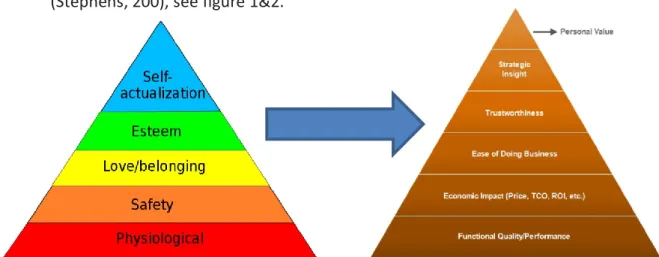
14 Maslow’s hierarchy of need used in social sciences and in business to conceptualize important principles, argues that the needs of human being can be arranged in a hierarchy from basic (physiological needs: food, water, breathing, etc.) to more complex (self-actualization: achievement of full potential as human ) needs. Maslow believes these needs are similar to instincts and play a role in motivating behaviour. Each lower need has to be satisfied before a person moves to the next level of need in the pyramid (Stephens, 200), see figure 1&2.
Maslow hierarchy has been used to provide a framework for customer experience in (Dodd, 2018). This framework has also been extended in this study to include all customers.
From the basic to complex needs, you have: Physiological needs mapping basic needs of the customer such as expected level of functional benefits and reliability level of the product/service, Economic impact : value for money, Ease of doing business: customer relationship ,Trustworthiness: accuracy, promises & fulfilments of commitments, strategic insight: helps customer goals/growth, to personal value : enhancing self-esteem
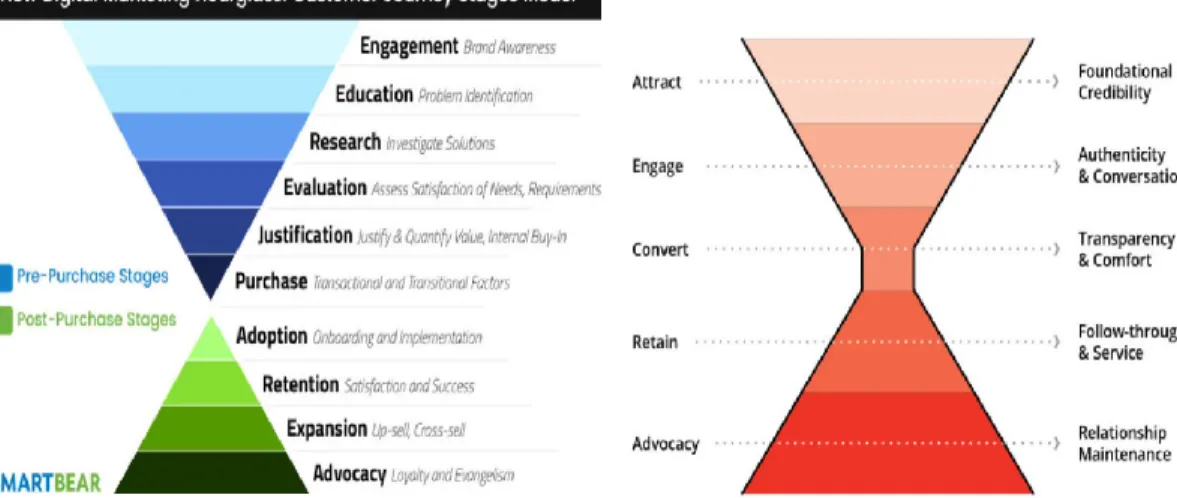
This Maslow/business framework is used to formulate the survey questionnaire across a modified modern customer journey as defined by (Deasi, 2016 ) and (Nelson, 2019) shown below in figures 3 & 4:
Figure 1. Maslow’s Hierarchy of Needs, Source(Dodd
2016
Figure 2. Customer Experience Hierarchy of Needs Source(Dodd 2016)
15 5.1 Data Collection
The method for data collection will be based on surveys questions. In addition, results of research and survey of organisations in the digital economy will be carried out.
Sampling methods will be used for data collection in the survey. The type of sampling will be stratified random sampling embedded in the survey questionnaire to be able to select subjects from diverse customer demography as (Generation Z (ages 14-18), Generation Y (ages 19-39), Generation X (ages 39-54), Baby boomers (ages 55-73) and Silent Generation (ages 74-92)
Survey:
1. Formulate the surveys questionnaires based on
a. Maslow's Need Hierarchy to identify the human needs. b. some other customer experience requirements
c. Survey questions spread across all stages of the customer journey (pre-purchase to post-purchase stages)
2. Send out the survey questions to stratified random group
Figure 3. Customer Journey Stages Model , Source(Deasi 2016)
16 There will be also “checking, verifying, testing, probing, and confirming collected data as the study proceeds within the stratified group.
Constantly reviewing literature and other studies related to the digital customer experience and digital transformation.
5.2 Analysis and Result
1. For the patterns in the industries observed or studied ,
o The data collected will be collated into manageable form and construct a digital transformation narrative for the
organisations.
o Conclusion or reasoning will be derived from the whole content of the data from the different sources combined.
o Attempt to look for patterns among several elements of the digital transformation and the perceive achieved capability of customer experience will be made
2. Data from Survey of individual customers
o Will be collated and construct the actual customer experience narrative
o Attempt to identify patterns among the survey data in terms of customer experience will be conducted.
3. Finally , comparisons will be made on data from company’s perceived customer needs and satisfaction with that of survey data from the actual customers
4. Comparison to literature and other study will be done to confirm or questioned the outcome of the study
5. Other variables discovered in the research will also be noted in the study for further studies
17 Reliability and validity are tools of an essentially positivist epistemology that have proved useful in providing checks and balances for quantitative methods(Winter n.d).
Quantitative research applies established mathematical ways such as statistical methods to evaluate the validity and reliability of research to ensure validity and reliability of research(Noble & Smith, 2015). In quantitative research, the concerns on validity revolves around the “ how valid the Construct of the research is. The construct is the questions or hypothesis that determines which data is to be gathered and how it is to be gathered (Winter n.d). The careful construct in this research is how customers perceived their experiences along the customer journey in the digital era as opposed to what companies see as customer experience .
The survey questions are developed along all the phases of the customer journey to capture these data . The data captured can either support or reject this construct which can then be can be put forward as a theory or further hypothesis (Cronbach & Meech ,1995 p. 20).
6
LITERATURE REVIEW
6.1 Customer Experience Theory
The mega trend and penetration of customer experience in today’s business environment is due to the increase in the commoditization of products, across all markets, driven by Internet revolution and digitalisation. The appetite for customer experience has increased by the demands of an increasing awareness in society which craves more stimuli as its knowledge and options increase. Other factors include the rapid reduction in the timescales from ‘innovation to imitation’ and how traditional differentiators such as price, features, quality and service – are losing their ability to differentiate companies. This trend affects all companies and if a company
18 does not take actions , today’s customer will quickly and easily shift to the companies that offer great customer experience . Customer experience will become the new sustainable differentiator, a new source of competitive advantage and a new threat to those organizations that do not react to its onset (Shaw & Ivens, 2002).
There is also the need to ask the question , what is a customer experience ? and how is customer experience made up? . A research by (Shaw & Ivens, 2002) of business leaders have found out that customers experience differentiation by the traditional elements such as price, delivery and lead times, is no long a sustainable business strategy. A differentiation in business have moved as a cumulative process from quality to functions like price , services delivery , emotional attachment built with brand loyalty to customer experience . When people describe their best customer experience , it always has some element of emotion to it i.e. how it feels , for example : he cared about me , I feel understood, I feel special ,etc. There is certainly a physical attribute to the customer experience, and these are the physical experience delivered, like higher quality, in-time delivery, good price for value but there is also emotional aspect which are about your feelings during the experience
In essence, customer experience as defined in (Shaw & Ivens, 2002) “…has two elements physical and emotions. Emotions overlooked by businesses but exist in all of us because we are human . It is constant . The physical things are what customer is entitled to get but emotional part is the customer experience...”
The customer experience is therefore a blend of a company’s physical performance and the emotions evoked, intuitively measured against customer expectations across all moment of contacts.
The philosophies that guides the new definition or view of customer experiences will be elaborated in the next section
19 6.1.1 Customer Experience Principles
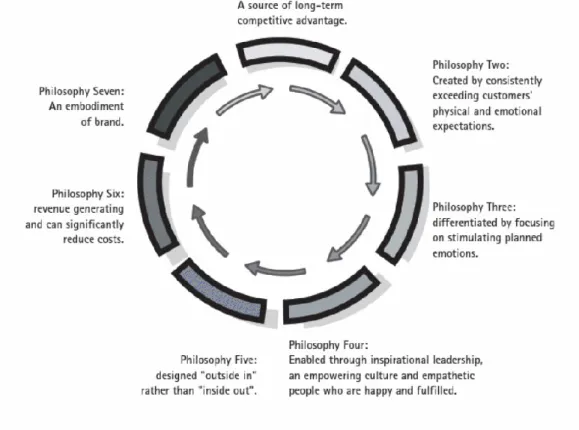
The customer experience philosophies of (Shaw & Ivens, 2002) is based from the notion that companies should stop being internally focused i.e. “inside out” which is the main traditional formation of companies meaning : organization, systems and processes. The proposal is for companies to be rather “Outside in” i.e. company build itself around what is good for customer and changes its organisational structures , systems and processes to build that customer experience . To achieve that , seven philosophies has been proposed as the guiding principles that guides a company’s behaviours(Shaw & Ivens, 2002), see figure 5.
Figure 5. The Seven Philosophies Virtuous Cycle in Building Customer Experience. Source (Shawn & Ivens, 2002)
These Seven philosophies are :
20 Customer experience is new strategic and competitive battle ground. Companies need to recognise this and place any resources needed to make the change
2. Created by consistently exceeding customers’ physical and
emotional expectations:
Examines the role of customer expectations during a customer experience, how they are built, how they should be understood and how they change throughout a customer interaction
3. Differentiated by focusing on stimulating planned emotions :
Emotions can provide a long-term sustainable differentiator. Examine why, at best, companies are only defining an emotion for their brand, and yet there is a massive disconnect between this and the actual delivery to a customer. What feeling your company wants to leave its customers with? Develop methodologies in evoking planned emotions from customers
4. Enabled through inspirational leadership , an empowering culture and empathetic people who are happy and fulfilled.
Investigate how the types of leadership and cultures impact on the customer experience. Explore the role of Daniel Goleman’s Emotional Intelligence 7 has on the customer experience. Examine how to recruit and train the right people, and how the right people give you happy customer
5. Designed ‘ outside in ’ rather than ‘ inside out ’
Examine how systems and processes that are built ‘inside out’ simply institutionalise ‘inside out’ practices, focusing on what is good for companies, rather than what is good for the customer. Measures and targets based on this could negative effect on customers. Examine how to build “outside in” around what is good for the customer
21 6. Revenue generating and can significantly reduce costs . Improving your customer experience can eventually save costs. Customer experience improvement drive improvements in customer satisfaction which drive increases in revenue. Build a business case to demonstrate that.
7. The embodiment of the brand
customer experience should reflect brand and people delivering the customer experience should be delivering a branded customer experience
6.1.2 The Physical Customer Experience
The speed of innovation in this digital era in all aspects of businesses such as innovations in channels, products and business models has created a competitive environment and very dynamic or changing markets .These speed of change or shorter innovation time cycles is leading to faster and faster commoditisation in the market to catch up with competition. Globalisation has easily provided the access both in products & services and resources quickly around the globe. This has led to imitation being commonplace now. The resulting competition also intend influences the speed of innovation creating a virtuous cycle. This means traditional differentiators are difficult to sustain and the cost of keep up with the speed of change expensive .
It is no surprise that 71 % of senior business leaders surveyed by (Shaw & Ivens, 2002) say now customer experience is the new battle ground.
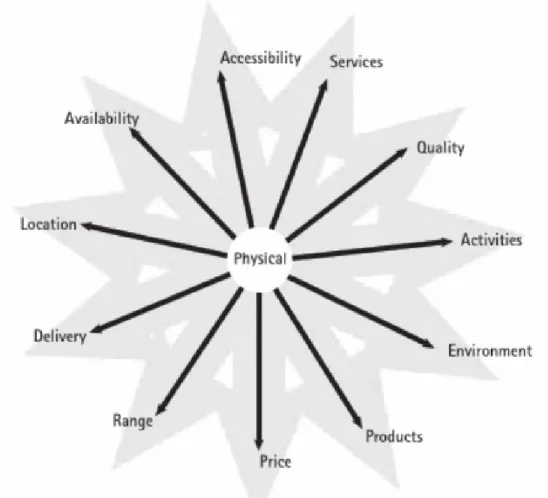
The physical element of customer experience is the heart of what of customer experience is and it contributes to the total great customer experience. This is the actual physical performance of the companies to the customers which include price, availability, accessibility, efficiency, ease of use, range and delivery.
22 These elements are difficult to radically redefined and change to keep up with the fast-changing markets as differentiating factor. What a company such as Amazon will do today will be a common thing tomorrow in the market by all competitors. Quality and reliability have reached a level in this era where is considered a basic guaranteed by all providers. Therefore, customers must base their buying decision on intangibles. Also, due short time cycle between innovation and imitation , the market is flooded with similar products and even driving commoditization to almost free products like Free/Premium business models .
And with the digitalisation and multiple channels opportunity to interact and engage the customer , there is additional physical element to extend and keep constant across all points of contacts with customer . For example, the experience of a customer online must be built around the customer because they have multiple choices and can walk away with just a click of a mouse. So, you are going to lose a customer if you don’t completely focus on every second of what customer wants , needs and their expectations in real-time as they navigate through online.
As defined by (Shaw, Ivens, 200), “… the customer experience is a blend of a company’s physical performance and the emotions evoked, intuitively measured against customer expectations across all moments of contact…” So, the customer experience is not just the physical or the emotional; it is both combined. But the physical (Consistent quality, shorter deliveries, great value for money, etc) at the heart of building great customer experiences. It should also be noted that customers intuitively measure their experience against their expectation at any point they are in contact with a company i.e. across all moments of contacts . These contact points are certainly the moments of truth for your company, regardless of how it is structure or its internal process, to deliver great customer experience to the customer
23 So, a company should not only strive to have the best product in the market ( which is a must) but also make it easily available , accessible worth right quality and value for money and give a thought about its environmental impact . These are physical elements that makes up the physical side of the customer experience and should be addressed at all points of contacts, see figure 6.
Figure 6. Physical Elements of Customer Experience
Customer experience starts with your expectation being built up through adverts, PR(Public Relations), word of mouth before purchase decision and these points of contacts must be part of the company’s plan in setting customer experience.
Expectation Setting :
Expectation is simply the view of customer before interacting or contacting the product. Expectation can be formed in many ways from various sources such as through adverts, brand of the company, experience in the past of
24 similar functionalities. If these sources are absent, then imaginations of the customers take over.
Pre-purchase : All activities leading to the purchase which could include gathering information about everything on the product, website, location , to create the momentum for the purchase .
Purchase interaction: This is the heart of the customer experience and is when purchase decision has been made. It includes all activities in purchasing both in Consumer and B2B markets.
Product or service consumption occurs when you have actually bought the service and you are using it. Some product consumption happens in minutes like eating a candy , some takes years like owning TV and cars.
Post experience review : Happens at the end of the customer experience. The customer reviews the performance against the expectation and reset them including customer’s opinion of the brand. Then the cycle begins again with “ expectation setting “
These are fundamental stages and contact points that must be considered in building a customer experience. A company should consider how their product and service fit around this cycle and examine what they are doing at each stage. Many companies tend to forget customer after they purchase product …customer can into a dangerous phase called buyer remorse
6.1.3 The Emotional Customer Experience
Businesses always eventually ends up about people and people are driven by emotions. People may not be aware that they are responding with emotion, but the fact is in human being’s information passes through the
25 emotional side of the brain before it goes into logical side during any experience. People are driven to purchase by emotion, and then later use logic to justify their purchase. Customers and employees are full of emotions and ignoring that leads to ignoring half of the customers brain
There may be several reasons why emotions do not feature dominantly in business environment and one of them is that emotions are untidy , unstructured and difficult to measure. In this era of competitive business environment and customer experience becoming a strategic competitive weapon, emotions are a major differentiator and are underestimated assets of business.
What is the feeling you want to leave your customer with ? and have you defined it? The feeling you want to evoke when customer interact with your brand and products must be defined and planned. If not, how would you expect employees to attempt to deliver the feeling consistently across all moments of contact? As customer would interact with your organisation at different contact points or moments of truth , you do not want employee or people responsible at these different contacts act differently depending on their assumption of what the experience to the customer should be. It is therefore very important for a company to define and plan the emotions they want to evoke with their customers. Great customer experience is differentiated focusing on stimulating planned emotions(Shaw & Ivens, 2002). As a company there are many types of emotions available to select for customer experience . Some of the types are
Enjoyment: happiness, joy , relief , content, bliss, delight, amusement, thrill, etc
Love : acceptance, friendliness, trust, kindness, adoration , affinity ,etc Surprise : shock. Astonishment , amazement , wonder, etc.
26 Selecting the right emotions for the company and its customers depends on the company’s specific context in terms of business , character and brand. Customer experience should reflect the brand image of the company and therefore the emotions evoke should be seamless from customer experience to the brand values.
To select the right emotion for both your brand image and customer experience, you can begin by listening to your customer language . If for example one takes an emotion “trust”, it is difficult to structure or measure trust in business sense . But lack of trust associated to product or brand can lead to significant negative effect to a business . At the same time associating trust to your brand and product & services can lead to positive outcome where customers always want to do business with you. So, you should plan the emotions you want to stimulate , define them and deliver them like a physical element. Emotion such as loyalty and trust cannot be measured but once identified by a business , there are set of activities that can be undertaken to build the loyalty or trust. For example, BMW involved a dealer and customer in the process of building the car. The customer and dealer can see at any time or second which phase and parts of the build process their car is in , thereby building trust and transparency with the stakeholders(Shaw & Ivens, 2002)
Once you start delivering the emotional customer experience , it should be developed over time . Human beings are complex, so the first positive emotional response will change or reset expectation of the customer . That means subsequent experience of the same form will not result in positive response
In the battleground of customer experience , gaining emotional loyalty from your customers is something that is very difficult for others to break . A company may have to invest in something completely unique and different their actual business but associated with the company’s brand to build the
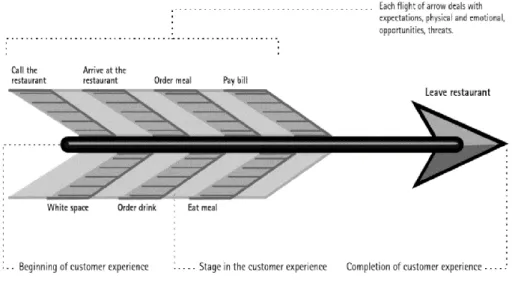
27 loyalty. Evoking the emotion is a process that should be kept consistent throughout all points of contacts , see figure 7 of an example of mapping the moments of customer interaction with a restaurant.
Figure 7. Moment Mapping: Restaurant Customer Journey. Source (Shawn & Ivens, 2002)
Develop a process to map customers as they move through the customer experience journey. One thing you will observe in the moment mapping is that there are many opportunities and threat as the customer navigates through the customer experience
6.1.4 Building a complete Customer Experience
This section looks at fundamentals of customer experience and why it has become a strategic competitive item.
The appetite for good customer experience is increasing as awareness and knowledge in the society increases and multiple options or alternatives easily available. The increase pace of innovation and the shorter time-cycle of innovation and imitation has made traditional differentiators like price, quality and delivery not a sustainable competitive strategy in the market.
28 This has led to customer experience to be new battleground for competitiveness.
The section goes on to describe and list customer experience philosophies as a guiding principle in building a great customer experience.
The customer experience as defined by (Shaw &Ivens, 2002) is a blend of physical and emotional customer experiences. The physical customer experience referred to predominantly in the industries are physical attributes like reliability, services, accessibility, delivery, quality , products , etc. However, these are not enough to differentiate in the market as innovation and global access have given all competitors capabilities to compete on these physical elements. Emotional customers experience, mostly ignored in today’s businesses, is the part where a company plans to evoke certain emotions associated to their product and brand so that no competitor can imitate. Emotions cannot be measured but a set of activities can be planned to build or evoke emotions at all points of contacts with customer.
The emphasis of this section is to combine the physical and emotional customer experience that flows seamless with the company brand image as one single experience . The experience should be built around the customers in what is referred as “Outside in” as oppose to traditional organisations approach of “Inside Out” .
The section concludes with setting and mapping the moments of the contacts with the customer to build these set of activities and process to offer both the physical and emotional experience to the customer
29 6.2 Managing Customer Experience and Relationships
Customers have long time been at the heart of company’s long-term growth strategies, marketing , sales ,product developments, labour, resource allocation , and overall profitability directives.
Companies until now , have been structured and managed around the product and services they manufacture and sell. That led to mass marketing and mass advertising for market share growth leading to commoditization .
Branding then emerged as a differentiator in the highly commoditised market . Branding have helped create value through familiarity, image and trust. Customers tend to value brand, but in actual fact , customers opinion are based on the relationship they have had with the brand. In essence , brand reputation and customer experience are becoming one and the same thing from a customer’s perspective.
But in today’s interactive era, companies are strategizing to gain competitive advantage from a two-way brand interaction that leverages on information gain from the customer and the interaction with the customer.
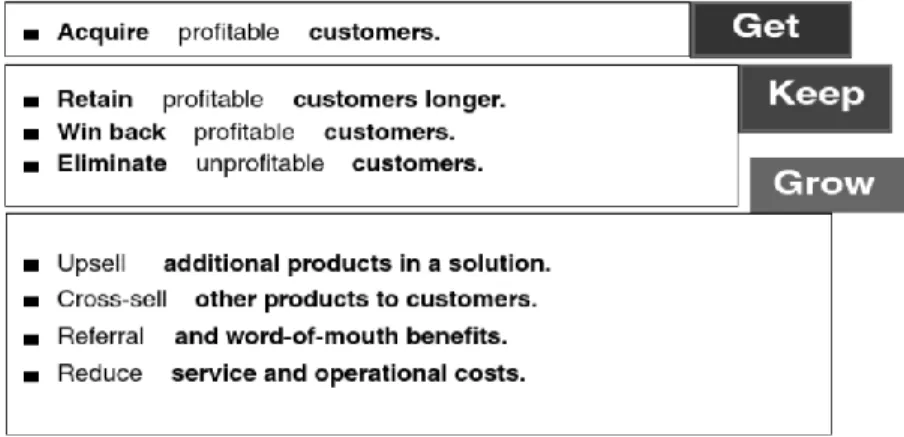
The root and basic goal of a company is to get , keep and grow customers. Customers are the source of revenue for a company. Focusing on customer strategy means growing the value of the company by deliberately and strategically growing the value of the customer base
Customer Strategy
Managing customer experience and relationship is what companies do to maximise the value of each customer . Companies that understand the perspective of the customer; what is and what should be-like the customer, put a lot of focus and resources in managing customer experience. A
30 company must have customer strategy to be able to develop the capability of managing customer relationship and customer experience
Technology advancement has also introduced other variables into the Customer strategy: business objective that requires involvement of the entire organisation. Technology advancement have enabled companies to manage customer relationship more efficiently and provide better customer experience.
competitive environment such as a trust platform , where the trust platforms connects buyers and sellers and build sort of crowdsourcing marketplace. This platform was found to be more trusted in the social media or circles than a company or organisations platform by a research conducted by(Peppers & Rogers, 2016). Furthermore, technology has also empowered customer to inform themselves and one another and demand much more from the companies they do business with.
To build a successful customer strategy focus organisation, traditional organisation must go through the process of transforming from product or service company to customer focus company. That means a company should develop :
• A strategy on ongoing process that helps transform to customer focus • Leadership commitment to implement throughout the organisation to put customer value and relationship first as the direct path to increasing shareholder value
The emphasis of being a customer focus strategy company is to able to get customers, keep customers and grow your customer base value, see figure 8.
31
Figure 8. Increasing Customer Base Value , Source : (Peppers, Rogers, 2016)
The reality about becoming a customer focus company is the ability to use customer information to gain competitive advantage to deliver excellent customer experience , growth and profit. Customer relationship management is key to the customer strategy and the subsequent deliverables such as customer experience , growth and profit.
Customer Relationship Management (CRM) is an enterprise-wide approach to understanding and influencing customer behaviour through meaningful analysis and communications to improve customer acquisition, customer retention and customer profitability
In essence , building customer strategy requires a company to treat different customers differently. All customers in all industries want to be treated individually and be personally served. Customer strategy means taking customer specific action, treating different customers differently, improving each customer experience with every interaction with the company and product , building the value of the customer base, creating and managing relationships with each customer that get better and deeper over time.
A customer strategy consists of both operational and analytic parts of Customer Relationship Management (CRM). The operational part is about the changes in processes affecting daily operations that provides different treatment to different customers. The analytical part is about the strategy
32 and planning needed to build customer value , cultural, measurement and organisational changes required to implement the strategy successfully. Customer strategy has become critical as there is declining customer loyalty due to easy global access to information and knowledge, and availability of multiple choices or alternatives to customers.
Technologies such as Enterprise Resource Planning (ERP) , Supply Chain Management (SCM) software, Enterprise Application Integration (EAI), Data Warehousing ,Salesforce have assisted companies in managing customers relation by mass marketing , delivering of customised communications , unique product and services to customers based on their feedback and specifications. These technologies have enabled companies to develop new and efficient customer relationship management and develop customer experience mapping. Companies can conduct business at intimate and individual customer level by developing customer relationship and mapping customer experience journey .
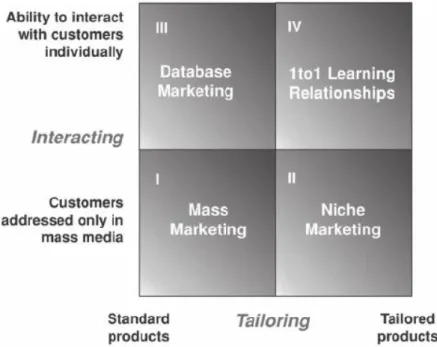
Building Customer value strategy through relationship management requires operating in the 4th quadrant in the figure 9 below;
33 Interactive dimension : If a company is high on the interactive dimension , then the company has capability to send different customised messages to different customers and the company can also remember feedback from each of the different customers
Tailoring dimension : If a company is high on the tailoring dimension, then the company can mass-customised in lot of one size.
Ideal customer strategy-based company wants to be in quadrant IV , where it can customise both the company’s interaction and products or service with each different individual customer separately.
Customer strategy focused companies are required to interact with customer and use the outcome of the interactions to deliver a customize products and services. Customer strategy focus is a time-driven process , it is dependent on time and is evolutionary, as product or service are continuously fine tune and customer is increasingly differentiated from others.
Technology advancements have given the enterprise capability to capture the feedback of its customer , then use the feedback to customise some aspect of its product and service to suit the customer individual needs .
In customer relationship focus businesses, companies must integrate the disparate information systems , databases, business units, customer touchpoints and many other parts of the business to ensure that employees who interacts with the customer at any point have real-time and up to date information on the customer in order to optimize interaction with each customer and ensure seamless dialogue. While technology enables one-to-one relationship with the customer, relationship is an ongoing process and not merely a technology.
34 Technology is therefore just a means to the end. Managing customer relationship also requires the commitment of the leadership and whole heartedly participation throughout the organisation
6.2.1 Principles of Managing Customer Experience and Relationships
Relationships are the crux of the customer strategy focus. Companies need to understand what makes up a relationship, how relationships are formed ,how relationships are strengthened , how relationships are weakened, and how relationships are different from customer experience? Can a company build a relationship with a customer ; if the company knows the customers and tailors offers and communications, remember things for the customers and deliberately builds customer experience? Or is the relationship more of customers attitude or predisposition toward the brand from the customer’s prior experience with the brand and knowledge of the brand from other sources?
Managing customer relationship is about establishing meaningful and profitable relationship with the most valuable customers on individual bases and increasing the value of the customer base. Relationships between a company and customer provides the framework for the whole customer value business model. Customer may not be aware of the relationship but will be aware of the experiences she feels from the company.
Customer experience is the sum total of customers individual interaction with a product or service or a company over time . So, managing customer relationship is about what the company does, and customer experience is about what the customer feels as a result (Peppers & Rogers, 2016) .
35 The exchange between the company and the customer results in mutually beneficial relationship , where customer gives information in return for personalized services that meets their individual needs.
A genuine business relationship has been characterized in (Peppers, Rogers, 2016) to poses the following attributes:
• Mutual • Interactive • Iterative
• Providing ongoing benefit to both parties
• Requires a change in behaviour for both parties • Unique
• Requires and produces trust
Since this is a continuous and evolving process , a company must adopt learning relationship concept to build customer relationship management.
The idea behind learning relationship is that a company gives customers opportunity to teach the company what the customer wants, the company remembers everything and gives back to the customer and keep the customer business. This is a continuous process as the company fine tunes exactly what the customer wants the more the customer teaches the company . This results in invested relationship that neither wants to quit and start all over again i.e. it creates a significant switch cost for the customer. The more a company knows about a customer that competitors don’t know, the more the company can do things ( services, offers, etc) for the customers that competitors don’t even know about(Peppers & Rogers, 2016).
Learning relationship is a collaborative learning platform where the company learns about individual customer through transaction and interaction during the process of interaction. The customer intend learns more about his preference from each experience and feedback from the firm
36 . The company learns about its own strength and weakness from each interaction and customer feedback and can adjust both strategy and operations. Customers do not want more choices, customers simply want exactly what they want, when , where and how they want it.
Technology is giving companies’ ability to use customer information to give customer the most relevant product at the right price and at the right moment
A framework for understanding the customer :
Building a relationship is a fundamental part of human life and people have all kinds of relationships with some closer or intimate than others.
The same concept applies to relationship with a customer by looking at the following human factors :
1. Customers are People too: customers are people and they bring to the role of customers the same set of needs and emotions they show in their daily lives. Business must then understand the psychology in relationship in general to be able to build meaningful relation with customers. Relationships don’t spring up out of nowhere, they evolve over time and some lead to a very strong or intimate relationships. Relationships must be nurtured once established and customers will genuine sense the loyalty. Business must understand how customer develop relation and what the customers get from the relation to build lasting connection
2. Retention is not a Relationship : Retention is essentially a behaviour concept meaning customer continue to buy from a company overtime . Customers can be enticed with loyalty programs to keep coming back to buy from the same company, so it is behaviour loyalty rather than emotional loyalty which is what relationship is about. A relationship in simplest terms as understood by customers is about feeling and emotions. Relationship can result in behavioural loyalty, but it is much more where customer is invested in the company, product ,image and speak glowing about anything from the company
37 3. Who decides is a relationship : Customer relationship , just as interpersonal relationship develops over time? Relationship are by definition a two-sided affair; they must be mutually felt. A company needs to have customer strategy that focus on ensuring that everything that the company does is oriented towards building solid customer relationship
4. The need for Insight : Companies must understand the customer and must understand the nature of genuine relationship. Hence the need to obtain the kind of insight needed for that. To obtain customer insight we must understand customers as people and how they live their daily lives , how they encounter the company i.e. more humanistic view.
A framework of understanding a customer is presented below by (Peppers & Rogers, 2016) :
A framework to facilitate thinking and understanding of the concept of Customer Relationship Management and the factors that allow companies to build closer relationships
1. Customer Environment :
To establish a genuine relationship , a company need to first understand the environment in which the customer operates i.e. customer context. Understanding customer context means , company must understand what is going on in customer daily lives, goals, challenges and opportunities, what customers are trying to achieve, what customers are looking forward to , what customers dread, what customers must get done, etc. on an individual basis.
2. Customer Expectation :
companies need to meet customer expectation but that is not enough for relationship building. Customers have difficulty in verbalizing what they need from a company they are dealing with. Expectation is also set by similar
38 experiences or imaginations of the customers. So, from the company perspective , it is important to not only understand what customers is expecting but also what customer is not expecting to deliver the “wow” factor
3. Customer Emotions :
Relationships are generally formed from emotions. Just like interpersonal relationships, customers also build emotional connections to companies and brand to the extent that they miss the company/brand when they are not available . Companies must therefore set out to reduce negative emotions and strengthened the positive emotions at every customer touchpoint
4. Customer Experience :
A succession of positive experience is likely to build a genuine relationship over time. Every interaction(i.e. all customer touchpoints) with the company or brand is an experience and most important thing is the view of the customer. What customers perceive the experience they have been provided?
5. Customer Engagement :
Involving customers more to become partners in the co-creation of products and service , involved in delivery of desired solution and outcomes
The framework above is a guiding principle in how to build emotional attachment to form a successful customer relationship to deliver a branded customer experience
6.2.2 A model for managing Relation and Improving Customer Experience
39 If a business strategy is based on managing customer relationships, then treating different customers differently must be a core part of the strategy. A company must be able to identify and recognize different, individual customers, and wat differentiates these customers.
A company must be able to interact individually with any customer and change the company’s behaviour to meet the specific needs of that customer, as it discovers those needs. A customer must perceive and see that the company is acting in the best interest of the customer first and then of the company. That over time will build the trust and create customer value which are part of the fundamentals of the mutually beneficial relationships.
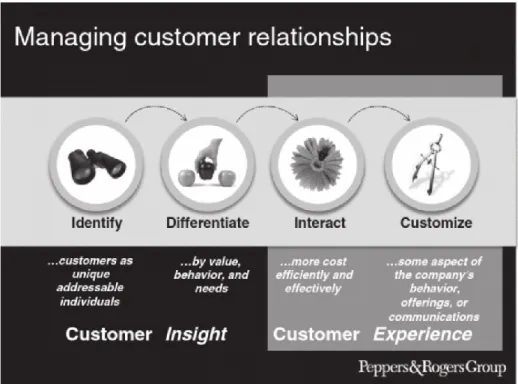
To build a customer value through a relationship management , a company must engage in four step process called IDIC : identifying customers, differentiating them, interacting with them and customizing for them, (Peppers & Rogers, 2016).
These four steps represent the mechanics of building a genuine customer relationship, but the most important thing is that the process happens in the context of trust. It is also important to note that building relationship has also non -emotional part i.e. mechanical and physical activities to engage the customer, which together with the emotional attachment solidifies a relationship . The four-step framework, see figure 10, are ;
40
Figure 10. Analysis and Actions Source : (Peppers, Rogers, 2016)
1. Identify customers.
Relationships can only be formed with individuals and not group or segment. So, companies must firstly identify individually their customers. This includes organising various information resources to have a customer-specific view of the business. That means the company has the capability to tag a customer and be able to recognize him when he comes back, whether in person, by phone, online, by mobile app, or wherever, The company must be able to know the details of each specific customer including the habits, preferences, and other characteristics that make each customer unique.
2. Differentiate customers.
Being able to differentiate customers allow companies
• to focus its resources on those customers who will bring in the most value for the company, and
• to develop and implement customer-specific strategies designed to satisfy individually different customer needs and improve each customer’s experience. Customers have
41 different needs and different needs drive different behaviour . Companies can observe the behaviour to estimate specific customer value . Customer grouping based on a specified variable is a critical step in understanding and profitably serving customers.
3. Interact with customers:
Companies should continuously improve their interaction with customers. Each successful interaction with a customer should take place in the context of all previous interactions with that customer. Customer interactions, when done right, provide better insight into a customer’s needs and keeps customer information up to date throughout all the customer touchpoints
4. Customize treatment :
Customer’s experience should be customised on that individual’s needs and value, to make it more relevant to the customer. Company should continuously adapt its behaviour to satisfy the customer expressed needs, whether in terms of product , package and keeping conversation going
6.2.3 Measuring and Managing
Customers have long term value because they have memories. Any time a customer has experience with any business , his intention or likelihood to buy from that business in the future is liable to change(Peppers & Rogers, 2016).
In financial terms , a company’s actual economic value is estimated in terms of discounted net present value of the future stream of cash flow that the company is expected to generate. With the same assessment of customer value , it means when a customer likelihood of buying or sharing her
42 experience with friends in the future changes, the company likelihood of future cash flow changes (Peppers & Rogers, 2016).
This may be not easily noticeable by companies, but company’s long-term value can be enhanced or destroyed by the current individual experiences of their customers. Customer lifetime value(LFV), defined as the net present value of the future cash flow attributed to that customer (Peppers, Rogers, 2016).
Customer equity:
Customers are revenue generating and source of value creation for a business, therefore customers are responsible for shareholder value. So, the sum of all customers(current and future) lifetime value represents the actual economic value of the company. That means if you take away profit generating customer , the value of the company declines. Customer equity is therefore determined by value of customer relationships.
Customer loyalty:
Most likely plays a significant part in company’s effort to maximize the value its customers create. That means increase in customer loyalty increase customer equity level. Customer acquisition, retention and churn may not be accurate measurement in this modern environment as customer behaviours change quickly and so is the customer’s value to the company. It is worth looking into how to measure or ensure increase/ avoid reduction in customer business with the company .
Return on Customer (ROC):
Is designed to track how well a company is using customers to create value. In financial terms , Total Shareholder Return is defined as the overall return a shareholder earns from owning a company’s stock over a period of time . The same definition applies to Return on Customer , in terms of customer equity.
43 ROC equals company current period cash flow from its customers plus any changes in the underlying customer equity, divided by the total customer equity at the beginning of the period.
A company can also measure the efficiency with which customer create value : customer base is a revenue generating asset for a company that means, to quantify how well business creates values from its customers, you will need to apply the equation ROC(Peppers & Rogers, 2016)
A company can then monitor how Customer Lifetime Value(LTV) changes and what causes those changes , then a company can use ROC metric to manage its overall business productivity. Company can then improve factors that affect customer equity like loyalty, profit on value -added services depending on the performance of LTV
By using LTV as a tool and tracking LTV changes over time a company can maximize its ROC on individual customer. A company can know whether acquisition or retention over a period of time, will be a better yield or not.
ROC metric balances the effect of short-term results with long term ones . At a company level, ROC equation is defined below :
ROC = Where
P(t) = company cash flow in period t CE(t) = customer equity in period t
A company should be able to analyse and deduce how LTV is likely to be influenced by various drivers and by the attitudes of customers. A company must however strategize not only for the short term i.e. “new customers added” but also maximize rate at which overall economic value is created for the long term
P(t) + (CE(t)-CE(t-1) ) CE(t-1)
44 Technology and tools for Customer relationship management :
In the interactive age , business need to continuously develop real-time insight into the nature of their individual customer not only for marketing but also that the customer can be given the right offer in time ( real-time analytics) at any touchpoint. Customer analytics offers the missing link to understanding a customer. Prediction based on the value of customer information helps companies to optimize each interaction with each customer. The analytics tool helps to classify, estimate, predict, cluster, and more accurately describe data about customers, simplify how it views its customer base and how it behaves toward individual customers. The critical fundamental element here that need mentioning is the quality of the data and data integrity as data from varying sources and ages are used as sources for these technologies and tools.
There has been certainly great progress in Customer Relation Management software and tools to provide key customer insights starting from the initial Enterprise CRM to current CRM in the cloud, where customers participate themselves in the environment rather being serve as target or lead.
It is important to use these technologies , such as CRM with analytics and predictive tools, but a business process to manage customer relationship should be the key focus of the company
6.2.4 The Fundamentals of Customer Relationship and Experience
This section discusses the understanding and the importance of customer strategy and how to apply it to the task of managing a company successfully in the 21st century. The emphasis of customer strategy for a company is to build the capability to get , keep and grow customer base value.