with Developing Countries
Prepared byJohn Humphrey (IDS) Robin Mansell (LSE) Daniel Paré (LSE) Hubert Schmitz (IDS)
with researchers based in Bangladesh, Kenya and South Africa. Members of the project team at the London School of Economics and Political Science (LSE) and the Institute of Development Studies (IDS), at Sussex are especially grateful for contributions by Zaid Bahkt, Bangladesh Institute for Development Studies, Dhaka; Mary Njeri Kinyanjui, Dorothy McCormick, and John Njoka, Institute of Development Studies, University of Nairobi, Kenya; Mike Morris, Sagren Moodley, and Myrian Velia, School of Development Studies, University of Natal, South Africa; and Norma Tregurtha and Nick Vink, Department of Agricultural Economics, University of Stellenbosch, South Africa. Working papers prepared in connection with this project by various members of the research team are available at: www.gapresearch.org/production/ ecommerce.html
The project team members are very grateful to the respondents from Bangladesh, Kenya and South Africa, and to the interviewees in the United Kingdom and elsewhere in Europe who contributed their time
from private firms, the public sector and various other stakeholder organisations and they gave us many valuable insights. We also acknowledge the assistance of staff at the International Trade Centre, UNCTAD/ WTO, who have provided opportunities for the dissemination of the research results.
This project was funded by the UK Department for International Development (DFID) whose support and encouragement is gratefully acknowledged. The project formed part of a DFID-funded programme of research on Globalisation and Poverty (see www.gapresearch.orgfor details). Members of the project team benefited substantially from the administrative and editorial support provided by the Globalisation and Poverty Programme at IDS and by Kathy Moir at LSE.
The views contained in this report are those of the authors. We accept full responsibility for any errors or omissions.
John Humphreyis a Professorial Fellow of the Institute of Development Studies at Sussex. He has researched extensively on global value chains in the automotive and horticulture sector. He is convenor of an international network of value chain researchers and director of a DFID-funded programme of research on globalisation and poverty.
Robin Mansellholds the Dixons Chair in New Media and the Internet at the London School of Economics and Political Science. Her research examines the integration of new technologies into society, the interaction between engineering design and the structure of markets, and sources of regulatory and policy effectiveness and failure.
Daniel Paréis a Research Fellow in the Interdisciplinary Programme in Media and Communications at the London School of Economics and Political Science. His research focuses on Internet governance, e-commerce developments and issues of scientific and technological innovation.
Hubert Schmitzis a Professorial Fellow of the Institute of Development Studies at Sussex. He is co-ordinator of a research programme on interactions between local and global governance and the implications for industrial upgrading, undertaken jointly by IDS and the Institute for Development and Peace at the University of Duisburg.
About the Authors
i 1. Business-to-business (B2B) e-commerce is widely
believed to promise a radical change in the way that firms trade with one another. B2B e-commerce applications are being promoted as tools that will enable producer firms in developing countries to reduce their costs substantially, thereby easing their access to global markets. The vision of B2B e-commerce is driven by a simple idea. The Internet provides an open global network and access to this network is relatively cheap. Internet-based B2B e-commerce should help producers in developing countries obtain better information on global markets and give them direct access to new customers.
2. The key question is: does the implementation of Internet-based B2B e-commerce actually lead to new trading opportunities for producer firms in developing countries?Some of the hype has gone out of the Internet debate, but policy makers and development assistance organisations continue to have a very optimistic view about the potential of the Internet and information and communication technologies (ICTs), more generally. They are concentrating on removing the obstacles that hold back the use of ICTs by developing country firms. Helping these firms to bridge the ‘digital divide’ and take advantage of ‘digital opportunities’ is a very high priority.
3. This project examines the expectations and assumptions behind this drive to invest in ICTs and B2B e-commerce, in particular. We arrive at an alternative set of conclusions about the appropriate priorities for policy and action. These come from investigating what actually happens on the Internet and from talking to producers and other stakeholders in developing countries who are involved in international trade and in some types of B2B e-commerce.
4. Our overall finding is that the main effect of B2B e-commerce is to enhance the relationships between existing trading partners. Its use does little to help forge ongoing relationships with new firms. There is a clear message for policy makers and practitioners – understanding how international trade is organised and how inter-firm relationships are developed is essential if the use of some types of B2B e-commerce is to assist producer firms in gaining more equitable access to international markets.
5. In spite of the optimism about the potential benefits of B2B e-commerce for developing country firms, there is remarkably little evidence about the way that it is actually used by producers in developing countries. This project aimed to fill this gap by addressing three research questions.
• Is B2B e-commerce opening new and cheaper access to global markets for developing country producer firms or, conversely, is it strengthening existing relationships between producers and global buyers and reinforcing existing power relations?
• Are developing country producers being marginalised by the spread of B2B e-commerce trading relationships that depend on sophisticated information and communication technologies and on efficient logistics systems, electronic payment systems and new certification procedures?
• How can government or technical assistance agencies help producers in developing countries to participate in B2B e-commerce on an equitable basis?
6. The project focused on B2B e-commerce
applications that can be accessed using the Internet. Two industrial sectors – garments and horticulture – were selected. Both are important for employment and export-led growth in developing countries and both produce a mix of ‘difficult to standardise’ and more easily standardised products, which rely on a range of services to ensure quality, timeliness of delivery and payment.
7. We examined Internet-based ‘e-marketplace’ sites that claimed to be supporting exporting firms in the two sectors. More than 180 of these ‘many-to-many’ e-marketplaces were examined to identify how they were supporting firms seeking to trade in
international markets. We also interviewed 74 managers of exporting firms in the garments and horticulture sectors in Bangladesh, Kenya and South Africa about their experiences with B2B e-commerce. A further 37 key informants were interviewed in these countries and several e-marketplace providers in Europe were consulted.
8. The results of our empirical research depart substantially from the predominant vision of B2B e-commerce. Our results show that even when some of the expectations about the benefits of better access to information and reduced communication costs are met, business with new firms is rarely generated by using Internet-based B2B e-commerce in the form of ‘many-to-many’ e-marketplaces. We found that very little business with new firms was being generated by using Internet-based B2B e-commerce.
ii
9. The vast majority of the Web-based e-marketplaces had no applications or services in place to support the completion of transactions on-line. Only a tiny percentage of these sites were providing facilities for payment on-line. The vetting of users was infrequent and buyers and sellers had to rely on information provided at the discretion of their trading partners. The e-marketplace providers were not accepting liability and were doing very little to build trust between potential trading parties.
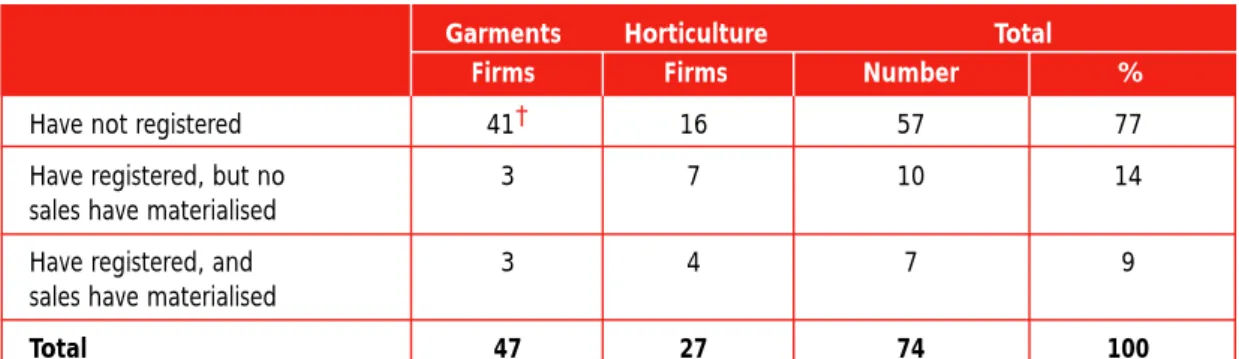
10. Registration with such e-marketplaces was extensive, but the results were disappointing for most of the firms. Almost one quarter of the firms had registered with Bulletin Boards and seven had bought or sold a product. This does not indicate widespread access to Internet-based trading for developing country producers. Some of these firms were traders who were making contacts on-line to supplement traditional ways of finding customers. The contacts were then followed up ‘off-line’ using face-to-face meetings, telephone calls and faxes. Overall, sale volumes were low, and a number of firms expressed disappointment at the high level of transaction costs involved in following up contacts made through Bulletin Boards.
11. The low level of on-line transacting is not surprising. In the garments and horticulture sectors, business relationships are forged through personal and inter-firm networks. They depend upon non-contractible commitments involving complex information that cannot be provided easily by using relatively unrestricted access to e-marketplace systems. These exporting firms are integrated within global value chains. Some of them had been invited by their buyers to participate in private, exclusive on-line auctions. This was not resulting in new business partners; it was a means of promoting competition between existing producer firms.
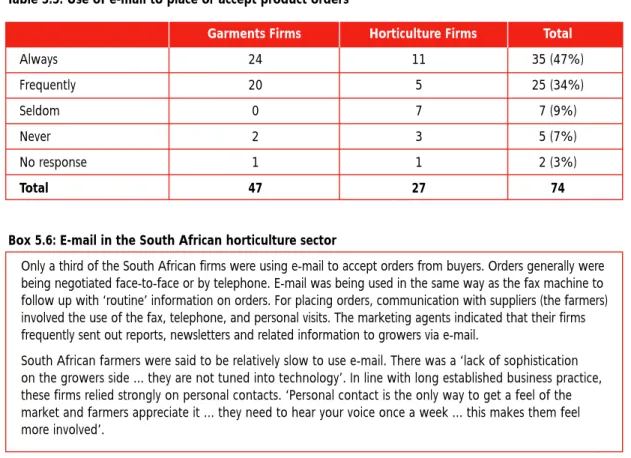
12. In our study, the primary B2B e-commerce application was e-mail. E-mail was being used to maintain contacts along the value chain. Its use was extensive, if not universal, in the two sectors to co-ordinate production schedules, provide complex information on shipping (for example, the layout of pallets in air-freighters), and to send digital images to verify the quality of products. The primary perceived benefit of e-mail by producer firms in developing countries was to reduce communication costs.
13. Our results show that B2B e-commerce applications are used primarily to exchange information and to enhance global supply chain integration.The use of the Internet to forge new trade relationships is more likely for trade in occasional products. For core products, developing country exporters operate in global value chains that encourage repeat transactions and require high levels
of co-ordination. Supply chain integration using the Internet is likely to expand as information is integrated through the use of multiple Internet-based information channels. However, access to new applications running on the Internet is likely to be by invitation from the e-marketplace operator or buyers.
14. The use of the Web was being limited by inadequate and costly domestic telecommunication infrastructures and slow connection speeds. The use of Web-based applications might increase as ICT costs decline, but the costs of dealing with new suppliers and customers will continue to be high. Most of the B2B e-commerce activities of developing country exporters are not dependent on very sophisticated ICT requirements. However, cost-effective and reliable access to telecommunication and Internet services is required.
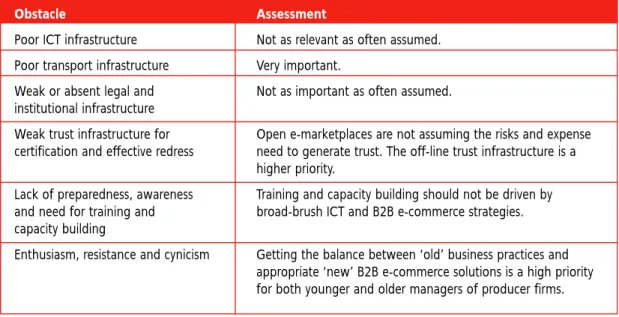
15. The emphasis of B2B e-commerce policy on developing legal frameworks for on-line trading (for example, digital signatures and electronic trust services) is questionable.However, high priority does need to be given to strengthening logistics and transport infrastructures to support time-sensitive, increasingly tightly integrated, global supply chains. Capacity building for B2B e-commerce is also important, but it needs to focus on the characteristics of specific sectors, countries and firms.
16. For Internet-based B2B e-commerce to become more widespread in a way that benefits producer firms in developing countries, much greater attention will need to be given to how firms relate to each other within global value chains and to the specific types of transactions they are involved in.Even though B2B e-commerce is not very effective for finding new trading partners, the ability to access and use Internet-based trading systems is critical for producer firms that need to be effective partners in their existing global value chains.
17. ‘Top-down’ government policies promoting ‘e-readiness’ will be unsuccessful unless much greater effort is given to examining how Internet applications are actually being used and to the circumstances around the implementation of new technologies. Policy makers, firms and development assistance agencies should support ‘bottom-up’ approaches that are based on realistic assessments of B2B e-commerce opportunities and obstacles, and region- and value chain-specific solutions.
Contents
Executive Summary i Contents iii Tables iv Figures iv Boxes iv Acronyms v 1 Introduction 12 B2B E-commerce: Issues for Developing Countries 3
2.1 B2B e-commerce: expectations and assumptions 3
2.2 The limited evidence base for B2B e-commerce optimism 6
3 The Research Strategy 7
3.1 Diversity in B2B e-commerce 7
3.2 Distinguishing between types of B2B e-commerce 7
3.3 Mapping the attributes of B2B e-marketplaces 8
3.4 Developing country producer firms and key informants 9
4 The Reality of E-Marketplaces 11
4.1 E-marketplaces: transaction- or information-oriented? 11
4.2 Support services in e-marketplaces 12
4.3 Trust services in e-marketplaces 13
4.4 The operation of open e-marketplaces 14
5 The Experience of Firms in Developing Countries 17
5.1 Firm use of open e-marketplaces 17
5.2 Using the Web for information purposes 19
5.3 Supply chain integration: e-mail. 20
5.4 Extent of technological advance 21
5.5 The use of private, exclusive e-marketplaces 22
5.6 B2B e-commerce or ‘business as usual’? 23
6 Business Relationships and B2B E-commerce 25
6.1 B2B e-commerce and arm’s-length transactions 25
6.2 Inter-firm networks and supply chain integration 26
6.3 Learning, intermediaries and global networking 29
7 Conclusions and Policy Implications 31
7.1 B2B e-commerce: new opportunities or marginalisation 31
7.2 Implications for policy makers and practitioners 32
7.3 Commerce first, technology second 35
7.4 Next steps: what can be done? 35
Appendix 1: Research Methodology 38
Appendix 2: Characteristics of the Garments Sector Firms 41
Appendix 3: Characteristics of the Horticulture Sector Firms 43
References 45
iv
Tables
Table 3.1: Number of interviews by country 9
Table 4.1: Types of B2B e-marketplaces 12
Table 4.2: Availability of on-line information about trading partners 13
Table 4.3: Availability of product information 14
Table 5.1: Registration with open e-marketplaces 17
Table 5.2: Registration at open e-marketplaces by size of firm 18 Table 5.3: Firms using the Internet to buy or sell products internationally 18
Table 5.4: Frequency of firm Web sites 20
Table 5.5: Use of e-mail to place or accept product orders 22
Table 7.1: Obstacles to B2B e-commerce and assessment 34
Figures
Figure 4.1: Payment arrangements for 184 e-marketplaces 12
Boxes
Box 2.1: Policy implications of the optimistic B2B e-commerce model 5
Box 4.1: Types of applications in B2B e-marketplaces 11
Box 4.2: Assurances to buyers and sellers from an e-marketplace provider 15
Box 5.1: Perceptions of open e-marketplaces 17
Box 5.2: Using e-marketplaces to find buyers for fruits and vegetables 19
Box 5.3: The on-line showroom 20
Box 5.4: Use of the Web for information purposes 21
Box 5.5: Random identification via a Web site 21
Box 5.6: E-mail in the South African horticulture sector 22
Box 5.7: E-mail in the Kenyan horticulture sector 23
v
Acronyms
AGOA Africa Growth and Opportunity Act AISI Africa Information Society Initiative B2B Business-to-Business
B2C Business-to-Consumer
DFID Department for International Development, UK E-commerce Electronic Commerce
ICT Information and Communication Technology ISO International Organisation for Standardisation
IDC Leading provider of data on providers and users of information technology ITC International Trade Centre, UNCTAD/WTO
MRO Maintenance, Repair and Operations PC Personal Computer
SA Social Accountability standard of Social Accountability International SGS Société Générale de Surveillance
SME Small and Medium-sized Enterprise UN United Nations
UNCTAD United Nations Conference on Trade and Development UNIDO United Nations Industrial Development Organisation USAID United States Agency for International Development WTO World Trade Organisation
1
This report is about the potential offered by Internet-based business-to-business (B2B) e-commerce for improving access to global markets for firms in developing countries. It addresses three questions:
• Is B2B e-commerce opening new and cheaper access to global markets for developing country producer firms or, conversely, is it strengthening existing buyer – producer relationships and reinforcing existing power relations?
• Are developing country producers being marginalised by the spread of B2B e-commerce trading relationships that depend on sophisticated information and communication technologies (ICTs) and on efficient logistics systems, electronic payment systems and new certification procedures?
• How can governments or technical assistance agencies help producers in developing countries to participate in B2B e-commerce developments on an equitable basis?
These questions have been answered by a research project which focused on how Internet-based electronic marketplaces were actually working in 2001-2002 and how firms in developing countries were using Internet applications to support and enhance their business operations. This study does not examine any aspects of business-to-consumer (B2C) e-commerce.
The conclusions of this research call into question many of the more optimistic views about the spread of B2B e-commerce and its potential for integrating developing country firms into the global economy. In this respect, the findings reinforce some of the more pessimistic assessments of the potential of B2B e-commerce in both industrialised and developing countries following the collapse of the dot.comboom. However, the research also shows that firms are using a variety of Internet applications in their businesses. Even if there has been no massive shift to on-line trading, the Internet is increasingly important for firms doing business internationally. Recognition of the excesses of the e-commerce bubble should not blind policy makers to the increasing use of the Internet in the management of inter-firm relationships in the global economy.
At the end of the 1990s, many analysts and policy makers believed that B2B e-commerce would lead to a radical change in the way that enterprises trade with one another. The extent of this change, it was claimed, would pose stark choices for developing country firms. If they did not change their way of doing business and move into the digital age, they could be marginalised from global markets. As
UNCTAD put it, ‘enterprises in developing countries that are or plan to be involved in international trade need to start incorporating ICT and the Internet into their business models in order to stay competitive’ (UNCTAD 2001: 18). e-competitiveness would become a condition for survival.
The optimistic view was fuelled by the expectation of specific advantages that B2B e-commerce might bring to firms in developing countries. Use of the Internet was expected to reduce the effect of geographical distance, providing better information on final markets and lowering the costs of registering a presence in global markets. Some observers even went so far as to suggest that producer firms in developing countries could ‘leap-frog’ earlier generations of ICTs and use them to build stronger buyer-seller relationships. This was expected to lead to substantial benefits in the form of improved access to international markets and strengthened competitiveness. The ability of Internet-based B2B e-commerce systems to facilitate business linkages across the world seemed to open up new possibilities even for small and isolated rural enterprises and communities.
The high levels of optimism about the potential benefits of B2B e-commerce were not accompanied by any substantial evidence on whether and how firms were using it. The focus on the ‘electronic’ in e-commerce – telecommunication infrastructure, Internet penetration and new types of intermediaries – was not
accompanied by an equivalent focus on the realities of conducting business. The trading practices of producer firms in developing countries and their use of B2B e-commerce have been largely undocumented. This report addresses this gap. It focuses specifically on the use of Internet-based B2B e-commerce by developing country exporters. Electronic trading using closed, dedicated systems has been developing for several decades. The Internet, however, offers the potential for establishing low-cost, open, ‘many-to-many’ trading systems. By the end of the 1990s, international agencies were encouraging the
governments of developing countries to formulate ICT Strategies in which Internet-based B2B e-commerce would have a central role. The private sector was investing heavily in infrastructure and electronic services to cash in on the expected B2B e-commerce bonanza. This study provides empirical evidence about how Internet-based B2B e-commerce operates in practice. It examines how B2B e-commerce enables, or fails to enable, firms in developing countries to do business. It provides a detailed examination of B2B e-commerce activities in two sectors – garments and horticulture. Both are important for employment and export-led growth in developing countries.
2
This study focuses on Internet-based ‘e-marketplaces’ and on the ways in which firms may use the opportunities opened up by the Internet to do business. Many analyses of B2B e-commerce mainly examine technology impacts. In contrast, we examine the features and services that were being provided at B2B e-marketplaces on the World Wide Web in 2001-2002. We assess how these trading forums were operating and how firms in developing countries might be able to conduct business using them. The examination of e-marketplaces is supported by research in three developing countries – Bangladesh, Kenya and South Africa. Garments and horticulture firm managers were interviewed about their use of B2B e-marketplaces and about their use of the Internet in their businesses. How were they making use of the Internet to buy or sell products? How were the new opportunities for communication being used to change the way they were doing business with buyers and suppliers in their global supply chains? In spite of the limited empirical reach of this study, the results throw considerable light on the prospects for B2B e-commerce in developing countries.
Our results confirm the crucial importance of empirical investigations of how B2B e-commerce is actually being developed and used. As of 2002, very little B2B e-commerce using ‘many-to-many’ e-marketplaces was found in our sample of firms. This finding is consistent with OECD country experience which indicates that ‘... the leading reason cited by businesses for not conducting transactions electronically was a view that electronic commerce was not suited to the nature of their business’ (OECD 2002: 70).
However, this negative picture is not the only one. Some forms of B2B e-commerce are opening up opportunities for some types of firms. The Internet is having an impact on the ways that firms do business – particularly on the way firms handle relationships with their existing trading partners. The main effect of the use of the Internet is to make communication with existing trading partners cheaper and quicker. It was not being widely used to forge relationships with new trading partners.
These conclusions have substantial implications for policy makers who are seeking to maximise the benefits of B2B e-commerce for firms in developing countries. The emphasis of most ‘e-readiness’ strategies is on sophisticated technology, legal infrastructures, and awareness and training. Most of these strategies presume that B2B e-commerce occurs in ‘many-to-many’ e-marketplaces and that exporting firms are constantly searching for new international trading partners.
Our results show that firms in developing countries are using some types of B2B e-commerce
applications, but their primary uses are to strengthen existing business relationships and to deepen integration between suppliers and buyers. This has very important implications for the policy framework needed to realise some of the expected benefits of B2B e-commerce for developing country firms. In section 2, we set out why the vision of B2B e-commerce is creating issues for producer firms in developing countries and highlight the weakness of the evidence based in this area. The research strategy for the project is set out in section 3. Sections 4 and 5 provide the empirical evidence, first, on the characteristics of B2B e-marketplaces and, second, on the views of respondents from the firms and key informants about the impact of these e-marketplaces and B2B e-commerce. In section 6, our analysis of this evidence emphasises the main features of the nature of B2B e-commerce and the business relationships of firms that are operating within global value chains. Section 7 provides the answers to our three main research questions and emphasises the urgency of changing policy priorities for B2B e-commerce. The objective must be to support producer firms in developing countries to achieve more equitable access to global markets.
3
Optimism about the potential of B2B e-commerce depends upon the idea that the major obstacle to increased sales is the cost of making products known to potential buyers in industrialised countries. What is particularly relevant for developing countries is the fact that the transfer of information over the Internet operates largely irrespective of physical location and that the basic hardware and software are widely available and relatively cheap. According to this view, therefore, Internet-based B2B e-commerce should offer particular advantages for firms in developing countries. Before the dot.comshake out in 2000, this vision of the benefits of this new form of transacting was accompanied by the expectation that firms in developing countries would achieve widespread access to ICTs. Growing use of digital technologies as a result of actions to tackle the ‘digital divide’ was expected to enable much greater access to global markets for smaller and larger firms in developing countries. The spread of the Internet and growing use of the World Wide Web were expected to generate new economic activity through the use of open networks and e-marketplaces.
This section makes explicit some of the expectations and assumptions surrounding the optimistic views of the potential of B2B e-commerce for firms in developing countries. It considers the policy implications that arise from these expectations and assumptions. It also examines the strength of the evidence supporting projections of rapid growth in B2B e-commerce transactions.
2.1 B2B e-commerce: expectations
and assumptions
The idea that B2B e-commerce would radically transform the way firms do business can be summed up in four propositions about how this form of e-commerce is expected to work. These are taken from the publications of just two UN organisations concerned with trade and development, UNCTAD and ITC. However, they broadly reflect the general state of the expectations for B2B e-commerce in 2000 and 2001.
Proposition 1: e-commerce works through ‘many-to-many’ e-marketplaces
B2B e-commerce marketplaces are on-line spaces where many buyers and sellers can come together in one trading community and obtain sufficient information to make decisions about whether to buy or sell. UNCTAD’s 2001 E-commerce and Development Reportsuggested that ‘many-to-many’ e-marketplaces would become the dominant component of e-commerce activity and argued that:
‘E-markets involve a large number of buyers and sellers that engage in many-to-many transactions and relationships. They create a trading community in which buyers’ orders are matched with sellers’ offers and the trading partners benefit from other forms of collaboration’ (UNCTAD 2001: 65).
Proposition 2: ‘Many-to-many’ e-markets will be supported by complementary business functions If buyers and sellers are to make decisions to transact on-line, then sufficient information must be provided on-line for the transaction to be completed and the systems must be in place to arrange binding contracts and payment:
‘B2B e-marketplaces and the implementation of their business models rely to a very large extent on technology infrastructure. The market maker must possess or have access to a technology that is capable of handling the full range of commercial processes from ordering to order fulfilment and settlement. The technology must support transactions involving large numbers of users over the Internet and be capable of handling complex business practices, user relationships and integration with third-party commercial
applications’ (UNCTAD 2001: 74).
Further, effective on-line business also needs the complementary services required to complete transactions. The types of services that may be offered by the marketplaces include:
‘[The] ability to process payments, credit financing, credit validation, tax laws, trade restrictions, integrated business management accounting, on-line exchange of information and transaction-supporting documents, such as invoices and shipping documents; import/export compliance; providing on-line linkage to transportation and logistics and other third-party services linked to purchases, support for multi-currency and multi-language transactions; tariffs and tax data collection and management; automated landed cost calculations, customs compliance and documentation’ (UNCTAD 2001: 73).
4
Proposition 3: B2B e-commerce offers greater returns to firms in developing countries than other trading channels
B2B e-commerce offers two important advantages for developing country firms. First, e-commerce related transaction costs are less sensitive to distance than traditional marketing channels, so access to global markets is made easier. Second, by simplifying and making market channels more efficient, B2B e-commerce should enable developing country firms to retain a larger share of the final consumer price of products. The process is not necessarily one of disintermediation, but rather one of more efficient, Internet-based intermediation:
‘Traditional marketing and export channels [for primary products] tend to be inefficient and dominated by multiple intermediaries … Developing countries, using existing local commodity exchanges and commodity export associations as a foundation, can use B2B on-line trading as a means of
transforming existing commodity marketing systems to great advantage’ (UNCTAD 2001: XXII).
Proposition 4: B2B e-commerce particularly helps smaller firms to enter global markets
Reductions in the costs of accessing global markets are particularly important for SMEs:
‘E-trade opens new commercial opportunities to the export-oriented enterprise. In particular, it empowers the small and medium-sized enterprise (SME), allowing it to participate in international markets where previously market entry and promotion costs were prohibitive. It enables the firm to source production inputs more expeditiously, to streamline (ie. eliminate intermediaries) its own supply- and export-distribution chains and to reduce business transaction costs’ (International Trade Centre 2000: 8).
‘E-commerce gives small and medium-sized enterprises (SMEs) the ability to access international markets that used to be difficult to enter due to high transaction costs and other market access barriers’ (UNCTAD 2002: 4).
Not all analysts and policy makers held the
expectations reflected in these propositions. Indeed, even in the publications from which these
propositions are taken there are more nuanced views on the different forms that B2B e-commerce might take and the obstacles that might limit its growth.1 Nevertheless, these nuances were largely submerged in the wave of optimism about the impact of B2B e-commerce. Both analytical and business forces drove this optimism.
Analytically, the surge of enthusiasm for B2B e-commerce reflected a tendency to focus inordinately on the impact of technology. Alternatively, the focus was on the ways that the uses of technology might impact on transaction costs and the role of intermediaries within industry value chains. The complexity of industrial sectors was treated as an issue subsidiary to the technical solutions and to the measurement of transaction costs.
Transaction cost analysis suggests that if ICT use provides a basis for reducing transaction costs, then firms will benefit from reduced barriers to
international trade (Wigand 1997). Many of these transaction costs are associated with the need to co-ordinate relationships between distant buyers and sellers – searching for products, services, sellers, and buyers; negotiating and fulfilling contracts; ensuring that contract terms are met; and adapting contracts to changes in circumstances (Milgrom and Roberts 1992). The use of ICTs is also expected to alleviate information asymmetries between buyers and sellers by making it easier to monitor the performance of firms in the value chain.
Towards the end of the 1990s, there were high expectations that B2B e-commerce would encourage substantial changes in the way firms buy and sell products and that this would be associated with major reductions in the costs of transacting on the international market. It was suggested that:2
• buyers and sellers could eliminate the ‘middlemen’ or intermediaries, establish one-to-one on-line trading and rationalise marketing channels;
• electronic trading would create opportunities for developing country producer firms to enter new markets and to strengthen their position in international trade.
E-marketplaces hosted on World Wide Web were expected to offer advantages to these firms as a result of:
• the rapid, low cost, distance-insensitive transfer of information, reducing the costs of trading across geographical boundaries;
• the spread of open types of Internet-based e-marketplaces; and
• the availability of digital technologies and software applications.
1.See, for example, Mansell (2001) for a review of the many factors that influence B2B e-commerce developments.
5
The force of this analytical vision was reinforced by business trends. At the end of the 1990s, investments in the Internet and its underlying infrastructure were increasing rapidly and considerable investments were also being made in e-marketplaces as a form of B2B e-commerce. In a scramble for critical mass, first-movers were soon followed by imitators. The competing firms invested heavily in pursuit of the goal of being the leading global or regional provider of e-marketplaces in particular lines of business. As part of the process of attracting a client base, these firms had a vested interest in exaggerating the potential size of the market, playing down the obstacles to trading on-line and over-estimating the growth of their businesses.
At many conferences about B2B e-commerce during this period, multiple presentations by representatives of firms building e-commerce businesses would each claim that they were aiming to be the number one portal or e-marketplace in a particular business area. The firms building e-marketplaces themselves were supported by firms developing support services and by specialist financial investors seeking to build up B2B e-commerce portfolios.
The hype around B2B e-commerce spread to developing countries. The message was that significant parts of global trade would switch to e-commerce and those firms and countries that did not jump on the bandwagon would be marginalised. An article published in the journal of the Fresh Produce Exporters Association of Kenya offers one
example of the message being given to the businesses in Africa:
‘As the world switches over to e-commerce as the modern way of transacting businesses [sic], Africa has been urged to join the fray or risk losing out... The solution for Africa to take part in the global market lies in developing “E-markets”, electronic meeting places for buyers and sellers with defined rules for e-purchasing, e-bidding and e-selling... A wider global reach opens new markets for African products globally, while elimination of trading inefficiencies will result in better prices... “For Africa to get a slice of this business it will have to commence on-line trading exchanges which create tremendous efficiencies such as reducing processing costs by up to 90%, reducing cycle time by up to 80% and improving staff
productivity between 20% and 300%”, the Managing Director of Electrade said’ (Fresh Produce Exporters Association of Kenya 2000: 14).
The expectations and assumptions about B2B e-commerce seemed to lead to a clear set of policy implications. If B2B e-commerce involves complex on-line transactions requiring sophisticated forms of transaction support, and if these capabilities become a requirement for trading successfully in global markets, then certain policy consequences must follow. The consequences are shown in Box 2.1 and they appeared to be relatively straightforward.3The next section examines the very limited evidence base upon which these assertions rested.
Box 2.1: Policy implications of the optimistic B2B e-commerce model
1. B2B e-commerce is essential for market access and export growth. Developing country governments must give priority to ensuring that the conditions for the participation of their businesses are met.
2. B2B e-commerce transactions are complex and information-intensive. The ICT infrastructure must be sophisticated enough to handle the data required. A quantum leap in telecommunications capabilities may be required.
3. Governments should ensure that telecommunication services are modern and efficient in order to lower the prices of network usage through effective competition and market liberalisation. Governments should also reduce tariffs to support trade in ICT hardware and software.
4. A legal framework to support electronic transactions has to be in place in order for firms to buy and sell on-line. This framework must include effective authentication and certification mechanisms (ie. digital signatures, secure settlement procedures) and a means of protecting against on-line fraud as well as achieving redress in cases where disputes arise.
5. Significant amounts of business will migrate to B2B e-marketplaces with complex requirements. Governments should support investment in human resources.
6. Governments must ensure that national regimes for taxation, security and privacy protection are compatible with international governance regimes.
3.Policy statements can be found in various places. In addition to the documents cited above, see, for example, UNIDO (2000) and McConnell International (2000).
6
2.2 The limited evidence base for
B2B e-commerce optimism
The evidence base for the prevailing assessment of B2B e-commerce and the consequent policy priorities was limited. Three types of evidence were marshalled to support the idea that on-line trading was developing rapidly across a diverse range of business sectors:
1. Anecdotes about the development of B2B e-marketplaces. These stories were subject to bias because the providers of e-marketplaces had an interest in talking up their successes as part of the process of attracting new business. Furthermore, the success of one type of e-marketplace would not necessarily indicate that other types of business could be successfully transacted on-line. At the most basic level, data on the development of B2C e-commerce (such as the sale of books, music and airline tickets) were cited as an indication of the potential for B2B e-commerce.4
2. Many discussions of the potential of B2B e-commerce for developing countries quoted predictions of its likely growth that were circulating in various reports. Companies such as eMarketer, Forrester Research, ActivMedia and IDC frequently projected growth rates of B2B e-commerce of 100 per cent per annum.5Different bodies projected different numbers, but they all projected rapid growth and the increasing importance of B2B e-commerce relative to B2C e-commerce.
3. In the absence of evidence about B2B e-commerce, data on the spread of telecommunication services and Internet hosts and users were used as proxies for the growth of Internet-based B2B e-commerce. Many reports also relied on indicators of B2C growth or on the availability of Internet Web sites offering products as an indicator of B2B growth prospects (see, for example, UNIDO 2000: 34-35). By 2002 the optimistic predictions for the growth of B2B e-commerce were giving way to
acknowledgements that growth had been much slower than anticipated. The new forms of trading should be expected to have different impacts depending on the business sector and the specific form of B2B e-commerce that is introduced (Standifird and Sandvig 2002; OECD 2002). Independent empirical evidence for the OECD countries was becoming available on the growth of B2B e-commerce, but it was based on aggregate indicators (OECD 2002).
In 2001 when this project started, development programmes and technical assistance agencies were strongly promoting the potential of B2B e-commerce for producer firms in developing countries, but they were doing so in the absence of systematic empirical evidence. More recently, in-depth analysis of B2B e-commerce use by firms in a number of sectors in OECD countries has shown that B2B e-commerce use is limited (OECD 2002). Quite apart from the lack of reliable quantitative data, there is limited understanding of the interaction between B2B e-commerce and the buyer-supplier relationships that are forged between firms in a given industrial sector value chain.
The development of various types of B2B e-commerce is likely to differ depending on the existing structure of an industrial sector and its value chain. Earlier studies of the development of electronic trading networks suggest that there is scope for the elimination of some types of intermediaries, but that there are often new roles for existing and new intermediaries in the value chain. The costs of transacting may increase or decrease depending on how B2B e-commerce is introduced and whether it is developed in open or restricted electronic environments (Kraut et al. 1998;Hawkins et al.1999; Mansell et al.1991; Mansell and Jenkins 1992). Studies that provide empirical evidence on the development of B2B e-commerce suggest that a cautious approach to assessing its benefits and opportunities for firms in developing countries is important.6By providing information about how B2B e-marketplaces actually operate and about how firms are using Internet applications to support their business activities, this report helps to fill a major gap in the evidence base.
4.See, for example, Coppel (2000) and some of the papers in O’Connor and Goldstein (2002).
5.See, for example, UNCTAD (2000: 7), UNCTAD (2001: 71) and Coppel (2000: 7).
6.See, for example, Moodley, Morris and Velia (2002), Tregurtha and Vink (2002), Kinyanjui and McCormick (2002), Moodley, Morris and Barnes (2001) and Maitland (2001) who have undertaken studies that reveal the relationships between B2B e-commerce and commercial practice.
7
This study focuses on the commercial aspects of trade between buyers and sellers in their value chains. It examines the issues that developing country producer firms, governments and technical assistance agencies need to consider when promoting B2B e-commerce. Our research strategy differs from that used in many studies of B2B e-commerce which focus on
connectivity, network access and security, ICT skills, and e-commerce legislation.7
The study was designed to investigate relationships between enterprises and their actual and potential customers and suppliers and the potential for changes when the Internet is used to support B2B e-commerce. The study draws on industrial sector expertise that has been developed through ongoing research initiatives in the United Kingdom and in Bangladesh, Kenya and South Africa (see acknowledgements). This study focuses mainly on the ‘commerce’ aspects of B2B e-commerce rather than on the ‘e’ or technology aspect. We focus particularly on the operation of e-marketplaces and on the way firms are using the Internet to support their business activities.
3.1 Diversity in B2B e-commerce
What is e-commerce? Much of the debate on definitions is concerned with quantification – what transactions to include or not to include. This gives rise to broad and narrow definitions, distinguished by whether they focus solely on Internet-generated transactions, or include computer networks more generally:‘An electronic transaction is the sale or purchase of goods or services, whether between businesses, households, individuals, governments, and other public or private organisations, conducted over computer mediated networks. The goods and services are ordered over those networks, but the payment and the ultimate delivery of the goods or service may be conducted on or off-line’ [broad definition]. ‘An Internet transaction is the sale or purchase of goods or services, whether between businesses, households, individuals, governments, and other public or private organisations, conducted over the Internet. The goods and services are ordered over those networks, but the payment and the ultimate delivery of the good or service may be conducted on or off-line’ [narrow definition] (OECD 2002: 89).
However, one OECD report on e-commerce offers a broader approach, focusing on the use of the Internet and related applications to support business. It emphasises that e-commerce ‘is more than a technology or application’ and that it has implications for the entire value chain of business processes (OECD 2000: 10). In this study we follow this broader approach, focusing on the use of the Internet to support inter-firm business dealings.
3.2 Distinguishing between types
of B2B e-commerce
One consequence of focusing on the business dimensions of B2B e-commerce from the point of view of the users rather than of the service providers or policy makers, is that it is important to distinguish between the different types of Internet applications that are being used. The Internet is a set of protocols that enables communication between computers and a physical infrastructure linking computers across the world.8E-commerce involves the use of applications that run on the Internet and these applications influence the commercial relationships between firms. The different types of applications are often conflated into the general category of B2B e-commerce. The variety of ways that firms do business with each other on-line tends to be grouped under the generic term ‘e-marketplace’, concealing the diversity of ways firms relate to each other through Internet-based
applications. Most attention focuses on whether or not transactions take place on the Internet or through dedicated channels. The research strategy in this study involved an effort to distinguish between the different kinds of B2B e-commerce applications that might be supported by e-marketplaces.
E-marketplaces based on the Web may include on-line auctions, trade leads, requests-for-quotes and on-line catalogues. Some Web sites offer multiple e-marketplaces, each organised around a particular trading system such as a request for quotes. The companies that host one or more of these trading systems at their Web sites have been called ‘e-hubs’, ‘portals’, or ‘market makers’ (Kaplan and Sawhney 1999). The term ‘e-marketplace’, applied
indiscriminately to all of these types of applications, implies that they all support on-line buying and selling. Frequently they do no such thing. The term ‘e-marketplace’ is misleading because:
3. The Research Strategy
7.These issues are the focus of most studies of developing country ‘e-readiness’, see Bhatnagar (1999), Braga (2000), Hossain (2000), Mann (2000), McConnell International (2000; 2001), World Information Technology and Services Alliance (2000).
8.‘The Internet, like many networks, has a layered architecture. That is to say, all the tasks necessary to communicating via network are divided among several functional layers, and the programs residing on these layers co-operate in standardised ways. Applications and their associated protocols occupy a layer above the basic Internet protocols that supervise basic data transmission’ (Wu 1999: 1164).
8 • it signifies transactions, obscuring the fact that
Internet-based applications may not support on-line trading (in the sense of firms making decisions to buy or sell on-line);
• even if decisions to buy and sell are taken on-line, the ‘marketplace’ may not support the completion of transactions on-line; and
• it suggests that business is conducted by agents that encounter each other in ‘marketplaces’, obscuring the importance of the complementary information flows and relationships required to support business transactions.
Nevertheless, given the widespread use of the term ‘e-marketplace’, we use it in this study to denote any type of application aimed at promoting trade between firms available at a particular Internet site. This study is mainly concerned with the diversity of B2B e-commerce applications and their implications for access by developing country firms to global markets. Given the range of B2B e-marketplaces that were being hosted, it was also important to consider three aspects of their features. The research strategy distinguishes between: (i) information content and services for transaction preparation; (ii) information content and services for transaction completion; and (iii) the means of access to the e-marketplace. For example, in the case of transaction preparation, information may be available about products and trading partners but it may not be sufficient for firms to decide whether or not to trade. The quality and the timeliness of the information will affect whether it can be used to make decisions about whether to buy or sell. Some e-marketplaces provide only trade leads or classified ads that must be followed up using e-mail, hyper-links, the telephone, fax or the post. Other e-marketplaces provide firms with access to on-line auctions or catalogues that may enable them to make quick decisions about whether to buy or sell. In the case of transaction completion the services involved might include on-line payment, logistical support and dispute resolution services. E-marketplaces that give potential buyers a good idea of whether they would want to make a purchase may not enable firms to complete the process on-line. Other e-marketplaces offer direct or indirect access to a means of carrying out a transaction and purchases and payments can be made on-line.9
The ease with which firms can participate in a B2B e-marketplace varies considerably. Some providers of e-marketplaces may permit completely unrestricted
access by firms, requiring only that firms complete a short, on-line registration procedure. Others may restrict access in various ways. Registration requirements may include trade or bank references or deposits. In other cases, access may only be available to firms that are invited by those who own or control the site. These private e-marketplaces may exist within a Web site located on the public Internet and be protected by firewalls or passwords. Alternatively, they may employ Internet protocols within a network supported by private telecommunication links. To examine these variations and their implications for producer firms in developing countries, the research strategy included two components. The first was to map attributes of the e-marketplaces that could be accessed via the public Internet. The second was to assess the views of producer firms in developing countries that might be actual or potential users of these e-marketplaces.
Given the focus on real user businesses and
operational e-marketplaces, the research had to focus on particular sectors. Two sectors, garments and horticulture, were chosen because of their importance for employment and export growth in poorer developing countries.
3.3 Mapping the attributes
of B2B e-marketplaces
The diversity of the e-marketplace attributes contrasts with the expectations and assumptions outlined in Section 2, where B2B e-commerce is portrayed as involving on-line transactions with support services for business conducted mainly or entirely on the Web. This type of B2B e-commerce is expected to offer packages of services such as payment and settlement mechanisms; insurance and logistics systems; inspection services; certification of quality services; and customs clearance services that are attractive to producer firms in developing countries. These expectations are confronted in this study with the reality of the functions and services that are actually provided at ‘e-marketplaces’.
In 2001, a large number of e-marketplaces were hosted at Web sites for products in the garments and horticulture sectors. The study examines 117 Web sites or portals that were supporting a total of 184 different e-marketplaces in 2001.10The way in which these e-marketplaces support trade was examined using a taxonomy of functions and services that might be needed to trade on-line (see Appendix 1 for an account of how these e-marketplaces were located).
9. The B2C equivalent of this would be Amazon.com. The user can decide to make a purchase, pay for it, and expect it to be delivered without further effort. It should be noted, however, that Amazon (i) relies on an array of logistics services (credit card payments, the mail, etc.); (ii) is selling products whose characteristics are widely known; (iii) is retailing products whose manufacturers are often well-known brands; and (iv) acts as a reseller, taking ownership of the products and assuming liability with the purchaser. These characteristics are not found in most B2B e-commerce applications.
10.A single Web site or portal can host a number of distinct e-marketplaces. Therefore, the number of providers of these portals (117) is lower than the number of e-marketplaces (184).
Each of the selected e-marketplaces was examined to assess:
• The type of application used to enable interaction between buyers and sellers.
• The kinds of information about products, buyers and sellers that was available to users.
• Who supplied this information and how (if at all) it was verified.
• The services offered to support transaction completion, arrangements for payment, logistics services, etc., and whether these were offered by the Web site provider or by other agents.
The findings of this analysis were supplemented by some interviews with e-marketplace providers in Europe. The findings of this phase of the research are presented in Section 4.
3.4 Developing country producer
firms and key informants
The second component of the research examined whether the development of Internet-based B2B e-commerce is influencing the way producer firms in developing countries engage in international trade in the garments and horticulture sectors. The B2B e-marketplace activities were examined in the context of the integration of these firms within the global markets for their products. Firm-level research was undertaken in Bangladesh, Kenya and South Africa. In Bangladesh, only the garments industry was studied. The number of interviews by sector and by country is shown in Table 3.1.The 38 key informant interviews were conducted in the three countries with industry experts, business association representatives, chambers of commerce representatives, e-commerce solution providers and government officials. The details of the sample are set out in Appendix 2 (Garments) and Appendix 3 (Horticulture).
The garments sector is by far the most important of all export sectors in Bangladesh. Horticulture (fresh vegetables, fresh fruit and flowers) is a major export industry in Kenya and South Africa. South Africa and Kenya are also exporters of garments to both the United States and the European Union and the potential for growth in exports to the United States has been enhanced by the introduction of the African Growth and Opportunity Act (AGOA) (Gibbon 2002). These two sectors have some common features in addition to their significance for developing country exports. Although some of the products they produce can be standardised reasonably easily, for the most part, the products are difficult to standardise. Competitiveness strengths are built on product differentiation and this is what both global buyers and producers in developing countries are trying to achieve. Such differentiated products are not the ones which fit most naturally into the world of ‘many-to-many’ e-marketplaces. However, the study of these sectors can provide a basis for generalisations about the value of these e-marketplaces and the use of e-commerce applications by firms that have relevance to many other sectors.
The more general conclusions about B2B e-commerce and the use of the Internet that we draw in sections 6 and 7 of this report are not specific to garments and horticulture. It would be wrong to believe that there is extensive potential for open, B2B e-marketplaces trading in standardised products that a study of garments and horticulture would fail to capture. Insofar as we find empirical evidence that B2B e-commerce is not developing in line with the dominant vision summarised in section 2, there are grounds for proposing that these findings have broad relevance to other sectors:
• Even products that are relatively standardised in terms of product characteristics often require distinct bundles of services to facilitate trade. Aspects of trade such as reliability of delivery, consistent quality and responsiveness to changes in order requirements cannot be negotiated easily on-line.
9
Table 3.1: Number of interviews by country
Country Garments Firms Horticulture Firms Key Informants Total
South Africa 28 12 16 56
Kenya 12 15 14 41
Bangladesh 7 NA 8 15
Total: 47 27 38 112
10 • Open e-marketplaces for standard products such as
steel have been collapsing, and some providers of this type of site have been moving to providing private, exclusive sites for large companies.11
• Apparently, open e-marketplaces may, in fact, deal with small numbers of global firms, trading in excess inventory and facilitating price transparency. Various B2B commodity exchanges bring together firms that know each other well.
• The growth of private trading sites on the Internet indicates the importance of pre-qualification of suppliers and a preference for repeat transactions to generate confidence between buyers and sellers in many lines of business.
The firms in the country samples were selected because they were known to be active on the international market. They were expected to be implementing B2B e-commerce or to be considering implementation in the near future. The firm interviews focused on the ways that firms might use Internet applications to generate or sustain their business relationships. Respondents were asked about their:
• connections to the Internet;
• use of Internet applications for communication and information-seeking;
• transactions that involved any use of the Internet;
• experiences with e-marketplaces.
This focus on firms in the garments and horticulture sectors allowed a broad range of B2B e-commerce experiences to be analysed and the two sectors display a wide variety of business relationships. In parts of horticulture, for example, production and exports are managed by large firms that supply major retailers on the basis of long-term contracts. Traceability, maintenance of the cool chain, collaboration over product innovation and concerns with safety, quality and reliability of delivery lead to tight and complex linkages along the value chain.12In other parts of the business, auctions, spot markets and one-off transactions prevail, particularly for smaller markets and for smaller retailers. Representatives of businesses of different types, and at different stages in the value chain (growers, small traders, large exporters, etc.), were interviewed in order to assess the potential of B2B e-commerce applications for different types of firms in the value chain.
In the garments sector, a majority of the firms studied were global contract manufacturers. They were making finished products according to the specifications of foreign buyers. They were making-to-order rather than making-to-stock. Only one firm, based in South Africa, was adding higher-order services such as styling and design to its garments. These were supplied to small independents and boutiques in the United Kingdom.13
The results of this phase of the study are set out in Section 5 of this report. Section 6 provides an analysis of the implications of the two empirical components of the research for producer firms in developing countries and a realistic assessment of the likely impact of B2B e-commerce. Section 7 answers the initial research questions for this study (set out in section 1) and provides the main messages for policy makers. The next section turns to the results of the B2B e-marketplace attribute mapping.
11.See, for example, Connectis, 20 September 2001, http://specials.ft.com/connectis accessed 31 January 2003 reporting on e-Steel – ‘Large steel customers targeted earlier by exchanges, such as Ford, are not interested in randomly picking up critical steel by an unknown producer on an exchange’, says Michael Levin, chief executive of e-Steel. He adds that ‘90 per cent of steel mills’ customers stay on their books year after year after year, because of interests including quality requirements, transportation and demand’.
12.These issues are discussed extensively in Dolan and Humphrey (2000; 2001).
13.A detailed review of the way leading export-oriented garment producers in South Africa are using B2B e-commerce is provided by Moodley et al. (2002).
11
How do e-marketplaces operate in practice? The answer to this question is based on the mapping of the characteristics or attributes of 184 e-marketplaces in the garments and horticulture (including some sites concerned with a broader range of agricultural products) sectors. Box 4.1 illustrates the types of applications that were present at the e-marketplaces based on the Web which were included in the sample.
4.1 E-marketplaces: transaction-
or information-oriented?
The 184 B2B e-marketplaces were classified according to the types of applications they supported. The results shown in Table 4.1 indicate that most sites did not support on-line buying and selling of products.14 The most common e-marketplace application was the posting of trade leads or classified advertisements by buyers and sellers. This accounted for 45 per cent of the 184 e-marketplaces. Direct buyer and seller links was the second most frequent type of application, accounting for 17 per cent of the 184 e-marketplaces. A third application, requests for quotes, accounted for another 15 per cent of the e-marketplaces. These usually involved firms posting statements about products they wished to purchase from or sell to specific buyers or sellers. Interested parties then made contact with the prospective buyer or seller.
Taken together, trade leads and classified advertising, direct buyer and seller links, and requests for quotes accounted for 77 per cent of the 184 e-marketplaces. For these e-marketplaces, conducting business on-line meant only the provision of applications that enable firms to identify trading partners that they could contact off-line with a view to doing business. The follow-up to an initial contact generally was taking place through other channels such as e-mail, a hyper-link, the telephone, fax, or the post.
These so-called ‘e-marketplaces’ are not marketplaces at all. Little or no buying or selling was taking place on-line. Rather, the providers were mimicking catalogues and trade directories, etc. The e-marketplaces classified as ‘on-line auctions’ accounted for 15 per cent of the sample and e-Retail applications accounted for 5 per cent of the sample total. These latter two applications might be expected to provide for on-line transaction preparation and completion. The specific services offered by these e-marketplaces are discussed in greater detailed below.
4. The Reality of E-Marketplaces
Box 4.1: Types of applications in B2B e-marketplaces
Direct Buyer/Seller Links:Provide a means for sellers to post direct links from a Web site to their own company Web sites. Potential buyers can follow these links to a vendor’s Web site. Alternatively, there may be no link and only product and contact information about particular firms (e.g. electronic showrooms, on-line directories, on-line catalogues).
On-line Auctions:Applications may take three forms: (i) Listing-Agent Auctions where the service provider acts as an agent running Web-based auctions on the behalf of independent sellers who list their own auctions; (ii) Merchant Auctions where no independent sellers are identified, and the service provider acts as a retailer which happens to conduct its transactions by auction; (iii) Hybrid Auctions where elements of the first two categories are combined. These auctions may take place instantaneously in much the same way that a product might be sold in a physical auction house, or they may involve buyers placing bids over the period of time (e.g. the model used by eBay for B2C auctions).
Request for Quotes:This consists of a seller or buyer posting a message to a forum within an on-line environment or to individual members, indicating a desire to buy or sell items. Buyers and sellers may be able to select the firms to which their quotes are sent as well as the individual firms from which they receive quotes. Messages may include price information.
Trade Leads/Classifieds:Buyers and/or sellers post messages to an on-line forum or to individual members indicating a desire to buy or sell items. Buyers and sellers do not have control over which user firms can access messages posted to the forum. Messages generally do not include price information.
e-Retail:The service provider sells products directly to users. Visitors take the role of buyers and the site provider takes the role of a seller. These platforms parallel the exchange processes common on B2C Web sites.
12
4.2 Support services in e-marketplaces
To what extent were providers of e-marketplaces offering affordable services to support the settlement of transactions on-line? On-line trading might be greatly facilitated by services that:• enable payments to be made; and
• facilitate the delivery of the product.
Our examination of the e-marketplaces in the sample showed little or no evidence of these support services. Users of these e-marketplaces had to arrange payment and delivery for themselves (see Figure 4.1). In 80 per cent of the 184 e-marketplaces, users had no access to supplementary applications or support services to facilitate the settlement of transactions on-line. Only seven per cent of the e-marketplaces provided facilities
for payment on-line. A further four per cent of e-marketplaces were facilitating off-line payment. Product delivery was equally unsupported. The companies hosting e-marketplaces rarely played a direct role in arranging for the delivery of products. For 80 per cent of the e-marketplaces, the buyers were left to take responsibility for arranging for the delivery of the products once they had been purchased. This was facilitated by links from some of these e-marketplaces to third party service providers.
For an additional cost, e-marketplace users could access logistic services including shipping and delivery services, financial services, customs brokering, insurance services and travel services. Shipping and/or delivery support services were accessible to users in 34 per cent of the 77 horticulture and 53 per cent of Table 4.1: Types of B2B e-marketplaces
Type of e-marketplace Horticulture Garments All
No. % No. % No. %
Trade Leads/Classifieds 43 56 39 36 82 45
Direct Buyer/Seller Link 7 9 24 22 31 17
(includes link to seller Web page, storefronts, showrooms)
Request for Quotes 10 13 18 17 28 15
On-line Auction 8 10 20 19 28 15
e-Retail 7 9 3 3 10 5
Unknown† 2 3 3 3 5 3
Total 77 100 107 100 184 100
† Type of application not specified
Figure 4.1: Payment arrangements for 184 e-marketplaces
Not specified 9% Payment off-line 4%
Payment on-line 7%
13
the 107 garments e-marketplaces. It was not possible to assess the effectiveness of these services using the method employed in this study, but in many cases the Web site provider merely provided a link to the Web site of the provider of these services.
4.3 Trust services in e-marketplaces
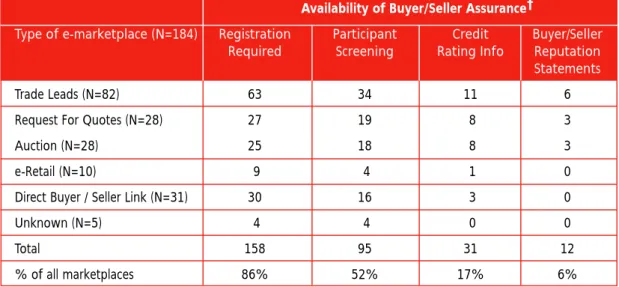
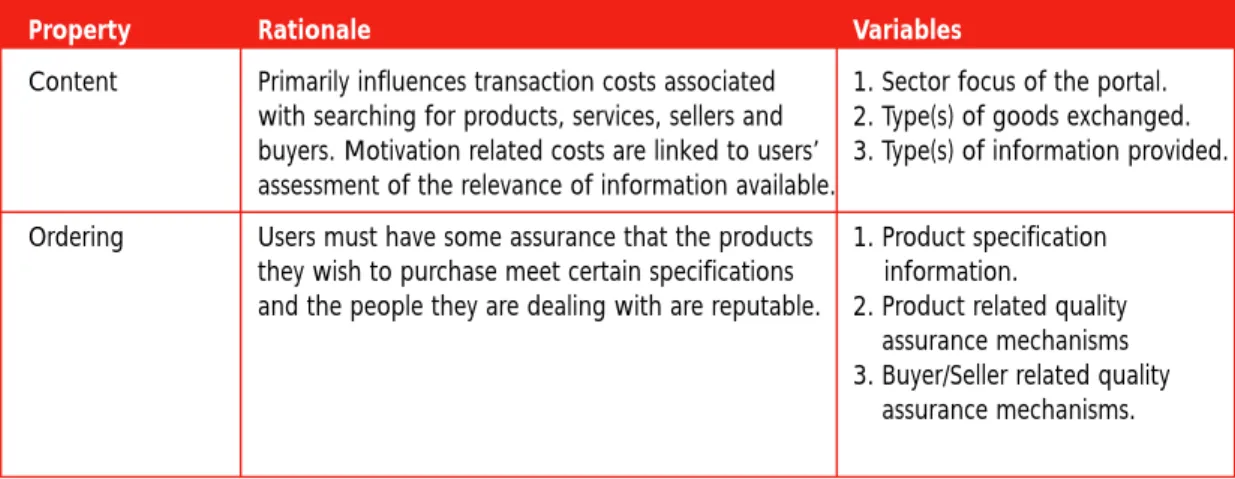
A crucial issue for the use of e-marketplaces is how to establish trust. Firms purchasing products on-line need assurances about the companies they are dealing with and about the products they are buying. Firms selling products on-line need to be confident that payment will be made. Trust-enhancing processes to support the use of e-marketplaces are very important and these were very weakly developed in the e-marketplaces included in this study. An extremely limited amount of product and partner information was available to users of the e-marketplaces. ‘Buyer and seller beware’ was the norm. Of the 117 e-marketplace providers, 46 per cent noted on their Web sites that they did not mediate between firms using their sites. It was the user’s responsibility to evaluate whether to enter into an exchange agreement with another firm.For potential trading partners with no prior relationship with each other, the registration requirements and the screening procedures applied by the providers of these e-marketplaces were unlikely to generate trust between ‘strangers’. Before entering into a commercial arrangement with a ‘stranger’, access to information about credit history, annual turnover and previous trading associates would be desirable. Firms could then evaluate the legitimacy and credibility of a potential trading partner.
Information about trading partners was available only to a very limited extent from the e-marketplaces, as shown in Table 4.2. Most sites required some form of registration, but this by itself would provide very little assurance to users. Key informants suggested that registration has to be kept as simple as possible. Complex registration requirements tend to reduce the number of firms registering. It seems likely that many e-marketplace providers do little more than weed out obviously fraudulent firms. Some type of additional participant screening was offered by slightly more than 50 per cent of the e-marketplaces, but the effectiveness of the screening was not assessed. The provision of further, firm-specific information on firms was even more limited (see Table 4.2). Credit rating information on participating firms was available in only 17 per cent of the e-marketplaces. In these instances, the information was available only for an unspecified fee by contacting a third party or a ‘strategic partner’ linked to the site, e.g. Dun and Bradstreet, The CIT Group, etc. Reputation statements about buyers or sellers were available in only 6 per cent of the e-marketplaces.
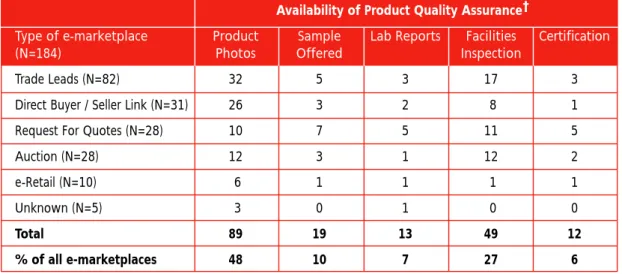
Assessment of quality or product characteristics either via the Internet or by following up contacts off-line could, in principle, be managed in a variety of ways. These include the use of digital photographs, the provision of product samples, laboratory reports on products, inspection of facilities and provision of information about certification to international standards such as the ISO 9000 quality standard and the SA 8000 social accountability standard.15Such information was generally not made available for the products being offered for sale in the e-marketplaces studied (see Table 4.3). In more than three-quarters of the 184 e-marketplaces, it was left to the buyers and sellers to decide the amount and type of product
Table 4.2: Availability of on-line information about trading partners
Availability of Buyer/Seller Assurance†
Type of e-marketplace (N=184) Registration Participant Credit Buyer/Seller Required Screening Rating Info Reputation
Statements
Trade Leads (N=82) 63 34 11 6
Request For Quotes (N=28) 27 19 8 3
Auction (N=28) 25 18 8 3
e-Retail (N=10) 9 4 1 0
Direct Buyer / Seller Link (N=31) 30 16 3 0
Unknown (N=5) 4 4 0 0
Total 158 95 31 12
% of all marketplaces 86% 52% 17% 6%
† The data indicate the number of times specific mention was made of users having access to quality assurance applications. In some instances more than one was mentioned.