Richard F. Eng
PRINCE2, PMP, CSQE, CRE, CQE
14 March 2014
Applying Process Mining to
IT Big Data
The author’s affiliation with The MITRE Corporation
is provided for identification purposes only, and is
not intended to convey or imply MITRE’s
concurrence with, or support for, the positions,
opinions, or viewpoints expressed by the author.
Biography
Big Data Definitions
Process Mining
Quantitative Analysis Stages and Steps
Applying Process Mining
Lessons Learned
Biography
Principal Software Systems Engineer at the MITRE
Corporation
Over 20 years of industry experience in telecommunications
and software systems
Areas of interests
–
Solving systems level problems
–
Applying quantitative methods to improve business , IT
processes, and software quality
Education:
–
M.S. in Data Analytics, University of Maryland (Expected 2015)
–
MBA, Georgetown University
–
M.S. in Bioengineering, Brooklyn Polytechnic Institute
–
B.S. in Chemistry, Brooklyn Polytechnic Institute
Big data is data which
“exceed(s) the capacity or capability of
current or conventional methods and systems.”
In other words,
the notion of “big” is relative to the current standard of
computation.
The National Institute of Standards and Technology
“… the increasing size of data, the increasing rate at which it is
produced and the increasing range of formats and
representations employed. This report predated the term “big
data” but proposed a three-fold definition encompassing the
“
three Vs”: Volume, Velocity and Variety
. This idea has since
become popular and sometimes includes a
fourth V: Veracity
, to
cover questions of trust and uncertainty
.”
Gartner. In 2001, a Meta (now Gartner) report
“Big data is the term increasingly used to describe the process of
applying
serious computing power
—the latest in
machine learning
and
artificial intelligence
— to
seriously massive
and often
highly
complex sets of information
.”
Microsoft
“Big data opportunities emerge in organizations generating a
median of
300 terabytes of data a week.
The most common forms of
data analyzed in this way are
business transactions
stored in
relational databases
, followed by
documents, e-mail, sensor data,
blogs, and social media.
Intel
The Method for an Integrated Knowledge Environment open-source
project. The MIKE project argues that big data is
not a function of the
size of a data set
but its
complexity
. Consequently, it is the high
degree of
permutations
and
interactions
within a data set that
defines big data.
Data analytics technique
System agnostic
Examines large amounts of process data
Provides the ability to
–
Evaluate and understand actual process flows
–
Compare actual against expected process flows from a
Policy, procedures, and/or Information Technology perspective
Impact of visualizing actual process flows
–
Detection of process patterns
–
Identification of process inefficiencies
–
Identification of anomalous behavior
Process Mining
Frame the Problem
• Problem
recognition
• Review previous
results
Solving the Problem
• Modeling and
variable selection
• Data collection
• Data analysis
Communicating and
Acting On Results
• Results
presentation and
action
Quantitative Analysis 3 Stages and 6 Steps
Source: Keeping up with the Quants: Your Guide
to Understanding and Using Analytics –
Problem recognition
–
Figure out where the problems are with the
SYSTEM
& fix them fast
–
E-Commerce site experiencing significant operational availability
issues
Site performance degrades and crashes as more customers access services
No current documentation (e.g., Systems requirements, design specifications,
applications software, test procedures, test scripts, etc.)
– We were Agile. We didn’t have time to …
Review of previous results
–
Ad hoc problem solving huddles
It’s not my system. It must be your …
Try this, it should/might fix it …
–
No tracing of business processes to software applications to IT
infrastructure
–
Manual review of system logs
Frame the Problem
“Furious activity is no substitute for understanding.”
- H. H. Williams
Modeling and variable selection
–
Apply process mining to model end user transactions through the
E-commerce site
–
Variables needed
Unique Transaction ID
, Start and Stop
Time Stamp
, and
Activity
Data collection
–
Gain access to system log files
Normal operations
During outages and low operational availability
Data analysis
–
Run process model
–
Review results
–
Provide feedback to stakeholders that own the processes,
application software, and IT infrastructure
Results presentation and action
–
Demonstrate process mining results to stakeholders
–
Capture process mining visualization as a video and e-mail to
stakeholders so they can see the process bottlenecks and
deviations
–
Explain the findings
Modeling and variable selection
–
Process mining
Visualize normal and anomalous operations
– Transaction process flows
– Application process flows
– IT Infrastructure process flows
–
Variables needed
Unique Transaction ID
Start and End Time Stamps
Business Process
Application Software
IT Infrastructure
IP Address
Data collection
–
Talk with system administrators to capture log data
–
Explain the data fields and formats you want
–
Transform the log files into the format that the process mining
system needs
Data analysis
–
Load the data into the process mining model
–
Run the process mining models
–
Visualize and analyze data
Transaction business process flows
Application software process flows
IT infrastructure process flows
–
Review the results
Applying Process Mining to IT Big Data
(Continued)
Data Collection
Transform Data
Run the Model & Data Analysis
Communicate results
–
Provide feedback to stakeholders
Process owners
Application software team
IT Infrastructure team
Benefits
–
Visualization of the actual process flows
–
Comparison of normal and anomalous operations - rather than
manually reviewing individual system logs
–
More rapidly identify spurious processes
Applying Process Mining to IT Big Data
(Continued)
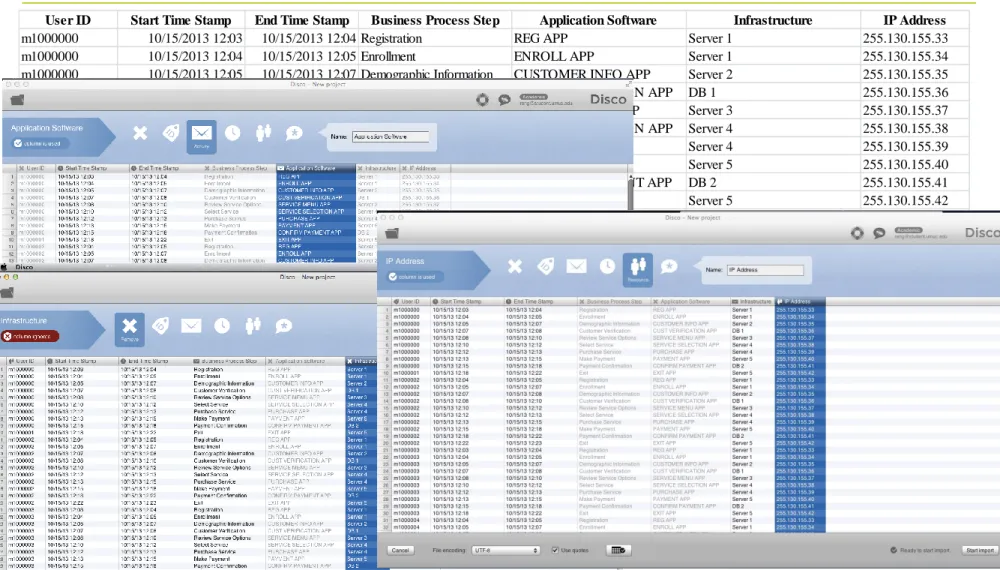
Illustration of Process Mining Data
User ID Start Time Stamp End Time Stamp Business Process Step Application Software Infrastructure IP Address
m1000000 10/15/2013 12:03 10/15/2013 12:04 Registration REG APP Server 1 255.130.155.33 m1000000 10/15/2013 12:04 10/15/2013 12:05 Enrollment ENROLL APP Server 1 255.130.155.34 m1000000 10/15/2013 12:05 10/15/2013 12:07 Demographic Information CUSTOMER INFO APP Server 2 255.130.155.35 m1000000 10/15/2013 12:07 10/15/2013 12:08 Customer Verification CUST VERIFICATION APP DB 1 255.130.155.36 m1000000 10/15/2013 12:08 10/15/2013 12:10 Review Service Options SERVICE MENU APP Server 3 255.130.155.37 m1000000 10/15/2013 12:10 10/15/2013 12:12 Select Service SERVICE SELECTION APP Server 4 255.130.155.38 m1000000 10/15/2013 12:12 10/15/2013 12:13 Purchase Service PURCHASE APP Server 4 255.130.155.39 m1000000 10/15/2013 12:13 10/15/2013 12:15 Make Payment PAYMENT APP Server 5 255.130.155.40 m1000000 10/15/2013 12:15 10/15/2013 12:18 Payment Confirmation CONFIRM PAYMENT APP DB 2 255.130.155.41 m1000001 10/15/2013 12:18 10/15/2013 12:22 Exit EXIT APP Server 5 255.130.155.42 m1000002 10/15/2013 12:04 10/15/2013 12:05 Registration REG APP Server 1 255.130.155.33 m1000002 10/15/2013 12:05 10/15/2013 12:07 Enrollment ENROLL APP Server 1 255.130.155.34 m1000002 10/15/2013 12:07 10/15/2013 12:08 Demographic Information CUSTOMER INFO APP Server 2 255.130.155.35 m1000002 10/15/2013 12:08 10/15/2013 12:10 Customer Verification CUST VERIFICATION APP DB 1 255.130.155.36 m1000002 10/15/2013 12:10 10/15/2013 12:12 Review Service Options SERVICE MENU APP Server 3 255.130.155.37 m1000002 10/15/2013 12:12 10/15/2013 12:13 Select Service SERVICE SELECTION APP Server 4 255.130.155.38 m1000002 10/15/2013 12:13 10/15/2013 12:15 Purchase Service PURCHASE APP Server 4 255.130.155.39 m1000002 10/15/2013 12:15 10/15/2013 12:18 Make Payment PAYMENT APP Server 5 255.130.155.40 m1000002 10/15/2013 12:18 10/15/2013 12:22 Payment Confirmation CONFIRM PAYMENT APP DB 2 255.130.155.41 m1000002 10/15/2013 12:22 10/15/2013 12:23 Exit EXIT APP Server 5 255.130.155.42