Notice: This is a reference manual only. For official information, please refer to the Miami 21
Code, as amended, the Zoning Ordinance of the City of Miami. Additional regulations may be
applicable. All applications require zoning review and referral prior to commencement.
City of Miami Zoning Information
Urban Core Transect
T6-8
Miami 21 Zoning Code
III.8
AS ADOPTED - APRIL 2013
j. 22nd Avenue
1. Boundary: 22nd Avenue from NW 1st Street to SW 8th Street.
22nd Ave Setback: Zero (0’) feet with Arcade
k. Central Coconut Grove
1. Boundary:
• All properties Adjacent to Grand Avenue between Margaret Street and Mary Street.
• All properties Adjacent to Commodore Plaza between Grand Avenue and Main Highway
• All properties Adjacent to Fuller Street between Grand Avenue and Main Highway.
• All properties Adjacent to Main Highway between Charles Avenue to Grand Avenue.
• All properties Adjacent to McFarlane Road between Grand Avenue and South Bayshore
Drive.
• All properties Adjacent to Virginia Street between Oak Avenue and Grand Avenue.
• All properties Adjacent to Florida Avenue between Virginia Street and Mary Street.
• All properties Adjacent to Rice Street between Oak Avenue and Florida Avenue.
• All properties on the west side of Mary Street between Oak Avenue and Grand Avenue.
• All properties on the south side of Oak Avenue between Matilda Street and Tigertail
Avenue.
Central Coconut Grove Setback (on the streets listed above): Five (5) feet.
3.4
DENSITY AND INTENSITY CALCULATIONS
3.4.1
Lot Area, inclusive of any dedications, is used for purposes of Density and Intensity calculation.
3.4.2
Density shall be calculated in terms of units as specified by Article 4, Tables 3 and 4. The referenced
tables provide the maximum allowable Densities. Intensity shall be calculated in terms of Floor Lot
Ratio. The buildable Density or Intensity on any particular site will be affected by other regulations
in this Code and thus the stated maximums of this Miami 21 Code may exceed the actual Capacity
that a site can sustain when other regulations of this Code are applied to the site. The inability to
reach the maximum Density or Intensity because of the necessity to conform to the other regulations
of this Code shall not constitute hardship for purposes of a Variance.
3.4.3
Lodging Units shall be considered as equivalent to one-half (0.50) of a Dwelling Unit.
3.4.4
The allowable Transect Zone Density may be increased as provided by the Future Land Use Element
of the Miami Comprehensive Plan (Residential Density Increase Areas), as illustrated in Article 4,
Diagram 9.
3.5
MEASUREMENT OF HEIGHT
3.5.1
Unless otherwise specified herein, the Height of Buildings shall be measured in Stories. The height
of Fences and walls shall be measured in feet. The Height of Buildings, Fences and walls shall be
measured from the Average Sidewalk Elevation or, where no sidewalk exists, the average of the
III.9
AS ADOPTED - APRIL 2013
record profile grade elevation of the street Abutting the Principal Frontage of the Building, as
deter-mined by the Public Works Department. In the event that the base flood elevation, as established
by FEMA, is higher than the sidewalk or grade elevations, the Height of the first Story but not the
height of Fences and walls shall be measured from the base flood elevation.
3.5.2
A Story is a Habitable level within a Building of a maximum fourteen (14) feet in Height from finished
floor to finished floor. Basements are not considered Stories for the purposes of determining Building
Height. A ground level retail Story may exceed this limit up to a total height of twenty-five (25) feet. A
single floor level exceeding fourteen (14) feet, or twenty-five (25) feet at ground level retail, shall be
counted as two (2) Stories; except for T6-36, T6-48, T6-60, T6-80, and D1, where a single floor level
exceeding fourteen (14) feet may count as one (1) story if the building height does not exceed the
maximum height, including all applicable bonuses, allowed by the transect at fourteen (14) feet per
floor. Where the first two stories are retail, their total combined Height shall not exceed thirty-nine
(39) feet and the first floor shall be a minimum of fourteen (14) feet in Height. Mezzanines may not
exceed thirty-three percent (33%) of the Habitable Space Floor Area, except for D1, where
mezza-nines may not exceed fifty percent (50%) of the Habitable Space Floor Area. Mezzamezza-nines extending
beyond thirty-three percent (33%) of the Floor Area, or fifty percent (50%) of the Floor Area in D1,
shall be counted as an additional floor. The Height of a Parking Structure concealed by a Liner may
be equal to the Height of the Liner; this may result in a Liner Story concealing more than one level
of Parking.
3.5.3
Except as specifically provided herein, the Height limitations of this Code shall not apply to any roof
Structures for housing elevators, stairways, tanks, ventilating fans, solar energy collectors, or similar
equipment required to operate and maintain the Building (provided that such Structures shall not
cover more than twenty percent (20%) of roof area for T4 and T5); nor to church spires, steeples,
belfries, monuments, water towers, flagpoles, vents, or similar Structures, which may be allowed
to exceed the maximum Height by Waiver; nor to fire or parapet walls, which shall not extend more
than five (5) feet above the maximum Height in T4 and T5 and ten (10) feet in T6 and Districts.
3.5.4
No Building or other Structure shall be located in a manner or built to a Height which constitutes a
hazard to aviation or creates hazards to persons or property by reason of unusual exposure to
avia-tion hazards. In addiavia-tion to Height limitaavia-tions established by this Code, limitaavia-tions established by
the Miami-Dade County Height Zoning Ordinance as stated in Article 37 of the Code of Miami-Dade
County (Miami International Airport) shall apply to Heights of Buildings and Structures.
A letter authorizing clearance from the Miami-Dade Aviation Department or the Federal Aviation
Administration (FAA) may be required by the Zoning Administrator prior to the issuance of any
Building permit.
Construction of an Educational facility within the delineated Miami International Airport Critical
Ap-proach Area as defined by the Miami-Dade County Code shall only be granted by Exception.
Con-struction of such facility is subject to the approval by the Miami-Dade County Aviation Department
or any other agencies authorized by law to approve the construction.
3.5.5
Height limitations for Properties Abutting and in Proximity to National Historic Landmarks
a. All properties designated a National Historic Landmark (NHL) which include a Designed
Land-scape that is an integral part of the documented significance supporting the NHL designation shall
be protected by height limitations throughout the entire Civic Institution zoned property of which
the NHL is a part, so as to protect the Designed Landscape from the potentially adverse effects
III.10
AS ADOPTED - APRIL 2013
of an undertaking that may diminish the integrity of the NHL property’s location, design, setting,
materials, workmanship, association or qualities that qualified it for NHL designation. Examples
of adverse effects which diminish the integrity of the NHL property include those which: cause
physical destruction of or damage to all or part of the NHL property; or change the character of
the NHL property’s use or physical features within the NHL property’s setting that contribute to
its historic significance; or introduce visual, atmospheric or audible elements that diminish the
integrity of the NHL property’s significant historic features; or alter the NHL property in a way that
is not consistent with the federal standards for the treatment of historic properties and applicable
guidelines, as published by the United States Department of the Interior.
b. The height of structures throughout the entire Civic Institution zoned property of which the NHL
is a part shall not exceed that established by a six (6) degree vertical plane which is measured
beginning from the ground floor elevation of the principal historic building at the façade that
over-looks the Designed Landscape, which plane shall extend in a one hundred eighty (180) degree
arc facing the Designed Landscape and measured at grade from the midpoint of the building
façade. The ground floor elevation shall be measured according to the 1929 N.G.V.D. of Mean
Sea Level supplied by the City of Miami. Structures existing on affected properties at the time of
the effective date of this Miami 21 Code shall not be considered nonconforming structures.
c. Should the height limitations for structures located in such Civic Institution zoned property as of
the effective date of this Miami 21 Code be more restrictive than that created by this section, the
most restrictive height shall apply. In the event of a rezoning of all or part of the Civic Institution
property, either by successional zoning or by Special Area Plan, the height limitations specified
in this Section 3.5.5 shall be incorporated in all subsequent rezonings.
d. For purposes of this Section 3.5.5., the following definitions shall apply:
1. Designed Landscape is one or more of the following:
• a landscape that has significance as a design or work of art;
• a landscape consciously designed and laid out by a master gardener, landscape
archi-tect, archiarchi-tect, or horticulturalist to a design principle, or an owner or other amateur using
a recognized style or tradition in response or reaction to a recognized style or tradition;
• a landscape having a historical association with a significant person, trend, event, etc. in
landscape gardening or landscape architecture; or
• a landscape having a significant relationship to the theory or practice of landscape
ar-chitecture.
2. National Historic Landmark is a nationally significant historic place designated by the Secretary
of the Interior because it possesses exceptional value or quality in illustrating or interpreting
the heritage of the United States, and defined in Title 36, Section 65.3 of the Code of Federal
Regulations.
3.5.6
See Chapter 23 of the City Code, titled Historic Preservation, for regulations and additional height
requirements.
III.25
AS ADOPTED - APRIL 2013
2. Portions of SD-2, originally adopted by Ord. No. 12651, January 27, 2005; and
3. SD 18, originally adopted by Ord. No. 10863, March 28, 1991; and
4. SD 18.1, originally adopted by Ord. No. 11240, March 27, 1995.
The Coconut Grove NCD is hereby adopted and codified in Appendix A.3 to this Code.
3.13
SUSTAINABILITY
3.13.1
General
a. Landscape requirements are as required in Article 9 of this Code and the City of Miami Tree
Protection regulations of Chapter 17 of the City Code, except that where this Code is more
re-strictive than the Tree Protection regulations, this Code shall apply.
b. All new Buildings of more than 50,000 square feet of Habitable Rooms and Habitable Space in
the T5, T6, CI and CS zones shall be at a minimum certified as Silver by the United States Green
Building Council (USGBC) Leadership in Energy and Environmental Design (LEED) standards
or equivalent standards adopted or approved by the City.
1. At the time of Building Permit application, the owner shall submit:
c. Proof of registration with the Green Building Certification Institute, or equivalent agency;
d. A signed and sealed affidavit from a LEED Accredited Professional, or applicable designation,
stating that the proposed Building is designed
to achieve the required certification; and
e. A LEED Scorecard, or equivalent document, identifying anticipated credits to be achieved.
2. At the time of Certificate of Occupancy application, the owner shall submit:
f. Proof of certification by the Green Building Certification Institute, or equivalent agency;
g. A bond posted in a form acceptable to the City, in the amount indicated below;
i. Two percent (2%) of the total cost of construction for a 50,000 - 100,000 square feet Building;
ii. Three percent (3%) of the total cost of construction for a 100,001 - 200,000 square feet
Build-ing;
iii. Four percent (4%) of the total cost of construction for any Building greater than 200,000
square feet; or
h. Proof of partial compliance from the Green Building Certification Institute, or applicable agency,
which demonstrates the credits presently achieved. In addition, a prorated portion of the full
bond amount, as indicated in subsection 2(b) above, shall be posted based on the number of
III.26
AS ADOPTED - APRIL 2013
remaining credits needed to meet minimum certification requirements. The bond amount to be
posted shall be calculated as follows:
(credits remaining for certification / credits required for certification) x full bond amount = prorated
bond amount
3. Forfeiture of Bond
A bond under this Section 3.13.1 shall be forfeited to the City in the event that the Building
does not meet the for LEED Silver certification or applicable certification. The City will draw
down on the bond funds upon failure of the owner to submit proof of LEED Silver certification
in a form acceptable to the City within one (1) year of the City’s issuance of the Certificate of
Occupancy for the Building. If required certification is not achieved but a majority of the credits
have been verified, the owner shall forfeit a portion of the bond based on any outstanding
credits which shall be calculated as follows:
(credits remaining for certification / credits required for certification) x full bond amount =
bond amount forfeited
If the amount to be forfeited is greater than fifty percent (50%) of the full bond amount, the
bond shall be forfeited in its entirety. Funds that become available to the City from the
for-feiture of the bond shall be placed in the Miami 21 Public Benefits Trust Fund established by
this Code.
i. Affordable Housing Developments that qualify under Section 3.15, may elect to comply with the
sustainability requirements promulgated by the Florida Housing Finance Corporation, or its
suc-cessor agency, in lieu of the requirements set forth in Section 3.13.1.b above.
j. The preservation of Natural Features of land such as trees, vegetation, geological, and other
characteristics and the preservation of features of archaeological significance are declared to
be in the public interest. Said preservation may justify the relaxation of Setbacks or required
Off-street Parking by Waiver. The Zoning Administrator shall determine that the trees, vegetation,
geological and other natural characteristic, or archaeological features are in the Buildable Area
of the Site and not in Setback areas required for the development of the site.
3.13.2
Heat Island Effect
The intent of this section is to reduce the heat island effect in the City of Miami and to consequently
reduce energy consumption and bills for buildings within the City.
a. Applicability
In all Transect Zones, except T3, the provisions of this section are applicable to all new
construc-tion and to repair or replacement greater than fifty percent (50%) by area of existing roofs or site
Hardscape. All repairs or replacement of existing roofing or Hardscape shall be reviewed by the
Zoning Department for compliance with this section. The following portions of new or existing
roofs are exempted from the requirements of section 3.13.2:
1. The portion of the roof acting as a substructure for and covered by a rooftop deck, vegetation
associated with an extensive or intensive green roof as defined by the U.S. Environmental
III.27
AS ADOPTED - APRIL 2013
Protection Agency, or any area of a roof utilized by photovoltaic and solar equipment.
2. A rooftop deck covering a maximum of 1/3 of the rooftop total gross area.
3. Existing roofs where less than fifty percent (50%) of existing roof area is repaired or replaced
are exempt from the requirements of 3.13.2.c.
4. Existing Hardscapes where less than fifty percent (50%) of existing Hardscape area is being
repaired or replaced are exempt from the requirements of 3.13.2.d.
b. Solar Reflectance
1. For roofing materials, all roof exterior surfaces and building materials used to comply with
this section, shall have a minimum Solar Reflectance as specified in sections 3.13.2.c and
3.13.2.d when (i) tested in accordance with ASTM E903 or ASTM E1918, (ii) tested with
a portable reflectometer at near ambient conditions, (iii) labeled by the Cool Roof Rating
Council, or (iv) labeled as an Energy Star qualified roof product. Any product that has been
rated by the Cool Roof Rating Council or by Energy Star shall display a label verifying the
rating of the product.
2. For paving materials, all paving materials used to comply with this section shall have a
mini-mum solar reflectance as specified in sections 3.13.2.d when (i) tested in accordance with
ASTM E903 or ASTM E1918, (ii) tested with a portable reflectometer at near ambient
condi-tions, or (iii) default values of Solar Reflectance for listed materials may be used as follows:
c. Roof
1. Requirements for Low Sloped Roofs
Roofing materials used in roofs with slopes of a rise of zero (0) units in a horizontal length
(0:12 pitch) up to and including roofs with slopes of a rise of two (2) units in a horizontal
length of 12 units (2:12 units) (“low-sloped”) shall meet the following requirements:
a. Low-sloped roofs constructed as part of a new building shall utilize roofing products that meet
or exceed an initial reflectance value of 0.72 or a three-year installed reflectance value of 0.5 as
determined by the Cool Roof Rating Council or by Energy Star.
b. Exception. Where more than 50% of the total gross area of the low-sloped roof is covered with
vegetation associated with an extensive or intensive green roof as defined by the US EPA, the
remainder of the roof shall have a reflectance value of a minimum of 0.30 and the rooftop deck
Material
Solar Reflectance
Typical new gray concrete
0.35
Typical weathered gray concrete
0.20
Typical new white concrete
0.40
Typical weathered white concrete
0.40
New asphalt
0.05
Weathered asphalt
0.10
III.28
AS ADOPTED - APRIL 2013
exception in section 3.13.2.a.1 applies.
c. Exception. Ballasted roofs with a minimum of 15 lbs/sq. ft. or ballast over the entire roof surface
may have a reflectance value of a minimum of 0.30. For the purposes of this section, “ballast”
shall mean river rock aggregate or larger, pavers or other means of weighing down a roofing
membrane over a substrate to resist wind uplift.
2. Requirements for Steep Sloped Roofs
Roofing materials used in roofs with slopes of a rise greater than two (2) units in a horizontal
length (2:12 pitch) (“steep-sloped”) shall meet the following requirements:
(a)
Steep sloped roofs shall have an initial Solar Reflectance of 0.15 or greater.
3. Requirements for Roofs with Multiple Slopes
Roofs with multiple slopes shall be subject to those requirements applicable to the slope which
covers the largest area of the building footprint.
d. Non-roof Requirements
1. Provide any combination of the following strategies for fifty percent (50%) of the site
Hard-scape:
(a)
Shade from solar panels or roofing materials with a Solar Reflectance of at least 0.30.
(b)
Shade from trees within five (5) years of occupancy.
(c)
Paving materials with a Solar Reflectance of at least 0.30.
(d)
Pervious Pavement System.
OR
2. Place a minimum of fifty-percent (50%) of parking spaces under cover (defined as
under-ground, under deck, under roof, or under building). Any roof used to shade or cover parking
must have a Solar Reflectance of at least 0.30.
3.14
PUBLIC BENEFITS PROGRAM
The intent of the Public Benefits Program established in this section is to allow bonus Building Height
and FLR in T6 Zones and bonus Building Height in D1 Zones in exchange for the developer’s
con-tribution to specified programs that provide benefits to the public.
3.14.1
The bonus Height and FLR shall be permitted if the proposed Development contributes toward the
specified public benefits, above that which is otherwise required by this Code, in the amount and in
the manner as set forth herein.
The bonus shall not be available to properties in a T6 Zone if the property abuts a T3 Zone or in a
T6-8 Zone if the property abuts a CS Zone.
IV.5
AS ADOPTED - APRIL 2013
ARTICLE 4. TABLE 1 TRANSECT ZONE DESCRIPTIONS
THE NATURAL ZONE
consists of lands
approximat-ing a wilderness condition, permanently set aside for
conservation in an essentially natural state.
THE RURAL ZONE
consists of lands in open or cultivated
state or sparsely settled. These include woodland,
grassland and agricultural land.
T
HE SUB-URBAN ZONE
consists of low-Density
areas, primarily comprised of Single-Family and Two
Family residential units with relatively deep Setbacks,
Streetscapes with swales, and with or without
Side-walks. Blocks may be large and the roads may be
of irregular geometry to accommodate natural and
historic conditions.
THE GENERAL URBAN ZONE
consists of a Mixed-Use
but primarily residential urban fabric with a range of
Building types including rowhouses, small apartment
Buildings, and bungalow courts. Setbacks are short
with an urban Streetscape of wide Sidewalks and trees
in planters. Thoroughfares typically define
medium-sized blocks.
THE URBAN CENTER ZONE
consists of higher Density
Mixed-Use Building types that accommodate retail and
office Uses, rowhouses and apartments. A network of
small blocks has Thoroughfares with wide Sidewalks,
steady street tree planting and Buildings set close to
the Frontages with frequent doors and windows.
THE URBAN CORE ZONE
consists of the highest
Density and greatest variety of Uses, including Civic
Buildings of regional importance. A network of small
blocks has Thoroughfares with wide Sidewalks, with
steady tree planting and Buildings set close to the
Frontage with frequent doors and windows.
THE CIVIC ZONE
consists of public use space and
facilities that may contrast in use to their surroundings
while reflecting adjacent Setbacks and landscape.
THE DISTRICT ZONE
consists of the least regulated
Building and accommodates commercial and industrial
Uses of a scale and with a Streetscape that facilitate
vehicular access.
T1
T2
T3
T4
T5
T6
C
D
MIAMI 21
IV.6
AS ADOPTED - APRIL 2013
ARTICLE 4. TABLE 2 MIAMI 21 SUMMARY
R U R A L l l l l l l l l l l l l l l l l l l l l l l l l l l l l l l l l l l l l l l l l l
NATURAL ZONE RURAL ZONE SUB-URBAN ZONE GENERAL URBAN ZONE URBAN CENTER ZONE URBAN CORE ZONES
LOT OCCUPATION
a. Lot Area 5,000 s.f. min. 1,400 s.f. - 20,000 s.f. ** 1,200 s.f. - 40,000 s.f.** 5,000 sf. min
40,000 s.f. max.** 5,000 sf. min.70,000 s.f. max.** 5,000 sf. min.100,000 s.f.max. ** b. Lot Width 50 ft. min. 16 ft. min / 50 ft. min.** 16 ft. min / 50 ft. min.** 50 ft. min. 50 ft. min. 50 ft. min. c. Lot Coverage 50% max.1st Floor
30% max. 2nd Floor for T3 R & T3L only
60% max. 80% max. 80% max.** 80% max.** 80% max.**
d. Floor Lot Ratio (FLR) 5 / 25% additional Public
Benefit *** 8 / 30% additional Public Benefit *** 7 / 30% additional Public Benefit *** e. Frontage at front Setback 50% min. 70% min. 70% min. 70% min. 70% min.
f. Green / Open Space Requirements 25% Lot Area min. 15% Lot Area min. 10% Lot Area min. 10% Lot Area min. 10% Lot Area min. 10% Lot Area min. g. Density 9-18 du/acre max.** 36 du/acre max. 65 du/acre max. 150 du /acre * 150 du /acre * 150 du /acre * BUILDING SETBACK
a. Principal Front 20 ft. min. 10 ft.min. 10 ft. min. 10 ft. min. 10 ft. min. 10 ft. min. b. Secondary Front 10 ft. min. 10 ft. min. 10 ft. min. 10 ft. min. 10 ft. min. 10 ft. min. c. Side 5 ft. min.** 0 ft. min. / 5 ft. min.** 0 ft. min.** 0 ft. min.** 0 ft. min.** 0 ft. min.** d. Rear 20 ft. min. 20 ft. min. 0 ft. min.** 0 ft. min.** 0 ft. min.** 0 ft. min.** OUTBUILDING SETBACK
a. Principal Front 20 ft. min. (T3 L only) 30 ft. min. b. Secondary Front 10 ft. min. (T3 L only) 10 ft. min. c. Side 5 ft. min. (T3 L only) 0 ft. min. / 5 ft. min. d. Rear 5 ft. min. (T3 L only) 5 ft. min. PRIVATE FRONTAGES
a. Common Lawn permitted permitted prohibited prohibited prohibited prohibited b. Porch & Fence permitted permitted prohibited prohibited prohibited prohibited c. Terrace or L.C. prohibited permitted prohibited prohibited prohibited prohibited d. Forecourt prohibited permitted permitted permitted permitted permitted e. Stoop prohibited permitted permitted permitted permitted permitted
f. Shopfront prohibited permitted (T4 L, T4 O) permitted (T5 L, T5 O) permitted (T6-8 L, T6-8 O) permitted (T6-12 L, T6-12 O) permitted (T6-24 L, T6-24 O)
g. Gallery prohibited prohibited permitted ** permitted ** permitted ** permitted ** h. Arcade prohibited prohibited permitted ** permitted ** permitted ** permitted ** BUILDING HEIGHT (Stories)
a. Principal Building 2 max. 3 max. 2 min.
5 max. 2 min.8 max. 2 min.12 max. 2 min.24 max.
b. Outbuilding 2 max. 2 max.
c. Benefit Height
Abutting T6, T5 & T4 only 4 max.** 8 max.** 24 max.**
T6-12 T6-24 T6-8 T5 T4 T3 T2 T1 * Or as modified in Diagram 9
** Note: Refer to Article 5 for Specific Transect Zone Regulations
*** Note: Bonus shall not be available for T6 properties abutting T3 properties (refer to Article 3)
IV.8
AS ADOPTED - APRIL 2013
ARTICLE 4. TABLE 3 BUILDING FUNCTION: USES
T3
SUB-URBAN T4URBAN GENERAL T5URBAN CENTER T6URBAN CORE CCIVIC DDISTRICTS
R L O R L O R L O R L O CS CI CI-HD D1 D2 D3
DENSITY (UNITS PER ACRE) 9 9 18 36 36 36 65 65 65 150* 150* 150* N/A AZ** 150* 36 N/A N/A RESIDENTIAL
SINGLE FAMILY RESIDENCE R R R R R R R R R R R R
COMMUNITY RESIDENCE R R R R R R R R R R R R R
ANCILLARY UNIT R R R R
TWO FAMILY RESIDENCE R R R R R R R R R R
MULTI FAMILY HOUSING R R R R R R R R R R
DORMITORY E E R R R R E R
HOME OFFICE R R R R R R R R R R R R R
LIVE - WORK R R R R R R R
WORK - LIVE R R
LODGING
BED & BREAKFAST W R R E R R E R R R R
INN R R R E R R R R
HOTEL R R R R R
OFFICE
OFFICE R R R R R R E R R R W
COMMERCIAL
AUTO-RELATED COMMERCIAL ESTAB. W W W R R
ENTERTAINMENT ESTABLISHMENT R W R R R R R
ENTERTAINMENT ESTAB. - ADULT R
FOOD SERVICE ESTABLISHMENT R R R R W R R W E R R R W
ALCOHOL BEVERAGE SERVICE ESTAB. E E E E E E E E E E
GENERAL COMMERCIAL R R R R W R R E E R R R W
MARINE RELATED COMMERCIAL ESTAB. W W W W E R R R
OPEN AIR RETAIL W W W W W E R R R W
PLACE OF ASSEMBLY R R E R R E E R R W RECREATIONAL ESTABLISHMENT R R R R E R R R W CIVIC COMMUNITY FACILITY W W W W W W W E W R R RECREATIONAL FACILITY E E E E R R E R R E R R W E W R R RELIGIOUS FACILITY E E E E R R E R R E R R W E R R R W
REGIONAL ACTIVITY COMPLEX E E E
CIVIL SUPPORT
COMMUNITY SUPPORT FACILITY W W W W W W E E R R W
INFRASTRUCTURE AND UTILITIES W W W W W W W W W W W W W E W W R W
MAJOR FACILITY E R E E E MARINA E W W E W W E W W R E R R R PUBLIC PARKING W W E W W E W W E R R R W RESCUE MISSION E R E W W TRANSIT FACILITIES W W E W W E W W E R R R W EDUCATIONAL CHILDCARE E W W E W W W W W E E R E COLLEGE / UNIVERSITY W W W W E R E ELEMENTARY SCHOOL E E E E E E E W W E W W E R E LEARNING CENTER E E R R R R E E R E
MIDDLE / HIGH SCHOOL E E E E E E E W W E W W E R E
PRE-SCHOOL E E E E E E E R R E R R E R E
RESEARCH FACILITY R R R R R R E R R R W
SPECIAL TRAINING / VOCATIONAL E W W W W E R R R W
INDUSTRIAL
AUTO-RELATED INDUSTRIAL ESTBL. R R W
MANUFACTURING AND PROCESSING R R W
MARINE RELATED INDUSTRIAL ESTBL. R R R
PRODUCTS AND SERVICES R R W
STORAGE/ DISTRIBUTION FACILITY R R W
R Allowed By Right
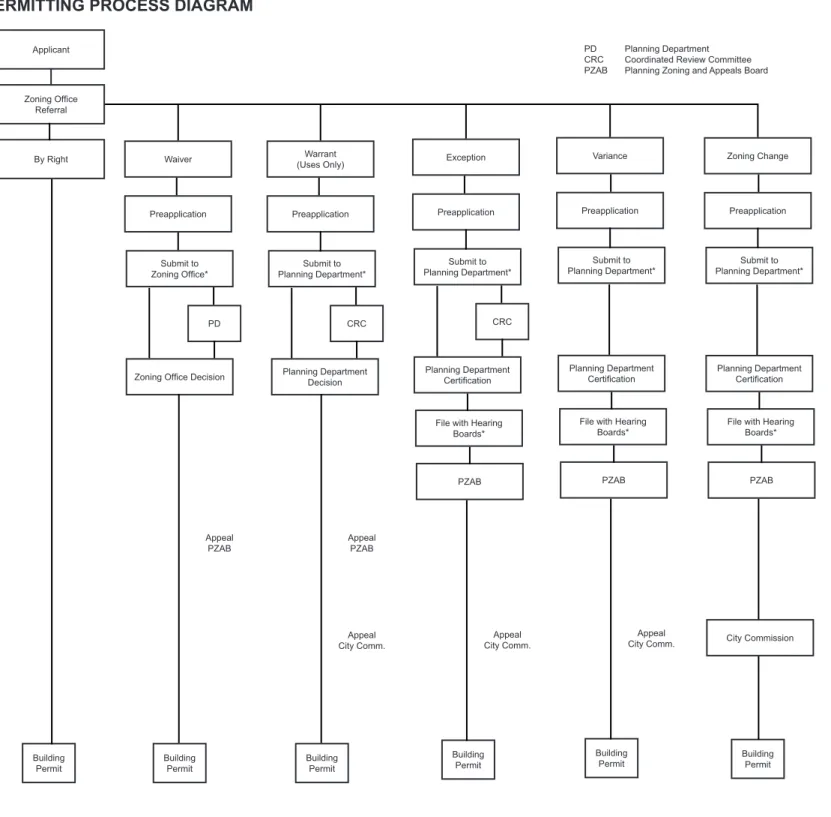
W Allowed By Warrant: Administrative Process - CRC (Coordinated Review Committee) E Allowed By Exception: Public Hearing - granted by PZAB (Planning, Zoning & Appeals Board) Boxes with no designation signify Use prohibited.
Uses may be further modified by Supplemental Regulations, State Regulations, or other provisions of this Code. See City Code Chapter 4 for regulations related to Alcohol Beverage Service Estab. * Additional densities in some T6 zones are illustrated in Diagram 9.
** AZ: Density of lowest Abutting Zone
IV.15
AS ADOPTED - APRIL 2013
T6 - URBAN CORE ZONE
RESTRICTED LIMITED OPEN
DENSITY (UPA) 150 UNITS PER ACRE * 150 UNITS PER ACRE * 150 – 1,000 UNITS PER ACRE * RESIDENTIAL Residential Uses are permissible as listed in Table 3,
limited by compliance with:
• Minimum of 1.5 parking spaces per Dwelling Unit. • Minimum of 1 additional visitor parking space for every
10 Dwelling Units.
• Adult Family-Care Homes - Minimum 1 space per staff member and 1 space per 4 residents.
• Community Residence - Minimum of 1 parking space per staff member in addition to the parking required for the principal Dwelling Unit(s).
• Parking requirement may be reduced according to the shared parking standard, Article 4, Table 5. • Minimum of 1 Bicycle Rack Space for every 20 vehicular
spaces required.
• Parking ratio may be reduced within ½ mile radius of TOD or within ¼ mile radius of a Transit Corridor by thirty percent (30%) by process of Waiver, except when T6 is within 500 feet of T3.
• In T6-60 & T6-80, parking for residential Uses located within 1,000 feet of a Metrorail or Metromover station shall not be required.
• Parking may be provided by ownership or lease offsite within 1,000 feet by process of Waiver, except when site is within 500 feet of T3.
• Loading - See Article 4, Table 5
Residential Uses are permissible as listed in Table 3, limited by compliance with:
• Minimum of 1.5 parking spaces per Dwelling Unit. • Minimum of 1 additional visitor parking space for every
10 Dwelling Units.
• Live-work - Work component shall provide parking as required by the non-residential use in addition to parking required for the Dwelling Unit.
• Adult Family-Care Homes- Minimum 1 space per staff member and 1 space per 4 residents.
• Community Residence- Minimum of 1 parking space per staff member in addition to the parking required for the principal Dwelling Unit(s).
• Parking requirement may be reduced according to the shared parking standard, Article 4, Table 5. • Minimum of 1 Bicycle Rack Space for every 20 vehicular
spaces required.
• Parking ratio may be reduced within ½ mile radius of TOD or within ¼ mile radius of a Transit Corridor by thirty percent (30%) by process of Waiver, except when T6 is within 500 feet of T3.
• In T6-60 & T6-80, parking for residential Uses located within 1,000 feet of a Metrorail or Metromover station shall not be required.
• Parking may be provided by ownership or lease offsite within 1000 feet by process of Waiver, except when site is within 500 feet of T3.
• Loading - See Article 4, Table 5
Residential Uses are permissible as listed in Table 3, limited by compliance with:
• Minimum of 1.5 parking spaces per Dwelling Unit. • Minimum of 1 additional visitor parking space for every
10 Dwelling Units.
• Live-work - Work component shall provide parking as required by the non-residential use in addition to parking required for the Dwelling Unit.
• Adult Family-Care Homes- Minimum 1 space per staff member and 1 space per 4 residents.
• Community Residence- Minimum of 1 parking space per staff member in addition to the parking required for the principal Dwelling Unit(s).
• Parking requirement may be reduced according to the shared parking standard, Article 4, Table 5. • Minimum of 1 Bicycle Rack Space for every 20 vehicular
spaces required.
• Parking ratio may be reduced within ½ mile radius of TOD or within ¼ mile radius of a Transit Corridor by thirty percent (30%) by process of Waiver, except when T6 is within 500 feet of T3.
• In T6-60 & T6-80, parking for residential Uses located within 1,000 feet of a Metrorail or Metromover station shall not be required.
• Parking may be provided by ownership or lease offsite within 1000 feet by process of Waiver, except when site is within 500 feet of T3.
• Loading - See Article 4, Table 5
LODGING Lodging Uses are permissible as listed in Table 3.
• Minimum of 1 parking space for every 2 lodging units. • Minimum of 1 additional visitor parking space for every
10 lodging units.
• Parking requirement may be reduced according to the shared parking standard, Article 4, Table 5. • Minimum of 1 Bicycle Rack Space for every 20 vehicular
spaces required.
• Parking ratio may be reduced within ½ mile radius of TOD or within ¼ mile radius of a Transit Corridor by thirty percent (30%) by process of Waiver, except when site is within 500 feet of T3.
• Parking may be provided by ownership or lease offsite within 1,000 feet by process of Waiver, except when site is within 500 feet of T3.
• Loading - See Article 4, Table 5
Lodging Uses are permissible as listed in Table 3. • Minimum of 1 parking space for every 2 lodging units. • Minimum of 1 additional visitor parking space for every
10 lodging units.
• Parking requirement may be reduced according to the shared parking standard, Article 4, Table 5. • Minimum of 1 Bicycle Rack Space for every 20 vehicular
spaces required.
• Parking ratio may be reduced within ½ mile radius of TOD or within ¼ mile radius of a Transit Corridor by thirty percent (30%) by process of Waiver, except when site is within 500 feet of T3.
• Parking may be provided by ownership or lease offsite within 1,000 feet by process of Waiver, except when site is within 500 feet of T3.
• Loading - See Article 4, Table 5
Lodging Uses are permissible as listed in Table 3. • Minimum of 1 parking space for every 2 lodging units. • Minimum of 1 additional visitor parking space for every
15 lodging units.
• Parking requirement may be reduced according to the shared parking standard, Article 4, Table 5. • Minimum of 1 Bicycle Rack Space for every 20 vehicular
spaces required.
• Parking ratio may be reduced within ½ mile radius of TOD or within ¼ mile radius of a Transit Corridor by thirty percent (30%) by process of Waiver, except when site is within 500 feet of T3.
• Parking may be provided by ownership or lease offsite within 1,000 feet by process of Waiver, except when site is within 500 feet of T3.
• Loading - See Article 4, Table 5
OFFICE Office Uses are permissible as listed in Table 3, limited
by compliance with:
• The Building area allowed for office use on each lot is limited to four Stories of the Principal Building and Office and Commercial Uses shall be less than 25% of Building floor area total.
• Minimum of 3 parking spaces for every 1,000 square feet of office use.
• In T6-24, T6-36 and T6-48 a minimum of 1 parking space for every 800 square feet of office use shall be provided
• In T6-60 and T6-80, a minimum of 1 parking space for every 1,000 square feet of office use shall be provided • Parking requirement may be reduced according to the
Shared Parking Standard, Article 4, Table 5. • Minimum of 1 Bicycle Rack Space for every 20 vehicular
spaces required.
• Parking ratio may be reduced within ½ mile radius of TOD or within ¼ mile radius of a Transit Corridor by thirty percent (30%) by process of Waiver, except when site is within 500 feet of T3.
• Parking may be provided by ownership or lease offsite within 1,000 feet by process of Waiver, except when site is within 500 feet of T3.
• Loading - See Article 4, Table 5
Office Uses are permissible as listed in Table 3. • Minimum of 3 parking spaces for every 1,000 square
feet of office use.
• In T6-24, T6-36 and T6-48, a minimum of 1 parking space for every 800 square feet of office use shall be provided
• In T6-60 and T6-80, a minimum of 1 parking space for every 1,000 square feet of office use shall be provided • Parking requirement may be reduced according to the
shared parking standard, Article 4, Table 5. • Minimum of 1 Bicycle Rack Space for every 20 vehicular
spaces required.
• Parking ratio may be reduced within ½ mile radius of TOD or within ¼ mile radius of a Transit Corridor by thirty percent (30%) by process of Waiver, except when site is within 500 feet of T3.
• Parking may be provided by ownership or lease offsite within 1,000 feet by process of Waiver, except when site is within 500 feet of T3.
• Loading - See Article 4, Table 5
* Or as modified in Diagram 9
ARTICLE 4. TABLE 4 DENSITY, INTENSITY AND PARKING (CONTINUED)
IV.16
AS ADOPTED - APRIL 2013
T6 - URBAN CORE ZONE
RESTRICTED LIMITED OPEN
DENSITY (UPA) 150 UNITS PER ACRE * 150 UNITS PER ACRE * 150 UNITS PER ACRE * COMMERCIAL Commercial Uses are permissible as listed in Table 3,
limited by compliance with:
• Commercial establishments limited to a maximum area of 4,000 square feet each and shall be less than 25% building floor area total.
• The Building area allowed for commercial use on each lot is limited to the first two Stories of the Principal Building. • Minimum of 3 parking spaces for every 1,000 square feet
of commercial use.
• Parking requirement may be reduced according to the shared parking standard, Article 4, Table 5. • Minimum of 1 Bicycle Rack Space for every 20 vehicular
spaces required.
• Loading - See Article 4, Table 5
Commercial Uses are permissible as listed in Table 3, limited by compliance with:
• The Building area allowed for Commercial Use on each lot is limited to two Stories of the Principal Building and Office and Commercial Uses shall be less than 25% of Building floor area total.
• A maximum area of 55,000 square feet per establish-ment.
• Minimum of 3 parking spaces for every 1,000 square feet of commercial use.
• Parking requirement may be reduced according to the shared parking standard, Article 4, Table 5. • Minimum of 1 Bicycle Rack Space for every 20 vehicular
spaces required.
• Parking ratio may be reduced within ½ mile radius of TOD or within ¼ mile radius of a Transit Corridor by thirty percent (30%) by process of Waiver, except when site is within 500 feet of T3.
• Parking may be provided by ownership or lease offsite within 1,000 feet by process of Waiver, except when site is within 500 feet of T3.
• Loading - See Article 4, Table 5
Commercial Uses are permissible as listed in Table 3, limited by compliance with:
• A maximum area of 55,000 square feet per establishment, except for Public Storage Facilities.
• Minimum of 3 parking spaces for every 1,000 square feet of commercial use, except for Public Storage Facilities, minimum 1 parking space for every 10,000 square feet with a minimum of 8 parking spaces.
• Parking requirement may be reduced according to the Shared parking standard, Article 4, Table 5, except for Public Storage Facilities.
• Minimum of 1 Bicycle Rack Space for every 20 vehicular spaces required.
• Auto-related - Drive-Thru or Drive-In Facilities - See Article 6.
• Parking ratio may be reduced within ½ mile radius of TOD or within ¼ mile radius of a Transit Corridor by thirty percent (30%) by process of Waiver, except when site is within 500 feet of T3.
• Parking may be provided by ownership or lease offsite within 1,000 feet by process of Waiver, except when site is within 500 feet of T3.
• Loading - See Article 4, Table 5
CIVIC Civic Uses are permissible as listed in Table 3, limited by
compliance with:
• Minimum of 1 parking space for every 5 seats of assembly uses.
• Minimum of 1 parking space for every 1,000 square feet of exhibition or recreation area, and parking spaces for other Uses as required.
• Parking requirement may be reduced according to the shared parking standard, Article 4, Table 5. • Minimum of 1 Bicycle Rack Space for every 20 vehicular
spaces required.
• Loading - See Article 4, Table 5
Civic Uses are permissible as listed in Table 3, limited by compliance with:
• Minimum of 1 parking space for every 5 seats of as-sembly uses.
• Minimum of 1 parking space for every 1,000 square feet of exhibition or recreation area, and parking spaces for other Uses as required.
• Parking requirement may be reduced according to the shared parking standard, Article 4, Table 5. • Minimum of 1 Bicycle Rack Space for every 20 vehicular
spaces required.
• Parking ratio may be reduced within ½ mile radius of TOD or within ¼ mile radius of a Transit Corridor by thirty percent (30%) by process of Waiver, except when site is within 500 feet of T3.
• Parking may be provided by ownership or lease offsite within 1,000 feet by process of Waiver, except when site is within 500 feet of T3.
• Loading - See Article 4, Table 5
Civic Uses are permissible as listed in Table 3, limited by compliance with:
• Minimum of 1 parking space for every 5 seats of as-sembly uses.
• Minimum of 1 parking space for every 1,000 square feet of exhibition or recreation area, and parking spaces for other Uses as required.
• Parking requirement may be reduced according to the shared parking standard, Article 4, Table 5. • Minimum of 1 Bicycle Rack Space for every 20 vehicular
spaces required.
• Parking ratio may be reduced within ½ mile radius of TOD or within ¼ mile radius of a Transit Corridor by thirty percent (30%) by process of Waiver, except when site is within 500 feet of T3.
• Parking may be provided by ownership or lease offsite within 1,000 feet by process of Waiver, except when site is within 500 feet of T3.
• Loading - See Article 4, Table 5
CIVIL SUPPORT Civil Support Uses are permissible as listed in Table 3,
limited by compliance with:
• Minimum of 1 parking space for every 800 square feet of Civil Support Use; or
• Minimum of 1 parking space for every 5 seats of assembly use; or
• Minimum of 1 parking space for every 5 slips of marine use; or
• Parking requirement may be reduced according to the shared parking standard, Article 4, Table 5. • Minimum of 1 Bicycle Rack Space for every 20 vehicular
spaces required.
• Parking ratio may be reduced within ½ mile radius of TOD or within ¼ mile radius of a Transit Corridor by thirty percent (30%) by process of Waiver, except when site is within 500 feet of T3.
• Loading - See Article 4, Table 5
Civil Support Uses are permissible as listed in Table 3, limited by compliance with:.
• Minimum of 1 parking space for every 1000 square feet of Civil Support Use.
• Minimum of 1 parking space for every 5 seats of assembly use.
• Minimum of 1 parking space for every 5 slips of marine use.
• Adult Daycare - Minimum of 1 space per staff member. • Parking requirement may be reduced according to the
shared parking standard, Article 4, Table 5. • Minimum of 1 Bicycle Rack Space for every 20 vehicular
spaces required.
• Parking ratio may be reduced within ½ mile radius of TOD or within ¼ mile radius of a Transit Corridor by thirty percent (30%) by process of Waiver, except when site is within 500 feet of T3.
• Parking may be provided by ownership or lease offsite within 1,000 feet by process of Waiver, except when site is within 500 feet of T3.
• Loading - See Article 4, Table 5
Civil Support Uses are permissible as listed in Table 3, limited by compliance with:.
• Minimum of 1 parking space for every 1000 square feet of Civil Support Use.
• Minimum of 1 parking space for every 5 seats of assembly use.
• Minimum of 1 parking space for every 5 slips of marine use.
• Adult Daycare - Minimum of 1 space per staff member. • Parking requirement may be reduced according to the
shared parking standard, Article 4, Table 5. • Minimum of 1 Bicycle Rack Space for every 20 vehicular
spaces required.
• Parking ratio may be reduced within ½ mile radius of TOD or within ¼ mile radius of a Transit Corridor by thirty percent (30%) by process of Waiver, except when site is within 500 feet of T3.
• Parking may be provided by ownership or lease offsite within 1,000 feet by process of Waiver, except when site is within 500 feet of T3.
• Loading - See Article 4, Table 5
ARTICLE 4. TABLE 4 DENSITY, INTENSITY AND PARKING (CONTINUED)
* Please refer to Diagram 9
MIAMI 21
IV.17
AS ADOPTED - APRIL 2013
RESTRICTED LIMITED OPEN
DENSITY (UPA) 150 UNITS PER ACRE * 150 UNITS PER ACRE * 150 UNITS PER ACRE *
T6 - URBAN CORE ZONE
EDUCATIONAL Educational Uses are permissible as listed in Table 3,
limited by compliance with:
• Minimum of 2 parking spaces for every 1,000 square feet of Educational Use.
• Schools – Minimum of 1 parking space for each faculty or staff member, 1 visitor parking space per 100 students, 1 parking space per 5 students in grades 11 and 12. • Childcare Facilities- Minimum of 1 space for the owner/
operator and 1 space for each employee, and 1 drop-off space for every 10 clients cared for.
• Parking requirement may be reduced according to the Shared Parking Standard, Article 4, Table 5. • Minimum of 1 Bicycle Rack Space for every 20 vehicular
spaces required.
• Parking ratio may be reduced within ½ mile radius of TOD or within ¼ mile radius of a Transit Corridor by thirty percent (30%) by process of Waiver, except when site is within 500 feet of T3.
• Loading - See Article 4, Table 5
Educational Uses are permissible as listed in Table 3, limited by compliance with:.
• Minimum of 2 parking spaces for every 1,000 square feet of Educational Use.
• Schools – Minimum of 1 parking space for each faculty or staff member, 1 visitor parking space per 100 students, 1 parking space per 5 students in grades 11 and 12 or College/University.
• Childcare Facilities- Minimum of 1 space for the owner/ operator and 1 space for each employee, and 1 drop-off space for every 10 clients cared for.
• Parking requirement may be reduced according to the Shared Parking Standard, Article 4, Table 5. • Minimum of 1 Bicycle Rack Space for every 20 vehicular
spaces required.
• Parking ratio may be reduced within ½ mile radius of TOD or within ¼ mile radius of a Transit Corridor by thirty percent (30%) by process of Waiver, except when site is within 500 feet of T3.
• Parking may be provided by ownership or lease offsite within 1,000 feet by process of Waiver, except when site is within 500 feet of T3.
• Loading - See Article 4, Table 5
Educational Uses are permissible as listed in Table 3, limited by compliance with:
• Minimum of 2 parking spaces for every 1,000 square feet of Educational Use.
• Schools – Minimum of 1 parking space for each faculty or staff member, 1 visitor parking space per 100 students, 1 parking space per 5 students in grades 11 and 12 or College/University.
• Childcare Facilities- Minimum of 1 space for the owner/ operator and 1 space for each employee, and 1 drop-off space for every 10 clients cared for.
• Parking requirement may be reduced according to the Shared Parking Standard, Article 4, Table 5. • Minimum of 1 Bicycle Rack Space for every 20 vehicular
spaces required.
• Parking ratio may be reduced within ½ mile radius of TOD or within ¼ mile radius of a Transit Corridor by thirty percent (30%) by process of Waiver, except when site is within 500 feet of T3.
• Parking may be provided by ownership or lease offsite within 1,000 feet by process of Waiver, except when site is within 500 feet of T3.
• Loading - See Article 4, Table 5
ARTICLE 4. TABLE 4 DENSITY, INTENSITY AND PARKING (CONTINUED)
IV.22
AS ADOPTED - APRIL 2013
LOADING BERTH STANDARDS T5, T6, CS, CI-HD & CI DISTRICT NOTES RESIDENTIAL* From 25,000 sf to 500,000 sf
Berth Types
Residential*: 200 sf =
10
ft x 20 ft x 12 ft
Commercial**: 420 sf = 12 ft x 35 ft x 15 ft
Industrial***: 660 sf= 12 ft x 55 ft x 15 ft
* Residential loading berths shall be set back
a distance equal to their length.
** 1 Commercial berth may be substituted by
2 Residential berths
*** 1 Industrial berth may be substituted by 2
Commercial berths.
A required Industrial or Commercial loading
berth may be substituted by a Commercial
or Residential loading berth, by Waiver, if
the size, character, and operation of the
Use is found to not require the dimensions
specified and the required loading berth
dimension could not otherwise be provided
according to the regulations of this Code.
Berth Size420 sf 200 sf
Loading Berths
1 per first 100 units
1 per each additional 100 units or fraction of 100. Greater than 500,000 sf Berth Size 660 sf 200 sf Loading Berths
1 per first 100 units
1 per each additional 100 units or fraction of 100.
LODGING From 25,000 sf to 500,000 sf From 25,000 sf to 500,000 sf Berth Size 420 sf 200 sf Loading Berths 1 per 300 rooms 1 per 100 rooms Berth Size 420 sf 200 sf Loading Berths 1 per 300 rooms 1 per 100 rooms
Greater than 500,000 sf Greater than 500,000 sf Berth Size 660 sf 200 sf Loading Berths 1 per 300 rooms 1 per 100 rooms Berth Size 660 sf 200 sf Loading Berths 1 per 300 rooms 1 per 100 rooms OFFICE COMMERCIAL** INDUSTRIAL*** From 25,000 sf to 500,000 sf From 25,000 sf to 500,000 sf Berth Size 420 sf 420 sf 420 sf 420 sf Loading Berths 1st 2nd 3rd 4th Area 25K sf - 50K sf 50K sf - 100K sf 100K sf - 250K sf 250K sf - 500K sf Berth Size 420 sf 420 sf 420 sf 420 sf Loading Berths 1st 2nd 3rd 4th Area 25K sf - 50K sf 50K sf - 100K sf 100K sf - 250K sf 250K sf - 500K sf
Greater than 500,000 sf Greater than 500,000 sf Berth Size
660 sf Loading Berths1 / Area500K sf Berth Size660 sf Loading Berths1 / Area500K sf
ARTICLE 4. TABLE 5 BUILDING FUNCTION: PARKING AND LOADING
The shared Parking Standards Table provides the method for calculating shared parking for buildings
with more than one Use type. It refers to the parking requirements that appear in Table 4.
The parking required for any two Functions on a Lot is calculated by dividing the number of spaces
required by the lesser of the two uses by the appropriate factor from this Table and adding the result to
the greater use parking requirement.
For instance: for a building with a Residential Use requiring 100 spaces and a Commercial Use
requir-ing 20 spaces, the 20 spaces divided by the sharrequir-ing factor of 1.2 would reduce the total requirement
to
100 plus 17 spaces. For uses not indicated in this chart on a mixed use lot a sharing factor of 1.1 shall
be allowed. Additional sharing is allowed by Warrant.
SHARING FACTOR
Function with Function RESIDENTIAL RESIDENTIAL LODGING LODGING OFFICE OFFICE COMMERCIAL 1.4 1.1 COMMERCIAL 1.2 1.7 1.3 1.2 1.1 1.4 1.2 1 1 1 1 1.7 1.3 1.2 ANGLE OF
PARKING ONE WAY ACCESS AISLE WIDTH TRAFFIC SINGLE LOADED ONE WAY TRAFFIC DOUBLE LOADED TWO WAY TRAFFIC DOUBLE LOADED 90 23 ft 23 ft 23 ft 60 12.8 ft 11.8 ft 19.3 ft 45 10.8 ft 9.5 ft 18.5 ft Parallel 10 ft 10 ft 20 ft Standard stall: 8.5 ft x 18 ft minimum
• Driveways shall have a minimum of 10 feet of paved width of a one-way drive and 20 feet for a two-way
drive for parking area providing 10 or more stalls.
• Pedestrian entrances shall be at least 3 feet from stall, driveway or access aisle.
• Allowable slopes, paving, and drainage as per Florida Building Code.
• Off-street Parking facilities shall have a minimum vertical clearance of 7 feet. Where such a facility is
to be used by trucks or loading Uses, the minimum clearance shall be 12 feet Residential and 15 feet
Commercial and Industrial.
• Ingress vehicular control devices shall be located so as to provide a minimum driveway of 20 feet in
length between the Base Building Line and dispenser.
• For requirements of parking lots, refer to Article 9 and the City of Miami Off-street Parking Guides
and Standards.
OFF-STREET PARKING STANDARDS SHARED PARKING STANDARDS
MIAMI 21
IV.23
AS ADOPTED - APRIL 2013
ARTICLE 4. TABLE 6 FRONTAGES
SECTION
PLAN
LOT PRIVATE ► Frontage R.O.W. ◄ PUBLIC Frontage LOT PRIVATE ► Frontage R.O.W. ◄ PUBLIC Frontagea. Common Lawn: a Frontage wherein the Façade is set back
sub-stantially from the Frontage Line. The front yard created remains
unfenced and is visually continuous with adjacent yards, supporting
a common landscape. The Setback can be densely landscaped to
buffer from higher speed Thoroughfares.
b. Porch & Fence: a Frontage wherein the Façade is set back from
the Frontage Line with an attached Porch permitted to encroach. A
fence at the Frontage Line maintains the demarcation of the yard
while not blocking view into the front yard.
c. Terrace or Light Court: a Frontage wherein the Façade is set back
from the Frontage Line by an elevated terrace or a sunken light
court. This type buffers residential use from urban sidewalks and
removes the private yard from public encroachment. The raised
terrace is suitable for outdoor cafes.
d. Forecourt: a Frontage wherein a portion of the Façade is close
to the Frontage Line with a portion set back. The forecourt
with a large tree offers visual and environmental variety to
the urban Streetscape. The Forecourt may accommodate a
vehicular drop off.
e. Stoop:
a Frontage wherein the Façade is aligned close to the
Frontage Line with the first Story elevated from the sidewalk
sufficiently to secure privacy for the windows. The entrance is
usually an exterior stair and landing. This type is recommended
for ground-floor Residential Use.
f. Shopfront: a Frontage wherein the Façade is aligned close to the
Frontage Line with the Building entrance at sidewalk grade. This
type is conventional for retail Use. It has substantial glazing at the
sidewalk level and an Awning that may overhang the sidewalk.
g. Gallery: a Frontage wherein the Façade is aligned close to the
Frontage Line with an attached cantilevered or a lightweight
colonnade overlapping the sidewalk. This type is conventional for
retail Use. The Gallery shall be no less than 15’ feet wide and may
overlap the whole width of the sidewalk to within 2 feet of the curb.
Permitted by Special Area Plan.
h. Arcade: a Frontage wherein the Façade includes a colonnade that
overlaps the sidewalk, while the Façade at sidewalk level remains
at the Frontage Line. This type is conventional for retail Use. The
arcade shall be no less than 15’ feet wide and may overlap the
whole width of the sidewalk to within 2 feet of the curb. Permitted
by Special Area Plan.
IV.24
AS ADOPTED - APRIL 2013
a. Park: A natural preserve available for unstructured and structured recreation programs. A Park may
be independent of surrounding Building Frontages. Its landscape may be naturalistic and consist of
paths and trails, meadows, woodland, sports fields and open shelters. Parks may be Conservation
Areas, preserving natural conditions and their size may vary.
b. Green: An Open Space, available for unstructured recreation programs. A Green may be spatially
defined by landscaping rather than Building Frontages. Its landscape shall consist of lawn and trees,
naturalistically disposed. The minimum size shall be one acre and the maximum shall be 4 acres.
c. Square: An Open Space available for unstructured recreation programs and civic purposes. A square
is spatially defined by Building Frontages with streets on at least one Frontage. Its landscape shall
consist of pavement, lawns and trees, formally disposed. Squares shall be located at the intersection
of important Thoroughfares. The minimum size shall be 1/3 acre and the maximum shall be 2 acres.
d. Plaza: An Open Space available for civic purposes and programmed activities. A Plaza shall be
spatially defined by Building Frontages and may include street Frontages. Its landscape shall consist
primarily of pavement and trees. Plazas shall be located at the intersection of important Thoroughfares.
The minimum size shall be 1/8 acre and the maximum shall be 2 acres.
e. Courtyard / Garden: An Open Space spatially defined by Buildings and street walls, and visually
accessible on one side to the street.
f. Playground: An Open Space designed and equipped for the recreation of children. A Playground
shall be fenced and may include an open shelter. Playgrounds shall be interspersed within residential
areas and may be placed within a Block. Playgrounds may be included within Parks and Greens.
There shall be no minimum or maximum size.
g. Pedestrian Passage: An Open Space connecting other public spaces, that is restricted to
pedes-trian use and limited vehicular access, of a minimum width of 20 feet. Building walls enfronting a
Pedestrian Passage shall have frequent doors and windows. In T6-36,
T6-48,
T6-60 and T6-80, a
Pedestrian Passage may be roofed.
h. Community Garden: A grouping of garden plots available for small-scale cultivation, generally to
residents of apartments and other dwelling types without private gardens. Community gardens
should accommodate individual storage sheds.
ARTICLE 4. TABLE 7 CIVIC SPACE TYPES
This table describes the standards for areas zoned as Civic Space (CS) and for Public Parks and Open Space provided by the Public Benefits Program.
Civic Space Types should be at the ground level, landscaped and/or paved, open to the sky and shall be open to the public. Civic Space Types may be publicly or
privately owned. Open Space requirements for each zone are described in Article 5.
IV.25
AS ADOPTED - APRIL 2013
Thoroughfare (R.O.W.)
a. THOROUGHFARE & FRONTAGES
1
-Radius at the Curb
2
-Effective Turning Radius
b. TURNING RADIUS
1-Frontage Line
2-Lot Line
3-Façades
4-Elevations
5-Streetscreen
e. FRONTAGE & LOT LINES
d. LOT LAYERS
1
- Principal Building
2
- Backbuilding
3
- Outbuilding
c. BUILDING DISPOSITION
Building Private Frontage Public Frontage Vehicular Lanes Public Frontage Private Frontage BuildingPrivate Lot
Private Lot
Parking Lane
Moving Lane
2
1
1
1
2
3
3
ARTICLE 4. TABLE 8 DEFINITIONS ILLUSTRATED
2
4
3
3
4
4
1
1
3
1
4 4
5
g. VISIBILITY TRIANGLE
Fig 1.
At Thoroughfare
inter-sections with Building
Setbacks
Fig 2.
At intersections of
driveways with
Thor-oughfare with no
Building Setbacks
Fig 3.
At Thoroughfare
in-tersections with no
Building Setbacks
Principal Frontage Secondary Frontage 1st Layer 2nd Layer 3rd Layer 1st Layer 2nd Layer 3rd Layer1
2
1
2
2
1
3
f. SETBACK DESIGNATIONS
1
-Front Setback
2
-Side Setback
3
-Rear Setback
MIAMI 21
V.29
AS ADOPTED - APRIL 2013
LOT OCCUPATION
a. Lot Area 5,000 s.f. min.; 40,000 s.f. max. b. Lot Width 50 ft min.
c. Lot Coverage
- 1-8 Stories 80% max.
- Above 8th Story 15,000 sq. ft. max. Floorplate for
Residential & Lodging
30,000 sq. ft. max. Floorplate for Office & Commercial
d. Floor Lot Ratio (FLR) 5 / 25% additional Public Benefit e. Frontage at front Setback 70% min.
f. Open Space 10% Lot Area min. 9. Density 150 du/ac max.*
BUILDING SETBACK
a. Principal Front 10 ft. min.; 20 ft. min. above 8th Story
b. Secondary Front 10 ft. min.; 20 ft. min. above 8th Story
c. Side 0 ft. min.; 30 ft. min. above 8th Story
d. Rear 0 ft. min.; 30 ft. min. above 8th Story
e. Abutting Side or Rear T5 0 ft. min. 1st through 5th Story
10 ft. min. 6st through 8th Story
30 ft. min. above 8h Story
Abutting Side or Rear T4 6 ft. min. 1st through 5th Story
26 ft. min. above 5th Story
Abutting Side or Rear T3 10% of Lot depth** min. 1st through 2nd Story
26 ft. min. 3rd through 5th Story
46 ft. min. above 5th Story
ILLUSTRATION 5.6 URBAN CORE TRANSECT ZONES (T6-8)
BUILDING DISPOSITION
FRONTAGE
a. Common Lawn prohibited b. Porch & Fence prohibited c. Terrace or L.C. prohibited d. Forecourt permitted e. Stoop permitted
f. Shopfront permitted (T6-8 L and T6-8 O only) 9. Gallery permitted by Special Area Plan h. Arcade permitted by Special Area Plan
BUILDING HEIGHT
a. Min. Height 2 Stories b. Max. Height 8 Stories
c. Max. Benefit Height 4 Stories Abutting all Transects Zones except T3
* Or as modified in Diagram 9