ENABLING AN OPERATOR-INDEPENDENT TRANSACTION MODEL
FOR MOBILE PHONE CONTENT SERVICE PROVISION THROUGH THE
OPEN CPA STANDARD
Petter Nielsen
University of Oslo
+47 41506058
[email protected]
Ole Hanseth
University of Oslo and London School of
Economics
[email protected]
ABSTRACT
Content services for mobile phone subscribers compose a new business area based on the constellation of and symbiotic relationship between mobile telecommunication operators and content providers. In this paper we discuss the development and internationalization of the CPA (Content Provider Access) business model and platform by the Norwegian telecommunication operator Telenor. CPA is firmly grounded on and driven by common interests and incentives among operators and content providers. Through a discussion of relevant actors, we identify different factors supporting and hampering the success of CPA in different national markets. We further discuss how CPA relates and challenges traditional and institutionalized standardization approaches within the telecommunication industry.
Keywords:
Mobile phone content service, CPA, open platform, standardization,
internationalization.
INTRODUCTION
Predictions of convergence between information technologies and communication technologies describe a future environment of new mobile devices, content services, business opportunities and usages. In this paper, we describe in details the complex process of the coming together of mobile telecommunication operators (MTO) and content providers. Together, they enable economically sustainable provision of content services to mobile phones. We discuss how these different actors manage to develop a relationship with common incentives and drivers, enabling an open service environment with the CPA (Content Provider Access) business model. In particular we focus on how this process has unfolded in the context of different countries and cultures, as well as how one MTO has pursued to expand CPA to their international portfolio of MTOs.
By offering their expertise and experience in the creation of a transparent business model, MTOs are currently not simply trying to get a free ride on reselling content, but also to create a common and open market for content providers. The MTOs’ implementations of the CPA business model enable all content providers to deliver content to any mobile phone subscribers in their national market. At the same time, the MTOs provide the content providers the billing services need for the content services. The MTOs make their value chain accessible to content providers through this arrangement based on a revenue sharing transaction model in return. Enabled by CPA, content providers reach economies of scale through easy access to the market, a viable billing solution as well as a possibility to brand through the use of short-codes (phone numbers with only four digits). At the same time, the content providers are able to what the MTOs are not: provide innovative services related to entertainment and impulse more than utility. At the same time they have easy and economical viable access to marketing channels.
From the point of view of content service provision, there is a need for a certain “centralization” of the telecommunication market. In particular, this is motivated by the need for easy user-access to services. This is enabled by CPA providing common service user-access points and pricing policies independently of to which operator the user subscribes. Providing content services for mobile phones also separates the content services and service provision. This separation is manifested in a need for non-technical standards to enable technology-based services. We conceptualize this distinction by exploring the composite transaction and coordination layers of the CPA business model. Only one of these layers is composed of technical standards related to the CPA-platforms, while the rest concerns the non-technical standardization requirements of the CPA business model.
In Norway, the CPA business model has emerged trough small-scale efforts within and between different telecommunication operators, in tight cooperation with entrepreneur-spirited content providers. The CPA business model is thus not a result of technical standardization prior to the implementation of the platforms, but a result of coordination of common interests, creation of a common open service environment (opening walled gardens). In parallel, dynamic technical development of the CPA-platforms has followed according to the development of new content services and concepts as well as the market. This process unfolds outside both the scope and the abilities (related to for example speed and flexibility) of the traditional telecommunication standardization institutions, and therefore requires new institutions for coordination of activities and standardization of technologies. In addition, there is also a need for different kinds of standards.
For some time now, the Norwegian telecommunication operator Telenor Mobile has pursued an expansion of the CPA business model to their international portfolio of MTOs located in Bangladesh, Denmark, Hungary, Malaysia, Russia, Sweden, Thailand and Ukraine. Based on data from different national markets on the CPA business models’ implementation, we describe how regulatory, business and cultural issues are hampering and supporting the process. We also discuss the appropriateness of the expansion and standardization approach followed by Telenor Mobile.
Methodologically, this paper primarily draws on interviews with central actors regarding the development of the CPA business model, the implementation of CPA-platforms and the market in Norway. During 2003, several interviews were conducted with the two Norwegian MTOs, content providers as well as involved authorities. While following the current development of the CPA-market and its new applications, a reconstruction of the historical development since 1999 was provided by Telenor. The data from the different national markets and implementation efforts are primarily based on secondary sources, in particular as interviews with Telenor Mobile employees engaged in the implementation efforts in the different companies. As research is in progress, we are planning to visit several of the companies early 2004.
This research approach is grounded in an understanding of processes of innovation and standard making as being open. Innovations and standards are not coming by them selves or emerge as a bi-product of convergence. They develop through a process unfolding within a context where a multiple of stakeholders cultivate their different strategies and agendas. In our analysis, we include a broad context of influent factors, on the levels of culture, institutions and organizations. Cultural factors are ranging from strong presence of entrepreneurship to acceptance of adult entertainment. Institutions are in particular the innovation regime of telecommunication, their related standard setting approach as well as the institutionalized practices of cooperation between operators. Organizations are primarily mobile telecommunication operators and content providers.
CPA AS BUSINESS MODEL AND PLATFORM
In 1997, the mobile division of the Norwegian MTO Telenor, Telenor Mobil (TM) introduced a collection of content and utility-based short message services (SMS) for their (and only their) mobile phone subscribers, branded as Mobilinfo (the second MTO in Norway branded SMSinfo). The content services were aggregated by TM, based on information from content providers, primarily news, stock quotes, weather forecasts and phone directories. The content services were priced regardless of content, and simply per transaction (NOK 31). Even if less utility-based contents (in particular jokes) were introduced over time, the market stagnated. The cost of marketing and advertising for a telecommunication operator, concerns about relating the brand of TM to non-utility services (services with great market potential), the pricing policy, a walled garden approach as well as stagnation in the market made Mobilinfo a costly and not very successful endeavor. In 1999, TM took an initiative to meet these challenges, finally resulting in the CPA business model. While the decision to change approach was clear, the management efforts and the investment in further implementation of the platform were limited. On a day-to-day basis a few key people within the TM organization still managed by initiative and a spirit of entrepreneurship. Through identification and negotiation with the other key actors in the market, they created the business model, in parallel implementing the minor technical changes the CPA platform initially required within TM. Fortunately, content providers were currently seeking new outlets and cost-effective transaction cost models for their relatively inexpensive content services. They were also concerned with getting access to the whole Norwegian market of mobile subscribers. Luckily, TM found a lead user in a small content provider Mobilnet, already engaged with content services available through premium-rate voice services.
In spring 2000, Mobilnet became available on the CPA-platform, without TM doing any real technical changes in the Mobilinfo platform. However, Mobilnet got a more open access to the network, as well as the responsibility to decide which services to provide, how to market as well as price them. When May had passed, a range of smaller as well as strong international content providers as Finnish based “Jippi” had entered the market and the traffic boosted and was ten-folded in one month. Coordination with the second Norwegian MTO NetCom, common short-codes and price categories provided the required functionality to make services easy to market and easy to use.
From providing relatively simple services as logos and stock quote subscriptions, the CPA-platform is today also providing more advanced services, in particular integrated with interactive services as voting and discussions in TV-shows and off broadcast time shows (the hours where a TV channel does not normally broadcast programming). By providing the only common available return channel, the mobile phone enables interactivity. The CPA-platform does also provide billing support for content services delivered by MMS, WAP, WEB, and POS (positioning).
The CPA business model requires only some simple steps for the mobile phone subscriber to access content services. For example, if a subscriber would like to have the song “9 to 5” by Dolly Parton as new ring tone on his mobile phone, he first locate the required information for ordering the service (for example on the web, e.g. www.inpoc.no). The information needed for ordering the service are typically a short-code identifying the content provider from where to order and the content item name. As a request for the content, the consumer sends an SMS
1
containing “9to5” to the number 1985 (that is easy to remember). As the subscriber is already registered with the MTO and the billing solution is available, there is no need for a cumbersome registration of personal data, credit card number etc and further time-consuming credit checks. The MTO receives the SMS, recognizes the number 1985 and forwards the request as well as the customer’ phone number to the content provider over a simple TCP/IP connection. The content provider receives the request, recognizes 9to5 as the item, and produces and returns the proper content back to the operator by TCP/IP together with the contents’ rating class. The MTO requests their invoice system to bill the service according to the rating class, and if successful, the content is delivered to the customer. Finally, when the customer pays his regular mobile phone bill including the cost of the content, the revenue is split between the operator and the content provider.
The business model as layers of transactions/coordination
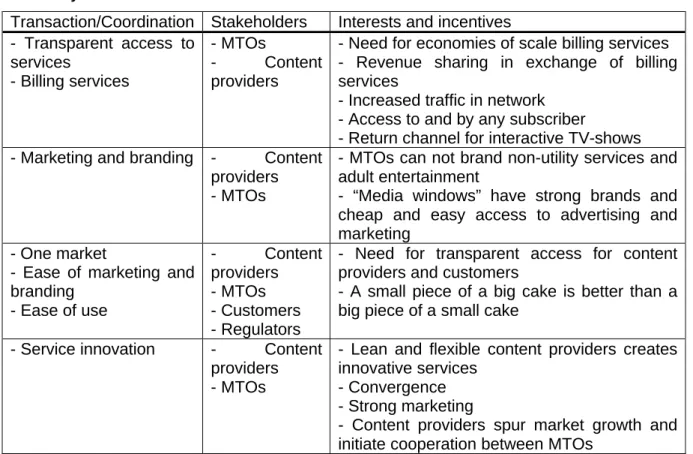
The CPA business model and its approach to meet the challenges of providing services to customers in the mobile phone market can be conceptualized as layers of transactions and coordination. These layers together provide what is necessary to enable the CPA business model to be successful in a market (summarized in Table 1).
Related to the layers, various actors have different needs, interests and incentives. The primary actors related to the business model are MTOs and content providers. Content providers are either lean and flexible “greenfielders” (as for example Mobilinfo) or “media windows” (as for example TV broadcasters and media houses) with strong marketing channels and brands. The “greenfielders” provides innovative business ideas while the “media windows” mobilize and make own content interactive and offering market space to other content providers. Some content providers operate only in their national market, while other internationally. MTOs in advanced mobile phone-markets face saturation in relation to traditional services. Positioning them selves in relation to content providers is one approach to create increased traffic in their networks. At the same time, their competence and installed base of customers and billing systems are valued as an asset by the content providers. MTOs in advanced but saturated markets, as for example in Norway, also seek new opportunities in less developed markets by expanding their operations through international operations.
The coordination of short-codes and ease of use of the services are close related to intervention from authorities. Regulatory authorities can take a role as supporting cooperation between MTOs to enable competition and open garden access to services, hampering ease of use by complicating advertisement (supposedly on behalf of the users) or taking no role at all. Also other actors have a stake in the CPA business model, as integrators giving one single access point for content providers to the various CPA-platforms, content aggregators, content owners etc.
Table 1. Layers of transactions/coordination
Transaction/Coordination Stakeholders Interests and incentives - Transparent access to services - Billing services - MTOs - Content providers
- Need for economies of scale billing services - Revenue sharing in exchange of billing services
- Increased traffic in network - Access to and by any subscriber
- Return channel for interactive TV-shows - Marketing and branding - Content
providers - MTOs
- MTOs can not brand non-utility services and adult entertainment
- “Media windows” have strong brands and cheap and easy access to advertising and marketing
- One market
- Ease of marketing and branding - Ease of use - Content providers - MTOs - Customers - Regulators
- Need for transparent access for content providers and customers
- A small piece of a big cake is better than a big piece of a small cake
- Service innovation - Content
providers - MTOs
- Lean and flexible content providers creates innovative services
- Convergence - Strong marketing
- Content providers spur market growth and initiate cooperation between MTOs
The technical challenge with the CPA-platform is to provide seamless connections between subscribers and content providers, in addition to provide open billing services to the content providers. The interfaces to the CPA-platforms implemented by the two Norwegian MTOs are not coordinated, but provide approximately the same services. As a third MTO currently enters the CPA market, there is at the same time a certain entrance and maintenance cost, especially for international content providers. This is however not addressed by the MTOs.
Plain access to subscribers for the content providers only requires interconnection between the mobile networks. However, implementing, operating and managing a billing system is for the content providers not sensible, because the content is cheap (between NOK 1 and 302). Such implementations also require the user to register with each content provider and thus impede impulsive content acquisition. The content providers do have alternative payment solutions available, from companies (as for example MTOs) providing electronic purses related to a credit card or a bank account. These alternatives do also require a time consuming registration process.
By opening up their value chain, letting content providers bill their transaction on the pone bill in exchange for increased network traffic and a revenue sharing model (where the MTOs get from 30-60 percent of the revenue), the MTOs introduce a common driver for them selves and the content providers. Utilizing their already existing customer base and billing system, billing additional services has a marginal cost for the MTOs. However, in relation to concepts like interactive voting in TV-events, the MTOs have to introduce extra queuing mechanisms to handle traffic peaks.
2
On the business layers, the MTOs face the challenge of marketing and branding. For MTOs, the cost of advertising is high and they do not have strong brands related to content, at least compared with “media windows”. The MTOs are also not willing to brand non-utility services and important services as adult entertainment (for example XXX jokes). Trading the responsibility of marketing, advertising and branding with the content providers, the operators meet this challenge.
Coordination and standardization between the mobile operators (in the national market) is another layer needed to enable success of the CPA business model. This enables on the one hand the content providers to have access to the whole market and on the other the customers to access services independent of to which operator they subscribe. This requires every MTO in the market to appreciate that the CPA business model will give higher revenue as on open garden, rather than a multiple of walled gardens (as for example Mobilinfo and SMSinfo). The primary argument supporting this approach is that coordinating common short-codes and price-categories are mechanisms which make services easy to brand, market and use, a market is more easily developed, and users more easily educated. Regulators can facilitate this process by providing and coordinating series of short-codes, or hamper it by e.g. as in the case of Denmark where customers are required to acknowledge the cost of the content in the requests for content.
The content is not created based on explicit needs from the users. Content is rather ringtones and logos, or close related to an ongoing TV-show. Service acquisition is thus primarily done on impulse. Service innovation within such an environment will necessarily be close related to the strength of marketing. In addition, new concepts can also act as an outset for content providers to initiate cooperation between the MTOs. In Thailand, where there is a lack of cooperation between the MTOs, stations have made the operators coordinate in relation to special TV-events.
In the Norwegian market, all these layers are present and coordinated. At the same time, the business model shows some weaknesses. Content sold with CPA is not big business for the content providers, as a TV-station may not earn more than 20 percent revenue on the services they provide. In particular, where content providers use integrators to ease the burden of adhering to the interfaces provided by the different MTOs, there is not much left. In the Norwegian market, there is also only standard (and non-negotiable) agreements between the content provides and the MTOs, with fixed revenue sharing. This approach can on the one hand slow down content innovation, but on the other also spur initiatives to seek alternative and more attractive business models for billing. At the same time, a range of mediators as content aggregators and integrators sees an opportunity as service providers in between MTOs and content providers. Norwegian actors with the aim to expand into the international market are however not supported, as the coordination does not cross national borders.
INTERNATIONAL EXPANSION OF CPA
Restructuring their business strategy, Telenor is turning from being a primarily financial investor to an industrial investor in their international operations. The coordination of these efforts is centralized in two synergy areas: Products and Markets and Operations and Technology within
the Telenor Mobile organization. Together with Group Support and Top management, the
Synergy areas compose Telenor Mobile, facilitating cooperation among the companies. TM has the same relation to Telenor Mobile as the other companies, even if co-located with Telenor Mobile in Oslo.
Synergies between the companies have shown easy to achieve through economies of scale in procurement projects, related to network infrastructure and handsets. Telenor Mobile has also developed knowledge networks and synergy workshops, trying to facilitate introduction of new profitable services faster in the markets of the companies, as well as reduce the resources necessary to implement services. This has however shown to be more challenging.
Our further discussion of the expansion of the CPA business model and platform through internationalization is not related to economies of scale in procurement internationally, but focuses on the process driven by Telenor Mobile related to the internationalization of CPA, and how the business model have been received in the market of the companies.
Internationalization of the CPA-platform and business model
In 2001, Telenor Mobile identified the CPA business model as interesting for expansion into their portfolio of companies. During fall 2001, representatives from Telenor Mobile traveled the companies introducing the concept. CPA-platforms are now implemented in all but one of the companies3. The standard brought to the companies is only a description CPA business model along with consultancy support from Telenor Mobile. The business model is described briefly in “12 guidelines for best practice”, mainly as how to best build the market, the need for symbiotic relationship between operators and content providers and the required ease of use.
The status of CPA in the different companies reveals variations in market success and implementation approach. These differences can be attributed both to differences in the context of the companies (as maturity of market, culture etc.) as well as the nature of the internationalization process driven centrally from Telenor Mobile. In the following, we describe several contextual issues: Choice of MT/MO-billing, presence of entrepreneur spirited content providers, maturity of the market and regulatory issues.
Most MTOs provides mobile originating billing (MT-billing), billing the subscriber on the receipt of content. Some of the companies do however understand it more appropriate to base their billing on the subscribers’ request of content (MO-billing). The former is enabling different models of billing, in particular subscriptions to for example daily weather forecasts or alerts when a stock quote passes certain values. This is not possible with MO-billing, and thus limits the innovative space for the content providers and the potential for CPA success. One of the companies has implemented MO-billing which they see as the only possibility in relation to the underlying billing system. On the other hand, the real reason might as well be that the technical responsible only appreciate MO-billing as more elegant.
Some sort of proactive-ness from the MTOs towards the content providers and an entrepreneurship-spirited approach by the content providers are required to create a good CPA market. Companies based in countries were content providers are not flourishing are suffering from lack of services and a growing market, as Hungary and Russia. This is in sharp contrast with Malaysia, where a range of small entrepreneur spirited content providers are active in the market, both before and after the CPA business model was introduced.
The maturity of the mobile phone content market both relates to the MTOs and the subscribers. Some of the companies operate in markets where the operators have a long and fruitful history of cooperation (as in Norway and Malaysia), while other operates in markets with “walled gardens” and further strong mistrust (as in Thailand). In Thailand, cooperation has been spurred by the content providers in relation to CPA, but no agreements to create permanent open
3
gardens have been made. However, cooperation through CPA could at least be one step in the direction of further cooperation. In some markets, there are strong cultures of using SMS, and thus it comes easy to consume services with a well-known tool. In other countries, there is no SMS-culture, for example due to the recent introduction of SMS. As the content are primarily directed toward impulse consumption related to the “fashion” of sending SMS, the maturity of the market can change fast with strong marketing and branding.
The regulatory issues related to CPA are primarily related to what role the national telecommunication regulator takes. In some countries they have taken none. In other, they are enabling and supporting coordination of short-codes between the operators. However, in Hungary, it is required that the rating class is reflected in the short-codes and branding of the short-code and ease of use is hampered. In Denmark, the consumer must confirm the price of content in the service request also hampering ease of use, and requiring advertises to be more like user manuals.
The success factors of the CPA and where they are missing are presented in Table 2 related to the five main actors: Operators, content providers, authorities, local culture and Telenor Mobile. Table 2. Success factors for the CPA business model
Actors Success factors Factors missing in
Operators - Coordination between operators, open garden - Market and content provider oriented
Thailand, Ukraine, Russia, Bangladesh Hungary, Denmark Content providers - Multiple of entrepreneurs
- “Greenfielders” and “media windows”
Ukraine, Bangladesh Authorities - Support from regulators in coordination
- No interference related to ease of use Hungary, Denmark
Local culture - Entrepreneurship - Low risk of fraud - Language - SMS-culture
Hungary Hungary Bangladesh Telenor Mobile - Commitment from Telenor
- Appreciation of assistance from Telenor
Thailand
STANDARDIZING AND EXPANDING THE CPA-PLATFORM AND THE BUSINESS MODEL
The implementation of the CPA-platforms in the different companies has not followed any particular standard. The “12 guidelines for best practice” are only describing the principles of the CPA business model, even if technical issues are supposed to be derived. In retrospect, the team in Telenor Mobile responsible for the implementation of CPA-platforms in the companies suggests that a stronger approach to standardization would have given some benefits, at least as more common technical implementations. In addition, the lack of standards has also turned against the principles of the CPA business model, in particular implementation of MO-billing. The idea of one global technical standard for CPA interfaces and functionality should be appreciated both from the perspective of global content providers, as well as giving economies of scale if one of the companies could develop a reusable technical solution. This is however not an issue for Telenor Mobile, and the few content providers with a global scope have not explicitly requested such initiatives.
The various implementations of the CPA-platform are in line with the companies understanding of what is the best technical approach, as well as close related to their already existing technical infrastructure, primarily the billing system. As the CPA-markets and the technical requirements develop over time, a common standard must be highly flexible to accommodate the changes in every market.
Globalizing the business model
On the national level, the CPA business model obliges standards. These standards are however not technical and internal for one MTO, but related to coordination with other actors to enable an open market. Primarily these actors are other MTOs, content providers and regulatory authorities.
The standardization of the market through the business model and the common implementation of CPA-platforms by MTOs are out of the scope of institutionalized standardization organizations, as for example ETSI (the European Telecommunications Standards Institute). The actors currently coordinate ad-hoc, but will probably over time create new institutions. In countries where the history of cooperation between MTOs is weak, this becomes a challenge. MTOs have a general approach of walled gardens, and a very strong belief in differentiation as market approach towards mobile subscribers. Thus, they are not primarily interested in cooperation and coordination with other MTOs, even if they find CPA as one exception. At the same time, content providers can take the role of being the driver or the mediator to make the MTOs cooperate.
The case of CPA shows that there is a need for standards in largely the same way as in other areas of telecommunication technology. At the same time, there are strong reasons to believe that CPA based content services increasingly will get an international character. This fact in addition to the increasingly international character of mobile phone operators generates a need for international standards. On the other had, the variety of services, the unpredictability of what kind of services users will adopt implies that the traditional hierarchical specification driven model followed within telecommunication standardization will very unlikely be feasible in this area. Other approaches accounting for the required flexibility in the technology will be required (Hanseth et al. 1996).
CONCLUSION
As a result of convergence, the telecommunication industry is facing new challenges and opportunities. The case of the CPA business model and platforms in particular illustrates the need for standardization, but standardization making happens outside the scope of institutionalized standardization bodies. At the same time, even if services and platforms globalizes, there is a need to accommodate local national and cultural issues. In particular, the history of cooperation between MTOs, their relation to content providers and their recognition of the open garden approach of the CPA business model as appropriate is decisive for the success of the business model. At the same time, regulators may hamper the business model by introducing requirements reducing the ease of use and advertising. The implementation process followed by Telenor Mobile has been soft and has resulted in different technical implementations, some of them also in conflict with the business model. At the same time, this approach does not favor international operations of content providers. However, an effective standardization of the platform will necessitate more than a stronger standardization approach from Telenor Mobile towards its companies, as it is closer related to the MTOs and the content providers in the local national markets.
REFERENCES
Hanseth, O., Monteiro, E., and Hatling, M. Developing information infrastructure: The tension between standardization and flexibility. Science, Technology and Human Values. Vol. 21 No. 4, Fall 1996, 407-426.
Authors’ biographies
Petter Nielsen is a Ph.D. candidate at the Department of informatics at the University of Oslo. His research interest is related to strategies for designing services for mobile telecommunication devices. He is currently engaged in empirical research related to the emergence of new content services and telecommunication platforms, seen as a result of convergence between telecommunication and information technology, both locally and on a global scale.
Ole Hanseth is currently Professor at Department of informatics at the University of Oslo and Visiting Professor at London School of Economics. He worked within applied research and business until he moved to academia in 1997. His main research interests are related to large scale (complex, global ...) information systems and infrastructures. He has published in, among others, Information and Organization (Accounting, Management & Information Technology); Information Technology & People; The Data Base for MIS; Science, Technology & Human Values; Scandinavian Journal of IS; Computer Supported Cooperative Work; Knowledge, Technology and Policy.