Cloud Computing
Benefits, risks and recommendations for information security
Rev.B – December 2012Document History
Date Version Modification Author
December 2009
1.0 Initial Release, Rev.A Daniele
Catteddu, Giles Hogben December 2012 2.0 Rev.B Thomas Haeberlen Lionel Dupré
About ENISA
The European Network and Information Security Agency (ENISA) is a centre of network and information security expertise for the EU, its member states, the private sector and Europe’s citizens. ENISA works with these groups to develop advice and recommendations on good practice in information security. It assists EU member states in implementing relevant EU legislation and works to improve the resilience of Europe’s critical information infrastructure and networks. ENISA seeks to enhance existing expertise in EU member states by supporting the development of cross-border communities committed to improving network and information security throughout the EU. More information about ENISA and its work can be found at www.enisa.europa.eu.
Contact details
This report has been edited by: Lionel Dupré, Thomas Haeberlen
For contacting ENISA or for general enquiries about this report, please use the following details: Email: [email protected]
Legal notice
Notice must be taken that this publication represents the views and interpretations of the authors and editors, unless stated otherwise. This publication should not be construed to be a legal action of ENISA or the ENISA bodies unless adopted pursuant to the ENISA Regulation (EC) No 460/2004 as lastly amended by Regulation (EU) No 580/2011. This publication does not necessarily represent state-of the-art and ENISA may update it from time to time.
Third-party sources are quoted as appropriate. ENISA is not responsible for the content of the external sources including external websites referenced in this publication.
This publication is intended for information purposes only. It must be accessible free of charge. Neither ENISA nor any person acting on its behalf is responsible for the use that might be made of the information contained in this publication.
Reproduction is authorised provided the source is acknowledged. © European Network and Information Security Agency (ENISA), 2011
1
Introduction and Recap
1.1
Updating the 2009 Cloud Risk Assessment
Since the publication of the 2009 Cloud Risk Assessment study, the perception of Cloud computing has changed, and so has the perception of the associated risks. However, the 2009 Cloud Risk Assessment continues to be one of the most downloaded documents on the ENISA website. It is therefore worthwhile to revise the document in general, but especially have a new look at the risks and try to re-assess them, taking the developments of the last three years into account.
This document is the result of a first review round carried out by ENISA with the assistance of external experts.
To simplify things, the risks were separated from the extensive legal considerations that form part of the 2009 Cloud Risk Assessment. This does not mean, however, that legal aspects are not considered. On the contrary, there will be a separate working document covering the legal aspects in the appropriate depth, and the final revision of the Cloud Risk Assessment will again contain a discussion of legal aspects.
1.2
Cloud computing - working definition
During the first review round, the working definition of Cloud computing used in the Cloud Risk Assessment in 2009 was kept unchanged.Even at the time of the original report, this working definition was not intended as yet another definitive definition. Cloud computing is an on-demand service model for IT provision, often based on virtualization and distributed computing technologies. Cloud computing architectures have:
- Highly abstracted resources
- Near instant scalability and flexibility - Near instantaneous provisioning
- Shared resources (hardware, database, memory, etc)
- ‘Service on demand’, usually with a ‘pay as you go’ billing system
- Programmatic management (e.g., through WS API).
Cloud computing is an on-demand service model for IT provision, often based on virtualization and distributed computing technologies. Cloud computing architectures have:
highly abstracted resources
near instant scalability and flexibility near instantaneous provisioning shared resources (hardware, database,
memory, etc)
‘service on demand’, usually with a ‘pay as you go’ billing system
programmatic management (eg, through WS API).
There are three categories of cloud computing:
- Software as a service (SaaS): is software offered by a third party provider, available on demand, usually via the Internet configurable remotely. Examples include online word processing and spreadsheet tools, CRM services and web content delivery services (Salesforce CRM, Google Docs, etc).
- Platform as a service (PaaS): allows customers to develop new applications using APIs deployed and configurable remotely. The platforms offered include development tools, configuration management, and deployment platforms. Examples are Microsoft Azure, Force and Google App engine.
- Infrastructure as service (IaaS): provides virtual machines and other abstracted hardware and operating systems which may be controlled through a service API. Examples include Amazon EC2 and S3, Terremark Enterprise Cloud, Windows Live Skydrive and Rackspace Cloud.
Clouds may also be divided into:
- Public: available publicly - any organisation may subscribe
- Private: services built according to cloud computing principles, but accessible only within a private network
- Partner or Community: cloud services offered by a provider to a limited and well-defined number of parties.
1.3
Top security benefits
The 2009 Cloud Risk Assessment considers a number of security benefits offered by the Cloud computing model. These have to be weighed against the risks that this model brings with it. Although they are not strictly necessary for the purpose of assessing the risks, they have been kept in this document (see section 2 Security benefits of cloud computing) to put the risks into perspective. Security and the benefits of scale: put simply, all kinds of security measures are cheaper when implemented on a larger scale. Therefore the same amount of investment in security buys better protection. This includes all kinds of defensive measures such as filtering, patch management, hardening of virtual machine instances and hypervisors, etc. Other benefits of scale include: multiple locations, edge networks (content delivered or processed closer to its destination), timeliness of response, to incidents, threat management.
Security as a market differentiator: security is a priority concern for many cloud customers; many of them will make buying choices on the basis of the reputation for confidentiality, integrity and resilience of, and the security services offered by, a provider. This is a strong driver for cloud providers to improve security practices.
More timely, effective and efficient updates and defaults: default virtual machine images and software modules used by customers can be pre-hardened and updated with the latest patches and security settings according to fine-tuned processes; IaaS cloud service APIs also allow snapshots of virtual infrastructure to be taken regularly and compared with a baseline. Updates can be rolled out many times more rapidly across a homogenous platform than in traditional client-based systems that rely on the patching model.
Rapid, smart scaling of resources: the ability of the cloud provider to dynamically reallocate resources for filtering, traffic shaping, authentication, encryption, etc, to defensive measures (e.g., against DDoS attacks) has obvious advantages for resilience.
Benefits of resource concentration: Although the concentration of resources undoubtedly has disadvantages for security [see Risks], it has the obvious advantage of cheaper physical perimiterisation and physical access control (per unit resource) and the easier and cheaper application of many security-related processes.
1.4
Top security risks
The 2009 Cloud Risk Assessment contains a list of the top security risks related to Cloud computing. After the first review round, the top risks have turned out to be more or less unchanged from the 2009 Cloud Risk Assessment.
The most important classes of cloud-specific risks (see section 4 Risks) are:
Loss of governance: in using cloud infrastructures, the client necessarily cedes control to the Cloud Provider (CP) on a number of issues that may affect security. At the same time, SLAs may not offer a commitment to provide such services on the part of the cloud provider, thus leaving a gap in security defences.
This also includes compliance risks, because investment in achieving certification (e.g., industry standard or regulatory requirements) may be put at risk by migration to the cloud:
if the CP cannot provide evidence of their own compliance with the relevant requirements if the CP does not permit audit by the cloud customer (CC).
In certain cases, it also means that using a public cloud infrastructure implies that certain kinds of compliance cannot be achieved (e.g., PCI DSS).
Lock-in: there still is little on offer in the way of tools, procedures or standard data formats or services interfaces that could guarantee data, application and service portability. This can make it difficult for the customer to migrate from one provider to another or migrate data and services back to an
in-house IT environment. This introduces a dependency on a particular CP for service provision, especially if data portability, as the most fundamental aspect, is not enabled.
Isolation failure: multi-tenancy and shared resources are defining characteristics of cloud computing. This risk category covers the failure of mechanisms separating storage, memory, routing and reputation between different tenants (e.g., so-called guest-hopping attacks). However it should be considered that attacks on resource isolation mechanisms (e.g.,. against hypervisors) are still less numerous and much more difficult for an attacker to put in practice compared to attacks on traditional OSs.
Management interface compromise: customer management interfaces of a public cloud provider are accessible through the Internet and mediate access to larger sets of resources (than traditional hosting providers) and therefore pose an increased risk, especially when combined with remote access and web browser vulnerabilities.
Data protection: cloud computing poses several data protection risks for cloud customers and providers. In some cases, it may be difficult for the cloud customer (in its role as data controller) to effectively check the data handling practices of the cloud provider and thus to be sure that the data is handled in a lawful way. This problem is exacerbated in cases of multiple transfers of data, e.g., between federated clouds. On the other hand, some cloud providers do provide information on their data handling practices. Some also offer certification summaries on their data processing and data security activities and the data controls they have in place, e.g., SAS70 certification.
Insecure or incomplete data deletion: when a request to delete a cloud resource is made, as with most operating systems, this may not result in true wiping of the data. Adequate or timely data deletion may also be impossible (or undesirable from a customer perspective), either because extra copies of data are stored but are not available, or because the disk to be destroyed also stores data from other clients. In the case of multiple tenancies and the reuse of hardware resources, this represents a higher risk to the customer than with dedicated hardware.
Malicious insider: while usually less likely, the damage which may be caused by malicious insiders is often far greater. Cloud architectures necessitate certain roles which are extremely high-risk. Examples include CP system administrators and managed security service providers.
Customers’ security expectations: the perception of Security levels by Customers might differentiate from the actual security (and availability) offered by the CP, or the actual temptation of the CP to reduce costs further by sacrificing on some security aspects.
Availability Chain: Reliance on Internet Connectivity at Customer’s end creates a Single point of failure in many cases.
The risks listed above do not follow a specific order of criticality; they are just ten of the most important cloud computing specific risks identified during the assessment. In terms of criticality, loss of governance is still considered the top risk associated with moving to the Cloud.
The risks of using Cloud computing should be compared to the risks of staying with traditional solutions, such as desktop-based models. To facilitate this, the 2009 Cloud Risk Assessment contains estimates of relative risks as compared with a typical traditional environment. These were also reconsidered during the first review round, and in many cases explanations were added.
It is often possible, and in some cases advisable, for the cloud customer to transfer risk to the cloud provider.However not all risks can be transferred: If a risk leads to the failure of a business, serious damage to reputation or legal implications, it is hard or impossible for any other party to compensate for this damage. Ultimately, you can outsource responsibility but you can't outsource accountability.
1.5
Target audience
The intended audience of this report is the “Cloud community” at large, including Cloud providers, current and potential Cloud customers, consultants as well as policy makers concerned with the area of Cloud computing.
The feedback received from all stakeholders will be used in a second review round that will yield a comprehensive update of the 2009 Cloud Risk Assessment.
2
Security benefits of cloud computing
It is hardly necessary to repeat one again about the economic, technical, architectural and ecological benefits of cloud computing. However, in the direct experience of the members of our expert group, as well as according to recent news from the ‘real world’, an examination of the security risks of cloud computing must be balanced by a review of its
specific security benefits. Cloud computing has significant potential to improve security and resilience. What follows is a description of the key ways in which it can contribute.
2.1
Security and the benefits of scale
Put simply, all kinds of security measures are cheaper when implemented on a larger scale. Therefore the same amount of investment in security buys better protection. This includes all kinds of defensive measures such as filtering, patch management, hardening of virtual machine instances and hypervisors, human resources and their management and vetting, hardware and software redundancy, strong authentication, efficient role-based access control and federated identity management solutions by default, which also improves the network effects of collaboration among various partners involved in defense. Other benefits of scale include:
- Multiple locations: most cloud providers have the economic resources to replicate content in multiple locations by default. This increases redundancy and independence from failure and provides a level of disaster recovery out-of-the-box.
- Edge networks: storage, processing and delivery closer to the network edge mean service reliability and quality is increased overall and local network problems are less likely to have global side-effects.
- Improved timeliness of response to incidents: well-run larger-scale systems, for example due to early detection of new malware deployments, can develop more effective and efficient incident response capabilities.
- Threat management: cloud providers can also afford to hire specialists in dealing with specific security threats, while smaller companies can only afford a small number of generalists.
2.2
Security as a market differentiator
Security is a priority concern for many cloud customers – customers will make buying choices on the basis of the reputation for confidentiality, integrity and resilience, and the security services offered by a provider, more so than in traditional environments. This is currenly still a strong incentive for cloud providers to improve their security practices and compete on security.
Put simply, all kinds of security measures are cheaper when implemented on a larger scale. Therefore the same amount of investment in security buys better protection.
2.3
More timely and effective and efficient updates and defaults
Virtual machine images and software modules used by customers can be pre-hardened and updated with the latest patches and security settings according to fine-tuned processes; moreover, IaaS cloud service APIs also allow snapshots of virtual infrastructure to be taken regularly and compared with a baseline (e.g., to ensure software firewall rules have not changed). Updates can be rolled out many times more rapidly across a homogenous platform than in traditional client-based systems that rely on the patching model. Finally in PaaS and SaaS models the applications are more likely to have been hardened to run outside the enterprise environment, which makes them likely to be more portable and robust than the equivalent enterprise software (where it exists). They are also more likely to be regularly updated and patched in a centralized fashion minimizing the window of vulnerability.
2.4
Rapid, smart scaling of resources
The list of cloud resources that can be rapidly scaled on demand already includes, e.g., storage, CPU time, memory, web service requests and virtual machine instances, and the level of granular control over resource consumption is increasing as technologies mature.
A cloud provider has the potential to dynamically reallocate resources for filtering, traffic shaping, encryption, etc, in order to increase support for defensive measures (e.g., against DDoS attacks) when an attack is likely or it is taking place. When this ability for dynamic resource reallocation is combined with appropriate resource optimisation methods, the cloud provider may be able to limit the effect that some attacks could have on the availability of resources that legitimately hosted services use, as well as limit the effect of increasing the use of resources by the security defence to combat such attacks. Achieving this requires however that the provider implements adequate coordination of autonomics for security defence and for resource management and optimisation.
The ability to dynamically scale defensive resources on demand has obvious advantages for resilience. Furthermore, the more all kinds of individual resources can be scaled in a granular way, without scaling all of the system resources, the cheaper it is to respond to sudden (non-malicious) peaks in demand.
2.5
Standardised interfaces for managed security services
Large cloud providers can offer a standardised, open interface to managed security services (MSS) providers offering services to all its customers. This potentially creates a more open and readily available market for security services where customers can switch providers more easily and with lower set-up costs.
2.6
Audit and evidence-gathering
IaaS offerings support on-demand cloning of virtual machines. In the event of a suspected security breach, the customer can take an image of a live virtual machine – or virtual components thereof – for offline forensic analysis, leading to less down-time for analysis. With storage on tap, multiple clones can be created and analysis activities parallelised to reduce investigation time. This improves the ex-post analysis of security incidents and increases the probability of tracking attackers and patching weaknesses. However, it does presume the customer has access to trained forensic experts (which is not a standard cloud service as of writing).
It can also provide more cost-effective storage for logs, thus allowing more comprehensive logging without compromising performance. Pay as you go cloud storage brings transparency to your audit storage costs and makes adjusting to meet future audit log requirements easier. This makes the process of identifying security incidents as they happen more efficient (7).
2.7
Audit and SLAs force better risk management
The need to quantify penalties for various risk scenarios in SLAs and the possible impact of security breaches on reputation (see Security as market differentiator) motivate more rigorous internal audit and risk assessment procedures than would otherwise be exist. The frequent audits imposed on CPs tend to expose risks which would not otherwise have been discovered, having therefore the same positive effect.
2.8
Benefits of resource concentration
Although the concentration of resources undoubtedly has disadvantages for security it has the obvious advantage of cheaper physical perimiterisation and physical access control (per unit resource) and the easier and cheaper application of a comprehensive security policy and control over data management, patch management, incident management, and maintenance processes. The extent to which those savings are passed on to customers will obviously vary.
3
Risk assessment
3.1
Use-case scenario
The scenario used for the Risk Assessment uses a generic approach, and no statement was intended to be completely realistic for a specific case, a given cloud client or provider. However, many or even all elements of this scenario are likely to occur, and should be considered by all organisations.
3.2
Risk assessment process
The level of risk is estimated on the basis of the likelihood of an incident scenario, mapped against the estimated negative impact. The likelihood of an incident scenario is given by a threat exploiting vulnerability with a given likelihood.
In many cases the estimate of likelihood depends heavily on the cloud model or architecture under consideration.
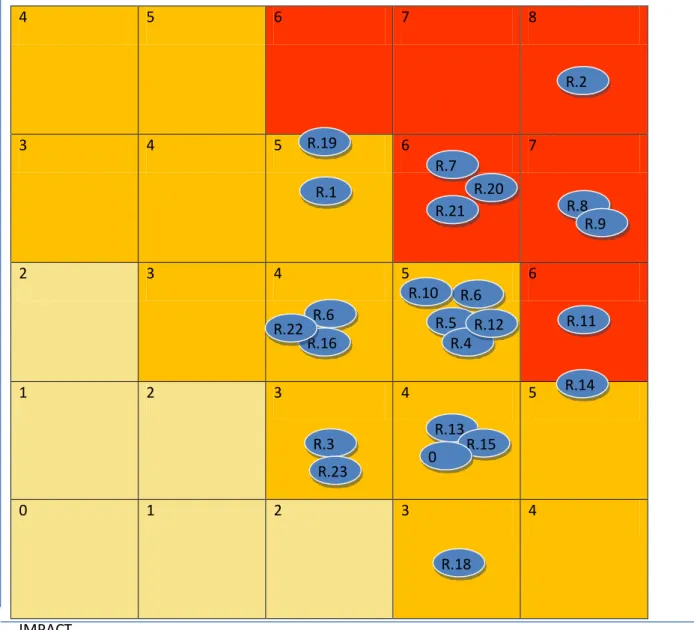
The following shows the risk level as a function of the business impact and likelihood of the incident scenario. The resulting risk is measured on a scale of 0 to 8 that can be evaluated against risk acceptance criteria. This risk scale could also be mapped to a simple overall risk rating:
Low risk: 0-2 Medium Risk: 3-5 High Risk: 6-8 Likelihood of incident scenario Very Low (Very Unlikely) Low (Unlikely) Medium (Possible) High (Likely) Very High (Frequent) Business Impact Very Low 0 1 2 3 4 Low 1 2 3 4 5 Medium 2 3 4 5 6 High 3 4 5 6 7 Very High 4 5 6 7 8
We have based the estimation of risk levels on ISO/IEC 27005:2008 (10).
3.3
Threats, Vulnerabilities, Assets and Risks
A risk is commonly described by a combination of a threat and a vulnerability, affecting an asset. In the 2009 Cloud Risk Assessment, the risks included references to lists of assets and vulnerabilities, while the risk title in most cases describes the threat involved.
During the first review round, we found that while the lists of assets and vulnerabilities also need some revision, the risks can stand quite well by themselves because it is rather obvious how the combination of threat, vulnerability and asset would look like.
In order to keep the document short, the lists of assets and vulnerabilities were therefore omitted for the time being. In the full revision of the Cloud Risk Assessment, they are likely to be included again, in revised form.
4
Risks
The following points should be noted in relation to the descriptions of risk below:
- Risk should always be understood in relation to overall business opportunity and appetite for risk – sometimes risk is compensated by opportunity.
- Cloud services are not only about convenient storage, accessible by multiple devices, but include important benefits such as more convenient communication and instant multi-point collaboration. Therefore, a comparative analysis needs to compare not only the risks of storing data in different places (on premises vs. the cloud) but also the risks when on premises-data stored on premises – e.g. a spreadsheet - is emailed to other persons for their contributions, against the security issues of a spreadsheet stored in the cloud and open to collaboration between those persons. Therefore, the risks of using cloud computing should be compared to the risks of staying with traditional solutions, such as desktop-based models.
- The level of risk will in many cases vary significantly with the type of cloud architecture being considered.
- It is possible for the cloud customer to transfer risk to the cloud provider and the risks should be considered against the cost benefit received from the services. However not all risks can be transferred: if a risk leads to the failure of a business, serious damage to reputation or legal implications, it is hard or impossible for any other party to compensate for this damage.
- The risk analysis in this paper applies to cloud technology. It does not apply to any specific cloud computing offering or company. This paper is not meant to replace a project-specific organisational risk assessment.
The following table shows the distribution of the risk probabilities and impacts: PROBABILITY 4 5 6 7 8 3 4 5 6 7 2 3 4 5 6 1 2 3 4 5 0 1 2 3 4 IMPACT
Figure 1: Risk distribution
The risks are classified into three categories: Policy and Organizational
Technical R.1 R.2 R.3 R.5 R.4 R.6 R.6 (1) R.7 R.8 R.9 R.10 R.11 R.12 R.13 R.14 R.15 R.16 0 R.18 R.19 R.20 R.21 R.22 R.23
Legal.
Each risk is presented in tables which include: Probability estimate
Impact estimate Level of risk
Comparison (where applicable) between the “Classic IT” and “Cloud” settings. The arrows show the way the risk changes when moving from the “Classic IT” to the “Cloud” setting
As in the original Risk Assessment document, we have not included an overall comparative risk since it is assumed that all the risks selected are higher in the Cloud setting.
4.1
Policy and organizational
risks
R.1Lock-inRisk number and name R.1 Lock-in
Short description Relying strongly on the services of one provider can lead to severe difficulties in changing the provider. Migrating to another provider may even become virtually impossible.
Risk rating¶ Probability: High Impact: Medium Risk: High Probability in
Comparison to classic IT
Cloud services are often based on proprietary non-standard data formats and application logic. This can make migrating data and services to another CP difficult or even impossible,
A missing exit strategy exacerbates this risk.
Lock-in also occurs in the classic IT setting, but in this case the customer usually has more control over the data and services.
Impact in
Comparison to classic IT
In both cases, data and own development efforts can be lost.
There is currently little on offer in the way of tools, procedures or standard data formats or services interfaces that could guarantee data and service portability. This makes it extremely difficult for a customer to migrate from one provider to another, or to migrate data and services to or from an in-house IT environment. Furthermore, cloud providers may have an incentive to prevent (directly or indirectly) the portability of their customers services and data.
This potential dependency for service provision on a particular CP, depending on the CP's commitments, may lead to a catastrophic business failure should the cloud provider go bankrupt and the content and application migration path to another provider is too costly (financially or time-wise) or insufficient warning is given (no early warning).
The acquisition of the cloud provider can also have a similar effect, since it increases the likelihood of sudden changes in provider policy and non-binding agreements such as terms of use (ToU).
It is important to understand that the extent and nature of lock-in varies according to the cloud type:
SaaS Lock-in
Customer data is typically stored in a custom database schema designed by the SaaS provider. Most SaaS providers offer API calls to read (and thereby ‘export’) data records. However, if the provider does not offer a readymade data ‘export’ routine, the customer will need to develop a program to extract their data and write it to file ready for import to another provider. It should be noted that there are few formal agreements on the structure of business records (e.g., a customer record at one SaaS provider may have different fields than at another provider), although there are common underlying file formats for the export and import of data, e.g., XML. The new provider can normally help with this work at a negotiated cost. However, if the data is to be brought back in-house, the customer will need to write import routines that take care of any required data mapping unless the CP offers such a routine. As customers will evaluate this aspect before making important migration decisions, it is in the long-term business interest of CPs to make data portability as easy, complete and cost-effective as possible.
Application lock-in is the most obvious form of lock-in (although it is not specific to cloud services). SaaS providers typically develop a custom application tailored to the needs of their target market. SaaS customers with a large user-base can incur very high switching costs when migrating to another SaaS provider as the end-user experience is impacted (e.g., re-training is necessary). Where the customer has
developed programs to interact with the providers API directly (e.g., for integration with other applications), these will also need to be re-written to take into account the new provider’s API.
PaaS Lock-in
PaaS lock-in occurs at both the API layer (ie, platform specific API calls) and at the component level. For example, the PaaS provider may offer a highly efficient back-end data store. Not only must the customer develop code using the custom APIs offered by the provider, but they must also code data access routines in a way that is compatible with the back-end
In using cloud infrastructures, the client necessarily cedes control to the CP on a number of issues which may affect security. For example ToUs may prohibit port scans, vulnerability assessment and penetration testing. Moreover, there may be conflicts between customer hardening procedures and the cloud environment. On the other hand, SLAs may not offer a commitment to provide such services on the part of the cloud provider, thus leaving a gap in security defenses.
Moreover the cloud provider may outsource or sub-contract services to third-parties (unknown providers) which may not offer the same guarantees (such as to provide the service in a lawful way) as issued by the cloud provider. Or the control of the cloud provider changes, so the terms and conditions of their services may also change.
data store. This code will not necessarily be portable across PaaS providers, even if a seemingly compatible API is offered, as the data access model may be different (e.g., relational v hashing).
PaaS lock-in at the API layer happens as different providers offer different APIs.
PaaS lock-in happens at the runtime layer as ‘standard’ runtimes are often heavily customised to operate safely in a cloud environment. For example, a Java runtime may have ‘dangerous’ calls removed or modified for security reasons. The onus is on the customers' developers to understand and take into account these differences.
PaaS also suffers from data lock-in, in the same way as in SaaS, but in this case the onus is completely on the customer to create compatible export routines.
IaaS-Lock-in
IaaS lock-in varies depending on the specific infrastructure services consumed. For example, a customer using cloud storage will not be impacted by non-compatible virtual machine formats.
IaaS computing providers typically offer hypervisor based virtual machines. Software and VM metadata is bundled together for portability – typically just within the provider’s cloud.
Migrating between providers is non-trivial until open standards, such as OVF (11), are adopted. IaaS storage provider offerings vary from simplistic key/value based data stores to policy
enhanced file based stores. Feature sets can vary significantly, hence so do storage semantics. However application level dependence on specific policy features (e.g., access controls) may limit the customer’s choice of provider.
Data lock-in is the obvious concern with IaaS storage services. As cloud customers push more data to cloud storage, data lock-in increases unless the CP provides for data portability.
Common to all providers is the possibility of a ‘run on the banks’ scenario for a cloud provider. For this scenario, suppose there is a crisis of confidence in the cloud provider’s financial position, and therefore a mass exit and withdrawal of content on a first come, first served basis. Then, in a situation where a provider limits the amount of ’content’ (data and application code) which can be ‘withdrawn’ in a given timeframe, some customers will never be able to retrieve their data and applications. As in any new IT market, competitive pressure, an inadequate business strategy, lack of financial support, etc, could lead some providers to go out of business or at least to force them to restructure their service portfolio offering. In other words, it is possible that in the short or medium term some cloud computing services could be terminated.
The impact of this threat for the cloud customer is easily understandable, since it could lead to a loss or deterioration of service delivery performance, and quality of service, as well as a loss of investment. Furthermore, failures in the services outsourced to the CP may have a significant impact on the cloud customer’s ability to meet its duties and obligations to its own customers. The customer of the cloud provider may thus be exposed to contractual and tortuous liability to its customers based on its
provider’s negligence. Failures by the cloud provider may also result in liability by the customer to its employees.
Acquisition of the cloud provider could increase the likelihood of a strategic shift and may put non-binding agreements at risk (e.g., software interfaces, security investments, non-contractual security controls). This could make it impossible to comply with the security requirements. The final impact could be damaging for crucial assets such as: the organization’s reputation, customer or patient trust, and employee loyalty and experience.
R.2Loss of governance
Risk number and name R.2 Loss of governance
Short description When using Cloud services, the CC necessarily cedes control to the CP on a number of issues which may affect security.
Risk rating¶ Probablity: Very High Impact: Very High Risk: Very High Probability in
Comparison to classic IT
Ceding control to a service provider lies in the nature of Cloud services, and of any kind of outsourcing in general, and is therefore almost certain to occur.
Impact in
Comparison to classic IT
Loss of governance might occur in classic IT scenarios, as well. If it occurs, the impact will be similar.
In using cloud infrastructures, the client necessarily cedes control to the CP on a number of issues which may affect security. For example ToUs may prohibit port scans, vulnerability assessment and penetration testing. Moreover, there may be conflicts between customer hardening procedures and the cloud environment. On the other hand, SLAs may not offer a commitment to provide such services on the part of the CP, thus leaving a gap in security defenses.
Moreover the CP may outsource or sub-contract services to third-parties (unknown providers) which may not offer the same guarantees (such as to provide the service in a lawful way) as issued by the CP (see also below). Or the control of the CP changes, so the terms and conditions of their services may also change.
The loss of governance and control could have a potentially severe impact on the organization’s strategy and therefore on the capacity to meet its mission and goals. The loss of control and governance can also lead to the impossibility of complying with the security requirements, a lack of confidentiality, integrity and availability of data, and a deterioration of performance and quality of service, not to mention the introduction of compliance challenges, as certain organisations migrating to the cloud have made considerable investments in achieving certification either for competitive
Certain organisations migrating to the cloud have made considerable investments in achieving certification either for competitive advantage or to meet industry standards or regulatory requirements (eg, PCI DSS).
advantage or to meet industry standards or regulatory requirements (e.g., PCI DSS). This investment may be put at risk by a migration to the cloud:
if the CP cannot provide evidence of their own compliance to the relevant requirements;
if the CP does not permit audit by the CC.
In certain cases, it even means that using a public cloud infrastructure implies that certain kinds of compliance cannot be achieved and hence cloud hosted services cannot be used for services that need them. For example, EC2 says customers would be hard-pressed to achieve PCI compliance on their platform. So EC2 hosted services cannot be used to handle credit card transactions.
A CP can also outsource certain specialised tasks of its ‘production chain’ to third parties. In such a situation the level of security of the CP may depend on the level of security of each one of the links and the level of dependency of the CP on the third party. Any interruption or corruption in the chain or a lack of coordination of responsibilities between all the parties involved can lead to: unavailability of services, loss of data confidentiality, integrity and availability, economic and reputational losses due to failure to meet customer demand, violation of SLA, cascading service failure, etc.
An important example here is where a critical dependency exists on a third party single-sign-on or identity management service. In this case, an interruption of the third party service or of the CP’s connection to the service or a weakness in their security procedures may compromise the availability or confidentiality of a CC or indeed the entire cloud offering.
In general, a lack of transparency in the contract can be a problem for the whole system. If a CP does not declare which core IT services are outsourced - it is not realistic that providers should list the contractors since these may change frequently - the CC is not in a position to properly evaluate the risk he is facing. This lack of transparency could decrease the level of trust in the provider.
Resource sharing means that malicious activities carried out by one tenant may affect the reputation of another tenant.
R.3Suppy Chain Failure
Risk number and name R.3 Suppy Chain Failure
Short description A CP can outsource parts of its production chain to third parties, or even use other CPs as part of its service. This way, a potential for cascading failures is created
Risk rating¶ Probability: Low Impact: Medium Risk: Medium
Probability in
Comparison to classic IT
Supply chain failiures can occur also in classic IT setups, but the probability is considered to be higher in Cloud scenarios.
Impact in
Comparison to classic IT
The potential impact of supply chain failures has to be considered higher than in classic IT setups, because the supply chain is likely to be longer and the customer’s options fewer.
A CP can outsource certain specialised tasks of its ‘production chain’ to third parties, or even use another cloud service as a ‘backend’. In such a situation the level of security of the cloud service depends on the level of security of each one of the links and the level of dependency of the cloud provider on the third party. Any interruption or corruption in the chain or a lack of coordination of responsibilities between all the parties involved can lead to: unavailability of services, loss of data confidentiality, integrity and availability, economic and reputational losses due to failure to meet customer demand, violation of SLA, cascading service failure, etc.
An important example here is where a critical dependency exists on a third party single-sign-on or identity management service. In this case, an interruption of the third party service or of the CP’s connection to the service or a weakness in their security procedures may compromise the availability or confidentiality of a cloud customer or indeed the entire cloud offering.
In general, a lack of transparency in the contract can be a problem for the whole system. If a CP does not declare which core IT services are outsourced - it is not realistic that providers should list the contractors since these may change frequently - the customer is not in a position to properly evaluate the risk he is facing. This lack of transparency could decrease the level of trust in the provider.
R.4Conflicts between customer hardening procedures and cloud environment
Risk number and name R.4 Conflicts between customer hardening procedures and cloud environment
Short description Certain security measures of a CC may conflict with a CP’s environment, making their implementation by the CC impossible. Risk rating¶ Probability: Medium Impact: Medium Risk: Medium Probability in
Comparison to classic IT
n.a. This risk doesn’t exist in classic IT settings
Impact in
Comparison to classic IT
n.a.
CPs must set out a clear segregation of responsibilities that articulates the minimum actions customers must undertake. The failure of customers to properly secure their environments may pose a vulnerability to the cloud platform if the CP has not
taken the necessary steps to provide isolation. CPs should further articulate their isolation mechanisms and provide best practice guidelines to assist customers to secure their resources.
Customers must realize and assume their responsibility as failure to do so would place their data and resources at further risk. In some cases CC have inappropriately assumed that the CP was responsible for, and was conducting, all activities required to ensure security of their data. This assumption by the customer, and/or a lack of clear articulation by the CP, placed unnecessary risk on the customer’s data. It is imperative that CCs identify their responsibilities and comply with them.
CPs, by their very nature, are tasked with providing a multi-tenant environment, whether this is via virtualization on a server or the common network shared by the customers. The co-location of many customers inevitably causes conflict for the CP as customers’ communication security requirements are likely to be divergent from each other.
Customers must realize and assume their responsibility as failure to do so would place their data and resources at further risk.
Take, for example, the case of two customers on a shared traditional network infrastructure. If one customer wishes the network firewall to block all traffic except for SSH, but another customer is running a web server farm and requires passage of HTTP and HTTPS, who wins? This same type of issue is raised by customers who have competing and conflicting compliance requirements. This type of challenge only worsens as the number of tenants and the disparity of their requirements increase. Therefore, CPs must be in a position to deal with these challenges by way of technology, policy and transparency (where appropriate).
R.5Social engineering attacks
Risk number and name R.5 Social engineering attacks
Short description Social engineering is understood to mean the art of manipulating people into performing actions or divulging confidential information. While it is similar to a confidence trick or simple fraud, it is typically trickery or deception for the purpose of information gathering, fraud, or computer system access; in most cases the attacker never comes face-to-face with the victims.
Risk rating Probability: Medium Impact: High Risk: Medium
Probability in
Comparison to classic IT
Due to the involvement of different organisations, the probablility for social engineering attacks is considered higher. This is mostly due to the greater attack surface created by the interaction between two different entities.
Impact in
Comparison to classic IT
If a social engineering attack occurs, the impact will be the same in both classic IT and Cloud settings.
4.2
Technical risks
R.6Resource exhaustion (under or over provisioning)
Risk number and name R.6 Resource Exhaustion
Short description As Cloud services are on-demand services, there is the possibility that the CP won’t be able to
meet an increased demand in a certain shared resource, or to maintain a given service level.
Ris rating for failing to meet an increase in demand
Probability: Medium Impact: Medium Risk: Medium
Risk rating for failing to maintain the current service level
Probability: Low Impact: High Risk: Medium
Probability in
Comparison to classic IT
Resource exhaustion can also occur in classic IT settings. As the CP is supposed to have an effective capacity management in place that will make it unlikely that a resource exhaustion event occurs, the probability is considered lower in a Cloud setting.
Impact in
Comparison to classic IT
If a resource exhaustion event occurs, the impact will be the same in both classic IT and Cloud settings.
Cloud services are on-demand services. Therefore there is a level of calculated risk in allocating all the resources of a cloud service, because resources are allocated according to statistical projections. Inaccurate modelling of resources usage - common resources allocation algorithms are vulnerable to distortions of fairness - or inadequate resource provisioning and inadequate investments in infrastructure can lead, from the CP perspective, to:
Service unavailability: failure in certain highly specific application scenarios which use a particular resource very intensively (ie, CPU/Memory intensive number crunching or simulation (eg. forecasting stock prices;
Access control compromised: in some cases it may be possible to force a system to ‘fail open’ in the event of resource exhaustion.
Economic and reputational losses: due to failure to meet customer demand.
The opposite consequences of inaccurate estimation of resource needs could lead to:
Infrastructure oversize: excessive provisioning leading to economic losses and loss of profitability.
From the CC perspective, a poor provider selection and lack of supplier redundancy could lead to: Service unavailability: failure in the delivery (or degrading performance) of services both in real
time and not in real time;
Access control system compromised: put the confidentiality and Integrity of data at risk; Economic and reputational losses: due to failure to meet customer demand, violation of SLA,
cascading service failure, etc.
Note: this risk could be also a consequence of a DDoS attack and of misbehaving applications due to poor application compartmentalization in some CPs’ systems.
There is a level of calculated risk in allocating all the resources of a cloud service, because resources are allocated according to statistical projections.
R.7Isolation failure
Risk number and name R.7 Isolation failure
Short description In shared environments, errors or attacks can lead to situations where one tenant has access to another tenant’s resources or data. In the case of attacks, an attacker gets access to the resources or data of a specific customer, or even of all customers of the Cloud service.
Risk rating¶ Probability: High Impact: High Risk: High
Probability in
Comparison to classic IT
Isolation failures can also occur in classic IT settings, but due to the shared nature of Cloud services and the exposed interfaces, the probability is considered higher for Cloud services.
Impact in
Comparison to classic IT
The impact of an isolation failure is considered the same for both classic IT and Cloud settings.
Multi-tenancy and shared resources are two of the defining characteristics of cloud computing environments. Computing capacity, storage, and network are shared between multiple users.
This class of risks includes the failure of mechanisms separating storage, memory, routing, and even reputation between different tenants of the shared infrastructure (e.g., so-called guest-hopping attacks, SQL injection attacks exposing multiple customers’ data stored in the same table, and side channel attacks).
Note that the likelihood (probability) of this incident scenario depends on the cloud model considered; it is likely to be low for private clouds and higher (medium) in the case of public clouds.
The impact can be a loss of valuable or sensitive data, reputation damage and service interruption for cloud providers and their clients.
Resource sharing also means that malicious activities carried out by one tenant may affect the reputation of another tenant. For example, spamming, port scanning or the serving of malicious content from cloud infrastructure can lead to:
a range of IP addresses being blocked, including the attacker and other innocent tenants of an infrastructure;
confiscation of resources due to neighbour activities (neighbour subpoenaed).
The impact can be deterioration in service delivery and data loss, as well as problems for the organization’s reputation.
R.8Cloud provider malicious insider - abuse of high privilege roles
Risk number and name R.8 Cloud provider malicious insider - abuse of high privilege roles
Short description Malicious insiders at the CP can cause various kinds of damage to a CC’s assets.
Risk rating Probability: Medium Impact: Very high Risk: High Probability in
Comparison to classic IT
The malicious insider threat also exists in classic IT settings, but the likelihood of an incident has to be considered higher because admin roles at CPs provide more temptation and more opportunities.
Impact in
Comparison to classic IT
The impact caused by mailicious insider is considered the same for both classic IT and Cloud settings.
The malicious activities of an insider could potentially have an impact on: the confidentiality, integrity and availability of all kind of data, IP, all kind of services and therefore indirectly on the organization’s reputation, customer trust and the experiences of employees. This can be considered especially important in the case of cloud computing due to the fact that cloud architectures necessitate certain roles which are extremely high-risk. Examples of such roles include CP system administrators and auditors and managed security service providers dealing with intrusion detection reports and incident response. As cloud use increases, employees of cloud providers increasingly become targets for criminal gangs (as has been witnessed in the financial services industry with call centre workers).
R.9 Management interface compromise (manipulation, availability of infrastructure)
Risk number and name R.9 Management interface compromise (manipulation, availability of infrastructure)
Short description The customer management interfaces of public cloud providers are Internet accessible and mediate access to larger sets of resources (than traditional hosting providers) and therefore pose an increased risk especially when combined with remote access and web browser vulnerabilities.
Risk rating¶ Probability: Medium Impact: Very high Risk: High Probability in
Comparison to classic IT
This risk doesn’t exit in classic IT settings
Impact in
Comparison to classic IT
If management interfaces are compromised in classic IT settings, the impact is the same as for Cloud settings.
The customer management interfaces of public cloud providers are Internet accessible and mediate access to larger sets of resources (than traditional
hosting providers) and therefore pose an increased risk especially when combined with remote access and web browser vulnerabilities. This includes customer interfaces controlling a number of virtual machines and, most importantly, CP interfaces controlling the operation of the overall cloud system. Of course, this risk may be mitigated by more investment in security by providers.
The customer management interfaces of public cloud providers are Internet accessible and mediate access to larger sets of resources (than traditional hosting providers) and therefore pose an increased risk especially when combined with remote access and web browser vulnerabilities.
R.10 Intercepting data in transit
Risk number and name R.10 Intercepting data in transit
Short description Whenever data is transferred between different computers or sites, there is the possibility that the transfer can be intercepted, This is especially relevant in shared environments and when data is transferred between sites (e.g. between CC and CP).
Risk rating¶ Probability: Medium Impact: High Risk: Medium Probability in
Comparison to classic IT
The risk of data being intercepted is considerably higher in Cloud environments, because these always involve both a shared environment and transfers between sites. Impact in
Comparison to classic IT
If data is intercepted, the impact is the same in both Cloud and classic IT settings.
Cloud computing, being a distributed architecture, implies more data in transit than traditional infrastructures. For example, data must be transferred in order to synchronise multiple distributed machine images, images distributed across multiple physical machines, between cloud infrastructure and remote web clients, etc. Furthermore, most use of data-centre hosted computing is implemented using a secure VPN-like connection environment, a practice not always followed in the cloud context. Sniffing, spoofing, man-in–the-middle attacks, side channel and replay attacks have to be considered as possible threat sources.
Moreover, in some cases the CP does not offer a confidentiality or non-disclosure clause or these clauses are not sufficient to guarantee respect for the protection of the customer’s secret information and ‘know-how’ that will circulate in the ‘cloud’.
R.11 Insecure or ineffective deletion of data
Risk number and name R.11 Insecure or ineffective deletion of data
Short description Deleting data from Cloud storage does not in fact mean that the data is removed from the storage or eventual backup media. If disk storage is not encrypted, the data could be accessed at at later time by another customer of a Cloud provider
Risk rating¶ Probability: Medium Impact: Very high Risk: High Probability in
Comparison to classic IT
Scaling up or down resources and moving data around is a characteristic of the Cloud deployment model. In this context, the probability of a data exposure due to ineffective deletion is considered higher than in a classic IT setting.
Impact in
Comparison to classic IT
The impact of a data exposure is considered the same for both Cloud and classic IT settings.
Whenever a provider is changed, resources are scaled down, physical hardware is reallocated, etc, data may be available beyond the lifetime specified in the security policy. It may be impossible to carry out the procedures specified by the security policy, since full data deletion is only possible by destroying a disk which also stores data from other clients. When a request to delete a cloud resource is made, this may not result in true wiping of the data
(as with most operating systems). Where true data wiping is required, special procedures must be followed and this may not be supported by the standard API (or at all).
If effective encryption is used then the level of risk may be considered to be lower.
There are several different scenarios in which a cloud customer's resources may be used by other parties in a malicious way that has an economic impact.
R.12 Distributed denial of service (DDoS)
Risk number and name R.12 Distributed denial of service (DDoS)
Short description Distributed Denial of Service attacks aim at overloading a resource (network or service interface) by flooding it with requests from many sources distributed across a wide geographical or topological area, so that the legitimate users are unable to use the resource as intended.
Risk rating¶ Probability: Medium Impact: High Risk: Medium Probability in
Comparison to classic IT
The probability of a DDoS attack affecting a particular customer is considered lower than the probability of a standalone service being affected by a targeted DDoS attack. The reason is that a Cloud provider is expected to have better resources and mitigation techniques available than an individual company could have. Impact in
Comparison to classic IT
The impact of a DDoS attack is considered to be the same in both classic IT and Cloud settings.
R.13 Economic denial of service (EDoS)
Risk number and name R.13 Economic denial of service (EDoS)
Short description As a consequence of attacks, poor budget planning, or mis-configurations, the cost of a Cloud service can strain the financial resources of a CC to an extent that the service is no longer affordable.
Risk rating¶ Probability: Low Impact: High Risk: Medium
Probability in
Comparison to classic IT
Although this risk is to some extent also present in classic IT settings, it becomes much more relevant in Cloud settings, because resources are allocated and billed dynamically.
Impact in
Comparison to classic IT
If an EDoS event occurs, the impact will be the same both in a classic IT and in Cloud setting.
There are several different scenarios in which a CC's resources may be used by other parties in a malicious way that has an economic impact:
Identity theft: an attacker uses an account and uses the customer's resources for his own gain or in order to damage the customer economically.
The CC has not set effective limits on the use of paid resources and experiences unexpected loads on these resources through no malicious actions.
An attacker uses a public channel to use up the CC's metered resources - for example, where the customer pays per HTTP request; a DDoS attack can have this effect.
EDoS destroys economic resources; the worst case scenario would be the bankruptcy of the customer or a serious economic impact.
R.14 Compromise of Service Engine
Risk number and name R.14 Compromise of Service Engine
Short description The service engine is a fundamental part of a Cloud service. A compromise of the service engine will give an attacker access to the data of all customers, resulting in a potential complete loss of data or denial of service.
Risk rating¶ Probability: Low Impact: Very high Risk: High Probability in
Comparison to classic IT
This risk does not exist in classic IT settings.
Impact in
Comparison to classic IT
n.a.
Each cloud architecture relies on a highly specialized platform, the service engine that sits above the physical hardware resources and manages customer resources at different levels of abstraction. For example, in IaaS clouds this software component can be the hypervisor. The service engine is developed and supported by cloud platform vendors and the open source community in some cases. It can be further customized by the CPs.
Like any other software layer, the service engine code can have vulnerabilities and is prone to attacks or unexpected failure. An attacker can compromise
the service engine by hacking it from inside a virtual machine (IaaS clouds), the runtime environment (PaaS clouds), the application pool (SaaS clouds), or through its APIs.
Hacking the service engine may be useful to escape the isolation between different customer environments (jailbreak) and gain access to the data contained inside them, to monitor and modify the information inside them in a transparent way (without direct interaction with the application inside the customer environment), or to reduce the resources assigned to them, causing a denial of service.
Cloud providers must set out a clear segregation of responsibilities that articulates the minimum actions customers must undertake.
R.15 Loss of Cryptographic Keys
Risk number and name R.15 Loss of Cryptographic Keys
Short description The loss or compromise of cryptographic keys used for encryption, authentication or digital signatures can lead to data loss, denial of services, or financial damages
Risk rating¶ Probability: Low Impact: High Risk: Medium
Probability in
Comparison to classic IT
This risk is also present in classic IT settings, but cryptographic techniques are more likely to be used in Cloud settings
Impact in
Comparison to classic IT
If a loss of cryptographic keys occurs, the impact is considered the same both in classic IT and in Cloud settings.
This includes disclosure of secret keys (SSL, file encryption, customer private keys, etc) or passwords to malicious parties, the loss or corruption of those keys, or their unauthorised use for authentication and non-repudiation (digital signature).
R.16 Non Cloud-Specific Network-Related Technical Failures or Attacks
Risk number and name R.16 Non Cloud-Specific Network-Related Technical Failures or Attacks
Short description Cloud services can be affected by a number of network-related technical failures that can also occur on classic IT settings. Examples include the loss of Internet connectivity due to failures at the CC’s site or the CC’s Internet service provider, temporarily reduced network bandwidth on the path between CC and CP, disruptions in the global Internet routing infrastructure leading to the loss of the network path between CC and CP, and failures of the CP’s Internet connectivity. Risk rating¶ Probability: Medium Impact: Medium Risk: Medium Probability in
Comparison to classic IT
Network-related technical failures or attacks can occur both in Cloud and in classic IT settings.
Impact in
Comparison to classic IT
The impact of network-related failures is considered higher in a Cloud setting because of the rather immediate effect on the performance or even the availability of the Cloud service.
R.17 Loss of Backups
Risk number and name 0
Loss of Backups
Short description The backups a CP makes of it’s customers’ data can get lost, damaged, or the physical media on which the backup is stored can get stolen.
Risk rating¶ Probability: Low Impact: High Risk: Medium
Probability in
Comparison to classic IT
The probability of a loss of backups is considered lower in a Cloud setting because it is assumed that a CP will have better protection mechanisms in place than an average CC.
Impact in
Comparison to classic IT
If backups are lost or stolen, the impact is the same for both Cloud and classic IT settings.
R.18 Natural disasters
Risk number and name R.18 Natural disasters
Short description Natural disasters like flooding, earthquakes, tsunamis can affect the infrastructure of a CP. This way, a CC might be affected by natural disasters occurring far away from its own location.
Risk rating¶ Probability: Very low Impact: High Risk: Medium Probability in
Comparison to classic IT
The probability of a natural disaster affecting a Cloud service is considered lower for a Cloud service than for classic IT because it is assumed that a CP has more redundancy built into its infrastructure than an average CC.
Impact in
Comparison to classic IT
If a natural disaster does affect a Cloud service, the impact is considered higher than in a classic IT setting, because the recovery efforts of a CP will not be focussed on restoring service to a particular customer, but rather to restore the service in general. Therefore, the time to recovery may be higher than in a classic IT setting.
Generally speaking, the risk from natural disasters is lower compared to traditional infrastructures because CPs often offer multiple redundant sites and network paths by default. This is illustrated e.g. by the 2011 Japan earthquake where “classic” IT often failed, but no large datacentre went down.
4.3
Legal risks
R.19 Subpoena and e-discovery
Risk number and name R.19 Subpoena and e-discovery
Short description Law enforcement authorities may ask operators of IT infrastructures to provide information pertaining to criminal cases, or information may have to be provided during civil lawsuits. In some cases, storage media or other hardware might be seized as evidence.
Risk rating¶ Probability: High Impact: Medium Risk: High Probability in
Comparison to classic IT
Due to the shared usage of hardware resources in a Cloud setting, a CC can also be affected by subpoenas or civil law suits directed at the CP or third parties, not just those directed at the CC himself. The probability is therefore higher in a Cloud setting than in a classic IT setting.
Impact in
Comparison to classic IT
The impact of subpoena or e-discovery is considered to be the same in both classic IT and Cloud settings.
In the event of the confiscation of physical hardware as a result of subpoena by law-enforcement agencies or civil suits, the centralisation of storage as well as shared tenancy of physical hardware means many more clients are at risk of the disclosure of their data to unwanted parties.
At the same time, it may become impossible for the agency of a single nation to confiscate ‘a cloud’ given pending advances around long distance hypervisor migration.
R.20 Risk from changes of jurisdiction
Risk number and name R.20 Risk from changes of jurisdiction
Short description When data is stored or processed in a data centre located in a country other than the CC’s, there are numerous ways in which the change in jurisdiction could affect the security of the information.
Examples include:
Data might be seized or the operations of a service disrupted due to reasons that don’t exist in the CC’s country.
In some cases, national security interests of the hosting country might be cited as a reason for seizing data.
Additionally, a CP might be subject to law enforcement or national security actions from the country its business headquarters is based in, not just those from the countries where its data centres are located.
Risk rating¶ Probability: High Impact: High Risk: High
Probability in
Comparison to classic IT
This risk is considered to be considerably higher in a Cloud setting, because a potentially large number of different countries’ jurisdictions might be involved. Impact in
Comparison to classic IT
The impact of an event related to this risk is considered the same in both classic IT and Cloud settings.
Customer data may be held in multiple jurisdictions, some of which may be high risk. If data centres are locat