71
DEVELOPMENT AND VALIDATION OF ANALYTICAL METHODS
FOR SIMULTANEOUS ESTIMATION OF MOXONIDINE AND
AMLODIPINE IN BULK AND FORMULATIONS
Poornima K
1*, Santhosh YS
2and Channabasavaraj KP
21Department of Pharmaceutical Chemistry, East West College of Pharmacy, Bangalore, Karnataka, India. 2
Department of Pharmaceutical Chemistry, Government College of Pharmacy, Bangalore, Karnataka, India.
ABSTRACT
A simple, sensitive, precise and rapid reverse phase high performance liquid chromatography (RP-HPLC) method was developed and validated for simultaneous estimation of Moxonidine (MOXO) and Amlodipine (AMLO) in bulk drug and tablet dosage forms. The separation was achieved by using Qualisil BDS C8 column (250mm X 4.6mm, 5µ) as stationary
phase and mobile phase consists of Methanol: Buffer (10mM Sodium Dihydrogen Ortho Phosphate) in ratio 70:30v/v with a flow rate of 1ml/min. Analysis was performed at ambient temperature with detection at 245 nm. The retention times of Moxonidine and Amlodipine were found to be3.4 and 6.3 min and the calibration curves were linear (r2=0.999) over a
concentration range from 1-50µg/ml for Moxonidine and Amlodipine respectively. The Limit of detection (LOD) of Moxonidine and Amlodipine was observed to be 0.5µg/ml and 0.5µg/ml respectively, the Limit of quantitation (LOQ) of Amlodipine was observed to be 0.6µg/ml and 0.6µg/ml respectively. The developed method was validated for parameters like system suitability, specificity, linearity, accuracy, precision, ruggedness and robustness as per ICH guidelines and the results were found to be within the limits. So it can be used for the routine quality control of Moxonidine and Amlodipine in bulk sample and tablet dosage forms.
Keywords: Simultaneous estimation, Moxonidine, Amlodipine and RP-HPLC.
INTRODUCTION
Moxonidine is a new-generation centrally-acting antihypertensive drug licensed for the treatment of mild to moderate essential hypertension. It is a selective agonist at the imidazoline receptor subtype 1. Moxonidine causes a decrease in sympathetic nervous system activity and therefore a decrease in blood pressure. It also used with ACE inhibitors, diuretics and calcium channel blockers. In addition it demonstrates favorable effects on parameters of the insulin resistance syndrome, apparently independent of blood pressure reduction [1, 2].
Amlodipine(as besylate, mesylate or maleate) is a long-acting calcium channel blocker dihydro pyridine (DHP) class used as an antihypertensive and in the treatment of angina pectoris [3]. Like other calcium channel blockers, amlodipine acts by relaxing the smooth muscle in the arterial wall, decreasing total peripheral
resistance and hence reducing blood pressure in angina, it increases blood flow to the heart muscle (although DHP- class calcium channel blockers are more selective for arteries than myocardium, as the cardiac calcium channels are not of the dihydropyridine type 9 [4].
HPLC (Svetlana, 2012) HPLC [5] Mass Spectrometry [6] and UPLC methods are studied for the determination of Monoxidine and RP-HPLC and other methods were used for the simultaneous estimation of Amlodipine with other drugs [7-15]. But there was no information found about the simultaneous estimation of Moxonidine and Amlodipine according our literature survey. Hence the present study designed to perform estimation of Moxonidine and Amlodipine.
Corresponding Author: - Poornima K Email: [email protected]
International Journal of
Medicinal Chemistry & Analysis
72
MATERIALS AND METHODSChemicals and Reagents
Moxonidine and Amlodipine were procured from Micro labs, Bengalore and Karnataka Antibiotics Private Limited (KAPL) Bengaluru, respectively along with Certificate of Assurance (COA). Acetonitrile (HPLC grade), methanol and reagents of analytical grade were procured from Merck, India. HPLC grade water is collected from Milli-Q3 water purifier system. Class A apparatus were used throughout the experiment. Formulations are procured from local markets of Bangalore specificity determination and for recovery studies.
Instrumental and Chromatographic system HPLC system
Shimadzu, 20 AT model attached with pump, degasser, auto sampler, Ultra-violet detector.
Chromatographic Column
Lichospere RP C-18, (250 x 4.6mm, 5 µm) end capped, Merck made.
Flow rate: 1.0 mL/min. Acquisition time: 10 min. Detection wavelength: 245nm Injection volume: 20µL
Preparation mobile phase
Volume of 700 ml HPLC grade methanol were mixed with 300 ml of 10mM Sodium Dihydrogen Ortho Phosphate buffer, prepared by dissolving 1.56 gm of Sodium Dihydrogen Ortho Phosphate in 1000 ml of Millipore water, filtered with 0.45µ filter paper and sonicated for 10 min.
Determination of wavelength range
Wavelength for detection (UV detector) was selected by injecting the solution consists of Moxonidine and Amlodipine (10µg/ml) to SHIMADZU- SIL-20A instrument. The overlay spectrum shows isobestic point at 245nm which was selected as wavelength of detection, the overlay spectrum.
Determination of retention time
The retention time for Moxonidine and Amlodipine were determined individually and in combination by injecting 20µl of working standard solutions at 1ml/min into the chromatograph and UV detected at 245nm. Retention time was observed; chromatogram was recorded.
Preparation of Standard and Sample solutions
Preparation of working standard solutions of Moxonidine and Amlodipine
Accurately 10 mg of Moxonidine and 10 mg of Amlodipine were weighed into clean and dry 10 ml
volumetric flasks separately, dissolved with sufficient volume of diluent. The final volumes were made up to 10 ml with diluent to get the concentration of 1000 µg/ml for Moxonidine and Amlodipine respectively (stock I). From the stock I solution pipette out 1ml into 10ml volumetric flasks separately to get concentration of 100 µg/ml for Moxonidine and Amlodipine, respectively(stock II) .
Preparation of working standard solutions of Moxonidine and Amlodipine
1.2 ml stock II solution of Moxonidine and 1.2 ml stock solution of Amlodipine were further diluted separately to 10 ml in 10 ml volumetric flasks with diluent to get a concentration of 12µg/ml for Moxonidine and 12µg/ml for Amlodipine respectively.
Sample preparation
Twenty tablets ofMoxonidine and twenty tablets of Amlodipine were weighed and crushed to a fine, homogenous powder. Quantity equivalent to 10mg is weighed and diluted to 10mL of mobile phase. 10mL is further diluted to 100mL with mobile phase which is stock B of 100 µg/ mL. Stock B serially diluted to contain 10, 20, 30, 40 and 50 µg/mL of final concentration using mobile phase for both the tablets and are further mixed for the specificity studies.
Optimization of chromatographic conditions
The method was made on trial and error basis and the best resolution was obtained at mobile phase of Methanol: Buffer (10mM Sodium Dihydrogen Ortho Phosphate) in ratio 70:30v/v pH adjusted to 4.0 (with dilute ortho phosphoric acid).
Method Validation
The method was validated as per ICH guidelines. The method was validated in terms of linearity, specificity, accuracy, precision, Limit of Detection (LOD) and Limit of Quantification (LOQ) [16, 17].
Linearity and range
20 µl of each of these working standard solutions of Moxonidine and Amlodipine ranging from 1 to 50 µg/ml were injected into a chromatograph at flow rate of 1 ml/min. Retention time and peak area obtained were recorded and standard calibration curve was plotted forMoxonidine and Amlodipine, linearity equations were derived. The Correlation coefficient, % curve fitting were also calculated.
Specificity
73
PrecisionSystem precision
Successive six injections of 20 µl working standard mixture solution (six replicates) were injected into a HPLC chromatograph, the peak area and chromatograms obtained were recorded. The % relative standard deviation was calculated for peak areas of replicates.
Method precision Intra-day Precision
Successive six injections of 20 μl of working standard mixture solutions were injected separately at different intervals in the same day and chromatograms were recorded. The % relative standard deviation was calculated for concentration of drug in replicates.
Inter-day Precision
Successive six injections of 20 μl of working standard mixture solutions were injected separately on different days and chromatograms were recorded. The % RSD was calculated for concentration of drug in replicates
Intermediate Precision
Intermediate precision (Ruggedness) expresses the variations within laboratories variations: (different days, different analysts, different equipment, etc.). The Intermediate precision was performed for Moxonidine and Amlodipine by different analyst on different instrument using different lot of column on different day.
Accuracy
20µl solution of the resulting mixture was injected repeatedly into the chromatograph, the peak area and chromatogram obtained were recorded and the % recovery of standard MOXO and were calculated.
Limit of Detection and Limit of Quantification
For estimation of LOD and LOQ, visualization method was followed. In visualization method lower dilutions of working standard solution each of Moxonidine and Amlodipine of 20μl were injected in to the chromatograph till the drug solution gives response and peak area. The chromatogram and peak area obtained for different concentrations of Moxonidine and Amlodipine were recorded.
Robustness
For the method developed, flow rate of 1 ml/min was used. The robustness study was carried out with small deliberate change to 0.9 and 1.1ml/min. 20 µl working standard mixture solutions were injected in chromatograph at a flow rate of 0.9 and 1.1 ml/min, the peak area and chromatograms obtained were recorded.
For the method developed, mobile phase comprising of MEOH:Sodium Dihydrogen Ortho
Phosphate (70:30v/v) was used. For Robustness study, the ratio of MEOH and Sodium Dihydrogen Ortho Phosphate buffer were slightly altered from the ratio of (70:30v/v) to (68:32) and (72:28).20μl of working standard mixture solutions of Moxonidine and Amlodipine were injected in to the chromatograph with altered mobile phase ratios, the peak areas and chromatograms obtained were recorded, and the % assay was calculated.
System suitability
20 µl of standard solutions of Moxonidine and Amlodipine were injected into chromatograph and chromatograms were recorded. From the data obtained system suitability parameters like theoretical plates, tailing factor and resolution were calculated.
RESULTS
The objective of the present study was to develop simple and sensitive RP-HPLC method for simultaneous estimation of Moxonidine and Amlodipine. The results obtained for the entire research work are presented here.
Developed method for simultaneous estimation
A RP-HPLC method was developed and validated for simultaneous estimation of Moxonidineand Amlodipine in pure and combined formulation.
Column and standardization of the mobile phase
A HPLC method was developed with mobile phase consisting of Methanol: Buffer (10mM Sodium Dihydrogen Ortho Phosphate) in ratio 70:30v/v. The mobile phase was delivered at a flow rate of 1.0 ml/min on Qualisil BDS C8 column (250mm X 4.6mm, 5µm) as
stationary phase. Analysis was performed at ambient temperature with detection at 245nm gave a satisfactory chromatogram of Moxonidine and Amlodipine. Different columns and various combinations of organic solvents were tried but, Qualisil BDS C8 column (250mm X
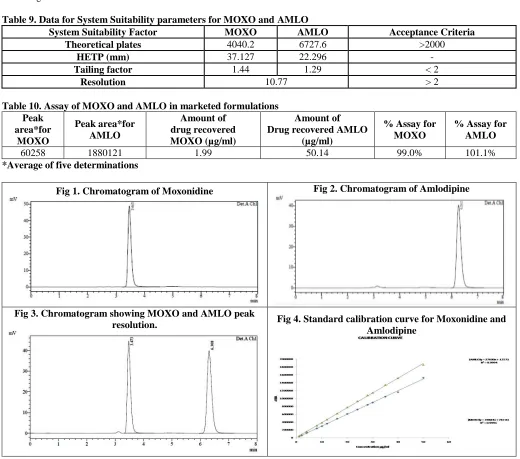
4.6mm, 5µm) column and the mobile phase of Methanol: Buffer (10mM Sodium Dihydrogen Ortho Phosphate) in ratio70:30v/v % showed good resolution and was used. Standard solutions of Moxonidine and Amlodipine (12µg/ml) were injected into chromatograph and scanned in the wavelength range of 200-400 nm, the overlain UV spectrum of Moxonidine and Amlodipine was prepared and isobestic point was found to be at 245 nm. The retention time of Moxonidine and Amlodipine were found to be at 3.4 min and 6.3 min, respectively. The chromatograms for Moxonidine and Amlodipine individually and in the combination are given are presented in the Fig No: 1 to Fig No 3.
Validation parameters
74
Linearity, Precision, Accuracy, Robustness and Ruggedness etc. as per ICH guidelines.
Linearity and Range
The linearity was determined by injecting replicates of working standard solution and found to be in the concentration range of 1-50μg/ml for both Moxonidine and Amlodipine respectively, with Correlation coefficient, percentage curve fittings found to be well within the acceptance criteria limit. The percentage curve fitting was found to be 99.90% and 99.90%for Moxonidine and Amlodipine, respectively (Fig No: 4).
Specificity
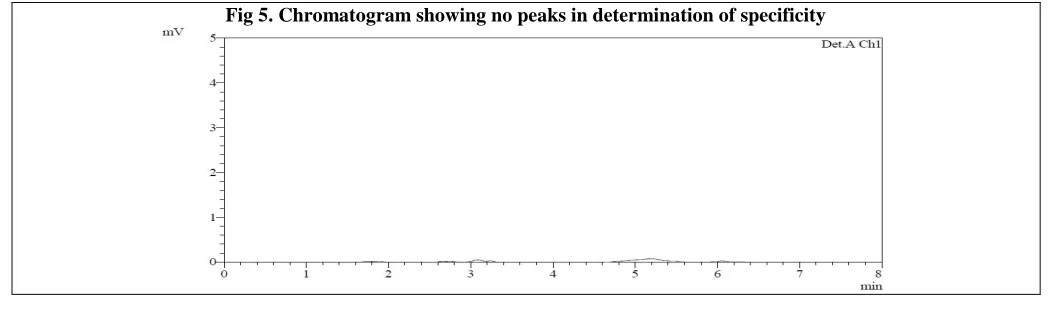
No peaks were found at retention time of 3.4 min and 6.3min in the present study. The method is specific for estimation of Moxonidine and Amlodipine as no other peak could be detected in the retention time upto 15 min with diluents (Fig No: 5).
Precision System Precision
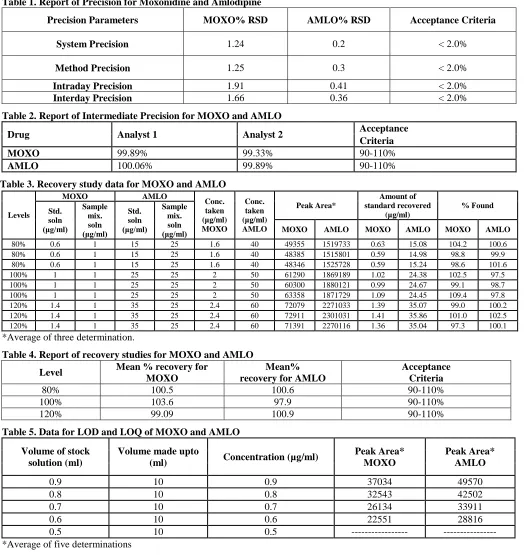
The % RSD values of peak area for six replicate injections of Moxonidine and Amlodipine were found to be 1.24 and 0.20respectively, which are well within the acceptance criteria limit of not more than2% (Table No: 1).
Method Precision
The % RSD values of concentration for method precision of six replicate injections of Moxonidine and Amlodipine were found to be 1.25 and 0.36respectively. Which are well within the acceptance criteria limit of not more than 2 % (Table No: 1).
Inter-day precision
All the values of % RSD for precision study obtained are within the acceptance criteria of less than 2%, the proposed method is found to show good degree of precision and reproducibility.
Intraday precision
The % RSD was found to be 1.91 and 0.41 for intraday precision; 1.66 and 0.36for inter day precision of Moxonidine and Amlodipine respectively. As the results were within the acceptance limits so both method as well as the system provides good precision (Table No: 1).
Intermediate precision
The intermediate precision (Ruggedness) with Analyst 1, the assay was found to be99.89%and 100.06%forMoxonidine and Amlodipine respectively. With Analyst 2, the assay was found to be99.33% and 99.89% for Moxonidine and Amlodipine respectively. The
percentage assay was found to be within the acceptance limits, hence the proposed method was found to be rugged (Table: 2).
Accuracy
The mean percentage recovery for Moxonidine and Amlodipine at three different levels was found to be between99.09-100.5% and97.60-100.6%respectively, which was well within the acceptance limit and hence the method was found to be accurate. The percentage recovery iswithin total agreement with acceptance criteria of 90- 110% (Table No 3 and 4).
Limit of detection (LOD) and Limit of Quantitation (LOQ)
It was found from the chromatogram that the concentration of 0.5μg/ml for Moxonidine and Amlodipine peak or response was observed but no area was observed. Hence the LOD for Moxonidine and Amlodipine by visualization was found to be 0.5μg/ml and LOQ was found to be 0.6μg/ml respectively for Moxonidine and Amlodipine (see Table No: 5).
Robustness
The robustness of the method were determined by carrying out the assay after performing slight changes in the mobile phase ratio, detection wavelength and flow rate. It was found that the % assay of Moxonidine and Amlodipine ranges between 94% to 100.10% indicating that the method is robust (see Table No: 6).
Results suggested that % assay of Moxonidine and Amlodipine ranges between94.28-100.41% and 96.32-100.10% respectively, indicating that the method is robust with respect to slight change in ratio of mobile phase (see Table No: 7).It was found that % assay of Moxonidine and Amlodipine ranges between99.07-101.01% and 99.15-100.85% respectively, indicating that the method is robust with respect to slight change in detection wavelength (Table No: 8).
System suitability
75
Table 1. Report of Precision for Moxonidine and AmlodipinePrecision Parameters MOXO% RSD AMLO% RSD Acceptance Criteria
System Precision 1.24 0.2 < 2.0%
Method Precision 1.25 0.3 < 2.0%
Intraday Precision 1.91 0.41 < 2.0%
Interday Precision 1.66 0.36 < 2.0%
Table 2. Report of Intermediate Precision for MOXO and AMLO
Drug Analyst 1 Analyst 2 Acceptance
Criteria
MOXO 99.89% 99.33% 90-110%
AMLO 100.06% 99.89% 90-110%
Table 3. Recovery study data for MOXO and AMLO
*Average of three determination.
Table 4. Report of recovery studies for MOXO and AMLO
Level Mean % recovery for
MOXO
Mean% recovery for AMLO
Acceptance Criteria
80% 100.5 100.6 90-110% 100% 103.6 97.9 90-110% 120% 99.09 100.9 90-110%
Table 5. Data for LOD and LOQ of MOXO and AMLO
Volume of stock solution (ml)
Volume made upto
(ml) Concentration (µg/ml)
Peak Area* MOXO
Peak Area* AMLO
0.9 10 0.9 37034 49570
0.8 10 0.8 32543 42502
0.7 10 0.7 26134 33911
0.6 10 0.6 22551 28816
0.5 10 0.5 --- --- *Average of five determinations
Table 6. Robustness data of MOXO and AMLO with change in flow rate Change in
Flow rate ml/min peak area* MOXO peak area* AMLO
%Assay MOXO
%Assay AMLO
0.9 359001 464555 94.02% 94.18% 1.0 358952 453920 100.10% 99.74% 1.1 361707 453936 93.93% 95.16% *Average of five determinations
Levels
MOXO AMLO
Conc. taken (µg/ml) MOXO
Conc. taken (µg/ml) AMLO
Peak Area*
Amount of standard recovered
(µg/ml)
% Found Std.
soln (μg/ml)
Sample mix. soln (μg/ml)
Std. soln (μg/ml)
Sample mix. soln
(μg/ml) MOXO AMLO MOXO AMLO MOXO AMLO
80% 0.6 1 15 25 1.6 40 49355 1519733 0.63 15.08 104.2 100.6 80% 0.6 1 15 25 1.6 40 48385 1515801 0.59 14.98 98.8 99.9 80% 0.6 1 15 25 1.6 40 48346 1525728 0.59 15.24 98.6 101.6
100% 1 1 25 25 2 50 61290 1869189 1.02 24.38 102.5 97.5
100% 1 1 25 25 2 50 60300 1880121 0.99 24.67 99.1 98.7
100% 1 1 25 25 2 50 63358 1871729 1.09 24.45 109.4 97.8
76
Table 7. Robustness data of MOXO and AMLO with change in ratio of mobile phaseChange in Mobile phase ratio v/v Peak area* MOXO Peak area* AMLO % Assay MOXO % Assay AMLO
68:32 338879 447505 94.28% 96.39% 70:30 360867 462596 100.41% 100.10% 72:28 336501 441313 94.40% 96.32% * Average of five determinations
Table 8. Robustness data of MOXO and AMLO with change in Wavelength Change in
wavelength in nm
Peak area* MOXO Peak area* AMLO
Amount of drug
recovered (µg/ml) % Assay
MOXO AMLO MOXO AMLO
243 356076 459947 11.9 11.9 99.07 99.15 245 361240 462306 12.1 12 100.51 99.68 247 363001 467622 12.0 12.2 101.01 100.85 * Average of five determinations
Table 9. Data for System Suitability parameters for MOXO and AMLO
System Suitability Factor MOXO AMLO Acceptance Criteria
Theoretical plates 4040.2 6727.6 >2000
HETP (mm) 37.127 22.296 -
Tailing factor 1.44 1.29 < 2
Resolution 10.77 > 2
Table 10. Assay of MOXO and AMLO in marketed formulations Peak
area*for MOXO
Peak area*for AMLO
Amount of drug recovered MOXO (µg/ml)
Amount of Drug recovered AMLO
(µg/ml)
% Assay for MOXO
% Assay for AMLO
60258 1880121 1.99 50.14 99.0% 101.1%
*Average of five determinations
Fig 1. Chromatogram of Moxonidine Fig 2. Chromatogram of Amlodipine
Fig 3. Chromatogram showing MOXO and AMLO peak
resolution. Fig 4. Standard calibration curve for Moxonidine and
77
Fig 5. Chromatogram showing no peaks in determination of specificityDISCUSSION
The objective of the present study was to develop simple and sensitive RP-HPLC method for simultaneous estimation of Moxonidine and Amlodipine.
A HPLC method was developed with mobile phase consisting of Methanol: Buffer (10mM Sodium Dihydrogen Ortho Phosphate) in ratio 70:30v/v. The mobile phase was delivered at a flow rate of 1.0 ml/min on Qualisil BDS C8 column (250mm X 4.6mm, 5µm) as
stationary phase. Analysis was performed at ambient temperature with detection at 245nm gave a satisfactory chromatogram of Moxonidine and Amlodipine. Different columns and various combinations of organic solvents were tried but, Qualisil BDS C8 column (250mm X 4.6mm,
5µm) column and the mobile phase of Methanol: Buffer (10mM Sodium Dihydrogen Ortho Phosphate) in ratio70:30v/vshowed good resolution and was used. Standard solutions of Moxonidine and Amlodipine (12µg/ml) were injected into chromatograph and scanned in the wavelength range of 200-400 nm, the overlain UV spectrum of Moxonidine and Amlodipine was prepared and isobestic point was found to be at 245 nm. The retention time of Moxonidine and Amlodipine were found to be at 3.4 min and 6.3 min, respectively.
The developed method was then validated by using various parameters like specificity, LOD, LOQ, Linearity, Precision, Accuracy, Robustness and Ruggedness etc. as per ICH guidelines.
The linearity was determined by injecting replicates of working standard solution and found to be in the concentration range of 1-50μg/ml for both Moxonidine and Amlodipine respectively. The linearity graph for both the drugs is satisfactory as observed from the correlation coefficient (R2) values of for Moxonidine and Amlodipine respectively.
The method is specific for estimation of Moxonidine and Amlodipine as no other peak could be detected in the retention time upto 15 min with diluent.
As all the values of % RSD for precision study obtained are within the acceptance criteria of less than 2%, the proposed method is found to show good degree of precision and reproducibility. In determination of
accuracy, the percentage recovery is with in total agreement with acceptance criteria of 90- 110%.
The LOD was determined by visualization method were found to be 0.5and 0.5μg/ml for Moxonidine and Amlodipine respectively. The LOQ were found to be 0.7 and 0.7μg/ml for Moxonidine and Amlodipine respectively. The robustness of the method were determined by carrying out the assay after performing slight changes in the mobile phase ratio, detection wavelength and flow rate. All the robustness results indicated that the new method developed was robust and did not show significant variations on slight changes in the mobile phase ratio, detection wavelength and flow rate.
The system suitability parameters were calculated to ascertain the suitability of the proposed method in mobile phase at 245nm as a detection wavelength. Theoretical plates HETP, Tailing factor and Resolution were shown to be well within the acceptance criteria
The developed RP-HPLC method was then applied for the simultaneous estimation of Moxonidine and Amlodipine in marketed tablet formulation. The % assay of Moxonidine and Amlodipine by proposed method was obtained in the range of 99.0%-101.1%respectively, which was well within the acceptance criteria limit of 90-110% indicating that the method can be applied for simultaneous determination of Moxonidine and Amlodipine in marketed tablet formulation. Hence, the developed HPLC method results shows to be accurate, precise, linear, robust, rugged and specific.
CONCLUSION
The developed RP-HPLC method was suitable and valid method for the simultaneous estimation of Moxonidine and Amlodipine in pure and in tablet dosage form. For routine analytical purpose it is always necessary to establish methods capable of analyzing huge number of samples in a short time period with due accuracy and precision.
78
are a good approach for obtaining reliable results and were found to be suitable for the routine estimation of MOXO and AMLO in bulk and tablet formulation.
ACKNOWLEDGEMENTS
The authors would like to thank the Principal, GCP, HOD of Pharmaceutical chemistry department GCP,
Chief Scientific Officer and Scientific Officer Drug testing Laboratory, Bengaluru, for providing laboratory facilities to carry out this work and Micro labs for providing gift sample of Moxonidine and Amlodipine.
CONFLICT OF INTEREST:
The authors declare that they have no conflict of interest.
REFERENCES
1. British Pharmacopoeia Monographs Medicinal and Pharmaceutical Substances. Published by, the stationery office on behalf of the medicines and healthcare products regulatory agency, 2009, 4057.
2. http://en.wikipedia.org/wiki/Amlodipine (cited21.01.2013)
3. Indian Pharmacopoeia. The Indian Pharmacopoeia Commission, Ghaziabad, ministry of health and family welfare, Government of India, 02, 2007, 96-98.
4. British Pharmacopoeia Monographs Medicinal and Pharmaceutical Substances. Published by, the stationery office on behalf of the medicines and healthcare products regulatory agency, 2009, 325.
5. Rajendra K, Kamlesh G and Obaid QM. Stability indicating hptlc method for determination of Moxonidine in pharmaceutical preparations. Int J PharmTech Res, 4(1), 2012, 358-63.
6. Rakesh SU, et al. New spectrophotometric method applied to the simultaneous estimation of Losartan Potassium and Amlodipine Besylate in tablet dosage form. J Pharmacy Research, 2(7), 2009, 1252-1255.
7. Biljana O, Svetlana M, Mira Z, Jelena G and Ana P. UPLC method for determination of Moxonidine and its degradation products in Active pharmaceutical ingredient and pharmaceutical dosage form. Chromatographia, 77(1-2), 2014, 109-118.
8. Chitlange SS, Kiran B and Sakarkar DM. Stability indicating RP-HPLC Method for Simultaneous estimation of Valsartan and Amlodipine in capsule formulation. Asian J Chem, 2008, 130-45.
9. Priyanka RP, SachinUR, Pandurang ND, and Kishor BB. Simultaneous estimation of Ramipril and Amlodipine by UV-spectrophotometric method. J Pharm Tech, 2(2), 2009, 304-07.
10. Rima NS, Deesha BG and Mehul MP,Simultaneous determination of Amlodipine besylate and Indapamide in tablet dosage form by absorption correction method and first-order derivative UV-spectrophotometry. Int JPharmTechRes, 4(3), 2012, 1018-24.
11. Patil PR, et al. Simultaneous UV spectrophotometric method for estimation of Losartan Potassium and Amlodipine besylate in tablet dosage form. Asian J Research Chem, 2(1), 2009, 183-187.
12. Patil PR, et al. Simultaneous estimation of Ramipril and Amlodipine by UV-Spectrophotometric Method. Res J Pharm
and Tech, 2(2), 2009, 304-307.
13. Kakde RB, et al. Spectrophotometric Method for simultaneous estimation of Amlodipine Besylate and Bisoprolol Fumarate in pharmaceutical preparations. Research J Pharm and Tech, 1(4), 2008, 513-515.
14. Rudolph M, Janssen W, and Strassner M. Determination of Moxonidine in plasma by gas chromatography-negative ion chemical ionization mass spectrometry. J Pharm Biomed Anal, 10(5), 1992, 323-8.
15. Shah K, Mishra P and Gupta A. Spectrophotometric methods for simultaneous estimation of Nebivolol Hydrochloride and Amlodipine Besylate in tablets. Int J Pharm Pharma sci, 1(2) 2009, 55-61.
16. ICH Guidance. Validation of analytical methods - definition and terminology. Q2A. Geneva: International Conference on Harmonization, 2005.