Preparing nurses for retirement: A concept analysis
Monir Nobahar1,*, Fazlollah Ahmadi2, Fateme Alhani2, Masoud Fallahi Khoshknab3
(Received: 13 Oct 2014; Accepted: 22 Nov 2014)
Abstract
Background and Purpose: Retirement is an important event in nurses’ life. Preparation and planning are the essential necessities before nurses get retired. Healthcare leaders play an important role in preparing nurses for retirement. This study aims to explore the process by which nurses were prepared for retirem ent.
Methods: The theory development method according to Walker and Avant was used to derive a model from the reviewed literature. Based on Walker and Avant's (2005) three-step method, retirement planning for the nurses has been conducted. The first step is to identify the key concepts for manufacturing and processing the theoretical basis, The second stage, the literature review is done to identify the factors related to the focal concepts and the nature of the framework's concept. In third stage of theory, the concepts and statements are organized generally concerning the study phenomenon.
Results: Four categories were identified influencing nurses' preparation for retirement: "enjoying appropriate education", "prevention from financial strait", "appropri ate work conditions before retirement", and "reduced negative interactions".
Conclusion: Prepare for retirement induced transfer to successful retirement. Understanding these factors can be used to aid nursing leaders to prepare nurses for retirement.
Keywords: Pre-retirement planning, Preparing for Retirement, Transition, Nurse, Nursing Theories, Theory development
Introduction
It is indicated that the mean age of retirement as 51 years old is getting shorter in Iran (1). Also, the number of the retired nurses and retirement duration are increasing in the recent years. Generally, person’s life time after retirement has increased from 3 years in 1990 to 15 years in 2000, and continues to increase (2). Evidence implies that nursing workforce is on the verge of a crisis because the number of full-time faculty members expected to retire in the next 10 years is predicted to escalate dramatically (3). It is believed that proper planning
facilitates retirement process (4-9). Regarding this subject, Vaus et al. (2007) stated that planning for retirement makes it possible for people to change their life-style (10). Hawken and Hillestad (2000) believe that planning is necessary for retirement (8). Zinner (2006) wrote that planning for retirement is critical for people's social, mental and physical health (11). Appropriate planning for retirement leads to good preparation and may facilitate a safe
and comfortable transfer to retirement (12,13).
Planning for making nurses to get ready for
1,
*Corresponding author: Faculty of Nursing and Paramedical, Semnan University of Medical Sciences, Semnan, Iran. [email protected].
2
Department of Nursing. Faculty of Medical Sciences, Tarbiate Modarres University, Tehran, Iran.
3
Department of Psychiatric Rehabilitation Nursing & Geropsychiatric Nursing in Welfare and Rehabilitation Sciences University, Tehran, Iran.
retirement is required (13-15). While there are a few studies on the nurses’ retirement process, concerns about delayed or insufficient preparation for retirement are available (16-19). There is a positive relationship between preparing for retirement and successful transfer to retirement
(4,5,7, 13). In Letvak and Buck's study (2008),
11% of the employees aged less than 54 years old
and 60% between 55 and 59 years old planned for
retirement (20). Therefore, planning for retirement must initiate at primary professional stage
(18, 21). Planning for retirement has not been in
the spotlight of the researchers (15). Some retirement preparation plans for nurses have focused on retirement as an encounter with an individual event, not as a complicated process needing a plan (22).
Little attention has been paid to retirement and its effects, given the fact that planning for the retirement preparation can prevent retired nurses’ future issues (23). Accordingly, preparation and planning are the essential necessities before nurses get retired. Moreover, with nurses' retirement, a few studies are conducted and published, and few studies are available on "planning for nurses' retirement". According to Blakeley and Ribeiro's
study (2008), only 24% of nurses planned for
retirement, 39% on average, and 37% had little or
no plan for retirement (24). Most nurses have a little knowledge about retirement (25). If nurses get prepared before retirement, they will face this phenomenon very well with and many threats and responses related to retirement will be avoided (13). Retirement is a new period of life for Iranian nurses accompanied with change in their identity. Losing job, friends and colleagues, being separated from patients and the working environment create an emotional bubble, and reduce nurses' social status (25). Iranian studies have revealed that the reaction of the retired nurses facing the threat to identity is disbelief, denial, fear, hopelessness, depression, and even a sense of approaching death (13). Nurses mainly
believe that limited knowledge about retirement, inflexibility in work conditions before retirement and financial problems in transition to retirement are challenges of transition to retirement (12). Doing further research is critical to determine the factors influencing the retirement process (26).
It is urgent to encourage and help nurses to plan for retirement (15, 25). Since very few researches have conducted studies on how to plan retirement for nurses, and it has not been found what planning nurses need to get ready for retirement (24). The goal behind this study is to explore the process by which nurses were prepared for retirement.
Materials and Methods
Theory synthesis according to Walker and Avant (2005) served as a guideline for this study. Walker and Avant (2005) said that the aim to build theory
is relationship between a set of beliefs and
empirical evidence, in this respect, a theorist organizes an entity synthesis theory by collection the information about a phenomenon, concepts, and the statements in a single network (27).
Based on Walker and Avant's (2005) three-step method, retirement planning for the nurses has
been conducted. The first step is to identify the
key concepts for manufacturing and processing the theoretical basis, at this stage, the theorist form a concept or set of related concepts used to develop the model. At this stage, the focal concept and the conceptual framework based on theory are chosen: In this study, preparing nurses for retirement, selecting a concept to specify the focal concepts of the theory or conceptual model.
The second stage based on Walker and Avant's (2005), the literature review is done to identify the factors related to the focal concepts and the nature of the framework's concept .So at this stage, developing the central concept of "preparing for retirement" and focusing on other concepts
associated with the central concept occurs.In this
stage, the research is reviewed as a broad, exact and purposeful all available in Persian and English texts to identify the main concepts-dependent factors as well as to specify the nature of communications about the issue and in connection with the concepts related to planning for transfer to retirement and that paradigm, and to determine the relationship between those ideas and the factors influencing them. In this study, we identify the factors related to the focal concepts and theory synthesis & the plan for transferring to retirement.
In third stage of theory, according to Walker and Avant (2005), the concepts and statements are
organized generally concerning the study
phenomenon. The researcher based the findings obtained in the second step to explore the definition, connectivity and logical structure of the concepts. At this step, after reviewing sources and analyzing them is the selected appropriate
phrases or statements are organized. These
phrases are organized to define and describe the paradigm concepts and appropriate strategies to achieve the goals of the model and their relationship in a general conceptual framework
applied as integrated. In the thirdstep, to identify
the concept being used in the literature, the concepts and statements are organized as a whole and the phenomenon under study (Prepare nurses for retirement) were formed by using the findings of the above steps (27).
This study was conducted during 2010-2011 to explore the process by which nurses were prepared for retirement as the focal concept of the
model. It would be valuable to know about
planning for transfer to retirement. Therefore, to identify the factors influencing nurses' preparation for retirement, we collected and analyzed all studies and references on retirement and preparation for retirement (in Persian and English) without time limitation. Filters were used to exclude non-English article by y using search
words: retire, transition, prepare retirement,
retirement plan, nurse. This research was carried
out using ISI, MEDLINE and CINAHL database covering a wide range of scientific literature and journals. Studies in Persian through electronic databases including the Scientific Information Database (SID), Database of Medical Sciences in Iran articles (IranMedex), Institute for Scientific Information and Documentation of Iran (IranDoc), Country Information (Magiran) and (Medlib) and Google were performed using Persian keywords. In addition, offline search was conducted on retirement in the available archive library journals, dissertations and books. The studies on retirement were selected. Publications were included if the focus the article was on management of retirement rather than about assurance as the related different concept. The results of this research led to 97 relevant references out of which 69 were the most appropriate in terms of covering the subject with an emphasis on various aspects of retirement and preparation for retirement. They included quantitative (descriptive, analytic, systematic, meta-analysis) and qualitative studies (grounded theory, phenomenology, and content analysis), text books, and abstracts of research projects. As this study goal is to generate theory, no restrictions were set regarding the evidences quality level. The statements about preparation for retirement were extracted. Similar statements related to retirement preparation under the same code have been summarized in the categories and the derived codes were used to construct an integrated representation of the concepts. In the end, the derived codes and categories were related to each other and the theory concluded (27).
Ethical Considerations: The approval for
conducting the study was granted by the Ethics
Committee of Tarbiate Modarres University,
Faculty of Medical Sciences, Tehran, Iran.
Results
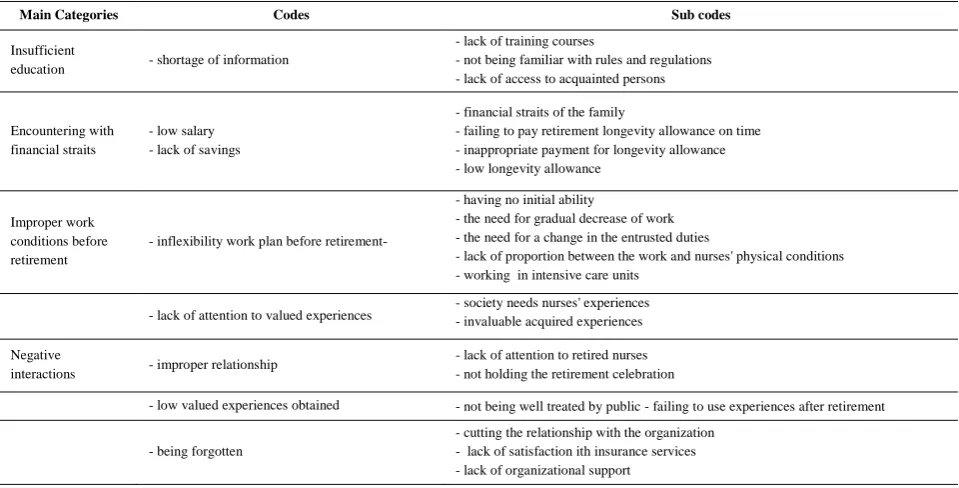
Table 1 shows the codes and categories derived from the existing literature. The process by which nurses were prepared for retirement consisted of
four concepts: "enjoying appropriate education", "prevention from financial strait", "proper work condition before retirement", and "negative
interactions reduction".A summary of author, year,
place, goal and the findings of some studies about
preperation for retirement is given in table 2.In this
section, each category with its codes and subcodes has been explained. The theoretical model based on these categories introduced at the end of the findings. The concept of "Preparation for as the
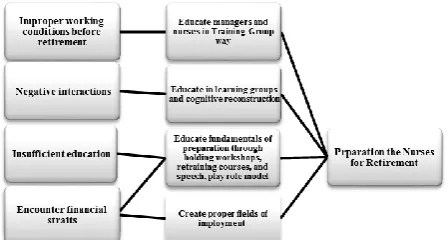
Retirement" central and main concept is presented in Figure 1.
Figure 1. Conceptual framework of preparing nurses for retirement
Table 1. Insufficient Readiness for Retirement
Main Categories Codes Sub codes
Insufficient
education - shortage of information
- lack of training courses
- not being familiar with rules and regulations - lack of access to acquainted persons
Encountering with financial straits
- low salary - lack of savings
- financial straits of the family
- failing to pay retirement longevity allowance on time - inappropriate payment for longevity allowance - low longevity allowance
Improper work conditions before retirement
- inflexibility work plan before retirement-
- having no initial ability
- the need for gradual decrease of work - the need for a change in the entrusted duties
- lack of proportion between the work and nurses' physical conditions - working in intensive care units
- lack of attention to valued experiences
- society needs nurses' experiences - invaluable acquired experiences
Negative
interactions - improper relationship
- lack of attention to retired nurses - not holding the retirement celebration
- low valued experiences obtained - not being well treated by public - failing to use experiences after retirement
- being forgotten
- cutting the relationship with the organization - lack of satisfaction ith insurance services - lack of organizational support
Table 2. Author, year, place, purpose and findings of some studies about preperation for retirement
Author, Year & Place Goal Findings
Kelly & Swisher (1998) USA The process of transition to retirement for
nurses
Retirement associate with a sense of confusion, loss of money, status, safety, self-confidence and the difference between what is expected from reality.
Lo & Brown (1999) Australia Stress and coping: Preparation for
successful retirement
Retirement can create major challenges in coping with financial, social and emotional.
Rosenkoetter & Garris (2001) USA Planning for retirement,the use of time and
psychosocial coping
Preparing for retirement is essential. The emphasis is not only on financial factors, but also on the psychosocial needs of the retired and their families. Mojan-Azzia et al. (2007)
Suisszerland
Determining retirement effects on criteria of
health Retirement can lead to improved health and reduced depression and anxiety.
Blakeley & Ribeiro (2008) Canada Determining various factors and sources of
income in retirement planning
Retirement needs to maintain health and activity in physical and mental and financial condition.
Hewitt et al (2010) Australia Determining job performance in retirement The three concepts of environment, planning processes, and experiences are
effective in retirement. Nobahar et al (2012)
Iran Retired nurses' experience from retirement
Nurses' experiences during retirement is identity threat.
Nobahar et al (2012) Iran
The present challenges in the transition to retirement from the retired nurses view: Shock and disbelief
lack of information about the transition to retirement is associated with shock and disbelief.
Nobahar et al (2012)
Iran Designing a coping model for retired nurses.
Transition to retirement is not simple and one-step, but it is a coping process over time.
Insufficient Readiness: It was also found that those who retired were no ready enough for retirement, while becoming ready for retirement would facilitate adjustment to it (4).
Insufficient education: It was shown that one of the categories related to insufficient readiness for retirement was insufficient education before retirement. Schieber (2004) believes that there is not sufficient training on transition to retirement (28). Retirement education includes education about family and spouse concerns, natural process of aging, maintenance of physical and mental health, financial planning, social security, investment, budgeting, appropriate part-time/full-time job, housekeeping and accepting new roles, legal planning, asset and property planning, social situation, actual asset management, health care services, death and dying, consequences of leisure and entertainment, social organizations and the governmental contribution to retirement (29). Ebersole and Hess (1990) claim that education before retirement should cover aspects such as mental, social, and family problems & so on (30). Education can be planned and implemented for nurses some years before retirement. In this respect, by acquiring such education, retired nurses may be assisted to reconstruct their identities (13).
Facing Financial Straits:One of the categories of
insufficient readiness for retirement was facing financial straits during retirement. Ericsson's Model of confrontation with losing role in retirement emphasizes the role's development and getting significant work in retirement (31) and the role theory emphasizes the importance of assuming new roles in retirement (32). Rosenkoetter and Garris (1998), mention that salary is one of the main concerns regarding retirement (4). The results of literature review denote that the acceptance of new roles by retired persons can help them to facilitate identity reconstruction strategies. Holding useful jobs prevents from financial straits after retirement (31). Eyster et al. (2008) assert that planning for
retirement helps nurses to extend their working life rather than leave working fully. This plan helps to earn income, transfer to part-time work, encourage the previous employees to work in contract independently, employ the retired again in order to help short-term projects, and use the retired and effective employees in mentoring tasks (33). Accordingly, preventing financial straits will be
possible through creating appropriate employment.
Improper Work Conditions before Retirement: One of the categories of insufficient readiness for retirement was the nurses' improper working conditions before retirement. Health and Retirement
Studies (2007) showed that 75% of employers liked
their working hours get reduced gradually (34). Rothwell et al. (2008) stated that adult workers tend to work in flexible hours (35). In the American culture, the values of women and men decline after retirement and their skills and experiences are not compensated by the community (36). Improper working conditions before retirement negatively influence identity reconstruction in nurses and their adjustment to retirement. On the one hand, effective leadership can empower nurses for identity
reconstruction (37,38). Educating nursing
managers during on-the-job training courses helps them to improve nurses' capabilities and efficiencies using correct and systematic managerial skills in different fields (39). Sloman (1994) believes that manager training programs to improve and modify managerial performance and the skills of the managers for accepting their own future roles are required because of various situations (40). Training-Group is a training way in which managers are taught on methods, prejudices, personal intentions and desires, behavioral tendencies, and disadvantages and strengths of communication with others (41).
Given the adult education features and using adults' valued experiences through the development of managers training programs, considering environmental conditions and selecting proper educational methods (learner-centered learning) in
which small groups of 8-10 persons interact with each other in a group without structure for several weeks in a free and participatory environment, as well as regarding their own previous experiences, nurses' learning is improved and they would correct their faults and reinforce their strengths, through the received feedback and given each other's feelings (42). Accordingly, nurses' education in training-group can provide appropriate work conditions before retirement and facilitate identity reconstruction after retirement (9).
Negative Interactions: One of the categories of insufficient readiness for retirement was negative interactions. Retirement decreases nurses' physical and social activities (36). Blakeley and Ribeiro (2008) asserted that retirement needs developing communication and social support (43), while Osborne (2009) declares that men experience getting alone after retirement at home (fever center) and women experience another one (empty nest syndrome) (31). The participation of managers and experienced nurses in learning groups by inviting the retired nurses for active participation in different plans in the university, hospital, and the retirement organization according to their interests and abilities, the participation of nurses in different celebrations and ceremonies, appreciation and acknowledgment of the retired people through holding retirement celebrations, inviting them and their families to attend at the retirement ceremony, holding annual celebration in a special day for "Retirement", giving gifts to the retired in the Retirement Day and all lead to
decreased negative interactions (9). While
reconstructing nurses' identities and participation in decision-making given their high job records, educating managers and experienced nurses using Training-Group will cause the organization environment to change so that negative interactions drop, while creating the environmental conditions proportional to the experienced nurses' logic wills, the necessary readiness for retirement will be provided in the retired nurses (9). On the one hand,
the researchers believe that the substitution of negative thoughts and stressful beliefs for positive, constructive, and realistic thoughts will decrease negative evaluation by the person having interactions. Therefore, cognitive reconstruction in order to review and change undesirable approaches as well as substituting logic thoughts will reduce negative interactions (44). ccordingly, educating the learning groups and cognitive reconstruction are considered the proper strategies for reducing negative interactions (9).
Theoretical Rationale: Organizing concepts and statements inside a related whole and preparing the phenomenon under study will be effective. The researchers explained the logic structure for retirement preparation .Since retirement for nurses is difficult and stressful; preparation for retirement is composed of the essential bases for the model. The preparation includes any empowerment at each stage of the retirement process (before, during and after retirement) that must be planed, implemented and evaluated. The goal behind the preparation process is to provide appropriate work conditions before retirement, reducing negative interactions, nurses getting familiarity with the fundamentals of
teaching retirement and creating suitable
employment. The favorable working condition for nurses is provided by training managers and learning through learning group. Preretirement working flexibility includes the change of duties,
physical condition and ability to assign
appropriate tasks to nurses is dwindling and work according to their experiences. Avoiding rush negative thoughts through retirement plan preparation and reviewing an unfavorable attitude's change and substituting logical thoughts effectively in order to lower negative interactions. Based on this, teaching in learning group and cognitive restructuring are considered as strategies to reduce negative interactions. Having the proper training to deal with lack of information, lack of courses, lack of familiarity with the rules and regulations and lack of access to anyone for
preparation provides retirement planning. Facing financial difficulties with basic training for pre-retirement planning and developing suitable employment will be eliminated after retirement (Figure 2).
Figure 2. Steps of preparation of nurses for retirement
Discussion
This study finding shows that transition to retirement is possible by creating preparation for retirement, preserving identity combined with good health and benefiting the support by family members, authorities, organizations and society. Retirement experience for the nurses was hard & stressful and accompanied with identity threat. What caused insufficient readiness for retirement and increased identity threat is related to
insufficient education, encountering with
economic straits, improper work conditions before retirement and negative interactions. Identity threat was due to shock and disbelief, strict work separation from personal life and frustration that complicates a nurse's adjustment to retirement (25). Floyd et al. (1992) believes that those who are retired experience initial crisis after retirement due to work pressure (45). In Iran, retired nurses consider their retirement as some sort of threat to their identity, and react with disbelief, denial, fear, frustration, depression or even feeling close to death (13). Moreover, job loss causes or aggravates emotional emptiness, insufficient social status, and lack of funding (46).
Kelly & Swisher (1998) stated that retirement
stresses often resulted from insufficient
information (47). The literature discussed about insufficient readiness for retirement in nurses stated by professional individuals in different groups (5, 48). It is suggested that nurses should begin to plan retirement in their initial job stages (17, 18, 21). Educating nurses' retirement can be conducted in three levels: in level 1, nursing students should be trained in the initial introduction about the importance of retirement planning. In level 2, in the middle period of nurses' work (22-40 years old), nurses' basic needs must be emphasized through workshops & refreshing education in working environments. In level 3, for the employees who work in the middle period or more, and more than 40 years old, more specialized training courses are planned (24). Retirement planning should not be performed 1 or 2 years or even 10 years before retirement. It should be designed years before this so that the retired person is allowed to have social position and financial stability. Lo and Brown (1999) believe that planning for retirement can be along with transfer to a successful retirement. Retirement planning and education are better
during middle-age periodand essential at the end
of the middle-age (23). Nursing managers should be of the different resources for retirement planning in all three levels. The managers' perception of retirement planning importance for nurses must increase, and their participation in providing retirement planning should be more (24). Zinner (2006) stated that planning social, mental, and physical dimensions in retirement is important (11). The topics of the discussions about retirement planning should include different economic, mental, social, and physical dimensions of preparation. Financial components (Pensions and benefits, Budgeting, Investment decisions, Tax , Insurance issues, Estate planning, Will writing,
Trust formation), psychosocial components
(Role adjustment, Career transition, Working alternatives, Leisure activities, Volunteering,
Mental health, Time management,
fulfillment, Women's issues), & physical components (Healthy eating/nutrition, Physical fitness/activity, Personal safety, Stress management, Housing options, Transportation, Health insurance, Care of older relatives, Normal changes of aging, Legal issues) (24).
Nurses need to consider several factors in planning for retirement. One of them is financial factor. The nurses with retirement pension don’t have enough money for their needs (49). Some studies indicated that retired nurses faced with reduced standard of living (12, 46). Wiggins & Henderson (1996) found that low attention has been paid to financial planning for nurses (15). Insufficient income may prevent the retired person from having a good nutrition regime and from reaching many social values, voluntary activities and leisure time (24). Salary paid by the government is not sufficient for providing the required standard for their normal living and due to financial need, some retired nurses had to work. Given the current economic problems, many retired persons may still choose to work (50). They need more resources of income such as personal savings or investment (19, 51). Hewitt et al. (2010) suggested that enough resources for helping the persons to be ready for retirement and to participate actively in the society must be considered (52).
Retirement planning requires formal
substitution, structural activities of work, and social networks along with employment (53). These dimensions are supported by other studies (47, 54). Working part time or full time in different or similar employments may be one part of retirement planning (55-57). Donner and Wheeler (2005) recommended that retirement should not be taken as the end of working life. This stage of one's life should be treated as part of continuing life seen in the retirement planning (21). Atchley (1987) and Henretta et al. (1993) reported that 10 to 15 percent of the retired return to their work environments (58, 59). Dorfman
(1989) said in the UK, one third, and in the United States, a half of the retired return to their previous work environment (60). The retired nurses have obtained standards of competence, expertise, knowledge, ability, and skill for many years. Enjoying these capabilities is of the most fundamental necessities of nursing profession (61). The studies' results revealed that the retired persons with more income (62), more education and higher job position have more tendency for working (62, 63).
Also the working conditions before retirement is another variable helping the nurses get ready for retirement. Taylor (2006) said that two third of the employees more than 50 years old hope that their working hours decrease, and their work environment be flexible as well as their duties decrease before retirement (64). Attention to mentoring role can be considered by the nursing managers for preparing the nurses for retirement. Benefiting from the retired nurses' experiences sets the scene for professional development and promotion (65). Negative interactions in preparing the nurses for retirement have an undesirable effect. Beehr et al. (2003) asserted that after retirement, many stresses may be formed by colleagues. Negative interactions exacerbate psychosocial stress, impairs self-esteem and induces feelings of worthlessness in retired nurses which delay retirement adjustment (13). That is when stressors are generated in the same social support resource, it can lead to anxiety or stress and increase pressure on the retired person (66). Lack of support brings with it a bigger feeling of lacking and perceptions of affective non-support (67). Retired nurses felt frustrated following their retirement due to physical weakness, inadequate social support, emotional emptiness and desperate living situation (46). It is important that the managers recognize the effects of support and know how to modify negative interactions for the retired ones (68). Nursing managers have a key role to improve job satisfaction, thus support the
tendency of retired nurse to keep on working (65). Via good communication, the managers are able to increase the employees' identities in adjustment to actual retirement-dependent stressors (69).
Conclusion
The analysis of the literature revealed four different categories of factors influencing each other; these factors make up a conceptual model. In addition, the retirement model test can be proposed with quantitative studies based on this retirement model.
Conflict of Interests
The authors declare that they have no competing interests.
Author's Contributions
Monir Nobahar: Study conception, data collection/analysis; manuscript drafting; critical revisions for important intellectual content. Fazlollah Ahmadi: Study conception/design; data analysis; manuscript drafting; critical revisions for significant intellectual content; supervision. Fateme Alhani: Data analysis; critical revisions for important intellectual content. Masoud Fallahi Khoshknab: Data analysis; administrative/ /technical/ material support.
Acknowledgement
The research proposal was approved by the Research and Ethical Committee of Tarbiate
Modarres University who supported the
implementation of this project.
References
1. Agheli L, Ghaffari H. A Study of Factors Affecting Elderly Women’s Retirement and Participation in the Labor Market: a Case Study in Tehran. International Journal of Women’s Research 2011; 1: 21-41.
2.Vaillant GE, DiRago AC, Mukamal K. Natural history of male psychological health, XV: retirement satisfaction. Am J Psychiatry 2006; 163(4): 682-688. PMID: 16585444.
3. Cook LS, Williamson M, Salmeron L, Burton D, Goad DM. Critical issues in the decision to retire: a comparison of retired and retirement-age faculty. J Nurs Educ 2011; 50(12): 670-675. PMID: 22007710 4. Rosenkoetter MM, Garris JM. Psychosocial changes following retirement. J Adv Nurs 1998; 27(5): 966-976. PMID: 9637323.
5. Rosenkoetter MM, Garris JM. Retirement planning, use of time, and psychosocial adjustment. Issues Ment Health Nurs 2001; 22(7): 703-722. PMID: 11881183.
6. Sharpley CF, Layton R. Effects of age of retirement, reasons for retirement, and pre-retirement training on psychological and physical health during retirement. Australian Psychologist 1998; 33(2): 119-124. 7. Anderson CE, Weber JA. Pre-retirement planning
and perceptions of satisfaction among retirees. Educ gerontol 1993; 19: 397-406.
8. Hawken PL, Hillestad EA. Retirement--a job in and of itself. Nurs Adm Q 2000; 25(1): 102-106. PMID: 18188912.
9. Nobahar M, Ahmadi F, Alhani F, Fallahi Khoshknab M. Exploration of coping proccess in retire nurses: designing model. Ir j psychiat nurs. 2011; 1(2): 38-53 (Persian).
10. Vaus DD, Wells Y, Kendig H, Quine S. Does gradual retirement have better outcomes than abrupt retirement? Results from an Australian panel study. Ageing Soc 2007; 27: 667-682.
11. Zinner P. Preparing the work force for retirement--the role of occupational health nurses. AAOHN J 2006; 54(12): 531-536. PMID: 17190096.
12. Nobahar M, Ahmadi F, Alhani F, Fallahi Khoshknab M. The Challenges of Transition to Retirement from the Point of View of Retired Nurses: Shock and disbelief. J Qual Res Health Sci 2012; 1(2): 112-122 (Persian).
13. Nobahar M, Ahmadi F, Alhani F, Fallahi Khoshknab M. Designing an adaptation model for retired nurses. Iran Journal of Nursing (IJN) 2012; 24(74): 63-71 (Persian).
14. Evans L, Ekerdt DJ, Bosse R. Proximity to retirement and anticipatory involvement: findings from the
Normative Aging Study. J Gerontol 1985; 40(3): 368-374. PMID: 3886774.
15. Wiggins SD, Henderson CM. Preretirement planning of female registered nurses. West J Nurs Res 1996; 18(5): 580-94. PMID: 8918209.
16. Bolton J, Roy W. Succession planning: securing the future. J Nurs Adm. 2004; 34(12): 589-93. PMID: 15632755.
17.Barginere C, Franco S, Wallace L. Succession planning in an academic medical center nursing service. Nurs Adm Q. 2013; 37(1): 67-71. PMID: 23222756.
19. O'Connor R. Plan early, retire happy. Nurs Stand 2003; 17(16): 16-17. PMID: 12600126.
20. Letvak S, Buck R. Factors influencing work productivity and intent to stay in nursing. Nurs Econ 2008; 26(3): 159-165. PMID: 18616053.
21. Donner G, Wheeler M. The next chapter. Can Nurse 2005; 101(3): 42. PMID: 15913274.
22. Siegel S, Rees B. Preparaing the public employee for retirement. Public pers manage1992; 21(1): 89-100.
23. Lo R, Brown R. Stress and adaptation: preparation for successful retirement. Aust N Z J Ment Health Nurs 1999; 8(1): 30-38. PMID: 10382397
24. Blakeley J, Ribeiro V. Are nurses prepared for retirement? J Nurs Manag 2008; 16(6): 744-752. PMID: 18808469.
25. Nobahar M, Ahmadi F, Alhani F, Fallahi Khoshknab M. Retired nurses' experience from retirement: Aqualitative study. J health promotion manage 2012; 1(4): 69-81 (Persian).
26. Friedrich LA, Prasun MA, Henderson L, Taft L. Being a seasoned nurse in active practice. J Nurs Manag 2011; 19(7): 897-905. PMID: 21988437. 27. Walker LO, Avant KC. Strategies for theory
construction in nursing. editor: NJ: Upper Saddle River: Pearson/Prentice Hall Co; 2005.
28. Schieber SJ. Retirement income adequacy: good news or bad? Benefits Q 2004; 20(4): 27-39. PMID: 15628616.
29. U.S. Department of Health EaW. Preretirement Series, Aging. Washington, DC: U.S. Government Printing Office, 1979.
30. Ebersole P, Hess P. Towards healthy aging: Human needs and nursing response.: St Louis, MO: C. V. Mosby Company; 1990.
31.Osborne JW. Commentary on retirement, identity, and Erikson's developmental stage model. Can J Aging 2009; 28(4): 295-301. PMID: 19925695. 32. Kim J, Moen P. Is retirement good or bad for
subjective well-being? Curr Dir Psycholo Sci 2001; 10(3): 83-86.
33. Eyster L, Johnson RW, Toder E. Current strategies to employ and retain older workers: final report. Washington, DC: Prepared by the Urban Institute for the U.S. Department of Labor (DOL), Employment and Training Administration (ETA), 2008.
34. Aging. NIo. Growing older in America: The health and retirement study. Washinton, DC: National Institutes of Health, 2007.
35.Rothwell WJ, Sterns HL, Spokus D, Reaser JM. Working longer: New strategies for managing, training, and retaining of older employees. New York: AMACOM, Division of American Management Association, 2008.
36. Mojon-Azzia S, Sousa-Pozab A, Widmerc R. The effect of retirement on health: a panel analysis using data from the Swiss Household Panel. Swiss Med Wkly 2007; 137(41-42): 581–585. PMID: 17990151 37. Özaralli N. Effects of transformational leadership on empowerment and team effectiveness. Leadership and Organization Development Journal 2003; 24(6): 335-344.
38.Kingdon BL. Nurses' perception of desirable qualities/characteristics of a good leader. Can Oper Room Nurs J 1994; 12(1): 22-27. PMID: 8180894 39. Laschinger HK, Wong C, McMahon L, Kaufmann
C. Leader behavior impact on staff nurse empowerment, job tension, and work effectiveness. J Nurs Adm 1999; 29(5): 28-39. PMID: 10333859. 40. Sloman M. A hand book traininig Strategies for
managers. editor. London: Gower Pub; 1994. 41. Kearney WJ, Martin DD. Sensitivity training: an
established management development tool? Acad Manag J 1974; 17(4): 755-760.
42. Zaeimipour Kermanshahi M, Vanaki Z, Hajizadeh E. Learning Groups in Training Programs for Nurse Managers: A Method to Enhance Nursing and Leadership Capabilities. Iran J Med Educ 2007; 7(1): 69-76 (persian).
43. Blakeley JA, Ribeiro VES. Early retirement among registered nurses: Contributing factors. J Nurs Manag 2008; 6(1): 29-37. PMID: 18211333.
44.Kim S, Feldman DC. Working in retirement: The antecedents of bridge employment and its consequences for quality of life in retirement. Acad Manag J 2000; 43: 1195-1210.
45.Floyd FJ, Haynes SN, Doll ER, Winemiller D, Lemsky C, Burgy TM, et al. Assessing retirement satisfaction and perceptions of retirement experiences. Psychol Aging 1992; 7(4): 609-621. PMID: 1466830. 46.Nobahar M, Ahmadi F, Alhani F, M. FK.
Experiences of Retired Nurses of Health Status during Retirement: A Content Analysis. J Qual Res Health Sci 2013; 2(1): 21-32 (Persian).
47. Kelly NR, Swisher L. The transitional process of retirement for nurses. J Prof Nurs 1998; 14(1): 53-61. PMID: 9473904.
48. Perkins K. Psychosocial implications of women and retirement. Soc Work 1992; 37(6): 526-532. PMID: 1448697.
49. Moore K, Biordi D. Nurses' retirement preparation. J Nurs Adm 1995; 25(6): 62-67. PMID: 7776010. 50. Nobahar M, Ahmadi F, Alhani F, Fallahi Khoshknab
M. Work or retirement: Exploration of the experiences of Iranian retired nurses. Work 2014 (Inpress). 51.Minor MD. Retirement planning. Don't wait too
long! Revolution 1996; 6(4): 91-92. PMID: 9043435 52. Hewitt A, Howie L, Feldman S. Retirement: What
will you do? A narrative inquiry of occupation-based planning for retirement: Implications for practice. Aust Occup Ther J 2010; 57(1): 8-16. PMID: 20854560.
53. Fulks JS, Fallon LF. The older worker. Occup Med 2001; 16(3): 501-507. PMID: 11401794.
54. Goldberg E. A healthy retirement. AORN J 2002; 76(5): 873-874. PMID: 12463088.
55. Davison N. Planning ahead for your life after work. Nurs Times 2004; 100(28): 44-45. PMID: 15311539. 56. Hill KS. A business case for phased retirement: will
it work for nursing? J Nurs Adm. 2010; 40(7-8): 302-8. PMID: 20661059.
57. Weiss B. A nurse's guide to retirement planning. RN 2005; 68(12): 63-65. PMID: 16411557.
58.Atchley R. Aging: Continuity & change. editor. Belmont: CA: Wadsworth; 1987.
59.Henretta JC, O'Rand AM, Chan C. Gender differences in employment after spouse's retirement. Res Aging 1993; 15: 148-169.
60.Dorfman L. British and American academics in retirement. Educ Gerontol 1989; 15: 25-40.
61. Ahmadi F, Nobahar M, Alhani F, Fallahi Khoshknab M. Prespectives of retired nurses on factors that affect quality of nursing. Hayat 2011; 17(1): 24-34 (Persian). 62.Streib G, Schneider C. Retirement in American
society. London: Cornell University Press, 1971. 63.Karp DA. The social construction of retirement
among professionals 50-60 years old. Gerontologist 1989; 29(6): 750-760. PMID: 2620837.
64. Taylor P. Imployment initiatives for an ageing workforce in the EU15. Luxembourg: European Foundation for the Improvement of Living and Working Conditions, 2006.
65. Nobahar M, Ahmadi F, Alhani F, Fallahi Khoshknab M. Nursing management from retired nurses' perspective. J Urmia Nurs Midwifery Fac 2012; 10(1): 87-96 (Persian).
66. Beehr TA, Farmer SJ, Glazer S, Gudanowski DM, Nair VN. The enigma of social support and occupational stress: source congruence and gender role effects. J Occup Health Psychol 2003; 8(3): 220-231. PMID: 12872959.
67.Nahum-Shani I, Bamberger PA. Work hours, retirement, and supportiverelations among older adults. J Organl Behav 2011; 32(2): 345–369. PMID: 20485475.
68. Kim JE, Moen P. Retirement transitions, gender, and psychological well-being: a life-course, ecological model. J Gerontol B Psychol Sci Soc Sci 2002; 57(3): 212-222. PMID: 11983732.
69. Nuttman-Shwartz O. Like a high wave: adjustment to retirement. Gerontologist 2004; 44(2): 229-236. PMID: 15075419.