Advanced Ceramics Progress
J o u r n a l H o m e p a g e : w w w . a c e r p . i r
Molecular Dynamics Simulation of Straight-chain Alkanes Adsorption and
Diffusion in Zeolite
H. Rahimipour, R. Tafreshi, M. Davoodpour, Y. Mortazavi*, A.A Khodadadi
Department of Chemical Engineering, University of Tehran, Tehran, Iran
P A P E R I N F O
Paper history:
Received 26 December 2014
Accepted in revised form 17 January 2015
Keywords:
Molecular dynamics simulation Alkanes
SiO2 ceramic
Adsorption and self-diffusion
A B S T R A C T
Molecular dynamics simulations were applied to calculate self-diffusion coefficients (Di,self) and heats
of adsorption for ethane, propane and n-butane. Simulations were done in temperature range of 300-525 K for various concentrations inside the pores of silicalite type zeolite. Calculated values of self-diffusion coefficients and heats of adsorption resulted from the current work, were in better agreement with experimental estimated values found in literature than those resulted from simulations reported by other authors. For instance, at temperature of 300K and loading of 5 molecules/unit cell, self-diffusion coefficients of 16.56×10⁻⁵, 7.62×10⁻⁵ and 5.81×10⁻⁵ cm2/s were calculated for C
2H6, C3H8 and n-C4H10
respectively was compared to experimental reported values of 10×10-5, 9×10⁻⁵ and 6×10⁻⁵ cm2/s. At the
same conditions, adsorption energies of 9.2, 11.48, and 13.66 kcal/mol. were calculated for ethane, propane, and n-butane respectively, while the experimental reported values found to be6.93, 9.7 and 12.7 kcal/mol. Simulations showed that the diffusion decreases when loading increases and the heats of adsorptions were increase by molecular weight of hydrocarbons for all adsorbates studied.
1. INTRODUCTION1
Zeolites, as well-ordered micro porous structures, represent promising features for various industrial applications such as purification, separation and catalysis. A key parameter which is proven to play an important role in such applications is the diffusion rate of molecules in zeolite pores [1, 2]. Faujasite (FAU) type zeolites are amongst the most studied micro porous materials and well applied in various laboratorial and industrial applications. The FAU frame work consists of sodalite cages connected with hexagonal prisms which in turn create unique pores with perpendicular arrangments. Getting 10 sodalite cages together, an inner cavity of 12 Å diameter is formed with a quite large entrance of 7.4 Å diameter [3]. Promising features of zeolites and especially FAU type zeolites motivate researchers to broadly study zeolite-containing systems. Specifically, effects of molecule(s)-zeolite interactions on the diffusion rate, the ratio of Al/Si in the zeolite structure, the molecular configuration and the influence of Brønsted acid sites were widely investigated in such systems[2].
Evaluating the diffusion rate of different species in zeolites, is of big concerns of researchers and led to
1*Corresponding Author’s Email:[email protected] (Y. Mortazavi)
arise several experimental methods [3]. Quasi-elastic neutron scattering and pulsed field gradient nuclear magnetic resonance PFG-NMR techniques are widely performed to experimental measure both self (DS) and
transport (DT) diffusion coefficients as a function of
concentration to different gases in silicate and Faujasite systems [4, 5]. It is repeatedly emphasized that diffusions largely depend on the relevant volume of the studied system and also physical conditions under which the measurements were carried out. In addition, thermal effects, pore size of zeolites and the surface properties also have major impacts on validity and precision of diffusion measurements[6, 7].
Many articles have focused on experimental measurement of diffusions in zeolite pores[8, 9]; However, different measurement techniques led to different results. For instance, self-diffusion of methane, ethane and propane in zeolite frame works were measured by the pulsed field gradient NMR (PFG-NMR) technique[10]. Schwarz et al. measured self-diffusions of propane and propylene in NaX zeolite by using the same technique [11]. Brandani et al. measured the diffusion of propane and propylene in 13X and 5A zeolite crystals, and showed that there is no considerable differences between diffusions of propane and propylene, however associated NMR values were much larger than propane diffusion obtained by ZLC method[12]. Two different measurements, PFG-NMR
and ZLC methods were carried out by Banas et al. in order to highlight the differences among experimental results[13]. Large deviations were also found in estimation of self-diffusions of branched alkanes in MFI-type structures obtained by different experimental and theoretical techniques[14]. The self-diffusion coefficients are considerably dependent on the configuration of gas molecules. For example, quasi-elastic neutron scattering (QENS) showed that self-diffusion coefficient of isobutene in ZSM-5 is much smaller than that of n-butane[15]. Therefore, experimental measurement of diffusion in zeolites can be a controversial issue. Thus, it seems reliable for comparing the experimental data with simulative calculations if possible [6, 7]. In the similar molecular dynamic simulation work the self-diffusion of methane, ethane, propane and i-butane into the zeolite ZSM-5 were estimated 6.02×10⁻⁵
, 2.71×10⁻⁵
, 2.53×10⁻⁵
and 0.06×10⁻⁵
respectively [16].
The main purpose of this work was to calculate the heats of adsorption and diffusions of ethane, propane, and n-butane in siliceous faujasite zeolite (silicalite) by molecular simulation using an optimized new force field for the adsorbent,which enabled fast molecular dynamics simulations on parallel structures .Molecular dynamics simulations were applied for alkanes in four levels of temperatures (300, 375, 450 and 525 K) and three levels of concentrations (5, 10 and 15 molecules per unit cell). The results of molecular dynamics simulations were then compared with some of the reported experimental measurements and other simulations.
2. METHODOLOGy
2.1. Zeolite framework The structure of zeolite
was taken from the work of Zhu and Seff [17]. The faujasite unit cell is cubic and belongs to the space group Fd3m. Each unit cell has an edge length of 24.4 Å, and a composition of Si192O384. However, our
simulation included 16 connected cells for higher accuracy.
2.2. Potential parameters A new force field for
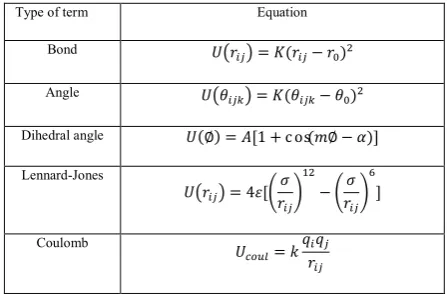
silicalite structure was proposed, by which fast molecular dynamics simulations were possible[18]. In this investigation, the potential energy of the zeolite included energies of O–Si–O and Si–O–Si angle bends, Si–O bond stretches, and bond torsions which are expressed as simple harmonic potentials. In addition Si– O–Si–O dihedral interactions were approximately estimated with acosine potential model. Table 1 lists all mentioned potential formulas in this work. The summation of Lennard-Jones (LJ 12-6) and Coulomb terms were used to present the inter molecular interactions (i.e. guest-guest, guest-zeolite). A very common method was applied to approximate the values
of LJ parameters for C–O, C–Si, H–O and H–Si; in which the values of σij and εij were presented as a
function of characteristics of O–O, Si–Si, H–H and C– Cbonds based on Lorentz–Berthelot combination rules theory:
= (1)
= (2)
TABLE 1. Terms in the analytical intra molecular potential
for siliceous faujasite zeolite and alkanes.
Type of term Equation
Bond = ( − )
Angle = ( − )
Dihedral angle (∅) = [1 + cos( ∅ − )]
Lennard-Jones
= 4 [ − ]
Coulomb
=
Where εij and σij are constants of i-j interaction.
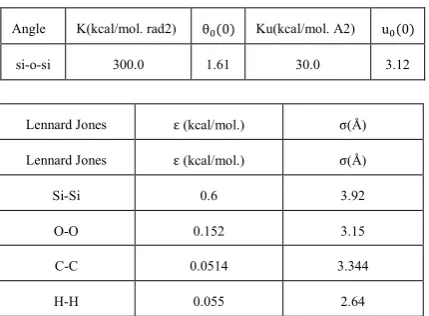
Required potential parameters derived by this method are presented in Table 2[18, 19]. The molecular orbital calculations were done by using density functional theory (DFT) methods in which all computations were carried out using Gaussian 98 program[20]. The geometry was established by the B3LYP method with 6-31++G** basis set and NBO populations were taken for the atomic partial charges of the alkanes (Table 3).
TABLE 2. Inter molecular harmonic force field parameters
for zeolite and alkanes[18, 30].
Bond K (kcal/mol. A2) R0 (A2)
Ethane Propane Butane Ethane Propane Butane
C-H 338.47 331.059 338.47 1.093 1.13 1.093
C-C 341.49 316.66 341.49 1.543 1.523 1.543
Si-O 300 300 300 1.61 1.61 1.61
Angle K (kcal/mol. rad2) θ (0)
Ethane Propane Butane Ethane Propane Butane
H-C-H 43.61 23.03 35.69 109.47 109.40 109.47
H-C-C 38.93 25.90 47.64 109.47 109.39 109.47
Lennard Jones ε (kcal/mol.) σ(Å)
Lennard Jones ε (kcal/mol.) σ(Å)
Si-Si 0.6 3.92
O-O 0.152 3.15
C-C 0.0514 3.344
H-H 0.055 2.64
TABLE 3. Calculated atomic partial charges of zeolite and
alkanes.
Atom Partial charge
Zeolite Si +2.00000
O -1.00000
Ethane C1, C2 -0.66600
H1, H2 +0.22200
Propane C1, C3 -0.66100
C2 -0.46000
H1, H2, H3 0.22275
Butane C1, C4 -0.65800
C2, C3 -0.45500
H1, H2, H3, H4 0.22260
2.3. Molecular dynamics simulations The
Lammps program package [21]was used for MD simulations on windows work stations. Since the simulation needs infinite frame work, cubic periodic boundary conditions were defined in each simulation box direction. Four temperature levels of 300, 375, 450 and 525K and three levels of loadings (5, 10 and 15 molecules/unit cell) were applied in simulation. The pppm summation method was performed for coulomb ic and the van der Waals interactions calculations within a cut off length fixed at 12 Å. Equations of motion were modeled by obtaining the velocity form of the Verlet algorithm with a time step of 1 fs. Prior to the simulation, the structure of the frame work was optimized for a while by using the NPT ensemble. During optimization step, total energies were monitored and investigated in order to find out if the system reached the equilibration. Finally, the optimized frame work configuration was employed as the input for the main simulation run in a 10000 fs period at different temperatures.
3. RESULT AND DISCUSSION
3.1. Self-diffusion coefficients Sample MD
geometry is depicted in Figure 1. which shows 5
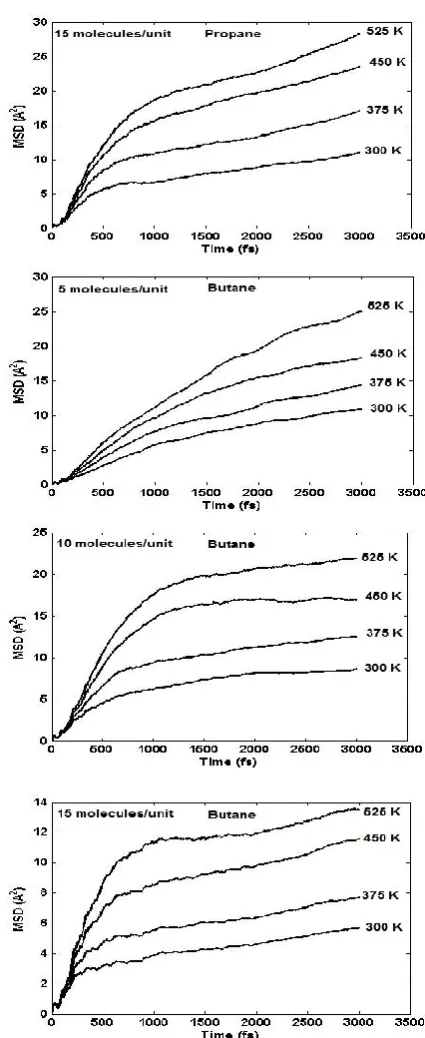
molecules of studied alkanes loaded in one cage of silicalite in the simulation cell defined for this work. Figure 2. demonstrates the mean-square displacements (MSDs) of ethane, propane and n-butane molecules at different loadings and temperatures for 3000s of simulation. At low loading, MSD changes seem to rapidly stabilize to establish a linear relationship with time (Figure 2.) while for high loadings, more time was required for stabilization of simulation results.
Figure 1. Loading of a unit cell for ethane (a), propane (b) and
butane (c) with5 molecules per cell.
According to Einstein equation, self-diffusion coefficients can be easily calculated by applying a relatively constant slope from MSD curve sat elevated time scales.
= lim→ ∑ ∆ ( ) (3)
Where ∆ ( ) is the mean-square displacement of particle i at time t, N is the number of particles and is
the self-diffusion coefficient.So self-diffusion coefficients were easily calculated by fitting a linear regression on calculated data at specific periods of time and are presented in Figure 3. Experimental determined values of self-diffusion coefficients for studied alkanes were inferred from the work of Ka¨rger et al. in which the pulsed field gradient (PFG)-NMR technique was used[22]. At the temperature of 300 K and almost the same concentration of 5 molecules/cell these values were reported 10 × 10 , 9 × 10 , and 6 × 10
cm2/s for ethane, propane, and n-butane, respectively, which are in a good agreement with calculated values of our work. Comparing Figures 3a, 3b and 3c showed self-diffusions were decrease by increasing the chain length of the molecules. At low loadings, molecules have very high mobility and are free to move in all directions inside the structure of zeolite through the super cages and inter cages. At high loadings, the overall mobility is significantly decreased due to reduced volume for an individual molecule. The mobility of molecules like ethane is moderately higher than those of other alkanes because of their small sizes. Therefore, differences between self-diffusions at low and high loadings are the most for n-butane and the least for ethane, as seen in Figure 3.
Angle K(kcal/mol. rad2) θ (0) Ku(kcal/mol. A2) u (0)
Figure 2. Mean square displacement (MSD) of ethane, propane and n-butane at various temperatures and loadings.
Bosanquet equation is a frequently used and easily applied about meso- and macro-porous materials for estimation of self-diffusion of species i, in which Di,self
is determined as a function of molecule–molecule and the molecule–wall interactions based on equation below [23]:
The quantities of the molecule–wall interactions are expressed byKnudsen equation:
, = (5)
And the term Dii which stems from molecule–molecule
interactions, is estimated by several approximations of fluids [24]. In this studyDii was calculated by using
Chapman and Hirsch felder equation for binary mixtures[25].
Figure 3. Simulated self-diffusions of(a) ethane, (b) propane
and(c) n-butane in zeolite as a function of loading at various temperatures.
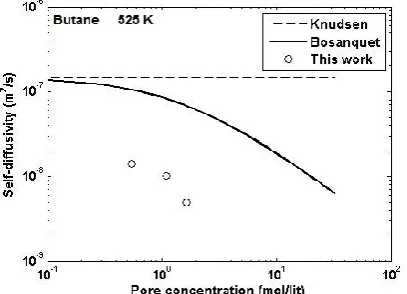
We also compared self-diffusion coefficients obtained by Molecular Dynamics (MD) simulations with those estimated by Bosanquet equation for the studied molecules in the afore mentioned ranges of molar concentration (Ci) and temperature (Figure 4). It was
supposed that over-estimation in self-diffusion coefficients would be occurred by using Bosanquet formula when the molecules had relatively strong adsorption on the zeolite, in other words when the molecule-wall interaction is considerable. In all studied molecules, an inverse relationship between Di,self and
concentration is obvious, which is contributed to less free volume available for molecule to move when concentration increases. The values of Di,self obtained by
MD simulation are significantly lower than those calculated by Eq.4 whether the adsorption is
considerable or not. In other words, when interactions between alkanes and zeolite are significant, self-diffusions are quite over-estimated by the Bosanquet formula. However, the differences become less for low pore concentrations. This deviation seems to be the result of the error of Knudsen formula for molecules with strong molecules-zeolite interaction, a failure marked in many articles[26].
Figure 4. also compares the simulation results of present work with both the experimental data[22] and the simulation results reported by other authors[27] under identical conditions; which hints better agreement between our simulation results and the experimental data than those of the previous simulations.
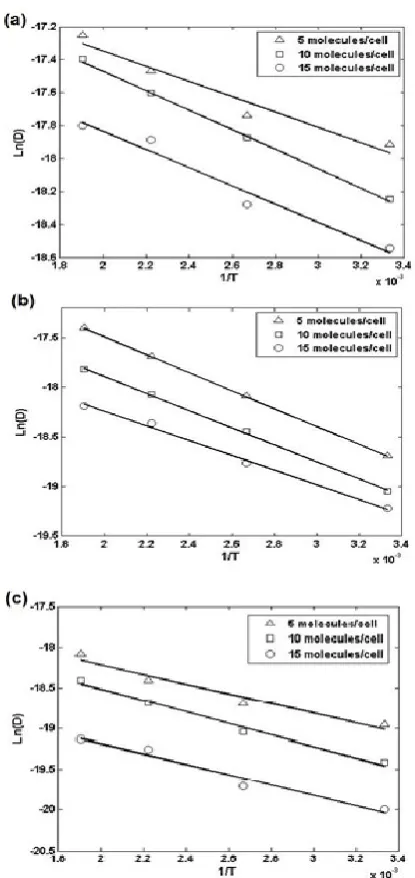
Quantitatively the relationship between the self-diffusion coefficient and the temperature is expressed by the Arrhenius Equation:
= exp ( ) (6)
Where represents the activation energy, D0 is the
self-diffusion coefficient at a specified temperature, T is the absolute temperature and R is the ideal gas constant. Plottingln Ds versus gives a straight line which slope
is and can be well interpreted by our simulation results (Figure 5). The values of and D0 estimated
Figure 4. MD simulation of self-diffusions of ethane, propane and butane at four different temperatures 300, 375, 450 and 525 K are compared to estimations using the Bosanquet and Knudsen formula.
TABLE 4. Arrhenius coefficients for alkanes in zeolite.
Molecule Loading (molecules/unit cell) (kj/mol) (m2/s)
Ethane 5 3.85 7.39 × 10
Ethane 10 4.93 8.50 × 10
Ethane 15 4.59 5.42 × 10
Propane 5 7.51 15.49 × 10
Propane 10 7.17 9.58 × 10
Propane 15 6.18 5.32 × 10
n-Butane 5 5.00 4.09 × 10
n-Butane 10 5.85 3.71 × 10
n-Butane 15 5.33 1.68 × 10
TABLE 5. Adsorption energies in silicalite from molecular dynamics (MD), molecular mechanics (MM) and experiment values.
Adsorbate Our MD (kcal/mol) Other MM (kcal/mol) [31] Experiment (kcal/mol) [28]
Ethane 9.2 8.7 6.93
Propane 11.48 12.1 9.7
Butane 13.66 15.1 12.7
3.2. Adsorption of alkanes The molecules-wall
interaction energies were exploited to calculate the heats of adsorption for the corresponding molecules. In Table 5 the heats of adsorption at low coverage of linear alkanes in siliceous faujasite resulted from our MD simulations were compared with the experimental data reported by Titiloye et al.[28] and molecular mechanics data reported by Stach et al.[29]measured at 300 K.
The heats of adsorption of alkanes on zeolite consist of both terms of van der Waals and the Coulombic interactions. In fact, the values of 9.2, 11.48, and 13.66 kcal/mol. for ethane, propane, and n-butane respectively resulted from our work are in a better agreement with
Figure 5. Arrhenius plots of the self-diffusion coefficients of (a): ethane, (b): propane and (c): butane in silicalite obtained for different loading bars.
Figure 6. Heats of adsorption at low coverage (kcal/mol.) of
linear alkanes.
TABLE 6. The relationship between heats of adsorption at
low coverage obtained with our MD and other MM, and the carbon number of linear alkanes on zeolite compared to the experimental data.
−∆ = +
Method A b
Our MD 2.23 4.757
Other MM [31] 3.2 2.367
Experiment [28] 2.885 1.122
4. CONCLUSION
A developed and new force field facilitating fast and efficient molecular dynamics simulations, was performed to calculate self-Diffusion coefficients and physical adsorption energies of C2H6, C3H8 and n-C4H10
in to the pores of siliceous faujasite (silicalite) for a range of temperatures and pore concentrations. A comparison was made between the values of self-diffusion coefficients calculated by our simulations and the experimental data which confirmed the validity of simulations. For instance, the values of self-diffusion coefficients at 300 K were calculated 16.56 × 10 ,
7.62 × 10 , and 5.81 × 10 cm2/s for C2H6, C3H8
and n-C4H10, respectively, which better mimic the
experimental values of 10 × 10 , 9 × 10 , and
6 × 10 cm2/s than those obtained by similar
simulations. Self-diffusion coefficients were also calculated using well known Bosanquet formula, However, significant differences were then seen between these results and experimental data which are mainly attributed to the error of Knudson formula when adsorption of molecules in zeolite pores is significant i.e. when the molecule–wall interactions are dominant. This conclusion was also confirmed by the results of adsorption energies which showed increasing the molecular weights of alkanes leads to increasing both heat of adsorption and error of Bosanquet formula. We calculated the self-diffusions and activation energies for some of the straight-chain alkanes by considering the Arrhenius equation. Their heats of adsorption in siliceous faujasite were also calculated and compared to those determined by the molecular mechanics approach, which in a better agreement with corresponding experimental results was shown by our results.
5. ACKNOWLEDGMENTS
6. NOTATION
,
self-diffusion coefficient [m2/s] , Knudsen diffusion coefficient [m2/s]
molecule–molecule diffusion coefficient [m2/s] pre-exponential factors [m2/s] Pore diameter[Å]
activation energy for diffusion[kj/mol.] Ideal gas constant, 8.314 j/K Absolute Temperature [K] Molecular mass [g/mol.]
∆ Heat of adsorption[kcal/mol.]
∆ Displacement [m2]
Time [s] Number of atoms or molecules
Greek letters
characteristic energy in Lennard–Jones potential, [K] characteristic distance in Lennard–Jones potential, [Å]
REFERENCES
1. Martínez, A. and Prieto, G., "The application of zeolites and periodic mesoporous silicas in the catalytic conversion of synthesis gas", Topics in Catalysis, Vol. 52, (2009), 75-90. 2. Palomino, M., Corma, A., Rey, F., Valencia, S., "New Insights
on CO2− Methane Separation Using LTA Zeolites with Different Si/Al Ratios and a First Comparison with MOFs",
Langmuir, Vol. 26, No. 3, (2009), 1910-1917.
3. Rives, S.B., Jobic, H., Beale, A. and Maurin, G., "Diffusion of CH4, CO2, and Their Mixtures in AlPO4-5 Investigated by QENS Experiments and MD Simulations", The Journal of Physical Chemistry C, Vol. 117, No. 26, (2013), 13530-13539. 4. Jobic, H., Skoulidas, A.I. and Sholl, D.S., "Determination of
concentration dependent transport diffusivity of CF4 in silicalite by neutron scattering experiments and molecular dynamics",
The Journal of Physical Chemistry B, Vol. 108, No. 30, (2004), 10613-10616.
5. Valiullin, R., Kortunov, P., Kärger, J. and Timoshenko, V., "Concentration-dependent self-diffusion of liquids in nanopores: A nuclear magnetic resonance study", The Journal of Chemical Physics, Vol. 120, No. 24, (2004), 11804-11814. 6. Babarao, R. and Jiang, J., "Diffusion and separation of CO2 and
CH4 in silicalite, C168 schwarzite, and IRMOF-1: a comparative study from molecular dynamics simulation",
Langmuir, Vol. 24, No. 10, (2008), 5474-5484.
7. Trzpit, M., Soulard, M., Patarin, J., Desbiens, N., Cailliez, F., Boutin, A., Demachy, I. and Fuchs, A., "The effect of local defects on water adsorption in silicalite-1 zeolite: A joint experimental and molecular simulation study", Langmuir, Vol. 23, No. 20, (2007), 10131-10139.
8. Krishna, R. and Van Baten, J.M., "Diffusion of hydrocarbon mixtures in MFI zeolite: Influence of intersection blocking",
Chemical Engineering Journal, Vol. 140, No. 1, (2008), 614-620.
9. Krishna, R. and Van Baten, J.M., "Linking the loading dependence of the Maxwell–Stefan diffusivity of linear alkanes in zeolites with the thermodynamic correction factor", Chemical Physics Letters, Vol. 420, (2006), 545-549.
10. Caro, J., Bülow, M., Schirmer, W., Kärger, J., Heink, W., Pfeifer, H. and Ždanov, S.P., "Microdynamics of methane, ethane and propane in ZSM-5 type zeolites", Journal of the Chemical Society,Vol. 81, No. 10, (1985), 2541-2550.
11. Schwarz, H., Ernst, H., Ernst, S., Kärger, J., Röser, T., Snurr, R. and Weitkamp, J., "NMR study of intrinsic diffusion and reaction in CsNaX type zeolites", Applied Catalysis A: General,
Vol. 130, No. 2, (1995), 227-241.
12. Brandani, S., Hufton, J. and Ruthven, D., "Self-diffusion of propane and propylene in 5A and 13X zeolite crystals studied by the tracer ZLC method", Zeolites, Vol. 15, No. 7., (1995), 624-631.
13. Banas, K., Brandani, F., Ruthven, D.M., Stallmach, F. and Kärger, J., "Combining macroscopic and microscopic diffusion studies in zeolites using NMR techniques", Magnetic Resonance Imaging, Vol. 23, No. 2, (2005), 227-232.
14. Jobic, H., Bée, M., Caro, J., Bülow, M. and Kärger, J., "Molecular self-diffusion of methane in zeolite ZSM-5 by quasi-elastic neutron scattering and nuclear magnetic resonance pulsed field gradient technique", Journal of the Chemical Society, Vol. 85, No. 12, (1989), 4201-4209.
15. Millot, B., Méthivier, A., Jobic, H., Moueddeb, H. and Bée, M., "Diffusion of isobutane in ZSM-5 zeolite: a comparison of quasi-elastic neutron scattering and supported membrane results", The Journal of Physical Chemistry B, Vol. 103, No. 7, (1999), 1096-1101.
16. Lins, D.A. and Millan, J.O., "Molecular Dynamics Studies of Light Hydrocarbons Diffusion in Zeolites", Molecular Engineering, Vol. 7, (1997), 309-316.
17. Olson, D. and Dempsey, E., "The crystal structure of the zeolite hydrogen faujasite", Journal of Catalysis, Vol. 13, (1969), 221-231.
18. Gabrieli, A., Sant, M., Demontis, P., Suffritti, G.B., "Development and optimization of a new force field for flexible aluminosilicates, enabling fast molecular dynamics simulations on parallel architectures", The Journal of Physical Chemistry C, Vol. 117, No. 1., (2012), 503-509.
19. Nicholas, J.B., Hopfinger, A.J., Trouw, F.R., Iton, L.E., "Molecular modeling of zeolite structure. 2. Structure and dynamics of silica sodalite and silicate force field", Journal of the American Chemical Society, Vol. 113, (1991), 4792-4800. 20. Frisch, M., Trucks, G., Schlegel, H., Scuseria, G., Robb, M.,
Cheeseman, J., Zakrzewski, V., Montgomery, J. and Stratmann, R., Burant, J., Gaussian 98. 1998, Gaussian, Inc., Pittsburgh, PA, (1998).
21. Plimpton, S., “Fast parallel algorithms for short-range molecular dynamics”, Journal of Computational Physics, Vol. 117, (1995), 1-19.
22. Kärger, J. and Ruthven, D.M., “Diffusion in zeolites. Comparison of sorption and nuclear magnetic resonance diffusivities”, Journal of the Chemical Society, Vol. 77, (1981), 1485-1496.
23. Krishna, R. and van Baten, J.M., “Investigating the validity of the Bosanquet formula for estimation of diffusivities in mesopores”, Chemical Engineering Science, Vol. 69, No. 1, (2012), 684-688.
24. Poling, B.E., Prausnitz, J.M., John Paul, O.C. and Reid, R.C., “The properties of gases and liquids”, McGraw-Hill New York, 2001.
25. Chen, N.H. and Othmer, D.F., “New generalized equation for gas diffusion coefficient”, Journal of Chemical and Engineering Data, Vol. 7, No. 1, (1962), 37-41.
26. Bhatia, S.K., Bonilla, M.R. and Nicholson, D., “Molecular transport in nanopores: a theoretical perspective”, Physical Chemistry Chemical Physics, Vol. 13, No. 34, (2011), 15350-15383.
27. Wongthong, P., Rungsirisakun, R., Probst, M. and Limtrakul, J., “Adsorption and diffusion of light alkanes on nanoporous faujasite catalysts investigated by molecular dynamics simulations”, Microporous and Mesoporous Materials, Vol. 100, (2007), 160-166.
Journal of Physical Chemistry, Vol. 95, No. 10, (1991), 4038-4044.
29. Stach, H., Lohse, U., Thamm, H. and Schirmer, W., “Adsorption equilibria of hydrocarbons on highly dealuminated zeolites”, Zeolites, Vol. 6, No. 2, (1986), 74-90.
30. Toth, J., Adsorption, CRC Press, 2002.
![Figure 4. also compares the simulation results of present work with both the experimental data[22] and the simulation results reported by other authors[27] under identical conditions; which hints better agreement between our simulation results and the expe](https://thumb-us.123doks.com/thumbv2/123dok_us/8894516.1827080/5.595.119.242.234.522/simulation-experimental-simulation-reported-identical-conditions-agreement-simulation.webp)