Copyright © The Author(s). All Rights Reserved. Published by American Research Institute for Policy Development DOI: 10.15640/jea.v7n2a12 URL: https://doi.org/10.15640/jea.v7n2a12
Study on Priority and Relationship between Residential Houses and Building Safety
Measures under Strong Ground Motion
Feng Zeng
1, Jinglin Xu
2& Toru Takahashi
3Abstract
Based on the changes in residents' concerns and the results of previous indoor safety research, it is necessary to clarify the relationship between the factors affecting structural safety for the development of new building structural systems. This study aims to construct a new structural analysis system by considering the relationship between indoor residency and safety when the performance objectives of the building are set, and to find out the relationship and priority between elements. It is important to consider how the elements influence the building structural design safety. The results show that the degree of influence and the priority of each factor on the safety design of the new building structure system are different, and the builders, occupants, and designers give some advises when constructing the structural safety design. The highest priority is given to factors such as the vertical support structural frame, construction engineering, and construction management technology, building shockproof technology, indoor dispersion, and the impossibility of indoor action. In addition, from the change of the degree of human influence caused by the difference of indoor variation results, the relationship between the priority of factors related to the target level and the safety of indoor construction is clarified.
Keywords: Indoor safety; Priority and relationship; Interpretive structural model analysis; Threshold analysis;
Building structural systems
1. Introduction
In present-day Japan, human safety and comfort during strong building motions are important issues in structural engineering and design, in addition to structural reliability[1]. When earthquakes occur, evaluating the ability to evacuate building occupants according to factors such as human psychology and falling furniture or debris is very important for ensuring indoor safety[2]. In past studies that examined injuries that occurred during a magnitude 7 earthquake, the proportion of injuries due to falling furniture was higher than those caused by the collapse of the building itself[3]. In addition, buildings are easily affected by ground motions, and there are dangers such as expansion of structural damage caused by repeated shaking, as well as the movement and falling of indoor furniture[4]. Therefore, it is necessary to comprehensively investigate seismic vulnerability and countermeasures in buildings from the point of view of safety, evacuation, and maintenance, which are considered as important factors to human habitation of buildings. Moreover, human behavior is related to the movement of furniture in such situations. The seismic responses to buildings, up until now, has been mainly studied and developed from three viewpoints: technology for protecting property (the development of technology to improve the seismic performance of buildings), technology for protecting people (ensuring the safety of building living spaces and avoiding the danger of refuge), and technology for protecting life (development of support methods for seismic countermeasures from the perspectives of residents)[5][6].The changes in indoor environments, such as the dumping of indoor furniture, sometimes have an impact on the difference in perception and the change in behavior of those seeking refuge in the building[7].
1 Graduate School of Science and Engineering, Chiba University, Chiba, Japan 2 Graduate School of Science and Engineering, Chiba University, Chiba, Japan
3 Graduate School of Science and Engineering, Chiba University, Chiba, Japan, Corresponding Author:
Through simulation and shaking table experiments, it is concluded that the indoor capacitance difference caused by the change in seismic vibration characteristics may affect human perception of the safety of the building, which needs to be considered in structural safety design[8][9]. Therefore, in this study, there are two research purposes. Firstly, it is important to construct a new structural analysis system by considering the relationship between indoor residency and safety when the performance objectives of the building are set, and to find out the relationship between and the priority of elements, and to consider how the elements influence the building structural design safety. Secondly, with the development of information technology, residents are more intuitive towards indoor transformation and safe shelter during earthquakes. Based on the influence of indoor deformation, such as the collapse of indoor furniture, on human perception of building safety, it is very important to clarify how the indoor safety factors affect the safety design of building structure.
2. Research method and process
The relationships between the evaluation indicators are not clear a priori. A hierarchically structured model, interpretive structural model (ISM)[10], can be cited as a tool for quantitatively analyzing and visualizing relationships among these elements. ISM was developed at Battelle Columbus Institute in the United States and is a structured modeling method that is widely used as a system analysis tool. ISM is a mathematical method for creating a hierarchical structure of causal relationships of problems, starting with determining the adjacency matrices representing direct causal relationships between factors. The components of these adjacency matrices take a value of 1 or 0 depending on whether there is a direct causal relation from factor i to factor j among n factors that can constitute a problem element. Figure 1 shows the ISM directed graph example.
Kitahara[11][12] observed that the occurrence pattern for indoor personal injuries during earthquakes are first (direct effects) caused by the damage of structures, non-structural components, and collapse and scattering of furniture; the secondary injuries (indirect effects) are caused by the unavailability of shelter after earthquakes, the earthquakes themselves, and influence of surrounding environment after strong earthquakes and the following social and economic effects. Takahashi[13] noted that some factors such as structural safety, budget limit, and building code directly affect the setting of target performance; others, such as economic development, educational level, population density, and awareness of disaster prevention indirectly affect the setting of target performance. The evaluation and design of the vibrations generated by daily activities in the building are compiled by the Architectural Institute of Japan.
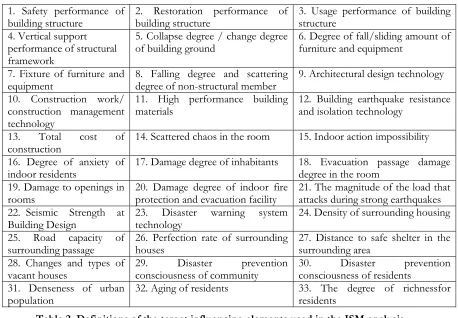
First, the authors classify the occurrence forms of indoor personal suffering during earthquakes into four categories: primary human suffering (direct influence) caused by the damage of structural and non-structural components and the falling and scattering of furniture, secondary human suffering (indirect influence) caused by occurrence of situations in which evacuation is impossible, influence of the surrounding environment at the time of a strong earthquake and afterwards, and social and economic influences. After the discussion, the authors carefully selected 33 factors that are shown in Table 1 for ISM analysis. Some definitions of the target influencing elements are shown in Table 2.
Then, the authors created a 33×33 relationship matrix for the ISM analysis with 5 ranks of influence strength: -2, -1, 0, 1, and 2. In addition, factor 34 refers to each factor's importance in determining target reliability with three ranks: 0, 1, and 2. The relationships between the design elements and order of priority are found by attending the discussions of eight members: (a), (b), ..., (h). An examples of this relationship matrix created by one of the subjects is shown in Table 3. In Table 3, when the factors on the left side grow, the upper side factors also grow, and this is judged as a plus and positive influence. In conventional ISM analysis, only 0 and 1 are used. Therefore, we set some threshold values before performing our analysis.
Table 1. Target influencing elements used in the ISM analysis
1. Safety performance of
building structure 2. Restoration performance of building structure 3. Usage performance of building structure 4. Vertical support
performance of structural framework
5. Collapse degree / change degree
of building ground 6. Degree of fall/sliding amount of furniture and equipment 7. Fixture of furniture and
equipment 8. Falling degree and scattering degree of non-structural member 9. Architectural design technology 10. Construction work/
construction management technology
11. High performance building
materials 12. Building earthquake resistance and isolation technology 13. Total cost of
construction 14. Scattered chaos in the room 15. Indoor action impossibility 16. Degree of anxiety of
indoor residents 17. Damage degree of inhabitants 18. Evacuation passage damage degree in the room 19. Damage to openings in
rooms 20. Damage degree of indoor fire protection and evacuation facility 21. The magnitude of the load that attacks during strong earthquakes 22. Seismic Strength at
Building Design 23. Disaster warning system technology 24. Density of surrounding housing 25. Road capacity of
surrounding passage 26. Perfection rate of surrounding houses 27. Distance to safe shelter in the surrounding area 28. Changes and types of
vacant houses 29. consciousness of community Disaster prevention 30. consciousness of residents Disaster prevention 31. Denseness of urban
population 32. Aging of residents 33. The degree of richnessfor residents
Table 2. Definitions of the target influencing elements used in the ISM analysis
1. Safety performance of
building structure Safety mainly refers to the safety of protecting the inhabitants, and it is directly harmful to reducing the life of occupants inside and outside the building.
2. Restoration performance
of building structure The repairability is mainly the preservation of the property of the building, and the control of external damage to the building damage. 3. Usage performance of
building structure Usability refers to the convenience and practicality of building residence to ensure the lives of residents. 4. Vertical support
performance of structural framework
The performance refers to the factors that have the most direct impact on the safety of the building structure itself, related to material properties and structure types.
5. Collapse degree / change degree of building ground
The factor mainly refers to the foundation damage that has a direct impact on the overall safety of the building, which is related to the type of soil and the cause of damage.
6. Degree of fall/sliding amount of furniture and equipment
This factor mainly refers to the degree of falling and sliding of indoor furniture when the main body of the building structure and the auxiliary facilities are deformed and vibrated.
7. Fixture of furniture and
Table 3. Examples of partial factor definitions (Member a)
target 34 1 2 3 4 5 6 7 8 9 10 11 12 13 14 15 16 17 18 19
1 stronger 2 2 2 1 -2 -2 2 -2 1 -2 -2 -1 -1 -1 -1
2 stronger 2 1 2 2 -2 -2 1 1 -1 -1 -1 -1 -1 -1
3 stronger 1 2 1 -2 -2 1 -2 1 -1 -1 -1 -1 -1 -1
4 stronger 1 2 1 1 2 1 1 -1 -1 -1 -1 -1 -1
5 increase 2 -2 -2 -2 -2 2 2 2 1 1 1 1 1 1
6 increase 2 -2 -1 -1 2 -1 2 2 2 1 1 1 1
7 increase 2 2 -2 -2 2 -1 -2 -2 -1 -1 -1 -1
8 increase 2 -2 -2 2 -1 2 -1 2 2 1 1 1 2
9 improve
s 2 2 2 2 2 1 -2 -1 2 1 1 2 1 -1 -1 -1 -1 -1 -1
10 improve
s 2 2 2 2 2 1 -1 -2 1 2 1 1 -1 -1 -1 -1 -1 -1
11 increase 1 1 1 1 1 -1 -1 1 1 2 2 1 -1 -1 -1 -1 -1 -1 12 improve
s 2 2 2 2 2 -1 -1 -1 2 2 1 2 1 -1 -1 -1 -1 -1 -1
13 increase 1 1 1 1 1 -1 -1 1 -1 1 1 1 1 2 -1 -1 -1 -1 -1 -1
14 increase 2 -2 -1 -2 1 2 -2 2 2 2 2 2 2
15 stronger 2 -2 -1 -2 1 2 -2 1 2 2 2 2 2
16 increase 2 -1 -1 1 2 -1 1 1 2 2 1 1
17 increase 2 -2 -1 -2 1 2 -2 1 2 1 1
18 increase 2 -2 -2 1 2 -2 2 2 1 1 2 1
19 increase 2 -2 -2 1 2 -2 2 2 1 1 1 2
20 increase 2 -2 -2 1 2 2 1 1 1 1
21 increase 2 -2 -1 -1 2 1 2 1 1 1 1 1 1 1 1 1
22 stronger 2 2 1 1 1 -1 -1 1 -1 1 1 1 1 1 -1 -1 -1 -1 -1 -1 23 improve
s 1 1 1 1 1 -1 -1 2 1 1 1 1 -1 -1 -1 -1 -1 -1
24 increase 1 -1 25 increase 1 1
26 increase 1 -1 1 1 1
27 increase 1 -1 28 increase 1 -1
29 increase 2 1 2 -1 1 1 1 1 -1 -1
30 increase 2 1 2 2 1 1 1 1 -1 -1
31 increase 1 -1 32 increase 2 -2
33 increase 2 -2 -1 -1
3. Analysis results
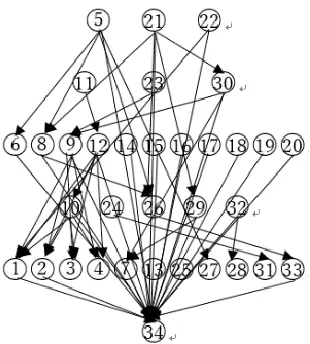
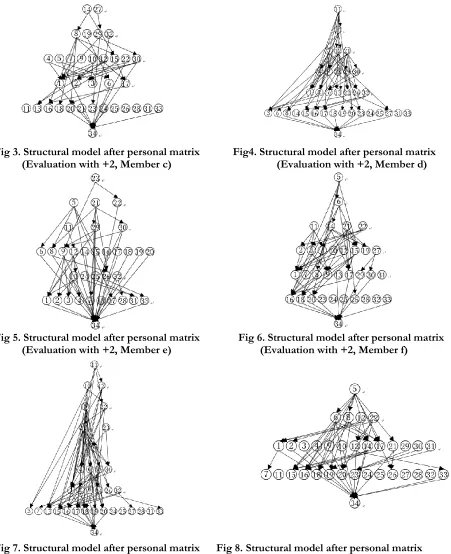
First, the authors consider the situation of positive and plus influences between the factors. Each of the survey results for +2 is replaced with 1, and the others are replaced by 0 to obtain a schematic diagram of the relationships between the layers. Figure from 1 to 8 show the structural models produced by each of the authors’ matrices.
Fig 1. Structural model after personal matrix Fig 2. Structural model after personal matrix
Fig 3. Structural model after personal matrix Fig4. Structural model after personal matrix (Evaluation with +2, Member c) (Evaluation with +2, Member d)
Fig 5. Structural model after personal matrix Fig 6. Structural model after personal matrix (Evaluation with +2, Member e) (Evaluation with +2, Member f)
Fig 7. Structural model after personal matrix Fig 8. Structural model after personal matrix (Evaluation with +2, Memberg) (Evaluation with +2, Memberh)
The directed chart in Figure 2 shows that not only are the numbers associated with secondary injury factors ranging from 14 to 17 (indoor dispersion, impossibility of indoor action, etc.) affected by cause numbers 21 (the magnitude of the impact in the event of a strong earthquake) and 5 (degree of building foundation collapse and deformation) but they also have a higher priority over other factors. This means that these causes have an impact on other factors and goals, and special attention should be paid to them at the time of design. The directed charts in Figure 3 and 6 show that factors such as indoor human injuries have different priorities for secondary damage. Cause number 14 (indoor dispersion) takes precedence over 15 (impossibility of indoor action) and 19 (indoor opening injury), and cause numbers 15 and 19 take precedence over 17 (indoor residents). There is noticeable class structure wherein 17 has a priority impact on 16 (danger to indoor residents), 18 (degree of damage to indoor refuge access), and 20 (degree of damage to indoor fire-safety shelter equipment). Thus, references to these results can be made in the design of the target performance structure analysis. The directed charts of Figure 4 and 7 show that the numbers associated with secondary damage factors such as indoor injuries, ranging from 14 to 20 (indoor dispersion, impossibility of indoor action, restlessness of indoor occupants, etc.) have the lowest priority. This means that these numbers are widely influenced by other factors and they are not treated as importantly at the time of design. Figure 8 exhibits different results, indicating that there is a difference in the way individuals perceive importance.
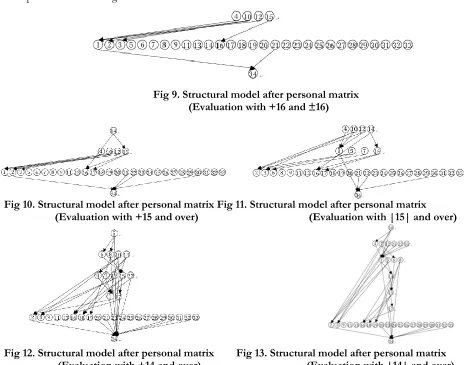
Second, in order to clarify the relationship between the elements in the strong connection, the results need to be further improved. It is necessary to change and examine the threshold. Therefore, the eight matrices of the authors were added and analyzed using certain threshold values. In a case where the priority is high and the critical value is large, the factor is particularly important; this means that the factor is considered to have the greatest impact on the target performance. Therefore, priority should be given to the factor at the time of design. In addition, as the threshold value becomes smaller, the relationship becomes more complex as more levels of priority are included. Thus, this study only uses the threshold level above 13 and the threshold levels between 9 to 12 are considered in other studies. Moreover, plus 16 indicates that all authors determined a strong positive correlation among factors. Some examples are shown in Figure from 9 to 15.
Fig 9. Structural model after personal matrix (Evaluation with +16 and ±16)
Fig 10. Structural model after personal matrix Fig 11. Structural model after personal matrix (Evaluation with +15 and over) (Evaluation with |15| and over)
Fig 14. Structural model after personal matrix Fig 15. Structural model after personal matrix (Evaluation with +13 and over) (Evaluation with |13| and over)
The directed charts in Figure 9 and 10 show that the highest priority is given to the factors numbered 4 (vertical support performance of structural framework), 10 (construction work/construction management technology), 12 (building earthquake resistance and isolation technology), 14 (scattered chaos in the room), and 15 (indoor action impossibility), indicating that they have important impact on the target performance of the vertical support structural frame, construction engineering and construction management technology, building shockproof and shockproof technology, indoor dispersion, and the impossibility of indoor action. This helps promote residents’ interest in the development of building technology and indoor environment. In addition, as the threshold becomes smaller, there are more layers of priorities; thus, the priority levels among factors become more specific. The directed charts in Figures from 11 to 15 show that among secondary injury factors such as indoor injuries, 14 (scattered chaos in the room) to 15 (impossibility of indoor action), 15 to 17 (degree of damage to inhabitants), 17 to 16 (degree of anxiety of indoor residents), 18 (evacuation passage damage degree in the room), 19 (damage to openings in rooms), and 20 (degree of damage to indoor fire protection and evacuation facilities) are preferred. This defines the order in which the influencing factors are given priority when indoor safety measures are considered in the design and helps provide reference for indoor safety design with respect to the target performance design. The results show that, considering the indoor safety factors, the degree of influence and the priority of each factor on the safety design of the new building structure system are different, and the builders, occupants, and designers give some advises when constructing the structural safety design. The highest priority is given to factors such as the vertical support structural frame, construction engineering, and construction management technology, building shockproof and shockproof technology, indoor dispersion, and the impossibility of indoor action. In addition, from the change of the degree of human influence caused by the difference of indoor variation results, the relationship between the priority of factors related to the target level and the safety of indoor construction is clarified.
4. Generating impact path diagrams for target performance requirements
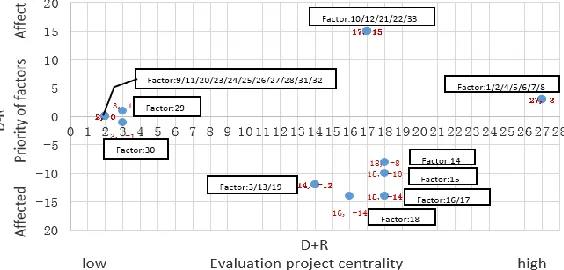
The degree of influence between evaluation projects (D-R) and the center of evaluation projects (D+R) can be calculated. Taking the influence degree (D-R) between evaluation items as the vertical axis and the center degree (D+R) of evaluation items as the horizontal axis, a graph of each evaluation project can be plotted as shown in Figure 16. By using Figure 10 to evaluate location information of the project, an impact path diagram for the performance in relation to the target requirements at the time of building design can be established as shown in Figure 17.
Fig 17. Impact path diagram
At the same time, considering Figures from 15 to 17, the evaluation of inter-project influence degree (D-R) is positive, and some factors have high priority, and mainly focus on the direct impact of the single primary damage, which has a great influence on the performance of the target. Specifically, it has a direct impact on the building structural safety (D-R = 3), such as the change of construction technology and seismic protection technology, the change of strong earthquake load and the change of residents' living poverty (D-R = 15), which has a further impact on indoor safety (D-Risnegative value) and disaster prevention consciousness. Moreover, many factors have the lowest priority and (D-R = 0), which means that these factors can be given no priority or can even be ignored. The influence degree of factors ranging from 14 to 19 (indoor dispersion, impossibility of indoor action, danger to indoor occupants, etc.) is negative, and the factors related to the indirect impact of the indoor secondary injury are in the affected position. Specifically, the increase of indoor dispersion, the possibility of infeasible action is high, the degree of injury of indoor opening increases, the degree of insecurity of residents and the degree of injury increase, which have an impact on indoor refuge operations. The priority level is obvious and they have a considerable influence on the target performance.
From the influence path diagram, it can be seen that compared with the personal analysis, the model can be constructed to study the relationship between factors more deeply, and the relationship between factors can be understood in more detail by changing the threshold. In the future of building design, the indoor safety design, which is easy to cause secondary disasters, should also attract the attention of designers and engineers. An increasing number of projects should consider high requirements and paying greater attention to indoor safety in the target performance design of building structure system.
5. Conclusions
In this paper, we discussed the main indicators affecting the safety of residential houses and buildings during strong ground motions. We established ISMs and compared their results by introducing various trends (increases, becomes stronger, improves, etc.) of factors to determine survey matrices. According to the survey results, +2 was replaced with 1; a threshold analysis was introduced to establish the adjacency matrix and obtain a directed chart of the structural model through calculations.
Furthermore, compared with the previous building construction systems, considering the factors related to indoor safety, the influence of various elements on the safety design of new building construction systems is different, and the priority relationship between the parameters is clearly expressed. As a result, focusing on the point of view of indoor secondary damage, the important relationship between the primary injury, secondary injury, strong earthquake, and the influence of surrounding environment, society, and economy in order to mitigate the damage is clearly defined in the development of the structural system of new buildings and the maintenance of building function during earthquakes in the future. Finally, when determining the structural performance of the building, more consideration is given to the orientation, price, availability, convenience and other performance of the house, and little consideration is given to the performance of indoor safety features or facilities. As a result, the preparation and arrangement of indoor furniture equipment have an impact on the action, insecurity, and victimization of residents, in the actual design projects of builders, users, designers, and so on. Priority relationships between elements provide a clear and unified consciousness of indoor safety design, such as human perceptions of safety, and refuge routes.
6. References
M. Wada, A. Masuzawa, T. Yamashita, and T. Takahashi (2018). Experimental Study on Quantification of Anxiety under Strong Motion using Small Shaking Table, Journal of Structural Engineering, Architectural Institute of Japan, Vol. 64B, pp. 345-350.
T. Takahashi, M. Sadahiro, T. Saito, T. Azuhata, K. Morita, K. Noguchi, and C. Minowa (2017). Proposal of Human Action Limit Curve on Evacuation for Long Period Ground Motion, Architectural Institute of Japan, Summaries of Technical Papers of Annual Meeting BII, pp. 497-498.
T. Takahashi, A. Mazaki, T. Saito, T. Azuhata, and K. Noguchi (2006). Shaking Table Test on Indoor Human Performance Limit in Strong Motion, Proceedings 12JEES, Paper No. 0322.
T. Takahashi, T. Azuhata, T. Saito, and K. Ohtomo (2003). Structural Performance Considering Human Response Limit During Strong Earthquake, Proceedings JCOSSAR2003, JSME, Vol. 5, pp. 825-828.
T. Takahashi, T. Azuhata, K. Noguchi, D. Kounsana, and Y. Watanabe (2001).Shaking table test on indoor human response and its feeling in strong ground motion, Architectural Institute of Japan, Summaries of Technical Papers of Annual Meeting BII pp. 861-864.
U.Kimura, Y. Watanabe, T. Takahashi (2013).Quantification of the anxiety degree by two-dimensional vibration with the shaking table test, Architectural Institute of Japan, Summaries of Technical Papers of Annual Meeting BII, pp. 51-52.
T. Hida, and M. Nagano (2012). Research on indoor destruction of super high-rise residential buildings - restlessness and behavioral difficulty and furniture dumping rate based on questionnaires and strong earthquake records in the Pacific Ocean earthquake in Northeast region in 2011, Architectural Institute of Japan, Summaries of Technical Papers of Annual Meeting BII, pp. 1065-1072.
T. Saito, T. Ishikawa, and T. Takahashi (2011). Technology development for people and life in super high-rise apartments protected from huge earthquakes. Architectural Institute of Japan, Summaries of Technical Papers of Annual Meeting B2, pp. 945-946.
M. Ishida, M. Wada, T. Takahashi, and T. Yamashita (2017). Reappearance of indoor damage of 10-story RC structures using shaking table experiment by HMD, Architectural Institute of Japan, Summaries of Technical Papers of Annual Meeting BII, pp. 561-562.
T. Yukimachi, K. Nishikawa (1997): TA Study of Causality Analysis for Human Error,The Journal of the Society for Industrial Plant Human Factors of Japan, Vol. 2, No. 2, pp.152-159.
A. Kitahara, S. Fujiwara (1992): Estimation of structural and functional earthquake damage of living space, Annual report of Kyoto University Disaster Prevention Research Institute, No. 35 B-1, pp. 1-16.
A. Kitahara (1996): Study on earthquake damage estimation of building structure group in urban area, Doctoral dissertation of Kyoto University.