*
Corresponding author: [email protected]
83 Research note
Prediction of the Pharmaceutical Solubility in Water and Organic
Solvents via Different Soft Computing Models
A. Yousefi, K. Movagharnejad *
Faculty of Chemical Engineering, Babol Noushiravani University of Technology, Babol, Iran
ARTICLE INFO ABSTRACT
Article history: Received: 2018-06-06 Accepted: 2018-11-11
Solubility data of solid in aqueous and different organic solvents are very important physicochemical properties considered in the design of the industrial processes and the theoretical studies. In this study, experimental solubility data of 666 pharmaceutical compounds in water and 712 pharmaceutical compounds in organic solvents were collected from different sources. Three different artificial neural networks, including multilayer perceptron, radial basis function, and support vector machine, were constructed to predict the solubility of these different pharmaceutical compounds in water and different solvents. Molecular weight, melting point, temperature, and the number of each functional group in the pharmaceutical compound and organic solvents were selected as the input variables of these three different neural network models. The neural network predictions were compared with the experimental data, and the SVR-PSO model with the Average Absolute Relative Deviation equal to 0.0166 for the solubility in water and 0.0707 for solubility in organic compounds was selected as the most accurate model.
Keywords:
Organic Compound, Solubility,
Artificial Neural Network, Group Contribution, Support Vector Machine
1.Introduction
Solubility is known as the maximum limit of solute dissolved in a solvent under specified conditions [1]. The IUPAC definition of solubility is an analytical composition of a saturated solution expressed as a proportion of a designated solute in a designated solvent [2]. The solubility is a strong function of intermolecular forces between the solute and solvent, describing the solvent-solute systems [3]. The solubility of a pharmaceutical in water and organic solvents is controlled by two types of interactions. The first interaction
84 Iranian Journal of Chemical Engineering, Vol. 16, No. 1 (Winter 2019)
different organic solvents is one of the most important physicochemical properties considered in the design of the industrial processes and the theoretical studies. Production and purification of pharmaceuticals [7], design and optimization of industrial crystallization processes [8], separation of organic products [9], and chemical reaction systems [10] are just some examples of the importance of this property. Therefore, accurate knowledge of the solubility of solute in a given solvent is very important for developing optimal processes. Experimental determination of the solubility is difficult and time-consuming; therefore, many researchers have attempted to predict solubility. Generally, these studies are divided into two main categories. The first category includes the thermodynamic models such as UNIFAC method [11], perturbed-chain statistical associating fluid theory (PC-SAFT) that predicts the solubility on the basis of the melting point and the enthalpy of fusion [12], and segment activity coefficient (COSMO-SAC) model that predicts the solubility on the basis of the available surface area of the solvent [13]. A new theoretical model has been recently published by Zhao et al. [14], which is based on an estimated equation of molar intermolecular potential energy for species in fluid mixtures [14]. However, this category of methods has been reported to have several drawbacks to estimate the pharmaceutical solubility in different solvents [15].
The second category is the mathematical/empirical/semi-empirical
correlations to predict the solubility. One of the first semi-empirical methods was
presented by Yalkowsky [16]. This
correlation was based on the entropy of fusion, melting point, and octanol-water
partition coefficient. Ruelle [17] predicted the solubility of pharmaceuticals using the mobile order theory considering the hydrophobic effect. Abraham and Le [18] used the linear solvation energy relationship (LSER) method based on the acidity and basicity of the solute, excess molar refractivity, polarizability of solute, and McGowan’s characteristic volume [18] to reach a new solubility correlation. Another method in this category may be the COSMO-RS, which is based on the quantum chemical calculations and Gibbs free energy of fusion [19]. Wang et al. [20] presented a method for solubility prediction using the atom types, the molecular polarizability, molecular weight, intermolecular hydrogen bonding, and hydrophobicity. The other methods are based on the quantitative structure–properties relationship (QSPR) such as group contribution [21] and atom contribution [22].
Iranian Journal of Chemical Engineering, Vol. 16, No. 1 (Winter 2019) 85
the results of several empirical methods. All of these researches have shown that the solubility is a strong function of temperature, melting point, and chemical functional groups of solute and solvent. The purpose of this study is to develop three types of neural networks: multilayer perceptron (MLP), radial basis function (RBF), and support vector machine (SVM) based on the group contribution method (GC) and particle swarm optimization algorithm (PSO) for exact and comprehensive predictions of pharmaceutical solubility in water and organic solvents.
2. Theory
Artificial neural networks are mathematical models that fall into the category of
computational intelligence tools. These
networks are able to process a large quantity of data and achieve a generalized result. ANN models are powerful tools for function approximation, classification, and prediction by adjusting appropriate parameters [27]. The aim of this research is to develop different MLP, RBF, and SVR models and analyze their performance. The particle swarm optimization algorithm is also used to optimize the performance of the neural networks.
2.1. Particle swarm optimization algorithm
Particle swarm optimization algorithm is an
optimization technique, introduced by
Kennedy & Eberhart [28]. The main idea of this method is based on the collective motion of groups of animals such as birds and fishes to find food without any previous knowledge about its position.
In this algorithm, it is assumed that, in an n-dimensional search space, the total number of particles is m, particle is the optimization
variable shown by x=
(
x1,x2,2,xm)
, andeach particle in the position of the space is
presented by xi =
(
xi,1,xi,2,2,xi,n,i)
T, with thevelocity of the ith particle
(
)
Tn i i
i
i v v v
v = ,1, ,2,2, , . The value of the local
best position of the ith particle is shown by
(
)
Tn i i
i
i p p p
p = ,1, ,2,2, , , and the global best
position of all particles is presented by
(
)
Tn g g
g
g p p p
p = ,1, ,2,2, , . After finding the
local and global best positions, the velocity and the new location of each particle are updated with the following equations. These steps will continue several times until the desired answer is achieved.
vij(t + 1) = w vij(t) + r1c1�pij(t)−xij(t)�+ r2c2 (gj(t)−xij(t)) (1)
xij(t + 1) = xij(t) + vij(t + 1) (2)
where i= 1…, m; 𝑥𝑥𝑖𝑖𝑖𝑖(𝑡𝑡) and 𝑣𝑣𝑖𝑖𝑖𝑖(𝑡𝑡) denote the position and velocity of the ith particle in j-dimension and the tth iteration, respectively;
𝑤𝑤 denotes the inertia weight; 𝑐𝑐1 and 𝑐𝑐2 are acceleration coefficients; 𝑟𝑟1 and 𝑟𝑟2 are random numbers with a uniform distribution;
𝑝𝑝𝑖𝑖𝑖𝑖(𝑡𝑡) denotes the best position of the ith particle in j-dimension; 𝑔𝑔𝑖𝑖(𝑡𝑡) denotes the
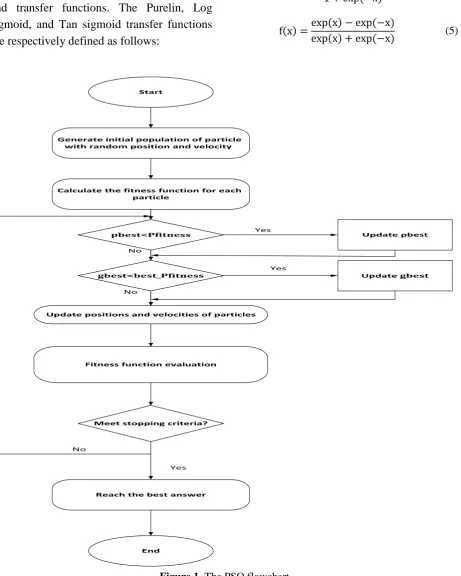
global best position [28]. The flowchart of this algorithm is shown in the Figure 1.
2.2. Multilayer perceptron network
86 Iranian Journal of Chemical Engineering, Vol. 16, No. 1 (Winter 2019)
neuron. MLP network is a multi-layer structure of neurons linked to each other with the weight connections matrix, bias vectors, and transfer functions. The Purelin, Log sigmoid, and Tan sigmoid transfer functions are respectively defined as follows:
f(x) = x (3)
f(x) =1 + exp (1 −x) (4)
f(x) =exp(x)−exp(−x)
exp(x) + exp(−x) (5)
Figure 1. The PSO flowchart.
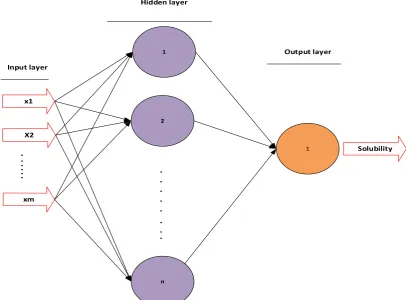
A typical MLP that is shown in Figure 2 consists of at least 3 layers. These layers include an input layer that receives the input
variables from the outside, one or more hidden layer(s) to estimate the output variables using the weight matrix, and an Start
Generate initial population of particle with random position and velocity
Calculate the fitness function for each particle
Update positions and velocities of particles
Fitness function evaluation
Meet stopping criteria?
Reach the best answer Pfitness <
pbest
Pfitness _
best < gbest
Update pbest
Update gbest
End
Yes No
Yes
No
Yes
Iranian Journal of Chemical Engineering, Vol. 16, No. 1 (Winter 2019) 87
output layer to present the output variable(s). The process of tuning the weights and biases using a training dataset that contains the experimental inputs and outputs is called the supervised Training Algorithm. There are two supervised methods for training the network
and determining the neural network
coefficients. The first category is called the classical algorithms such as back propagation algorithm as one of the most popular
algorithms, and the second category is called the intelligent algorithms such as particle swarm optimization algorithm for training MLP. All of these methods are used to obtain the optimized connection weights and biases [29, 30]. The number of hidden layers, the type of the transfer function, and the general structure of the neural network are obtained by the trial-and-error approach.
Figure 2. Schematic diagram of the three layer MLP.
2.3. Radial basis function neural network (RBF)
Radial basis function (RBF) networks are another type of feed-forward networks, which were introduced by D.S. Broomhead and David Lowe [30]. This type of network is based on the supervised learning methods and is a general approach to the quantization of information. MLP and RBF networks can be applied for the similar type of applications with the relatively same structure, yet
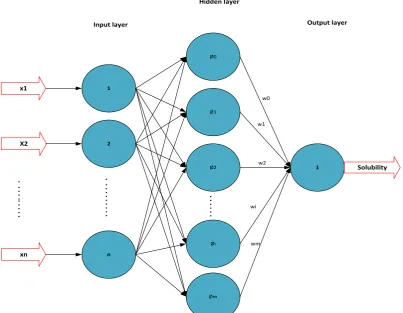
different internal computation methods. A schematic diagram of an RBF neural network consisting of three layers is shown in Figure 3: (a) an input layer that does not process the information and only distributes the input vectors to the hidden layer, (b) a hidden layer that converts 𝑛𝑛-dimensional input space to 𝑚𝑚 -dimensional feature space (𝑚𝑚 ≥ 𝑛𝑛) with nonlinear function mapping, and (c) an output layer.
1
2
n
1 Solubility
x1 Input layer
Hidden layer
Output layer
X2
. .
. . . . . .
.
.
.
.
88 Iranian Journal of Chemical Engineering, Vol. 16, No. 1 (Winter 2019) Figure 3. Schematic diagram of RBF.
The output of the output layer can be determined by a linear combination of the kernel functions, which is defined as follows:
y = wTϕ(x) =�w iϕi(x) m
i=1
+ b (6)
where 𝑤𝑤 is the weight vector, b is the bias,
𝜙𝜙(𝑥𝑥) is the kernel function defined as a function whose value depends only on the distance of 𝑥𝑥from 𝑥𝑥0, and ||∗|| denotes the Euclidean norm as in the following:
ϕ(x) = f(r) = f(||x−x0||) (7)
There are many kernel functions such as the polynomial, Gaussian, and multiquadric functions. The Gaussian function is used in this study:
ϕi(x) = (−12�x−σmi
i �
2
) (8)
By substitution of Eq (8) in Eq (6), the output
of the RBF neural network is computed according to Eq (9).
y =�wiexp (−12�x−σmi
i �
2 ) n
i=0
(9)
where 𝑤𝑤𝑖𝑖 is the weight connection from the hidden layer to the output layer, 𝑚𝑚𝑖𝑖 is the center of each neuron in the radial basis function, and 𝜎𝜎𝑖𝑖 is the spread parameter of the ith kernel [31]. The learning algorithm for determining these parameters consists of two sections. The first section consists of random sampling of input samples. The main parameters of kernel function center (𝑚𝑚𝑖𝑖) of neurons in the hidden layer and the spread (𝜎𝜎𝑖𝑖) are determined in this section. The second section consists of training the weights that link the hidden layer to the output layer [32].
2.4. Support vector regression
1
2
n
Ø0
Ø1
Øm Ø2
Øi
1 Solubility
Input layer
Hidden layer
Output layer
w0
w2 w1
wi
wm x1
X2
. . . . .. . . . . . . . .
. . .
.
Iranian Journal of Chemical Engineering, Vol. 16, No. 1 (Winter 2019) 89
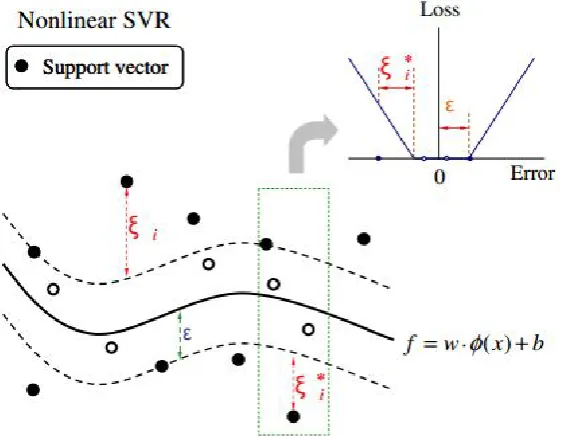
Support vector machine for regression (SVR) is a supervised learning method for the function approximation. This network, which was first introduced by Vapnik, minimizes the risk of correct classification instead of minimizing the modeling error [33]. SVR neural networks have been used in recent years for modeling several systems [34, 35]. The goal of this method is to find the optimal hyperplane in the high-dimensional feature space and use it for the function approximation in the regression problem. Vapnik’s loss function is used for the application of support vector machine in the regression problem, which is known as the 𝜀𝜀 -insensitive loss function. In other words, errors are not significant as long as they are smaller than 𝜀𝜀, but the larger values are not
allowed:
Lε�yi,f(xi)�
=� |yi−f(xi)|− ε if |yi−f(xi)|≥ ε 0 otherwise
(10)
This function creates a hyperplane 𝑓𝑓(𝑥𝑥) which has the biggest deviation 𝜀𝜀 from the actually obtained targets 𝑦𝑦𝑖𝑖 for all training data. Suppose the training patterns(𝑥𝑥1,𝑦𝑦1), (𝑥𝑥2,𝑦𝑦2),…, (𝑥𝑥𝑙𝑙,𝑦𝑦𝑙𝑙), where
𝑥𝑥𝑖𝑖 ∈ 𝑅𝑅𝑛𝑛 is a feature vector,𝑖𝑖= 1,2,…,𝑙𝑙, 𝑙𝑙 is the number of training patterns, and 𝑦𝑦𝑖𝑖 ∈ 𝑅𝑅 is the target value. Regression function of 𝑓𝑓(𝑥𝑥) can be formulated as follows:
f(x) = wTϕ(x) + b (11)
Similarly, the nonlinear regression problem can be expressed schematically in Figure 4.
Figure 4. Nonlinear SVR with 𝜀𝜀-insensitive loss function [38].
where 𝜙𝜙(𝑥𝑥) indicates the nonlinear mapping function from the input space to the feature space. 𝑤𝑤 is the vector of weight coefficients, and b stands for the bias term. These parameters are estimated by minimizing the risk function with constraints as shown in the following:
ϕ(w,ξ) = 1 2�|w|�
2
+ C�(ξi+ξi∗) N
i=1
(12)
� yi−< w
,ϕ(xi) >−b≤ ε − ξi < w,ϕ(xi) > +b−yi≤ ε − ξi∗
ξi.ξi∗≥0
(13)
90 Iranian Journal of Chemical Engineering, Vol. 16, No. 1 (Winter 2019)
cost function measuring the empirical risk, and 𝜉𝜉𝑖𝑖,𝜉𝜉𝑖𝑖∗ are the slack variables used to control overfitting; the solution problem as a quadratic programing based in the Karush-Kuhn-Tucker (KKT) conditions for nonlinearly separable data could be achieved by simply preprocessing the training patterns into feature space by 𝜙𝜙(𝑥𝑥). In this state, the following equation is achieved.
f(x) =�(αi− αi∗) n
i=1
K(xi. x) + b (14)
b =|S|1 �yi− �(αi− αi∗) n
i=1
K(xi. x) i
−sign(αi +αi∗)ε)
(15)
In the above equations, 𝛼𝛼𝑖𝑖 and 𝛼𝛼𝑖𝑖∗ are nonzero Lagrangian multipliers, and S denotes support vector. 𝐾𝐾(𝑥𝑥𝑖𝑖.𝑥𝑥) is the kernel function that represents the inner product (<𝜙𝜙(𝑥𝑥𝑖𝑖),𝜙𝜙(𝑥𝑥𝑖𝑖) >). Different kernels, such as linear, polynomial, and Gaussian, may be used as kernel functions for regression; however, in this study, the Gaussian function is used as the kernel [36].
3. Results and discussion
3.1. Data collection and preprocessing
In order to create a comprehensive model for the solubility prediction, a large experimental dataset has to be collected. In this study, the experimental aqueous solubility data of 666 different pharmaceutical compounds [37–39] and solubility data of 712 pharmaceutical compound in organic solvents [39–43] were collected from different standard sources. The chemical structures of all pharmaceutical compounds and organic solvents of the dataset were presented according to the first order functional groups of the Marrero and Gani method [44]. The dataset consisted of 78 functional groups for the aqueous systems and
65 structural groups for the organic solvents, respectively. The input variables for the solubility prediction consisted of the melting point (MP), molecular weight (MW), temperature (T), and the number of functional groups forming the molecule of a pharmaceutical compound and the organic solvents (𝑁𝑁𝑖𝑖).
All data were divided into three groups of training, validation, and testing. The training data consisting of (70 %) of all data were used to construct the structure of the ANN and update the weight vector and biases. The validation data consisting of (10 %) of the total data were used to validate the generalized feature of the model. The testing data consisting of (20 %) of data were used to check the model performance [45]. The data were normalized between [−1 +1] due to Eq. (16):
pn.i= 2∗ppi−pmin
max−pmin−1 (16)
where 𝑝𝑝𝑛𝑛.𝑖𝑖 stands for the normalized value of input variable 𝑝𝑝𝑖𝑖; 𝑝𝑝𝑚𝑚𝑖𝑖𝑛𝑛 and pmax stand for the minimum and maximum values, respectively [24].
The next calculation step is to find a relationship between the chemical functional groups and the solubility data using the collected dataset. For this purpose, the multilayer perceptron neural network, radial basis function network, and the support vector machine for regression were applied to the collected dataset.
3.2. Model development
3.2.1. The optimized MLP network configuration
Iranian Journal of Chemical Engineering, Vol. 16, No. 1 (Winter 2019) 91
and the transfer function in each layer by trial and error according to the minimization of an objective function, which is the Average Absolute Relative Deviation (AARD) between the output of the developed MLP and the target values for the presented dataset. This optimization process is performed during the training process with the Levenberg-Marquardt (LM) and particle swarm optimization algorithms to determine the weight matrix and bias vector.
To avoid the overfitting of the neural network, the number of the neurons in the
hidden layer of the network was limited to 20. The MLP model was trained with different transfer functions, training algorithms, and the variable number of neurons in the hidden layers. Finally, the MLP models with the 81-14-1 and 68-81-14-1 architectures (81 and 68 neurons in the input layer, 14 neurons in the hidden layer, and 1 neuron in the output layer) with the tan-sigmoid transfer function showed the least AARD value for water and organic solvents. The results are presented in Figure 5.
Figure 5. AARD versus the number of neurons in the second hidden layer for (a) water and (b) organic solvents.
The predicted values for the solubility in water and organic solvents using the trained
MLP model with Levenberg–Marquardt (LM) and particle swarm optimization (PSO)
0 2 4 6 8 10 12 14 16 18 20
number of neuron
0.4 0.6 0.8 1 1.2 1.4 1.6 1.8 2 2.2
AARD
AARDtr
AARDts
AARDval
a
0 2 4 6 8 10 12 14 16 18 20
number of neuron
0 1 2 3 4 5 6 7 8
AARD
AARDtr
AARDts
AARDval
92 Iranian Journal of Chemical Engineering, Vol. 16, No. 1 (Winter 2019)
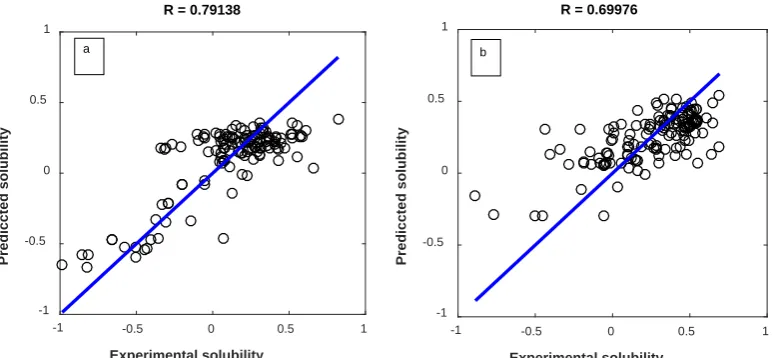
algorithms versus the experimental value of test data are compared, as shown in Figures 6 and 7.
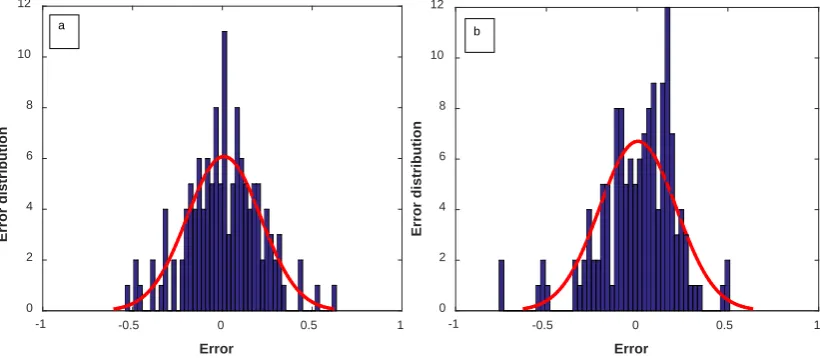
The error distribution of the optimized
MLP-LM and MLP-PSO models for water and organic solvents is shown in Figures 8 and 9 to detect the accuracy of different MLP models.
Figure 3. Regression graph for pharmaceutical solubility in (a) water and (b) organic solvents for test data by the optimized MLP-LM model.
Figure 4. Regression graph for pharmaceutical solubility in (a) water and (b) organic solvents for test data by the optimized MLP-PSO model.
-1 -0.5 0 0.5 1
Experimental solubility -1
-0.5 0 0.5 1
Prediccted solubility
R = 0.8972
-1 -0.5 0 0.5 1
Experimental solubility -1
-0.5 0 0.5
1
Prediccted solubility
R = 0.81719
a b
-1 -0.5 0 0.5 1
Experimental solubility -1
-0.5 0 0.5 1
Prediccted solubility
R = 0.79138
-1 -0.5 0 0.5 1
Experimental solubility -1
-0.5 0 0.5 1
Prediccted solubility
R = 0.69976
Iranian Journal of Chemical Engineering, Vol. 16, No. 1 (Winter 2019) 93 Figure 5. Histogram of error distribution for pharmaceutical solubility in (a) water and (b) organic
solvents for test data by the optimized MLP-LM model.
Figure 6. Histogram of error distribution for pharmaceutical solubility in (a) water and (b) organic solvents for test data by the optimized MLP-PSO model.
3.2.2. The optimized RBF network configuration
The structure of the RBF neural network was created and trained using a newrb function in Matlab 2015. To find the optimized RBF model, it is necessary to obtain two main
parameters. These two main parameters include the number of maximum hidden neurons and the spread, which have to be calculated by the trial-and-error approach. After finding the optimized values of these parameters, the best performance of the
-0.5 0 0.5 1
Error 0
5 10 15 20
Error distribution
-1 -0.5 0 0.5 1
Error 0
5 10 15 20
Error distribution
a
b
-1 -0.5 0 0.5 1
Error 0
2 4 6 8 10 12
Error distribution
-1 -0.5 0 0.5 1
Error 0
2 4 6 8 10 12
Error distribution
a
94 Iranian Journal of Chemical Engineering, Vol. 16, No. 1 (Winter 2019)
network was obtained by minimizing the Average Absolute Relative Deviation (AARD). The optimal value of the spread and maximum neuron numbers according to AARD were equal to 80 and 30 for water and organic solvents, respectively. The predicted values of solubility for water and organic
solvents are presented versus the experimental values of the test data in Figure 10.
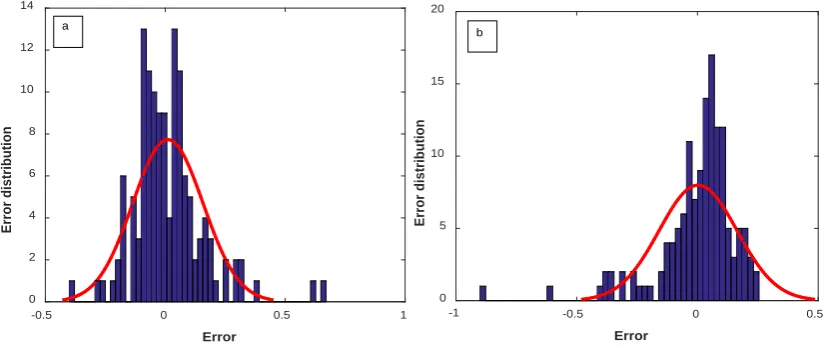
The error distribution of the optimized RBF model for water and organic solvents is shown in Figure 11 to show the accuracy of the RBF model.
Figure 7. Regression graph for pharmaceutical solubility in (a) water and (b) organic solvents for test data by the optimized RBF model.
Figure 8. Histogram of error distribution for pharmaceutical solubility in (a) water and (b) organic solvents for test data by the optimized RBF model.
-1 -0.5 0 0.5 1
Experimental solubility
-1 -0.5
0 0.5
1
Prediccted solubility
R = 0.87061
-1 -0.5 0 0.5 1
Experimental solubility
-1 -0.5
0 0.5
1
Prediccted solubility
R = 0.77824
a b
-0.5 0 0.5 1
Error
0 2 4 6 8 10 12 14
Error distribution
-1 -0.5 0 0.5
Error
0 5 10 15 20
Error distribution
a
Iranian Journal of Chemical Engineering, Vol. 16, No. 1 (Winter 2019) 95 3.2.3. The proposed SVR-PSO model
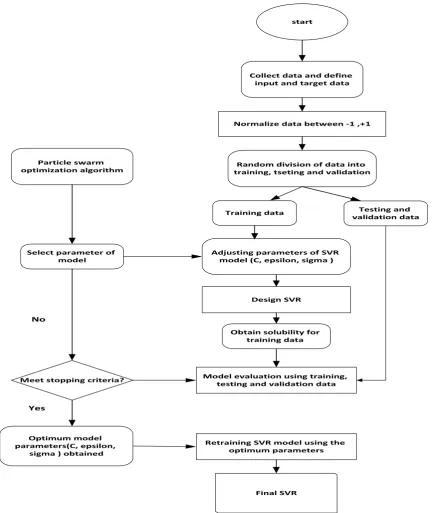
In this study, the support vector regression method combined with particle swarm optimization was used to develop a neural model for the prediction of pharmaceutical solubility. A Gaussian function was used as the kernel function with a spread parameter, called sigma. The first step of designing an SVR model is to obtain the parameters (C,
epsilon) and the RBF spread parameter. To search for the optimum value of these parameters, the particle swarm optimization algorithm based on the Average Absolute Relative Deviation as the objective function was used. This algorithm is shown in the flowchart presented in Figure 12. The optimum values of the parameters for the current dataset are presented in Table 1.
Figure 9. Flowchart of SVR-PSO model.
start
Normalize data between -1 ,+1 Collect data and define
input and target data
Random division of data into training, tseting and validation
Testing and validation data Training data
Adjusting parameters of SVR model (C, epsilon, sigma )
Design SVR
Obtain solubility for training data
Meet stopping criteria? Select parameter of
model Particle swarm optimization algorithm
Optimum model parameters(C, epsilon,
sigma ) obtained
Model evaluation using training, testing and validation data
Retraining SVR model using the optimum parameters
Final SVR
96 Iranian Journal of Chemical Engineering, Vol. 16, No. 1 (Winter 2019) Table 1
Optimum parameters for the SVR-PSO model.
solvent C Epsilon Sigma
water 195.0803 0.001274 0.246
Organic solvents 425.26 0.00793 0.298
The predicted solubility values for water and organic solvents using the optimum SVR-PSO model are compared with the testing experimental data in Figure 13.
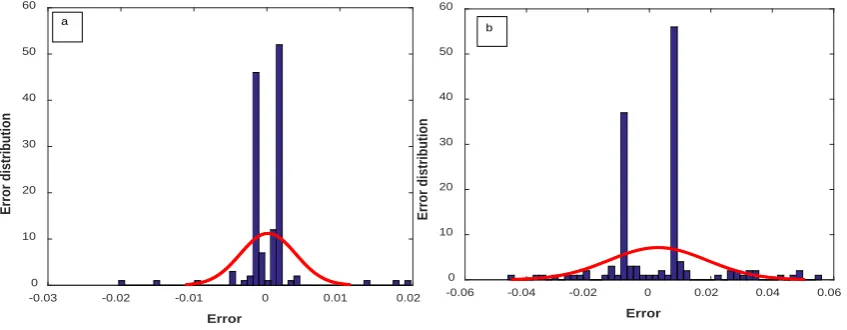
The error distribution of the optimized SVR-PSO model for water and organic solvents is shown in Figure 14.
Figure 10. Regression graph for pharmaceutical solubility in (a) water and (b) organic solvents for test data by the optimized SVR-PSO model.
Figure 11. Histogram of error distribution for pharmaceutical solubility in (a) water and (b) organic solvents for test data by the optimized SVR-PSO model.
-1 -0.5 0 0.5 1
Experimental solubility
-1 -0.5
0 0.5
1
Prediccted solubility
R = 0.99993
-0.5 0 0.5 1
Experimental solubility
-0.5 0 0.5
1
Prediccted solubility
R = 0.998
b a
-0.03 -0.02 -0.01 0 0.01 0.02
Error
0 10 20 30 40 50 60
Error distribution
-0.06 -0.04 -0.02 0 0.02 0.04 0.06
Error
0 10 20 30 40 50 60
Error distribution
a
Iranian Journal of Chemical Engineering, Vol. 16, No. 1 (Winter 2019) 97 3.2.4. The statistical measures for the
model performance
In order to compare the accuracy of prediction models, three different statistical measures of Average Absolute Relative Deviation (AARD), correlation factor (𝑅𝑅), and Root Mean Squared Error (RMSE) were used. These parameters are calculated as follows:
𝐴𝐴𝐴𝐴𝑅𝑅𝐴𝐴= ��𝑌𝑌𝑝𝑝𝑝𝑝𝑝𝑝𝑝𝑝(𝑌𝑌𝑖𝑖)− 𝑌𝑌𝐸𝐸𝐸𝐸𝑝𝑝(𝑖𝑖)�
𝐸𝐸𝐸𝐸𝑝𝑝(𝑖𝑖) 𝑁𝑁
𝑖𝑖=1
(17)
𝑅𝑅=�1− �∑ �𝑌𝑌𝑝𝑝𝑝𝑝𝑝𝑝𝑝𝑝(𝑖𝑖)− 𝑌𝑌𝐸𝐸𝐸𝐸𝑝𝑝(𝑖𝑖)�
2 𝑁𝑁
𝑖𝑖=1
∑ �𝑌𝑌𝑁𝑁𝑖𝑖=1 exp(𝑖𝑖)�2
� (18)
𝑅𝑅𝑅𝑅𝑅𝑅𝑅𝑅= 1
𝑁𝑁 �(
𝑌𝑌𝑝𝑝𝑝𝑝𝑝𝑝𝑝𝑝(𝑖𝑖)− 𝑌𝑌𝐸𝐸𝐸𝐸𝑝𝑝(𝑖𝑖)
𝑌𝑌𝐸𝐸𝐸𝐸𝑝𝑝(𝑖𝑖) ) 𝑁𝑁
𝑖𝑖=1
(19)
In these equations, N is the number of input data, and 𝑌𝑌𝑝𝑝𝑝𝑝𝑝𝑝𝑝𝑝(𝑖𝑖) and 𝑌𝑌𝐸𝐸𝐸𝐸𝑝𝑝(𝑖𝑖) are the
predicted and actual output values of the 𝑖𝑖𝑡𝑡ℎ input dataset, respectively [25].
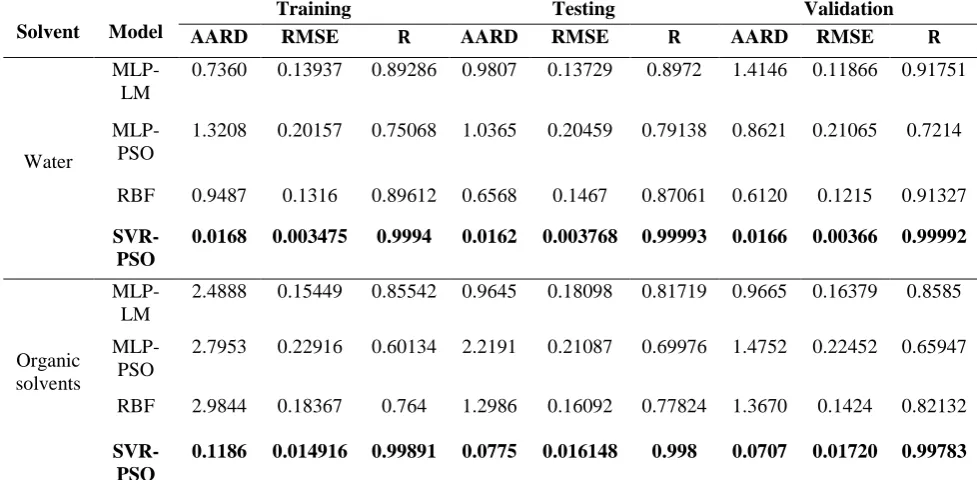
In order to compare the accuracy of the developed models, the statistical parameters for training, testing, and validation data were calculated, as presented in Table 2. The results of this table showed that the SVR-PSO model was more accurate than the MLP and RBF models.
Table 2
Statistical parameters of the developed models.
Solvent Model
Training Testing Validation
AARD RMSE 𝐑𝐑 AARD RMSE 𝐑𝐑 AARD RMSE 𝐑𝐑
Water
MLP-LM
0.7360 0.13937 0.89286 0.9807 0.13729 0.8972 1.4146 0.11866 0.91751
MLP-PSO
1.3208 0.20157 0.75068 1.0365 0.20459 0.79138 0.8621 0.21065 0.7214
RBF 0.9487 0.1316 0.89612 0.6568 0.1467 0.87061 0.6120 0.1215 0.91327
SVR-PSO
0.0168 0.003475 0.9994 0.0162 0.003768 0.99993 0.0166 0.00366 0.99992
Organic solvents
MLP-LM
2.4888 0.15449 0.85542 0.9645 0.18098 0.81719 0.9665 0.16379 0.8585
MLP-PSO
2.7953 0.22916 0.60134 2.2191 0.21087 0.69976 1.4752 0.22452 0.65947
RBF 2.9844 0.18367 0.764 1.2986 0.16092 0.77824 1.3670 0.1424 0.82132
SVR-PSO
0.1186 0.014916 0.99891 0.0775 0.016148 0.998 0.0707 0.01720 0.99783
4. Conclusions
Four intelligence models, namely MLP, MLP-PSO, RBF, and SVR-PSO, based on the group contribution, and neural networks were developed in order to present a comprehensive and accurate model for the prediction of pharmaceutical solubility in
98 Iranian Journal of Chemical Engineering, Vol. 16, No. 1 (Winter 2019)
(PSO) training algorithm showed the AARD equal to 1.3208 and 2.7953 for the solubility of pharmaceuticals in water and organic solvents, respectively. Optimum RBF network architecture was created with 30 neurons and a spread equal to 80. The AARD of this model was equal to 0.6568 for pharmaceutical solubility in water and 1.2986 for pharmaceutical solubility in organic solvents. PSO algorithm was used to determine the cost function and the C, epsilon, and sigma parameters in the SVR model. The AARD of the SVR model optimized by the PSO algorithm was equal to 0.0162 and 0.0775 for water and organic solvents, respectively. The cross plot and error distribution figures showed that the SVR-PSO model with RBF kernel function predicted the pharmaceutical solubility better than MLP-LM, MLP-PSO, and RBF models. These results showed that the predictions of SVR-PSO were the most comprehensive and accurate.
References
[1] Siepmann, J. and Siepmann, F.,
“Mathematical modeling of drug dissolution”, Int. J. Pharm., 453, 12 (2013).
[2] Inczedy, J., Lengyel, T. and Ure, A. M., Compendium of analytical nomenclature, 3rd edition, Blackwell Science, USA, (1998).
[3] Prausnitz, J. M., Lichtenthaler, R. N., de Azevedo, E. G. and Rowlinson, J., Molecular thermodynamics of fluid-phase equilibria, Pearson Education, USA, (1998).
[4] Delaney, J. S., “Predicting aqueous
solubility from structure”, Drug Discov. Today, 10, 289 (2005).
[5] Babu, V. R., Areefulla, S. H. and
Mallikarjun, V., “Solubility and
dissolution enhancement: An overview”, J. Pharm. Res., 3, 141 (2010).
[6] Savjani, K. T., Gajjar, A. K. and Savjani, J. K., “Drug solubility: Importance and enhancement techniques”, ISRN Pharm.,
2012, 195727 (2012).
[7] Feng, L., van Hullebusch, E. D.,
Rodrigo, M. A., Esposito, G. and Oturan, M. A., “Removal of residual
anti-inflammatory and analgesic pharmaceuticals from aqueous systems by electrochemical advanced oxidation processes: A review”, Chem. Eng. J.,
228, 944 (2013).
[8] Lindenberg, C., Kråttli, M., Cornel, J.
and Mazzotti, M., “Design and
optimization of a combined
cooling/antisolvent crystallization
process”, Cryst. Growth Des., 9, 1124 (2009).
[9] Blanchard, L. a. and Brennecke, J. F., “Recovery of organic products from ionic liquids using supercritical carbon dioxide”, Ind. Eng. Chem. Res., 40, 2550 (2001).
[10]Crerar, D. A. and Anderson, G. M., “Solubility and solvation reactions of quartz in dilute hydrothermal solutions”, Chem. Geol., 8, 107 (1971).
[11]Gmehling, J. G., Anderson, T. F. and Prausnitz, J. M., “Solid-liquid equilibria
using UNIFAC”, Ind. Eng. Chem.
Fundam., 17, 269 (1978).
[12]Feelly Ruether, G. S., “Modeling the solubility of pharmaceuticals in pure solvents and solvent mixtures for drug process design”, J. Pharm. Sci., 98, 4205 (2009).
Iranian Journal of Chemical Engineering, Vol. 16, No. 1 (Winter 2019) 99
mixed solvent mixtures for organic
pharmacological compounds with
COSMO-based thermodynamic
methods”, Ind. Eng. Chem. Res., 47, 1707 (2008).
[14]Zhao, Y., Wu, Z., Liu, W. and Pei, X., “A new theoretical model for predicting the solubility of solid solutes in different solvents”, Fluid Phase Equilib., 412, 123 (2016).
[15]Gharagheizi, F., “Representation/
prediction of solubilities of pure compounds in water using artificial neural network-group contribution method”, J. Chem. Eng. Data, 56, 720 (2011).
[16]Yalkowsky, S. H. and Valvani, S. C., “Solubility and partitioning, I: Solubility of nonelectrolytes in water”, J. Pharm. Sci., 69, 912 (1980).
[17]Ruelle, P. and Kesselring, U. W., “Solubility predictions for solid nitriles and tertiary amides based on the mobile
order theory”, Pharm. Res., 11, 201
(1994).
[18]Abraham, M. H. and Le, J., “The
correlation and prediction of the solubility of compounds in water using an amended solvation energy relationship”, J. Pharm. Sci., 88, 868 (1999).
[19]Klamt, A., Eckert, F., Hornig, M., Beck, M. E. and Brger, T., “Prediction of aqueous solubility of drugs and pesticides with COSMO-RS”, J. Comput. Chem., 23, 275 (2002).
[20]Wang, J., Krudy, G., Hou, T., Zhang, W., Holland, G. and Xu, X. J., “Development of reliable aqueous solubility models and their application in druglike analysis”, J. Chem. Inf. Model., 47, 1395 (2007). [21]Huuskonen, J., “Estimation of aqueous
solubility for a diverse set of organic
compounds based on molecular
topology”, J. Chem. Inf. Comput. Sci.,
40, 773 (2000).
[22]Hou, T. J., Xia, K., Zhang, W. and Xu, X. J., “ADME evaluation in drug discovery: 4. Prediction of aqueous solubility based on atom contribution approach”, J. Chem. Inf. Comput. Sci.,
44, 266 (2004).
[23]Gharagheizi, F., Eslamimanesh, A.,
Mohammadi, A. H. and Richon, D., “Determination of critical properties and acentric factors of pure compounds using the artificial neural network group contribution algorithm”, J. Chem. Eng. Data., 56, 2460 (2011).
[24]Chen, G., Luo, X., Zhang, H., Fu, K.,
Liang, Z., Rongwong, W.,
Tontiwachwuthikul, P. and Idem, R., “Artificial neural network models for the prediction of CO2 solubility in aqueous
amine solutions”, Int. J. Greenh. Gas
Control., 39, 174 (2015).
[25]Tatar, A., Naseri, S., Bahadori, M., Hezave, A. Z., Kashiwao, T., Bahadori, A. and Darvish, H., “Prediction of carbon dioxide solubility in ionic liquids using MLP and radial basis function (RBF) neural networks”, J. Taiwan Inst. Chem. Eng., 60, 151 (2016).
[26]Mehdizadeh, B. and Movagharnejad, K., “A comparison between neural network method and semi empirical equations to predict the solubility of different compounds in supercritical carbon dioxide”, Fluid Phase Equilib., 303, 40 (2011).
[27]Graupe, D., Principles of artificial neural networks, World Scientific, Singapore, (2013).
100 Iranian Journal of Chemical Engineering, Vol. 16, No. 1 (Winter 2019)
swarm optimization”, Proceedings of IEEE Int. Conf. Neural Networks, Perth, WA, Australia, 4, pp. 1942–1948 (2002).
[29]Haykin, S. S., Neural networks and
learning machines, 3rd Edition, USA, (2009).
[30]Broomhead, D. S. and Lowe, D., “Radial basis functions, multi-variable functional interpolation and adaptive networks”, DTIC Document, (1988).
[31]Mustafa, M. R., Rezaur, R. B., Rahardjo, H. and Isa, M. H., “Prediction of pore-water pressure using radial basis function neural network”, Eng. Geol., 135–136, 40 (2012).
[32]Shen, W., Guo, X., Wu, C. and Wu, D., “Forecasting stock indices using radial basis function neural networks optimized by artificial fish swarm algorithm”, Knowledge-Based Syst., 24, 378 (2011). [33]Vladimir, V. N. and Vapnik, V., The
nature of statistical learning theory, Springer-Verlag, Berlin, Germany, (1995).
[34]Kazem, A., Sharifi, E., Hussain, F. K., Saberi, M. and Hussain, O. K., “Support vector regression with chaos-based firefly algorithm for stock market price forecasting”, Appl. Soft Comput., 13, 947 (2013).
[35]Yu, P. S., Chen, S. T. and Chang, I. F., “Support vector regression for real-time flood stage forecasting”, J. Hydrol., 328, 704 (2006).
[36]Smola, A. J. and Schölkopf, B., “A tutorial on support vector regression”, Stat. Comput., 14, 199 (2004).
[37]Yalkowsky, S. H., He, Y. and Jain, P., Handbook of aqueous solubility data, 2nd ed., CRC Press, USA, (2010).
[38]Ribeiro Neto, A. C., Pires, R. F., Malagoni, R. A. and Franco, M. R., “Solubility of vitamin C in water, ethanol, propan-1-ol, water + ethanol, and water + propan-1-ol at (298.15 and 308.15) K”, J. Chem. Eng. Data, 55, 1718 (2010).
[39]Pobudkowska, A., Domańska, U. and
Jurkowska, B. A., “Solubility of
pharmaceuticals in water and alcohols”, Fluid Phase Equilib., 392, 56 (2015). [40]Wenju, L., Leping, D., Black, S. and
Hongyuan, W., “Solubility of
carbamazepine (form III) in different solvents from (275 to 343) K”, J. Chem. Eng. Data, 53, 2204 (2008).
[41]Li, Q. S., Li, Z. and Wang, S.,
“Solubility of trimethoprim (TMP) in different organic solvents from (278 to 333) K”, J. Chem. Eng. Data, 53, 286 (2008).
[42]Jouyban, A., Handbook of solubility data for pharmaceuticals, CRC Press, USA, (2009).
[43]Wang, L., Du, C., Wang, X., Zeng, H., Yao, J. and Chen, B., “Solubilities of phosphoramidic acid, N-(phenylmethyl)-, diphenyl ester in selected solvents”, J. Chem. Eng. Data, 60, 1814 (2015). [44]Marrero, J. and Gani, R.,
“Group-contribution based estimation of pure
component properties”, Fluid Phase
Equilib., 183–184, 183 (2001).
[45]Agirre-Basurko, E., Ibarra-Berastegi, G. and Madariaga, I., “Regression and multilayer perceptron-based models to forecast hourly O3 and NO2 levels in the