Original Article
Identification of Human Cytomegalovirus pUL27 R233 point
mutation using PCR-RFLP
Mohebbi A1,3, Mirarab A2, Eskandarian S1 , Bagheriye F4, Lorestani N2, Javid N2, Tabarraei A1*
1. Infectious Diseases Research Center, Golestan University of Medical Sciences, Gorgan, Iran, 4916953358 2. Department of Microbiology, Faculty of Medicine, Golestan University of Medical Science, Gorgan, Golestan Province, Iran, 4918936316
3. Student Research Committee, Golestan University of Medical Sciences, Gorgan, Iran
4. Department of Biotechnology, Faculty of Medicine, Golestan University of Medical Science, Gorgan, Golestan Province, Iran
Abstract
Background and Aims: Human Cytomegalovirus (HCMV) is one of the life-threatening
agents in immunosuppressed patients and congenitally infected neonates in the world. Mutations in UL27 were suggested to confer low- to high-grade Maribavir (MBV) resistance. As pUL27 R233S variation may involve in either MBV-resistance, we aimed to establish a method for identifying R233 coding sequence mutation.
Materials and Methods: Eleven boiled-DNA extracts from 2000 congenitally CMV infected
(cCMV) neonates urines were provided. Polymerase Chain Reaction (PCR) was performed to amplify R233 coding sequence. Restriction Fragment Length Polymorphism (RFLP), after selection of HhaI as a proper cutting enzyme at given site by NEBcutter server, was performed. PCR amplicons and digested samples were run on gel-electrophoresis for demonstration expected fragments.
Results: Our result has proved that HhaI can cut UL27 containing wild type R233 coding sequence but not theR233 mutants. Among eleven clinical samples, one has shown R233 mutation, but other 10 samples had no variations by PCR-RFLP.
Conclusions: It seems that HhaI can be employed for molecular examination of HCMV
UL27 R233 variations and this is the first report demonstrating that PCR-RFLP can be used to recognize CMV-pUL27 R233 mutation. Therefore, this work can open a new window for HCMV UL27 polymorphism analysis in the future.
Keywords: cCMV, Maribavir, pUL27, R233 mutation, HhaI
Introduction
*uman Cytomegalovirus (HCMV) is a member of family Herpesviridae with high spread infections which may be life-threatening in immunosuppressed organ transplant and AIDS patients (1, 2). HCMV is also the most important congenital infection in the developed countries (3).
*Corresponding author: Alijan Tabarraei, Associated Professor of Virology, Infectious Diseases Research Center, Golestan University of Medical Sciences, Gorgan, Iran, 4916953358 [email protected] , Tel: +989112733321 , Fax:+981732470224
CMV infections can be treated with a few approved inhibitors, ganciclovir (GCV), cidofovir (CDV), foscarnet (PFA), and Maribavir (MBV), which targeted the viral replication (4). During long-term treatment, antiviral drugs effects in most of the time have failed because of specific mutations.(5, 6). Accordingly, understanding of mutations and its role in drug resistance is a principle to identify efficient treatment.
Because of resistant mutations against the majority of approved antiviral pharmaceuticals, diverse mutations in UL97 (code for phosphotransferase), UL54 (codes for DNA polymerase), and UL27 (codes for membrane
H
protein) have been suggested (7, 8). In 2003, it was found that Maribavir (MBV) resistance is due to single Leu355Pro substitution in protein UL27 (pUL27) (9). Since then, a few other UL27 ORF mutations were also found to confer MBV resistance. In AD169 isolates, under increasing concentrates of MBV and its carbocyclic analogue, 2916W93 mutations including A406V, W362R, 415 stop codon, and R233S were also occurred in response to the drug pressure (8).
UL27 is an early transcript of CMV replication phase and it could be a substrate for the UL97 gene product. Then, UL27 was considered to be a paralog of UL97 by sharing 12% identity in amino acid levels (10). There is an antagonistic relationship between UL27 and UL97, which may provide a better insight about MBV antiviral activity (11).
After phosphorylation, UL27 plays a role in nuclear export of sub-viral particles (8). A trial demonstrated three instances of UL27 mutation R233S, A406V/C415stop, and W362R which are common and confer low-grade drug resistance to CMV (8). Investigation of these mutations is crucial to decide drug regimens. Polymerase Chain Reaction (PCR) followed by Restriction Fragment Length Polymorphism (RFLP) was suggested which can be used extensively for such epidemiological studies (12). This approach has also been applied to detection of CMV UL27 mutations (13, 14). Discovery of novel mutations in viral genome needs deep sequencing and full genome analysis. Here we aimed to establish a method by which strain with MBV resistant profile can be isolated. For that, we performed PCR-RFLP on MBV-resistance conferring R233 variation. Data has demonstrated that this procedure can be used for R233 containing point mutation isolation.
Methods
Clinical samples preparation. Eleven DNA
extracted CMV positive urine samples from 2000 congenitally infected newborns which were stored from the previous study were used (15).
Enzyme Selection. HhaI Endonuclease
enzyme were identified by NEBcutter v2.0 (16) for cutting R233 region. For each nucleotide (nt) stretches containing given coding region manually incorporated to server. Enzyme acting on certain sequence was selected for the study. The server was also applied to predict fragments size of the digested sequence on gel electrophoresis.
Primer Design and PCR-RFLP Experiment.
Following primers encompassing R233 designed and for this experiment; forward TCCGGTACTTGACGGGCAAC, and reverse TGACCGAGGAGCTGTACCTG used at final 100pm concentration. Primer-BLAST Tool was used to determine primers specificity and product size (17). MgCl2 and dNTPs were supplied in 1mM final concentration and 0.6mM, respectively. Taq DNA polymerase (GeNet Bio. Inc. Korea) also used in final 1.25Unit / reaction. Almost 100ng DNA containing samples measured for Polymerase Chain Reaction (PCR). PCR program cycles were as follows: 95° for 5 minutes, 30 loops with 30 seconds at 95°, 61.5°, and 72°, with final extension at 72° for 5 minutes. All PCR products were run on 1.5% agarose gel electrophoresis containing 1:1000 DNA staining SYBR® Green (ThermoFisher, USA). Restriction Fragment Length Polymorphism (RFLP) was carried out with HhaI Endonuclease according to manufacturing protocol (Fermentase, Thermo Scientific, USA). Briefly, 1ug PCR product was diluted in a solution containing restriction enzyme and buffer. After 16hrs exposure, digested samples were ran on 3% gel-electrophoresis and observed by gel-documentation (Cleaver Scientific, France). Finally, products were sent for sequencing. Because of short extension of PCR products, Taq DNA polymerase fidelity has not assessed.
Results
Nucleotide encompassed with primers. As it
is shown in figure 2 lane1, 126bp size fragment was observed experimentally as primers were
incorporated manually to Primer-BLAST tool was estimated that product size would be 126bp of Human Cytomegalovirus.
Accordingly, because of GenBank policy for accepting sequences shorter than 200bp, we were not able to submit obtained sequences.
Endonuclease Prediction and
Computational Digestion. HhaI was found,
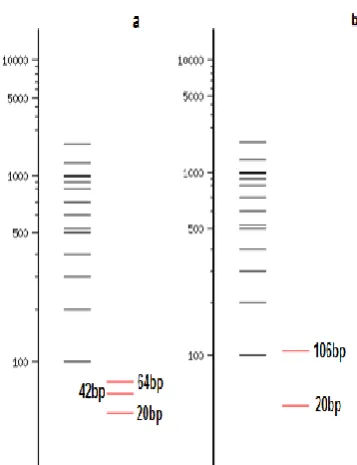
among all other NEB enzyme, to cut CMV UL27 arginine coding sequence. In addition, in NEBcutter v2.0, as showed in Figure 1a, three fragments were predicted in wild type UL27 R233 coding sequence cut by HhaI. On the other hand, two segments were expected to occur in UL27 R233 mutant digested with the enzyme. Bands, which estimated with NEBcutter, had sizes 64bp, 42bp, and 20bps in digested HCMV UL27 R233 wild type and 106bp and 20bp in R233 mutant (Figure 1a, b).
PCR-RFLP analysis for verifying computer
approach. Polymerase Chain Reaction (PCR)
was performed with the given primers for both UL27 amplification in CMV positive samples and confirmation of expected UL27 126bp size. As pictured in Figure 2 Lane1, all amplified samples had 126bp size products. Amplicons then were employed to RFLP with HhaI enzyme. Digested sequences were run on gel-electrophoresis, and electrophoretic
e treated control (126bp). enzym
-Gel Electrophoresis of 11 CMV clinical samples digestion. Lane1: no .
2 Fig.
13: Ten samples with no
-control. Lane4
-Lane2: Control mutant digested with HhaI (106bp). Lane3: negative mutation on R233 detected with RFLP (64bp and 42bp fragments).
Prediction of Electrophoretic patterns of Fig. 1.
CMV R233 wild type (a) and mutant (b).
patterns were observed under gel-documentation. As it was predicted on NEBcutter server, control positive no-HhaI treated had 126bp size (Figure 2, Lane1), while R233 mutant control (Figure 2, Lane2) had 106bp size. Eleven congenitally CMV positive samples were digested with HhaI to find out if there are any R233 variations. As a result, ten of them had three predicted fragments, as they had no mutations in R233 sequence (Figure 2). However, predicted 20bp fragments in both mutant and wild type was not observed on gel probably because of short size.
Discussion
In this study, we were computationally predicted HhaI endonuclease for detection of R233 coding sequence point mutation by using PCR-RFLP method. Cases containing such mutations and wild type would be cut into two and three separate pieces, respectively.
Because of variations in UL97, mutation derived from UL27 would be appear which no longer are required to be phosphorylated. In such cases antiviral drugs such as MBV, which inhibit nuclear egress, are no more effective (8, 18).
MBV was introduced for prevention and treatment of human cytomegalovirus disease in hematopoietic stem-cell or bone marrow transplant patients, which was in clinical trial phase III since 2009 (19). Owing to UL27 mutations in laboratory and clinical strains, that confers low-grade MBV resistance. So that, some strain containing UL27 mutation R233S and UL97 mutations L337M or V353A result in greater overall degree of MBV resistance instead of UL97 single mutation (20). Plaque purified rA5-13 isolate containing R233S is already thought to be a phosphorylation serine site for the viral UL97 kinase (8, 21). Therefore, the investigation of these mutations needs a rapid and accurate test. Here, CMV-pUL27 R233 mutation has been recognized to confer low-grade MBV-resistance by PCR-RFLP method for the first time, while sequencing analysis has been demonstrated for identifying CMV mutations as an only way now. Identification of UL27
mutations in clinical cases will be crucial in any virus isolated after MBV therapy. We have demonstrated that HCMV UL27 with R233 variations can be analyses by PCR-RFLP method as an approach to prediction of MBV resistance mutation. In 11 clinical samples obtaining from congenitally CMV infected neonates, ten samples were cut into two fragments, representing R233 wild types. This study, in addition to correlate with the previous report of MBV-mediated R233 occurrence, shows such variation has not been prevalent. Additionally, this work suggests a PCR-RFLP procedure for prediction of MBV-resistance based R233 in the future studies.
Conclusion
In clinical samples evaluated here, UL27 R233 variation has not occurred, reflecting the idea that the mutation cannot be existed in the setting of virus infection for adaptation, cellular factor regulation, or antagonizing UL97 kinase. Therefore, it would initiate a new window for HCMV UL27 polymorphism analysis in the future.
Acknowledgements
This study was funded by the Infectious Diseases Research Center, Golestan University of Medical Sciences, Gorgan, Iran.
Author Declaration
The authors declare that there is no conflict of interest regarding the publication of this paper.
References
1. Miller W, Flynn P, McCullough J, Balfour HH, Jr., Goldman A, Haake R, et al. Cytomegalovirus infection after bone marrow transplantation: an association with acute graft-v-host disease. Blood. 1986;67(4):1162-7.
2. Jacobson MA, Mills J. Serious cytomegalovirus disease in the acquired immunodeficiency syndrome (AIDS). Clinical findings, diagnosis, and
treatment. Annals of internal medicine.
1988;108(4):585-94.
3. Cannon MJ, Grosse SD, Fowler KB. The epidemiology and public health impact of
congenital cytomegalovirus infection.
Cytomegaloviruses: from molecular pathogenesis to intervention. 2013;2.
4. Williams SL, Hartline CB, Kushner NL, Harden EA, Bidanset DJ, Drach JC, et al. In vitro activities of benzimidazole D- and L-ribonucleosides against
herpesviruses. Antimicrobial agents and
chemotherapy. 2003;47(7):2186-92.
5. Lurain NS, Chou S. Antiviral drug resistance of human cytomegalovirus. Clinical microbiology reviews. 2010;23(4):689-712.
6. Limaye AP. Ganciclovir-resistant
cytomegalovirus in organ transplant recipients. Clinical infectious diseases : an official publication of the Infectious Diseases Society of America. 2002;35(7):866-72.
7. Göhring K, Hamprecht K, Jahn G. Antiviral
Drug- and Multidrug Resistance in
Cytomegalovirus Infected SCT Patients.
Computational and Structural Biotechnology Journal. 2015;13:153-8.
8. Chou S, Marousek GI, Senters AE, Davis MG,
Biron KK. Mutations in the human
cytomegalovirus UL27 gene that confer resistance
to maribavir. Journal of virology.
2004;78(13):7124-30.
9. Komazin G, Ptak RG, Emmer BT, Townsend
LB, Drach JC. Resistance of human
cytomegalovirus to the benzimidazole
L-ribonucleoside maribavir maps to UL27. Journal of virology. 2003;77(21):11499-506.
10. Prichard MN, Quenelle DC, Bidanset DJ, Komazin G, Chou S, Drach JC, et al. Human cytomegalovirus UL27 is not required for viral replication in human tissue implanted in SCID mice. Virology journal. 2006;3:18.
11. Bigley TM, Reitsma JM, Terhune SS.
Antagonistic Relationship between Human
Cytomegalovirus pUL27 and pUL97 Activities
during Infection. Journal of virology.
2015;89(20):10230-46.
12. Pourzand C, Cerutti P. Genotypic mutation analysis by RFLP/PCR. Mutation research. 1993;288(1):113-21.
13. Gohring K, Feuchtinger T, Mikeler E, Lang P, Jahn G, Handgretinger R, et al. Dynamics of the
emergence of a human cytomegalovirus UL97 mutant strain conferring ganciclovir resistance in a pediatric stem-cell transplant recipient. The Journal of molecular diagnostics : JMD. 2009;11(4):364-8. 14. Boivin G, Gilbert C, Gaudreau A, Greenfield I, Sudlow R, Roberts NA. Rate of emergence of cytomegalovirus (CMV) mutations in leukocytes of patients with acquired immunodeficiency syndrome who are receiving valganciclovir as induction and maintenance therapy for CMV retinitis. The Journal of infectious diseases. 2001;184(12):1598-602.
15. Javid N, Cheraghali F, Moradi A, Kelishadi M, Tabarraei A. Newborn Screening for Congenital Cytomegalovirus Infection in Iran. The Pediatric Infectious Disease Journal. 2016;35(9):1052. 16. Vincze T, Posfai J, Roberts RJ. NEBcutter: A program to cleave DNA with restriction enzymes. Nucleic acids research. 2003;31(13):3688-91. 17. Ye J, Coulouris G, Zaretskaya I, Cutcutache I, Rozen S, Madden TL. Primer-BLAST: a tool to design target-specific primers for polymerase chain reaction. BMC bioinformatics. 2012;13:134. 18. Hantz S, Couvreux A, Champier G, Trapes L, Cotin S, Denis F, et al. Conserved domains and structure prediction of human cytomegalovirus UL27 protein. Antiviral therapy. 2009;14(5):663-72.
19. Biron KK, Harvey RJ, Chamberlain SC, Good SS, Smith AA, 3rd, Davis MG, et al. Potent and selective inhibition of human cytomegalovirus replication by 1263W94, a benzimidazole L-riboside with a unique mode of action.
Antimicrobial agents and chemotherapy.
2002;46(8):2365-72.
20. Chou S, Hakki M, Villano S. Effects on maribavir susceptibility of cytomegalovirus UL97 kinase ATP binding region mutations detected after drug exposure in vitro and in vivo. Antiviral research. 2012;95(2):88-92.
21. Baek MC, Krosky PM, He Z, Coen DM. Specific phosphorylation of exogenous protein and peptide substrates by the human cytomegalovirus UL97 protein kinase. Importance of the P+5 position. The Journal of biological chemistry. 2002;277(33):29593-9.