Gender As Determinant of Openness of Information
Processing of Consumers in Making Buying Decisions
Abstract: The study of consumer innovativeness leads to identify the innovative behavior and it has been a major thrust among the researchers. Present study is an attempt to explore the consumers’ innovativeness or openness of information processing in making buying decisions i.e. how a consumer uses the information given to him or her, in making buying decisions for trying out new product. In this study we have measured demographic variables such as Gender with consumer’s openness for information processing. Responses were collected from 218 consumers having different demographic profile through a non probability convenience sampling approach and analyzed with the help of inferential statistics tools. The finding shows that Gender have significant influence on the consumers’ openness for information processing. The study is given valuable insights and implications for marketers to increase the success of new products.
Key words: Innovativeness, Openness, innovative behavior, Information processing.
I. INTRODUCTION
In today’s scenario, introducing new product or service in the market is a very strategic task for the marketers and to get success, all the marketing programs should be strategically developed. So it is become very important to understand that, how a consumer uses the information given to him or her, in making buying decisions for trying out new product. It’s called openness of information processing in making buying decision. Further it can be described separately as: Openness is willing to consider or deal with something; characterized by an attitude of ready accessibility (especially about one's actions or purposes) without concealment; not secretive; willingness or readiness to receive (especially impressions or ideas). Information is a knowledge derived from study, experience, or instruction. Knowledge of specific events or situations that has been gathered or received by communication, intelligence or news. Processing deals to gain an understanding or acceptance of; come to terms with and Information processing is the sciences concerned with gathering, manipulating, storing, retrieving, and classifying
Dr. Vipin Choudhary Associate Professor PIMR, Indore, India [email protected]
Dr. Rupal Chowdhary Sr. Assistant Professor
PIMR, Indore, India [email protected]
Vikas Chauhan Research Scholar PIMR, Indore, India [email protected]
Buying Decision is a process of making a decision by the consumer to purchase any product or service. It starts with pre purchase stage: need recognition & information search and ends with the post purchase behavior. In other words, decision making is a process of selecting a course of action among multiple alternatives. Some examples include deciding and purchasing a food product to eat. Decision making is said to be a psychological construct. This means it is a step by step process of mind to come to a decision, we can’t see a decision but we can infer it from noticeable behavior. Consumer’s buying behavior is a basis of all the consumer behavior studies, in which payer, buyer and user are the three distinct roles of consumers. For consumer behavior analysis the relationship marketing is an effective tool and it has great importance to customer retention, relationship management, personalization, customization and one-to-one marketing. In today’s scenario relationship marketing is adopted by almost every marketing organization and the researchers also have great interest to conduct study in this context.
Present study trying to explore the consumers’ innovativeness or openness of information processing in making buying decisions processing i.e. how a consumer uses the information given to him or her, in making buying decisions for trying out new product, with the help of the standard scale given by Leavitt and Walton [1] [2]. The study mainly divided into six sections. First and second sections deals with introduction and related literature respectively, third shows the specific objectives of the study, fourth and fifth section consists research methodology and data analysis part, sixth section deals with results and discussion and last two sections provide the implications and conclude the study respectively.
II. REVIEW OF LITERATURE
Tellis et al. [3] concluded that although globalization is creating commonalities across different cultures, there is considerable difference in the rates at which take-off and diffusion of new products occur in different countries. According to them the importance of understanding what drives consumer innovativeness is underscored by the fact that multinational companies have to launch products in different markets based upon their understanding of the rate of product adoption. This understanding is dependent upon measuring consumer innovativeness in the selected market.
Clark and Goldsmith [5] said that innovators represent a small and somewhat elusive group of consumers who are often the earliest adopters of new products. They examined the relationships of three characteristics (attention to social comparison information, susceptibility to interpersonal influence and role-relaxed consumption) to individual innate innovativeness. Their results supported hypothesized negative relationships between consumer innovativeness and both susceptibility to interpersonal influence and attention to social comparison information, as well as a positive relationship between consumer innovativeness and role-relaxed consumption.
Subin Im et al. [6] concluded that the adoption behavior doesn’t influenced directly by the innate innovativeness but does so indirectly through two of three components of vicarious innovativeness (modeling and engagement in word of mouth but not exposure to advertising). They said that despite the evidence that consumer’s decision processes differ for service versus product adoption, vicarious innovativeness plays a similar intervening role in service contexts.
Park et al. [7] aimed to investigate the relationship between sensory and cognitive innovativeness and consumer shopping styles. They said that sensory innovativeness and cognitive innovativeness can lead to different shopping styles. Cognitive innovators are the price conscious, quality conscious and they confuse over choice. On the other hand, sensory innovators are the fashion conscious, brand conscious, recreational orientation, impulsive shopper, and brand loyal/habitual.
Pierre et al. [8] characterized the intensity of innovation by a sales-weighted measure of innovation: the share of sales in innovative products, but other output indicators of innovation were considered as well. They explore technological, organizational, cultural and environmental factors which drive consumer’s innovativeness.
III. OBJECTIVES OF THE STUDY & HYPOTHESIS
To study the consumer openness of information processing.
To investigate the impact of gender on consumer openness of information processing.
H1:There is significant difference between male and female consumers in their openness for information processing in making buying decision.
IV. RESEARCH METHODOLOGY
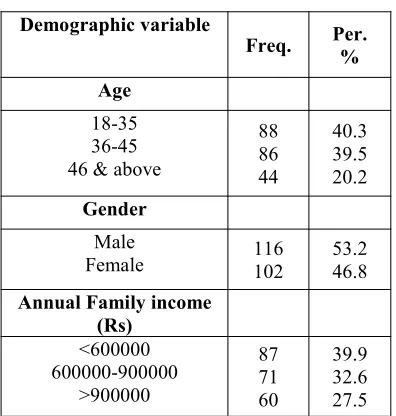
B. The Sample:The sample of the study was collected from 218 respondents belonging to Indore city of central India, using a questionnaire survey during the period 07 March 2016 to 31 March 2016. A non probability convenience sampling technique was used for the study. The demographic profile of respondents is given in table 1.
TABLE 1
DEMOGRAPHIC PROFILE
C. Tools for Data Collection: Data were collected by administering innovativeness: openness of information processing Scale designed by Leavitt and Walton in 1975[1] and 1988[2]. All the 46 items of scale were measured on a five point continuous places scale labeled as (1) not well at all, (2) not very well, (3) fairly well, (4) very well, (5) extremely well.
V. DATA ANALYSIS
Tools such as Mean, Standard Deviation and T-test were applied for analyze the data using SPSS18. Prior to data analysis, the constructs’ reliabilities and validities were ensured through the following criteria. The reliability of scale was measured through Cronbach’s alpha which was found 0.760 for 46 items, which is higher than 0.7 that means it’s a good consistency [9] and The Z value of skewness and kurtosis indicate that the data is normally distributed as both the values lies between ± 1.96 and gender performed Robust Tests of Equality of variances (Welch Test) which permitted us to proceed and compare the group means as it was found significant less than 0.05.
Demographic variable
Freq. Per.%
Age
18-35 36-45 46 & above
88 86 44
40.3 39.5 20.2
Gender
Male
Female 116102 53.246.8
Annual Family income (Rs)
<600000 600000-900000
>900000
87 71 60
TABLE 2 DATA STATISTICS
N of Items Cronbach's Alpha Z value Welch test (Sig.)
46 .760 Skewness- .78
Kurtosis- -1.80 7.982 (.005)
VI. RESULTS AND DISCUSSION
The mean score was 3.025 (see table 3) which indicate that consumers are moderately open or innovative towards information processing while making buying decision for new products or services. Table 4 indicates the influence of gender on openness of information processing. When we applied T-test gender wise on the whole data it also was found significant (p=.004<0.05) so that our null hypothesis is rejected. That means there is a significant difference between male and female for openness of information processing of consumers in making buying decisions i.e. how a consumer uses the information given to him or her, in making buying decisions for trying out new products. It describes that the male consumers (Mean =3.08) are more open or innovative towards using information given to him or her, in making buying decisions for trying out new products then female consumers (Mean=2.95). This supported by Tellis et al. [3] with noted that the men are more likely than women to be innovative.
TABLE 3
OVERALL MEAN AND STANDARD DEVIATION FOR OPENNESS OF INFORMATION PROCESSING
No. of
respondents Mean Std. Deviation Std. Error Mean
218 3.0248305 .3575839 .0242186
TABLE 4 RESULTS OF T-TEST
Demographic variable
T-test
Gender Freq. Mean F Sig.
Male
VII. IMPLICATIONS
This research done on openness of information processing of consumer in making buying decisions with the help of the standard scale given by Leavitt, Clark and John R. Walton in their research paper for studying the consumer’s openness for information processing in making buying decisions for trying new products.
The results of the research can be used by marketers to make promotional ads and schemes according to the target audience and customers or it will be very useful for devising proper segmentation strategies for new products.
This research can be taken forward by conducting a research on the basis of other demographic variables such as age, income and occupation of the consumers i.e. how consumers of different occupation would show the openness of information processing in making buying decisions for trying out new products.
VIII. CONCLUSION
Present study is an attempt to research on openness of information processing of consumer in making buying decisions with the help of the standard scale given by Leavitt and John Walton in their research paper for studying the consumer’s openness for information processing in making buying decisions for trying new products, and analyzing the data with the help of SPSS software by performing T-test and interpreting the results of this analysis. In this study we have measured one demographic variable Gender with consumer’s openness for information processing i.e. how a consumer uses the information given to him or her, in making buying decisions for trying out new product. As overall, consumers are showing moderate openness of information processing and according to the findings the Gender have shown the potential to influence the consumers’ openness for information processing in making buying decision i.e. how a consumer uses the information given to him or her, in making buying decisions for trying out new product.
Further, the analysis provide the evidence that the male consumers are more innovative or open for information processing in making buying decisions for trying out new products than female consumers.
REFERENCES
[3] Tellis, G. J., Yin, E. & Bell, S. (2009). Global Consumer Innovativeness: Cross-Country Differences and Demographic Commonalities.Journal of International Marketing, 17(2), pp. 1-22.
[4] Vandecasteele, B. & Geuens, M. (2010). Motivated Consumer Innovativeness: Concept, Measurement, and Validation.
International Journal of Research in Marketing, 27(4), pp. 308-318.
[5] Clark, R. A. & Goldsmith, R. E. (2006). Interpersonal Influence and Consumer Innovativeness. International Journal of Consumer Studies, 30(1), pp. 34–43.
[6] Subin, Im, Mason, C. H. & Houston, M. B. (2007). Does Innate Consumer Innovativeness Relate to New Product/Service Adoption Behavior? The Intervening Role of Social Learning via Vicarious Innovativeness.Journal of the Academy of Marketing Science, 35(1), 63-75.
[7] Park, J. E., Yu, J. & Zhou, J. X. (2010). Consumer Innovativeness and Shopping Styles.Journal of Consumer Marketing, 27(5), pp. 437 – 446.
[8] Pierre, M., Mairesse, J. & Dagenai, S. M. (2007). Innovativity: A Comparison Across Seven European Countries.Economics of Innovation and New Technologies, 15(4-5), pp. 391- 413.