Heather Burns, Ed.D., is an Assistant Professor and Coordinator of the Leadership for Sustainability Education graduate program in the Educational Leadership & Policy department at Portland State University. She is also the PSU Coordinator of the Learning Gardens Laboratory, a garden-based education site. Dr. Burns completed her doctorate in Educational Leadership with an emphasis in Sustainability Education. Her research interests include sustainability pedagogy in higher education, sustainable food systems,
Teaching for Transformation: (Re)Designing sustainability courses based on ecological principles
Heather Burns
Portland State University [email protected]
Abstract:
If educators are to effectively prepare learners with the knowledge, skills, and values they will need for creating more sustainable places and communities, a transition must be made from transmissive teaching models to transformative learning processes. But how can courses be designed or redesigned so that they create opportunities for
transformational sustainability learning, and how can ecological principles guide this process? The Burns model of sustainability pedagogy provides a practical model for course design that is rooted in ecological principles. The Burns model is comprised of five key dimensions: (1)Content; (2)Perspectives; (3)Process; (4)Context; and (5)Design
and seeks to: (1) increase learners’ systemic understanding of complex sustainability issues (Content); (2) provide learners with opportunities to think critically about
dominant paradigms, practices and power relationships and consider complex ecological and social issues from diverse perspectives (Perspectives); (3) enhance learners’ civic responsibility and intentions to work toward sustainability through active participation and experience (Process); (4) increase learners’ understanding of and connection with the geographical place and the community in which they live (Context); and (5) utilize an ecological course design process that weaves the other four dimensions together to create transformative learning experiences (Design). This design process has the potential to create learning experiences that are transformative and lead to systemic sustainable change.
Key Words: sustainability pedagogy; transformative learning; postsecondary education; course design
possible sustainable solutions to these problems. However, students very quickly become disenfranchised if theprocess of sustainability education does not prepare them how to engage in these complex issues and become problem solvers and change agents. Since sustainability is rooted in deep ethical and spiritual commitments (Hawken, 2007), postsecondary educators need to find ways not only teach sustainability, but to do so in a way that acknowledges the personal and collective transformation inherent in
sustainability work.
Postsecondary educators can (re)design courses that prepare students how to make decisions, participate in collaborative leadership, and create systemic solutions to meet the urgency of increasing global and local sustainability challenges (Chambers, 2009). But perhaps even more importantly, priority must be given to transformative
sustainability learning that prepares graduates with the new ways of knowing and being human that sustainability requires (O’Riordan & Voisey 1998).
David Orr (2004) argues that we need “education that prepares people for lives and livelihoods suited to a planet with a biosphere that operates by the laws of ecology and thermodynamics” (p. 27). Instead, traditional teaching and learning in universities largely ignores ecological principles, and prepare learners to be successful in
unsustainable cultural systems, thus perpetuating these systems. Teaching sustainability will require relying less on information transmission and more on transformational learning that incorporates community contexts (Cress, 2004). Teacher-centered and transmissive models of education are not sufficient for teaching sustainability issues because of their complexity and deeply challenging nature (Sterling, 2002).
Sustainability education that aims to be transformative requires a shift toward reflective-learning, problem-based learning and collaborative group work because these pedagogies focus on learning through inquiry, experience and reflection (Moore, 2005). Further, best practices in adult education show that adults learn best when engaged in learning though relationships, dialogue and direct experience (Vela, 1994; Knowles, 1970). Sustainability education within postsecondary settings should build on best-practices in higher education such as experiential learning, service-learning, project-based learning and active learning (Allen-Gil, Walker, Thomas, Shevory, & Shapiro, 2005). Alvarez and Rogers (2006) argue for teaching sustainability as discourse, allowing students to be confronted with complexity and to address the multiples ways that
sustainability is interpreted and developed in real lives in a specific place. In order for sustainability to make a real difference in students’ lives, a change in educational culture toward systemic, connective and ecological ways of learning is necessary (Sterling, 2002).
Although we know something about what sustainability education should look like, there is very little theory or research that explores how to develop or implement sustainability pedagogy that is indeed systemic, connective and ecological. In particular, research that is focused on teaching sustainability at the postsecondary level is very limited and remains rather conceptual. The research in this area does not indicate much about how sustainability pedagogy is designed or implemented, and whether or not learners actually become prepared to take action to address sustainability challenges in their communities. However, it is imperative that postsecondary learners be prepared with the knowledge, values and skills to be able to contend with the pressing and
therefore a need for sustainability pedagogy that can be widely and effectively implemented in various postsecondary settings.
What then might this sustainability pedagogy look like? How can educators design transformative sustainability courses that prepare learners to create positive changes for local communities and ecosystems? Where do educators start in the somewhat overwhelming task of teaching sustainability transformatively? How can ecological principles serve as a guide in this process? The Burns Model of Sustainability pedagogy (Burns, 2009) builds on postsecondary trends toward transformational learning, but contributes a much needed comprehensive approach for designing or redesigning sustainability courses based on ecological principles. This article provides an overview of this model, its dimensions, and applications to course design. An ecological course design process is provided, and ecological principles that guide this design process are described. The aim is to provide practical ways, based on ecological systems, for designing postsecondary sustainability courses that encourage transformative learning.
The Burns Model of sustainability Pedagogy:
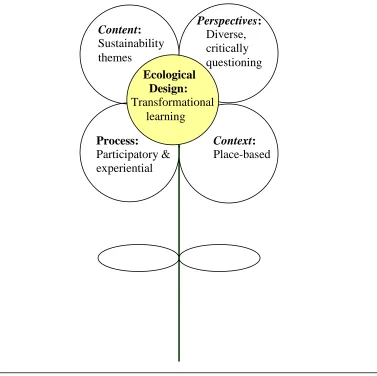
The Burns model is an ecological teaching Design that brings together Content
that is thematic and multidisciplinary, Perspectives that are diverse and critically question dominant paradigms and practices, a Process that is participatory and experiential, and a
Context that is place-based (Burns, 2009). See figure 1. The Burns model of sustainability pedagogy builds on the theory and practice of sustainability education to provide
educators with an ecologically-based framework for designing holistic sustainability courses and programs with the purpose of transformation, and based on research is an effective tool for doing so (Burns, 2009b). This sustainability pedagogy model holds multiple goals for learners. It seeks to: (a) increase learners’ systemic understanding of complex sustainability issues (Content); (b) provide learners with opportunities to think critically about dominant paradigms, practices and power relationships and consider complex ecological and social issues from diverse perspectives (Perspectives); (c) enhance learners’ civic responsibility and intentions to work toward sustainability through active participation and experience (Process); (d) increase learners’
understanding of and connection with the geographical place and the community in which they live (Context); and (e) utilize an ecological course design process that intertwines the other four dimensions to create transformative learning experiences (Design).
The central goal of the Burns model is to promote transformative learning for sustainability. Mezirow (2000) describes transformational learning as a process by which “we transform our taken-for-granted frames of reference…to make them more inclusive, discriminating, open, emotionally capable of change, and reflective so that they may generate beliefs and options that will prove more true or justified to guide action” (p. 7-8). Other aspects of transformational learning include becoming conscious of how social structures are oppressive, sense-making within a holistic and contextual approach, and a spiritual dimension of soul-based learning (Dirkx, 1998). One of the most clear
beliefs that guide sustainable action. While this is an individual process of transformation, it may also lead to community transformation.
Figure 1. TheBurns model of sustainability pedagogy.
The ultimate purpose of the Burns model of sustainability pedagogy, therefore,is to serve a tool for designing education that empowers and inspires learners to be able to solve complex problems and make changes that regenerate and sustain places and communities (Burns, 2009).
Process: Participatory & experiential
Context: Place-based Perspectives:
Diverse, critically questioning Content:
Sustainability themes
Organic Nature of Classrooms,
Communities and Campuses
Dimensions of the Model: Content
The first goal of the Burns Model of Sustainability Pedagogy is to: increase learners’ systemic understanding of complex sustainability issues (Content). Sustainability must be addressed multidimensionally in order to take into account systemic relationships between the biological and cultural dimensions of life. Since sustainability is concerned with recognizing relationships, patterns and dynamics, learners must be introduced to a holistic non-fragmented understanding of pertinent issues.
While the disciplinary nature of most postsecondary education is a challenge to using a multidisciplinary approach, the goals of the Burns model can initially be achieved by structuring Content around a salient sustainability theme(s) within an existing course. Choosing a thematic approach can be an effective way to teach sustainability in a
multidisciplinary way. For example, the theme of stream restoration in geography courses have focused on sustainable relationships between people, places, and environments (Moran, 2002).
Education for livable cities has also been used as a theme in which students explore sustainability through personal experience, observation, action and reflection (Pruneau, McLaughlin, Langis, & Gravel, 2002). A livable cities theme could be applied within a variety of disciplinary courses with emphasis on elements such as transportation, energy use, housing, community building, watersheds, or land use. The food system can also be used to teach sustainability within a wide array of disciplines (Harmon, 2002) such as English, Economics, or Sociology.
Sustainability Content may be applied to a course in any discipline, using a sustainability theme that is applicable to the discipline or course. However, in the Burns model of sustainability pedagogy, the Content is just one element of five. Rather than simply providing information about sustainability, or tacking sustainability Content onto other disciplinary content, whatever is to be learned about sustainability will be
accomplished in relationship with and through the other dimensions of the pedagogy including the Perspectives, Processes, Context, and Design of the course. While the learning objectives of a course may contain specific sustainability Content (information, issues, perspectives, beliefs, skills, and values to be gained), this Content cannot be separated from the other elements of the pedagogy.
Furthermore, effectively reorienting a course to incorporate sustainability Content
will require an educator to begin with what learners already know and believe about sustainability, and then help them to build a stronger understanding of sustainability issues. In order to learn new Content related to complex sustainability issues, learners must be able to connect new knowledge to previous understanding, and construct new meaning within a complex socio-cultural discourse. Sustainability Content is thus constructed within relationship to other learners. These relationships will, in turn, challenge students’ current views and help them to be able to consider multiple
Perspectives on sustainability issues. Dimensions of the Model: Perspectives
diverse Perspectives should be included in order to provide multiple ways of understanding a sustainability issue. Incorporating a variety of perspectives should include the questioning of and reflection on dominant ways of seeing the world. Cortese (2005) argues that it is important for learners to reflect on the systemic causes of
unsustainable practices, and to make visible the physical, social, ecological and economic impacts that are often largely left invisible. By questioning and examining dominant attitudes and behaviors, learners may recognizes that many aspects of sustainability crises are cultural in nature (Bowers, 1999). Questioning and critiquing the underlying cultural assumptions and economic and power relationships that create unsustainable and harmful practices is an essential perspective to be included in sustainability education.
For example, if the theme of global warming was used within a Sociology course to teach sustainability, it would be important to reflect on dominant systems such as driving cars, the global production and shipping of food and goods, and coal-burning energy production which contribute to global warming. These systems, while causing major ecological damage, require cultural acceptance and daily participation by millions of people. Learning about global warming would require examining the underlying causes and assumptions of dominant patterns and practices such as reliance on continual economic growth, nonrenewable resources, and the maintenance of huge social
inequities. Learning about global warming would also include listening to
Perspectives that provide alternatives to these dominant practices. This may include inviting speakers such as a bicycle transportation advocate, or a business owner of a service or product that is produced locally and sustainably. Visiting an alternative energy project such as a wind farm or even a small-scale project such as a home with a micro-hydro turbine or solar panels would provide another Perspective.
In order to question assumptions and power relationships, it is important for learners to be introduced to and consider a variety of diverse Perspectives. Sustainability problems are complex and not easily understood from a single perspective. Many
Perspectives are needed in order to interpret the information, and there is no single right answer. Dresner and Seamans Blatner (2006) posit, “problems possess multiple solutions and multiple criteria for evaluating possible solutions, and require students to engage in a cycle of problem definition, redefinition, and using multiple problem representations” (p. 214). This requires learners to identify multiple stakeholder Perspectives, positions, and preferred solutions. Cortese (2005) suggests that including a variety of less-heard
Perspectives including intergenerational, multi-cultural, local and ecological Perspectives
are crucial to the process of understanding local sustainability issues. Considering diverse
Perspectives can also be applied within the classroom, where there may be diverse learners who can provide unique and underrepresented Perspectives.
Incorporating diverse Perspectives into a course may be accomplished in a variety of ways. For example, in a business course that is using the theme of sustainable
Dimensions of the Model: Process
The third goal of the Burns model of sustainability pedagogy is to: enhance learners’ civic responsibility and intentions to work toward sustainability through active participation and experience (Process). In this model, Process signifies opportunities for direct participation and experiential learning. In adopting thematic sustainability Content, and by challenging dominant assumptions and power structures and considering diverse
Perspectives, sustainability pedagogy is inherently focused on change, and making change requires engagement with one’s self, with others, and with places. Within a sustainability paradigm, change is viewed as finding new ways (or adopting more traditional ways) of living and working so that human systems are in harmony and balance with ecological systems. This change will require a transformational learning
Process that will prepare students to take action for sustainable change (Burns, 2009). Sustainability pedagogy should emphasize active, experiential, and participatory learning (Cortese, 2005). Participatory learning can be empowering and can help learners build the capacity and power to confront sustainability problems (Serrano, 2000). This capacity building and empowerment can be specifically expressed as increasing learners’ civic responsibility and desire to work for sustainability. However, gaining these values is a Process.
As Kaza (1999) notes, learners in postsecondary education today often experience despair, denial, and self-absorption when exposed to facts about socio-ecological
problems, and this is not enough to inspire action for social change. Learners must also have the opportunity to engage in the issues, and actively participate in transforming their world (Kaza, 1999). Service-learning, due to its participatory and experiential nature with goals of civic engagement and leadership, serves as an excellent application of sustainability pedagogy (Burns, 2009). Service-learning integrates meaningful community service with instruction and reflection, and serves to enhance both the learners and the service site. Steinke, Fitch, Johnson and Waldstein (2002) explain that service learning may be a particularly effective way to develop a sustainable democracy that is dependent on the active engagement of an enlightened citizenry.
Participation in the sustainability Process should include the opportunity for learners to participate in sustainable practices in local communities, in their own lives, and on postsecondary campuses (Cortese, 2005). The importance of active participation for change implies that sustainability pedagogy must be situated within its immediate context. The civic responsibility that may evolve from sustainability pedagogy can be a natural extension of learners’ relationships within the places and communities where they live.
Opportunities for participation and direct experience should be incorporated into courses that focus on sustainability. For example, visits to a particular site such as a riverbank, a farm, a park, an office, a social service agency, or even a grocery store can serve to give students direct interaction with the issues they are learning about. In a course with a sustainable food systems theme, a food-inventory shopping activity in a grocery store can reveal much about the availability (or lack) of local food, and the cost of feeding a family of four on a minimum wage job.
sustainability themes could incorporate active participation in campus gardens, or in biofuel development projects. Marketing courses could include projects in which students research and promote information about sustainable living. English or Communication courses could incorporate projects in which students interview people within local organizations that are working for sustainability and write essays or create presentations about these agencies. All of these options may include valuable opportunities for creative thinking and problem-solving in small groups.
A participatory, experiential learning Process is a key dimension of the Burns model of sustainability pedagogy because this Process prepares learners with skills, values and relationships that can only be developed through direct participation.
Dimensions of the Model: Context
A fourth goal of the Burns Model of Sustainability Pedagogy is to: increase learners’ understanding of and connection with the geographical place and the community in which they live (Context).
Context is central to thematic sustainability Content, critical questioning and understanding diverse Perspectives, and the Process of active learning, and is thus an essential dimension of the Burns model. In order for engagement to take place, effective sustainability pedagogy must be rooted in the place where learning is happening. Therefore, the Context of sustainability is critical. According to Cortese (2005) the goal of sustainability education is working towards healthy, socially vibrant, economically secure and environmentally sustainable places. Place-based learning is therefore an application that specifies the importance of Context (Burns, 2009).
According to Sobel (2004), place-based learning focuses on “how the local landscape, community infrastructure, watersheds, and cultural traditions all interact and shape each other” (p. 9). Orr (1992) explains that this integration of place into education is important for several reasons. First, it requires the combination of intellect with
experience, allowing learners the opportunity for direct observation, investigation and experimentation essential for the development of the whole person. Second, place-based education helps to mitigate the problems of overspecialization and the division of
subjects into disciplines because it focuses on understanding interrelatedness. Orr (1992) comments, “places are laboratories of diversity and complexity, mixing social functions and natural processes” (p. 129). Another advantage of the study of place lies in
reeducating people in the art of living well where they are, in learning to be an inhabitant of a place from which an organic reciprocal relationship with place can grow. Orr (1992) puts it this way, “knowledge of a place - where you are and where you come from - is intertwined with knowledge of who you are. Landscape, in other words, shapes
mindscape” (p. 130). Place-based education not only helps learners understand who they are, but to value the places they live and thus to value themselves within that place. In addition, place-based learning not only actively connects learners to the local community (Sobel, 2004), but provides a way to explore and question economic, ecological, social and political relationships through the lens of local places.
such as watershed health, local food accessibility, or waste disposal. Students could also create and analyze their own statistics through the development and dissemination of a survey tool focused on a particular sustainability issue in their community. In a nursing course, students could research and make presentations about sustainable health related resources in various neighborhoods such as community centers, community gardens, walking trails, clinics, natural food co-ops, and yoga or meditation centers. In an economics course, students could learn about small-scale sustainable economies that operate around the world and how these are being applied or might be applied within their bioregion.
The capacity to learn in Context helps bring together sustainability Content, multiple Perspectives, and an active learning Process, all rooted within a specific place, adding layers of meaning and understanding to transformative sustainability learning.
Dimensions of the Model: Design
The fifth goal of the Burns Model of Sustainability Pedagogy is to utilize an ecological course design process that intertwines the other four dimensions to create transformative learning experiences. An ecological course Design links the other four dimensions of the Burns model of sustainability pedagogy with the purpose of creating learning that has the potential to transform learners’ attitudes and values, and ultimately to transform unsustainable systems within unsustainable cultures. The intention is that students become empowered and transformed when learning in a way that is thematic, critically questions dominant norms and incorporates diverse perspectives, is active and participatory and is grounded in a specific context. The intentional and purposeful weaving of these elements together into a course, constitutes its design.
Ecological Design, according to Hemenway (2000), includes five basic steps: (1) observation; (2) visioning; (3) planning;(4) development; and (5) implementation. These steps are not necessarily linear, however, and any steps can be revisited throughout the process of designing and implementing a postsecondary course. While this general design process was originally intended for creating a permaculture garden, the process can usefully be adapted to sustainability teaching and learning. The practice of permaculture focuses on mimicking patterns and relationships in nature to create permanent and sustainable culture (Holmgren, 2002). This course design process applies the lessons of ecological principles. When applied to the context of teaching, ecological principles can be valuable guides that can show us how to create social and cultural systems that are resilient and sustainable.
Design Step 1: Observation
In the first design step, observation, it is important to consider a number of factors: What elements are available to work with and what are the conditions and constraints? This is the stage in which an educator may consider what salient sustainability theme could reasonably be incorporated into a course. This includes considering what community and campus resources can be integrated, and what constraints might apply to implementing this theme (Burns, 2009).
The observation stage of design is linked to the ecological principle, “Observe and Interact” (Holmgren, 2002). A process of continuous observation helps in
foundation of understanding and design. Natural systems thrive on patterns and relationships. The permaculture phrase “the problem is the solution” is also helpful in recognizing the need to slow down and observe relationships. An open inquiring attitude to problems may be more fruitful than an immediate demand for solutions (Holmgren, 2002). In course (re)design, this may begin with thoughtful observation of the educational institution and its people. Who are the students? What is the climate/culture of the
institution and its surrounding community? Who and what are the resources in the area of sustainability? What is already happening in this realm? Over time and through
thoughtful observation, the design can evolve based on the needs and the resources available. Developing a course that addresses sustainability too shallowly may fail to meet local needs. Creating an asset map, lists, or charts may be helpful. What resources are readily available? What are the particular strengths of the educator and what areas may require additional outside resources?
Design Step 2: Visioning
The second design step, visioning, considers what the design should do. What should it accomplish and how should it feel? Considering the learning goals of the Burns Model of sustainability pedagogy and considering the most important outcomes of the course may be helpful in this stage. In this step, it will also be important to solidify a vision for which sustainability theme will best weave together the course goals.
Envisioning opportunities for relationship building between learners and envisioning the tone of the course are also important. Most importantly, the design should include
visioning around what kind of transformative learning will take place.
The visioning stage of design is linked to the ecological principle: Life builds from the bottom up (Hawken, 2007). A tree doesn’t become a tree overnight, but rather starts as a seed, then a shoot, then grows roots and eventually branches and leaves. Complex organisms are created from cooperating communities of cells (Hawken, 2007) that work together to create a whole, just as a complex course design is comprised of many cooperating parts. In starting with a central vision or intention for what will be created and what kind of transformation may take place, the details of a course design can grow naturally from the bottom up.
Design Step 3: Planning
The third design step, planning, involves asking, what is needed to implement ideas? How should the pieces be assembled? At this point the educator can consider what texts, community resources, field visits, speakers, classroom activities and assignments can be incorporated into the course in order to effectively teach
sustainability through the chosen theme. Community projects can be carefully chosen for proximity, applicability, and time/energy of the community organization. This step is a good place to begin a detailed consideration of how to incorporate diverse perspectives, critical questioning of dominant paradigms and power relationships, active participation and direct experience, and place-based understanding (Burns, 2009).
(Holmgren, 2002). In course design, it is essential to create systems that are closely integrated and to “stack functions.” This refers to the use of one element for many uses. For example, a small group assignment may serve as a way for students to learn about diverse perspectives by volunteering together at a local sustainability organization. At the same time, students may be learning how to build relationships and solve problems in groups, and learning how to think critically about sustainability issues. Creating relationships between all aspects of a course mimics the synergistic relationships in nature and provides learning opportunities that are meaningful and potentially transformative.
Design Step 4: Development
The fourth design step, development, focuses on how the design will be implemented. This stage involves making decisions about assignments and learning activities. It also involves writing a syllabus that reflects the ecological design of the course and the chosen sustainability theme. Will there be weekly themes? Will all learning activities center around one main project, or will there be multiple projects? How will the learning be structured and sequenced?
The development step is linked to the ecological principle that life tends to optimize rather than maximize (Hawken, 2007) and always obtains a yield (Holmgren, 2002). Natural systems tend to develop in ways that promote balance, without excessive accumulation. Yet, at the same time natural systems obtain yields. Plants produce seeds for reproduction and to feed other species, but if there are too many plants crammed together, they won’t produce as much. The development of a course should optimize learning rather than maximizing, understanding that in the case of learning sustainability, less can often be more. Obtaining a yield of learning and transformation can be promoted by careful tending and development of learning experiences.
Design Step 5: Implementation
The fifth development step, implementation, involves teaching the course, and in doing so, making adjustments based on further observation, visioning, planning, and development to enhance sustainability learning. Implementing the design also involves assessing whether or not it is flexible enough to meet potential surprises in the classroom. Assessing student learning is an organic learning process for the designer. Assessment provides ongoing opportunities for development of the course, and changes to the Design.
The implementation step is linked to the ecological principles that nature works in cycles and uses self-correcting systems of feedback to thrive (Holmgren, 2002; Hawken, 2007). In nature, systems self regulate. The overpopulation of certain species is regulated by predator species or other environmental factors. Cycles of birth, growth, decay, death and rebirth are inherent to natural systems and provide balance to these systems. In a similar way, a sustainability course can incorporate a cyclical design that returns again and again to a central theme. The instructor can apply systems of feedback by doing frequent in class assessment of learning, attitudes and group dynamics.
Conclusion
(re)designing sustainability courses with the purpose of transformational learning. Educators can use an ecological design process to create transformative sustainability courses that prepare learners to create positive changes for local communities and ecosystems by incorporating thematic sustainability content, diverse perspectives, an active and participatory learning process, and contextual learning rooted in place. Students’ learning experiences must allow them to develop the leadership capacity to be able to understand and address complex sustainability problems holistically, the ability to ask critical questions and understand diverse perspectives, to participate in finding solutions, and to develop personal connections to the places in which their biological, social, and economic lives are grounded. Postsecondary courses that are designed ecologically will allow for learning is connected and systemic, for learning as
References
Allen-Gil, S., Walker, L., Thomas, G., Shevory, T., & Shapiro, E. (2005). Forming a community partnership to enhance education in sustainability. International Journal of Sustainability in Higher Education, 6(4), 392-402.
Alvarez, A., & Rogers, J. (2006). Going “out there”: Learning about sustainability in place. International Journal of Sustainability in Higher Education, 7(2), 176-188. Author. (2009). Skilled in sustainability: teaching sustainability in skills-based courses.
In W. Leal Filho (Ed.), Sustainability at universities: Opportunities, challenges and trends (pp. 195-206). Frankfurt: Peter Lang.
Author. (2009b). Education as sustainability: An action research study of the Burns model of sustainability pedagogy. (Doctoral dissertation). Portland State University, Portland Oregon.
Bowers, C. A. (1999). Changing the dominant cultural perspective in education. In G. A. Smith, & D. R. Williams (Eds.), Ecological education in action (pp. 161-178). Albany, NY: State University of New York Press.
Cajete, G. (Ed.).(1999). A people’s ecology: Explorations is sustainable living. Santa Fe, NM: Clear Light.
Chambers, D. (2009). Assessing & planning for environmental sustainability: A framework for institutions of higher education. In W. Leal Filho (Ed.),
Sustainability at universities: Opportunities, challenges and trends (pp. 287-298). Frankfurt: Peter Lang.
Cortese, A. (2005). Learning principles for sustainability: Sustainability curriculum framework for curriculum development. Second Nature: Education for
Sustainability. Retrieved December 12, 2005 from http://www.secondnature.org. Cress, C. (2004). Critical thinking development in service-learning activities:
pedagogical implications for critical being and action. Inquiry: Critical Thinking Across the Disciplines, 23, 87-93.
Dirkx, J. (1998). Transformative learning theory in the practice of adult education: An overview. PAACE Journal of Lifelong Learning, 7, 1-14.
Dresner, M., & Seamans Blatner, J. (2006). Approaching civic responsibility using guided controversies about environmental issues. College Teaching, 54, 213-219. Harmon, A. (2002) Teaching sustainability using the food system as a model. In W. Leal
Filho (Ed.), Teaching sustainability at universities: Towards curriculum greening
Hawken, P. (2007). Blessed Unrest. New York: Penguin Group.
Hemenway, T. (2000). Gaia’s garden. White River Junction, VT: Chelsea Green. Holmgren, D. (2004). Permaculture: Principles and pathways beyond sustainability.
Hepburn, Australia: Holmgren Design Services.
Kaza, S. (1999). Liberation and compassion in environmental studies. In G. A. Smith, & D. R. Williams (Eds.), Ecological education in action (pp. 143-160). Albany, NY: State University of New York Press. .
Knowles, M. (1970). The modern practice of adult education: An autobiographical journey. New York: Association Press.
Mezirow, J. (2000). Learning as transformation. San Francisco: Jossey-Bass.
Moore, J. (2005). Seven recommendations for creating sustainability education at the university level. International Journal of Sustainability in Higher Education, 6(4), 326-339.
Moran, S. (2002) Stream restoration: A senior seminar theme.In W. L Filho (Ed.),
Teaching sustainability at universities: Towards curriculum greening (pp. 25-44). New York: Peter Lang.
Orr, D. (1992). Ecological Literacy. Albany, NY: State University of New York. Orr, D. (2004). Earth in Mind: On Education, Environment, and the Human Prospect.
Washington, DC: Island Press.
O’Riordan, T., & Voisey, H. (1998). The politics of Agenda 21 in Europe. London: Earthscan.
Pruneau, D., McLaughlin, E., Langis, S., & Gravel, H. (2002). Education for liveable cities-Environmental and pedagogical actions at the university level.In W. Leal Filho (Ed.), Teaching sustainability at universities: Towards curriculum greening
(pp.45-60). New York: Peter Lang.
Serrano, I. (2000). Learning sustainability from crisis. Convergence, 33(1), 78-101. Sobel, D. (2004). Place-based education. Great Barrington, MA: The Orion Society. Steinke, P., Fitch, P., Johnson, C., & Waldstein, F. (2002). An interdisciplinary study of
Sterling, S. (2002). Sustainable education: Re-visioning learning and change. Devon, UK: Green Books.
Vela, J. (1994). Learning to listen, learning to teach: The power of dialogue in educating adults. San Francisco: Jossey-Bass.