Robert J. Korenic is currently an Assistant Professor of Civil and Construction Engineering Technology at Youngstown State University 44555, USA. He earned a Bachelor of Engineering in Civil Engineering and a Master of Science in Environmental Engineering from Youngstown State University. He has approximately eleven years of work experience in water resources planning and management and in the wood and light gauge steel roof truss industry. He teaches a variety of courses including hydraulics and land development, properties and strength of materials and sustainable design pertaining to Leadership in Energy and Environmental Design (LEED). Prof. Korenic can be reached at [email protected].
Assessing the Effectiveness of Problem and Project Based
Learning in a Green Building Design and Construction
Course Using ETAC Criteria
Robert J. Korenic
School of Engineering Technology, Youngstown State University, United States
Abstract: Sustainable design practices have become more prevalent in the fields of Civil and Construction Engineering Technology and traditional Civil Engineering. Therefore, educators must prepare the next generation of engineers with courses on sustainable engineering and incorporate sustainable topics into traditional engineering subjects. Such is the case at Youngstown State University where the first course in LEED (Leadership in Energy and Environmental Design) was taught Fall semester 2012. The course used the USGBC LEED Reference Guide for Green Building Design and Construction as the basis for learning. The students were asked to learn the aforementioned USGBC publication through traditional
classroom lectures, case studies and projects. Each of the case studies and the final project used Problem and Project Based learning principles to allow the students to gain greater
understanding of the material. The effectiveness of this was assessed using ETAC learning outcomes. This was done by choosing specific outcomes to be evaluated and then evaluating each assignment and test based on the outcomes which reflect what the students were supposed to learn. This paper describes the Problem and Project based methodology used and the
approach to selecting the ETAC outcomes used to assess the student learning. Also discussed will be the process of setting up and analyzing the rubrics used to get meaningful data and results of the student learning.
Journal of Sustainability Education http://www.susted.org/ Introduction and Background
Due to national trends which indicate an increasing number of “green building” design projects and based on the suggestion of the Civil and Construction Engineering Technology (CCET) Industrial Advisory Board (IAB) at Youngstown State University, the CCET program has begun to implement sustainable engineering topics into a variety of classes. However, up until the fall semester 2012 there has never been a class totally devoted to sustainable practices. The first class of this type revolved around LEED principles and used the USGBC LEED Reference Guide for Green Building Design and Construction (USGBC, 2009) as the basis for lecture materials. The assignments for the class were developed using Problem and Project based learning
methodology. This gave the students in the class the freedom to formulate their own solutions, based on the USGBC Guide, to various case studies discussed or given as graded assignments. The case studies, which are very open-ended in nature, require the students to use the
information in the USGBC Guide and the information given in the case study to explain how LEED credit was given on the project described in the case study. Also, required of the students was an explanation of what additional LEED credit could have been received on the project if other design items were added to the original project. Thus, the students were evaluating these case study scenario’s based on what was present and what could be added which leads to a greater and deeper level of understanding. This follows the contention of Sancho, Fuentes, Gomez-Martin and Fernandez-Manjon (2009, 668) stating Problem and Project Based Learning “leads to deeper levels of learning, critical thinking, shared understanding, and long-term retention of the learning materials”.
Problem and Project Based Learning Relevance
Vol. 6, May 2014 ISSN: 2151-7452
they give the students a glimpse of what types of situations they will encounter while practicing engineering technology.
The lecture format of the course offers an ideal way to emphasize the importance of the
aforementioned critical thinking skills in two main ways. First, during our lectures, the faculty member and the students interact which allows for a convivial atmosphere. This atmosphere encourages the students to interject their ideas into the discussion. This corresponds with the aforementioned Jonassen and Hung quote. The soft structured nature of the selected case studies allows the students the freedom to apply the LEED principles from the USGBC Guide to the existing information and then to subsequently use their creativity in projecting what LEED items could be added to the project to achieve more LEED credit. This also aligns with the contention of Savery (2006, 12) who states “critical to the success of the approach is the selection of ill-structured problems (often inter-disciplinary) and a tutor who guides the learning process and conducts a thorough debriefing at the conclusion of the learning experience”[3]. Therefore, through these types of lecture sessions, the students and the instructor discuss the specifics of the LEED manual by engaging in meaningful conversations similar to what would be done in the workforce.
Lastly, since LEED is primarily regulatory in nature, the course featured extensive use of
secondary teaching and learning resources. One of the learning resources used in the lecture was the vast array of web sites which help the LEED professional apply the LEED regulations to various situations. Many of the LEED regulations and guidelines for applying them to specific cases are located on various on-line web sites. Therefore, another “real world” principal that was able to be reinforced was seeking out information in secondary resources (government regulation sites etc.) to be used to further explain the LEED guide and subsequently develop further
analysis points of the cases studies. These web sites also help the students gain a deeper
understanding of the regulations in the USGBC Guide by offering more in-depth explanations of the Guides content. The web addresses also give more insight into all of the “team members” who are required to work together to gain certain LEED credits and also explain the process preparing the paper work/forms required to achieve certain credits. Therefore, the lecture format of the class and the large final project assignment firmly exemplify the main objectives of PBL as stated by Sancho et al. (2009, 668) which is “building on prior knowledge, problem solving, the use of critical thinking approaches and reflection”.
Selection of ETAC outcomes and assessment techniques
Journal of Sustainability Education http://www.susted.org/ Assessment Approach and Rubrics
It was decided that the initial offering of this class would be evaluated using the following four (4) ETAC-ABET outcomes. Each outcome speaks to a different area of learning which pertains to the breadth and depth of learning required in an upper division (junior/senior level) class. The outcomes assessed (identified by their ETAC labels) are listed below.
A – Mastery of knowledge, skills and tools of CCET
D – Ability to apply creativity in design of systems, components and processes G – Communicate Effectively
H – Recognize the need for lifelong learning
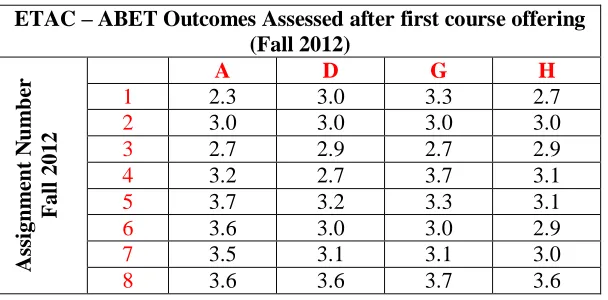
In order to assess the students work based on these outcomes, each assignment needed to be formulated in such a way that one or all of the outcomes could be assessed. Therefore, each assignment (typically case studies and exams) was carefully selected. Each case study was selected in order to assess certain outcomes listed above. Furthermore, each exam question was designed to allow for one or more of the desired criteria to be evaluated. Each of the outcomes was assessed throughout the semester and the results were normalized to a value of four (4). This was done for one main reason. When using ETAC-ABET outcomes to evaluate student learning in engineering technology courses at Youngstown State University, it is customary to strive to achieve a normalized score of 2.85 on a scale of 4.0. This value indicates that the learning by students was sufficient.
Results and Discussion
The following table summarizes each outcome assessed over the course of the semester. Eight different assignments (case studies and exams) were assessed in order to assess each outcome multiple times. This gave a larger set of data to evaluate student learning.
Table 1: Results (Fall Semester 2012)
ETAC – ABET Outcomes Assessed after first course offering (Fall 2012)
A
ss
ign
m
en
t
N
u
m
b
er
Fall
201
2
A D G H
1 2.3 3.0 3.3 2.7
2 3.0 3.0 3.0 3.0
3 2.7 2.9 2.7 2.9
4 3.2 2.7 3.7 3.1
5 3.7 3.2 3.3 3.1
6 3.6 3.0 3.0 2.9
7 3.5 3.1 3.1 3.0
8 3.6 3.6 3.7 3.6
Vol. 6, May 2014 ISSN: 2151-7452
achievement. In subsequent offerings of the LEED class (Spring 2014), we hope to continue with similar course content and assignments. This will allow for a more thorough and statistically relevant analysis because there will be more data, similar in nature to what was accumulated in the first offering in order to draw conclusions.
Summary, Conclusions and Proposed Adjustments
While we were pleased with the results from the first offering of the course, we are going to seek continuous improvement by updating the content where applicable. This includes adding in new homework assignments, case studies and final project which incorporates varied areas discussed in the lecture portion of the course. In order to acquire input from the students at the end of the semester, we requested that students complete a survey which indicated what portions of the class they enjoyed and what potential improvements could be made in subsequent offerings. Some of the comments made were thoughtful and insightful and will be taken into consideration for the next offering. Some of the more thought provoking comments dealt with students wanting more introductory material on how LEED credits are assigned to projects while some students wanted more detail on how much LEED criteria garners certain LEED classifications (i.e. How many criteria are required to attain silver, gold and platinum project ratings). Several students indicated that they would like more case study assignments because the case studies allowed them to gain a more in depth understanding of the lecture material/USGBC Guide. Finally, most of the students indicated that they really enjoyed the class project because it allowed them to explore the USGBC Guide and all of the websites pertaining to the material which will benefit them as they graduate and join the workforce as practicing engineering technologists.
In conclusion, the first offering of the LEED course was successful on many levels. First, Youngstown State University and The School of Engineering Technology now have a class that is completely devoted to sustainable practices. Second, the course is based on the USGBC manual which outlines LEED guidelines that students may refer to while practicing. Finally, many of the assessments of the course based on ETAC-ABET criteria were above the stated minimum which would indicate that the learning outcomes selected were attained during the course.
References
ETAC-ABET Accreditation guidelines. Accessed January 1, 2013. http://www.abet.org.
Jonassen D., and Hung W. 2008. “All Problems are not Equal: Implications for Problem-Based Learning.”The Interdisciplinary Journal of Problem-based Learning 2(2), 6-28.
Mills J., and Treagust D. 2004. “Engineering Education-is Problem-Based or Project-Based Learning the Answer?” Australasian Journal of Engineering Education. http://www.aaee.com.au/journal/2003/mills_treagust03.pdf, 2-16.
Sancho P., Fuentes R., Gomez-Martin P., and Fernandez-Manjon B. 2009. “Applying Multiplayer Role Based Learning in Engineering Education: Three Case Studies to Analyze the Impact on Students’ Performance.” International Journal of Engineering Education 25(4), 665-679.
Savery J. 2006 “Overview of Problem-based Learning: Definitions and Distinctions.” Interdisciplinary Journal of Problem-based Learning 1 (1), 9-20.
Journal of Sustainability Education http://www.susted.org/ Robert J. Korenic: (Author Thumbnail)