[Alegria* 4(7): July, 2017] ISSN 2349-4506
Impact Factor: 2.785
G
lobal
J
ournal of
E
ngineering
S
cience and
R
esearch
M
anagement
EVALUATION OF GRANULAR MATERIAL QUALITY ACCORDING TO
CURRENT SPECIFICATIONS FOR GRANULAR BASES
M.E. Montes-Arvizu, O. Chávez Alegría*, S.A. Zamora Castro
*
Student of the Engineering department, Autonomous University of Queretaro, Cerro de las Campanas
s/n, Col. Las Campanas, Queretaro, Mexico
Professor of the Engineering department, Autonomous University of Queretaro, Cerro de las Campanas
s/n, Col. Las Campanas, Queretaro, Mexico
Engineering department, Veracruz University, Veracruz, México
DOI: 10.5281/zenodo.824961
KEYWORDS
: granular base, geotechnical parameters, standards, compliance
ABSTRACT
Establishing the quality methods and specifications for the granular material of the granular base is a topic of interest and concern to societies. However, it is common to find in many regions that quality specifications are obsolete, do not present the current level of knowledge about the characterization of granular material and reject the use of some materials for not meeting their requirements. The objective of this investigation is to evaluate consistency and compliance of different granular material properties with respect to current standards of granular base of pavement, by means of the standard deviation and Percent within Limits (PWL) respectively. The quality requirements analyzed are the percentage of elongated and slab particles, sand equivalent value, liquid limit, plasticity index, resistance to abrasion and California Bearing Ratio (CBR) index. The results showed that the granular materials do not satisfactorily meet the requirements of the standards as well as the properties of the materials are inconsistent. This suggests that the current requirements for bases probably need to be restructured to obtain a higher compliance for materials that present geotechnical conditions similar to those evaluated in this research, under scientific support and without compromising the stability and functionality of the base.
INTRODUCTION
The base is the structural layer of the pavement made up of selected materials of specific dimensions (high quality aggregates such as crushed rock, partially crushed gravel and sand, or the combination of these materials), placed on a sub-base o subgrade, whose purpose is to resist the road surface while providing uniform support. In addition, the base provides structural capacity to the flexible pavement and improves soundness of rigid pavement, as well as it functions as a drainage layer on both pavements (Babić et al., 2000; Christopher et al., 2006; Delatte, 2008). For this reason, the base is considered the main structural component of the pavement (Siswosoebrotho et al., 2005), since its quality significantly impacts pavement performance (Kwon et al., 2017).
The quality of the base, due to its influence on pavement performance, should be evaluated according to the geotechnical profile of the aggregates that ensures the functionality and stability of the layer under the circumstances for which it is designed (Hardy et al., 2011). Therefore, the selection of the materials for the base is generally done according to its physical and mechanical properties, seeking to fit the mentioned geotechnical profile (Lima & Motta, 2016; Osouli et al., 2016). Thus, there is uncertainty about the selection of materials, since poor selection (materials of lower quality than necessary) can result in structural or functional failures, which result in high reconstruction and maintenance costs, as well as repercussions on society by compromising their safety and increasing their travel times (Masad et al., 2011).
[Alegria* 4(7): July, 2017] ISSN 2349-4506
Impact Factor: 2.785
G
lobal
J
ournal of
E
ngineering
S
cience and
R
esearch
M
anagement
materials. This leads to poorly performing and costly pavements due to constant repairs and transport of materials of high quality (Gautam et al., 2013). For this reason, it is important that the quality requirements (standards) for aggregates of granular base are structured based on the geotechnical properties that are related or have an impact on the stability and functionality of this layer, considering the consistency of the materials. However, before a full restructuring, it is necessary to adequately understand the quality of the granular materials evaluated by the current specifications (Hardy et al., 2011), with the purpose of determining the current level of acceptance of the materials with respect the standards and analyzing their reliability to evaluate the materials.The objective of this investigation is to evaluate compliance and consistency (variability) of different granular material properties with respect to current standards of granular base of pavement, taking as case of study materials located in Mexico. This with the intention of verify if there is a need to restructure the current standards, considering the degree of compliance obtained in each of the quality requirements of this document. For this purpose, samples from eleven quarries located in the cities of Querétaro (eight) and Mexicali (three) were extracted and characterized. Subsequently, variability and compliance with respect to the quality requirements from mentioned standards were measured by means of the standard deviation and Percent within Limits (PWL) respectively. The quality requirements analyzed are the percentage of elongated and slab particles, sand equivalent value, liquid limit, plasticity index, resistance to abrasion and California Bearing Ratio (CBR) index. The results showed that the granular materials do not satisfactorily meet the requirements of the standards (except for AASHTO and ASTM standards when evaluating Mexicali materials), as well as the properties of the materials are inconsistent. This suggests that the current requirements for bases probably need to be restructured, at least the mexican one (N-CMT-4-02-002) to obtain a higher compliance for materials that present geotechnical conditions similar to those evaluated in this research, under scientific support and without compromising the stability and functionality of the base, because this low level of material acceptance is likely to occur in other regions.
BACKGROUND
Quality Requirements for granular bases
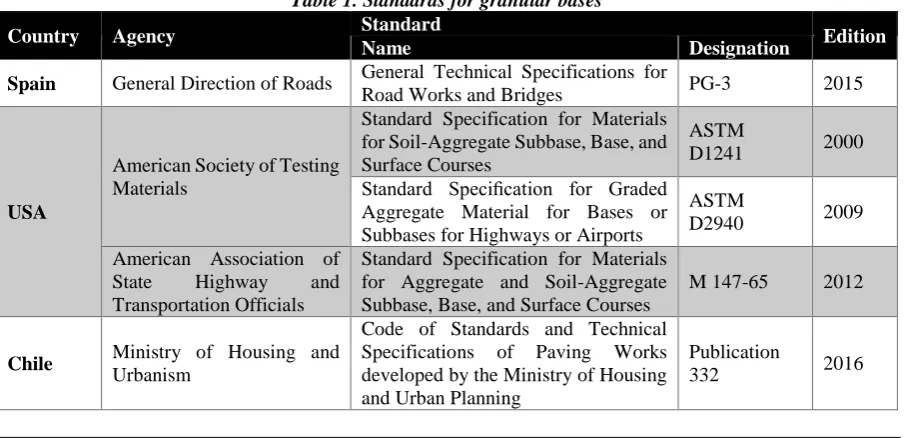
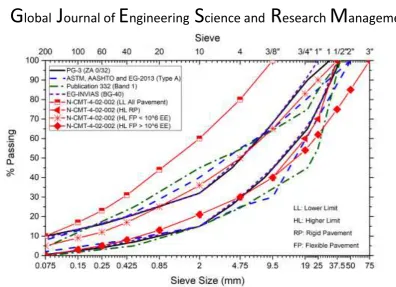
The geotechnical parameters commonly used as quality requirements in the standards of the granular materials are the abrasion resistance, soundness and the percentage of the fine aggregate (Hardy et al., 2011). Other properties usually found in the standards are particle size distribution and plasticity. Each country has its own quality requirements for pavement materials, which may or may not meet your specifications. Table 1 shows some international standards for granular materials used in the construction of the base of pavement, as well as the agency in charge of its management. Also, Table 2 shows the quality specifications (only those of interest for this research) of each standard and Figure 1 shows the gradation limits.
Table 1. Standards for granular bases
Country Agency Standard Edition
Name Designation
Spain General Direction of Roads General Technical Specifications for
Road Works and Bridges PG-3 2015
USA
American Society of Testing Materials
Standard Specification for Materials for Soil-Aggregate Subbase, Base, and Surface Courses
ASTM
D1241 2000
Standard Specification for Graded Aggregate Material for Bases or Subbases for Highways or Airports
ASTM
D2940 2009
[Alegria* 4(7): July, 2017] ISSN 2349-4506
Impact Factor: 2.785
G
lobal
J
ournal of
E
ngineering
S
cience and
R
esearch
M
anagement
Colombia National Institute of Routes
General road construction
specifications and test standards for road materials
EGC-INVIAS 2012
Mexico
Ministry of
Communications and
Transportation
Materials for Hydraulic Bases
N-CMT-04-02-002 2016
Peru Directorate General of
Roads and Railways
Manual of Roads with General Technical Specifications for Construction
EG-2013 2013
Table 2. Quality Requirements of standards for granular bases. Adapted from: AASHTO, 2004; ASTM International, 2000, 2009b; Dirección General de Carreteras, 2015; Instituto Nacional de Vías, 2012;
MINVU, 2008 and SCT, 2016
Standard
Designation of
material according to standard
Elongated and slabs particles (%) Sand Equivalent Value (%) Liquid Limit (%) Plasticity Index (%) ReD by LA (%) CBR (%) PG-3 ADI
p ≥ 2000
< 35
> 40
NP NP ≤ 30 ---
1999 – 200 > 35
< 200 > 30 ≤ 35
ASTM D1241 and
D2940 Type I
---- ≥ 35 ≤ 25
≤ 6 for roads ≤ 4 for Highways
≤ 50 ---
AASHTO
M 147-65 ---- ---- ≤ 25 ≤ 6 ≤ 50 --- Publicación
332 ---- ---- ≥ 50 ≤ 25 ≤ 6 ≤ 35 > 100
EG-INVIAS
C DT < 0.5x10⁶ EE
≤ 35 ≥ 30
≤ 25 ≤ 3 ≤ 40 ≥ 80
B 0.5x10
6 EE < DT
< 5x10⁶ EE --- 0 ≤ 40 ≥ 80
A DT > 5x10⁶ EE --- 0 ≤ 35 ≥ 95
N-CMT-4-02-002
Flexible Pavement
EE ≤ 106 ≤ 40 ≥ 40
≤ 25 ≤ 6
≤ 35 ≥ 80
EE ≥ 106 ≤ 35 ≥ 50 ≤ 30 ≥ 100
Rigid Pavement ≤ 40 ≥ 40 ≤ 35 ≥ 80
EG-2013 Altitude
< 3000 masl ≤ 15 ≥ 35 ---- ≤ 4 ≤ 40 > 80* > 100**
≥ 3000
masl ≥ 45 ≤ 2
[Alegria* 4(7): July, 2017] ISSN 2349-4506
Impact Factor: 2.785
G
lobal
J
ournal of
E
ngineering
S
cience and
R
esearch
M
anagement
Figure 1. Quality requirements of grain size distribution of standards for granular bases. Adapted from: AASHTO, 2004; ASTM International, 2000, 2009b; Dirección General de Carreteras, 2015; Instituto
Nacional de Vías, 2012; MINVU, 2008 and SCT, 2016
In these standards similarities can be observed, such as that the requirements depend on the intensity of the traffic and that they propose different gradation zones according to the consistency of the material. The most specified geotechnical parameters in these documents are gradation, sand equivalent, plasticity and abrasion resistance. This indicates that standards focus on their requirements mainly in the distribution of particle size, the strength of the coarse aggregate and the composition of the fine soil.
Compliance and variation of quality requirements
The quality of the materials should be evaluated both in compliance with respect to standards and in variability of laboratory results, since these two aspects are not always congruent with each other. Although two different material samples meet the quality specifications (100% compliance), their results may be very different (drastic variability). This undetected variation can significantly affect pavement behavior (Hardy et al., 2011).
The compliance of the materials with respect to the standards can be evaluated by the Percentage Within the Limits (PWL) and the variability by the standard deviation. The PWL shows the general performance of the materials using normal distribution curves, so if the material exhibits a different behavior than normal, the material is discarded. The standard deviation gives an approximation of the distribution of the results over the mean. Investigations by Breakah et al. (2007), Hardy et al. (2011) and Villiers et al. (2003) are focused on the calculation of the compliance of the materials with respect to the standards.
[Alegria* 4(7): July, 2017] ISSN 2349-4506
Impact Factor: 2.785
G
lobal
J
ournal of
E
ngineering
S
cience and
R
esearch
M
anagement
M-MMP-1-07/07 (SCT, 2007), the resistance to degradation in the Los Angeles Machine by the standard ASTM C131 – 06 (ASTM International, 2006a), the CBR test by the standard ASTM D1883-07 (ASTM International, 2007) and the compaction of soil using Modified Proctor by the standard ASTM D1557-09 (ASTM International, 2009c).The results from the elongated and slabs particles test, the sand equivalent value test, the plasticity tests, the resistance to degradation test and the CBR test were evaluated with the quality requirements of the mentioned standards, to determine the compliance and variability of these properties of the materials, by the calculation of the PWL (for single sided specification limits), the media and the standard deviation. The conformity and variability of the grain size was not calculated because this parameter is based on manufacturing, and this study focuses only on source properties.
RESULTS AND DISCUSSION
Characteristics of Tested Materials
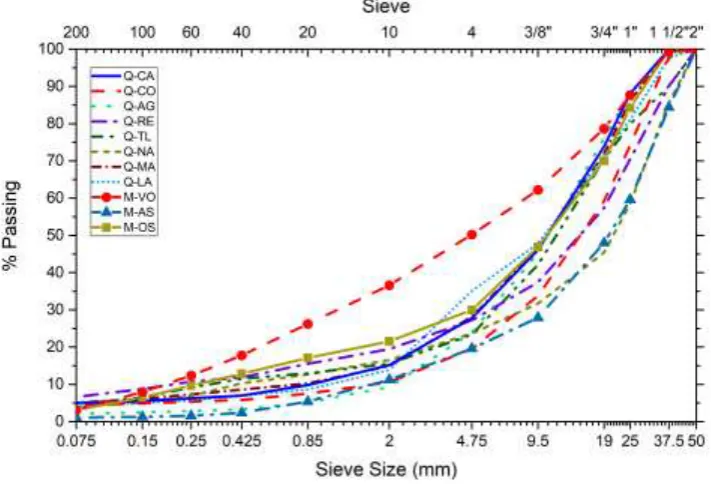
Eight materials were obtained from different quarries in the city of Querétaro (CA, CO, AG, RE, Q-TL, Q-NA, Q-MA and Q-LA) while three materials were obtained from other quarries in the city of Mexicali (M-VO, M-AS and M-OS). The Figure 2 presents their grain size distribution.
Figure 2. Grain size distribution of the tested materials.
[Alegria* 4(7): July, 2017] ISSN 2349-4506
Impact Factor: 2.785
G
lobal
J
ournal of
E
ngineering
S
cience and
R
esearch
M
anagement
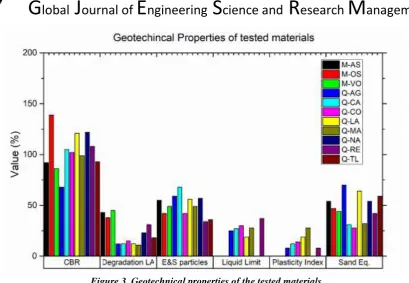
Figure 3. Geotechnical properties of the tested materials
Variation calculation
In contemplation of evaluated how the quality of aggregates can vary in a region, the mean and standard deviation of the geotechnical properties, both at city level and in general, were calculated. The results are shown in Table 5. This means that the materials of Querétaro and Mexicali have similar geotechnical behavior, but with advantages and disadvantages in certain aspects: Querétaro materials have better resistance to abrasion but they are more plastic, while Mexicali materials are not plastic but their resistance to degradation is smaller. However, although the average geotechnical behavior of the tested materials is similar, those of Querétaro have a higher standard deviation in all properties. This suggests that there is greater variability of materials in Querétaro than in Mexicali, that is, there is greater diversity in quality of aggregates in Querétaro than in Mexicali, where the quality of the materials is similar, at least in the sampled quarries.
Table 3. Mean and standard deviation values of the tested materials of Querétaro and Mexicali
Materials Elongated and slabs
particles (%)
Sand Equivalent Value (%)
Liquid Limit (%)
Plasticity Index (%)
Deg. LA (%)
CBR (%)
Media
Querétaro 50 48 28 15 17 110
Mexicali 49 48 NP NP 42 106
All 50 48 28 15 24 109
Standard deviation
Querétaro 12 16 6 8 7 29
[Alegria* 4(7): July, 2017] ISSN 2349-4506
Impact Factor: 2.785
G
lobal
J
ournal of
E
ngineering
S
cience and
R
esearch
M
anagement
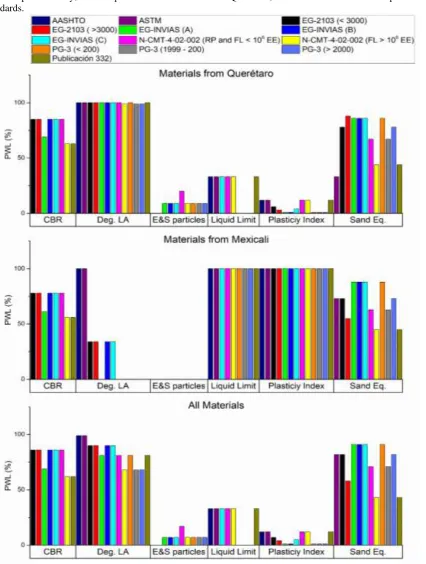
Table 7 (Mexicali materials) and Table 8 (all tested materials). To complement these tables, Figure 4 represents, in a comparative way, the compliance of the materials of Querétaro, Mexicali and both with respect to the standards.[Alegria* 4(7): July, 2017] ISSN 2349-4506
Impact Factor: 2.785
G
lobal
J
ournal of
E
ngineering
S
cience and
R
esearch
M
anagement
From the above, it is deduced that Querétaro materials, considering only the analyzed, do not present the minimum acceptance percentage (90%) for any of the geotechnical properties evaluated with respect to each standard, except the abrasion resistance (99 to 100%). A similar case occurs with the Mexicali materials, which only have a degree of compliance greater than 90% for the liquid limit (100%) and plastic index (100%) in all standards. On the other hand, in the case of analysis of all materials, the degree of minimum acceptance is hardly reached in some standards for the sand equivalent (91% only for PG-3 with ADIp< 200 heavy vehicles/day and for EG-INVIAS in all its classifications) and abrasion resistance (90% for EG-INVIAS in category A and B and for EG-2013, 99% for ASTM). It should be noted that the N-CMT-4-02-002 only obtained acceptable compliance for the abrasion resistance in the materials of Querétaro and for the plasticity of the materials of Mexicali, having no acceptance when all the materials were analyzed. This leads to establish that the quality requirements of this document should be adapted to the types of materials of the country, as already stated, the variability of the quality of materials is very drastic from one region to another, even within on, such as Querétaro.
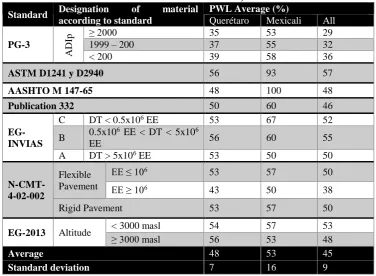
Additionally, the average PWL was calculated for each standard for each set of materials studied, in order to determine which aggregates are most accepted by the standards. The Table 9 shows these averages. It can be observed that the only cases where there is a level of acceptance greater than 90% is for the materials of Mexicali by the standards of ASTM (93%) and AASHTO (100%). On the other hand, the PG-3 standard has the lowest levels of acceptance for all sets of materials. It should be noted that these levels of acceptance are calculated only on the basis of the geotechnical parameters analyzed, so the degree of compliance can vary if other properties are considered indicated in standards, which are outside the scope of this investigation.
Table 4. Average compliance (PWL) with respect different standards (Querétaro materials, Mexicali materials and all materials)
Standard Designation of material
according to standard
PWL Average (%)
Querétaro Mexicali All
PG-3
ADI
p ≥ 2000 35 53 29
1999 – 200 37 55 32
< 200 39 58 36
ASTM D1241 y D2940 56 93 57
AASHTO M 147-65 48 100 48
Publication 332 50 60 46
EG-INVIAS
C DT < 0.5x10⁶ EE 53 67 52
B 0.5x10
6 EE < DT < 5x10⁶
EE 56 60 55
A DT > 5x10⁶ EE 53 50 50
N-CMT-4-02-002
Flexible Pavement
EE ≤ 106 53 57 50
EE ≥ 106 43 50 38
Rigid Pavement 53 57 50
EG-2013 Altitude < 3000 masl 54 57 53
≥ 3000 masl 56 53 48
Average 48 53 45
[Alegria* 4(7): July, 2017] ISSN 2349-4506
Impact Factor: 2.785
G
lobal
J
ournal of
E
ngineering
S
cience and
R
esearch
M
anagement
construction of pavements (Gautam et al., 2013).The low level of acceptance by the standards for available granular materials leads to the need to restructure them so that their quality requirements are adapted to different geotechnical conditions of materials, mainly mexican standard, since the materials analyzed are under its jurisdiction. This restructuring must be carried out based on scientific support, implementing the geotechnical properties that are related or have an impact on the stability and functionality of the granular base, considering the consistency and geological condition of the materials, choosing to establish material classifications according to the availability of local aggregates.
Other solutions to this problem are: 1) to investigate how local materials can be used as best as possible, since the use of local materials with a suitable pavement design can bring economic and environmental benefits, as well as improve the performance of the structure; and 2) to use recycled materials that meet the quality requirements in pavement construction
CONCLUSIONS
Establishing the quality methods and specifications for the granular material of the granular base is a topic of interest and concern to societies. However, it is common to find in many regions that quality specifications for granular materials are obsolete, do not present the current level of knowledge about the characterization of granular material ideal for pavement applications and reject the use of some granular materials for not meeting their requirements, mainly because commonly the current standards are developed under the experience of a group of people and do not consider the geotechnical conditions of the materials.
The objective of this investigation is to evaluate compliance and consistency (variability) of different granular material properties with respect to current standards of granular base of pavement, taking as case of study materials located in Mexico. This with the intention of verify if there is a need to restructure the current standards, considering the degree of compliance obtained in each of the quality requirements of this document.
The quality of the materials should be evaluated both in compliance with respect to standards and in variability of laboratory results, since these two aspects are not always congruent with each other.
The calculation of variability indicated that the materials of Querétaro are more inconsistent in comparison to those of Mexicali, mainly because the origin of the rock in Querétaro are more diverse than in Mexicali.
The materials of Querétaro obtained the acceptable level of acceptance (above 90%) only for abrasion resistance requirements (99 to 100%), while Mexicali materials obtained it for the liquid limit requirements (100%) and plasticity index (100%) with respect to all regulations. For the set of all materials, the degree of minimum acceptance is hardly reached in some standards for the sand equivalent (91% only for PG-3 with ADIp< 200 heavy vehicles/day and for EG-INVIAS in all its classifications) and abrasion resistance (90% for EG-INVIAS in category A and B and for EG-2013, 99% for ASTM).
The average conformity showed that the only materials suitable for the granular base, according to the requirements of the standards analyzed, are the Mexicali materials but only for the ASTM and AASHTO standards, with 93% and 100% acceptance respectively.
[Alegria* 4(7): July, 2017] ISSN 2349-4506
Impact Factor: 2.785
G
lobal
J
ournal of
E
ngineering
S
cience and
R
esearch
M
anagement
AKNOWLEDGMENTS
Authors are gratefully acknowledged the financial support of the Consejo Nacional de Ciencia y Tecnología (CONACYT) for this research.
REFERENCES
1. ABabić, B., Prager, A., & Rukavina, T. (2000). Effect of fine particles on some characteristics of granular base courses. Materials and structures, 33(7), 419–424.
2. Breakah, T. M., Williams, R. C., Kandil, A., & Shane, J. S. (2007). Implementing percent within limits for hot mix asphalt. En Proc. of the 2007 Mid-Continent Transportation Research Symposium (pp. 16– 17).
3. Christopher, B. R., Schwartz, C., & Boudreau, R. (2006). Geotechnical Aspects of Pavements Publicación No. FHWA NHI-05-037 (No. FHWA NHI-05-037) (pp. 1-5-6). Washington: U.S. Department of Transportation Federal Highway Administration.
4. Delatte, N. J. (2008). Concrete Pavement Design, Construction and Performance (1st ed). London; New York: Taylor & Francis.
5. Dirección General de Carreteras. (2015). Pliego de Prescripciones Técnicas Generales para Obras de Carreteras y Puentes (PG-3) (Norma No. Orden FOM/2523/2014) (pp. 51–55). España: Ministerio de Fomento del Gobierno de España.
6. Federal Aviation Administration. (2016). Airport Construction Standards (AC 150/5370-10). Section 110, Methods of Estimating Percentage of Material Within Specifications (PWL).
7. Gautam, B., Yuan, D., & Nazarian, S. (2013). Optimum Use of Local Materials for Roadway Base and Subbase. En Airfield and Highway Pavement 2013: Sustainable and Efficient Pavements (pp. 1348– 1357).
8. Hardy, A., Abdelrahman, M., & Yazdani, S. (2011). Evaluation of Coarse Aggregate Quality with respect to Current Specifications for Pavement Mixtures. Journal of Materials in Civil Engineering, 23, 110– 119.
9. Instituto Nacional de Vías. (2012). Especificaciones generales de construcción de carreteras y normas de ensayo para materiales de carreteras (Especificaciones generales de construcción de carreteras No. EGC-INVIAS). Colombia: Instituto Nacional de Vías.
10. Kwon, J., Kim, S.-H., Tutumluer, E., & Wayne, M. H. (2017). Characterisation of unbound aggregate materials considering physical and morphological properties. International Journal of Pavement Engineering, 18(4), 303–308.
11. Lima, C., & Motta, L. (2016). Study of Permanent Deformation and Granulometric Distribution of Graded Crushed Stone Pavement Material. Procedia Engineering, 143, 854–861.
12. Masad, E., Kassem, E., & Little, D. (2011). Characterization of Asphalt Pavement Materials in the State of Qatar: A Case Study. Road Materials and Pavement Design, 12(4), 739–765.
13. MINVU. (2008). Código de Normas y Especificaciones Técnicas de Obras de Pavimentación (Norma No. 332) (pp. 30–31). Santiago de Chile: Ministerio de Vivienda y Urbanismo del Gobierno de Chile. 14. Osouli, A., Salam, S., Tutumluer, E., Beshears, S., & Flynn, S. (2016). Effect of Dust Ratios on the
Strength of Aggregates with Low Plasticity Fines. En Geo-Chicago 2016 (pp. 253–265).
15. Siswosoebrotho, B. I., Widodo, P., & Augusta, E. (2005). The influence of fines content and plasticity on the strength and permeability of aggregate for base course material. En Proceedings of the Eastern Asia Society for Transportation Studies (Vol. 5, pp. 853–856). Citeseer.