Content or platform: Why do students complete MOOCs?
Yuan Wang
Department of Human Development Teachers College, Columbia University
New York, NY 10027, USA [email protected]
Ryan Baker
Department of Human Development Teachers College, Columbia University
New York, NY 10027, USA [email protected]
Abstract
The advent of massive open online courses (MOOCs) poses new learning opportunities for learners as well as challenges for researchers and designers. MOOC students approach MOOCs in a range of fashions, based on their learning goals and preferred approaches, which creates new opportunities for learners but makes it difficult for researchers to figure out what a student’s behavior means, and makes it difficult for designers to develop MOOCs appropriate for all of their learners. Towards better understanding the learners who take MOOCs, we conduct a survey of MOOC learners’ motivations and correlate it to which students complete the course according to the pace set by the instructor/platform (which necessitates having the goal of completing the course, as well as succeeding in that goal). The results showed that course completers tend to be more interested in the course content, whereas non-completers tend to be more interested in MOOCs as a type of learning experience. Contrary to initial hypotheses, however, no substantial differences in mastery-goal orientation or general academic efficacy were observed between completers and non-completers. However, students who complete the course tend to have more self-efficacy for their ability to complete the course, from the beginning.
Keywords: Massive Open Online Courses (MOOCs), Learner Motivation, Distance Learning, Learning Analytics, Mastery Goals, Self-Efficacy
Introduction
MOOCs, massive open online courses, have garnered worldwide attention as a new option for learning over the past 3 years. MOOCs are not entirely new; the first “connectivist” cMOOCs (Siemens, 2005; Siemens, 2006), emphasizing the social aspects of online learning and the autonomy afforded to learners in directing their own learning, emerged a decade ago. More recently, xMOOCs, with the “x” coming from the names of the MOOC providers MITx and edX (Rodriguez, 2013), have emphasized the potentials of access to materials and instructors from world-class universities. These xMOOCs, using more traditional pedagogy than the earlier cMOOCs, have captured considerable public attention (Haggard, 2013). A thorough review of the differences between xMOOCs and cMOOCs can be found in (Haggard, 2013) and (Rodriguez, 2013). Today, hundreds of xMOOCs are offered to the public through platforms such as Coursera, EdX, and Udacity.
such, it is unclear how much of the low completion rate of MOOCs reflects a genuine failure for MOOCs; a student who signs up only planning to watch one specific lecture of interest should not be considered a failure for the MOOC. Thereby, the differences in learner motivations for enrolling in MOOCs make it difficult to define whether a MOOC is successful. The many options that MOOCs create for learning in different ways is a virtue, not a flaw, and needs to be considered as one. Currently, relatively little is known about why learners choose to use MOOCs in different fashions; what the deeper motivations are that underlie these decisions. Researchers have only begun to delve into how different patterns of behavior and engagement in MOOC learners reflect different motivations.
In this paper, we attempt to assess some of the motivations that learners bring to a MOOC course offered through Coursera, one of the primary xMOOC hosting platforms, and then study whether these
motivations play an important role in whether a student completes a course or not. In doing so, we both investigate classical motivational variables – such as mastery goals and self-efficacy – and motivations that may be more specific to the context of MOOCs and the contemporary societal interest in MOOCs. We study these issues by correlating motivational measures given in a beginning-of-course survey to platform data on student course completion. Answering this question will help us to better understand whether the low rate of course completion seen in most MOOCs is reason for concern, or whether it is a natural result of the motivations that learners bring to their use of MOOCs.
Literature Review
In this section, literature on MOOC course completion, online learner motivation, and learner performance is reviewed to inform the design of a motivational survey for the present study. Specifically, we review work relating to the MOOC learning environment including course completion in MOOC learning
environments, learner usage of MOOCs, and learner motivation both in MOOCs and traditional courses. Course Completion
One of the key phenomena that have been observed in MOOCs, both in academic venues and in the popular press, is that many students fail to complete MOOCs (e.g., Anderson, 2013; Carr, 2012; DeWaard, et al.; Knox, et al.; Pappano, 2012). It is unclear, as discussed above, whether completion is even the goal for many students. Students approach MOOCs with a variety of goals and motivations, beyond just completing the course or earning a certificate.
Connectivism learning theory also suggests that modern learning contexts like MOOCs, which are digitally-mediated and informal (or at least less formal than more traditional settings), can lead to different motivations than previous learning contexts. Connectivism underscores that choosing what to learn is a core component of the learning process in these contexts (Siemens, 2005), in addition to the knowledge content itself. In the context of a MOOC, learners can freely decide to study only a subset of the entire course, whether to complete the entire course on a different timetable than the official one, or whether to follow the official course design. Hence, course completion in the MOOC ought to be interpreted with caution since not completing a course may not mean failure or lack of success for many students.
As Anderson (2013) has pointed out, many MOOC participants enroll in courses only to satisfy their initial curiosity with no intention of completing the course. This applies for both the earlier cMOOCs as wells the later xMOOCs. For cMOOCs, Fini (2009) noted that many course participants of the Connectivism and Connective Knowledge (CCK08) MOOC expressed that course completion was not their objective. Additionally, not completing a MOOC does not necessarily correspond to a less than desired learning experience. For example, Belanger and Thornton (2013) surveyed participants of Duke University’s first xMOOC and found out that the majority of the respondents rated the course highly regardless of whether they completed the course.
One core study that considered course completion as just one of several potential approaches to taking a MOOC was work by Kizilcec, Piech, and Schneider (2013), who suggested that MOOC learners could be categorized into four groups based on their behavior: Completing, Auditing, Disengaging, and Sampling. Their findings suggested that MOOC learners engage with content in at least four distinct different ways; these four patterns of behavior may represent four different goals. Alternatively, Clow (2013) views the same phenomenon as representing a “funnel of participation”, where learners can be categorized by their degree of participation, with each deeper level of participation being undertaken by a smaller number of students.
Learner Usage of MOOCs
As the work by Kizilcec and colleagues (2013) suggests, we may be able to understand students goals in MOOCs by investigating how students use MOOCs, including MOOC features such as video and
discussion forums. Some past research has focused on the association between these factors and course completion.
In terms of learner usage of videos, Guo, Kim, and Rubin (2014) examined video watching data from 6.9 million video watching sessions, with the research question of how design choices during video
production affects student engagement. They investigated student performance in relation to video styles such as whether the video was recorded in a live classroom, whether the captured video includes real audience, whether instructor shows a drawing freehand on a digital tablet, etc. They found shorter videos, inclusion of instructor talking-head videos, and presence of drawing-hand style instructions led to better engagement.
In terms of learner activities within the discussion forums, Yang, Sinha, David, and Rose (2013) looked into how social factors extracted from discussion forums influence course completion and identified predictors of completion, finding that metrics such as whether a student is a conversation initiator and a student’s frequency of posting are predictive of completion. Coetzee et al. (2014) conducted a field experiment with two experimental forums under an edX MOOC and examined whether the presence of a forum reputation feature can influence student performance. Their study showed that the presence of the forum reputation is correlated with higher course retention.
In addition, patterns of how students navigate between multiple key MOOC components including videos, discussion forums, wikis, and other features, have also been examined in relation to course completion. As an open learning environment, MOOCs offer students a high degree of freedom in terms of how and when the available learning resources can be used, making navigation patterns a potentially useful tool for understanding student engagement, goals, and learning strategies. Guo and Reinecke (2014) collected student activity data from four edX MOOCs to examine whether students belonging to different demographic categories exhibit ‘linear navigation’ (accessing course materials and videos according to the presented sequence), or ‘non-linear navigation’. Their results show that students completing the course adopt non-linear navigation strategies more often than students who do not complete the course.
Most of the prior MOOC studies mentioned above focused on student interactions with a MOOC, such as video watching habits and navigation patterns. In the present study, we attempt to augment this work by using self-report instruments to study students’ motivation, collecting a set of survey items on students’ motivations, and correlating them to student outcomes. In doing so, we study traditional measures of learner goals, and also MOOC-specific motivational items.
Learner Motivation
There is a long history of research into learner motivation in contexts other than MOOCs (cf. Ames & Archer, 1988; Ames, 1992; Elliot & Harackiewicz, 1994). One of the most popular ways to consider learner motivation over the last three decades has been the study of learner goals, or goal orientations. Dweck (1986) argued that two key goals characterize most learners: learning goals and performance goals. Students with learning goals – also called mastery goals – strive to increase their competence and master skills (Ames & Archer, 1987); learners with performance goals strive to succeed and obtain favorable assessments from others. Since then, researchers have argued that there is evidence that there are two types of performance goals (Elliot & Church, 1997): the goal of achieving good
More recently, it has been argued that different goal orientations are actually symptoms of underlying student mind-sets. Students with growth mind-sets hold the belief that intelligence is malleable; whereas students with a fixed mind-set consider intelligence an unchangeable entity (Dweck & Leggett, 1988; Dweck, 2010). A study conducted by Blackwell, Trzesniewski, and Dweck (2007) studied mind-sets across a year of junor high, finding links between mind-set and goal orientation, and also found that students with a growth mind-set outperform their counterparts who accept a fixed mind-set, over the long-term.
Many motivation theorists have also argued that learning/mastery goals are linked to intrinsic motivation (Deci & Ryan, 1985; Heyman & Dweck, 1992; Elliot & Harackiewicz, 1994). According to Ryan and Deci (2000), intrinsic motivation refers to undertaking a learning activity out of one’s inherent interests, whereas extrinsic motivation implies one intends to gain a separate outcome. MOOC students presumably consist of learners possessing each (or both) types of motivation. For example, a student with intrinsic motivation might register for a statistics course purely out of curiosity. In contrast, a student with extrinsic motivation might register for the same course because the skill sets covered in this course are useful for the student to advance in his or her career, or because the course will count for credit at his or her university.
Researchers have also studied learner motivation in online learning environments. Keller and Suzuki (2004) have argued that students of E-learning platforms confront more motivational challenges because they have to work independently at a distance in most cases, reducing the types of support available in a campus environment, including both social interaction and technical support (Muilenburg & Berge, 2005). Students taking MOOCs may face similar challenges.
Another factor of potential importance is self-efficacy, defined as one’s beliefs that one can accomplish a given task (Bandura, 1994). Zimmerman, Bandura, & Martinez-Pons (1992) found evidence that a learner’s self-efficacy is associated with learning achievement. A specific category of self-efficacy is academic efficacy, self-efficacy focused on academic situations (Ryan, Gheen, & Midgley, 1998; Pintrich & Schunk, 1996; Schunk, 1991). The motivational survey used in the present study included scales measuring academic efficacy. A self-rated question asking participants to rate their confidence in completing the course was also added.
Motivational aspects novel to the MOOC as a learning platform have also been considered in studies investigating why learners enroll in MOOCs (cf. Belanger & Thornton, 2013; MOOC @ Edinburgh, 2013). For example, researchers have asked MOOC participants whether they are geographically remote from the university where a course is based, since a MOOC can reach students in a broad range of countries and regions (Nesterko et al., 2013). This type of motivation may explain why some students take a specific MOOC, since it offers them content that is not available locally.
In addition, connectivism learning theory has identified that individual learners play an increasingly significant role as connectors in the knowledge development cycle in addition to being both consumers and feeders of knowledge (Siemens, 2005). In particular, in connectivism, students’ ability to initiate and maintain connections to the nodes of information is characterized as essential to the learning process. Within the context of a MOOC learning environment, students’ additional roles as knowledge connectors adds additional complexity to the already diverse landscape of learner motivation. For instance, it is possible that some MOOC learners register for a course primarily to bookmark a resource for future reference rather than to follow that MOOC’s prescribed learning path.
Data sources
We researched these issues within the context of a MOOC,“Big Data in Education”, delivered via
Coursera. A survey was distributed to students through the course E-mail messaging system to students who enrolled in this course prior to the course start date. Data on whether participants successfully completed the course was downloaded from the same course system after the course concluded. Participants
respondents were 18 years old or older, among which 9% were between 18 to 24 years old, 38% were between 25 to 34, 26% were between 35 to 44, 17% were between 45 to 54, 8% were between 55 to 64, and 1% were 65 or older. This indicates a student profile not too dissimilar to graduate student
populations taking more traditional online courses. Design
Big Data in Education involved video lectures, discussion forums, and a set of 8 weekly assignments. The videos taught students key methods used for analyzing large-scale educational data. In each assignment, students were asked to conduct an analysis on a data set provided to them (typically genuine data from educational settings) and answer questions about the results of that analysis. All the weekly assignments were automatically graded, involving numeric input or multiple-choice questions. For each assignment, students were allowed multiple attempts, with the exact number of attempts varying per assignment. In order to receive a grade, students had to complete this assignment within two weeks of its release, with 3-5 attempts allowed for each assignment. The best score out of the multiple attempts was counted.
“Completion” in the Big Data in Education course was pre-defined as earning an overall grade average of 70% or above, the grade required to receive a certificate. The overall grade was calculated by averaging 6 highest grades extracted out of a total of 8 assignments. A total of 638 students completed this xMOOC and obtained a certificate. Though completion of the assignments was required for a certificate, many students did not attempt the assignments, instead choosing solely to watch the videos.
Motivational Survey
To measure MOOC learner motivation, the pre-course survey incorporated 3 sets of questions: MOOC-specific motivational items; two PALS (Patterns of Adaptive Learning Survey) sub-scales (Midgley, et al., 2000), Academic Efficacy and Mastery-Goal Orientation; and an item around confidence in course completion.
The MOOC-specific items consisted of 10 questions drawn from previous MOOC research studies (cf. Belanger & Thornton, 2013; MOOC @ Edinburgh, 2013) asking respondents to rate their reasons for enrollment. These 10 items address traits of MOOCs as a novel online learning platform. Specifically, these 10 items included questions on both the learning content and features of MOOCs as a new platform. For example, items such as “Subject relevant to my academic field of study” and “Extending current knowledge of the topic” relates to the content of the course; whereas items like “Course is offered by a prestigious university” and “Curious to take an online course” emphasize features of the MOOC platform. Participants were asked to rate on how important each potential benefit of a MOOC was to them, using a 5-point Likert scale.
Two PALS Survey (Midgley, et al., 2000) scales measuring mastery-goal orientation and academic efficacy were used to study standard motivational constructs. PALS scales have been widely used to investigate the relation between a learning environment and a student’s motivation (cf. Clayton et al., 2010; Meece, Anderman & Anderman, 2006; Ryan & Patrick, 2001). For the present study, two sub-scales measuring academic efficacy and mastery-goal orientation were included to investigate whether differences between MOOC course completers and non-completers. Altogether ten items with five under each scale were included. Participants were asked to select a number from 1 to 5 with 1 meaning least relevant and 5 most relevant.
substitute for p-values, termed q-values, adjusted by controlling the proportion of false positives obtained from a set of tests. FDR methods attempt to adjust the degree of conservatism across tests so that 5% of significant tests may include false positives, instead of attempting to validate that each test individually has less than a 5% chance of being a false positive given other tests. This assures a low overall proportion of false positives, while avoiding the substantial over-conservatism found in methods such as the Bonferroni correction (see Perneger, 1998 for a good review of the criticisms of the Bonferroni correction). The FDR calculations in the results were calculated by using the QVALUE software package (Storey, Taylor, & Siegmund, 2004) within the R statistical software environment (R Development Core Team, 2011).
Results
MOOC-specific items
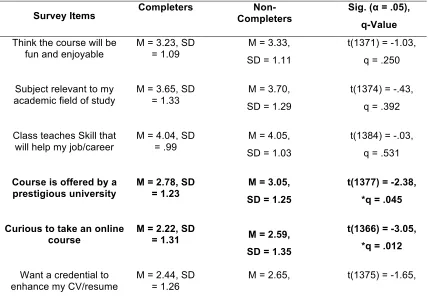
For the first set of questions (Table 1), 5 items were found to be statistically significant: “Course is offered by a prestigious university”, t(1377) = -2.38, q = .0451, “Curious to take an online class”, t(1366) = -3.05, q = .012, “Supplement other university/college class” t(1372) = -2.65, q = .025, “Geographically isolated from educational institutions”, t(1369) = -2.07, q = .049, and “Cannot afford to pursue a formal education”, t(1371) = -2.08, q = .045. For all five of these items (see Table 1 below), non-completers gave higher ratings than completers. Interestingly, all the above-mentioned items besides “Supplement other
college/university class” did not connect to respondents’ knowledge or interest in the specific content area of the course. They all addressed the features of MOOCs as a new learning medium. For example, “Course is offered by a prestigious university”, and “Cannot afford to pursue a formal education” address the unique opportunity afforded by the MOOC platform, whereas “Curious to take an online class” and “Geographically isolated from educational institutions” involve features common to all online learning platforms. As such, students who were motivated by the opportunities of online courses and/or MOOCs in specific were less likely to complete this MOOC.
Table 1.
Comparison of MOOC-Specific Motivational Items. Boldface indicates items with statistically significant differences between completers and non-completers
Survey Items Completers Completers Non- Sig. (α = .05), q-Value
Think the course will be fun and enjoyable
M = 3.23, SD = 1.09
M = 3.33, SD = 1.11
t(1371) = -1.03, q = .250
Subject relevant to my academic field of study
M = 3.65, SD = 1.33
M = 3.70, SD = 1.29
t(1374) = -.43, q = .392
Class teaches Skill that will help my job/career
M = 4.04, SD = .99
M = 4.05, SD = 1.03
t(1384) = -.03, q = .531
Course is offered by a prestigious university
M = 2.78, SD = 1.23
M = 3.05, SD = 1.25
t(1377) = -2.38, *q = .045
Curious to take an online course
M = 2.22, SD
= 1.31 M = 2.59,
SD = 1.35
t(1366) = -3.05, *q = .012
Want a credential to enhance my CV/resume
M = 2.44, SD = 1.26
SD = 1.39 q = .111
Supplement other college/university class
M = 1.92, SD = 1.25
M = 2.24, SD = 1.34
t(1372) = -2.65, *q = .025
Extending current knowledge of the topic
M = 4.39, SD = .77
M = 4.34,
SD = .82
t(1381) = .64,
q = .348
Geographically isolated from educational
institutions
M = 1.79, SD = 1.25
M = 2.04,
SD = 1.36
t(1369) = -2.07,
*q = .049
Cannot afford to pursue a formal education
M = 1.95, SD
= 1.24 M = 2.22,
SD = 1.40
t(1371) = -2.08, *q = .045
2 PALS sub-scales
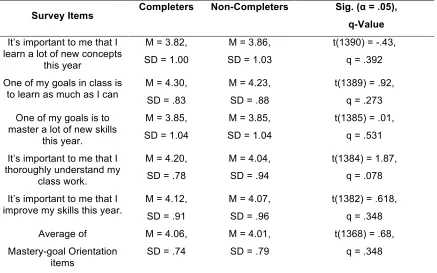
In the second set of questions (Table 2), both scale-level averages and individual items were
investigated. Evaluated as scales, neither the items measuring mastery-goal orientation, nor the items measuring academic efficacy showed significant differences between completers and non-completers. When looking at individual items, only “I'm certain I can master the skills taught in class this year.” had a statistically significant difference between groups. Completers gave higher ratings for this item than non-completers, t(1385) = 2.27, q = .045.
Table 2.
Comparison of PALS Scale Items. Boldface indicates items with statistically significant differences between completers and non-completers
Survey Items Completers Non-Completers Sig. (α = .05), q-Value
It’s important to me that I learn a lot of new concepts
this year
M = 3.82, SD = 1.00
M = 3.86, SD = 1.03
t(1390) = -.43, q = .392
One of my goals in class is to learn as much as I can
M = 4.30, SD = .83
M = 4.23, SD = .88
t(1389) = .92, q = .273 One of my goals is to
master a lot of new skills this year.
M = 3.85,
SD = 1.04
M = 3.85,
SD = 1.04
t(1385) = .01,
q = .531
It’s important to me that I thoroughly understand my
class work.
M = 4.20, SD = .78
M = 4.04, SD = .94
t(1384) = 1.87, q = .078
It’s important to me that I improve my skills this year.
M = 4.12, SD = .91
M = 4.07, SD = .96
t(1382) = .618, q = .348 Average of
Mastery-goal Orientation items
M = 4.06,
SD = .74
M = 4.01,
SD = .79
t(1368) = .68,
I'm certain I can master the skills taught in class
this year.
M = 3.99, SD = .94
M = 3.78, SD = .99
t(1385) = 2.27, *q = .045
I'm certain I can figure out how to do the most difficult
class work
M = 3.86, SD = 1.06
M = 3.68, SD = 1.03
t(1381) = 1.88, q = .078
I can do almost all the work in class if I don't give
up
M = 4.13, SD = .96
M = 4.03, SD = .96
t(1383) = 1.19, q = .223
Even if the work is hard, I can learn it.
M = 4.24, SD = .74
M = 4.11, SD = .89
t(1380) = 1.61, q = .111 Even if the work is hard, I
can learn it.
M = 4.11,
SD = .91
M = 4.02,
SD = .96
t(1379) = 1.06,
q = .250
Average of Academic Efficacy items
M = 4.07,
SD = .81
M = 3.93,
SD = .83
t(1362) = 1.86,
q = .078
Learner self-rating of completion confidence
The third section of the questions (Table 3 and Figure 1) consisted of a single question asking
respondents to assess whether they are likely to complete the course according to the pace set by the instructor. It is worth pointing out that all students had access to the course schedule from the main course page. Therefore the assumption was that all registered students had access to acquire basic course information and requirements prior to joining the course. For this question, the results showed that students taking the pre-course survey who completed the course self-rated higher (M = 7.27, SD = 2.10) than did those who did not complete the course (M = 6.41, SD =2.26), t(1354) = 4.15, q < .001.
Table 3.
Comparison of Students’ Self-Rating on Possibility of Course Completion
Survey Item Completers Non-Completers Sig. (α = .05), q-Value
Self-rated Score in Course Completion
M = 7.27, SD = 2.10 M = 6.41, SD = 2.26 t(1354) = 4.15, **q < .001
Conclusion and Discussion
Although MOOC participants represent a diverse population of learners with a diverse range of motivations, there may be important common features among subgroups of MOOC students. The low retention rate observed across different MOOC platforms is an important phenomenon, and
directions early in a MOOC. Particularly, this present study extended the knowledge of course completers versus learners opting not to complete the course.
Firstly, from the results from of MOOC-specific items (Table 1), it appears that students who are particularly motivated by the new and unique aspects of MOOCs as a new platform of learning are less likely to complete the course according to the pace set by the instructor. As shown in Table1, non-completers rated higher on items such as “Course is offered by a prestigious university”, “Geographically isolated from educational institutions”, and “Cannot afford to pursue a formal education”, when asked their reasons for enrolling in this course. These items address benefits of MOOCs as a platform, regardless of the specific course content area. It is possible that many MOOC participants were first drawn to the platform due to their curiosity about a new platform, or gaining access to previously unavailable materials from a prestigious university in an inaccessible location, rather than being primarily interested in the content area of the course. Since registering for a MOOC on Coursera only requires a single mouse click, many participants who registered for the course might not have thought through whether they will have the suggested amount of time and background to undertake the course. In some extreme cases,
participants who register for a course might actually be clicking a link in an email advertisement, making it easy to press the “join” button without even reading the introduction page for that specific course. While it is commendable that MOOCs make it easy to join a course, it probably does not benefit students or instructors for unprepared students to start (and drop out of) an advanced graduate-level course. The apparent high enrollment is impressive, but the high dropout makes MOOCs look less effective than they are. Thereby, it may be appropriate to ask prospective students to read through the course introduction page before they can access the “join” button, in order to avoid impulsive registrations likely to lead to poor experiences for some students.
Secondly, results from the PALS-scale items implied that mastery-goal orientation and levels of academic efficacy might not serve as useful predictors of whether a learner will successfully complete the course or not (Table 2). Only one out of the 12 items in the two PALS subscales showed a statistically significant effect when comparing completers and non-completers, and neither subscale is significant overall. One way of interpreting the finding about mastery-goal orientation is that there are few differences because students in MOOCs generally have mastery goals. Given the relatively low tangible rewards of this MOOC – little potential for formal credit – it is perhaps unsurprising that most students come to the MOOC with mastery goals. However, the finding for academic efficacy was somewhat surprising, since efficacy is often correlated with learning success. One possible explanation is that the efficacy items chosen were overly general, and there would have been an effect if items had more specifically discussed skills relevant to the course. Bandura (1982) has noted that self-efficacy is often very domain-specific. Evidence for this possibility is shown by the strong relationship between student expectations of course completion, and course completion. Another possibility is that the concept of “course completion” might have a different meaning in a MOOC environment than in other learning contexts. In traditional distance-learning courses, where a student (or someone) pays to take a course and obtain credit, “course
completion’ was adopted as a key and often predominant factor in evaluating both student performance (e.g., Picciano, 2002; Terrell, 2002) and course effectiveness (e.g., Nash, 2005; Aragon & Johnson, 2008). In comparison, “course completion” for MOOCs is only one metric applied in an effort to
understand the learning activities that occurred within and around the course. According to connectivism learning theory, learning activities can be highly fragmented, and many key activities occur outside the main platform (Siemens, 2005). As a result, the difference between completers and non-completers in MOOCs should be interpreted carefully since some of the non-completers might be downloading all learning materials and conducting the entirety of their learning activities outside the Coursera platform, learning all the materials but not officially “completing” the course.
Overall, these results suggest that as Kizilcec and colleagues (2013) hypothesized, the different behaviors seen by different students stem from different goals, which also echoes the essence of connectivism theory that online learners present evolving diversity in the ever-changing landscape of online learning environments (Siemens, 2005). By further studying how motivation influences student outcomes in MOOCs, we can enhance MOOCs to make them more effective for all the learners who choose to use them.
Limitations and Future Directions
The present study explored motivational variables between course completers and non-completers in the context of one MOOC. In considering these findings, it is worth noting that course completion is only one of many metrics that can be used to study persistence and learning in the context of MOOCs. As we develop better measures of other types of success in MOOCs, it will be valuable to connect these to traditional survey measures of student motivation. It has also been noted that MOOCs, as a new learning platform, presents learning and educational variables beyond those seen in conventional learning
environments (Deboer et al., 2014; Whitmer et al., 2014). Many learners conduct educationally-relevant discussions outside of the course provider platform, in private discussion forums, email discussions, and even face-to-face meetings. As such, it is worth noting that not all learning behaviors relevant to success and participation in MOOCs can be fully captured through existing online platforms.
The results found in the present study are suggestive that student interest in content is more important for course completion than student interest in MOOCs. However, since the present study was grounded in the context of only one MOOC, which may be idiosyncratic in various ways, future work should collect and analyze data from different MOOCs across different disciplinary areas and course platforms to determine whether the findings obtained here are general. For instance, it is reasonable to ask whether results may vary between MOOCs on science subjects and humanities subjects, or between more introductory and more advanced MOOCs. Similarly, national and cultural differences may also play a relevant role, which could be studied by analyzing differences between students in multiple populations taking the same MOOCs, and by comparing MOOCs offered in different languages. Additionally, follow-up interviews with students may also inform and enrich findings from the present study.
Acknowledgement
This research was supported by Athabasca University and a Gates Foundation Grant to The MOOC Research Initiative.
References
Ames, C. (1992). Classrooms: Goals, structures, and student motivation. Journal of educational psychology, 84(3), 261.
Ames, C., & Archer, J. (1988). Achievement goals in the classroom: Students' learning strategies and motivation processes. Journal of educational psychology, 80(3), 260.
Ames, C., & Archer, J. (1987). Mothers' beliefs about the role of ability and effort in school learning. Journal of Educational Psychology, 79, 409-414.
Anderson, T. (2013). Promise and/or Peril: MOOCs and Open and Distance Education.
Aragon, S. R., & Johnson, E. S. (2008). Factors influencing completion and noncompletion of community college online courses. The American Journal of Distance Education, 22(3), 146-158.
Baker, R., Walonoski, J., Heffernan, N., Roll, I., Corbett, A., & Koedinger, K. (2008). Why students engage in “gaming the system” behavior in interactive learning environments. Journal of Interactive Learning Research, 19(2), 185-224.
Bandura, A. (1982). Self-efficacy mechanism in human agency. American Psychologist, 37, 122-147.
Bandura, A. (1994). Self-efficacy. John Wiley & Sons, Inc..
Blackwell, L., Trzesniewski, K., & Dweck, C.S. (2007). Implicit theories of intelligence predict achievement across an adolescent transition: A longitudinal study and intervention. Child Development, 78, 246-263.
Belanger, Y., & Thornton, J. (2013). Bioelectricity: A Quantitative Approach Duke University’s First MOOC.
Benjamini, Y., & Hochberg, Y. (1995). Controlling the false discovery rate: A practical and powerful approach to multiple testing. Journal of the Royal Statistical Society, Series B, 57, 289–300. Breslow, L., Pritchard, D. E., DeBoer, J., Stump, G. S., Ho, A. D., & Seaton, D. T. (2013). Studying
learning in the worldwide classroom: Research into edX’s first MOOC. Research & Practice in Assessment, 8, 13-25.
Clayton, K., Blumberg, F., & Auld, D. P. (2010). The relationship between motivation learning strategies and choice of environment whether traditional or including an online
component. British Journal of Educational Technology, 41(3), 349-364. DeBoer, J., Ho, A. D., Stump, G. S., & Breslow, L. (2014). Changing "course":
Reconceptualizing educational variables for massive open online courses. Educational Researcher, 43(2).
Dawson, S. (2006). A study of the relationship between student communication interaction and sense of community. The Internet and Higher Education, 9(3), 153-162.
Carr, N. (2012). The crisis in Higher Education. MIT Technology Review Retrieved from: http://www.technologyreview.com/featuredstory/429376/the-crisis-in-higher-education/ Chen, K. C., & Jang, S. J. (2010). Motivation in online learning: Testing a model of self-determination
theory. Computers in Human Behavior, 26(4), 741-752.
Clow, D. (2013). MOOCs and the funnel of participation. Paper presented at the LAK'13: 3rd International Conference on Learning Analytics & Knowledge, Leuven, Belgium. Retrieved from Retrieved from http://oro.open.ac.uk/36657/1/DougClow-LAK13-revised-submitted.pdf
Coetzee, D., Fox, A., Hearst, M. A., & Hartmann, B. (2014). Should your MOOC forum use a reputation system?. In Proceedings of the 17th ACM conference on Computer supported cooperative work &
social computing (pp. 1176-1187).
Deci, E. L., & Ryan, R. M. ( 1985 ). Intrinsic motivation and self-determination in human behavior. New York: Plenum.
DeWaard, I., Abajian, S., Gallagher, M., Hogue, R., Keskin, N., Koutropoulos, A., & Rodriguez, O. C. (2011). Using mLearning and MOOCs to Understand Chaos, Emergence, and Complexity in Education. International Review Of Research In Open & Distance Learning, 12(7), 94-11 5.
Dweck, C. S. (1986). Motivational processes affecting learning. American psychologist, 41(10), 1040. Dweck, C. S., & Leggett, E. L. (1988). A social-cognitive approach to motivation and personality.
Psychological review, 95(2), 256.
Dweck, C. S. (2010). Mind-Sets and Equitable Education. Principal Leadership,10(5), 26-29.
Elliot, A. J., & Harackiewicz, J. M. (1994). Goal setting, achievement orientation, and intrinsic motivation: A mediational analysis. Journal of personality and social psychology, 66(5), 968.
Elliot, A. J., & Church, M. A. (1997). A hierarchical model of approach and avoidance achievement motivation. Journal of personality and social psychology, 72(1), 218.
Fini, A. (2009). The technological dimension of a massive open online course: The case of the CCK08 course tools. The International Review Of Research In Open And Distance Learning, 10(5).
Guo, P. J., Kim, J., & Rubin, R. (2014). How video production affects student engagement: An empirical study of MOOC videos. In Proceedings of the first ACM conference on Learning@ scale conference
Haggard, S. (2013). The maturing of the MOOC: Literature review of massive open online courses and
other forms of online distance learning [BIS Research Paper No. 130]. London: Department for
Business, Innovation and Skills. Retrieved from
https://www.gov.uk/government/uploads/system/uploads/attachment_data/file/240193/13-1173-maturing-of-the-mooc.pdf
Harter, S. (1978). Effectance motivation reconsidered: Toward a developmental model. Human Development, 1, 661-669.
Hershkovitz, A., de Baker, R. S. J., Gobert, J. D., & Wixon, M. (2011). Goal Orientation and Changes of Carelessness over Consecutive Trials in Science Inquiry. In EDM (pp. 315-316).
Keller, J., & Suzuki, K. (2004). Learner motivation and e-learning design: A multinationally validated process. Journal of Educational Media, 29(3), 229-239.
Heyman, G. D., & Dweck, C. S. (1992). Achievement goals and intrinsic motivation: Their relation and their role in adaptive motivation. Motivation and Emotion, 16, 231-247.
Kizilcec, R. F., Piech, C., & Schneider, E. (2013, April). Deconstructing disengagement: analyzing learner subpopulations in massive open online courses. In Proceedings of the Third International Conference on Learning Analytics and Knowledge (pp. 170-179). ACM.
Knox, J., et al. (2012). MOOC pedagogy: the challenges of developing for Coursera. Association for Learning Technology. Retrieved from: http://newsletter.alt.ac.uk/2012/08/mooc-pedagogy-the-challenges-of-developing-for-coursera/
McAuley, A., Stewart, B., Siemens, G., & Cormier, D. (2010). The MOOC model for digital practice.
Meece, J. L., Anderman, E. M., & Anderman, L. H. (2006). Classroom goal structure, student motivation, and academic achievement. Annual Review of Psychology, 57, 487-503.
Midgley, C., Maehr, M. L., Hruda, L., Anderinan, E.M., Anderman, L., Freeman, K. E., et al. (2000).Manual for the Patterns of Adaptioe Learning Scales (PALS). Ann Arbor: University of Michigan.
MOOC @ Edinburgh 2013 – Report #1 (2013). MOOC @ Edinburgh 2013 – Report #1. University of Edinburgh, Edinburgh, Scotland. Retrieved from
http://www.era.lib.ed.ac.uk/bitstream/1842/6683/1/Edinburgh%20MOOCs%20Report%202013%20% 231.pdf
Moore, M. G., & Kearsley, G. (2011). Distance education: A systems view of online learning. CengageBrain. com.
Muilenburg, L. Y., & Berge, Z. L. (2005). Student barriers to online learning: A factor analytic study. Distance education, 26(1), 29-48.
Nash, R. D. (2005). Course completion rates among distance learners: Identifying possible methods to improve retention. Online Journal of Distance Learning Administration, 8(4).
Nesterko, S. O., Dotsenko, S., Han, Q., Seaton, D., Reich, J., Chuang, I., & Ho, A. D. (2013). Evaluating the geographic data in MOOCs. In Proceedings of the 2013 NIPS Data-Driven Education Workshop. Nicholls, J. G. (1989). The competitive ethos and democratic education. Cambridge, MA: Harvard
University Press.
Pardos, Z.A., Bergner, Y., Seaton, D., Pritchard, D.; In Press (2013) Adapting Bayesian Knowledge Tracing to a Massive Open Online Course in edX. In Proceedings of the 6th International Conference on Educational Data Mining. Memphis, TN.
Pappano, L. (2012). The year of the MOOC. The New York Times, 2(12), 2012.
Picciano, A. G. (2002). Beyond student perceptions: Issues of interaction, presence, and performance in an online course. Journal of Asynchronous learning networks, 6(1), 21-40.
Pintrich, P.L., & Schunk, D. H. (1996). Motivation in education: Theory, research, and application. Englewood Cliffs, NJ: Prentice-Hall.
R Development Core Team (2011). R: A language and environment for statistical computing. R Foundation for Statistical Computing, Vienna, Austria. ISBN 3-900051-07-0, URL http://www.R-project.org/.
Rodriguez, O. (2013). The concept of openness behind c and x-MOOCs (Massive Open Online Courses). Open Praxis, 5(1), 67-73.
Ryan, A. M., Gheen, M. H., & Midgley, C. (1998). Why do some students avoid asking for help? An examination of the interplay among students' academic efficacy, teachers' social–emotional role, and the classroom goal structure. Journal of educational psychology, 90(3), 528.
Ryan, A. M., & Patrick, H. (2001). The classroom social environment and changes in adolescents’ motivation and engagement during middle school. American Educational Research Journal, 38(2), 437-460.
Ryan, R. M., & Deci, E. L. (2000). Self-determination theory and the facilitation of intrinsic motivation, social development, and well-being. American psychologist, 55(1), 68.
Ryan, R. M., & Deci, E. L. (2000). Intrinsic and extrinsic motivations: Classic definitions and new directions. Contemporary educational psychology, 25(1), 54-67.
Sansone, C., Smith, J. L., Thoman, D. B., & MacNamara, A. (2012). Regulating interest when learning online: Potential motivation and performance trade-offs. The Internet and Higher Education, 15(3), 141-149.
Schunk, D. H. (1991). Self-efficacy and academic motivation. Educational psychologist, 26(3-4), 207-231. Seaton, D. T., Reich, J., Nesterko, S. O., Mullaney, T., Waldo, J., Ho, A. D., & Chuang, I. (2014). 6.00 x
Introduction to Computer Science and Programming MITx on edX Course Report-2013 Spring. Retrieved from: http://papers.ssrn.com/sol3/Papers.cfm?abstract_id=2382322
Siemens, G. (2005). Connectivism: A learning theory for the digital age. International Journal of Instructional Technology and Distance Learning, 2(1), 3-10.
Siemens, G. (2006). Connectivism: Learning theory or pastime of the self-amused. Retrieved February, 2, 2008.
Simpson, O. (2013). Supporting students in online, open & distance learning. Routledge.
Veeramachaneni, K., Dernoncourt, F., Taylor, C., Pardos, Z., & O’Reilly, U. M. (2013, June). MOOCdb: Developing Data Standards for MOOC Data Science. In AIED 2013 Workshops Proceedings Volume (p. 17).
Storey, J.D., Taylor, J.E., & Siegmund, D. (2004). Strong control, conservative point estimation, and simultaneous conservative consistency of false discovery rates: A unified approach. Journal of the Royal Statistical Society, Series B, 66(1), 187-205.
Terrell, S. R. (2002). The effect of learning style on doctoral course completion in a Web-based learning environment. The Internet and Higher Education, 5(4), 345-352.
White, R. W. (1959) Motivation reconsidered: the concept of competence, Psychological Review, 78, 44-57.
Whitmer, J., Schiorring, E., & James, P. (2014, March). Patterns of persistence: what engages students in a remedial English writing MOOC?. In Proceedings of the Fourth International Conference on
Yang, D., Sinha, T., Adamson, D., & Rosé, C. P. (2013). Turn on, tune in, drop out: Anticipating student dropouts in massive open online courses. In Proceedings of the 2013 NIPS Data-Driven Education Workshop.
Yuan, L. & Powell, S.(2013). MOOCs and open education: Implications for higher education. Cetis White Paper.
Zimmerman, B. J., Bandura, A., & Martinez-Pons, M. (1992). Self-motivation for academic attainment: The role of self-efficacy beliefs and personal goal setting. American educational research journal, 29 (3), 663-676.
This work is published under a Creative Commons Attribution-Non-Commercial-Share-Alike License