Sn(IV) Compounds Interaction with
Metal-Schiff Base Complexes
M. Mohammadikish
*and Z. Seyedzadeh
Chemistry Department, Faculty of Sciences, Kermanshah Branch, Islamic Azad University, Kermanshah, Islamic Republic of Iran
Received: 1 January 2012 / Revised: 8 February 2012 / Accepted: 18 February 2012
Abstract
The formation constants and Gibbs free energy for the interaction of RnSnClm
(n = m = 2, R = Me, Ph, n-Bu or n = 4, m = 0, R = Ph) compounds as acceptors,
with ML complexes (H2L = N,N'-bis(salicylidene)-2-aminobenzylamine
(salabza-H2) and its derivatives, M = Mn
2+or Zn
2+), as donors in N,N'-dimethylformamide
(DMF) as solvent were studied. These parameters were measured by using UV-vis
spectrophotomety titration for 1:1 adduct formation of the selected complexes at
25 (±0.1) °C in the 200-500 nm regions. The trend of adduct formation constants
between metal Schiff base complexes as donors and tin(IV) as acceptor decreases
as follow:
Me2SnCl2
>
Ph2SnCl2
>
n
-Bu2SnCl2
>
Ph4Sn
[M(5-OMe-salabza)]>[M(salabza)]>[M(5-Br-salabza)]>[M(5-NO2-salabza)]
Zn > Mn
Keywords: Formation constant; Manganese; Schiff base complex; Tin adduct; Zinc
* Corresponding author, Tel.: +98(831)7252218, Fax: +98(831)7252218, E-mail: [email protected]
Introduction
The observation that transition metal Schiff base complexes, [ML] (L = quadridentate Schiff base), can act as neutral donor ligands has been led to several investigations of their intereactions with Lewis acids, specially tin compounds [1-11]. The results of X-ray diffraction analyses show that the square planar geometry of metal in their Schiff base complexes changed to octahedral geometry in the 1:1 adducts and the tin atom in these adducts have trigonal bipyramid, octahedral or pentagonal bipyramid geometries [4,5,7]. Cunningham et al. [5]have shown that the presence of methoxy substituents in the 3,3' positions of the metal salicylaldimine ligands markedly alters the nature of the
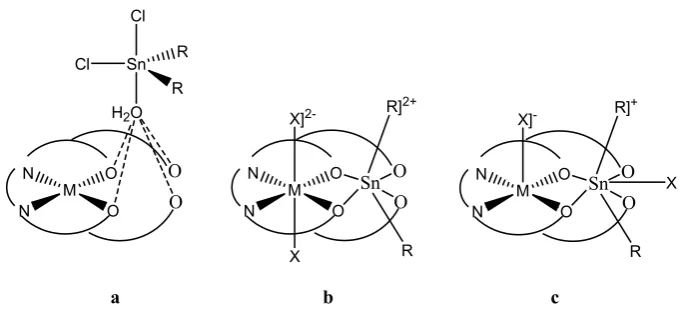
addition complexes that they form with diorganotin(IV) Lewis acids and generally two types of complexes may be resulted. When the linking of the salicylaldimine fragments is a two carbon atom chain such as ethylene group, aqua adducts of the diorganotin(IV) species are formed, with the donor water molecule held to the metal salicylaldimine complex by hydrogen bonding interactions, as shown schematically in Fig. l(a). When the chain contains three or four carbon atoms, diorganotin cations (SnR2)2+ or (SnR2X)+ (X = halogen
or pseudohalogen) are generated, the tin atom of which in all cases lies in the plane of, and engages in donor bond formation with, the four Schiff- base oxygen atoms, as shown in Figures l(b) and (c).
M N
N O
O
O O Sn
R]+
R X]
-X M
N
N O
O
O O Sn
R]2+
R X]
2-X M
N
N O
O
O O
Cl Sn
R R Cl
H2O
a b c
Figure 1. Schematic representation of the structures of the adducts from the reactions of SnR2X2 (R = organo group; X = halide,
thiocyanate, or nitrate) with divalent metal (M) 3-methoxysalicylaldiimine complexes. Dotted lines signify hydrogen bonding interactions [5]. When the linking of the salicylaldimine fragments is (a) two (b) and (c) three or four carbon atom chain.
with diorganotin(IV)dichloride and triorganotin(IV) dichloride have been investigated by Ng et al. [9,10] In these adducts, vanadyl oxygen acts as a donor atom and tin center as acceptor has trigonal bipyramid geometry.
Inada et al. [11] have been determined the stability constants of complex formation between Cu(Salen) and metal(I, II) ion in acetonitrile. Also, the equilibrium data have been reported for interaction of Ni(II) Schiff base complexes with alkaline earth metals in acetonitrile solution [12].
However, apart from the data of previous works by Asadi et al. [13-18], equilibrium data are lacking, and the range of stability constants for such adduct has not been established. This paper describes thermodynamic studies of novel 1:1 adduct formation of organotin compounds (Me2SnCl2, Bu2SnCl2, Ph2SnCl2 andPh4Sn)
as acceptors with M(II)-salabza Schiff base complexes (salabza-H2 =
N,N'-bis(salicylidene)-2-aminobenzyla-mine and its derivatives, M = Mn, Zn) as donors in DMF solvent. By comparing the thermodynamic properties of M(II) Schiff base complexes, we aimed to investigate the effects of different electronic and steric behaviors.
Materials and Methods
Salicylaldehyde, 5-methoxysalicylaldehyde, 5-bro-mosalicylaldehyde, 5-nitrosalicylaldehyde, 2-aminoben-zylamine, Mn(OAc)2.4H2O, Zn(OAc)2.2H2O, Ph2SnCl2,
Me2SnCl2, n-Bu2SnCl2, Ph4Sn, methanol, chloroform,
N,N'-dimethylformamide were purchased from Fluka, Aldrich, Alfa Aesar or Acros and used without further purification. The electronic absorption spectra were recorded using a Rayleigh UV-1600 spectrophotometer.
Synthesis of Schiff Base and Metal Complexes
The synthesis of the salabza-H2 ligands was achieved
by Schiff base condensation of a diamine with the app-ropriate aldehyde according to literature method [19].
The metal complexes used in this study were readily prepared by reaction of salabza-H2 with M(OAc)2.nH2O
in the molar ratio of 1:1 in reflux conditions according to previously published method [19].
Molar Ratio Method
For the purpose of performing the the molar ratio method [20], a series of solutions were prepared in which the complex concentration (1×10⁻⁴M) has kept
constant, while that of the organotin concentration (5×10⁻⁶ –2×10⁻⁴M) has been varied for covering the
molar ratios [Sn]/[ML] = 0.0–2.0. The spectra of all prepared solutions have been recorded within the wavelength range 200–500 nm. The relationship between the specific absorbance and molar ratio ([Sn]/[ML]) for the different formed complexes in solution is plotted.
Equilibrium Measurements
The adducts were obtained from the reaction of acceptors with donors, according to equation 1:
RnSnClm + M(L) RnSnClm∙M(L)
n = m = 2, R = Me, Ph, n-Bu or
n = 4, m = 0, R = Ph (1)
M = Mn(II), Zn(II)
A solution of each M(II) Schiff base complex in DMF with concentration about 10-4M was prepared. In a
typical measurement, 3 mL of this solution was transferred into the thermostated cell compartment of the UV-visible instrument, which was kept at constant temperature (25°C) by circulating water and was titrated by excess of the organotin compounds. The titration was performed with addition of aliquots of the titrant with a Hamilton µL syringe to the M(II) Schiff base complex.
The absorption measurements were carried out at various wavelengths where the difference in absorption was the maximum after the equilibrium was achieved. The formed adduct shows absorption different from the donor, while the acceptor shows no absorption at these wavelengths. As an example, the variation of the electronic spectra for [Zn(5-Br-salabza)].2H2O, titrated
with Me2SnCl2 at 25°C in DMF was shown in Figure 2.
The isosbestic points show that there is only one reaction in equilibrium. The same procedure was followed for other systems.
Results and Discussion
Electronic Spectra
The electronic spectra of the Schiff bases in solution show a relatively intense band in the 260−262 nm
region assigned to π–π* transitions that overlapped with n–π* electronic transitions, and a low intensity absorption in the 316–355 nm which can be ascribed to the transition within the whole molecule essentially as intramolecular charge transfer (CT) interaction. Complexation with M(II) results in significant changes of the spectra between 300–450 nm which can be ascribed to MLCT bands [19].
Upon interaction of metal complexes with organotin, the original absorption of metal Schiff-base complexes changed and new peaks appeared (Fig. 2). Changes in electronic spectra show that formation of adducts causes a blue shift in the MLCT transition. The clear isosbestic points in Figure 2 represent adducts formation in solution.
Stoichiometry Evaluation, Formation Constants and Gibbs Free Energy Interpretations
Molar ratio (MR) [20] method to evaluate the stoichiometry of adducts in solution have been applied. It is evident that, the relationship obtained for the MR method are characterized by one breakdown located at the molar ratio [Sn]/[ML] equals to 1. This indicates that the stoichiometry ratio of the complexes in solution is 1:1 (Sn:ML).
The thermodynamic parameters are useful tools to study the interactions between donor and acceptor species and understand the relative stability of the formed adduct. The formation constant of the metal complexes with organotin compounds were calculated using the well-known SQUAD program [21,22], which was designed to calculate the best value for the formation constant of the proposed equation model (Eq. 1) by employing a non-linear, least-squares approach. Also the free energy change ΔG° of the complexes formed were calculated from ΔG° = –RT ln K at 25°C.
In continuing of previous studies [13-18], we elucidated the steric and the electronic effects of a number of metal Schiff base complexes, and the organotin(IV) compounds, on the formation constant and the Gibbs free energy of the adduct formation. The results showed that the interaction between donors and acceptors depends on the type of the Schiff bases, metals and the organo groups on the tin(IV). It is useful to mention that, Sn(IV) compounds are Lewis acids with free coordination sites, and the reaction with Lewis bases leads to electronic and steric saturation of Sn center. According to the literature, all of these compounds are organotin aqua adducts with donor water molecule engaged in hydrogen bonding interactions with the phenolic oxygen atoms of the divalent metal Schiff base [4,5,8].
Previously, it has been shown that in nonpolar and weakly polar solvents such as chloroform and anisole, the water molecule stay coordinated in the adduct formed (Fig.1a); but in polar solvents such as methanol and DMF, the tin atom can directly coordinate the phenolic oxygen of the donor (Fig. 1b) [15].
Figure 2. Spectrophotometric titration of [Zn(5-Br-salabza)].2H2O (1×10⁻⁴M) with various amounts of
Me2SnCl2 (5×10⁻⁶–2×10⁻⁴M) in DMF at 25°C.
0 0.2 0.4 0.6 0.8 1 1.2 1.4
320 340 360 380 400 420 440 460 480 500
λ (nm)
Abs
Table 1. The formation constants, Kav(L.mol–1), for metal Schiff base complexes with organotin compounds in DMF solvent at 25°C
Me2SnCl2 Ph2SnCl2 Bu2SnCl2 Ph4Sn [Zn(5-OMe-salabza)].CH3OH 5.06 (±0.01) 4.66 (±0.01) 4.27 (±0.01) 2.81 (±0.02)
[Zn(salabza)].2H2O 4.53 (±0.03) 4.45 (±0.02) 4.22 (±0.01) 2.78 (±0.08) [Zn(5-Br-salabza)].2H2O 4.44 (±0.11) 4.31 (±0.01) 4.19 (±0.07) 2.65 (±0.08) [Zn(5-NO2-salabza)].2CH3OH 3.99 (±0.06) 3.45 (±0.11) 3.32 (±0.05) 2.45 (±0.05) [Mn(5-OMe-salabza)].2CH3OH 4.98 (±0.07) 4.60 (±0.08) 4.10 (±0.06) 2.80 (±0.01) [Mn(salabza)].2H2O 4.49 (±0.05) 4.14 (±0.04) 4.00 (±0.08) 2.74 (±0.01) [Mn(5-Br-salabza)].2H2O 4.39 (±0.08) 4.11 (±0.08) 4.00 (±0.07) 2.27 (±0.02) [Mn(5-NO2-salabza)].H2O 3.73 (±0.02) 3.37 (±0.05) 2.98 (±0.02) 2.19 (±0.08)
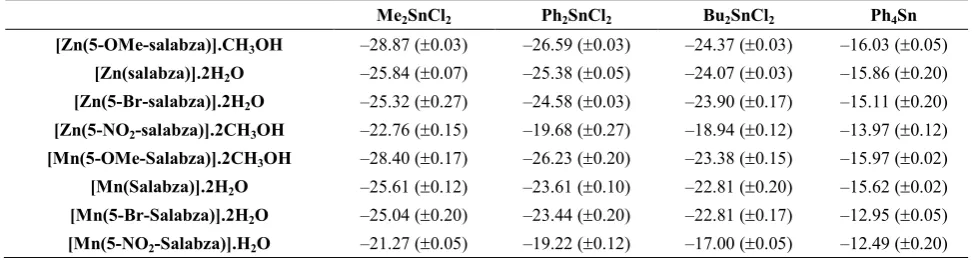
Table 2.ΔG°av, (kJ.mol–1), values for metal Schiff base complexes with organotin compounds in DMF solvent at 25°C
Me2SnCl2 Ph2SnCl2 Bu2SnCl2 Ph4Sn
[Zn(5-OMe-salabza)].CH3OH –28.87 (±0.03) –26.59 (±0.03) –24.37 (±0.03) –16.03 (±0.05) [Zn(salabza)].2H2O –25.84 (±0.07) –25.38 (±0.05) –24.07 (±0.03) –15.86 (±0.20) [Zn(5-Br-salabza)].2H2O –25.32 (±0.27) –24.58 (±0.03) –23.90 (±0.17) –15.11 (±0.20) [Zn(5-NO2-salabza)].2CH3OH –22.76 (±0.15) –19.68 (±0.27) –18.94 (±0.12) –13.97 (±0.12) [Mn(5-OMe-Salabza)].2CH3OH –28.40 (±0.17) –26.23 (±0.20) –23.38 (±0.15) –15.97 (±0.02) [Mn(Salabza)].2H2O –25.61 (±0.12) –23.61 (±0.10) –22.81 (±0.20) –15.62 (±0.02) [Mn(5-Br-Salabza)].2H2O –25.04 (±0.20) –23.44 (±0.20) –22.81 (±0.17) –12.95 (±0.05) [Mn(5-NO2-Salabza)].H2O –21.27 (±0.05) –19.22 (±0.12) –17.00 (±0.05) –12.49 (±0.20)
The Acceptor Properties of Organotin Compounds
Four organotin compounds i.e. dimethyltin dichloride, dibutyltin dichloride, diphenyltin dichloride and tetraphenyltin have been examined in this work. The electronic and the steric factors can govern the formation process of adducts.
The following trend of acidic strength has been shown by Colton et al. [23]: SnCl4 > RSnCl3 > R2SnCl2
> R3SnCl > R4Sn. Replacing of an electron withdrawing
chloride by electron donating methyl group compen-sates some of electron deficiency of the central tin(IV) atom and makes it a weaker Lewis acid. On the other hand, referring to the reported equilibrium constants for interaction of trialkyltin(IV) chlorides with pyrazine, we can see a good instance for influence of steric effect of alkyl groups on adduct stabilities [24]: Me2SnCl2 >
Et2SnCl2 > n-Pr2SnCl2 > n-Bu2SnCl2. By increasing in
steric effect of the organo group, the steric hindrance is increased. This parameter decreases the approaching of the acceptor and the donor and decreases the adduct formation. These two factors administrate the acceptor properties of the central tin atom.
On the basis of what has been described above, the trend of adducts formation of Sn(IV) compounds toward
metal(salabza), as is confirmed by ∆G° (25°C) and Kav
(25°C) values, is as follow (Tables 1 and 2): Me2SnCl2> Ph2SnCl2>n-Bu2SnCl2> Ph4Sn
It is clear that the electron withdrawing groups (Ph) on the tin center makes Ph2SnCl2 a stronger Lewis acid
but steric hindrance of two bulky phenyls led to decrease of K values with respect to Me2SnCl2. This
trend also indicates that replacing the methyl by a more bulky butyl group on the organotin(IV) compound causes the weakening of the interactions. The butyl group can affect the interaction in two ways; a more bulky butyl group makes adduct formation unfavorable because of its greater steric hindrance than the methyl group [24]. On the other hand, butyl groups have better electron releasing properties to reduce the acid strength of the organotin(IV) Lewis acid. Ph4Sn has the lowest
formation constants due to existence of four bulky phenyl groups.
Donor Properties of the Metal(II) Schiff Base Complexes
The Effect of the Substitution on Ligands
Tables 1 and 2 shows the following trend for the formation constants and Gibbs free energies:
[M(5-OMe-salabza)] > [M(salabza)] > [M(5-Br-salabza)] > [M(5-NO2-salabza)]
In the para-substituted Schiff-base ligands, the stability constants (K) varies with electronic effects of the substituents at positions 5,5′. Thus, the stability constants decrease according to the sequence OMe > H > Br > NO2. The more electron realising groups on the
ligands makes it a strong Lewis base and therefore the increase in formation constant can be seen. Similar results have been reported previously for electrochemical properties of analogous Cu(II), Ni(II), V(IV), and Co(III) systems [25-27].
Metal Effect
Zn(salabza) and Mn (salabza) complexes were selected to study the metal effect in the adduct formation between the divalent transition metal-salabza complexesandorganotin(IV)compounds(Tables1and 2). On the basis of the results, the formation constants for the adducts of M(salabza) complexes follow the below sequence:
Zn > Mn
In the studied systems, metal complexes act as donor species. By increasing the π-back bonding character of the metal atoms the donor ability of complexes were increased. Zn2+ complex with fully occupied d orbitals
(d10 system), has low tendency to accept π–donation
from ligands and has more ability to give π–back bond, therefore Zn complexes have higher formation constants than Mn complexes.
Although both of the Zn and Mn have low electron affinities, the value of electron affinity for Zn(–47 kJ/mol) is lower than Mn (0). The more electron affinity of central metal atom leads to decrease of donor properties of complexes and so decrease of adduct formation.
Acknowledgments
We are grateful to Islamic Azad University-Kermanshah branch for financial support. We also would like to thank Dr. M. Masteri-Farahani for his useful suggestions.
References
1.Srivastava, T. N. Chauhan, A. K. S. Agarwal, M.
Transition metal schiff base chelates as ligands for phenyltin(IV) chlorides. Trans. Met. Chem. 3: 378-379
(1978).
2.Cunningham, D. Fitzgerald, J. Little, M. Transition Metal Schiff-base Complexes as Ligands in Tin Chemistry. Part 1. A Tin-119 Mossbauer Spectroscopic Investigation of the Adducts SnX4.ML, SnMe2(NCS)2. ML, and SnRCl3.ML (X = Halide; M = CuII or NiII; L = Quadridentate Schiff-base Ligand; R = Phenyl or n-Butyl). J. Chem. Soc., Dalton Trans. 2261-2266 (1987).
3.Cunningham, D. McGinley, J. Transition Metal
Schiff-base Complexes as Ligands in Tin Chemistry. Part 2. A Tin-119 Mossbauer Spectroscopic Investigation of the Adducts SnBunxCl3-x,(OR).ML (x = 0 or 1; R = H or Alkyl; M = CuII or NiII; L = Quadridentate Schiff-base ligand). J. Chem. Soc., Dalton Trans. 1387-1391 (1992). 4.Cunningham, D. Gallagher, J. F. Higgins, T. McArdle, P.
McGinley, J. O'Gara, M. Transition-metal Schiff-base Complexes as Ligands in Tin Chemistry. Part 3. An X-Ray Crystallographic and Tin-119 Mossbauer Spectroscopic Study of Adduct Formation Between Tin(IV) Lewis Acids and Nickel 3-Methoxy-salicylaldimine Complexes. J. Chem. Soc., Dalton Trans. 2183-2190 (1993).
5.Clarke, N. Cunningham, D. Higgins, T. McArdle, P.
McGinley, J. O'Gara, M. Transition metal Schiff-base complexes as ligands in tin chemistry IV. Reactions of triphenyltin chloride with complexes and the molecular structures of [SnPh3Cl.H2O]-[Ni(3-MeOsall,3pn).H2O] (1:1) and [SnPh,Cl.H2O]-Ni(3-MeOsall,3pren) (1:1) [H23-MeOsall,3pn = N,N'-bis( 3-methoxysalicylidene) propane-1,3-diamine]. J. Organomet. Chem. 469: 33-40 (1994).
6.Clarke, B. Cunningham, D. Gallagher, J. F. Higgins, T.
McArdle, P. McGinley, J. NiCholchfiin, M. Sheerin, D. Transition-metal Schiff-base complexes as ligands in tin chemistry. Part 5. Structural studies of intimate ion-paired heterobimetallic complexes of tin(IV) and nickel, copper or zinc with 3-methoxysalicylaldimine ligands. J. Chem. Soc. Dalton Trans. 2473-2482 (1994).
7.Boyce, M. Clarke, B. Cunningham, D. Gallagher, J. F.
Higgins, T. McArdle, P. NiCholchuin, M. O'Gara, M. Transition-metal Schiff-base complexes as ligands in tin chemistry Part 6. Reactions of diorganotin(IV) dinitrates with M(3MeO-sall,3pn)[[M = Ni, Co or Zn; H23MeO- sall, 3pn = N,N'-bis(3-methoxysalicylidene)-propane-l,3-diamine]]. J. Organomet. Chem. 498: 241-250 (1995).
8.Clarke, B. Clarke, N. Cunningham, D. Higgins, T.
McArdle, P. NiCholchuin, M. O’Gara, M. Transition-metal Schiff-base complexes as ligands in tin chemistry. Part 7. Reactions of organotin(IV) Lewis acids with [M(L)]2[M = Ni, Cu and Zn; H2L = N,N'-bis(3-methoxysalicylidene)benzene-1,3-diamine and its -1,4-diamine analog]. J. Organomet. Chem. 559: 55-63 (1998). 9.Choudhary, N. F. Hitchcock, P. B. Leigh, G. J. Ng, S. W.
1:1 Adducts of triphenyltin chloride with oxovanadium(IV) tetradentate Schiff-base complexes. Inorg. Chim. Acta 293: 147-154 (1999).
10.Ng, S. W.
[Bis(N,N-dimethylthiocarbamoylthio)acetato-O]triphenyl(quinoline N-oxide-O)tin. Acta Crysallogr.,
Sect. C 53: 274-276 (1997).
formation between N,N'-ethylenebis(salicylideneiminato) copper(II) and metal(II,I) ions in acetonitrile. Inorg. Chim. Acta, 358: 3009-3014 (2005).
12.Carbonaro, L. Isola, M. Pegna, P. L. Senatore, L.
Marchetti, F. Spectrophotometric Study of the Equilibria between Nickel(II) Schiff-Base Complexes and Alkaline Earth or Nickel(II) Cations in Acetonitrile Solution. Inorg. Chem. 38: 5519-5525 (1999).
13.Asadi, M. AeinJamshid, Kh. Kyanfar, A. H. Nickel(II)
salophen-type complexes characterization and their thermodynamic studies with diorganotin(IV) dichlorides in chloroform. Trans. Met. Chem. 32: 822-827 (2007).
14.Asadi, M. AeinJamshid, Kh. ; Kyanfar, A. H. Synthesis
and thermodynamic studies of the dinuclear adducts between dimethyltin(IV) dichloride with SalenH2 and MII(Salen) complexes in chloroform. J. Coord. Chem. 61: 1115-1126 (2007).
15.Asadi, M. AeinJamshid, Kh. Kyanfar, A. H.
Thermodynamic Studies of the Interaction of Nickel(II) Schiff Base Complexes with Diorganotin (IV) Dichlorides in Non‐Aqueous Solvents. Synth. Reac. Inorg. Met-Org. NanoMet. Chem. 37: 77-83 (2007).
16.Asadi, M. AeinJamshid, Kh. Kyanfar, A. H. Synthesis,
characterization and equilibrium study of the dinuclear adducts formation between nickel(II) Salen-type complexes with diorganotin(IV) dichlorides in chloroform. Inorg. Chim. Acta 360: 1725-1730 (2007).
17.Aein Jamshid, Kh.; Asadi, M.; Kianfar. A. H. Synthesis, characterization and thermal studies of dinuclear adducts of diorganotin(IV) dichlorides with nickel(II) Schiff-base complexes in chloroform. J. Coord. Chem. 62: 1187-1198 (2009).
18.Kianfar, A. H. MosallaNejad, M. Thermodynamic study of
dinuclear adducts between copper(II) Salen-type complexes and organotin(IV) chlorides in acetonitrile. J.
Coord. Chem. 62: 3232-3242 (2009).
19.Asadi, M. Mohammadikish, M. Mohammadi, Kh.
Metallation of tetradentate N2O2 Schiff base with Mn(II), Co(II), Cu(II) and Zn(II): synthesis, characterization and formation constants measurement. Cent. Eur. J. Chem. 8: 291-299 (2010).
20.Yoe, J. H. Jones, A. L. Ind. Eng. Chem. Anal. Ed. 16
(1944).
21.Leggett, D. L. Computational Methods for the
Determination of Formation Constant, New York, Plenum Press, (1958).
22.Dey, D. K. Saha, M.K. Gielen, M. Kemmer, M.
Biesemans, M. Willem, R. Gramlich, V. Mitra, S. Synthesis, spectroscopy and structure of
[N-(2-carboxyphenyl)salicylideneiminato]dimethyltin(IV). J.
Organomet. Chem. 590: 88-92 (1999).
23.Colton, R. Nieks, D. D. Tin-119 NMR studies on
diorganoyltin(IV)dihalides and triorganoyltin(IV)halides; Formation and stereochemistry of adducts. Inorg. Chim. Acta 148: 31-36 (1988).
24.Yoder, C. H. Mokrynka, D. Coley, S. M. Cotter, J. C.
Haines, R. E. Grushow, A. Spencer, J. N. Stoichiometry of diorganotin dihalide adducts in solution. Organometallics 6: 1679-1684 (1987).
25.Sarvestani, A. H. Salimi, A. Mohebbi, S. Hallaj. R.
Synthesis, Spectroscopy and Electrochemistry of Cobalt(III) Schiff Base Complexes. J. Chem. Res. 3: 190-193 (2005).
26.Sarvestani, A. H. Mohebbi. S. Spectroscopy and
electrochemistry of cobalt(III) salophen complexes. J. Chem. Res. 4: 257-260 (2006).
27.Jager, E. G. Schuhmann, K. Gorls. H. Syntheses,
![Figure 2. Spectrophotometric titration of [Zn(5-Br-salabza)].2H2O (1×10⁻⁴M) with various amounts of MeSnCl (5×10⁻⁶–2×10⁻⁴M) in DMF at 25°C](https://thumb-us.123doks.com/thumbv2/123dok_us/25555.2002837/3.595.315.541.523.686/figure-spectrophotometric-titration-salabza-various-amounts-mesncl-dmf.webp)