1. Introduction
Forest management practices, such as timber har-vesting and off-road timber transportation, have the potential to cause detrimental levels of soil and site disturbances (Kozlowski 1999, Najafi and Solgi 2010, Labelle and Jaeger 2011, Naghdi et al. 2015). The grow-ing mechanization of forest operations combined with higher machine payload increases the magnitude of soil compaction, resulting in a decrease in soil macro-porosity (i.e., cavities larger than 0.08 mm in diameter) (Berli et al. 2004, Frey et al. 2009, Solgi et al. 2015a, Solgi et al. 2015b). This decrease, thereby, reduces the rate of exchange of air, water, and solutes (Greacen and Sands 1980, Botta et al. 2007).
In forest operations, the use of dry bulk density as a measure of estimating soil compaction is common (Pires et al. 2005a). Soil dry bulk density is defined as the mass of dry soil particles in a unit volume of soil (Craig 2004). During compaction, solid particles do not
change in volume, but are subject to rearrangement, which may be accompanied by bending of clay plate-lets, changes in the shape of organic matter, and break-ing of bonds (Soane and Van Ouwerkerk 1994).
Many studies presented and compared methods to quantify soil bulk density with both modern and con-ventional sampling procedures (Pires et al. 2005a, Timm et al. 2005). One of the conventional and stan-dard sampling methods used in the majority of studies is the volumetric ring method (Grossman and Reinsch 2002). Standard dimensions and construction material of the volumetric ring are used by some researchers. However, the method is highly dependent upon the specific location where the sample is taken (Lestarin-ingsih et al. 2013). This method is susceptible to error arising from compression and vibrations or shattering of the core, while the cylinder is inserted into the soil profile with external force. According to Pires et al. (2005a), there is a tendency of compaction near the cylinder walls and in the top and the bottom regions
Comparison of Sampling Methods Used
to Evaluate Forest Soil Bulk Density
Ahmad Solgi, Ramin Naghdi, Eric R. Labelle, Petros A. Tsioras, Ali Salehi
Abstract
The objective of this study was to compare forest soil bulk density values obtained through conventional sampling methods such as the volumetric ring (VR: diameter 5 cm, length 10 cm) and paraffin sealed clod (PSC), with a variation of the VR, where rectangular boxes (RB) of four different dimensions were used. Sampling transects were established on a machine oper-ating trail located in a beech (Fagus orientalis Lipsky) stand in Northern Iran. At each transect, three soil samples were collected at three different locations. Samples from different methods were spaced by a 50 cm distance to avoid direct interactions. The soil class of our study area was Combisols according to the WRB classification with a clay texture. Soil bulk density differed significantly between the three sampling methods. The lowest values were obtained with the RB (average 1.25 g cm-3), followed by the VR (average 1.40 g cm-3), and lastly the PSC (average 1.52 g cm-3). The values obtained with four variations of the RB method ranged from 1.22 to 1.28 g cm-3 and were not found significantly different. When soil bulk density was calculated after the removal of the weight and volume of roots included in the samples, the values were determined to be higher than before but with the same range of magnitude. The lowest coefficient of variation was found for RB4 (CV=2.3%), while the high-est values were observed for VR and RB1 (CV=5.7%).
of samples taken with the volumetric ring method. Thus, the risk of sample compression increases with decreasing core diameter (Soane and Van Ouwerkerk 1994). Freitag (1971) suggested that the diameter should be selected to give an adequate sample size and that the length should be no more than three times the diameter.
In the forest, trees have high root volumes that oc-cupy the soil space, in particular the topsoil. Under such circumstances, the estimation of bulk density by means of a cylinder is becoming a very difficult pro-cess. Parts of tree roots are often included in the core sample, making the sampled soil quantity unsuitable for further analysis. Therefore, a large number of sam-ples must be collected with this method in order to have the required statistical validity of the results, a prerequisite that increases sampling cost.
Another conventional soil sampling method is that of the paraffin sealed clod. In this method, the clod is weighted and its volume is determined by coating it in paraffin wax and immersing it in a volumenometer (Soane and Van Ouwerkerk 1994). The next step in-cludes removal and weighing of the wax. Reliable measurements can be performed especially on cohe-sive soils, but the method remains time-consuming as care has to be taken to ensure that the wax coats do not penetrate the soil pore system. Van Remortel and Shields (1993) reported that the penetration of some paraffin into the pores of the clods, reduced their mea-sured volume, resulting in higher soil bulk density values.
Apart from the conventional methods, modern methods such as computed tomography and nuclear moisture and density gauge have been introduced to forest soil bulk density measurements (Petrovic et al. 1982, Timm et al. 2005, Labelle and Jaeger 2011). These methods are advantageous in many aspects; the com-puted tomography provides a detailed analysis of soil bulk density variation along a sample, while the nu-clear moisture and density gauge allows for repeated measurements of an identical area without extracting and destructing the soil sample (Timm et al. 2005, Labelle and Jaeger 2011). Despite these important ad-vantages, the cost of this specific equipment can be prohibitive, especially in the case of developing coun-tries and as such the computed tomography and the nuclear moisture and density gauge methods were not targeted during our study. In this view, the rationale behind this research effort was to improve our knowl-edge on the use of rectangular boxes of different di-mensions as an alternative to the widely-used sam-pling cylinders of the volumetric method. Samples were collected with the volumetric ring, paraffin
sealed clod and rectangular box methods, and the re-spective soil bulk density values were compared with the aim of assisting future research endeavours on the choice of the more appropriate method.
2. Materials and Methods
2.1 Site description
The study was conducted in compartment 41 of the third district of Shenrood forest, Guilan Province, northern Iran (between 36°31′56″ N and 36°32′11″ N latitude and 51°47′49″ E and 51°47′56″ E longitude). The forest is comprised predominantly of oriental beech (Fagus orientals Lipsky) with an average canopy cover of 80%, stand density of 170 trees ha-1, mean tree
diameter at breast height of 29.7 cm, and mean tree height of 22.9 m. The study area has an elevation of approximately 800 m above sea level and a northerly aspect. The average annual rainfall recorded at the closest national weather station situated about 20 km away from the research site is 970 mm. The maximum mean monthly rainfall of 120 mm usually occurs in October, while the minimum rainfall of 25 mm occurs in August. The mean annual temperature is 15 °C, with the lowest values recorded in February. At the time of skidding, weather conditions were dry and warm with an average soil moisture content of 210 g kg-1 (21%).
The soil class of our study area in soil classification according to WRB was Combisols. Soil texture in the studied machine operating trail was determined based on particle-size analysis using the Bouyoucos hydrom-eter method (Kalra and Maynard 1991) and was clas-sified as clay (Table 1).
Table 1 Soil particle size distributions at different depths of the skid trail
Horizon Depth, cm Sand, % Silt, % Clay, %
A 0–15 26 26 48
B 15–55 23 28 49
C 55–85 21 29 50
The range of particle size in Table 1 was 0.05–2 mm, 0.002–0.05 and <0.002, for sand, silt, and clay, respec-tively. Soil texture in all three depths was clay.
forest road on machine operating trails in flat terrain. Traffic frequency of the loaded skidder was twelve passes.
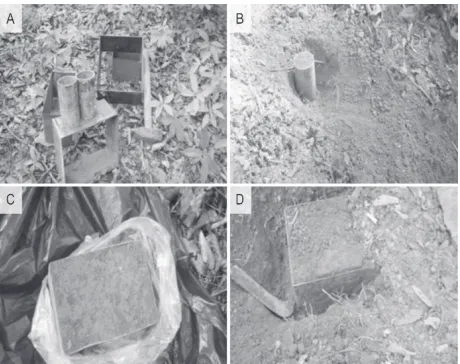
2.2 Experimental design and data collection Soil bulk density was measured with three differ-ent methods. The first method of the volumetric ring (hereafter VR) has been extensively used and could be considered as the standard method of soil bulk den-sity measurement. The volumetric ring was made from 1.5 mm thick stainless steel with an inside diam-eter of 5 cm and a length of 10 cm (Fig. 1).
The second method made use of paraffin sealed clods (hereafter PSC). The sampling procedure in this case consisted of excavating the soil surface down to a depth of 10 cm with a spade. The removed soil clod was wrapped in a plastic film directly after sampling to
avoid water loss, and care was taken during the trans-portation to minimize alterations in the clod structure. The third method referred to the use of a rectangu-lar box (hereafter RB) as a means for collecting soil samples. This method resembles the VR, with the ex-ception of the shape of the sampling device (Fig. 1). Four rectangular boxes with different dimensions (RB1: length 20 cm, width 20 cm, height 10 cm, RB2: length 20 cm, width 15 cm, height 10 cm, RB3: length 20 cm, width 10 cm, height 10 cm, and RB4: length 15 cm, width 10 cm, height 10 cm) were used in our study. All rectangular boxes were made from 1.5 mm thick steel. The characteristics of these rectangular boxes are giv-en in Table 3.
Table 3 Inside dimensions of rectangular boxes
Rectangular box
Thickness[a]
mm
Length cm
Width cm
Height cm
RB1 1.5 20 20 10
RB2 1.5 20 15 10
RB3 1.5 20 10 10
RB4 1.5 15 10 10
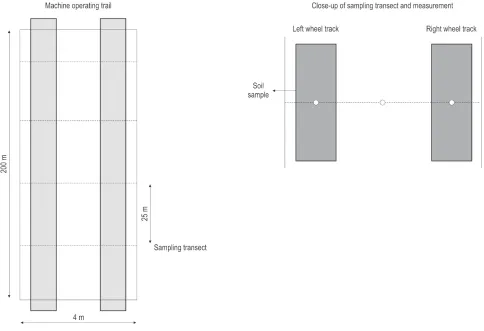
In order to compare the above mentioned methods, a 200 m longitudinal segment was chosen inside the beech stand, along which samples were taken from the soil surface layer (0–10 cm). More specifically, soil samples were collected from eight sampling transects each separated by 25 m and aligned perpendicular to the 200 m long segment. At each transect, 18 samples (three for each method including the different varia-tions of RBs) were collected at three different locavaria-tions: on the left track, between tracks, and on the right track (Fig. 2). Volumetric ring, clod, and rectangular boxes samples were spaced 50 cm apart to create a buffer zone, thus avoiding possible interactions. A total of 144 soil samples were collected for the analysis.
At the time of sampling (VR and RBs methods), we placed a piece of wood flush on one of the extremity of the rings and boxes and then we inserted those into the soil by hitting the piece of wood with a hammer. Using a piece of wood prevented damaging the top of rings and boxes as to maintain their shape and volume correctly. After extracting the rings and boxes from the soil with minimal disturbance to their contents, the soil samples were trimmed flush with the ring and box end and extruded into plastic bags for transportation to the laboratory. Immediately after sampling, the samples were brought to the laboratory and were
Fig. 1 Different sampling methods used in the study A: Rectangu-lar Boxes and Volumetric Rings; B: Volumetric Rings; C and D: Rect-angular Boxes
Table 2 Technical details of the rubber-tired skidder Timberjack 450 C
Specifications Timberjack 450C
Weight, kg 10,257
Number of wheels 4
Tire size, mm 775x813
Ground pressure, kPa 221
Engine power, hp 177
Year of manufacture 1998
promptly weighed. Soil samples were dried in an oven at 105 ºC (24 h) to obtain the dry weight value. The water content in the soil samples was measured grav-imetrically after drying in an oven. However, due to the large amount of wet soil mass in the rectangular boxes, dry soil weight was counted based on a sub-sampling method in which approximately 300 g of wet soil contained in a rectangular box was measured in the laboratory and oven-dried at 105 ºC (24 h) to obtain the dry weight value (Lestariningsih et al. 2013). For each sample originating from a rectangular box, wet weight and volume of tree roots were determined in a laboratory.
Soil bulk density value from volumetric ring was computed using Eq. (1):
ρ = d
d c
W
V (1)
Where:
ρd dry bulk density, g cm-3
Wd mass of dry soil, g
Vc volume of soil cores, 196.25 cm3.
Uncorrected bulk densities from rectangular boxes were computed with Eq. (2):
(
)
(
)
ρ
− −
+
=
t b r wc
d
t 1
W W W S
V (2)
Corrected bulk densities (for root correction) from rectangular boxes were computed with Eq. (3):
(
)
(
)
(
)
ρ
− −
+
=
− t b r
wc
d
t r
1
W W W S
V V (3)
Where:
ρd dry bulk density, g cm-3
Wt total mass of rectangular box and soil from the
field, g
Wb mass of rectangular box, g
Wr mass of wet root, g
Swc soil water content, g g-1
Vt volume of apparatus, cm-3
Total soil porosity was computed with Eq. (4): ρ
= − ×
d
1 100
2.65
AP (4) Where:
AP total porosity, %
ρd dry bulk density (g cm-3), and 2.65 (g cm-3) is the
assumed particle density (Najafi et al. 2009).
2.3 Statistical Analysis
Mean values of soil physical properties of each method were compared to those in other methods us-ing Tukey’s HSD test (Zar 1999). One-way ANOVA (significance test criterion a≤0.05), included in the SPSS statistical package version 11.5, was used to com-pare the soil physical properties among the different methods. Paired t-tests were used to analyze soil bulk density data from the »without« and »after« root cor-rection among RBs methods at an a level of 0.05.
3. Results and Discussion
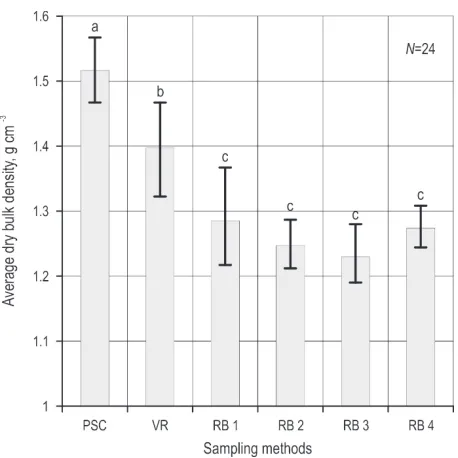
In the context of the study, soil bulk density values were used as indicator of soil compaction in an oriental beech stand. This forest species was chosen because of its importance in the Hyrcanian forest area in Iran, where it covers 16.5% (245 372 ha) of the total forested area and represents approximately 25% of the wood harvested annually (Sagheb Talebi et al. 2014). How-ever, it should be noted that oriental beech has a high density of roots that are located near the soil surface, which increased difficulty during the soil sampling pro-cess. The post-hoc Tukey test showed that the average values of PSC, VR, and RB differed statistically. How-ever, this was not the case in the RBs, where measure-ment differences were not statistically significant (Fig. 3). The lowest soil bulk density values were obtained with the RBs in the range of 1.22 to 1.28 g cm-3 (average 1.25 g cm-3)
and the highest with the PSC method (1.52 g cm-3). The
average bulk density value of the VR (1.40 g cm-3) was
11.7% higher than that of RBs and 8.7% lower than that of PSC. This result is in line with Lestariningsih et al. (2013), who also obtained lower soil bulk density values compared to the VR for box dimensions similar to our RB1 configuration. Pires et al. (2004) showed that the VR method induces changes in soil structure during sampling procedures, mainly for small soil samples, causing under- and over-estimated bulk density values. These modifications in bulk density occur due to com-paction close to the cylinder walls and, in some cases, at the top and bottom regions of the soil sample. The same problem was observed by Pires et al. (2005b) while working with different soil samplers.
Comparing the sample area can lead to some inter-esting results. The surface area of VR is 19.63 cm2,
while in the RB method it increases from 150.00 cm2
(RB4) up to 400.00 cm2 (RB1). Higher bulk density
val-ues in VR could be partly explained by the increased vibration and compression forces associated with this sampling technique and the effect of sampler walls on samples of smaller area. However, this trend has not been verified when comparing the various RB sam-ples. RB1 and RB4 had higher average soil density values than RB2 and RB3. Thus, more research is need-ed to clarify the reason for this and possibly define the optimum dimensions for the RB method.
The PSC samples were found to be more compact-ed than those of the VR, confirming the observations made by Van Remortel and Shields (1993) and Timm et al. (2005). Both studies suggest that bulk density obtained with the PSC method are, in general, higher than those collected with the VR method, due to some paraffin penetration into the pores of the clod, causing a reduction of the volume measurement.
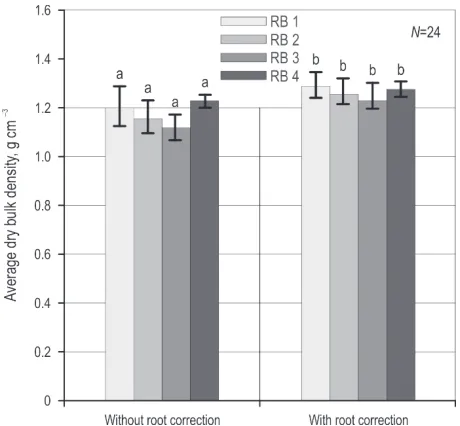
In rectangular box methods, when root correction is included (the volume and weight of roots included in the samples were subtracted from the total soil sample size and soil compaction was calculated based on the new data), bulk density values measured with volumetric rings and paraffin sealed clods continue to be higher than those obtained with rectangular boxes
(Table 4). Comparison of the bulk density values by means of the paired sample t-test showed that there was a significant difference between bulk density be-fore and after root correction among the same sam-pling methodologies (Fig. 4). Similar results have been reported by Lestariningsih et al. (2013).
The spatial variability of soil bulk density values, with an error pattern, along the 200 m longitudinal segment for the various sampling methods is
present-ed in Fig. 5. Table 5 presents average soil bulk density values determined by each method, the respective standard deviations and coefficients of variation (CV). Soil bulk density values obtained by the RB4 method present the smallest variation in relation to the average value (CV=2.3%), while that obtained by the VR and RB1 methods demonstrated the highest variation (5.7% in both cases). Variation in both methods is at low levels, especially considering the sample size. Sta-tistical analysis revealed that standard deviation value was significantly different between samples from dif-ferent methods with p<0.05. Standard deviation of soil
Table 4 Percentage differences between measurements of various RB dimensions, PSC and VR (comparison of soil bulk densities mea-sured with six sampling methods (N=24))
With root correction
RB1[c] PSC
[a] VR[b]
15.6% 8.3%
RB2 18.5% 11.5%
RB3 19.6% 12.7%
RB4 16.4% 9.2%
Without root correction
RB1 21.1% 14.3%
RB2 24.3% 17.7%
RB3 26.2% 19.8%
RB4 20.8% 13.9%
[a] Paraffin Sealed Clod; [b] Volumetric Ring; [c] Rectangular Boxes
Fig. 4 Average soil dry bulk density before and after root correction for rectangular box methods (means followed by a different letter are significantly different at p=0.05, error bars indicate standard deviations)
Fig. 5 Distribution of soil dry bulk density values along 200 m lon-gitudinal segment determined by different sampling methods, error bars indicate standard deviations
Table 5 Average soil bulk density values determined by the six different methods and respective standard deviations and coeffi-cients of variation (N=24)
Methods Dry bulk density g cm-3
Standard deviation g cm-3
Coefficient of variation
%
PSC 1.52a 0.04 2.6
VR 1.39b 0.08 5.7
RB1 1.28c 0.07 5.7
RB2 1.23c 0.06 4.8
RB3 1.22c 0.06 4.9
bulk density values from VR was higher than PSC and RB1 values indicating a larger heterogeneity in the VR samples. This larger heterogeneity could have been induced during the sampling procedure through modifications in soil structure caused by a limited vol-ume of soil sample inside the cylinders, as shown by Pires et al. (2004).
Also, our results showed that the standard devia-tion of soil bulk density values from the PSC samples were equal to those obtained with the RB1 method. Our finding is similar to that of Timm et al. (2005), who reported a coefficient of variation of 5.9% for soil den-sity values obtained with the volumetric ring method. Soil bulk density values were obtained for each method using Eq. (4), since for the PSC and VR meth-ods the bulk density values were higher, and conse-quently the total porosity estimates along the segment were smaller (on average 35% and 46%, respectively). The highest total soil porosity values were obtained with the RBs in the range of 51.76% to 54.27% (on aver-age 52.85%) and the lowest with the PSC method (35.52%), which, according to Kiehl (1979), is within the range of mineral soil porosity variations, usually from 40% to 60%. The average total soil porosity value of the VR (46.13%) was 14.6% lower than that of RBs and 29.8% higher than that of PSC, respectively. This fact shows the importance of the choice of the method for the determination of soil bulk density.
4. Conclusion
In our study, we compared the well-established method of volumetric ring to that of paraffin sealed clod and four rectangular boxes of varying dimensions under forest conditions. Statistical differences in soil dry bulk density have been found between the three general methods but not among the four rectangular boxes, indicating substantial differences between the three general methods. While the volumetric ring is the most commonly used methodology and is sup-ported by a large amount of international literature, there is evidence that it can overestimate soil dry bulk densities due to increased compaction and vibrations during the sampling process, in particular with small-er-sized cylinders.
The rectangular box method yielded promising results when used in the conditions (soil texture, water content and root size/density) observed at our study site. However, these results need to be tested in other conditions, such as different soil texture, soil moisture content, soil depth and soil organic matter content, before drawing general conclusions or giving recom-mendations.
5. Reference
Berli, M., Kulli, B., Attinger, W., Keller, M., Leuenberger, J., Flühler, H., Springman, S.M., Schulin, R., 2004: Compaction of agricultural and forest subsoils by tracked heavy construc-tion machinery. Soil Till Res 75(1): 37–52.
Botta, G., Pozzolo, O., Bomben, M., Rosatto, H., Rivero, D., Ressia, M., Tourn, M., Soza, E., Vazquez, J., 2007: Traffic al-ternatives in harvest of soybean (Glycine max L.): effect on yields and soil under direct sowing system. Soil Till Res 96(1–2): 145–154.
Craig, R.F., 2004: Soil Mechanics. Seventh edition. Spon press. British Library Cataloguing in Publication Data, 95 p. Freitag, D.R., 1971: Methods of measuring soil compaction. In: K.K. Barnes, W.M. Carleton, H.M. Taylor, R.I. Throckmor-ton and G.E. Vanden Berg (Editors), Compaction of Agricul-tural Soils. Am. Soc. Agric. Eng., St. Joseph, MI, USA, 47–103. Frey, B., Kremer, J., Rüdt, A., Sciacca, S., Matthies, D., Lüscher, P., 2009: Compaction of forest soils with heavy logging ma-chinery affects soil bacterial community structure. Eur J Soil Biol 45(4): 312–320.
Greacen, E.L., Sands, R., 1980: Compaction of forest soils: a review. Aus J Soil Res 18(2): 163–189.
Grossman, R.B., Reinsch, T.G., 2002: Bulk density and linear extensibility. In: Dane JH, Topp C, Co-editors. Method of soil analysis part 4 physical methods, Madison, Wisconsin: Soil Sci Soc Am Inc, 201–228.
Jourdan, C., Rey, H., 1997: Architecture and development of the oil-palm (Elae isguineensis Jacq.) root system. Plant Soil 189(1): 33–48.
Kalra, Y.P., Maynard, D.G., 1991: Methods and manual for forest soil and plant analysis. Forestry Canada, Re NOR-X-319. Northern Forestry Center, 125 p.
Kiehl, E.J., 1979: Manual de edafologia. São Paulo: Agronômi-ca Ceres, 262 p.
Kozlowski, T.T., 1999: Soil compaction and growth of woody plants. Scand J For Res 14(6): 596–619.
Labelle, E.R., Jaeger, D., 2011: Soil compaction caused by cut-to-length forest operations and possible short-term natural rehabilitation of soil density. Soil Sci Soc Am J 75(6): 2314– 2329.
Lestariningsih, I.D., Widianto, K.H., 2013: Assessing soil com-paction with two different methods of soil bulk density mea-surement in oil palm plantation soil. Proc Environ Sci 17: 172–178.
Naghdi, R., Solgi, A., Zenner, E.K., 2015: Soil Disturbance Caused by Different Skidding Methods in North Mountain-ous Forests of Iran. Inter J For Eng 26(3): 212–224.
Najafi, A., Solgi, A., Sadeghi, S.H., 2009: Soil disturbance fol-lowing four-wheel rubber skidder logging on the steep trail in the north mountainous forest of Iran. Soil Till Res 103(1): 165–169.
Pires, L.F., Arthur, R.C.J., Camponez Do Brasil, R.P., Cor-rechel, V., Bacchi, O.O.S., Reichardt, K., 2004: The use of gamma ray computed tomography to investigate soil com-paction due to core sampling devices. Braz J Phys 34(3A): 728–731.
Pires, L.F., Pilotto, J.E., Timm, L.C., Bacchil, O.O.S., Reichardt, K., 2005a: Qualitative and quantitative analysis of soil sam-ples by computerized tomography. Publ UEPG Ci Exatas Terra Ci Agr Eng Ponta Grossa 11(2): 7–15.
Pires, L.F., Arthur, R.C.J., Bacchil, O.O.S., 2005b: Assessment of soil sample quality used for density evaluations through computed tomography, International Nuclear Atlantic Con-ference – INAC 2005, Santos, SP, Brazil, August 28 to Septem-ber 2, 5 p.
Sagheb Talebi, K., Sajedi, T., Pourhashemi, M., 2014: Forests of Iran a treasure from the past, a hope for the future. Plant and Vegetation. Volume 10. ISBN 978-94-007-7370-7 (Print) 978-94-007-7371-4 (Online), 143 p.
Soane, B.D., Van Ouwerkerk, C., 1994: Soil Compaction in Crop Production. Developments in Agricultural
Engineer-ing Series, vol. 11. Elsevier Science, Amsterdam, Nether-lands, 643 p.
Solgi, A., Naghdi, R., Tsioras, P.A., Nikooy, M., 2015a: Soil compaction and porosity changes caused during the opera-tion of Timberjack 450C skidder in northern Iran. Cro J For Eng 36(2): 77–85.
Solgi, A., Naghdi, R., Nikooy, M., 2015b: Effects of skidder on soil compaction, forest floor removal and rut formation. Madera y Bosques 21(2): 145–153.
Petrovic, A.H., Siebert, J.E., Lieke, P.E., 1982: Soil bulk den-sity analyses in three dimension by computed tomographic scanning. Soil Sci Soc Am J 46(3): 445–450.
Timm, L.C., Pires, L.F., Reichardt, K., Roveratti, R., Oliveira, J.C.M., Bacchi, O.O.S., 2005: Soil bulk density evaluation by conventional and nuclear methods. Aust J Soil Res 43(1): 97–103.
Van Remortel, R.D., Shields, D.A., 1993: Comparison of clod and core methods for determination of soil bulk density. Commun Soil Sci Plant Ana 24(17–18): 2517–2528.
Zar, J.H., 1999: Biostatistical analysis, 4th edition, Prentice Hall, Upper Saddle River, NJ, USA, 662 p.
Received: June 27, 2017 Accepted: December 12, 2017
Authors’ addresses: Ahmad Solgi, PhD.
e-mail: [email protected] Prof. Ramin Naghdi, PhD.* e-mail: [email protected] Assoc. prof. Ali Saleh, PhD. e-mail: [email protected] Department of Forestry
Faculty of Natural Resources University of Guilan P.O. Box 1144
Sowmeh Sara Guilan IRAN
Assist. prof. Eric R. Labelle, PhD. e-mail: [email protected]
Department of Ecology and Ecosystem Management Technische Universität München
Hans-Carl-Von-Carlowitz-Platz 2 85354 Freising
GERMANY Tsorias A. Petros
e-mail: [email protected] Laboratory of Forest Utilization
Faculty of Forestry and Natural Environment Aristotle University of Thessaloniki
GR-54124 Thessaloniki GREECE