Semnan University
Journal of Heat and Mass Transfer Research
Journal homepage: http://jhmtr.journals.semnan.ac.irConstructal design of tree-shaped conductive pathways for
cooling a heat generating volume
Mohammad-Reza
Ebrahimnataj, Mahdi Sahebi
*Department of Mechanical Engineering, Qom University of Technology (QUT), Qom, Iran.
P A P E R I N F O A B S T R A C T
Paper history:
Received: 2017-02-05 Received: 2018-05-15 Accepted: 2018-05-16
Constructal design is used to study heat removal from a square heated body with a tree shaped high thermal conductivity pathways embedded in the body. The objective is to minimize the defined maximum dimensionless temperature difference for the body. The thermal conductivity of the body is low, and there is a uniform heat generation on it. The volume of the body is fixed. The amount of high conductivity material for building the pathways are also fixed, but their length and diameter are variable. The effect of parameters such as the angle among the pathways, number of pathways, thermal conductivity coefficient, dimensionless area fraction and different length ratios are investigated. The results show that by optimizing the angle among the pathways, the operation of them improves up to %12. By increasing the number of blades, dimensionless temperature difference decreases, but the best heat removal would be achieved when the pathways place along the direction of the diagonal of the square body, since, as the simulations show, the maximum temperature in the body occurs at the corners of the square.
DOI: 10.22075/jhmtr.2018.10481.1144
Keywords:
Constructal theory; Heat removal; Tree-shaped pathways; Heat generating body.
© 2018 Published by Semnan University Press. All rights reserved.
1.
Introduction
The constructal theory which has engrossed many researchers, has unleashed a huge wave of new design based on the natural sciences and nature. For instance, the design that exists in nature does not form haphazardly, but it improves access to flow through time. Generally, this theory tends to minimize the flow resistance in the system. The constructal theory states that in a system with limited dimensions, in order to minimize the flow resistance and stability system with time, it must evolve in a direction having easier access to stream [1-10].
Bejan’s constructal theory has been employed to explain deterministically how configurations in nature have been spontaneously generated, from inanimate rivers to animate designs with respect to vascular tissues and social organization [1,2,3,11].
It is worth to mention that the constructal design is not an optimization method; however, sometimes it can be utilized with an optimization method [12-13]. It is used to declare the problem, indicating the objective function, the
*Corresponding Author: M. Sahebi, Department of Mechanical Engineering, Qom University of Technology (QUT), Qom, Iran. Email: [email protected]
constraints and the problem degrees of freedom. A special feature of this method is that the effect of each degree of freedom must be studied successively [14]. The constructal design has also been applied successfully to the cooling of electronic devices by conductive heat transfer based on different thermal tree constructs [15].
Rocha et al. [16] studied the problem of connecting the heat generation volume to a point heat sink with finite high conductivity blades which have inserted inside the body. They showed that the distribution of high conductivity blades in optimal configuration has a tree shape.
heat conduction [10-20]. The results indicated that when the complexity of the control volume increases, the heat resistance does not always decrease. Also, there is an optimal complexity corresponding to the minimum heat resistance.
One of the most substantial variables to enhance the thermal performance is the configuration of high thermal conductivity pathways. One of these configurations is the Y-shaped conductive pathways investigated by Horbach et al. [21]. They found that for small and large values of high thermal conductivity pathways, the best configuration was belonged to Y and V shapes, respectively. Generally, among the typical configurations, the V-shaped pathways remarkably surpass the performance of some basic configurations already mentioned in literature [22].
Lorenzini et al. [23] studied the X-shaped conductive pathway for cooling a heat generating body and showed that for a large value of area fraction and high conductivity material, the X-shape configuration has a 51% better performance antithesis of I-shape model.
Lorenzini et al. [24] also investigated the non-uniform X-shaped pathways which have a variable angle among blades and compared their result with the uniform X-shaped pathways with a fixed angle among blades. They found that the performance of the optimized non-uniform pathways is approximately 10% better than the uniform one with equivalent length and thickness.
Lorenzini et al. [25] studied the influence of the X-shaped cavities and pathways that penetrate into a solid conducting wall. They demonstrated that when the value of dimensionless thermal conductivity tends to infinity, the X-shaped conductive pathways have the same heat removal capacity as the X-shaped cavities. Also, various shapes of such blades have been examined by the researchers. Feng et al. [26] studied the “+” shape cavities, Hajmohammadi [27] evaluated the ψ shape cavities and Lorenzini et al. [28] focused on the I shape cavities. All have obtained an optimal state of pathways in order that maximum heat transfer in their specific bondary conditions achieved. Moreover, some other researchers, [29] have investigated the open cavities shaped trapezodial solid in the round electronic devices in order to find the best shape by which the maximal access to temperature is minimized. They figured out that using Genetic Algorithm (GA) was well successful to find the best shapes which minimizes the maximal excess of temperature with a number of simulations strongly lower than that required by exhaustive studies [30].
In the present study, the problem of cooling a square heat generating volume as an electronic device, with a tree-like high conductivity insert is considered. The main purpose of this study is to minimize the maximum non-dimensional temperature difference of heat generating volume. To do this, the effect of some parameters such as the number of inserted tree-like branches, the thermal conductivity of blade material, area fraction and the blade dimensionless length parameter on the thermal resistance is investigated. The objective is to optimize the radial
blades number and geometry (L1/L0, n,
) with respect to minimizing the thermal resistance.2.
Model description
The problem which is shown in Fig. 1, consists of a square body with a uniform heat generation which acts as a working electronic device. The body is two-dimensional. There are some high thermally conductive materials, Kp, intercalated inside the wall to remove the generated heat. The wall has low thermal conductivity and generates uniform heat at the volumetric rate
/// 3 ( / )
q W m . The
body is insulated on its boundary. The heat current ///
(q AW) removed from the body into the heat sink which
is located in the rim at the end of tree caber at T0
temperature. The length of the wall and the branches are presented in dimensionless form (L1/L0). The angle among
the blades and the angle between blades and tree caber are supposed
as shown in Fig.1.According to constructal design, in order to solve these types of problems, some constraintsare needed. Eq. (1) is one of the constraints which is the wall area.
2
AL , L=H (1) In the above equation, L is the length and H is the height of the body. The other constraint is the total area of high heat conduction pathways, which can be calculated by Eq. (2).
2 1
0 0 1 1 180 (2)
4 tan( )
p
nD
A D L nD L
n
In the above formula, n is the number of insert blades, D0
is the diameter of the tree caber, D1 is the diameter of
pathways, L0 is the length of tree caber and L1 is the length
of pathways. Since the materials with high thermal conductivity are usually so expensive, a cost criterion called area fraction is defined in order to control and optimize the construction expenditures. It is the ratio of the high
conductivity area to the remained are of the heated body and is given by Eq. (3):
2
0 0 1 1 180 1
4 tan( )
p p
A n
D L nD L D
A
n
(3)Eq. (4) is the governing differential equation for the two dimensional steady-state with uniform heat generation in low thermal conductive body which is given as below.
2 2
2 2 1 0
x y
(4) Where is the dimensionless temperature. Eq. (5) is differential equation of steady-state heat conduction without heat generation in high thermal conductive material:
2 2
2 2 0
x y
(5) The equations with dimensionless variables is given by as follow:
0
T
T
q A
k
(6)max min
max
T
T
q A
k
(7)0 1 0 1
0 1 0 1
, , , , ,
, , , , , x y L L D D
x y L L D D
L
(8)
p p
K K
K
(9)
Which K and Kp are the thermal conductivity of the
body and pathways respectively.
The external surfaces of the wall are completely insulated and their related boundary conditions are given by Eq. (10):
0
(10) A small isothermal area which has the minimum temperature of the system is considered as a heat sink. The boundary condition which is associated with the heat sink is given by Eq. (11):
min
0
b bT
T
q A
k
(11)The non-dimensional temperature difference defined by Eq. (7) which has been specified numerically by solving Eq. (4) and Eq. (5), is to obtain temperature field.
3.
Results and discussions
In this section, the numerical analysis results of the problem of cooling a heated body with high thermal conductivity pathways are presented. The governing equations, (4) and (5), are partial differential equations with no analytical solution. It is subjected to the described boundary conditions and geometries. Equations (4) and (5), subject to their boundary conditions, are solved
numerically using MATLAB PDE-Tools toolbox finite element code. An unstructured non-uniform triangular mesh is used in the numerical solution. The mesh size independence is performed by successive refinements, until the convergence criterion is satisfied. Following this procedure, about 10000 grids were used in the solution.
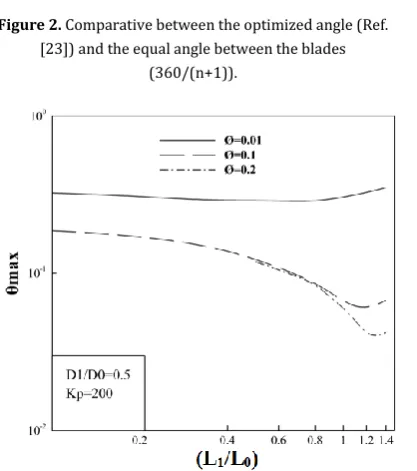
Whereas the paths of heat conduction are like a tree network, the amount of the angle among these pathways has a determinant role at the value of heat conduction. Therefore, prior to starting the main problem, the problem related to angle among the pathways is discussed to find the angle by which the thermal resistance minimizesIn order to answer this question, some numerical stimulation should be done considering the angle among the pathways as an independent variable. Regarding the fact that, if the thermal conduction pathways being designed in a way that the accessibilities of the pathways to all hot spots become uniform, better heat transfer will be achieved. So, it seems that, if the angle among the blades being considerd equal to each other, it will be close to the optimal state. Thus, the angle among the thermal conduction pathways is assumed equal to (360/n+1) degree, where n is the number of pathways with high thermal conductivity coefficient. In order to investigate the validity of the discussed analysis, the obtained result with explained hypothesis is compared to the results of [23]. In [23], the angle among the blades was considered constant and equal to 90 degrees so that the angle between blades and tree caber is set to 45 degrees. Also, number of blades in different states of the stimulation is considered constant and equal to four. Finally, the problem which was probed in reference [23] is repeated by considering the same situation and just with this difference that the angle among the thermal conduction pathways is set to (360/n+1). By considering the number of blades (n=4), the angle among the pathways is counted to 72 degrees.
Fig. 2 shows the effect of blade length ratio (L1/L0)
regarding the explained hypothesis on the dimensionless temperature difference and compares it with the results of [23]. As it could be seen from Fig. 2, if the angle among the pathways being counted to (360/n+1) degree, the dimensionless temperature difference would be decreased in comparing to the results of Ref. [23]. The reason that can be associated to this behavior, is the more uniform distribution of the pathways in the new design, and subsequently more uniform temperature distribution on the surface of the heated body. The maximum of decrease in this study is approximately 12% and occurs in Kp=200,
0.1and (D
1/D0=0.5).
Since the equal angle among the heat conduction pathways causes more uniform temperature distribution, all the subsequent simulations are carried out with this assumption. By studying the heat generating bodies, different parameters are effective in determination of the dimensionless temperature difference. One of these parameters is the ratio of the blade length to the length of tree caber (L1/L0). As generally known, heat transfer
conductivity blades. But regarding that, the blades with high thermal conductivity coefficients usually made from expensive materials. Consequently, it is important to design the length of high thermal conductivity pathways in a way that optimum state of heat transfer and cost is achieved. Fig. 3 shows the effect of the blade length ratio to the length of tree caber (L1/L0) in different area fractions
for the four blade cases. As seen in Fig. 3, by increasing
the length ratio (L1/L0), the dimensionless temperature
difference in different area fractions firstly decreases and then increases. By increasing the ratio of length (L1/L0),
the accessibility of the pathways to all regions of the heated surface would increase. Simultaneously, the diameter of the pathways of heat conduction decreases. These two factors act conversely to each other. In the case of low area fraction 0.01, the diameter of pathways is initially low. In this case, increasing the length ratio firstly leads to reducing the dimensionless temperature. But, since the length ratio is enlarged and diameter is decreased, dimensionless temperature would be increased. So, it could be possible to find an optimal state for length ratio. In other area fraction in the surveying surface, the process is mostly decreasing and the optimum state occurs later.
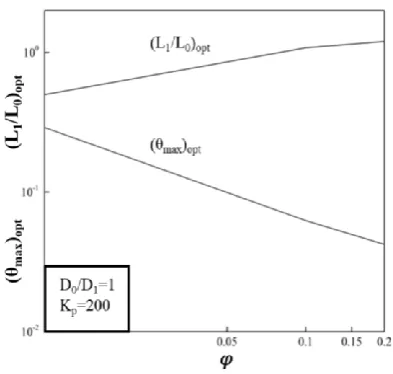
Optimal result of dimensionless temperature difference (max opt) and the length ratio of the blade (L1/L0)
which are calculated in Fig. 3 as a function of area fraction
, are summarized in Fig. 4. The figure shows that if the
area fraction, , increases from 0.01 to 0.2, the dimensionless maximum excess of temperature difference decreases approximately 85%. Actually when “the area fraction” increases, the ratio of the surface of the pathways to the surface of the body increases. It means that there is more surface with high thermal conductivity to remove the heat from the body.
As a result, there is more heat transfer and the maximum temperature of the body decreases. Also, by increasing the area fraction, the blade length ratio (L1/L0) increases.
As a result, there is more heat transfer and the maximum temperature of the body decreases. Also, by increasing the area fraction, the blade length ratio (L1/L0) increases.
As a result, there is more heat transfer and the maximum temperature of the body decreases. Also, by increasing the area fraction, the blade length ratio (L1/L0) increases.
The studies about cooling a square heat generating body using heat conduction pathways were limited up to 4 blades [23-25]. The heat was removed from the surface of the body by these blades and evacuates in heat sink. When the heat conductivity pathways set to 4, there is a huge gap between the blades. Thus, many parts of the heat generating body would not be affected by the heat evacuation pathways. As a result, it is better that the number of heat conduction pathways increases to expose more surface of the body at the action of the pathways. Whereas heat conduction pathways were built up from high conductivity materials which are typically so
expensive, the increase of the number of blades increases the cost of constructal design. Thus, the increase of the number of blades is considered in a fixed area fraction. Fixing the area fraction indicates that the total area of pathways is fixed and as a result, the cost of implementing high conductivity materials is constant. In investing the effect of the number of blades, it is supposed that the (L1/L0) ratio is constant and equal to 1. The ratio of
L1/L0)is used to investigate the length effect instead. Also,
increasing the number of blades in a fixed area fraction and length ratio, decreases the diameter of the blades.
Fig. 5 shows the effect of the number of blades and length ratio on the maximum dimensionless temperature difference
max at different length ratios, ( L1/L0). Asshown in Fig. 5, by increasing the length ratio (L1/L0) at
the fixed blade number (n), dimensionless temperature difference decreases. The reason of this problem can be explained as follows.
Figure 2. Comparative between the optimized angle (Ref. [23]) and the equal angle between the blades
(360/(n+1)).
Figure 3. the effect of length ratio, L1/L0, on the dimensionless temperature difference in different area
Increasing the length ratio, (L1/L0), because of the
fixed area fraction, the area of whole heat conduction pathways does not change. But, the diameter of the blades decreases and the length of blades increases. Decreasing the diameter of blades means decreasing the cross section area of the pathways.
Also, increasing the length of blades means there is more accessibility for heat conduction pathways to hot regions. Because the spots with high temperature occur on the corners of the body, longer blades have more access to such regions. Thus, the effect of increasing the length overcomes the effect of decreasing the diameter of the pathways. Consequently, better heat conduction is achieved at higher (L0/L) ratios. For example, by
increasing the length ratio, (L0/L), from 0.25 to 0.4 for
n=4, the dimensionless temperature difference,
max, 56% decreases. The percentage of decreasing of the dimensionless temperature difference,
max, for n=7 at the same condition is approximately 43. Also, it could be seen from Fig. 5 that, by increasing the number of blades at the constant area fraction, the dimensionless temperature difference,
max, generally decreases. The physical reason of this can be explained as follows. Since the angles among the blades are equal to each other, increasing the number of blades means increasing the area of the heated body which is under the influence by the heat conduction pathways. In fact, by this action, more area of heated body is in contact with heat conduction pathways. Therefore, heat transfer facilitates and the maximum temperature difference decreases. In addition, by increasing the number of blades, the hot spot regions do not concentrate at certain areas on the body and more uniform temperature distribution is achieved. As a result, the trend of dimensionless temperature difference
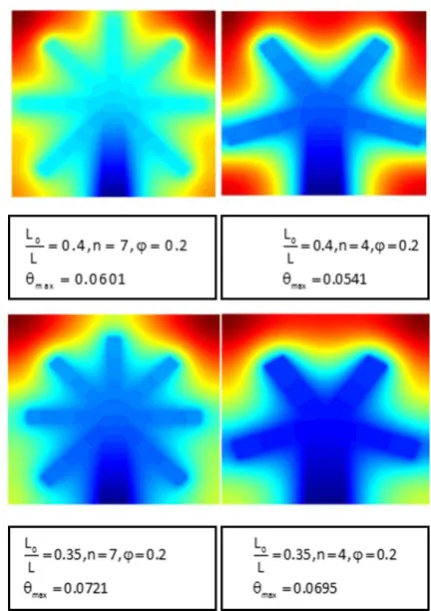
max is decreasing by increasing the number of blades without considering exceptional points. The maximum value of this decreasing is counted to over 19% in situation that (L0/L=0.4) and the number of blades increase from 3 to 8.There are two exceptional points in each diagram which do not follow the mentioned trend. In these two exceptional points,
max, is less than the expected value. These two points are related to the cases in which the number of heat conduction pathways is equal to 4 and 7. In seeking the reason of this behaviour, the contors of the temperature distribution over the body are considered.Fig. 6 shows the temperature distribution for the two exceptional points i.e. n=4 and n=7. When the number of blades is equal to the exceptional points, the angle among the blades is considered in a way that the blades place along the direction of the diagonal of the square body. As mentioned earlier, the spots of maximum temperature are located in the corner of the heat generating body. In this state, blades have the most accessibility to these points and they are perpendicular to isotherm lines (Fig. 6). Thus, in this state, more heat is removed from the surface of the body, and the dimensionless temperature difference is minimized.
Figure 4. The optimal configurations and performance of fig. 3
Figure 5. The effect of blades number (n) on the maximal dimensionless excess of temperature at different length ratios (L0/L).
Fig. 7 shows the effect of area fraction, , on the performance of the pathways. It is seen that dimensionless temperature difference decreases by increasing the area fraction. As it is known, total surface of heat conduction pathways increases by increasing area fraction (). This increase facilitates heat transfer and decreases the thermal resistant of heat conduction pathways. This causes decreasing the dimensionless temperature difference in body. As seen in Fig. 7, in n=4 and (L0/L=0.35), if area
Figure 6. The temperature distribution for the case of (n=4 and n=7).
Figure 7. The effect of area fraction on the performance of the heat conduction pathways.
As the material used in heat conduction pathways are so expensive, increasing the area fraction increases the cost of heat conduction system.
One of most important parameters in determining the dimensionless temperature difference is the thermal conductivity coefficient of pathways in heat transfer problems. In order to show the effect of thermal
conductivity, the dimensionless parameter, kp, is used.
Fig. 8 represents the variation of dimensionless temperature difference,
max, at different values of kp. As seen in Fig. 8, dimensionless temperature difference in the state of n=4 decreases about 61% by increasing kp from 30 to 1500. The reason of this is obvious, according to the well-known Fourier's law of heat conduction, increasing the thermal counductivity coefficient increases the heat transfer by the conduction mechanism. It can be seen from the figure that the dimensionless temperature difference does not decrease significantly in values higher thankp200. For example, if kp increases from 200 to 700 in n=4, the dimensionless temperature difference is decreased at only 16%. This subject is much considerable in designing, because the materials which have high thermal conductivity are typically so expensive.
4.
Conclusion
The present study deals with the geometric optimization of heat conduction pathways with a high thermal conductivity coefficient which are embedded in a square heated body according to Bejan’s theory. First of all, it is considered that if the angles among the blades become equal to each other i.e. (360/n+1), the performance of the heat transfer system is very close to maximum heat transfer state. It has been seen from simulations that by this assumption, the dimensionless temperature difference improves up to 12%. The effect of different parameters such as the number of blades (n), dimensionless length ratio (L0/L1), area fraction () and dimensionless thermal
conductivity of blades (Kp) is investigated by considering the equal angle among the blades (360/n+1). The results show that, generally by increasing the number of blades, dimensionless temperature difference
max decreases. But there are two exceptional points in simulations (n=4, n=7) which are not obeying the general trend. In these two cases, the pathways have maximal access to hot spots in the heated body. The pathways are just in the direction of the diagonal of the square body and thus perpendicular to the isothermal lines. As a result, the dimensionless temperature difference strongly decreases. The simulations indicate that by increasing the L0/L1parameter, there is more accessibility for the pathways to higher temperature regions, thus the dimensionless temperature difference decreases and a better heat removal is achieved. The results also demonstrate that increasing the thermal conductivity of the pathways (Kp) facilitates the heat removal process, and thus the
max parameter decreases. It is seen that when the value of Kp exceeds from 200, the dimensionless temperature difference
max does not change significantly. The simulations show that the optimum heat removal process with respect to the cost of the plan can be designed in Kp=200 and n=4.Nomenclature
A Area (m2)
D0 Diameter of tree caber (m)
D1 Diameter of high conductivity pathways (m)
H Height of the body (m)
K Thermal conductivity of the body (W m-1 k-1)
Kp Thermal conductivity of pathway (W m-1 k-1)
𝐾̃𝑝 Dimensionless thermal conductivity
L Length of the body (m) L1 Length of tree pathways (m) L0 Length of tree caber (m)
Q Heat current (W)
q’’’ Heat uniformly at volumetric rate (W m-3)
T Temperature field (K)
T0 Temperature of the body (K)
Tmax Maximum temperature of the body (K) Tmin Minimum temperature of the body (K) Tb Temperature of heat sink (K)
V Volume of the body (m3) x, y Coordinates
W Width (m)
Area fractionn Number of insert blades θ Dimensionless temperature max Maximum
min Minimum
opt Optimized
P Path (blades) of high thermal conductivity
(~) Dimensionless variables
References
[1] A. Bejan, Shape and Structure, from
Engineering to Nature, Cambridge University Press, Cambridge, UK, (2000).
[2] A. Bejan, S. Lorente, Design with Constructal
Theory, Wiley, Hoboken, (2008).
[3] A. Bejan, Advanced Engineering
Thermodynamics, second ed., Willey, New York, (1997).
[4] G.P. Peterson, A. Ortega, Thermal control of
electronic equipment and devices, Adv. Heat Transfer 20, 181–314, (1990).
[5] A. Bejan, E. Sciubba, the optimal spacing of
parallel plates cooled by forced convection, Int. J. Heat Mass Transfer 35 3259–3264, (1992).
[6] A. Bejan, V. Badescu, A. De Vos, Constructal
theory of economics structure generation in space and time, Energy Convers. Manage, 41, 1429 – 1451 (2000).
[7] S.J. Kim, S.W. Lee, Air Cooling Technology for Electronic Equipment,” CRC Press, Boca Raton, FL, 45-49, (1995).
[8] G.P. Steven, Q. Li, Y.M. Xie, Evolutionary topology and shape design for general physical field problem, Compute. Mech, 26(2), 129–139, (2000).
[9] L. Chen, Progress in the study on constructal theory and its applications,” Sci. China Tech Sci, 55(3), 802-820 (2012).
[10] A. Bejan, J. P. Zane, Design in Nature, New York, Doubleday, (2012).
[11] L.A.O. Rocha, S. Lorente, A. Bejan, Constructal design for cooling a disc-shaped area by conduction, Int. J. Heat Mass Transfer, 45, 1643–1652 (2002).
[12] E.S.D. Estrada, T.M. Fagundes, L.A. Isoldi, E.D. dos Santos, G. Xie, L.A.O. Rocha, Constructal design associated to genetic algorithm of asymmetric V-shaped pathways, J. Heat Transfer Trans. ASME 137 (6), (2015).
[13] G.V. Gonzales, E.D. Estrada, L.R. Emmendorfer, L.A. Isoldi1, G. Xie, L.A.O. Rocha, E.D. dos Santos, A comparison of simulated annealing schedules for constructal design of complex cavities intruded into conductive walls with internal heat generation, Energy, 93, 372-382 (2015).
[14] G. Lorenzini, E.X. Barreto, C.C. Beckel, P.S. Schneider, L.A. Isoldi, E.D. dos Santos, L.A.O. Rocha, Constructal design of I-shaped high conductive pathway for cooling a heat-generating medium considering the thermal contact resistance, International Journal of Heat and Mass Transfer, 93, 770–777, (2016).
[15] G. A. Ledezma, A. Bejan, and M. R. Errera, Constructal tree networks for heat transfer, Journal of Applied Physics 82(1), 89-100, (1997).
[16] L.A.O. Rocha, S. Lorente, A. Bejan, Conduction tree networks with loops for cooling a heat generating volume, Int. J. Heat Mass Transfer, 49(15-16), 2626–2635, (2006).
[17] S. Zhou, L. Chen, F. Sun, Optimization of constructal volume-point conduction with variable cross section conducting path, Energy Conversion and Management, 48(1), 106–111 (2007).
[18] F. Mathieu-Potvin, L. Gosselin, Optimal conduction pathways for cooling a heat-generating body: A comparison exercise,” Int. J. Heat Mass Transfer, 50(15-16), 2996–3006 (2007).
[20] E. Cetkin, Three-dimensional high-conductivity trees for volumetric cooling, Int. J. Energy Res, 38(12), 1571–1577, (2014).
[21] C. Horbach, E. dos Santos, L. Isoldi, L. Alberto O. Rocha, Constructal Design of Y-Shaped Conductive Pathways for Cooling a Heat-Generating Body, Fluid Flow, Energy Transfer and Design, 348, 245-260 (2014).
[22] M. R. Hajmohammadi, G. Lorenzini, O. Joneydi Shariatzadeh, C. Biserni, Evolution in the Design of V-Shaped Highly Conductive Pathways Embedded in a Heat-Generating Piece, Journal of Heat Transfer, 137, (2015).
[23] G. Lorenzini, C. Biserni, L.A.O. Rocha, Constructal design of X-shaped conductive pathways for cooling a heat-generating body, Int. J. Heat Mass Transfer 58(1-2), 513–520 (2013).
[24] G. Lorenzini, C. Biserni, L.A.O. Rocha, Geometric optimization of X-shaped cavities and pathways according to Bejan’s theory: Comparative analysis, Int. J. Heat Mass Transfer, 73, 1–8 (2014).
[25] G. Lorenzini, C. Biserni, L.A.O. Rocha, Constructal design of non-uniform X-shaped conductive pathways for cooling, Int. J. Heat Mass Transfer 71, 140-147 (2013).
[26] H. Feng, L. Chen, Z. Xie, Constructal optimizations for “+” shaped high conductivity channels based on entransy dissipation rate minimization, Int. J. Heat Mass Transfer, 119, 640-646, (2018).
[27] M. R. Hajmohammadi, Introducing a ψ-shaped cavity for cooling a heat generating medium. International Journal of Therm. Sci. 121, 204-212, (2017).
[28] G. Lorenzini, et al. Constructal design of I-shaped high conductive pathway for cooling a heat-generating medium considering the thermal contact resistance, Int. J. Heat Mass Transfer 93, 770-777, (2016).
[29] A. Pouzesh, M. R. Hajmohammadi, and S. Poozesh, Investigations on the internal shape of constructal cavities intruding a heat generating body” Therm. Sci. 19(2), 609-618, (2015).
[30]G. Gill Velleda, et al. Constructal Design of
Double-T Shaped Cavity with Stochastic
Methods Luus-Jaakola and Simulated

![Fig. 2 shows the effect of blade length ratio (L1regarding the explained hypothesis on the dimensionless temperature difference and compares it with the results of [23]](https://thumb-us.123doks.com/thumbv2/123dok_us/41958.2005022/3.595.72.273.274.436/regarding-explained-hypothesis-dimensionless-temperature-difference-compares-results.webp)