8 |
P a g e
International Journal of Pharmaceutical
Development & Technology
e ISSN - 2248 - 910X
www.ijpdt.com
Print ISSN - 2248 - 9096FORMULATION DEVELOPMENT AND EVALUATION OF
POTASSIUM CHLORIDE EXTENDED RELEASE TABLETS
Balaji Guddeti*, Gnanaprakash K, Suresh Karudumpala, Venkatesh B, Vidya Sagar N
Department of Pharmaceutics, Ratnam Institute of Pharmacy, Pidathapolur-524 346, Nellore District, Andhra Pradesh, India.
ABSTRACT
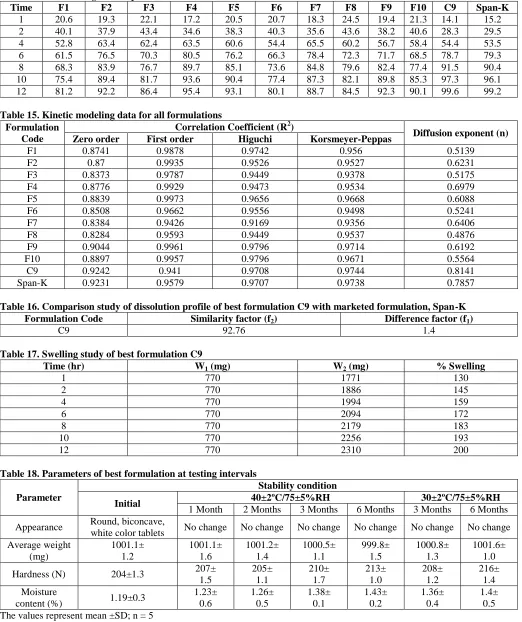
Potassium chloride is an electrolyte replenisher used in the treatment of hypokalemia. It has a short biological half-life of 1 to 1.5hours. It is a freely soluble drug in the gastric contents while taking it orally. Due to its rapid release, it causes local tissue irritation in the stomach. So, it is considered as an ideal drug for designing an extended release formulation. In the study of commercially prepared batches of Potassium chloride 600mg ER tablets, a few critical factors were identified. They are low hardness, high friability, lower side of assay, coating issues and rapid drug release rate. So the trials were made to overcome the issues by developed the formulation using hydrophobic polymers i.e., Eudragit RSPO and Ethyl cellulose in different ratios and optimized the process using various interrelated variables such as process and granulator parameters to achieve the desired quality of product. Among the various formulation development trials, the results indicated that trial C9 with Eudragit RSPO (11.68%) was the best formulation. Eventually, a reproducibility batch was done to check the similar results. Applying mathematical models, the dissolution profile of C9 formulation follow Korsmeyer-Peppas model and showed similarity factor f2 of 92.76 when
compared with the marketed product, Span-K. The stability study was carried out as per ICH guidelines. The stability study indicated there was no significant change in the parameters.
Keywords: Potassium chloride, Eudragit RSPO, Ethyl cellulose, Process optimization.
INTRODUCTION
The main objective of any drug delivery system is to provide a correct dose of drug at the proper site in the body to achieve results and then to maintain the desired drug concentration [1]. Successful commercialization of an extended release dosage form is usually challenging and involves consideration of many factors such as the physicochemical properties of the drug [nature and form of the drug, Biopharmaceutical Classification System (BCS) class, dose and stability of the drug in the gastrointestinal (GI) tract], physiological factors (route of administration, site and mode of absorption, metabolism and elimination) and manufacturing variables (choice of excipients, equipment and manufacturing methods) [2].
The pharmaceutical properties of the granules, which can significantly affect the performance and properties of the finished dosage forms are controlled by multiple interrelated variables such as formulation, process, and granulator parameters. In process optimization, only the amount of granulating liquid and granulation process variables need to be optimized. „„Design of experiment (DOE)‟‟ is often used to optimize the granulation process. In experimental designs, a number of cause factors which
comprise volume of binder solution, impeller speed, massing time, etc., and response variables (dependent variables), which comprise mean particle size, tablet hardness, time for 50% of drug released, etc., are selected [3].
Potassium chloride is an electrolyte replenisher used in the treatment of hypokalemia, metabolic alkalosis and diuretic acidosis [4]. Potassium chloride has short biological half-life of 1 to 1.5hours. It is saline, odorless, white colored powder and freely soluble drug in the gastric contents while taking it orally. When, the drug product shows rapid drug release, it causes local tissue irritation in the stomach. In the study of commercially exhibited batches of Potassium chloride extended release tablets, a few critical factors were identified such as low hardness, high friability, and rapid drug release rate, lower side of assay and coating issues. The main aim of the present research work was develop the formulation using hydrophobic polymers i.e., Eudragit RSPO and Ethyl cellulose in different ratios and also optimize the process using interrelated variables such as amount of granulating fluid, granulation process variables, etc.
9 |
P a g e
MATERIALS AND METHODS
Potassium chloride was bought from Nandu chemical industries, Hubli. Eudragit RSPO was from Evonik industries, Mumbai. Ethyl cellulose, Methocel E15 Premium and Rapid sub-coat white from Colorcon laboratories, Mumbai. Stearyl alcohol and Cetyl alcohol was from BASF, Germany. Talc and Magnesium stearate was from S. D. Fine Chem., Mumbai. Xanthum gum and Carnauba wax was from Signet chemicals, Mumbai. Isopropyl alcohol, acetone and ethanol (95%) were from Rankem chemicals, Secunderabad.
Pre-formulation Study
Potassium chloride (Pure drug) was evaluated for parameters i.e. organoleptic properties, solubility, Particle size distribution by sieve analysis, Flowability parameters and Loss on drying (LOD) as per standard procedure described in the section „Blend characteristics‟.
Linearity Studies by Atomic Absorption Spectrophotometer
Linearity was assessed by performing single measurement of several analyte concentrations. A minimum of five analyte concentrations was recommended for linearity studies. Linearity studies were conducted to know whether the test results are directly proportional to analyte concentration in samples within range or not [5].
Preparation of Potassium stock solution
A quantity of 190.70mg of Potassium chloride (pure drug), previously dried at 105ºC for 2hrs was dissolved in water. The solution was transferred to a 1000ml volumetric flask, diluted with water to volume and mixed. 100ml of the solution was transferred to a 1000ml volumetric flask, diluted with water to volume and mixed. The resulting solution contains 10µg of Potassium (equivalent to 19.07 of KCl) per ml.
Preparation of standard solution
To separate 100ml volumetric flasks, 10, 20, 30, 40, 50, 60, 70, 80, 90 and 100ml respectively of Potassium stock solution was transferred. To each flask, 2ml of NaCl solution and 1ml of HCl was added and diluted with water to volume and mixed. The standard preparations contain 1, 2, 3, 4, 5, 6, 7, 8, 9 and 10 µg of Potassium per ml respectively.
Preparation of NaCl solution:
1gr of NaCl was dissolved in 5ml of water.
Preparation Blank solution
2ml of NaCl solution and 1ml of HCl was transferred to a 100ml flask, diluted with water and mixed.
Procedure
Determine the absorbance of the Standard preparations at the potassium emission line of 766.5 nm,
with atomic absorption spectrophotometer equipped with a potassium hollow-cathode lamp and an air–acetylene flame, using blank solution. Plot the absorbance of the Standard preparation versus concentration, in µg per ml, of potassium, and draw the straight line best fitting the three plotted points. From the graph so obtained, determine the concentration, in µg per ml, of potassium in the Assay preparation.
Preparation of Potassium chloride Extended release tablets
Method: Wet granulation and melt granulation were allowed to formulate the Potassium chloride ER tablets [3,6,7].
Formulation procedure of Core tablets
1. Weighing/Dispensing the raw materials: All specified quantity of materials was weighed accurately using electronic weighing balance.
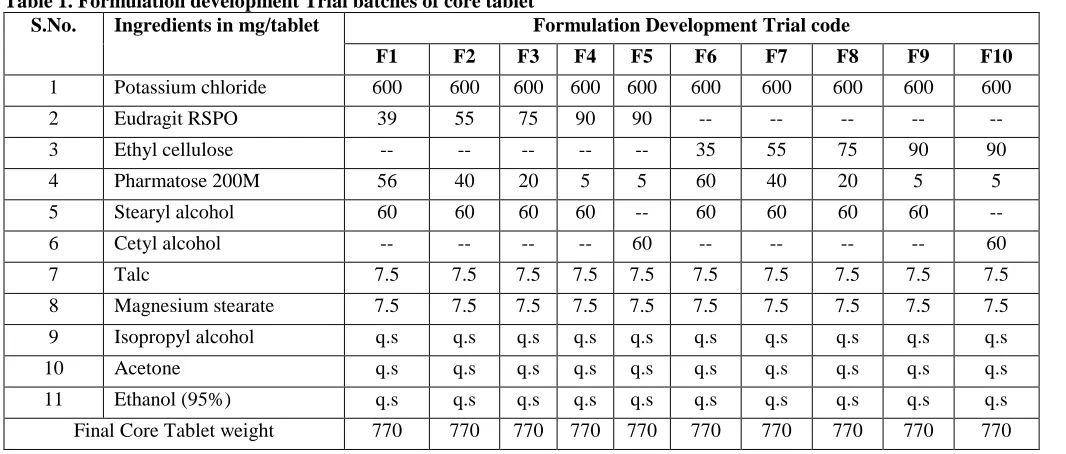
2. Sizing and mixing: Potassium chloride was milled through 0.5mm screen using multimill, Eudragit RSPO (5-13%), Ethyl cellulose (3-13%) and Pharmatose 200M was sieved through #30mesh. The sized materials were loaded to Rapid mixer granulator (RMG) and mixed for 5min.
3. Granulation-I/Wet granulation: Granulation fluid was added to the blend through gun with a spray rate 42-45RPM for about 6min.
4. Drying: The granulated blend was dried using Rapid dryer with air flow 20CFM at 40ºC for about 1hr. 5. Sizing and mixing: Dried blend was milled through
6mm screen followed by 2.5mm screen using multimill. The milled granules were loaded to RMG and mixed for 5min.
6. Granulation-II/Melt Granulation: Preparation of wax medium: The stearyl alcohol/ cetyl alcohol were melted at 60ºC and ethanol (95%) is added, mixed properly with stainless steel spatula.
7. Drying: The granulated blend was dried using Rapid dryer with air flow 20CFM at 40ºC for about 1hr. 8. Sizing: Weighed quantity of talc and magnesium
stearate was added to the dried granules and milled through 6mm screen using multimill.
9. Blending: The milled granules were loaded to octagonal blender and blended for 10min.
10.Compression: The granules were compressed into tablets using Rotary tablet compression machine.
Preparation of coating solution
Preparation of seal coating solution (For 2500 tablets)
A quantity of 0.4gr of Methocel 15cps was added to a beaker containing 24ml water and mixed properly through mechanical stirrer for 5min [6,7].
Preparation of sub coating solution (For 2500 tablets)
10 |
P a g e
glass rod to form uniform slurry without lumps. Weighed quantity of PEG 6000 and talc was added simultaneously to 700ml of water in a separate beaker with continuous stirring using mechanical stirrer. Weighed quantity of CaCo3 was
added to 200ml of water in a beaker with continuous stirring using mechanical stirring. The three solutions were mixed together under mechanical stirring to form a homogenous mixture.
Preparation of sugar coating solution (For 2500 tablets)
Preparation of simple syrup: Add weighed quantity of sucrose to 104ml of warm water under heating at 60-100ºC, stirred properly using glass rod until to form a clear solution. Add weighed quantity of PEG 6000 and TiO2
simultaneously to 46ml of water in a separate beaker with continuous stirring using mechanical stirrer. Add simple syrup to it under stirring to form homogenous mixture. *Note: Quantity of coating materials are taken as per formulation table 3 and water content will be depends on percentage of solid content taken.
Procedure of coating
Method of application of coating solution: Spray/Ladle technique
Seal coating: The core tablets were subjected to pre-worming at 40ºC for efficient adhesion of coating film. The prepared seal coating solution was sprayed on the tablet bed with a spray rate-2RPM, pan speed-2RPM and atomization-2.2kg/cm2. The inlet temperature is 45-50ºC.
Sub coating and smooth coating: The prepared coating solutions were applied on the tablet bed through spray/ladle technique with the parameters as per Table 4.
Polishing: Pre-warm the tablets in Pan coating pan. Thereafter pan is lined with canvas cloth and poured the tablets. Weighed quantity of carnauba wax and talc was added to the tablet bed with a pan speed-6RPM.
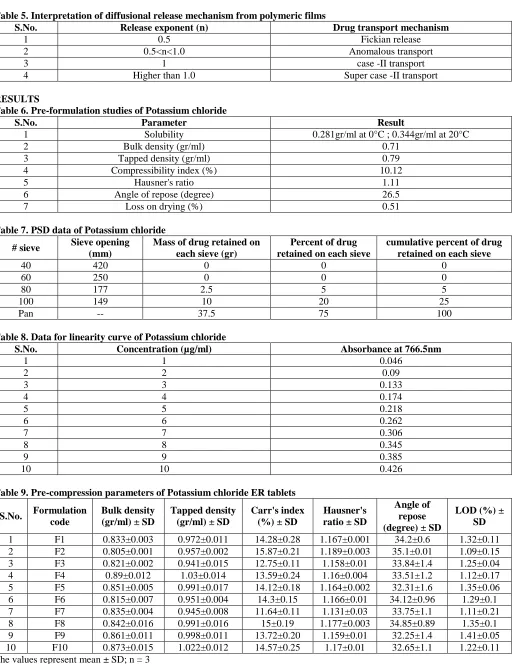
Method of application of coating solution: Formulation C1 to C8 – Spray technique; Formulation C9 - Ladle technique; Total weight of the coated tablet is 1000mg.
EVALUATION STUDIES
Pre-compression Parameters (Granulated blend characteristics)
Bulk density and Tap density
Both Bulk density (BD) and Tapped density (TD) was determined by using Tap density tester, USP. A quantity of 20gr of powder blend, previously lubricated in a poly bag for awhile to break any agglomerates formed, was poured into 100ml measuring cylinder without any gaps in between powder blend. After that the initial volume was noted and the cylinder was fitted to cylinder holder, allowed to fall under its own weight on to a hard surface from the height of 2.5cm at 249drops per min. tapping was continued until no further change in volume was noted. BD and TD were calculated using the following equations [8].
Compressibility index (Carr’s index)
Compressibility index is an important measure that can be obtained from the bulk and tapped densities of powder blend. It can be calculated using the following equation.
Hausner’s Ratio
It indicates the flow properties of the granules and is measured by the ratio of tapped density to the bulk density.
Loss on drying (%)
Moisture content was determined by using IR moisture analyzer. Calibrate the analyzer to show zero reading and set the program with 105ºC temperature and time point is 5min. About 1gr of Potassium chloride blend was evenly spread on flat aluminium plate, close the lid and run the program. The moisture content was calculated using following equation.
Angle of repose (θ)
It is defined as the maximum angle possible between the surface of pile of the powder and the horizontal plane. Fixed funnel method was used. A funnel was fixed with its tip at a given height (h), above a flat horizontal surface on which a graph paper was placed. Powder was carefully poured through a funnel till the apex of the conical pile just touches the tip of funnel. The angle of repose was calculated using the formula [8].
Where h is the height of the pile (cm) and r is the radius of the pile (cm)
Particle size distribution by sieve analysis:
11 |
P a g e
weighed and calculated the percentage of material remaining on each sieve [9-11].
Post-compression parameters
The tablets were evaluated for parameters such as weight variation test as per USP, hardness, thickness and diameter using Pharma test PTB 311E apparatus.
Friability
Tablet friability was measured using Friabilator USP EF-2. 10 tablets were weighed and note it as W1.
Placed the tablets in plastic chamber of friabilator and allowed to rotate at a speed of 25RPM for 100 revolutions (4min). Then tablets were removed from the plastic chamber, de-dusted and reweighed, noted it as W2. The
friability percent of tablets is not more than 1% [12].
Drug content uniformity
Placed 20 tablets in a suitable container with 400ml of water, heat to boiling and boil for 20min. Allowed to cool, transferred the solution to a 1000ml volumetric flask, diluted with water to volume and mixed. Filter and discard the first 20ml of the filtrate. An accurately measured volume of the subsequent filtrate, equivalent to about 600mg of Potassium chloride was transferred to a 100ml volumetric flask, diluted with water to volume and mixed. 10ml of this solution was transferred to a 100ml volumetric flask, diluted with water to volume and mixed. Sequentially, 10ml of the solution was transferred to a 100ml volumetric flask, diluted with water to volume and mixed. Eventually, 5ml of the resulting solution was transferred to a 100ml volumetric flask 2ml of NaCl and 1ml of HCl was added, diluted with water to volume and mixed.
Swelling study
The swelling study was carried for the best formulation C9. The tablets were weighed initially (W1) and
introduced into the dissolution apparatus USP-II containing 900ml of purified water at 37±5ºC temperature at 50RPM. The swollen tablets were taken out at predetermined time intervals and excess of water on the tablet surface was carefully removed using tissue paper and tablets were weighed (W2). The % swelling index was calculated using
the following formula [13,14].
In-vitro dissolution studies
In-vitro dissolution studies of Potassium chloride ER tablets were carried out using Electrolab TDT-08L USP dissolution test apparatus. The details are given below.
Electrolab TDT-08L USP dissolution test apparatus
Medium : Purified water Volume : 900ml
Apparatus : USP-II (Paddle) RPM : 50
Time point (hour) : 1, 2 and later on 2hr interval. Temperature : 37ºC ± 5ºC
Sample concentration (µg/ml): 666.66
Procedure
Tablet was introduced into dissolution fluid after it gets 37±5ºC temperature and the paddle was set at 50RPM motion. 9ml of test sample was withdrawn after 1hr, 2hr and later on 2hr interval, with syringe fitted with 0.45µ filter and replace with purified water to maintain sink condition. 9ml of the test sample was transferred to a 100ml volumetric flask, diluted with water to volume and mixed. 5ml of the resulting solution was transferred to a 100ml volumetric flask, 2ml of NaCl and 1ml of HCl was added to it, diluted with water to volume and mixed. The resulting solution was analyzed using atomic absorption spectrophotometer equipped with potassium hollow-cathode lamp and air-acetylene flame at potassium emission line 766.5nm [14, 5].
Kinetic Analysis of In-vitro Drug Release Rates of extended release tablets
The results of in vitro drug release profile obtained for all the formulations were plotted in modes of data treatment as follows [15]:-
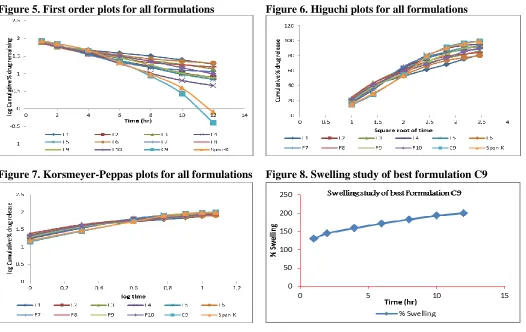
1. Zero – order kinetic model: Cumulative % drug released versus time.
2. First – order kinetic model: Log cumulative percent drug remaining versus time.
3. Higuchi‟s model: Cumulative percent drug released versus square root of time.
4. Korsmeyer-Peppa‟s model: Log cumulative percent drug released versus log time.
1. Zero order kinetics
It describes the system in which the drug release rate is independent of its concentration.
ft = 1 – (Wt / W0) ft = K0t
Where W0 is the initial amount of drug in the tablet, Wt is
the amount of drug in the tablet at time t, ft represents the
fraction of drug dissolved in time t and K0 is zero order
release constant. If the zero order drug release kinetic is obeyed, a graphic of the fraction of drug dissolved versus time will be linear with a slope of K0 and intercept at zero.
2. First Order Kinetics
It describes the drug release from the systems in which the release rate is concentrationdependent.
log Qt = log Q0 + K1t / 2.303
Where Qt is the amount of drug released in time t, Q0 is the
initial amount of drug in the solution and K1 is the first
order release constant. If the first order drug release kinetic is obeyed, a graphic of the decimal logarithm of the released amount of drug versus time will be linear with a slope of K1t
12 |
P a g e
3. Higuchi model
It describes the fraction of drug release from a matrix is proportional to square root of time.
ft = KH t1/2
Where ft is the fraction of drug release at time t and KH is
the Higuchi dissolution constant reflection formulation characteristics. If the Higuchi model of drug release (i.e. Fickian diffusion) is obeyed, then a plot of ft versust
1/2
will be straight line with slope of KH.
4. Korsmeyer–Peppas model
It describes the drug release from the polymeric system in which release deviates from Fickian diffusion, as expressed in following equation.
Mt / M∞ = a tn
log (Mt / M∞) = log a + n log t
Where a is a constant incorporating structural and geometrical characteristics of the dosage form, Mt / M∞ is
the fraction of drug release at time t and n is the release exponent indicative of the drug release mechanism.
Peppas used the n value in order to characterize different release mechanisms as shown in the table 5.
Comparison study of dissolution Profiles
In order to compare the dissolution profiles, model-independent methods are used. The similarity factor (f2) has been adopted by the CDER and EMEA, as a
criterion for the assessment of the similarity between two
In-vitro dissolution profiles and is included in SUPAC guidelines for modified release dosage forms.
The similarity factor (f2) is defined as a
logarithmic reciprocal square root transformation of one plus the mean squared differences of drug percent dissolved between the test and the reference products. The difference factor (f1) measures the percent error between two curves
over all time points. The similarity factor (f2) and difference
factor (f1) can be calculated using the following equation
[16-17].
Where n is the sampling number, Rt and Tt are the percent
dissolved of the reference product at each time point t. if (f2)
is between 50 and 100 can be considered as two dissolution profiles are similar.
Method: The dissolution profile of best formulation C9 is compared with the marketed formulation, Span-K. The similarity factor and difference factor were calculated using the equations.
Stability Studies
Stability studies of Potassium chloride ER tablets were carried out as per ICH guidelines using Thermolab stability chamber for best formulation. The stability studies were carried out at different stability conditions, long term (30ºC ± 2ºC/75 ± 5% RH) and accelerated (40ºC ± 2ºC/75% RH ± 5% RH) for a period of six months[18-20]. Selected best formulation is divided into 3 batches (50tablets in each batch) and packed in a 49X 100mm securitainer container with LDPE cap and filled with 5gr of rayon and kept at above specified conditions in stability chamber for six months. The samples were withdrawn at time points, 0, 1, 2, 3 and 6months from accelerated condition and 0, 3, 6months from long term stability condition, evaluated for parameters, i.e. appearance, average weight, hardness, moisture content, drug content analysis and In-vitro drug release study. The stability data were analyzed using software “Stab” [21-22].
Table 1.Formulation development Trial batches of core tablet
S.No. Ingredients in mg/tablet Formulation Development Trial code
F1 F2 F3 F4 F5 F6 F7 F8 F9 F10
13 |
P a g e
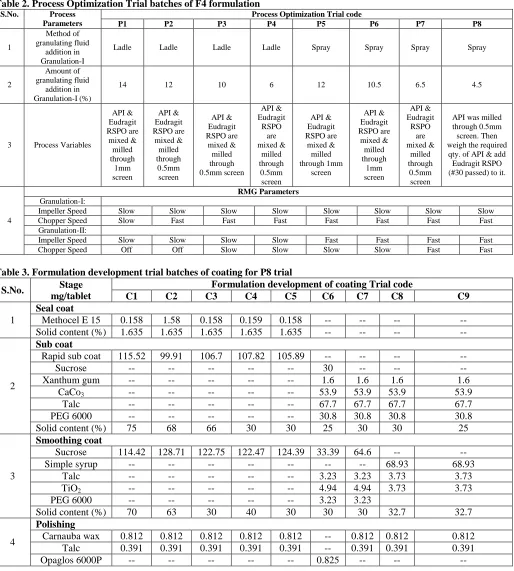
Table 2. Process Optimization Trial batches of F4 formulation
S.No. Process
Parameters
Process Optimization Trial code
P1 P2 P3 P4 P5 P6 P7 P8
1
Method of granulating fluid
addition in Granulation-I
Ladle Ladle Ladle Ladle Spray Spray Spray Spray
2
Amount of granulating fluid
addition in Granulation-I (%)
14 12 10 6 12 10.5 6.5 4.5
3 Process Variables
API & Eudragit RSPO are mixed & milled through 1mm screen API & Eudragit RSPO are mixed & milled through 0.5mm screen API & Eudragit RSPO are mixed & milled through 0.5mm screen API & Eudragit RSPO are mixed & milled through 0.5mm screen API & Eudragit RSPO are mixed & milled through 1mm screen API & Eudragit RSPO are mixed & milled through 1mm screen API & Eudragit RSPO are mixed & milled through 0.5mm screen
API was milled through 0.5mm screen. Then weigh the required qty. of API & add
Eudragit RSPO (#30 passed) to it.
4
RMG Parameters
Granulation-I:
Impeller Speed Slow Slow Slow Slow Slow Slow Slow Slow
Chopper Speed Slow Fast Fast Fast Fast Fast Fast Fast
Granulation-II:
Impeller Speed Slow Slow Slow Slow Fast Fast Fast Fast
Chopper Speed Off Off Slow Slow Slow Slow Fast Fast
Table 3. Formulation development trial batches of coating for P8 trial
S.No. Stage mg/tablet
Formulation development of coating Trial code
C1 C2 C3 C4 C5 C6 C7 C8 C9
1
Seal coat
Methocel E 15 0.158 1.58 0.158 0.159 0.158 -- -- -- -- Solid content (%) 1.635 1.635 1.635 1.635 1.635 -- -- -- --
2
Sub coat
Rapid sub coat 115.52 99.91 106.7 107.82 105.89 -- -- -- -- Sucrose -- -- -- -- -- 30 -- -- -- Xanthum gum -- -- -- -- -- 1.6 1.6 1.6 1.6
CaCo3 -- -- -- -- -- 53.9 53.9 53.9 53.9
Talc -- -- -- -- -- 67.7 67.7 67.7 67.7 PEG 6000 -- -- -- -- -- 30.8 30.8 30.8 30.8 Solid content (%) 75 68 66 30 30 25 30 30 25
3
Smoothing coat
Sucrose 114.42 128.71 122.75 122.47 124.39 33.39 64.6 -- -- Simple syrup -- -- -- -- -- -- -- 68.93 68.93
Talc -- -- -- -- -- 3.23 3.23 3.73 3.73 TiO2 -- -- -- -- -- 4.94 4.94 3.73 3.73
PEG 6000 -- -- -- -- -- 3.23 3.23
Solid content (%) 70 63 30 40 30 30 30 32.7 32.7
4
Polishing
Carnauba wax 0.812 0.812 0.812 0.812 0.812 -- 0.812 0.812 0.812 Talc 0.391 0.391 0.391 0.391 0.391 -- 0.391 0.391 0.391 Opaglos 6000P -- -- -- -- -- 0.825 -- -- --
Table 4. Sugar coating Process parameters for formulation C9
S.No Stage No. of doses Dose (gr) Roll (sec) Dry (sec) Drum speed (RPM) Inlet air flow (m/hr) Inlet temp. (ºC) Exhaust temp. (ºC)
14 |
P a g e
Table 5. Interpretation of diffusional release mechanism from polymeric films
S.No. Release exponent (n) Drug transport mechanism
1 0.5 Fickian release
2 0.5<n<1.0 Anomalous transport
3 1 case -II transport
4 Higher than 1.0 Super case -II transport
RESULTS
Table 6. Pre-formulation studies of Potassium chloride
S.No. Parameter Result
1 Solubility 0.281gr/ml at 0°C ; 0.344gr/ml at 20°C 2 Bulk density (gr/ml) 0.71
3 Tapped density (gr/ml) 0.79 4 Compressibility index (%) 10.12
5 Hausner's ratio 1.11
6 Angle of repose (degree) 26.5 7 Loss on drying (%) 0.51
Table 7. PSD data of Potassium chloride
# sieve Sieve opening (mm)
Mass of drug retained on each sieve (gr)
Percent of drug retained on each sieve
cumulative percent of drug retained on each sieve
40 420 0 0 0
60 250 0 0 0
80 177 2.5 5 5
100 149 10 20 25
Pan -- 37.5 75 100
Table 8. Data for linearity curve of Potassium chloride
S.No. Concentration (µg/ml) Absorbance at 766.5nm
1 1 0.046
2 2 0.09
3 3 0.133
4 4 0.174
5 5 0.218
6 6 0.262
7 7 0.306
8 8 0.345
9 9 0.385
10 10 0.426
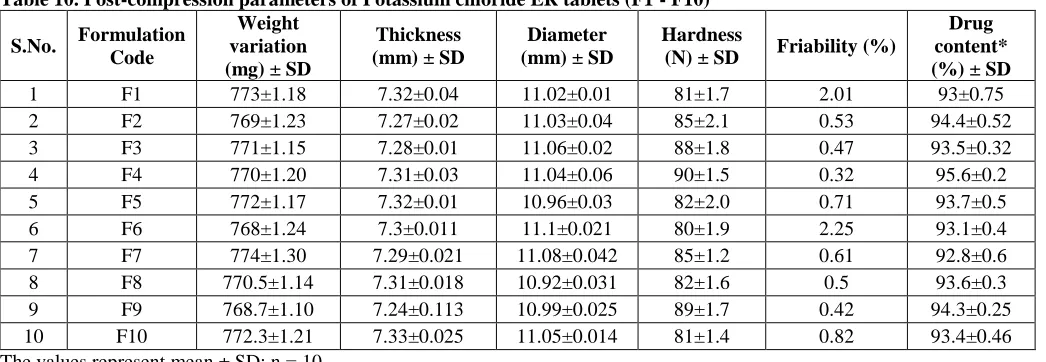
Table 9. Pre-compression parameters of Potassium chloride ER tablets
S.No. Formulation code
Bulk density (gr/ml) ± SD
Tapped density (gr/ml) ± SD
Carr's index (%) ± SD
Hausner's ratio ± SD
Angle of repose (degree) ± SD
LOD (%) ± SD
15 |
P a g e
Table 10. Post-compression parameters of Potassium chloride ER tablets (F1 - F10)
S.No. Formulation Code
Weight variation (mg) ± SD
Thickness (mm) ± SD
Diameter (mm) ± SD
Hardness
(N) ± SD Friability (%)
Drug content* (%) ± SD
1 F1 773±1.18 7.32±0.04 11.02±0.01 81±1.7 2.01 93±0.75 2 F2 769±1.23 7.27±0.02 11.03±0.04 85±2.1 0.53 94.4±0.52 3 F3 771±1.15 7.28±0.01 11.06±0.02 88±1.8 0.47 93.5±0.32 4 F4 770±1.20 7.31±0.03 11.04±0.06 90±1.5 0.32 95.6±0.2 5 F5 772±1.17 7.32±0.01 10.96±0.03 82±2.0 0.71 93.7±0.5 6 F6 768±1.24 7.3±0.011 11.1±0.021 80±1.9 2.25 93.1±0.4 7 F7 774±1.30 7.29±0.021 11.08±0.042 85±1.2 0.61 92.8±0.6 8 F8 770.5±1.14 7.31±0.018 10.92±0.031 82±1.6 0.5 93.6±0.3 9 F9 768.7±1.10 7.24±0.113 10.99±0.025 89±1.7 0.42 94.3±0.25 10 F10 772.3±1.21 7.33±0.025 11.05±0.014 81±1.4 0.82 93.4±0.46 The values represent mean ± SD; n = 10
*; The values represent mean ± SD; n = 3
Table 11. Post-compression parameters of Potassium chloride ER tablets (P1 – P8)
S.No. Formulation Code Hardness (N) ± SD Friability (%) Drug content* (%) ± SD
1 P1 93±1.3 0.41 95.6±0.4
2 P2 103±1.7 0.28 96.5±0.9
3 P3 100±2.0 0.32 96.1±0.8
4 P4 95±1.9 0.37 96.3±0.3
5 P5 104±1.6 0.21 97.2±0.5
6 P6 108±1.4 0.26 97.3±0.7
7 P7 114±1.8 0.18 97.1±0.2
8 P8 118±1.5 0.13 101.2±0.5 The values represent mean ± SD; n = 10
*; The values represent mean ± SD; n = 3
Table 12. Data for Parameters of coated tablet formulation (C1 – C9)
S.No. Formulation Code
Weight variation (mg) ±
SD Thickness (mm) ± SD Diameter (mm) ± SD Hardness (N) ± SD
1 C1 1002.7±1.6 8.03±0.018 11.87±0.033 194±1.5 2 C2 999.3±1.25 8.11±0.031 11.93±0.024 197±1.8 3 C3 1001.5±1.8 8.09±0.027 11.84±0.01 199±1.4 4 C4 1003±1.4 8.05±0.014 11.89±0.02 202±1.1 5 C5 998±1.3 7.97±0.03 11.90±0.04 198±1.8 6 C6 1000±1.0 8.10±0.02 11.86±0.015 200±2.0 7 C7 1002±1.7 8.04±0.05 11.97±0.03 196±1.6 8 C8 999±1.1 8.01±0.01 11.80±0.01 201±1.9 9 C9 1001±1.5 8.06±0.04 11.86±0.05 203±2.3 The values represent mean ± SD; n = 10
Table 13. PSD data of Optimized formulation P8 blend #
sieve Sieve opening (µm)
Mass of drug retained on each sieve (gr)
Percent of drug retained on each sieve
cumulative percent of drug retained on each sieve
20 840 10.5 20.8 20.8
40 420 17 33.66 54.46
60 250 7 13.86 68.32
80 177 6 11.88 80.2
100 149 3.5 6.93 87.13
16 |
P a g e
Table 14. In-vitro drug release profile of all formulations
Time F1 F2 F3 F4 F5 F6 F7 F8 F9 F10 C9 Span-K
1 20.6 19.3 22.1 17.2 20.5 20.7 18.3 24.5 19.4 21.3 14.1 15.2 2 40.1 37.9 43.4 34.6 38.3 40.3 35.6 43.6 38.2 40.6 28.3 29.5 4 52.8 63.4 62.4 63.5 60.6 54.4 65.5 60.2 56.7 58.4 54.4 53.5 6 61.5 76.5 70.3 80.5 76.2 66.3 78.4 72.3 71.7 68.5 78.7 79.3 8 68.3 83.9 76.7 89.7 85.1 73.6 84.8 79.6 82.4 77.4 91.5 90.4 10 75.4 89.4 81.7 93.6 90.4 77.4 87.3 82.1 89.8 85.3 97.3 96.1 12 81.2 92.2 86.4 95.4 93.1 80.1 88.7 84.5 92.3 90.1 99.6 99.2
Table 15. Kinetic modeling data for all formulations Formulation
Code
Correlation Coefficient (R2)
Diffusion exponent (n) Zero order First order Higuchi Korsmeyer-Peppas
F1 0.8741 0.9878 0.9742 0.956 0.5139 F2 0.87 0.9935 0.9526 0.9527 0.6231 F3 0.8373 0.9787 0.9449 0.9378 0.5175 F4 0.8776 0.9929 0.9473 0.9534 0.6979 F5 0.8839 0.9973 0.9656 0.9668 0.6088 F6 0.8508 0.9662 0.9556 0.9498 0.5241 F7 0.8384 0.9426 0.9169 0.9356 0.6406 F8 0.8284 0.9593 0.9449 0.9537 0.4876 F9 0.9044 0.9961 0.9796 0.9714 0.6192 F10 0.8897 0.9957 0.9796 0.9671 0.5564 C9 0.9242 0.941 0.9708 0.9744 0.8141 Span-K 0.9231 0.9579 0.9707 0.9738 0.7857
Table 16. Comparison study of dissolution profile of best formulation C9 with marketed formulation, Span-K Formulation Code Similarity factor (f2) Difference factor (f1)
C9 92.76 1.4
Table 17. Swelling study of best formulation C9
Time (hr) W1 (mg) W2 (mg) % Swelling
1 770 1771 130
2 770 1886 145
4 770 1994 159
6 770 2094 172
8 770 2179 183
10 770 2256 193
12 770 2310 200
Table 18. Parameters of best formulation at testing intervals
Parameter
Stability condition
Initial 40±2ºC/75±5%RH 30±2ºC/75±5%RH
1 Month 2 Months 3 Months 6 Months 3 Months 6 Months Appearance Round, biconcave,
white color tablets No change No change No change No change No change No change Average weight
(mg)
1001.1± 1.2
1001.1± 1.6
1001.2± 1.4
1000.5± 1.1
999.8± 1.5
1000.8± 1.3
1001.6± 1.0 Hardness (N) 204±1.3 207±
1.5
205± 1.1
210± 1.7
213± 1.0
208± 1.2
216± 1.4 Moisture
content (%) 1.19±0.3
1.23± 0.6
1.26± 0.5
1.38± 0.1
1.43± 0.2
1.36± 0.4
17 |
P a g e
Table 19. Comparison of observed with calculated assay of best formulation subjected to stability study
Time in months Observed Assay (%) Mean ± SD
Calculated Assay (%) Mean ± SD
0 101.30 ± 0.32 101.75 ± 0.44 1 100.20 ± 0.48 101.05 ± 0.71 2 99.96 ± 1.03 100.35 ± 0.71 3 99.87 ± 1.13 99.66 ± 0.71 4 98.32 ± 1.05 98.96 ± 0.71 5 97.98 ± 0.49 98.26 ± 0.71 6 97.23 ± 0.78 97.56 ± 0.71 Each value represents the mean ± standard deviation (n=3)
Table 20. Comparison of dissolution profile of best formulation subjected to stability study with initial dissolution profile
Time (hr)
Cumulative Percent Drug release Initial
(0 Month)
40±2°C/75±5%RH 30±2°C/75±5%RH 1 Month 2 Months 3 Months 6 Months 3 Months 6 Months
1 14.1 13.5 15.1 14.6 13.7 14.4 13.8 2 28.3 28.6 29.5 28.2 26.3 28.5 26.5 4 54.4 53.1 55.6 54.1 53.6 53.3 54.3 6 78.7 79.5 78.3 78.5 77.1 78.1 77.6 8 91.5 92.3 91.1 89.9 89.4 91.3 90.4 10 97.3 98.3 96.9 97.1 96.2 97.5 96.6 12 99.6 99.2 98.7 99 98.2 99.1 98.5
Figure 1. Representation of Particle size distribution
of Potassium chloride
Figure 2. Linearity curve of Potassium chloride
Figure 3. Representation of PSD of Optimized
formulation P8 blend
Figure 4.
In-vitro
drug release profiles of all
18 |
P a g e
Figure 5. First order plots for all formulations
Figure 6. Higuchi plots for all formulations
Figure 7. Korsmeyer-Peppas plots for all formulations
Figure 8. Swelling study of best formulation C9
Figure 9. Normal Q-Q plot of residuals obtained from
calculated values of best formulation subjected to
stability study
Figure 10. Graph showing predicted shelf-life of best
formulation
Figure 11. Drug release pattern of best formulation during stability study
*Note: A indicates accelerated stability condition
(A1: 1 Month, A2: 2 Months, A3: 3 Months, A6: 6 Month) L indicates Long-term stability condition
19 |
P a g e
DISCUSSION
The Organoleptic evaluation of Potassium chloride was found to be it is a white crystalline, odorless powder. It has a saline taste.Flowability study of KCl was found and tabulated in Table 1. The results indicate the material had excellent flow ability. Solubility study of Potassium chloride was found to be freely soluble in water at various temperatures i.e. 0°C, 20°c. Particle size distribution of API using sieve analysis method indicated the particle size, was found in a range of 149 to 250µm.
Drug solutions with concentration range from 12µg/ml were prepared. The Beer‟s law was obeyed from 1-10µg/ml. Linearity plot of drug absorbance and solution concentration was obtained with R2=0.9997 and slope=0.0426.
Pre-compression parameters of Potassium chloride ER tablets were found and tabulated in Table 9 and indicated the blend had good flow property. Particle size distribution of optimized formulation blend using sieve analysis method indicated the particle size of 79.2% of the blend was found in a range of 149 to 840µm. Loss on drying for the all formulations blend was found to be 1 to 1.41. It indicating the percentage of externally bounded moisture to the drug.
Post-compression parameters of Potassium chloride ER tablets were found and tabulated in Table 10, 11, 12. Tablets of C1, C2, C3 formulations had peel-off, roughness, and Splitting issues. C4 to C8 formulations had blooming issue. Remaining all formulation tablets were found to be round, biconcave and white color tablets with no issues. Weight variation of tablets was found to be within the USP limits. Hardness of core tablets of formulations F1 to F10 found to be 80 to 90±2N. The result hardness of core tablets were not sufficient for further coating process. The required hardness was produced to ensure good handling characteristics. Hardness of core tablets of formulations P1 to P8 found to be 95 to 118±2N. The formulations F1 and F6 were failed the friability test and the remaining all formulations were not more than 1% ensuring that the all formulations were mechanically stable. The percent of drug content of formulations F1 to F8 were found to be 92.8 to 95.6±0.2%. In wet granulation method, there is a chance to higher loss of material leads to lower the drug content in dosage form due to it is a lengthy process. So the interrelated variables such as process and granulation parameters of F4 formulation were optimized. The percent of drug content of optimization trails P1 to P8 were found
96 to 102±0.6%. The results were shown in Table-11.
In-vitro drug release studies revealed that, the formulation with Eudragit RSPO shows better dissolution profile when compared to other formulations, shown in Table 14 and Figure 4. In all the formulations the drug release was seen for twelve hours. The formulation C9 showed better drug release profile and found to be the best formulation in present research work.
F1, F2, F3, F4, F5, F6, F9 and F10 formulations were followed first order., F7, F8, C9 formulation followed Korsmeyer-Peppas model, F8 formulation follow Fickian diffusion mechanism with n= 0.4876, remaining all formulations were found to be follow anomalous diffusion mechanism with n= 0.5 to 1 when applied to Korsmeyer-Peppas kinetic model. The comparison study indicated the formulation C9 is the best formulation. The swelling study shown the drug release from C9 formulation was anomalous diffusion mechanism.
Stability studies shown that there was no significant change in physical appearance, average weight, hardness, moisture content 18), drug content 19) and dissolution profile of best formulation C9 (Table-20) at stability conditions, 30±2°C/75±5%RH and 40±2°C/75±5%RH. The shelf-life period of drug product was estimated to be 15 Months.
CONCLUSION
The present research work, Potassium chloride ER tablets were prepared using hydrophobic polymers i.e. Eudragit RSPO and Ethyl cellulose in different ratio. The rapid drug release is rectified through the formulation development by changing the polymer ratio and the remaining issues like low hardness, high friability, lower side of assay were rectified through the process optimization by optimized the process and granulator parameters. The coating issues were rectified through the formulation development of coating formula. From the results, it was concluded that the formulation C9 found to be best formulation and all issues were rectified.
ACKNOWLEDGMENT
It is my privilege to express my heartful thanks to my parents, G. Chalamaiah, G. Venkata Lakshmi and my brother G. Venkata Ramana who supported me to do M. Pharmacy and having great belief on my performance.
REFERENCES
1. Tapaswi Rani Dash, Pankaj Verma. Matrix Tablets: An Approach towards Oral Extended Release Drug Delivery. IJPR, 2(2), 2013, 12-24.
2. Kewal K Jain. Drug delivery systems. 2008, pp. 221-238.
3. Dilip M. Parikh et al. edited a book entitled as „Hand book of Pharmaceutical Granulation technology‟ describing various granulation technologies like wet granulation, melt granulation.1999, pp. 204-219, 385-400.
4. Potassium chloride drug literature will be available at www.drugbank.ca/drugs/DB00761.
5. USP Monograph of Potassium chloride extended release tablets will be available at
20 |
P a g e
6. FDA, Center for Drug Evaluation and Research (CDER) and Center for Biologics Evaluation and Research (CBER) Guidance for industry, Q8 (R2) Pharmaceutical Development; ICH, 2009.
7. Jyosna Donaparthi, B. Venkateswara Reddy, et al. Process development and standardization of carvedilol tablets 3.125mg during technology transfer. IJPBS, 2012.
8. Carr RL. Evaluating flow properties of solids. Chem. Eng, 72, 1965, 163-168.
9. Harry G. Brittain. Particle-Size Distribution by Analytical sieving, Part III, In: Pharmaceutical Technology, December 2002 available at: www.pharmatech.com.
10. Sieve Analysis Test Procedure will be available at www.uta.edu/ce/geotech/lab/Main//sieve.
11. General Test (786), Particle-Size Distribution Estimation by Analytical Sieving. USP 24-NF18, (USP convention, Rockville MD, 2000, pp: 1965-1967.
12. Koteswara Rao GSN, Bhavani Prasad V et al. In-vitro and In-vivo evaluation tests for floating drug delivery systems. A review. Int. J Pharm, 2(3), 2012, 645-655.
13. Akhgari A, Abbaspour MR, et al. Evaluation of the Swelling, erosion and drug release from polysaccharide matrix tablets based on pectin and insulin. JJNPP, 6(1), 2011, 51-58.
14. Khan Shagutta, Charhate Kishor, et al. Formulation and Release behavior of sustained release Stavudine HCl matrix tablet containing hydrophilic and hydrophobic polymers. IJDDR, 2013.
15. Paulo Costa, Jose Manuel Sousa Lobo. Modeling and comparison of dissolution profiles: Review. Eur. J Pharm. Sciences,
13, 2001, 123-133.
16. Saranadasa H, Krishnamoorthy K. A multivariate test for similarity of dissolution profiles. JBS, 15, 2005, 265-278.
17. Prior P. Fructose, Correa CP. Comparison of dissolution profiles: Current guidelines, Docencia 507 available at: www.sefig.org/doc/Congreso%20Granada/013_DOC.pdf.
18. FDA, Center for Drug Evaluation and Research (CDER) and Center for Biologics Evaluation and Research (CBER) Guidance for industry, Q1A (R2) Stability testing of new drug substances and products. ICH, November 2003.
19. Ulrich Markens, „Conducting stability studies - Recent changes to climatic zone IV‟ Life sciences/Technical Bulletin, March 2009.
20. Dr. Sabine Kopp. „Stability testing of Pharmaceutical products in a Global Environment‟ WHO. Also available at: www.rajpharma.com, May 2006.
21. FDA, Center for Drug Evaluation and Research (CDER) and Center for Biologics Evaluation and Research (CBER) Guidance for industry, Q1E Evaluation of Stability data. ICH, June 2004.