Vol. 3, Issue 2, June 2013
Vol. 3, Issue 2, June 2013
Modern Journal of Language Teaching Methods (MJLTM)
ISSN: 2251 - 6204
www.mjltm.com
Editor – in – Chief
Hamed Ghaemi, Islamic Azad University, Iran
Editorial Board
Abednia Arman
, PhD in TEFL,
Allameh Tabataba’i University,
Tehran, Iran
Azizi Masoud
, PhD in Applied
Linguisitcs, University of Tehran,
Iran
Basiroo Reza
, PhD in TEFL,
University of Tehran, International
Campus, Iran
Elahi Shirvan Majid
, PhD in
TEFL, Ferdowsi University of
Mashhad, Iran
Fernández Miguel
, PhD, Chicago
State University, USA
Ghaemi Hamide
, PhD in Speech
and Language Pathology, Mashhad
University of Medical Sciences,
Iran
Grim Frédérique
M. A., Associate
Professor of French, Colorado State
University, USA
Izadi Dariush,
PhD candidate in
Applied Linguistics, Macquarie
University, Sydney, Australia
Kargozari Hamid Reza
, PhD
Candidate in TEFL, Payame Noor
University of Tehran, Iran
Kaviani Amir
, Assistant Professor
at Zayed University, UAE
Kirkpatrick Robert
, Assistant
Professor of Applied Linguistics,
Shinawatra
International
University, Thailand
Vol. 3, Issue 2, June 2013
Morady Moghaddam Mostafa,
PhD
Candidate
in
TEFL,
University of Tabriz, Iran
Ndhlovu Finex,
PhD, Linguistics
Programme, University of New
England, Australia
Raddaoui
Ali Hechemi,
PhD,
Associate Professor of Applied
Linguistics,
University
of
Wyoming in Laramie, USA
Rezaei Saeed
, PhD in TEFL,
Sharif University of Technology,
Tehran, Iran
Rolstad Kellie,
PhD, Associate
Professor of Education, University
of Maryland, USA
Shahbazirad Mohammad
, PhD
in English language and Literature,
Yerevan State University, Armenia
Weir George R. S.,
PhD in
Philosophy
of
Psychology,
University of Strathclyde, Glasgow,
UK
Zegarac
Vladimir
,
PhD,
University of Bedfordshire, UK
Vol. 3, Issue 2, June 2013
Abstracting/Indexing
Index
Copernicus 2011
Linguistics Abstract
EBSCO Publication
Vol. 3, Issue 2, June 2013
Lulu Publication
Directory of Open Access Journals
ProQuest
Modern Language Association
Vol. 3, Issue 2, June 2013
Cabell's Directories
COPE
Directory Of Research Journal Indexing (DRJI)
Vol. 3, Issue 2, June 2013
Indian Citation Index
International Society of Universal Research in Sciences
J-Gate
Vol. 3, Issue 2, June 2013
TABLE OF CONTENTS
Sociological factors in politeness theory: emphasizing on distance in the
case of Jane Ayre and the Persian translations
Hossein Hosseini and Reza Biria……….8
Metacognitive awareness of reading strategies: a triangulated study
Majid Ghyasi, Zahra Safdaria and Mohammad Amini Farsani………15
American headway starter: a textbook evaluation
Parya Agharazi Ashtiani………...30
The relationship between motivation and language learning strategies in
foreign language learning: a cognitive perspective
Hengameh Tashakori………..…37
An investigation into the effect of teaching phrasal verbs on the learners’
knowledge of grammatical patterns
Akram Sadeqkouhestani and Ramin Rahimy………48
Does viewing test items at different times matter in English for
academic purpose listening test?
Aytaged Sisay Zeleke……….63
Critical discourse analysis of 20:30 news broadcasting
Omid Azad………78
The efficiency of planned focus on form on the success in ELT
Nejla Gezmiş Ceyhan………84
A study on indicators of writing instruction in Iranian English as a
foreign language curriculum at guidance and high school educational
levels
Maryam Danaye Tous, Abdorreza Tahriri and Fateme Gholami………100
The effect of mixed-up stories on vocabulary learning and retention of
EFL learners
Yaser Kheyrkhah Nia, Hamed Ghaemi and Shahram Afraz………111
Guided writing tasks vs. production writing tasks in teaching writing:
the impact on Iranian EFL learners' paragraph writing
Ensieh Saberi, Ramin Rahimi………..…129
Learning strategies of Malaysian learners of Arabic as a foreign
language: beliefs and frequency of use
Abdullah Musallam Alhashmi……….143
The use of address forms in Iranian religious discourse: the case of
people in different social classes of Iran
Ahmad Molavi and Akbar Afghari……….….161
Vol. 3, Issue 2, June 2013
World Language Teachers: Self-perceptions of Their TPACK
Kelly Moser and Jessica Ivy……….167
The Praxis II World Language Test: Perspectives of Spanish Faculty and
Teacher Candidates at One University
Kelly Moser………..191
Vol. 3, Issue 2, June 2013
SOCIOLOGICAL FACTORS IN POLITENESS
THEORY: EMPHASIZING ON DISTANCE IN THE
CASE OF JANE AYRE AND THE PERSIAN
TRANSLATIONS
Hosseini, H. PhD student (corresponding author) Department of English, Khorasgan Branch
Islamic Azad University, Isfahan, Iran [email protected]
Reza Biria, PhD
Azad University, Khorasgan Branch [email protected]
Abstract
Politeness refers to the activities which aim at the social and cultural norms of linguistic communication. The current study investigates the politeness strategies used in the “Jane Ayre” novel by Charlotte Brontё (1847) and the Persian translation by Mehdi Afshar (2005), emphasizing on sociological factors. The factors mentioned here are distance, power and imposition of rank by focusing on distance. According to this article it seems there is another factor in addition to the preceded factors which leads to expressing some especial utterances. By considering the culture, sociological factors and the situation in different parts of the story it has been clear that “character” is important in utterances as well. The achievement is that “character” can also lead to using politeness as other factors. Investigating the utterances indicates that the relationship between politeness theory and distance is reciprocal. That is, not only does distance cause politeness but also sometimes politeness is used to make distance. This paper examines how politeness is used to make distance between two characters.
1) INTRODUCTION
Linguistics and literature have been claimed to have a difficult relationship and some research have been done in this regard. Since one of the debating subjects in linguistic studies is politeness theory, recently it has been considered as one of the raising issues in stylistic analysis of literature, as well. Many researchers have investigated politeness theory from different viewpoints but the most significant one of all is Brown and Levinson’s (1987) study. The current study consists of two parts; first part attempts to take a look at Brown and Levinson’s theory of politeness in the case of sociological factors- power, distance and ranking of the imposition. The second part consists of the considering “Jane Ayre” novel by Charlotte Brontё (1847) and the Persian translation by Mehdi Afshar (2005), in order to examine the relationship between sociological factors and politeness theory.
Vol. 3, Issue 2, June 2013
2) Brown and Levinson’s theory of Politeness
One of the key concepts of Brown and Levinson’s theory is model person (MP) who is a fluent speaker of a natural language. According to Brown and Levinson (1987:84), “our MP is a reasonable approximation to universal assumptions”. MP’s properties are “rationality” and “face”. The theoretical concept is borrowed from Goffman (1967 :306), who defines it as “the image of self delineated in terms of approved social attributes”, and therefore as “the positive social value a person effectively claims for himself .” Hence the related notion of ‘face –work’, which designates all the actions taken by an individual to behave consistently with face. Goffman (1967) believes that face can be threatened, maintained or enhanced.
According to Brown and Levinson’s (1987) theory face is the public self-image that each member claims for himself. The concept of face is culture bound, but they emphasize that the mutual knowledge of members’ face and the social context that necessitate them choosing special utterances in interactions, are universal.
Face in this definition is divided into two types:
(i) Negative face: the want of every ‘component adult member’
that his actions be unimpeded by others.
(ii) Positive face: the want of every member that his wants be desirable to some others.
In this theory most speech acts which intrinsically threaten the face of both hearer and the speaker are known as face threatening acts (FTAs).
Politeness theory refers to redressing these speech acts that causes keeping the hearer/speaker’s face in an interaction.
a) Acts that threaten the hearer’s negative face
(1) Acts that predicate some future act by hearer (H) and put pressure
on H: e.g. orders, requests, suggestions, warnings and threats.
(2) Acts that predicate some future acts by the speaker (S) toward H.
they put some pressure on hearer: e.g. offers and promises.
(3) Acts that predicate some desire of S toward H or H’s goods: e.g.
compliments and expression of envy or admiration.
b) Acts that threaten the hearer’s positive face
(1) Acts showing that S evaluates negatively H’s positive face: e.g. expressions of disapproval, criticism, or ridicule; challenges or disagreements; and accusation.
(2) Acts showing that S does not care about H’s positive face: e.g. expression of violent emotions, irreverence, and mention of inappropriate or taboo subjects.
c) Acts that threaten the speaker’s negative face
E.g. expressing debt, acceptance of thanks, and justifying
previous or future action.
d) Acts that damage the speaker’s positive face
E.g. apologize, acceptance of compliments, and break down of physical control over body.
Vol. 3, Issue 2, June 2013
1.2. The sociological factors and politeness theory
To appraisal the suitable action toward the hearer, the speaker needs to consider three important sociological variables.
i) The “sociological distance”(D) between S and H
ii) The “relative power”(P) between S and H
iii) The “absolute ranking of impositions”(R) in the particular culture
As it was mentioned before, “rationality” is one of the properties of MP. It is practical reasoning, through which the speaker selects the best utterance in a particular situation to reach his/her means.
This practical reasoning underlies S’s evaluation of D, P and R. in this way, the S can decide to what extend an act can threaten or keep the face of S or H.
Both S and H consider a composition of these social factors inherently in interaction. Depending on the situation and culture Distance evaluation varies.
Distance evaluation varies from culture to culture and from situation to situation. Power is a value attached to the role or role-sets an individual takes part in. imposition varies in value; e.g. to ask for a small amount of money is easier than to ask for a large amount.
3) Methodology
The current study tries to investigate the politeness theory through the expressions of the novel “Jane Ayre” by Charlotte Brontё (1847) and the Persian translation by Mehdi Afshar (2005). In this regard, some utterances between two main characters (Jane Ayre and Mr. Rochester) of the story have been selected to be compared with the translation in the case of social factors in politeness theory.
4) Data collection and analysis
Jane is the main character of the story, who is an orphan and lives with her aunt and her cousins in a large house. She has a lot of problems. They are cruel toward her after a while her aunt sends her to a school. She has difficult days there and after some years she starts to work there as a teacher but she is not satisfied with the situation. Then she leaves the school and works as a governess in Mr. Rochester’s house. During her settlement in his house, they engage in a romantic relationship and they decide to get marry. On their wedding ceremony, Jane understands that Mr. Rochester has married before but his wife has mental problems. Therefore, she leaves him. Meanwhile Jane inherits a lot of money from her paternal uncle. In the same time Mr. Rochester’s wife fire his house and this accident cripples him for his life and he loses everything. Afterward, they meet again and get marry.
The selected utterances are divided into three parts. First those which are related to the beginning of their acquaintance that Mr. Rochester has power over Jane because she is in charge of him. The second part consists of those sentences which refer to the time that they start their romantic relationship and are closer to each other. The last part composes of the utterances of the end of the story that Jane has superiority over Mr. Rochester because not only he is poorer, but also disable.
Vol. 3, Issue 2, June 2013
EXAMPLES OF FIRST PART:1) O: “if you are hurt, and want help, sir, I can fetch someone either
from Thornfield Hall or from Hey.”
“Thank you I shall do: I have no broken bones-only a sprain.” T: نات یارب یه ای دلیفنروت زا و مورب مناوت یم دیهاوخیم کمک و دیا هدید همدص رگا"
کمک مروایب
" ".
مرکشتم
هب کمک یجایتحا تسین
.
یم مناوت هار ،متفیب یناوختسا هتسکشن
طقف
کی نیمز یگدروخ تسا
".
The first visiting is on the road. Two characters do not know each other. Therefore, they speak as strangers. There is no imposition of distance or power. In this case, the translation regards the original source.
Gradually, the power appears in the next conversations. In original text, Mr. Rochester speaks politely in redressive sentences.
O:”I should think you ought to be at
home yourself.”
T: “.دیشاب نات هناخ رد دیاب تعاس نیا رد امش منکیم رکف”
As a whole, a tinge of power can be seen in the translation, and both characters keep their distance.
In the end of the conversation Mr. Rochester finds out she is the governess of his adopted daughter, he inculcates the power by imperative sentences.
3) O:”Now make haste with the letter to Hey, and return as fast as you can.”
T: “.درگرب رتدوز هچ ره و ورب یه هب هلجع اب ورادرب ار همان لاح”
This sentence is negative face threatening for Jane but imposition of power for Mr. Rochester. In the translation, the sentence is more informal so the speaker is trying to show his power and make the distance less. So referring to the speakers, the sentences have different meanings and effects in their viewpoints.
4) O:”let Miss Eyre be seated.” T: “.دنیشنب دیامرفبریا هزیشود”
In the first meeting at home, Mr. Rochester regards the distance very much and he is trying to show the territory by this on record sentence. Referring to the translation it is less polite.
5) In the next sentence Jane uses positive politeness strategy and tries to keep the negative face.
O:”I should be obliged to take time, sir, before I could give you an answer worthy of your acceptance.”
T: “.مراد ندیشیدنا و تقو هب زاین مهدب امش هب یقطنم خساپ هکنیا یارب”
In the original text Jane wants to keep her boss’ negative face, but in the translation she is trying to keep her own negative face, therefore Mr. Rochester’s negative face is threatened in this way.
6) O:”you are not so unsophisticated as Adѐle: She demands a ‘cadeau’ clamorously,
the moment she sees me: you beat about the bush.”
Vol. 3, Issue 2, June 2013
T: ارم هکینامز زا و تسا وداک کی ناهاوخ راو هتفیش وا .دیتسین لدا یهاگآ ان هب امش“
هدید زا نم وداک دهاوخیم امش هک وا ار رد نتفرگ وداک قیوشت هدرکن دیا ! هدرک ؟دیا " ”
In the translation Mr. Rochester is trying to humiliate Jane, and it seems the climax of the power inculcating. In the original text Mr. Rochester is giving face and power to her.
7) In the following of the conversation, in the sentence:
O:”The men in green all forsook England a hundred years ago.” T: ".دنا هدش شومارف ناتسلگنا رد شیپ لاسدصکی دودح شوپ زبس نادرم "
Jane is defending her territory and tries to keep her positive face. She speaks as seriously as Mr. Rochester had done.
8) In the middle of the story, the style of the speaking of Mr. Rochester becomes more intimate and he breaks the distance and decreases the power. In this sentence, the translation shows the breaking of the distance (increasing the intimacy), as well. O:”Come, Jane-come hither. My bride is here, because my equal is here, and my likeness. Jane, will you marry me?”
T: .تساجنیا نم سورع "
یارب هکنیا وا یسک تسا هک اب نم ربارب تسا و هیبش دوخ نم تسا . نیج ایآ اب نم جاودزا ؟ینکیم "
9) In the end of the story, we would have the climax of the intimacy by both characters. As it is obvious in the current examples.
O:”Can you see me?”
“No, my fairy: but I am only too thankful to hear and feel you.” T:"؟دینیبب ارم دیناوتیم“
" هن هتشرف یولوچوک نم . اما ادخ ار رکش منکیم مناوتیم تیادص ار مونشب و تدوجو ار سح منک . “
Here in the sentences there is neither a track of power nor distance. The sentences are on record. The translation carries the intimacy.
10) O:”Am I hideous, Jane?”
“Very, sir; you always were, you know.”
T: “؟ما هدش بیهم و تشز نم ،نیج”
”.دیتسنادیم مه ار نیا و دیدوب تشز هشیمه امش ،اقآ یلیخ” 11) In the current sentence:
O:"A crippled man, twenty years older than you, whom you will have to wait on?"
T: this sentence is not translated explicitly.
Mr. Rochester completely threatens his negative face but Jane tries to keep his negative face by the next sentence. This part has not been translated.
12) O:”To the finest fiber of my nature, sir.”
T: “.مهاوخیم ار امش مدوجو تارذ همه اب اقآ”
Vol. 3, Issue 2, June 2013
It seems the translation could cope with that and indicates the intimacy and breaking the distance from Jane too.
In their last meeting, before they get married, although Jane is richer and in a better statue than Mr. Rochester, there is more intimacy in Rochester’s utterances. He mostly uses informal sentences but on the other hand Jane uses more formal utterances; for instance, the word “sir” almost can be seen in all of her sentences, even when they are too close to each other. Referring to the interactions and utterances it is explicit that it is the character of Jane that drives her to use the word “sir” as a habit, because she grew up like this. According to the definitions, “character” can be one more factor for politeness in addition to the other factors including: “distance”, “power” and “imposition of rank”. Following are some examples:
O:” what, Janet? Are you an independent woman? A rich woman?”
“Quite rich sir. If you won’t let me live with you, I can build the house of my own close up to your door, and you may come and sit in my parlour when you want company of an evening.”
T: ؟دنمتورث نز کی ؟یتسه لقتسم نز کی وت سپ:ر
ج : لاماک دنمتورث رگا،اقآ هزاجا دیهدن هک اب امش یگدنز منک یم مناوت رد رانک هناخ امش هناخ یا مزاسب و امش یم دیناوت ره نامز هک تبحاصم ارم دیتساوخ هب قاتا نمیشن نم دییایب و رد اجنآ دینیشنب .
O:” you are altogether a human being, Jane? You are certain of that?”
“I conscientiously believe so, Mr. Rochester.”
T: ؟اهناسنا رگید نوچ ینوخ و تشوگ و تسوپ زا یتسار هب وت نیج دیسرپ یم و و باوج یم مداد : نم هک روطنیا رکف یم منک .
When Mr. Rochester suspects that Jane might be fallen in love with St John, he changes his mode of speaking, using formal utterances to make distance.
Here is their conversation:
R: “well, you can leave me ma’am: but before you go you will be pleased to answer me a question or two.”
J: “what question, Mr. Rochester?”
J: “I beg your pardon, it is the literal truth: he asked me more than once, and was as stiff about urging his point as ever you could be.”
R: “Miss Eyre, I repeat it, you can leave me. How often am I to say the same thing? Why do you remain pertinaciously perched on my knee, when I have given you notice to quit? ”
J: “because I am comfortable there.”
R: “… Jane leaves me: go and marry Rivers.”
T: لیم رگا نتفر زا لبقو ؟ریا هزیشود دینیشنن نم یوناز یور رگید هک دشاب رتهب دیاش" :ر دیراد هب نیا ود لاوس نم باوج دیهدب ". ج " : یاقآ رتسچار ناتلاوس ؟تسیچ "
Vol. 3, Issue 2, June 2013
No translation :جر " : هزیشود ریا زاب مه رارکت ،منکیم امش دیناوتیم ارم کرت دینک . دنچ راب دیاب کی یفرح ار یارب امش رارکت ؟منک ارچ نانچمه هناجوجل یور یوناز نم هتسشن ،دیا رد هکیلاح هب امش رکذت مهدیم هک زا یور یوناز نم دنلب ؟دیوش "
5. Discussion and Conclusion:
The study has concerned itself with the politeness theory and the related factors including “distance”, “power” and “rank” by emphasizing on the “distance”. On the one hand, the article has considered the politeness theory of Brown and Levinson (1987). On the other hand, the relationship between the two main characters, Mr. Rochester and Jane, in the novel “Jane Eyre” by Charlotte Brontё (1847) and the Persian translation by Mehdi Afshar (2005) has been studied, in regard to social factors.
The study of Brown and Levinson proved that there is a relationship sociological factors and politeness. The politeness appears in the “face”, as negative and positive face. Negative face and positive face are divided into threatening and keeping by the speaker or the hearer.
Considering different parts of the story, reveals that “character” as another factor is involved in the politeness theory. By this rule, what causes the special kind of discourse in some situations is “character”. As in the story Jane uses the word “sir” in different situations for Mr. Rochester.
*Important factors for politeness:*
1. Distance 2. Power 3. Rank 4. Character
The other case is that, according to the examples in the story, there is a symbiotic relationship between distance and politeness. It means that sometimes speakers may use politeness strategies to keep the distance with the hearer.
* distance politeness
References
Abdesslem, Habib, (2001), Politeness strategies in the discourse of drama: a case study
Afshar, Mehdi ,(2005), Jane Ayre(translation)
Brontё, Charlotte, (1847), Jane Ayre
Ermida, Isabel,(2005),Linguistic mechanism of power in Nineteen Eighty- Four: Applying politeness theory to Orwell’s word
Politeness theory retrieved from http: //en .wikipedia .org/ wiki/ Politeness_theory Politeness theory retrieved from http:// www.scribd .com/doc
Vilkki, Liisa, Politeness, Face and Facework: Current Issues retrieved from http://www.ling.helsinki.fi/sky/julkaisut
Vol. 3, Issue 2, June 2013
METACOGNITIVE AWARENESS OF READING
STRATEGIES: A TRIANGULATED STUDY
Majid Ghyasi (corresponding author)
Foreign Languages Dept., Kharazmi University, Tehran, Iran University for Teacher Education, Tehran, IRAN
Zahra Safdaria
Foreign Languages Dept., Kharazmi University, Tehran, Iran University for Teacher Education, Tehran, IRAN
Mohammad Amini Farsani Young Researcher Club, Tehran, Iran
Islamic Azad University, North Tehran Branch, Tehran, IRAN [email protected]
Abstract
This study is an attempt to investigate metacognitive awareness and perceived use of specific reading strategies of university students when reading a text in English. To this end, a questionnaire called Survey of Reading Strategy (SORS) which classifies reading strategies into three categories of global, problem solving, and support strategies, was administered to 194 undergraduate students across three universities in Tehran, Iran. In addition to the questionnaire, a semi-structured interview was conducted to either highlight questionnaire data or/and discover the probable strategies that learners may use but have not been included in the questionnaire. The findings demonstrated that undergraduate students are moderately aware of reading strategies and the most frequently used strategies were found to be problem solving strategy, followed by global, and then support strategy. The study reaffirms the effectual role of the context of the study in learners’ strategic behavior, and concludes with the importance of encouraging the use of more global strategies among students. Keywords: Metacognitive Awareness, Reading Strategy, Survey of Reading Strategy (SORS)
1. Introduction
Of all the four skills, reading appears to be the most important channel for English language learners to learn the language and communicate with an English language society both in academic and non-academic contexts. In non-formal educational system and self-study situation, reading plays a critical role for learners’ life-long
Vol. 3, Issue 2, June 2013
learning and its efficient use will enhance learners’ progress and achievement (Anderson, 1999, p. 1). Also, in all academic fields, in order for the students to gain access to more knowledge and explore areas of science and technology, they do need to know how to read in English. This is also emphasized by Grabe (1991), who maintains that reading is the most essential skill for people who learn English as a second or foreign language in the academic setting. The importance of reading is highlighted by Strevens (1977) viewing its importance due to two reasons. 1) Reading provides an opportunity for the learners to be exposed to a great quantity of language use; 2) It offers the safest way for learners to continue their educational task. In EFL contexts- countries where English is not widely spoken- reading seems to be the most attainable language skill for students (Dubin, 1982). In such contexts, since English is a nonofficial language which is rarely spoken in social communities, and there are not many native speakers of the language, and also English multimedia is not as prevalent as those in ESL contexts, reading becomes the main tool for foreign language learning through which learners step the paths of language learning endeavor by being provided with huge amounts of language input. So, the importance of reading in EFL contexts doubles and more thorough research and studies on reading and its related variables become crucial.
During reading, some amateur readers face some difficulties that hinder their understanding and consequently block further progress. To name a few of the major weak points for such unsuccessful readers, we can refer to the inability in keeping attention on their progress when going through the text, and dealing with problems when it becomes difficult to make sense of the passage. Such learners are not so adept in exploiting reading techniques that boost comprehension, and carrying out a reading activity seems too complicated and challenging for them. Also, they often select ineffective and inefficient strategies with little strategic intent (Wood, Motz, & Willoughby, 1998). So, it seems that the main problem with reading difficulties of the students is their lack of strategic knowledge or even in case of being aware of some strategies, they do not know when and how to use them. Some experts believe that there is a distinct lack of focus on reading skills (Grenfell, 1992, 1995; Erler, 2002). Therefore, the problem could be overcome by consciousness-raising activities over reading strategies. The purposeful, cognitive practices that readers apply while reading to get a better comprehension of the text and also adopting appropriate techniques to keep information in mind are defined as reading strategies. Being a skilled reader necessitates being aware of reading strategies and monitoring the process of reading comprehension. This conscious awareness over the cognitive processes and using specific strategies during reading is referred to as metacognitive awareness. Many studies support the fact that there is a positive correlation between students’ awareness of their reading processes and strategies that they use in reading and their reading proficiency (Alderson, 1984; Carrell, 1991). Increasing awareness over reading strategies results in more frequent use of them by non-strategic readers, more efficient use of strategies by other students, and all contribute to improvement in reading comprehension (Carrell, Pharis, & Liberto, 1989).
So far we have put much emphasize on reading in EFL contexts, and the importance of reading strategies to gain improvement in this skill. However, we have not found
Vol. 3, Issue 2, June 2013
influential studies on surveying the degree of university students’ familiarity with reading strategies and on distinguishing the strategy that is applied much more than other strategies. The purpose of this study is to assess awareness of reading strategies or metacognitive awareness in reading among undergraduate students who have been studying English in academic setting for at least two years in Iran. In Iranian universities, reading is the main skill for academic studies both for the students who follow English related majors like English literature and English Translation and those students whose English courses are just a couple of mandatory courses. The English courses in Iranian universities are all introduced through some text books filled in with reading passages, vocabulary lists, and grammatical points with little or no concern on other skills. Also, students have gained their background knowledge in English from reading textbooks rather than speaking with native speakers or listening to English language programs or broadcasts. In such setting where other skills are almost entirely ignored, English language students rely on reading as the main skill in obtaining knowledge and establishing connection with international knowledge bases. So we intend to know to what extent learners are aware of their reading strategies or are metacognitively aware and what is the frequency of the used strategies reported in their questionnaires and interviews.
1.2 Reading Strategies
As a dynamic process, reading is constructing meaning through the interaction among the reader’s existing knowledge, the information suggested by the written language and the context of the reading situation (Songsiengchai, 2010). The process of changing a written message into comprehended data on learners’ mind is so complex, and this had made researchers to reflect more on reading process rather than the ultimate product. The emphasize on reading process necessitates understanding the way learners cope with the text, make sense of it, and send information to their long term memory. It means that the pendulum of reading considerations have moved toward reading strategies and the mental operations that help readers make sense of the text. Drawing on works in cognitive psychology, reading strategies are deliberate, conscious techniques that readers employ to enhance their comprehension or retention of the textual information. Cohen (1990) defined reading comprehension strategies as “those mental processes that readers consciously choose to use in accomplishing reading tasks” (p.83).” Reading strategies indicate how readers conceive a task, what textual cues they attend to, how they make sense of what they read, and what they do when they do not understand (Block, 1986).
To diagnose learners’ weak points in comprehending a reading text, discovering the reading strategies learners use and their conscious control over the strategies is a prerequisite. To achieve this purpose, there have been many attempts to determine reading strategies of the students some of which include questionnaire, think aloud, and interview methods. Sheorey and Mokhtari (2001) developed an instrument named the Survey Of Reading Strategies (SORS) designed to measure metacognitive awareness of reading strategies of L2 readers engaged in reading academic materials. In the present survey, we have adopted SORS which consists of three categories of global, problem solving, and support strategies.
Vol. 3, Issue 2, June 2013
Global strategies refer tothose intentional strategies which are utilized before, during, and after reading activity. They are usually carefully planned strategies carried out to monitor reading process, and are aimed at setting the stage for the reading activity. Examples include having a purpose in mind, noting text characteristics like length and organization, previewing the text before reading, evaluating what to read or ignore, predicting text’s content, noting text characteristics, and checking how text content fits one’s primary purpose.
Problem-solving strategies are localized, focused repair strategies used when readers are working directly with the text and encounter problems in understanding. These strategies enable students to process the text skillfully and get most of the meaning out of it, especially when the text becomes difficult. Checking one‘s understanding upon encountering conflicting information, guessing the meaning of unknown vocabulary from the context, and re-reading for better understanding are some of the examples of problem-solving strategies.
Support strategies are support mechanisms which are applied to sustain the responsiveness to reading. Using reference materials like dictionaries and other support systems, taking notes, underlining or circling information are some of the examples of support strategies.
1.3 Metacognition
Metacognition is learners’ knowledge about learning and their ability to self-control, understands, and regulates their own cognitive processes. It also refers to planning, monitoring and evaluating ones’ progress during learning process. Flavell in the mid 1970s invented the term and defined it as active monitoring and consequent control of learning process which is carried out in relation to the cognitive objects or data intended to achieve a concrete goal (Flavell, 1981). The difference between cognition and metacognition is worth being clarified here. While cognition alludes to those skills one utilizes to perform a task, metacognition is the awareness and conscious control over the performance of those skills that becomes essential when one wants to know how the task was performed. (Garner, 1987). Based on O’Malley and Chamot (1990 p. 8) “students without metacognitive approaches are essentially learners without direction or opportunity to plan their learning, monitor their progress, or review their accomplishments and future learning directions”. When students are aware of metacognitive approaches, they would be able to weigh up their learning progress and think of appropriate strategies to complete a task.
Flavell (1979) classified three important categories of metacognitive knowledge that are knowledge of person variables, task variables and strategy variables.
Person knowledge is concerned with factors related to the characteristics of individuals i.e. cognitive and effective factors such as age, language aptitude, and motivation that may have an effect on learning. They are regarded as metacognitive knowledge when learners are aware of such factors and know they play important role in their learning.
Task Knowledge is learners’ attentiveness of the purpose of the task they are engaged in and the usefulness of the task for their language learning needs.
Vol. 3, Issue 2, June 2013
Strategic knowledge refers to awareness of the learners over different learning strategies that aid learning process. It includes why and how strategies are useful and also when to use them.
Anderson (2002) have classified metacognitive strategies into five primary components: (1) preparing and planning for learning, (2) selecting and using learning strategies, (3) monitoring strategy use, (4) orchestrating various strategies, and (5) evaluating strategy use and learning. They are the primary metacognitive activities carried out during learning that along with cognitive activities can ensure the most effective language learning attempt. In order to promote metacognition, it is necessary to familiarize students with the reality of metacognition strategies, to tell them how to use the strategies, and assure them that they will be useful for their language learning. However, the point is whether metacognitive strategies should be applied consciously with thorough attention of the student or be carried out automatically when learners are trying to understand the meaning of the passage. Baumann, Jones, and Seifert-Kessel (1993) view metacognition as knowing if comprehension is occurring, and the
conscious application of one or more strategies to correct comprehension; however,
Pressley, Borkowski, and Schneider (1987), state that good readers automatically
employ metacognitive strategies to focus their attention, to derive meaning, and to make adjustments when something goes wrong. While making learners aware of metacognition is useful for its further application and it can encourage their thinking over learning activities, metacognition greatly helps individuals in learning a language or other subjects when it is carried out subconsciously and automatically. The encouragement of metacognitive awareness in the classrooms should be directed toward learners’ automatic use of them in a way that conscious attention of the students is on making sense of the text rather than being replete with the use of strategies.
In the present study we have surveyed metacognitive awareness in reading where
metacognition plays a prominent role. Carrell (1989) sees the importance of metacognitive strategies in their potential to reveal the way readers manage their reading while interacting with the text and the relationship between strategies and reading comprehension. During reading comprehension, when readers monitor and control their understanding, raise their awareness of specific reading strategies, and evaluate their achievement, they are called metacognitively skilled readers. Sheorey and Mokhtari (2001) see the reader’s metacognitive knowledge consisting of an awareness of a variety of reading strategies that greatly influence the cognitive enterprise of reading. “Skilled readers . . . are more able to reflect on and monitor their cognitive processes while reading. They are aware not only of which strategies to use, but they also tend to be better at regulating the use of such strategies while reading” (ibid).
Pressley, Warthon and Mc Donald (1997) believe that strategic readers are those who are very metacognitive readers and are fully conscious of the ongoing reading process, and also know how to deal with the difficulties of the text. In conclusion, many scholars consider metacognitive awareness as one of the critical elements of the reading process which is closely related to reading proficiency (Auerbach & Paxton, 1997; Carrell et al., 1989).
Vol. 3, Issue 2, June 2013
Empirical studies conducted by Chamot and Kupper (1989), and Baker & Brown (1984) show that successful L2 readers are aware of how to use appropriate strategies to enhance text comprehension, in other words, they are more aware of metacognitive strategies, while poor readers are not so metacognitively aware learners . Fan (1993) conducted a meta-analysis on 41 metacognitive strategies instruction studies, from 1979-1991. The writer reported that readers generally improve more in comprehension (effect size of .56) than in vocabulary (effect size=.23).
Nevertheless, Wirotanan (2002) working on metacognitive awareness of Thai graduate students, found that during L2 reading, both the high and low proficiency EFL readers used strategies, but the way the students used them made the two groups different. One significant study on the relationship between proficiency level and metacognitive strategies was conducted by O’Malley et al. (1985). They reported that development in proficiency level of the students make them more metacognitive. It was revealed that intermediate ESL students use more metacognition than beginners. Their study further implied that more proficient students are more aware of reading strategies while performing a reading task than those less proficient learners.
2. Method
2.1 Participants
The participants of the study were selected from six intact classes in three universities across Tehran, Iran. A total of 194 freshmen English-major undergraduate students with age range of 19-35 filled out the questionnaire and 16 volunteers were decided on to attend the interview sessions. The students majored in English Literature and English Translation studies and all were Persian native speakers. Concerning the selection and assignment procedures, the sampling was of probability type in which researchers randomly selected the EFL reading classes from among different classes available, and they are judged to be representative of the target population which is all Iranian EFL students at university level.
2.2 Instrumentation
Survey of Reading Strategy (SORS): A 30-item questionnaire based on a 5-point likert scale developed by Mokhtari and Shoerey (2002) was administered to determine the perceived use of the type and frequency of strategies. SORS which is a revised version of Metacognitive Awareness of Reading Strategies Inventory (MARSI) (Mokhtari, 1998–2000) is used for both native and non-native speakers of English to discover the reading strategies of students at university level in comprehending and acquiring the academic text. SORS measures learners’ awareness of reading strategy and also offers suggestions for improvement in reading skills. SORS classifies the strategies into three categories of Global Strategies, Problem Solving and Support Strategies, which help the readers to control, evaluate and manipulate the reading materials during the process of reading. The internal consistency reliability coefficient calculated by Cronbach’s alpha for the questionnaire is 0.93 which seems to be reliable enough and the details for the subcategories are: global (.92), problem solving (.79), and support (.87).
Vol. 3, Issue 2, June 2013
2.3 Procedure
After selecting the classes, the students and instructors were informed of the purpose of the study and instructed how to fill out the questionnaire. The SORS was administered at the last 15 minutes of each class and the students were asked to answer the questions honestly and were told that there were no right or wrong answers. Having collected data, they were transferred to SPSS version .18 and descriptive statistics was performed on the data. To validate the questionnaire data and obtain in-depth information about students’ reading strategies, an interview was conducted in a semi-structured format so that the participants could not be restricted within the confines of the interview questions and could openly discuss the reading strategies they utilize. Before starting the interview, each student was given a reading passage, which was taken out from IELTS examination papers published by Cambridge ESOL examinations, to read it without being under the pressure of time limitation. Having read the passage, each student was questioned over the reading strategies they had used to make sense of the text while their voice was being recorded. After the interview session, the recorded voices were transcribed and coded for ease of analysis. Then based on our questionnaire classification, the responses which supported the questionnaire data, as well as some other strategies pointed out by participants but not included in the questionnaire were identified and translated into English. It should be pointed out that since the data acquired through interviews are quite qualitative, other interpretations might be plausible, but we have tried to classify the strategies based on how the three categories of our questionnaire are explained by the designers so as to have the same categories for both questionnaire data and interview.
3. Results and Discussion 3.1 Questionnaire Data
As mentioned before, the questionnaire used for obtaining information about the metacognitive awareness of reading strategies consists of three content areas that are global, problem solving and support strategies. To investigate the frequency of use for each category, descriptive statistics was employed. Three levels of strategy use are suggested based on calculating the means, high (3.5 or higher), moderate (2.5 to 3.4), and low (2.4 or lower) (Oxford, 1990). The average for each sub-scale in the questionnaire show which group of strategies is used most or least.
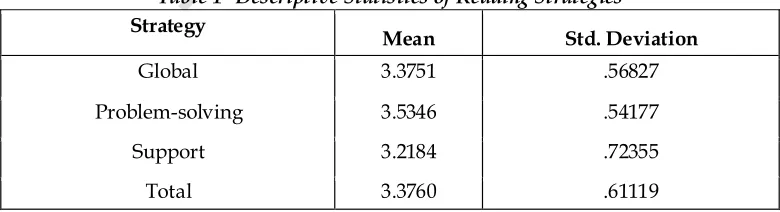
Table 1- Descriptive Statistics of Reading Strategies Strategy
Mean Std. Deviation
Global 3.3751 .56827
Problem-solving 3.5346 .54177
Support 3.2184 .72355
Total 3.3760 .61119
Vol. 3, Issue 2, June 2013
Table 1 shows that among the three categories, the most frequent one is problem-solving strategy with the mean of 3.53, followed by global strategy (Mean=3.37), and then support strategy (Mean =3.21). Evaluating the overall mean (3.37) against Oxford (1990) level definition, it is found that the students are moderately aware of metacognitive strategies and can be considered moderate strategy users. What is clear from the frequency data and the standard deviations is that numbers are so close to each other and there is not a sharp difference between the use of the three kinds of strategies so there might be some changes in the frequency of the strategies by changing some of the variables which may have an effect on the strategy use such as age, proficiency level, and personality.
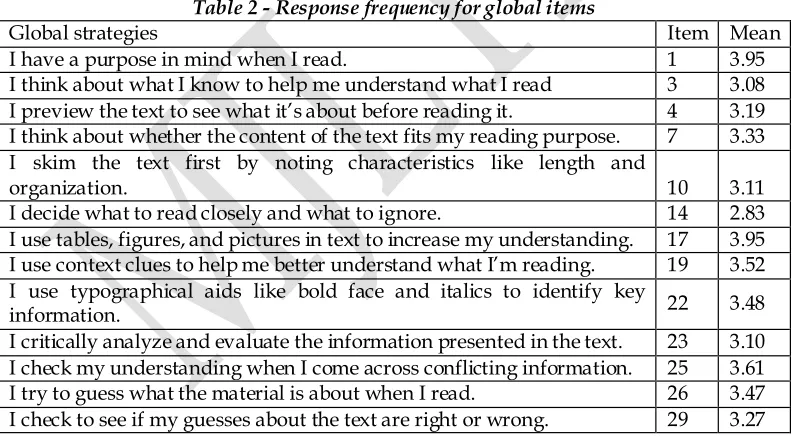
Here we have presented the mean of the students’ answers to questionnaire items that are distinguished by their types of strategy not their numbers in the questionnaire. About global strategies (Table 2), comparing means of responses to the individual strategies reveals that having a purpose in mind and using tables, figures, and pictures before reading with means of 3.95 are the most frequent global strategies employed during reading, and almost 70% of the participants usually or always are aware of
them. On the other hand, students did not show much interest in deciding what to read
closely or what to ignore (Mean = 2.83); only 30% of participants usually or always use put this strategy in their mental repertoire.
Table 2 - Response frequency for global items
Global strategies Item Mean
I have a purpose in mind when I read. 1 3.95
I think about what I know to help me understand what I read 3 3.08
I preview the text to see what it’s about before reading it. 4 3.19
I think about whether the content of the text fits my reading purpose. 7 3.33
I skim the text first by noting characteristics like length and
organization. 10 3.11
I decide what to read closely and what to ignore. 14 2.83
I use tables, figures, and pictures in text to increase my understanding. 17 3.95
I use context clues to help me better understand what I’m reading. 19 3.52
I use typographical aids like bold face and italics to identify key
information. 22 3.48
I critically analyze and evaluate the information presented in the text. 23 3.10
I check my understanding when I come across conflicting information. 25 3.61
I try to guess what the material is about when I read. 26 3.47
I check to see if my guesses about the text are right or wrong. 29 3.27
Table 3 shows the response frequency for problem solving strategies which are realized to be the highly employed strategy types among the three categories. It is clear that paying closer attention during reading in case of encountering difficult parts in the text
with the mean of 4.09 is the most preferred problem-solving strategy, which is used by 75% of learners. The least utilized strategies are related to the speed of reading as we
Vol. 3, Issue 2, June 2013
found that reading slowly and adjusting reading speed with the means of (3.30) and(3.27)
are rarely used.
Table 3 - Response frequency for problem solving items
Problem solving strategies Item Mean
I read slowly but carefully to be sure I understand what I’m reading 8 3.30
I try to get back on track when I lose concentration 11 3.86
I adjust my reading speed according to what I’m reading 13 3.27
When text becomes difficult, I pay closer attention to what I’m
reading 16 4.09
I stop from time to time and think about what I’m reading 18 3.76
I try to picture or visualize information to help remember what I
read 21 3.88
When text becomes difficult, I re-read to increase my understanding 27 3.70
I try to guess the meaning of unknown words or phrases 30 3.64
Finally, studying data on table 4 that are related to support strategies shows that using
reference materials like dictionaries is the most popular option (Mean=4.12) used by majority of the learners (75%). However, learners have not shown much interest in
taking notes (M=2.63) which is preferred only by 27% of the learners.
Table 4- Response frequency for support items
Support strategies Item Mean
I take notes while reading to help me understand what I read 2 2.63
When text becomes difficult, I read aloud to help me understand what I read
5 2.95
I summarize what I read to reflect on important information in the text 6 2.93
I discuss what I read with others to check my understanding 9 3.23
I underline or circle information in the text to help me remember it 12 3.86
I use reference materials such as dictionaries to help me understand what I read
15 4.12
I paraphrase (restate ideas in my own words) to better understand what I read
20 3.03
I go back and forth in the text to find relationships among ideas in it 24 3.70
I ask myself questions I like to have answered in the text 28 3.00
3.2 Interview Analysis
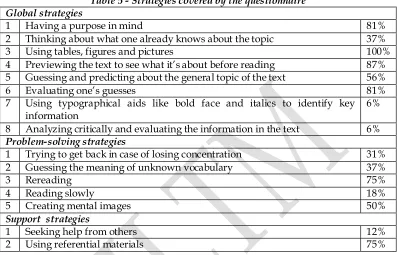
Strategies reported in interview sessions are analyzed according to Mokhtari and Sheorey’s (2002) classification of reading strategies that are global, problem-solving, and support strategies reviewed before. All of the strategies collected after interview analysis were 31 strategies of which 15 had corresponding items in the questionnaire while 16 strategies were new and the SORS did not contain such strategies. Table 5 shows the 15 reading strategies that are common between both the SORS and
Vol. 3, Issue 2, June 2013
interview data, and the following numbers show the percentage of the learners who have reported to use the strategy.
Table 5 - Strategies covered by the questionnaire Global strategies
1 Having a purpose in mind 81%
2 Thinking about what one already knows about the topic 37%
3 Using tables, figures and pictures 100%
4 Previewing the text to see what it’s about before reading 87%
5 Guessing and predicting about the general topic of the text 56%
6 Evaluating one’s guesses 81%
7 Using typographical aids like bold face and italics to identify key
information
6%
8 Analyzing critically and evaluating the information in the text 6%
Problem-solving strategies
1 Trying to get back in case of losing concentration 31%
2 Guessing the meaning of unknown vocabulary 37%
3 Rereading 75%
4 Reading slowly 18%
5 Creating mental images 50%
Support strategies
1 Seeking help from others 12%
2 Using referential materials 75%
The interesting point about global strategies is that all participants (100%), use tables,
figures and pictures to enhance their reading comprehension, so the importance of these visualizations comes to the mind here. It is also shown that Rereading is the most frequent problem-solving strategy reported by 75% of the learners. It was something quite predictable because rereading seems to be very usual among readers as they frequently get back to the text and read again in case of losing concentration, or encountering difficulties. As for support strategies, just two strategies of seeking help and using referential materials were reported by the students where the former is more often used (75%) than the latter.
Analyzing strategies collected in interview sessions, we have found some strategies that are not among questionnaire items and they are listed in Table 6. Based on how the questionnaire has classified the strategies, we have regarded them as global, problem-solving and support strategies.
Table 6- Strategies not covered by the questionnaire Global strategies
1 Trying to be more strategic 31%
2 Identifying difficulties in understanding 31%
3 Planning what to do after reading 31%
4 Managing time 6%
Vol. 3, Issue 2, June 2013
Problem-solving strategies
1 Making connection between a text and one’s prior knowledge 56%
2 Searching for the main idea of each paragraph 56%
3 Focusing on key words 43%
4 Trying to ignore some details to just serve the purpose of reading 5%
5 Ignoring certain parts and waiting to see if more information is provided
later
50%
6 Scanning 87%
7 Using discourse markers and their co-texts to identify relationship 18%
8 Analyzing the structure of the sentence or vocabulary 31%
9 Using co-text to understand the meaning of a vocabulary 37%
Support strategies
1 Stopping reading and resuming later on to refresh one’s mind 31%
2 Using different technological sources to gain some knowledge about the
topic of the text
31%
Table 6 shows that, among global and support strategies, there is not a distinguishing strategy mostly used by the participants. Although the students were informed to talk about the strategies not used in testing situations, those that they use when reading without time limitation, still some of them (6%) believed in the need for having time management in every reading activity. Also, we found that 31 per cent of the students favored trying to be strategic when reading. This is an interesting point that has been ignored by SORS. As some educational settings are accompanied with strategic based instruction programs and making readers aware of the strategies has recently increased in language classrooms, some readers try to remind themselves of different strategies that they have been instructed and try to apply them to develop their understanding. We have decided to include this strategy as a global strategy because it is the knowledge of other reading strategies and is the act of trying to remind oneself of the use of strategies during reading. A number of students often try to reflect on the difficulties with their reading skill, which means they try to think of the reason for their lack of understanding and their low level of proficiency in reading. It seems that this one is an important strategy so more thought should be given to its inclusion in instruments that try to discover about the reading strategies of the students.
About problem-solving, that most of the strategies fall in its category, scanning, which
is abundantly mentioned by many studies on reading strategy though ignored by the SORS, has gained the most popularity and 87% have testified using it in their reading.
Focusing on key words, which has been reported to be used by 43% of the interviewees, means the efforts applied by the students to find vocabulary that is thought to carry major ideas and to understand the message by paying attention to those key words instead of reading the whole parts of the text. Problem-solving strategy number 10, using co-text to understand the meaning of a vocabulary, is different from guessing strategy which is one of the questions in the SORS. Here we have used the term co-text to mean other words around an unknown vocabulary. While in guessing strategy, context, general topic of the text, visualizations etc., help reader understand the
Vol. 3, Issue 2, June 2013
meaning, by co-text we mean just the words before and after an unknown vocabulary that can be usually so helpful in guessing an unknown vocabulary. We have found that 37% of our participants apply this strategy to tackle the problems caused by unknown vocabulary. Discourse markers and their co-text are also used to identify relationship between the sentences because knowing the discourse markers greatly facilitate learners’ understanding of author’ point of view and the general meaning that the text carries. It should be pointed out that stopping reading and resuming later on as one of the support strategies, is used when there is not any time limitation. It can have good affective effects because boredom or mind’s going blank may happen to reader and temporary relaxation to refresh one’s mind is something that may work well in such cases.
Some students (31%) strongly believe in making use of technology to help them understand the text better. Some stated that they may search topics about the text on the internet to obtain a whole idea of the text content and gain some background before reading.
Regarding the frequency of strategies used, interview findings are in line with questionnaire data in that students mostly make use of problem-solving strategies (47%), then global strategies (41%) followed by support strategies (31%). Also, students reported using tables, figures, and pictures and referential materials as the most highly preferred strategies among all strategies of the questionnaire and interview.
4. Conclusion and Implication
This study was an investigation on the metacognitive awareness of reading strategies and the frequency of their use among a group of undergraduate students who were all English language learners. The results of Survey of Reading Strategy (SORS) and interview both showed that the participants are moderately aware of the reading strategies. The study further showed that the most frequent reading strategy used by the university students is problem solving strategy followed by global and then support strategies. This signifies that trying to keep concentration while reading, re-reading, and referring to previous knowledge, paraphrasing, ignoring less important vocabularies, visualizing, etc. are the strategies mostly preferred by the university students. However, some studies have shown that high proficient readers use more global or top-down strategies and found them more effective for reading comprehension (Mokhtari & Sheorey, 2002; Carrell, 1989). According to studies reported by Vann and Abraham (1990), the strategies employed by successful and unsuccessful readers could be similar reading strategies, but the successful ones were found to use more metacognitive strategies which were equivalent to global strategies in other instruments. Although problem solving strategies can effectively guide the readers through encoding and a better understanding of the text, it seems that the aims of a reading act would be easily achieved by employing global reading strategies. Besides, the findings showed that support strategies are among the least often used ones implying that participants do not place much worth on basic support tools that help reading comprehension.
So, creating ways to boost metacognitive awareness and making students aware of their own thinking process becomes more essential in language classrooms. However,
Vol. 3, Issue 2, June 2013
the point is that how we can do this and motivate our students and make sure that they make use of some strategies that we think are useful for their reading demands. As long as learners see the benefits of using specific strategies, can we be hopeful that they will use them again in future. Language teachers are recommended to diagnose their students strategies, for example by applying methods that we used in this study, and then identify some reading strategies that they think are appropriate for their students considering the students level, age, learning context, and individual characteristics. After wards, they can model the strategy, encourage the students to use those strategies while reading, and provide opportunities to practice the learned strategy, and even make students discuss the different aspects of the strategy with their peers. To foster the use of such strategies in learners’ mind, teachers may need to provide tasks and activities which require students to do them by making use of the
predetermined strategies. We propose the policy of “A reading class, A strategy class”
claiming that we will have strategic, autonomous readers when each session of a reading class is devoted to working on a particular strategy in a way that learners feel that they are learning reading steps; the feeling that they gain when they learn the grammar of a second language. Knowing about the strategies is not merely learners’ responsibility, rather teachers at the first stage play critical role of guiding the students through instructing and applying strategies until the students gain enough ability to use them on their own. Therefore, a reading classroom is not a class of translating, or providing definitions for the new words, rather it is a collaborative classroom aimed to breed autonomous readers, something that will be attainable because many studies have claimed that learner autonomy is intimately related to learning strategies (Huttunen, 1996; Vanijdee, 2003; Wenden, 1991; White, 1995).
Since the study has been carried out in Iran which is an EFL context, we hypothesize that the finding could have been affected by the context because strategies used by university students in an EFL context can be different from those used in ESL context. Riley and Harsch (1999) support this fact and state that learners in an ESL environment use more strategies than learners in an EFL environment. They believe that ESL learners are “more motivated and active and have more opportunities to use the target language and are more aware of strategy use because they stay in an English-speaking environment” (pp. 4-5).
Finally, it is worth mentioning that, our interview showed that there are many items reported by the students but not assessed by SORS, and majority of them were problem- solving strategies. For example focusing on key words, scanning, searching for the main idea of each paragraph, and a few others are among important reading strategies that the instrument does not ask about them. It seems that SORS is limited in obtaining information about problem solving strategies because of the few number of items given to this category. This limitation of our instrument could have touched our results, though the interview findings supported questionnaire data. This is a limitation for our study and the remedy for it is using a more comprehensive reading strategy assessment questionnaire where all probable problem solving strategies are included in it so that our findings could be more valid and reliable.
Vol. 3, Issue 2, June 2013
References
Alderson, J. C. (1984). Reading in a foreign language: A reading problem or a language
problem? In J.C. Alderson & A.H. Urquhart (Eds.), Reading in a foreign language
(pp.1-27). New York: Longman.
Anderson, N.J. (1999). Exploring Second Language Reading: Issues and Strategies. Boston:
Heinle & Heinle Publishers.
Anderson, N.J. (2002). The role of metacognition in second language teaching and learning. ERIC Digest (April 2002), 3-4.
Auerbach, E., Paxton, D. (1997). ‘‘It’s not the English thing’’: bringing reading research
into the ESL classroom. TESOL Quarterly , 31, 237–261.
Baker, L., & Brown, A.L. (1984). Metacognitive skills and reading. In P.D. Pearson,
M.Kamil, R.Barr, & P.Mosenthal(Eds.), Handbook of reading research (pp.353-394). White
Plains, NY: Longman.
Block, E. (1986). The comprehension strategies of second language readers. TESOL
Quarterly ,20, 163-494.
Baumann, J., Jones, L., & Seifert-Kessell, N. (1993). Using think alouds to enhance
children's comprehension monitoring abilities. Reading Teacher, 47, 184-193.
Carrell, P. L. (1991). Second language reading: Reading ability or language proficiency.
Applied Linguistics, 12, 159-179.
Carrell, P. L. (1989). Metacognitive awareness and second language reading. Modern Language Journal, 73, 121-134.
Carrell, P., Pharis, B., & Liberto, J. (1989). Metacognitive strategy training for ESL
reading. TESOL Quarterly, 23(4), 647-678.
Chamot, A.U., & Kupper, L. (1989). Learning strategies in foreign language instruction. Foreign Language Annals, 22, 13-24.
Cohen, A. (1990). Language Learning: Insight for learners, teachers, & researchers. New York: New bury Housepublisher.
Dubin, F. (1982). What every EFL teacher should know about reading. English Teaching
Forum, 20, 14-16.
Erler, L. ( 2002). Reading in a foreign language: Near-beginner adolescents’ experiences of French in English secondary schools. Unpublished Doctoral Dissertation. University of Oxford.
Fan, W. (1993). Metacognition and comprehension: A quantitative synthesis of metacognition strategy instruction. Unpublished Ed.D. University of Cincinnati, OH. Flavell, J. (1979) Metacognition and cognitive monitoring: A new area of
cognitive-developmental enquiry, American Psychologist, 34, 906-911.
Flavell, J. H. (1981). Monitoring social cognitive enterprises: Something else that may develop in the area of social cognition. In J.Flavell & R.Lee (Eds.) Social cognitive development (272-287). Cambridge: Cambridge University Press.
Flavell, J. H. (1981). Metacognitive aspects of problem solving. In L. Resnick (Ed) The
nature of intelligence. Hillsdale, NJ: Lawrence Erlbaum, 37-232.
Garner, R. (1987). Metacognition and Reading Comprehension. Norwood, NJ: Ablex
Publishing.
Grabe, W. (1991). Current development in second language reading research. TESOL
Quarterly, 25(3) 375-406.
Vol. 3, Issue 2, June 2013
Grenfell, M. (1992). Process reading in the communicative classroom. Language
Learning Journal, 6, 48–52.
Huttunen, I. (1996). Learning to learn: An overview. Language Teaching, April, 86–89.
Mokhtari, K., & Sheorey, R. (2002). Measuring ESL students' awareness of reading strategies. Journal of Developmental Education, 25 (3), 2-10.
Mokhtari, K. (1998–2000). Metacognitive-awareness-of-reading-strategies inventory (MARSI). Unpublished instrument, Oklahoma State University, Stillwater, Oklahoma, USA.
O’Malley, J.M. et al. (1985). Learning Strategy Applications with Students of English as a Second Language. TESOL Quarterly, 19(3), 557-584
O'Malley, J. M., & Chamot, A. U. (1990). Learning strategies in second language acquisition. New York: Cambridge University Press.
Oxford, R. (1990). Language learning strategies: What every teacher should know. Boston:
Heinle & Heinle.
Pressley, M., Borkowski,