Assessment of Tree Vigor Parameters in Successful Establishment
of
Dendroctonus micans
on
Picea orientalis
in Turkey
Hazan ALKAN-AKINCI1* Funda ERŞEN-BAK1
1Department of Forestry Engineering, Faculty of Forestry, Artvin Çoruh University, Seyitler
Campus, 08000 Artvin, TURKEY, *e-mail: [email protected]
ABSTRACT
Dendroctonus micans (Kugelann) (Coleoptera: Curculionidae) has caused severe outbreaks and killed millions of oriental spruce (Picea orientalis (L.) Link.) trees in the Black Sea Region of Turkey since its discovery in 1966. Besides wounded and overthrown trees, apparently healthy trees are also attacked by the beetle. In infested stands, repeatedly attacked trees and unattacked trees or trees with aborted attacks are reported. In this study, we experimentally investigated the role of some tree vigor parameters in the beetle’s successful establishment on its host. Phloem thickness, recent tree growth rate and tree size were used as tree vigor parameters. Beetle insertions were made at four cardinal points on each tree and establishment success of the beetles was investigated by ten replicates. In our experiment, D. micans females were successfully established more often on thicker phloem and they also tended to be successful on vigorously growing trees. Stressed or destroyed vigorous trees may produce epidemic
populations in stands.
Key words: Greater European spruce bark beetle, oriental spruce, phloem thickness, recent tree growth
rate
INTRODUCTION
ALKAN-AKINCI, H., ERŞEN-BAK, F.
Grégoire (1984) reports more than 70% (72-78%) abortive attacks in Belgium. Resin flow can contribute significantly to the failure of D. micans attacks, and this has been attributed to the horizontal direction of the maternal gallery that cuts both radial ducts and a high number of vertical ducts during the whole tunneling activity of the beetle (Lieutier et al., 1992; Lieutier, 2007). Beetle attack does not kill the host immediately and attacked trees are alive during several beetle generations (Grégoire, 1988).
During attacks, females have to find a suitable spot on the host (Vouland, 1991). After finding a suitable spot, females enter the bark. After reaching the xylem, females bore an oblique narrow channel that gets wider after a few centimeters. They then lay eggs in this wider part in batches. As the eggs hatch, gregarious larval groups start to feed in the phloem. Emergent young adults stay under the bark and perform maturation feeding (Grégoire, 1988). Thus nutritive phloem is consumed during brood development. Finding a suitable host and a suitable spot on this host for a successful establishment is a life sustaining matter for the beetle.
In North America, it’s reported that bark beetles can also establish preferentially on freshly dead vigorous trees or stressed trees that had been growing vigorously until the current year (Berryman, 1976; Reid and Robb, 1999). Because vigorously growing trees secure the development of a new generation by providing broader bark surface areas, thicker phloem and higher amounts of insect nutrients, we assume that D. micans may establish on vigorous oriental spruce trees in the forest. We experimentally investigated D. micans successful establishment on host trees according to tree vigor. One of the simplest measurements of vigor is that of radial growth (Wainhouse, 2005). We used phloem thickness, recent tree growth rate and tree size (diameter of breast height) as the tree vigor parameters that have formerly been used by other researchers (Mahoney, 1978; Reid and Robb, 1999). Tree growth represents an integrated response to a range of factors linked to the forest stand and ‘site’ such as elevation, nutrient and water availability as well as competitive interactions between trees within the stand (Wainhouse, 2005). Results will contribute to explaining the beetle’s ecology and ensure the position of silvicultural practices in management activities.
MATERIALS AND METHODS
Experimental trees
The experiment was conducted on healthy oriental spruce [Picea orientalis (L.) Link.] trees in a spruce-dominated mixed stand at 1723 m asl. in NW aspect in Cerattepe - Artvin. Study area was located in 41°10´4.55´´ - 41°10´5.23´´ N latitudes and 41°46´19.54´´ - 41°46´20.86´´ E longitudes. Diameter of breast height (DBH) of the trees was 35.6 cm ± 0.49 on average and tree age was 99.5 ± 17.01 on average. Beetle insertion
Assessment of Tree Vigor Parameters in Successful Establishment
the experiment. Ten replicates were established and four insertions were made on each tree for a total of 40 insertions. Insertions were made at 130 cm at four cardinal points on the trees. While inserting the females, the bark was removed by borer then the adult was placed in this hole in the bark. A plastic cap was placed over the insertion site to secure the beetle. Insertions were made on June 14, 2013.
Measurements
Six weeks after beetle insertion, on July 25, 2013, barks covering adult galleries were removed and the numbers of eggs, dead and live beetles were recorded, and tree cores and 2x2 cm bark samples were extracted from every tree. Tree cores were used to determine mean annual increment for the last five and 10 years (MAI-5, MAI-10) (Reid and Robb, 1999) by measuring growth ring widths formed in these years. Periodic growth ratio (PGR) was calculated as the mean annual increment in the past five years divided by the mean annual increment of the preceding five years (Mahoney, 1978; Reid and Robb, 1999; Wainhouse, 2005). Phloem thickness of each insertion point was measured from bark samples. These measurements were made by Leica M60 stereomicroscope.
Analyses
Data were analyzed using IBM SPSS statistics version 19.0. T test was performed to compare phloem thickness measurements at the insertion points where females successfully established or did not. SEM values were given with averages.
RESULTS
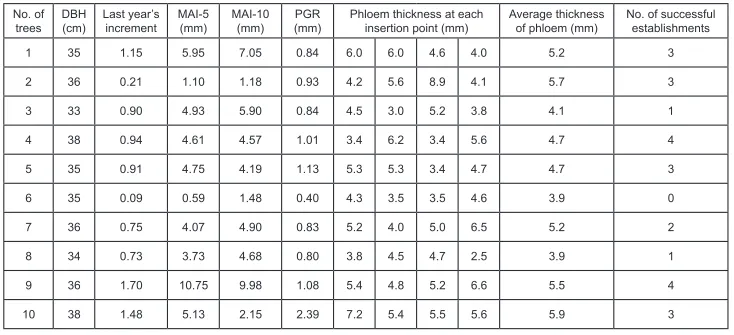
Of the total of 40 insertions, 24 (60%) were successful so females established and laid eggs and 16 (40%) were aborted. Five (12.5%) females were drowned in resin. All four insertions were successful on two trees (numbers 4 and 9) and abortive on one tree (number 6). Three insertions were successful on four trees (numbers 1, 2, 5 and 10), two on one tree (number 7) and one on two trees (numbers 3 and 8). Females laid 40.1 ± 4.9 (5 - 75) eggs on average on 15 insertion points. There were females opening maternal galleries on nine insertion points (Tables 1, 2).
Phloem thickness at the insertion points was 4.8 mm ± 1.23 (2.5 - 8.9 mm) on average (Table 2). Phloem thicknesses were significantly different between the insertion points where the females were successfully established and unsuccessful (t: 4.020, df: 38, P < 0.05). Phloem thickness of the insertion points where the females were successfully established and unsuccessful was 5.42 mm ± 0.24 and 4.05 mm ± 0.19 on average, respectively.
While all the four insertions were successful on tree number nine that had the highest values of last year’s increment, MAI-5 and MAI-10, all four insertions were unsuccessful on tree number six that had the lowest values (Table 2).
ALKAN-AKINCI, H., ERŞEN-BAK, F.
2.39 to 0.40. There were three to four successful insertions on trees that had PGR higher than one and one to three insertions on trees that had PGR between 0.80 - 1. All the insertions were unsuccessful on tree number six that had the lowest PGR value (Table 2). On trees that had PGR higher than 1 and between 0.80 and 1, females laid 42.2 ± 5.0 and 36.6 ± 11.7 eggs on average, respectively (Table 1).
Table 1. Reproductive success of Dendroctonus micans.
No. of trees DBH(cm)
First insertion Second insertion Third insertion Fourth insertion Aborted
attempt Maternal gallery No. of eggs Aborted attempt Maternal gallery No. of eggs Aborted attempt Maternal gallery No. of eggs Aborted attempt Maternal gallery No. of eggs
1 35 42 20 + 38
2 36 + + 5 +
3 33 +* + + +
4 38 36 12 58 28
5 35 + + +* +
6 35 + + + +
7 36 +* + + 75
8 34 +* + + +
9 36 48 56 58 36
10 38 32 58 +* +
* drowned beetles, DBH: diameter of breast height
Table 2. Tree vigor parameters and establishment of Dendroctonus micans at insertion points.
No. of
trees DBH(cm) Last year’s increment MAI-5(mm) MAI-10(mm) PGR(mm) Phloem thickness at each insertion point (mm) Average thickness of phloem (mm) No. of successful establishments 1 35 1.15 5.95 7.05 0.84 6.0 6.0 4.6 4.0 5.2 3
2 36 0.21 1.10 1.18 0.93 4.2 5.6 8.9 4.1 5.7 3
3 33 0.90 4.93 5.90 0.84 4.5 3.0 5.2 3.8 4.1 1
4 38 0.94 4.61 4.57 1.01 3.4 6.2 3.4 5.6 4.7 4
5 35 0.91 4.75 4.19 1.13 5.3 5.3 3.4 4.7 4.7 3
6 35 0.09 0.59 1.48 0.40 4.3 3.5 3.5 4.6 3.9 0 7 36 0.75 4.07 4.90 0.83 5.2 4.0 5.0 6.5 5.2 2 8 34 0.73 3.73 4.68 0.80 3.8 4.5 4.7 2.5 3.9 1
9 36 1.70 10.75 9.98 1.08 5.4 4.8 5.2 6.6 5.5 4
10 38 1.48 5.13 2.15 2.39 7.2 5.4 5.5 5.6 5.9 3
DBH: Diameter of breast height, MAI-5: mean annual increment for the last five years, MAI-10: mean an
Assessment of Tree Vigor Parameters in Successful Establishment
DISCUSSION
Sixty percent of the females established successfully on the experimental trees and they laid 40.1 eggs on average. Of the total females, 12.5% were drowned by resin exudation on five different trees. In two of these trees PGR values had the top two measurements.
Phloem thicknesses were different from each other at insertion points on a same tree. D. micans females were successfully established more often on thicker phloem but phloem thickness cannot be the only factor in successful establishment. If we look at Table 2, female adults had aborted attempts at some of the insertion points that had thicker phloem while they managed to establish at thinner phloem successfully. Local preformed resistance such as resin, stone cell masses, phloem moisture and stilbenes affects the access of beetles to nutritious phloem (Lieutier, 2007). D. micans also tended to be successful on vigorously growing trees that had higher PGR values. Females laid higher numbers of eggs on vigorous trees.
D. micans is known to attack any tree and even seems to prefer healthy trees (Lieutier, 2007). Host selection by D. micans may be determined in part by the suitability of the substrate for larval development as Storer and Speight (1996) expressed. Successful establishments on vigorous trees at thicker phloem points can secure larval development. On the contrary, live vigorous trees in our experiment may respond by higher preformed defenses that will be tried to avoid with packed chewed bark and frass in maternal galleries.
Important insect nutrients such as carbohydrates and nitrogen (Scriber and Slansky, 1981; Kirkendal, 1983; Storer and Speight, 1996; Reid and Robb, 1999) are reported to be higher in vigorously growing trees (Sundberg et al., 1993; Reid and Robb, 1999). Reid and Robb (1999) found that the reproductive performance of pine engraver bark beetles, Ips pini increased with recent tree growth rate in freshly dead jack pine, Pinus banksiana trees. Also, susceptibility of trees to bark beetles was reported to be related to a declining growth rate (Wainhouse, 2005). Slowly growing white spruce stands attacked by Dendroctonus rufipennis were highly susceptible to attack (Wainhouse, 2005).
Reid and Robb (1999) conclude that when trees are killed while growing vigorously, such as by windthrow, they may contribute significantly to the initial population increase leading from endemic to epidemic bark beetle populations. Similarly, D. micans outbreaks in Turkish oriental spruce forests may have originated from stressed or killed trees that were substantially growing vigorously. Alkan-Akıncı et al. (2014) reported 9.3% wounded trees in oriental spruce forests in Turkey and of the wounded trees, 84.4% were infested by the beetle. In an infested stand these trees may produce focal epidemic populations. From this point of view, our results necessitate the investigation of the effect of tree vigor parameters on the successful establishment of D. micans on a landscape scale and the testing of our results on naturally attacked trees.
ALKAN-AKINCI, H., ERŞEN-BAK, F.
trees will have an important effect during brood development. Gregariously feeding habits of D. micans larva will contribute to overcome induced defenses. Vigorous trees that are stressed in any way will benefit D. micans attacks. So, first, it is important not to damage and / or stress these trees by forestry activities. If not, second, damaged trees that are severely infested should be cut during brood development stages through silvicultural practices in beetle epidemics. Vigorous trees are important for forestry both for their ecological and economic value. Mechanical and biological control measures can be effective against endemic D. micans populations but under epidemic conditions spruce forests can lose vigorous individuals.
References
Alkan-Akıncı, H., Eroğlu, M., Özcan, G. E., 2014, Attack strategy and development of Dendroctonus micans (Kug.) (Coleoptera: Curculionidae) on oriental spruce in Turkey. Turkish Journal of Entomology,
38(1): 31-41.
Berryman, A. A., 1976, Theoretical explanation of mountain pine beetle dynamics in lodgepole pine
forests. Environmental Entomology, 5: 1225-1233.
Bevan, D., King, C. J., 1983, Dendroctonus micans Kug. - A new pest of spruce in UK. Commonwealth Forestry Review, 62: 41-51.
Eroğlu, M., 1995, Dendroctonus micans (Kug.) (Coleoptra, Scolytidae)’ın populasyon dinamiğine etki eden faktörler üzerine araştırmalar, I. Ulusal Karadeniz Ormancılık Kongresi, 23-25 Ekim, Trabzon, 3: 148-159.
Granet, A. M., Perrot, J. M., 1977, Dendroctonus micans Kug. dans le sud-est du Massif central. Aires
d’extension et premier essai d’interprétation des dommages. Mémoire de 3éme année, Ecole Nationale Des Ingénieurs Des Travaux Des Eaux Et Forêts, Les Bars, France, 127.
Grégoire, J. C., 1984, Dendroctonus micans in Belgium: The situation today, The EEC SeminarBiological Control of Bark Beetles (Dendroctonus micans), 3-4 October, Brussels, Belgium, 48-62.
Grégoire, J. C., 1985, Host colonization strategies in Dendroctonus: larval gregariousness or mass attack by adults? In: Safranyik, L. S. (Eds). The Role of the Host in the Population Dynamics of
Forest Insects. Canadian forest Service, Bannf, Symposium of IUFRO Working Parties S2.07-05 and S2.07-06, Banff, Canada, September 1983, Canadian Forestry Service and USDA Forest Service, Victoria, Canada, 147-154.
Grégoire, J. C., 1988, The greater European spruce beetle. In: Berryman, A. A. (Eds). Dynamics of Forest Insects Populations. Plenum Press, New York, 455-478.
Kirkendall, L. R., 1983, The evolution of mating systems in bark and ambrosia beetles (Coleoptera:
Scolytidae and Platypodidae). Zoological Journal of the Linnean Society, 77: 293-352.
Lieutier, F., 2007, Host resistance to bark beetles and its variations. In: Lieutier, F., Day, K. R., Battisti, A., Grégoire, J. C., Evans, H. F. (Eds). Bark and Wood Boring Insects in Living Trees in Europe, a Synthesis. Springer, Dordrecht, 135-180.
Lieutier, F., Vouland, G., Pettinetti, M., Garcia, J., Romary, P., Yart, A., 1992, Defence reactions of Norway
spruce (Picea abies Karst.) to artificial insertion of Dendroctonus micans Kug. (Col., Scolytidae).
Journal of Applied Entomology, 114: 174-186.
Mahoney, R. L., 1978, Lodgepole pine/mountain pine beetle risk classification methods and their
application. In: Kibbee, D. L., Berryman, A. A., Amman, G. D., Stark, R. W. (Eds). Proceedings, Theory and Practice of Mountain Pine Beetle Management in Lodgepole Pine Forests. 25-27 April, Pullman, Wash. University of Idaho, 106-113.
Assessment of Tree Vigor Parameters in Successful Establishment
Robinson, M. N., Grégoire, J. C., De Vos, L., 1984. A method of sexing live Dendroctonus micans. The EEC Seminar Biological Control of Bark Beetles (Dendroctonus micans), 3-4 October, Brussels, Belgium, 63-67.
Scriber, J. M., Slansky, F., 1981, The nutritional ecology of immature insects. Annual Review of Entomology, 26: 183-211.
Storer, A. J., Speight, M. R., 1996, Relationships between Dendroctonus micans (Kug.) (Coleoptera:
Scolytidae) survival and development and biochemical changes in Norway spruce, Picea abies (L.)
Karst., phloem caused by mechanical wounding. Journal of Chemical Ecology, 22: 559-573. Sundberg, B., Ericsson, A., Little, C. H. A., Nasholm, T. O. A., Gref, R., 1993, The relationship between
crown size and ring width in Pinus sylvestris L. stems: dependence on indole-3-acetic acid,
carbohydrates and nitrogen in the cambial region. Tree Physiology, 12: 347-362.
Vouland, G., 1991, Le dendroctone de l’épicéa: Dendroctonus micans (Col. Scolytidae) dans le Massif
central. Dissertation, Université d’Aix-Marseille III, 126.
Wainhouse, D., 2005, Ecological Methods in Forest Pest Management, Oxford University Press Inc., New
York, 228.
Wainhouse, D., Ashburner, R., Ward, E., Boswell, R., 1998, The effect of lignin and bark wounding on
susceptibility of spruce trees to Dendroctonus micans. Journal of Chemical Ecology, 24(9): 1551-1561.