Fuel Chip Supply System with Low Price
Mobile Chippers
Mika Yoshida, Hideo Sakai
Abstract
High price of chippers and small scale of forestry management area seemed to create a standstill situation of chip utilization system in Japan. By combining the benefits of small scale forestry and low price chippers, a simple and low-cost chip supply model could be established, creating new employments opportunities. The object of this study is to propose the benefits of a chip supply system in small scale forestry using multiple low price chippers at forest landings. The volume of chip material was ranged up to 56 000 m3 in a model area. The results showed that
the annual labor cost of the proposed system was higher than that of the conventional system because the utilization ratio of chipper of the proposed system was also higher. The chip supply cost of the proposed system became lower than that of the conventional system because of its proper productivity and machine price. The utilization ratio of machine used in this study will be an important indice for creating employments when establishing chip supply chain. The benefits of the proposed system using multiple chippers are not only creating employments in local community but also bringing flexibility to a stable chip supply system and avoiding the risk of machine workouts and troubles. Therefore, the proposed system that introduces mul-tiple lines using low price chippers will be useful for cost efficient management of small scale forestry and for providing sustainable bioenergy business.
Keywords: chip supply, employment, fuel chip, mobile chipper, small scale forestry
1. Introduction
One of the problems of Japanese forestry is that the
demand of wood has been decreasing with lowering
of wood price. Making new demand of wood in do
-mestic market is urgently required. One of the remark
-able new wood products is chip for energy use. There have been many studies about managing chipping and transportation (chip supply chain management) intended to optimize the large-scale operation and to reduce the cost (Young and Ostermeier 1991, Spinelli and Hartsough 2001, Stampfer and Kanzian 2006, To
-losana et al. 2011, Röser et al. 2011). Moreover, chip
-ping at forest roadside was clarified to be the cheapest system and became common (Allen et al. 1998, Laitila 2008, Lindroos et al. 2011, Ghaffariyan et al. 2013). However, there are few studies from the aspect of chip supply chain management in Japan. The main reason is the limited research opportunity of chip supply chain system in actual operations. The increase of in
-troduced chippers has been behind compared with other forestry machines (Fig. 1 Forestry Agency 2011). It can be said that one of the major reasons for the standstill in chip utilization in Japan is due to the un
-reasonably high price of mobile chippers compared to their performance (Yoshida and Sakai 2013) although the price of machines is usually confidential (Nordfjell et al. 2010).
To solve such situations, we introduced a low price disk type mobile chipper to the actual Japanese for
-estry from Korea. This low price chipper had already been investigated in detail (Yoshida and Sakai 2013) and the results have been announced. The chipping costs were lower than shown by other results in Japan, even though not lower than those of overseas chip
-pers. The benefit of a low price chipper was clarified
to be suitable for small scale forestry because it did not
require a large amount of material to achieve low chip
2. Materials and methods
2.1 MaterialsThe proposed system assumed the use of a mobile chipper made by »Yulim Machinery« in Korea as a
representative example of low price (€ 34 546) with reasonable performance. The precise data was inves
-tigated and summarized (Yoshida and Sakai 2013). A system using hummer mill chipper/grinder, with the price of € 371 471 (Yoshioka et al. 2006), was assumed here as the conventional system. The grinder was con
-sidered one of the most productive chippers in Japan compared to the other chippers used in Japan, as sum
-marized by Moriguchi et al. (2004). The main specifica
-tions such as price, productivity, and fuel consump
-tion are shown in Table 1. Both chippers required a grapple loader for preparing and loading materials. In this study, the difference of quality of products was not considered, on the assumption that all products could be fully utilized as fuel.
Table 1 Specifications of the investigated chipper of low cost and of the reference hummer mill chipper/grinder
Name YM-400C HD-9 Industrial Tub grinder
Type (four blades)Disc chipper (hummer mill)Tub grinder
Price, € 34 546 371 471
Engine power, kW 150 205.1
Width, m 1.95 2.39
Length, m 5 7.72
Height, m 2.7 2.62
Conveyor size, m Length 1.6 No conveyor
Width 0.55
Slot size, m
Height 0.5 Depth 1.02
Width 0.4 Top diameter 2.9
Bottom diameter 2.29
Productivity, m3/h 23.7 60
Fuel consumption, l/h 14.6 71.4
The specifications of tub grinder were cited from Yoshioka et al. 2006 The currency ratio was 1€ = 134.6 yen, at November 15, 2013
In this model, the chip material was assumed to be the byproduct of tree length or whole tree harvesting carried out at forest landing. Therefore, the cost for
Fig. 1 Forestry machines used in Japan (Forestry Agency 2011)
The benefit of small scale forestry is the flexible management system, which can be changed according to the change of social conditions and economy. More
-over, forestry is one of the major businesses in rural area, so that the development of a stable business mar
-ket in forestry sector can secure better employment opportunities. In Japan, 75% of forest owners own less than 5 ha of forest and 13% own 5 – 10 ha of forest. Because of such a situation, it is necessary to introduce small scale forestry management. Furthermore, not only small scale forest owners, but also low quality broad-leaved forests in Satoyama area (a forested area
near the city) all over the country and young conifer
plantation forests cannot be ignored for a full utiliza
-tion of forest resources. By combining the benefits of small scale forestry and low price chippers, it is pos
-sible to establish a simple and low-cost chip supply model and to create new employment opportunities.
The object of this study is to propose the benefits of a small scale chip supply model by using one or multiple low price mobile chippers at forest landings (proposed system), accompanied by new employment opportunities. At first, we made a chip supply model of chip production from landing to storage by estimat
harvesting was not considered here. Produced chip was directly put into the truck container with the ca
-pacity of 8 m3, because larger sized containers were
not always available for small scale forestry due to terrain conditions and width restrictions of the current
forest road regulations in Japan. The container filled up with chips was transported from the forest to the storage facility by truck. In this system, a single work
-er carried out all chipping op-erations.
The chip supply model was simulated by Touma town forest owners’ cooperative, Hokkaido Island, Ja
-pan, which had a high potential of regional fuel chip utilization, and the data was investigated by interviews of persons in charge. The setting area was 5 000 ha of private plantation forests. The main tree species were Japanese larch (Larix kaempferi) and Sakhalin fir (Abies Sachalinensis). Although they owned other 2 600 ha of broad-leaved forests, these were not considered in this study because they were not used regularly.
At first, the annual available volume of chip mate
-rial was estimated, and the chip production cost was calculated based on that volume. In this study, the
term m3 means 1 cubic meter of chips. The utilization ratio of machine to scheduled machine hours (SMH)
was also calculated to evaluate whether the machine
worked within the given capacity or not. The currency ratio was 1€ = 134.6 yen (November 15, 2013).
2.2 Methods
The annual volume of chip material Vr (m3/year) and the utilization ratio of chipper/grinder to SMH s were calculated by the following equations.
( )
g
= × × × − ×
r 1
V A G u k (1)
=( / ) /r c
s V E T (2)
Where:
A setting area, ha;
G annual forest growth, solid m3/ha;
γ ratio of byproduct (not including branches); u ratio of unavailable volume of material
because of dirt or ecological reasons; k density of chip volume to solid volume,
m3/solid m3;
Ec chipping productivity, m3/h;
T was annual scheduled machine hours. The chip supply cost C (€/m3) was calculated based on Miyata (1980) and Forestry Agency (2012) by the equations from (3) to (5) including depreciation cost, labour cost, maintenance and repair cost, tax, and supplemental grapple loader and truck transportation costs.
( )
− ×( ) ( )( )
a(
)
b= ma× + + − + × ×
ma ma
1
1 1 1 / 2
S P
C S Y P Y
Y (3)
(
)
=
∑
+∑
× × + × ×chip ma ( fuel fuel r/ )c labor r/ c
C C E C V E C V E n
(4)
= chip/ r+ trans
C C V C (5)
Where:
Cma was annual machinery cost including depre -ciation cost, maintenance and repair cost, and tax, €;
S salvage ratio of depreciation; Y depreciation years, years; Pma machine price, €;
α coefficient of maintenance and repair cost;
β coefficient of tax;
Cchip total cost of chipping operation, €/year;
Efuel machine fuel consumption, l/h; Cfuel fuel price, €/L;
Clabour labour cost per worker, €/h;
n number of workers for chipping operation; Ctrans was transportation cost, €/m3.
The annual forest growth was estimated to be 5 m3/ha in this area. The ratio of byproduct and unavailable volume were 0.3 and 0.2, respectively, in this community. As well as other forest owners’ cooperatives, this cooperative was surrounded by
forests and it managed a forest area where the furthest
point was at the distance of 10 km. The average transportation cost (round trip) was 7.43 €/m3. These data were obtained from interview investigations. The density of chip volume to solid volume was assumed to be 2.8 m3/solid m3 according to Helle et al. (2002). To evaluate the effect of annual volume size on the chip supply cost, the ratio of byproduct was changed in increments from 0.1 to 1.0 in 0.1, where the value of 1.0 meant full utilization of tree length as chip material.
The price of low price chipper and grinder were 34 546 € and 371 471 €, respectively, as shown in Table 1. The depreciation years of chipper were 5 years (Mi
-yata 1980) and the salvage ratio of depreciation was 0.1 according to Japanese law. The coefficient of main
-tenance and repair of low price chipper was assumed to be 1, and of the grinder it was 0.5, because the low price chipper might often be broken down. The fuel consumption of the chipper and grinder was 14.6 L/h and 71.4 L/h, respectively. The price of the grapple loader was 99 554 € and depreciation years of the grap
-cording to data obtained by interview. The labour cost was 14.8 €/hour. These cost calculation data of each system were summarized in Table 2.
Table 2 Machinery data of both proposed and conventional sys-tems for cost calculation
System Proposed system Conventional
system
Grapple loader
Price, € 99 554 99 554
*Depreciation, year 8.5 8.5
Salvage ratio, % 0.1 0.1
Maintenance ratio, % 0.5 0.5
Tax, % 0.05 0.05
Fuel consumption, l/h 5 5
Fuel cost, €/l 1 1
Chipper Disk chipper Tub grinder
Price, € ***34 546 ****371 471
**Depreciation, year 5 5
Salvage ratio, % 0.1 0.1
Maintenance ratio, % 1 0.5
Tax, % 0.05 0.05
Fuel consumption, l/h ***14.6 ****71.4
Fuel cost, €/l 1 1
Hourly labour cost, €/hour 15.1 15.1
Based on Forestry Agency; Ministry of Agriculture, Forestry and Fisheries, Japan 2012 **Based on Miyata 1980
***Based on Yoshida and Sakai 2013 ****Based on Yoshioka et al. 2006
The currency ratio was 1€ = 134.6 yen, at November 15, 2013
3. Results –
Rezultati
From the equation (1), the annually produced chip volume ranged from 5 600 m3 up to 56 000 m3 accord-ing to the ratio of byproduct in a model area. Fig. 2 shows the changes of utilization ratio of chipper/ grinder in each system, according to the ratio of by
-product. When using the proposed one-line system, the utilization ratio of chipper exceeded 1.0 around the ratio of byproduct of 0.8. Therefore, it was necessary to introduce one more chipper, should the ratio of by
-product rise over 0.8. The utilization ratios of the pro
-posed one-line and multiple (two) lines systems were always higher than that of the conventional system.
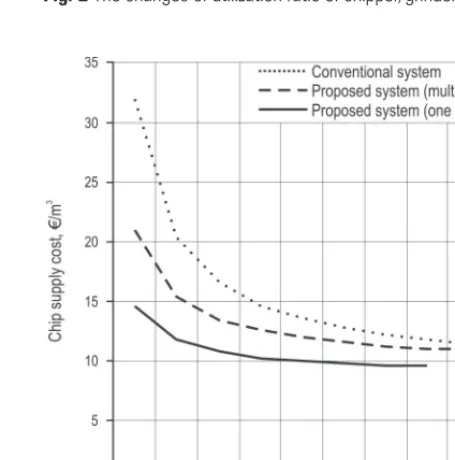
Fig. 3 shows the changes of chip supply cost. The costs of the proposed one-line and multiple lines sys -tems were always lower than that of the conventional
system, while the difference between the costs of the
proposed multiple lines system and that of the con -ventional system got close according to the increase of
the ratio of byproduct. The ratio of byproduct in this area was 0.3 and the chip supply costs of the proposed one-line, multiple lines, and conventional systems of were 10.7 €/m3, 13.4 €/m3, and 16.6 €/m3, respectively.
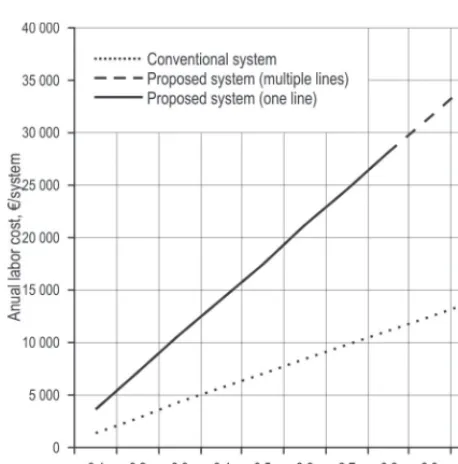
As the ratio of byproduct increased, the annual la
-bor cost for chipping increased, while the costs of the
Fig. 2 The changes of utilization ratio of chipper/grinder
proposed one-line and multiple lines systems were the
same and always higher than that of the conventional
system (Fig. 4). The annual labor cost of the proposed
one-line system has reached the ceiling at the ratio of
byproduct of 0.8 as shown in Fig. 2, while that of the proposed multiple lines system could be increased until the ratio of byproduct of 1.0.
4. Discussion
The machine utilization ratio in a system can be one of the important indices of employment. The in
-crease of the machine utilization ratio in a system
means that the net working hours of the worker
be-come longer, and the total labor costs bebe-come higher as shown in Fig. 4. Therefore, the proposed systems were more effective for creating employments than the conventional system as shown in the results of chip supply model in Touma town. As far as they produce chips within the volume of forest growth, it is possible to introduce two lines of the proposed chip supply system, while retaining cost efficiency and securing employment for two workers. Productivity is indeed important to reduce costs, but the small scale forestry
usually does not have enough material to achieve low
cost by increasing chipping productivity. Therefore, paradoxically, the low efficiency of a low price chipper can create job opportunities and assure lower produc
-tion cost provided that the quantities of the material in the region are limited. Local communities strongly
expect the economic effect of forestry, so that not only the production cost but also the machine utilization ratio is important when introducing chip supply chain to small scale forestry.
One of the difficulties of low productivity is the long response time for sudden chip demand caused by seasonal fluctuation. There are some solutions such as making storage terminal (Gunnarsson et al. 2004) and buying chip from other communities. In this study, we proposed introducing multiple lines system of chip supply, which can secure the production of a higher amount of chips. As mechanization of forest biomass for energy production is crucial in order to make forest operations economically sustainable (Rös
-er et al. 2012), it is important to be prepared for ma
-chine troubles and workouts, which are inherent in mechanized systems. By dividing the chip production system into multiple lines, such risks will be dispersed securing a stable chip supply. This is another benefit of introducing multiple lines into chip production, and it will also make chip supply system more flexible. Multiple lines of chip production may decrease the utilization ratio of machines but the lifetime of small chippers can be lengthened in exchange.
As seen through the analysis of the chip supply cost, the two typical systems considered in this study might be specific examples of the global standard be
-cause the productivity of both chipper and grinder was lower than in forestry developed countries such as Finland and Austria (Kärhä 2012, Stampfer and Kanzian 2006). More precise data about other chippers and chip supply chain management should be inves
-tigated to evaluate proper productivity and system according to the increase of chip demand.
5. Conclusions
Lowering the cost of the chipper is possible both for increasing employment opportunities in small scale forestry and for ensuring stable chip supply by providing cost efficiency. The utilization ratio of ma
-chine will be useful as an indice of employment. It should be considered, for instance, when applying subsidies to a chip supply system. Cost efficiency and new employment opportunities are usually in conflict with each other and cost efficiency is often given prior
-ity in such situations. However, energy business is dif
-ferent from the existing forestry businesses, since the stability of fuel supply is widely recognized as the most important. Therefore, the positive characteristics of the proposed system should be taken into account when establishing chip supply chain management in small scale forestry with limited resources.
6. References
Allen, J., Browne, M., Hunter, A., Boyd, J., Palmer, H., 1988: Logistics management and costs of biomass fuel supply. Int. J. of Phys. Distribution & Logistics Manag. 28(6): 763–477. Forestry Agency, Ministry of Agriculture, Forestry and Fish
-eries, Japan. 2011: The situation of forestry machineries in Japan. World Wide Web Site http://www.rinya.maff.go.jp/j/kaihatu/ kikai/daisuu.html (Accessed on18 February 2014). In Japanese.
Forestry Agency, Ministry of Agriculture, Forestry and Fish
-eries, Japan 2012: Kouseinou-ringyo-kikairiyou-koudoka-manual (Manual for efficient utilization of high productive forestry machineries). Tokyo. 124p. In Japanese.
Ghaffariyan, M.R., Sessions, J., Brown, M., 2013: Roadside chipping in a first thinning operation for radiata pine in south Australia. Croat. J. For. Eng. 34(1): 91–101.
Gunnarsson, H., Rönnqvist, M., Lundgren, J.T., 2004: Supply chain modelling of forest fuel. Eur. J. Oper. Res. 158(1): 103– 123.
Helle, S., Falster, H., Gamborg, C., Gundersen, P., Hansen, L., Heding, N., Jakobsen, H.H., Kofman, P., Nikolaisen, L., Thomsen, I.M., 2002: Wood for Energy Production, Technol
-ogy Environment Economy, Second revised edition. CO
-FORD, Dublin. 69 p.
Kärhä, K., 2012: Comminution productivity of forest chips during last 30 years in Finland. Abstracts. Latvian state for
-est research institute »SILAVA«. In: Special issue of scien
-tific proceedings »Mežzinātne« 25(58): 99–100.
Lindroos, O., Nilsson, B., Sowlati, T., 2011: Costs, CO2
emis-sions, and energy balances of applying Nordic slash recovery methods in British Columbia. West. J. Appl. For. 26 (1): 30–36. Miyata, E.S., 1980: Determining fixed and operating costs of logging equipment. General Technical Report NC-55. St.
Paul, MN: U.S. Dept. of Agriculture, Forest Service, North Central Forest Experiment Station.
Moriguchi, K., Suzuki, Y., Gotou, J., Inatsuki, H., Yamaguchi, T., Shiraishi, Y., Ohara, T., 2004: Cost of comminution and transportation in the case of using logging residue as woody biofuel. J. Jpn. For. Soc. 86(2): 121–128.In Japanese.
Nordfjell, T., Björheden, R., Thor, M., Wästerlund, I., 2010: Changes in technical performance, mechanical availability and prices of machines used in forest operations in Sweden from 1985 to 2010. Scand. J. For. Res. 25(4): 382–389. Röser, D., Mola-Yudego, B., Prinz, R., Emer, B., Sikanen, L., 2012: Chipping operations and efficiency in different opera
-tional environments. Silva Fenn. 46(2): 275–286.
Spinelli, R., Hartsough, B., 2001: A survey of Italian chipping operations. Biomass and Bioenergy 21(6): 433–444.
Stampfer, K., Kanzian, C., 2006: Current state and develop
-ment possibilities of wood chip supply chains in Austria. Croat. J. For. Eng. 27(2): 135–145.
Tolosana, E., Laina, R., Martínez-Ferrari, R., Ambrosio, Y., 2011: Recovering of forest biomass from Spanish hybrid poplar plantations. Biomass and Bioenergy (35)7: 2570–2580. Yoshida, M., Sakai, H., 2013: Importance of capital cost re
-duction of chippers and their required productivity. J. For. Res.DOI 10.1007/s10310-013-0426-x.
Yoshioka, T., Sakurai, R., Aruga, K., Nitami, T., Sakai, H., Kobayashi, H., 2006: Chipping of logging residues with a tub grinder: Calculation of productivity and procurement cost of wood chips. Croat. J. For. Eng. 27 (2): 103–114.
Young, T.M., Ostermeier, D.M., 1991: The economic avail
-ability of woody biomass for the Southeastern United States. Bioresource Technology 37(1): 7–15.
Received: July 02, 2013 Accepted: August 15, 2013
Authors’ address: Mika Yoshida, MSc.*
e-mail: [email protected] Prof. Hideo Sakai, PhD.
e-mail: [email protected] University Tokyo
Graduate School of Agricultural and Life Sciences Department of Forest Sciences
Bunkyo-ku Yayoi 1-1-1 113-8657 Tokyo JAPAN