Web 2.0 Interactivity in Open Access (OA) Repositories: An Analysis
Sheikh Shueb
1Rayees Ahmad Sofi
2Abstract
The adoption of Web 2.0 tools in open access repositories is indicate of the development of repositories for keeping pace with interactive technology. This paper is an earnest attempt to provide an overall picture of the application of Web 2.0 technologies and to analyze their number of occurrences in open access repositories. It has also brought into spotlight the region-wise diffusion of interactive web tools in open repositories. English-interfaced OA repositories enlisted in Directory of Open Access Repositories (DOAR) irrespective of their location, discipline, software, and type were manually accessed and the necessary data was harvested and tabulated. Of the total 1484 English-interfaced repositories, 1196 repositories (81%) were functional and 287 (19%) repositories were inaccessible. Of the functional repositories, 792 (66%) were Web 2.0 enabled and 405 (34%) have yet to embrace the Web 2.0 tools. Really Simple Syndication (RSS) is the most common Web 2.0 tool incorporated by the repositories (690) followed by FaceBook (291) and Twitter (266) respectively. On the other hand, Podcasts (12) and Wikis (7) are least in use. European region leads in terms of the number of OA repositories with 531 operational repositories and 393 (74.01%) as Web 2.0 enabled succeeded by North America, with 356 functional repositories, out of which 207 (58.15%) are Web 2.0 enabled. Central America maintains only one repository which is devoid of Web 2.0 tools. The mushrooming number of repositories have to increase their visibility by adopting more number of interactive technological tools. The potency of Web 2.0 tools in supporting the accessibility of knowledge and in the success of the repositories need to be researched
Keywords:
Web 2.0; Web 2.0 Tools; Interactive web, RSS; Social networking; Facebook; Twitter; ATOM; Podcast; YouTube; Flickr; Open Access Repositories; DOARIntroduction
Web 2.0 is a buzz word in the contemporary era introduced in 2003/04, represents state of the art suite of applications providing an innovative platform for content development, collaboration, communication, social organization and encompass various novel phenomena on the World Wide Web. Although largely a marketing term, some of the key attributes associated with Web 2.0 include the
growth of social networks, bi-directional communication, various ‘glue’ technologies, and significant
diversity in content types (Theimer, 2010).
1
Central University of Kashmir , Jammu and Kashmir, India, Masters in Library and Information Science, National Eligibility Test (NET)
2
The term ‘Web 2.0’ was officially coined in 2004 by Dale Dougherty, a vice-president of O’Reilly Media Inc. (the company famous for its technology-related conferences and high quality
books) during a team discussion on a potential future conference about the Web (Anderson, 2007; Han
& Liu, 2009). It was used by the company and its founder Tim O’Reilly to identify common features of a set of innovative Internet companies and their business characteristics, rather than describe a group of
technologies (O'Reilly, 2005). O’Reilly defines Web 2.0 as a set of economic, social, and technology
trends that collectively form the basis for the next generation of the Internet—a more mature, distinctive
medium characterized by user participation, openness, and network effects. The specific technologies
and tools of these new developments are collectively known by the name “Web 2.0” as opposed to Web
1.0 which was “read only”. Web 2.0 includes blogs, podcasts, wikis, photo-sharing, social bookmarking, collaborative document tools, instant messaging, mash-ups, and really simple syndication
(RSS), among others. (O’Reilly, 2006).
The popularity of the term Web 2.0, along with the increasing use of blogs, wikis, and social
networking technologies, has led many academic and business disciplines to adopt them. Brown and
Bussert (2007) opine that student learning will increase due to “personal engagement, use of preferred learning-styles, and application to daily life”.
Altogether, the use of these Web 2.0 technologies and applications, along with others not here mentioned and others not yet invented, will constitute a meaningful and substantive change in the history of libraries. The library's collection will change, becoming more interactive and fully accessible. The library's services will change, focusing more on the facilitation of information transfer and information literacy rather than providing controlled access to it. Similar case applies to the repositories. The OpenDOAR service provides a quality-assured listing of open access repositories around the world,
maintained by SHERPA Services, based at the Centre for Research Communications at the University of
Nottingham. Each of the repositories has been visited by OpenDOAR staff to ensure a high degree of
quality and consistency in the information is provided. Alexander (2006) provides a useful sound bite
with which to conclude; 'Web 1.0 took people to information; Web 2.0 will take information to the
people'. The web2.0 tools have made their presence in repositories, their level of infiltration and their efficacy in open access repositories needs to be researched.
Literature Review
The World Wide Web (WWW or Web) is one of the marvelous services of the internet that has impacted every aspect of our lives, and has become a common and popular platform for communicating, publishing, sharing, and disseminating information. It has kept pace with the changing time and has evolved from static in nature (Web-1.0) to dynamic one (Web-2.0).Many authors refer to the Britannica Online as a typical example of Web 1.0, and to the Wikipedia as a typical example of Web 2.0. Thus,
Web 1.0 is characterized as “read only Web” and Web 2.0 as “read-write Web” which “enables the
users to add, share, rate or adjust information” (Drachsler, Hummel & Koper, 2007). Web 2.0 is an umbrella term which describes several new web technologies and tools. Its foundation encompasses a number of web-based services and applications which ideally are not technologies themselves and most of them are being used in education. Examples of Web 2.0 technologies are blogs wikis, multimedia
sharing services, content syndication, podcasting and content tagging (Anderson, 2007; Chew, 2009).
This will increase usage and visibility of research contribution of any institution and authors
involved. Its characteristics are “Network as platform” or “cloud computing" open source, creation of
syndicated content, broad use of interactivity, prevalence of user creative content (Theimer, 2010).
Web 2.0 has been referred to as a:
➢ technology (Franklin & Harmelen, 2007);
➢ second generation of web-based tools and services (Guntram, 2007); and
➢ community-driven online platform or an attitude rather than technology (Downes, 2005)
The information world is in a state of constant change and Web 2.0 is playing a central part
(Aharony, 2009) and its development has led many academia and business to coin a flurry of 2.0s, including Library 2.0, Social Work 2.0, Enterprise 2.0, PR 2.0, Classroom 2.0, Publishing 2.0, Medicine 2.0, Telco 2.0, Travel 2.0, Government 2.0, etc. Many of these 2.0s refer to Web 2.0 technologies as the source of the new version in their respective disciplines and areas. Some of the popular examples of Web 2.0 include:
● YouTube – which allows members to upload videos for everybody to see and vote on their
popularity;
● Social networking sites, such as Facebook and MySpace, with hundreds of millions of users
which allow subscribers to create web spaces where they can share their thoughts, music, videos and pictures;
● Flickr’s photo collecting, tagging, and distribution service;
● Sites like del.icio.us that allow users to bookmark favorite sites and share those bookmarks
with others;
● Free audacity software for recording and editing sounds that allow users to record talk and
music which, when combined with RSS, become podcasting; and
● Tools such as CiteuLike allow scholars to share their personal bookmarks (Downes, 2005).
Boateng, Mbarika & Thomas (2010) explores the potentialities of Web 2.0 tools. They argue that Web 2.0 tools can allow new knowledge to be generated by becoming a medium for dynamic social interactions. They further point out in his research paper towards the potentiality of Web 2.0 tools in supporting the accessibility of knowledge, enhancing organizational learning process, and storing the
knowledge for the future use. Thomson (n.a) allege the same views that the universities can make use
of these tools to communicate with students, staff and the wider academic community and it can also be an effective way to communicate and interact with students and research colleagues. Discussing about
the potentialities of Web 2.0 applications in the academic/research circle, Myhill, Shoebridge & Snook
(2009) exhort the researchers to employ the latest tools of Web 2.0 to foster new ideas. Suber (2005)
suggests a solution for the researchers in poor countries by talking about the decentralization of Web 2.0 technologies and tools. He is of the opinion that it can alleviate this aspect to a greater extent by providing an alternative means for researchers to circumvent costly infrastructures and formal institutions, yet allowing them join international research communities, access relevant information and make results known.
Open Repositories are an opportunity to support the sharing of learning resources between teachers and lecturers. Sharing and reusing e-learning materials in this way may lead to an improved quality of teaching, the sharing of good practice, greater consistency and an enhanced sense of
community. A study of the institutional repository was conducted at the Cornell University by Davis,
To advance the objective of the high community use as a success factor for institutional
repositories, an approach was adopted by Cocciolo (2009) that placed emphasis on the institutional
repository's ability to connect individuals with the creative and intellectual output of one another.
Myhill, Shoebridge and Snook (2009) enumerate that Web 2.0 tools may provide the better option for finding the research/project partners and even providing a means of nurturing young researchers through social networking sites; identify a research project through open access repositories, RSS feeds, etc; collaborate a research information through the means of Google Documents and Wikis; disseminate results via open access repositories.
What can be the role of Web 2.0 in the success of the repositories? Powell (2008) states that, the
success of the repository is directly proportional to the use of Web 2.0 tools and services. According to him, successful repositories promote social activity that take place around the content as well as the content management and disclosure activity including friends, groups, social tagging, commenting, embedding etc. He exhort to the implementation of the web 2.0 technologies and social networking in order to smoothly set up and run the repositories.
Objectives
Following are the most prominent aims and objectives of the problem under study.
1. To discover Web 2.0 tools used by OA repositories;
2. To establish the frequency of various Web 2.0 tools in them;
3. To explore the region wise utility of Web 2.0 tools by OA repositories.
Methodology
The data for the study was collected by consulting Open DOAR, an authoritative and reliable directory of Open Access Repositories. Repositories having English language as one of the interface were identified by employing browsing/searching option. Each repository was manually accessed to check the presence of Web 2.0 tools on the Homepage. The study was limited to the utility of 15 commonly used Web 2.0 tools.
Findings and Discussion
Web 2.0 enabled Repositories
1484 English-interfaced repositories are indexed by DOAR, 1197 (81%) repositories were operational and 287 (19%) repositories were inaccessible during the study period as they were either obsolete in nature or the servers hosting these repositories were down. Of 1197 operational repositories, 792 (66%) were Web 2.0 enabled and 405 (34%) have yet to avail the benefits of Web 2.0 tools.
Occurrence of Web 2.0
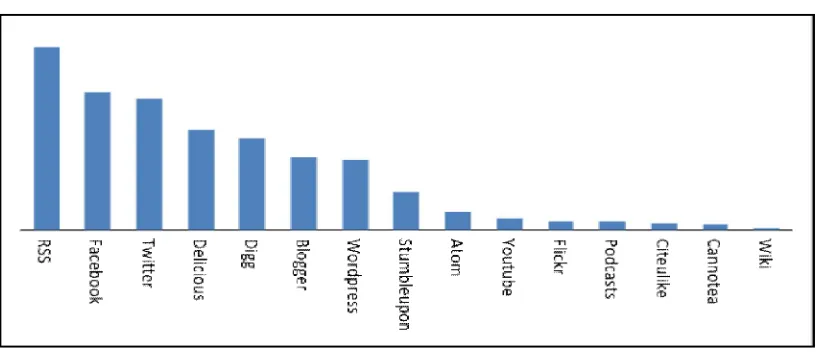
As clear from Fig. 1, RSS feed is the most common Web 2.0 tool incorporated by the
Fig. 1 Occurrence of Web 2.0 Tools
Region Wise Distribution Web 2.0 Enabled Repositories
Table-1 clearly reveals that Europe stands at the top, having 531 operational repositories to its credit with 393 (74.01%) as Web 2.0 enabled. North America follows Europe with 356 functional repositories, out of which 207 (58.15%) are Web 2.0 enabled. Asia holds the third position owning to 122 (63.54%) repositories as Web 2.0 enabled. Caribbean is second from the bottom holding 5 repositories with 80% repositories as Web 2.0 enabled while as Central America is at bottom maintaining only one repository which is devoid of Web 2.0 tools.
Table 1 Region Wise Distribution Web 2.0 Enabled Repositories
Region Total Repositories Operational Web 2.0 enabled %age*
Europe 626 531 393 74.01
North America 451 356 207 58.15
Asia 245 192 122 63.54
Australasia 80 56 36 64.29
Africa 44 36 15 41.67
South America 32 20 15 75
Caribbean 5 5 4 80
Central America 1 1 0 0
Total 1484 1197 792 66.17
*% age rounded off to two decimal places
Web 2.0 enabled European repositories 0
RSS is found in a maximum of 341 repositories, followed respectively by Facebook and Twitter
in 138 and 121 repositories. From Fig. 2, it is clear that least utilized tools are Podcasts and Wiki
embedded only in 4 and 2 repositories respectively.
Fig. 2 Web 2.0 enabled European Repositories
Web 2.0 Enabled North American Repositories
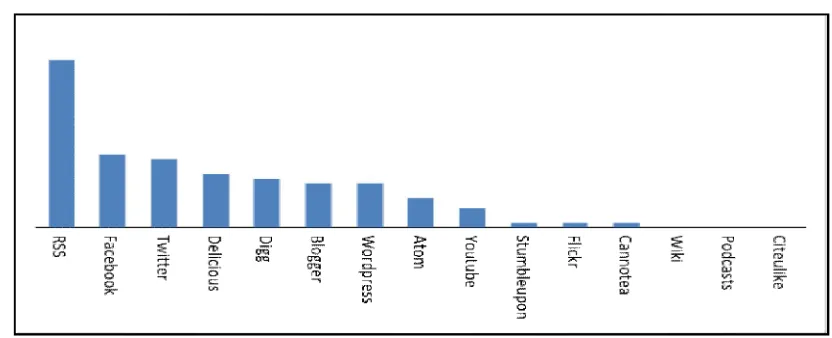
All the Web 2.0 tools included in the study are being used by the North American repositories. RSS (166) is predominant in 166 repositories, followed respectively by Facebook (125) and Twitter
(119). On the other hand, Cannotea (5) and Wiki (2) are least utilized (Fig 3).
Fig. 3 Web 2.0 tools in North American Repositories
Web 2.0 Enabled Asian Repositories
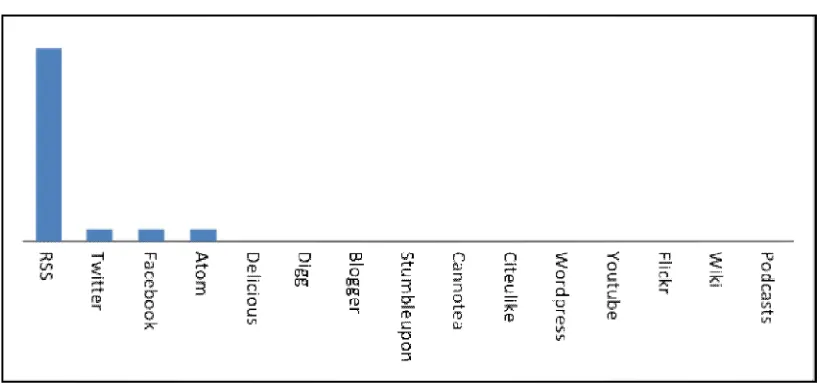
Of 122 Web 2.0 enabled repositories, RSS feeds is incorporated by maximum number of repositories (120) followed by Atom and Facebook in 30 and 9 repositories respectively. Flickr,
Fig. 4 Web 2.0 tools in Asian Repositories
Web 2.0 Enabled Australasian Repositories
Australasia comprises two geographical regions, i.e., Australia and New Zealand. Repositories of them make maximum use of RSS tools (34). Facebook (15) and Twitter (14) follows the list
respectively. On the extreme, Stumbleupon, Flickr and Cannotea appeared in one repository each (Fig.
5).
Fig. 5 Web 2.0 tools in Repositories of Australasia
Web 2.0 Enabled African Repositories
Of the total 15 Web 2.0 enabled repositories in Africa, 11 repositories do make use of RSS,
followed by Twitter and Delicious. Wikis, Podcasts, Wordpress, YouTube & Flickr have yet to make
Fig. 6 Web 2.0 tools in African Repositories
Web 2.0 Enabled South American Repositories
From Fig. 7, it is clear that only 4 tools have been utilized by different South American
repositories. RSS (15) is the most prominent, followed by Twitter, Facebook and Atom once in each.
Fig. 7 Web 2.0 tools in South America
Web 2.0 Enabled Caribbean Repositories
Only 2 Web 2.0 tools have been utilized by the Caribbean repositories i.e. RSS by 3 repositories and Wiki by 1 repository respectively.
Web 2.0 enabled repositories of Central America
Conclusion
A careful interpretation of the data gathered after an online investigation of each individual registered repository reveals that the application of Web 2.0 technologies will constitute a meaningful and substantive change in the history of institutional repositories. The Web 2.0 tools have made a visible impact but more web 2.0 tools need to the tagged by the increasing number of repositories to push the information to the user.
RSS among the Web 2. 0 tools leads the list followed by Facebook, Twitter and Delicious. Even
a study carried by Shafi, Gul and Shah (2013) also confirm the lead of RSS in repositories. Stephen
(2006 d) confirms that the possible reason behind the RSS implementation in repositories is the ease and simplicity required for its implementation and also it has been one of the most utilized technologies as it
enable users to create a one-stop-shop of information (as cited in Linh, 2008). On the other hand, Wikis
are least incorporated as they involve regular monitoring, editing thus maximum staff participation and time. The most interactive and collaborative region in terms of the maximum number and occurrences of Web 2.0 tools is Europe with higher count of OA repositories as the internet penetration rate is much
higher than the world average (Internet World Stats, 2014).
A small boat in the ocean, this may be the description of DOAR. For this small boat to reach the destination and survive during the voyage it must get hitched to the large ship of Web2.0. Thus, we may conclude that for the successful journey of the Open Access Repositories, design and implementation of Web 2.0 technologies are a must for criterion.
References
Alexander, B. (2006). Web 2.0: A new wave of innovation for teaching and learning. Educause Review,
41(2), 32–44. Retrieved from http:// www.educause.edu/apps/er/erm06/erm 0621.asp
Anderson, P. (2007). What is Web 2.0? Ideas, technologies and implications for education. JISC
Technology and Standards Watch. Retrieved from http://www.jisc.ac.uk /media/documents/techwatch/tsw0701b.pdf
Aharony, N.(2009). Web 2.0 use by librarians. Library & Information Science Research, Vol. 31, pp.
29–37. doi:10.1016/j.lisr.2008.06.004
Boateng, R., Mbarika, V., & Thomas, C. (2010). Web 2.0 becomes an organizational learning tool:
evaluating Web 2.0 tools. Development and Learning in Organizations, 24 (3). doi:
10.1108/14777281011037254
Brown, N.E. & Bussert, K. (2007). Information literacy 2.0: Empowering students through personal
engagement. Seventh International Educational Technology (IETC) Conference; Nicosia,
Turkish Republic of Northern Cyprus. Retrieved from
http://www.eric.ed.gov/ERICDocs/data/ericdocs2sql/content_storage_01/0000019b/80/3 d/00/95.pdf
Chew, I. (2009). Librarians 2.0: sowing padi in (the) SEA. Program: electronic library and information
systems, 43(3), 275-287.doi:10.1108/00330330910978572
Cocciolo, A. (2010). Can web 2.0 enhance community participation in an institutional repository? The
case of pocket knowledge at teachers college, Columbia university. The Journal of Academic
Librarianship, 36(4), 304-312. doi:10.1016/j.acalib.2010.05.004
Davis., Philip M., and Connolly, J. L. (2007). Institutional repositories: Evaluating the reasons for
non-use of Cornell university's installation of dspace. D-Lib Magazine, 13 (3/4). Retrieved from
http://www.dlib.org/dlib/march07/davis/03davis.html
Downes, S. (2005). E-Learning 2.0. eLearn Magazine: Education and Technology in perspective.
Drachsler, H., Hummel, H., & Koper, R. (2007). Personal recommender systems for learners in lifelong
learning: requirements, techniques and model. International Journal of Learning Technology,
3(4), 404-423. Retrieved from http://dspace.ou.nl/handle/1820/937
Franklin, T., & Harmelen, M. (2007). Web 2.0 for Content for Learning and Teaching in Higher
Education. Franklin Consulting and Mark van Harmelen , pp. 1-27. Retrieved from
http://repository. jisc.ac.uk/148/1/web2-content-learning-and-teaching.pdf
Guntram, G. (2007). Open Educational Practices and Resources. Salzburg Research EduMediaGroup.
Retrieved from http://www.olcos.org/cms/upload/docs/olcos_ roadmap. pdf
Han, Z., & Liu, Y. Q. (2009). Web 2.0 applications in top Chinese university libraries. Library Hi Tech,
28(1), 41-62. doi: 10.1108/07378831011026689
Linh, N. C. (2008). A survey of the application of Web 2.0 in Australasian university libraries. Library
Hi Tech, 26(4),630-653. doi: 10.1108/07378830810920950
Internet World Stats. (2014). Internet World Stats: Usage and Population Statistics. Retrieved from
http://www.internetworldstats.com/stats4.htm
Myhill, M., Shoebridge, M., & Snook, L. (2009). Virtual research environments –a Web 2.0 cookbook?.
Library Hi Tech, 27 (2). doi: 10.1108/07378830910968182
O'Reilly, T. (2005). Design Patterns and Business Models for the Next Generation of Software.
Retrieved from http://oreilly.com/web2/archive/what-is-web-20.html
O’Reilly, T. (2006). Web 2.0 Compact Definition: Trying Again. O’Reilly Radar. Retrieved from
http://radar.oreilly.com/archives/2006/12/web_20_compact.html
Powell, A. (2008). Web 2.0 and repositories. Have we got our repository architecture right? Talis
Project Xiphos Research Day. Retrieved from http://www.slideshare.net/eduserv foundation/repositories-and-web-20-have-e-got-our-repository-architecture-right.
Shafi, S. M., Gul, S., & Shah, T.A. (2013). Web 2.0 interactivity in open access repositories, The
Electronic Library, 31 (6), 703 – 712. doi: 10.1108/EL-08-2011-0121
Suber, P. (2005). Open Access Overview. Retrieved from http://www.earlham.edu/~peters/fos/
overview.htm
Theimer, K. (2010). Web 2.0 tools and strategies for archives and local history collections. London:
Facet Publishing.
Thomson, H. (n.a). Wikis, Blogs & Web 2.0 technology. University of Melbourne. Retrieved from