Wihastuti et al. Page 1 of 117
EFFECT OF CHOKING CHILDREN MANAGEMENT TRAINING USING SELF
DIRECTED VIDEO ON MOTHER'S KNOWLEDGE, SKILLS, AND INTENTIONS
Sekarini1, Titin Andri Wihastuti*2 and Septi Dewi Rachmawati3
1
Students of the Master Program in Emergency Nursing Specialization, Faculty of Medicine Universitas Brawijaya.
2,3
Nursing Lecturer, Faculty of Medicine Universitas Brawijaya.
Received date: 14 May 2018 Revised date: 04 June 2018 Accepted date: 25 June 2018
BACKGROUND OF THE STUDY
Choking is one cause of morbidity and mortality in infants and children, especially at the age of under three years. this condition can be fatal or nonfatal resulting in serious ventilatory and oxygenation disruption. The prevalence of choking events indicates that an average of 12,435 children under the age of 15 come to the Emergency Department each year with nonfatal choking cases caused by food. An average of 34 patients come each day from which 57 cases resulted in death annually (Hodges, et al., 2013., Chapin, et al., 2013). Rizkiyah's study, Setyaningsih & Arifin (2013) mentioned that (56.1%) parents of infants have enough knowledge and (62.1%) have less attitude in the effort to prevent choking in infants. Prevalence of choking in Malang Regency is still undetected and undocumented. However, in the community choking events often cause fatal impact, especially for toddlers. In Sumberpucung Health Center there is also no documentation of choking incident. Based on preliminary study many choking incidents include swallowing coins, meatballs, salak seeds and others. Puskesmas Sumberpucung itself is a
puskesmas with high number of patient visits and wide area coverage. A limited number of health workers in the field that is not balanced with the number of residents, especially the number of children under five in Sumberpucung village is more than 900 toddlers causing emergency events such as choking cannot be handled properly.
Therefore, one of the efforts to reduce the risk factor of choking in children in family and society is by providing appropriate health education. The appropriate target to be provided information about choking is mainly mothers with children aged less than 5 years and mothers with firstborn. A mother is the first person who mostly faced the dangerous situation that befell children every day. This effort can be done by providing child choking management training using Self Directed Video. This multimedia-based learning has proven to influence the knowledge, retention, and attitude of dentistry students in Iran (Khayat & Keshtkar, 2004). As an effort to educate the general public, Self Directed Video can easily be done (Plant et al, 2013). The purpose of this study is to
Original Article www.wjahr.com
Volume: 2. Issue: 4. Page N. 113-117
Year: 2018
WORLD JOURNAL OF ADVANCE
HEALTHCARE RESEARCH
Corresponding Author: Titin Andri Wihastuti
Nursing Lecturer, Faculty of Medicine Universitas Brawijaya.
ABSTRACT
Background of the study: Choking is one cause of morbidity and mortality in infants and children, especially at the age of under three years. This condition can be fatal or nonfatal resulting in serious ventilatory and oxygenation disruption. One effort to reduce the risk factor of choking in children in family and community is to provide child choking training using Self Directed Video.Objective: This study aims to analyze the effect of the child choking management training using Self Directed Video on the knowledge, skills, and intentions of mothers of toddlers. Method: The research design used was true experimental pre and post-test using Self Directed Video. The sampling technique used was simple random sampling with 10 samples. The research location is in Posyandu Tunas Harapan III Sumberpucung Village Sumberpucung District, East Java Province. The data analysis used is dependent t-test. Result: dependent t-test shows that there is an increase of value between pre and posttest that is: at knowledge variable p=0,028 (ẋ=1,30 SD=1,57), skill p=0,000 (ẋ=15,60 SD=1,955) and intention p=0,0250 (ẋ=6,50 SD=7,634). Conclusion: child choking management training using Self Directed Video method significantly influence to increase mother of toddlers’ knowledge, skill, and intention.
analyze the effect of the child choking management training using Self Directed Video on the mother of toddler's knowledge, skill, and intention.
RESEARCH METHOD
This research type is quantitative true experimental with pretest and posttest approach to assessing mother of toddler’s knowledge, skill and intention using self-directed video. The research was conducted at posyandu balita Tunas Harapan III Sumberpucung Village Sumberpucung District Malang Regency East Java for 3 days from 4-6 April 2018 to 10 mothers with children under five years old. The population was determined by inclusion criteria: had never received any socialization or training on children choking management, had children aged> 12 months to ≤56 months, had never attended Basic Life Support training, maternal age between18-45 year age range, could read and write with smoothly without help, has mobile gadget / DVD Player/ laptop/notebook (any kind of electronic goods that can be used to play video), does not work as health worker and not deaf, speechless, blind or feeble-minded and disabled.
The sampling technique used is simple random sampling using a card that reads "congratulations". Cards are distributed to 48 respondents who have met the population criteria and only 10 cards are labeled "congratulations". Respondents who received the card with the inscription were included in the sample group.
Knowledge and intention variables were measured using questionnaires. On the other hand, skill variables were measured using observation sheets. The questionnaire on the intentions of helping choking victims was based on Dula (2015) and the theory of planned behavior (Ajzen, 2013), a knowledge questionnaire developed by researchers based on American Red Cross (2015) and
Resuscitation Council (UK) (2015). The observation sheet was developed by researchers based on Standard Operating Procedure Resuscitation Council (UK) (2015). The tool used is handmade mannequin made of sponges formed according to the form of children and video on choking management compiled by researchers. In the first stage, researchers conduct a pretest to measure knowledge, skills, and intentions. On the second stage, respondents were given choking management video and given instructions to view video 2x in a day for 3 days then the respondent was allowed to go home. On the third stage, the respondents were gathered on the third day and conducted posttest by measuring knowledge, skill, and intention.
Normality test data used is Shapiro Wilk with p> 0,05. Homogeneity data was tested using Levene test p> 0,05. Data analysis used was descriptive analysis of age and gender data. The paired t-test is used to analyze each variable consisting of the mother of toddler knowledge, skill and intention of before and after training.
FINDINGS
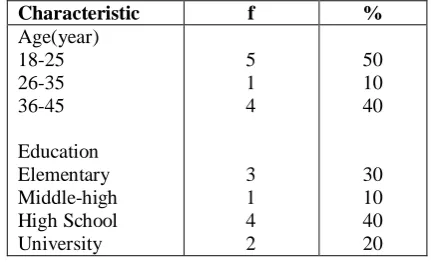
Table 1: Characteristics of Respondents by Age and Education.
Characteristic f %
Age(year) 18-25 26-35 36-45
Education Elementary Middle-high High School University
5 1 4
3 1 4 2
50 10 40
30 10 40 20
Table 2: Differences in Knowledge, Skills, and Intentions Helping Choking Victims Before and After Given Training on Choking Management using Self Directed Video.
Variable
Variable Pretest
Mean (SD)
Posttest
Mean (SD) Difference (SD) p-value Knowledge 3.50 (1,581) 4.80 (1,033) 1,30 (1,57) 0,028 Skill
Intention
2,60 (1,430) 58,10 (8,279)
18,20 (1,398) 64,60 (7,214)
15,60 (1,955) 6,50 (7,634)
0,000 0,025 SD=Deviation Standard
Dependent t test: knowledge p = 0,028, skill p = 0,000, intention: p = 0,025
DISCUSSION
Based on the statistical test, p = 0,028 (α <0,05) indicating that there is a significant influence of child choking management training using Self Directed Video to the knowledge of mother of a toddler. The results obtained are in accordance with research result conducted by Metrikayanto, et al (2017) indicating that the Self Directed Video given to the Youth Red Cross
students can significantly increase the students' knowledge about the benefits of Lung Heart Resuscitation (RJP) as RJP bystander.
receive, digest and understand the action and procedures information in the video provided. This data is in accordance with the study Febriana (2012) stating that higher age indicates better knowledge. There has been no cognitive change in early adulthood phase, therefore respondents are able to accept and learn new things. At this stage, the development of all the functions of the body is fully mature and cognitive abilities are more complex (Potter & Perry, 2005; Papilia, Sterns, Fieldman & Camp, 2017). Respondents also experienced low levels of stress because they were not present in the classroom.
The average respondent's education is high school level. Previous research has explained that the level of education is related to knowledge, higher education level provides better knowledge (Aruna, 2013). In addition, a total of 10 respondents in the Self Directed Video group possess gadgets that can be easily used to access good information about health and others. Although no respondents have ever attended emergency assistance training, the ease of accessing information via the internet in mobile phones can make it easier for respondents to study videos at home or anywhere in accordance with the needs of respondents. The ease of access to this information is the support of respondents to improve knowledge, learn and repeat training videos.
The choking management video can be learned at any time, does not require a long duration, and can be reviewed again if needed. According to Granito & Chernobilksy (2012) that learning media possessing images, motion, sound components can attract the attention of people and easily memorized. Assadi et al (2015) explain that the benefits gained from such modern training are to increase the retention of trainee knowledge. The video is processed by the brain 60,000 times faster than the text, therefore, it is easier for participants to absorb knowledge available in the video (Margalit, 2015).
The resulting score of pretest on the knowledge variable shows very low score on S (S) S.3 (choking children) S.8 and S.9 (choking management). The posttest score on the three items of the question increases slightly. The results are reinforced by Metrikayanto, et al (2017) stating that the Self Directed Video given to Youth Red Cross students can significantly increase the students' knowledge of the benefits of Lung Heart Resuscitation (RJP) as the RJP bystander.
The mean difference in skill variable is -15.6 (SD = 1,96) with p = 0,000 (α <0,05). This suggests that there is a significant difference between skills before and after training using Self Directed Video. Skill variables consist of accurate identification of the victim, the accuracy of doing back blows, the accuracy of doing abdominal thrusts technique. The average score of respondents' skills in performing choking management before training was 2.6. After training the average score
of skill in choking management was 18.2. With an average score of values before training 2.6, it can be seen that almost all respondents cannot perform choking management properly. Some of the actions taken by the respondents are by pounding the victim's back, turning the victim's body upside down and there are some respondents who directly take the victim to the health worker or ask for help. This shows that the average skills of respondents in the management of choking are low. After being trained, respondents can perform proper choking management in accordance with the taught material with an average score of 18.2. It can be concluded Self Directed Video provides a significant effect on respondents’ child choking management training.
This result is consistent with research conducted by Lwin, et al (2017) comparing the effect of Self Directed Interactive Video-Based Instruction vs. Instructor-Led Teaching to basic surgical skills performed on Nursing School students. Based on Lwin et al. Research result, there were significant differences in skills before and after training using Self Directed Interactive Video-Based Instruction vs. Instructor-Led Teaching. The value was p <0.001 for both treatment groups. The study is also in line with research conducted by Wang C, et al. It stated that there is an increase in CPR performance performed by students who received training using video, with a value of p <0.001. Assadi T, et al, (2015) explains that Video Self Learning improves performance in performing CPR in BLS training compared to other methods.
Choking management training videos given to respondents can also be economically useful because they do not cost much and time efficiency. Respondents are self-explanatory. This is reinforced by Assadi T, et al, (2015) research stating that BLS training conducted using Video Self Learning can save time and cost. Respondents practice independently at home or elsewhere appropriate and comfortable. Respondents may also view training materials at any time. Participants have laptops, DVD players or mobile phones. In addition, respondents can also set the time when they should practice. This condition can reduce stress levels when they meet with fellow trainees.
The choking management video provided comes with pictures, sounds, and explanation of steps in performing choking management. This makes it easier for respondents to understand and repeat the existing material in the video by making it easy to practice. Psychomotorically the movements shown in the video can be observed, copied, and evaluated. Granito & Chernobilksy (2012) explains that learning media that have components of images, motion, sounds can attract the attention of people and easily memorized.
years old) intention in helping the choking victim increase after the training. The average difference value -6,5 (SD = 7,63) with the mean value of the training that is 58, 1 and the mean score after training was 64.6. The p-value = 0.025 (α <0.05) means that there is influence between before and after given training using Self Directed Video on Intention in helping Choking Victim.
Intention in helping choking victims consists of 3 indicators of Perceived Behavioral Control, subjective norms, and attitudes. Judging from the score between before and after being given choking management training using Self Directed Video, there is a considerable increase of intention. Almost all respondents claimed to have less support from people around to save choking victims (S.1), stated that they were entitled to help or not help victims (S.2), small possibility to help choking victims (S.3), agreed that most people do not want to help choking victims (S.4), are less confident to perform choking first aid (S.5) lack of hope of others to provide help to choking victims (S.6), lack of effort providing help to choking victims (S.7), small possibility of others providing help to choking victim (S.8), the assumption that there is no point in providing help to choking victims (S.9), insufficient satisfaction (S.10) , low level intention to help choking victims (S.11). After training on Self Directed Video there is an increase of score on item 1, that is, the training given to the respondent is new and has never been done. Respondents felt that the training was very useful. Increased high scores on question number 3, that respondents stated the possibility to help victims of choking is large and item. Question number 9 which states that respondents are satisfied to provide help to choking victims. Ajzen (2005) explains that there are three factors that affect one's intention, Perceived Behavioral Control, subjective norm and attitude. If these three factors exists, then the possibility of someone to do something is also higher. This is also in accordance with the results obtained that the average difference between the value of before and after training is 6.5. It indicates that the respondents obtained good support from these three aspects. Therefore the respondent's intentions also increase, which means that there is influence between before and after choking management training using Self Directed Video.
The respondents who received training using Self Directed Video were statistically increasing intentions due to increased knowledge and skills in performing relief measures. The existence of moral support in the form of support of others (social), support knowledge about the choking hazard that occurs in children obtained through choking management training, the understanding choking could occur at any time that can not be predicted, and the ability to do choking management can be a separate motivation for respondents in providing help to victims.
This is in accordance with Metrikayanto (2018) that the self-directed video item analysis proved better in improving the attitude of high school students in performing CPR by using I-Career Cardiac Resuscitation Mannequin. The results of Kapti, Rustina & Widyatuti (2013) exhibit that effective video is also used to provide health education because it can increase knowledge and can change attitudes for the better. Kantohe, Wowor & Gunawan (2016) explains that the video can improve the learning experience through complete, clear, varied and fun method.
This training is also easier to understand because it involves multiple senses, the presentation of video can be controlled and can be repeated in accordance with the desired and can cover all the realms of both cognitive, affective and psychomotor. On the affective aspects of video, learning can improve the emotional aspects of respondents through video content.
CONCLUSION
The training method of a child choking management using Self Directed Video has a significant effect sequentially on mother of toddler’s skill, intention and knowledge.
RESEARCH LIMITATION
The study was conducted within 3 days. Therefore the researchers weren’t able to measure the retention of respondents' knowledge.
RECOMMENDATION
The researcher recommends child choking management training to the general public to overcome limited amount of manpower and tools. It can be carried out using self-directed video to get the optimal result as far as there is electronic equipment that can be used to play video.
REFERENCES
1. Ajzen, I. Theory of Planned Behaviour Questionnaire . Measurement Instrument Database for the Social Science, 2013. Retrieved from www.midss.ie.
2. American Academy of Pediatrics. Policy statement--prevention of choking among children. Pediatrics, 2010; 125(3): 601-607.
3. American Red Cross. First Aid /CPR/AED Participant’s Manual.
https://www.redcross.org/images/MEDIA_CustomP roductCatalog/m55540601_FA-CPR-AED-Part-Manual.pdf, 2015.
5. Dula Abera. Assessment of knowledge, attitude and practice towards the first aid management of foreign body aspiration and obstruction among the community living in addis alem town of ejere wereda of west shewa zone 2014/2015, 2015. 6. Kapti, r. E., rustina, y., & widyatuti, w. Efektifitas
audiovisual sebagai media penyuluhan kesehatan terhadap peningkatan pengetahuan dan sikap ibu dalam tatalaksana balita dengan diare di dua rumah sakit kota malang. Jurnal ilmu keperawatan, 2013; 1(1): 53-60.
7. Liraz Margalit. Video vs Text: The Brain Perspective. Watching a video and reading an article activate separate cognitive functions. Phsycology
Today, 2015.
www.psychologytoday.com/blog/behind-online-behavior/20150.
8. Markant, D., DuBrow, S., Davachi, L., & Gureckis, T. M. Deconstructing the effect of self-directed study on episodic memory. Memory & Cognition, 2014; 42(8): 1211-24.
9. Metrikayanto et.al. Perbedaan Metode Simulasi dan Self Directed Video Terhadap Pengetahuan, Sikap dan Ketrampilan Resusitasi Jantung Paru (RJP) Menggunakan I-Carrer Cardiac Resuscitation Manekin Pada Siswa SMA Anggota Palang Merah remaja (PMR). Jurnal Care, 2018; 6(1).
10. Osamu Higuchia, Yuichi Adachia,, Yoko S. Adachia, Hiromichi Taneichia, Tomohiro Ichimarub, Kazuteru Kawasakic Mothers’ knowledge about foreign body aspiration in young children. International Journal of Pediatric Otorhinolaryngology. Elsevier, 2013. http://dx.doi.org/10.1016/j.ijporl.2012.09.026 11. Salih, A. M., Alfaki, M., & Alam-Elhuda, D. M.
Airway foreign bodies: A critical review for a common pediatric emergency. World Journal of
Emergency Medicine, 2016; 7(1): 5–12.
http://doi.org/10.5847/wjem.j.1920-8642.2016.01.001.
12. Ramasamy Aruna. Hubungan Tingkat Pendidikan dengan Tingkat Pengetahuan Tentang Antenatal Care dalam Kalangan Ibu Usia Subur, 2013. jurnal.usu.ac.id/ejurnalfk/article/view/1296.
13. Utami, d. S. Teknik mencegah bayi tersedak pada ibu menyusui di puskesmas pembantu desa demung besuki situbondo. Kti d3 kebidanan, 2014.
14. Wang, C., Huang, C., Lin, S., & Chen, J. Using multimedia tools and high-fidelity simulations to improve medical students' resuscitation performance: An observational study. BMJ Open,
2016; 6(9): doi:http://dx.doi.org/10.1136/bmjopen-2016-012195.
15. Widiastuti, d. Aspirasi kacang pada anak. Sari
pediatri, 2016; 4(4): 186-191.