THEORETICAL FRAMEWORK FOR FOOD SECURITY AND
SUSTAINABLE MEANS OF SUPPORT
1Yusupov Erkin Djuraevich, 2Ziyadullayev Ilxomjon Narkabilovich, 3Tuxtamishev Shodimurod Qurbonboyevich, 4G’aybullayev Odil Baxtiyarovich
1Prof. Dr. (Sc.D.), Tashkent State Agrarian University, Uzbekistan, 234Independent researcher, Tashkent State
Agrarian University, Uzbekistan
1. INTRODUCTION:
On a global scale, there is a constant transformation of the views of the public and the scientific community on the concept of “food security”. We can note a shift in focus from the abstract representation of world food security as the ability to produce enough food to feed the world's population, to the level of the country, households and the availability (economic and physical) of products for each person [7; 16]. Summarizing some theoretical and regulatory approaches to the definition of food safety [1; four; 8; 10−13], food security of the country can be represented as the state of the state’s economy, under which the following conditions are fulfilled: 1) the population of the country as a whole and each of its inhabitants individually has stable physical and economic access to a sufficient quantity (volume and assortment) of high-quality, high-grade and environmentally friendly food (food, clean drinking water and other sources of nutrients) mainly of domestic production, providing healthy physical personal and social development of the individual and expanded reproduction of the country's population; 2) the agro-industrial complex, fisheries and forestry are provided with domestic raw materials, are developing steadily and have reserves for increasing food production; 3) there are operational reserves and strategic reserves of food; The concept of "economic security" in the most general way of the country tangible and intangible, renewable and non-recoverable economic potential. 4) science is developing, state support is provided for fundamental and priority applied research in the agricultural, environmental and medical fields. The Food Security Doctrine of the Russian Federation states that the main sources of food are products from the rural, forestry, fishery, hunting, and food industries1. Thus, by the food system of a country we will mean a set of measures of the state agrarian, marine, forestry policy, as well as policies in the field of hunting, food industry and trade. The concept of the institutional environment is one of the foundations of the institutional economy.
2. LITERATURE REVIEW:
Under the institutional environment (the institutional structure of the economy, the institutional framework), representatives of institutionalism (O. Williamson, D. North, L. Davis, A. Oleinik, R. Richter, etc.) understand the rules, norms that guide individual behavior. . Rules and norms can be both formal (politics, judicial system, property right, contract law), and informal (customs, traditions, cultural features, mentality) [2]. For the purpose of this study, the necessary formal the basis (normative legal base), which delineates the boundaries of the powers of the subjects of the food security system, the features of their interaction, responsibility for achieving the necessary level of food security population development. We will consider the development of the institutional environment as a form of organization of economic relations based on a constructive dialogue between the state and business in the agricultural sector of the economy.
3. MATERIALS AND METHODS:
The assessment methodology is based on the criteria for institutionalizing the food security of the population as a system of the following indicators: • availability of regulatory legal acts defining the concept of food security (independence) of the population; goals tasks; principles; directions of achieving food security of the population; threshold values of own agricultural production; methods of assessing food security of the population; distribution of powers and responsibilities between authorized bodies • the share of state support for agriculture in the framework of the “green basket” in the total amount of support • the quality of the procedure for assessing the regulatory impact of
Abstract: In this article, food security is economic security one of the most important types of food products is food
the growing need for food security and the importance of food security; Food Safety Assessment Indicators, CIS self-contained with the main types of food of the countries Recommended threshold value of the level of provision, Food security and nutrition in Uzbekistan Scientific proposals for further stockpiling practical recommendations are developed.
regulations in the field of business and investment activities affecting the region food security of the population, including agriculture, safety and quality of food and agricultural raw materials. We consider each x the characteristics of the institutionalization criterion for the food system are more detailed.
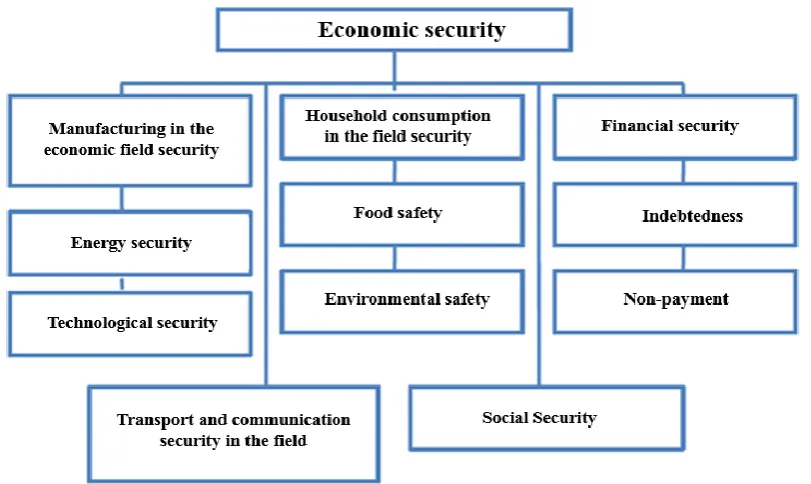
The concept of economic security as an economic category independence of national economy, its stability, stability, the ability to constantly renew and improve on its own a set of conditions and factors that provide.
Food security is an important form of economic security one (Figure 1).
Figure 1. Types of economic security in the areas of economic activity
In the Strategy of Action for the five priority areas of development of the Republic of Uzbekistan in 2017-2021, the President of the country Sh. Mirziyoev significant capacity building” [1].
Food security implies that the population of the country is provided with basic foodstuffs with sufficient internal capacity to achieve a minimum import dependence. Since Uzbekistan gained independence, two steps have been taken to ensure food security:
- expanding rural areas and allocating new villagers; - Revision of the composition of agricultural crops.
The state's food policy also provides for self-sufficiency in potatoes, fruits and vegetables. Provision of adequate livestock products and vegetable oil to the population,
The key areas of food security are the establishment of the necessary base for processing and storage of agricultural products, as well as the formation of sufficient supplies of basic foodstuffs, ensuring the stability of their retail prices, and reducing the volume of imported products.
Speaking at a joint session of the Chambers of Oliy Majlis dedicated to the inauguration of the President of the Republic of Uzbekistan, Mr. Sh. Mirziyoev said that "the issues of agricultural reform and food security will undoubtedly remain one of our most important tasks».
The concept of food security was first proposed at the World Food Summit in 1974, meaning that "there is always enough food in the world to provide sustainable growth in food consumption and offset by changes in production volumes and prices." In recent years, the concept of food security has been expanded to include the safety and nutritional status of foods and their personal preferences. There is a great deal of understanding and performance in the modern food security literature. Although there are many concepts and indicators regarding food security, the idea is extremely important.
In 1996, the World Food Security Summit established food security as a prerequisite: “… all people have sufficient and economical access to safe and nutritious foods to meet their nutritional needs and personal preferences and to lead an active and healthy life. can be”.
Food security is the state of the economy, ensuring that food supply is sustained, regardless of the fluctuations in the global markets, with conditions that satisfy consumption on the one hand, in scientifically reasonable rates, and at the level of medical norms [7].
The increasing demand for food can be explained by the following. First, with the population growth, the need for food will increase substantially. For example, in 1804 the world population was 1 billion people, and now it is more than 7 billion (Table 1).
Table 1. Increase in the number of every billion people in the world and its outlook is [7].
Population Year The difference in the population growth rate of every billion people with the previous period
1 billion 1804 -
2 billion 1927 123
3 billion 1960 33
4 billion 1974 14
5 billion 1987 13
6 billion 1999 12
7 billion 2011 12
8 billion 2025 14
9 billion 2043 18
10 billion 2050 7
As can be seen from the table, the population has increased almost sevenfold over the past 200 years. And food is grown on the ground. The surface of the earth has not changed. In addition, in recent years there has been an increase in desertification rates and a decrease in soil fertility as a result of salinization of arable land.
Secondly, the growing income of the population also contributes to the quantitative and qualitative growth of food demand. The economic growth of the world's most populous countries in recent years has also led to increased demand for food. In this regard, the First President of the Republic of Uzbekistan I.A. Karimov said: “… In several Asian countries, such as China, India, the population's incomes are growing rapidly and, accordingly, food consumption is increasing” [2] as mentioned.
Thirdly, there is a growing trend towards food diversity. That is, we need to understand that there is an increase in the range of food products, the creation of new varieties, and the need for other new types of food products.
The main goal of achieving food security is to provide raw materials to the processing enterprises, regardless of internal and external impacts. It should not even be related to the lack of currency, the rising embargo on the import of goods from other countries.
Important conditions for achieving food security are:
Etarli availability of food per person (sufficient supply thereof);
Iqtisodiy Economic feasibility of purchasing food by all social categories of the population, including the poor; Etarli Sufficient intake of high quality foods for proper nutrition [5].
According to FAO experts, food security status is determined by factors such as food security factors, indicators, sustainability, availability and health. These are detailed below.
Sustainability: In order to ensure the continuity of food supply, the population, family or individual must always have access to food. They should not be cut off from food because of unforeseen events (eg economic or climate crisis) or cyclical events (eg, climate food shortages).
Food Availability: The provision of sufficient quality foodstuffs through internal production or imports (including food aid). The most commonly used measure of food availability is daily per capita energy consumption (KES), which is calculated in calories. According to FAO methods, KES is calculated based on the type of food consumption based on the food balance. FAO calculates food balance using data from different sources of food supply (production, savings, trade) and consumption (or consumption) of products (feed, seeds, industrial use, waste) [5].
Access to Food: Material, Economic and Social Opportunities for Using the Resources That Need to Get Nourishing Nutrition.
The food supply assumes that foodstuffs are available on the market in the quantity and choice required by consumers, and that there is an infrastructure to feed the population.
Economic opportunity means that all social strata of the population can afford to buy enough food. In other words, economic opportunity means that households have sufficient income to buy food and that the country has enough foreign currency to import food.
Use: Achievement of all physiological needs by proper nutrition, clean water, sanitation and health care. Failure to meet any indicator may result in low food security or malnutrition.
Food inadequacy is a situation where the population does not have sufficient access to safe and nutritious foods that are necessary for normal growth, development and an active lifestyle.
Malnutrition or inadequate food insecurity can lead to malnutrition among the population, with serious consequences for people, families, and the population of the country.
At the national level, the analysis of food security levels is reflected in the food balance (FOB), ie availability of food in the country. The FBS provides statistical estimates of food availability and human consumption in the country over a specific period and their nutritional value. The food balance has collected data on food, agriculture and imports, which allows us to assess the food and agricultural conditions in the country and the extent of the country's dependence on imports (import dependence index).
Assessment of the food security of the population is carried out using the following indicators: Constant availability of foodstuffs in assorted quantities and assortments throughout the country; Minimal availability of food for all consumers, regardless of their social status and place of residence;
Xavfsiz Food safety - the absence of substances which make the product unsuitable or dangerous for the person; Sif Quality of food, ie daily consumption of calories and nutritional components of the person, depending on his age and area of activity. At the same time, the nutritional quality is ensured by the combination of proteins, fats, carbohydrates, vitamins, macro and micronutrients that meet the dietary rationale recommended by the authorities.
To meet the needs of the aforementioned population, the country's food security criteria are set. In assessing the availability of food for the population, the critical value in terms of both quantity and quality is calculated as the level of self-sufficiency and transient stocks of food in the world, which should be between 15 and 20% [9].
For international food security assessments, the indicators proposed by the Commonwealth of Independent States (CIS) in the food security concept can be used. The concept of improving the food security of the CIS member states was approved by the decision of the Council of Heads of Government of the CIS on November 19, 2010, which provides the following set of indicators for assessing the country's food security level (Table 2).
Food Safety Assessment Indicators
1 Availability of economic opportunities for food consumption is the ratio of food costs to total costs of all types of goods and services;
2 Potential capacity of the domestic market for certain food products is the increase in per capita consumption of certain food products by the actual consumption of this product;
3 The level of food independence of certain foods - the ratio of the actual production of a particular type of food in the country to the actual consumption of that product;
4 The biological value of the product is the nutritional value of the product and is determined by the amount of vital nutrients and energy in 1 gram of food: energy (kcal), protein (mg), fat (mg), carbohydrates (mg);
5 The biosecurity indicator is determined by the amount of hazardous ingredients in the food, which should not exceed the permissible levels;
6 the daily nutritional and energy value of the human diet; 7 Sufficiency of each individual food intake;
8 adequacy of grain reserves in the state resources; 9 Sufficiency of fresh drinking water resources;
10 availability of food accessibility for different categories of the population;
11 dependence of import dependence of the country on food supply and resource supply of agro-industrial complexes;
12 strategic, operational, and transient food stocks comparable to their normative levels;
13 Share of agricultural and fish products and food products in the total consumption and commodity resources of our country (share);
14 satisfaction of physiological needs of food products with their safety and nutritional value;
15 Percentage of the share of agricultural and fish products, raw materials and food products in the total volume of commodity resources in the domestic market.
The aggregate assessment of the level of food security of the CIS member states is used as a percentage of the proportion of agricultural and fish products, raw materials and food products to the total volume of commodity resources on the domestic market [5].
Satisfaction of physiological needs of food products with their safety and nutritional value; 15. Percentage of the share of agricultural and fish products, raw materials and food products in the total volume of commodity resources in the domestic market.
Table 3. Recommended levels of self-sufficiency in basic foodstuffs in the CIS countries
Product Name Recommended level of self-sufficiency, not less than%
Don 95
Milk and dairy products (in terms of milk) 90 Meat and meat products (in terms of meat) 85 Fish products, vegetable oil, sugar 80
In addition to the key threshold values and indicators recommended by international organizations, food safety assessment should take into account and evaluate the country's capacity for food security in the following areas:
-agricultural production capacity is assessed based on available production capacity, land and labor resources; The level of development and sustainability of agricultural production, taking into account the actual quality of available machinery and technologies, the results of the evaluation of the financial and economic condition of the branches and organizations of the ASM;
the level of provision of production resources in the country, including budgetary financing and other sources; Sif The quality of agricultural products and food produced by domestic organizations;
- the volume of imports, including those in the country, compares with domestic production and the needs of the population in food;
Mechanism of response to import interventions with the openings of food;
- environmental level of the network in terms of environmental pollution and the use of banned drugs, technologies, including genetically modified organisms (GMOs), growth stimulants, antibiotics and more;
- compliance of food security requirements with legal legislation, system of regulatory documents, directions of the state agrarian policy and world trends and norms;
- food security threats and threats.
The achievement of food security in the context of agricultural development over a period of time can be assessed in terms of the following indicators [5] (Table 4):
Table 4. Estimates from the food security attainment level
1 Per capita production of basic agricultural products.
This index can be used to estimate the dynamics of reproduction in this sector of the economy, taking into account the changes in population during the period under review.
2. Compliance of agricultural products with the standards recommended by the Ministry of Health of the Republic of Uzbekistan and international standards.
In accordance with these standards it is possible to recommend quantitative and qualitative composition to ensure sufficient level of per capita consumption of agricultural production.
3. Main financial and economic indicators.
The following indicators can be used to quickly evaluate the financial and economic status of agricultural production at the state or regional levels:
-Residual result (profit minus loss) of all agricultural enterprises; -Number of enterprises doing profit or loss;
-Profitability of agricultural production in general, including crop and livestock production.
In particular, household food security is largely influenced by per capita income, as the actual consumption of food depends on the level of income. Income, in turn, depends on the wages of family members, pensions and social allowances for the disabled, pensioners and the poor; depends on income from individual activities. At the same time, there is a correlation between food expenditures and changes in the real cash income of agricultural products, prices in the food and processing industries of the ACM.
The lower limit for the quantitative and qualitative diet of the population can be considered as the minimum consumer basket, which includes a certain set of goods and services.
The minimum subsistence basket is defined based on the subset of goods and services, which is the minimum income that is equivalent to the cost of the minimum consumer basket to meet the minimum biological needs of the individual. Given this, the subsistence minimum is designed for:
assessment of living standards;
the definition of poverty;
justification of social policy directions;
social support measures
implementation;
most of wages, pensions, allowances and other social payments
to justify small amounts.
The impact of these factors on food security can be assessed on the basis of the following food consumption indices:
Estimation of purchasing power of income of the population;
minimum and average monthly wage, minimum ratio of the pension to the subsistence minimum; if the ratio is 1, the level of consumption of food products the minimum consumer basket;
if the ratio is greater than 1, the level of food consumption exceeds the minimum consumer basket; Practice basic foods;
per capita consumption;
State food security policy, mainly in its agricultural production and domestic sales food markets, in part, from overseas food products based on the import of the population are acceptable level. Food of the state safety policy with food products the level of supply and the levels of importation are reasonable harmonization of the population of the country with food products creation of guaranteed opportunities, international in this regard the ability to build partnerships is important. From this In addition, this policy is food that is periodically updated will also be focused on creating new reserves.
Food security and nutrition in Uzbekistan the following suggestions and recommendations for further stockpiling.
Developed by:
1. Reliable food security in the Republic of Uzbekistan in this way, agriculture is irrigated to ensure sustainability to improve the ameliorative condition of lands, perform the following it is necessary to increase:
- advanced technologies in irrigation of agricultural crops and increasing the responsibility of water users efficient use of water resources;
- It is advisable to regularly monitor the reclamation of irrigated agricultural land, to take drastic measures against unauthorized land use and irrigated land, and to take decisive action against those who have made it unusable.
2. To change the structure of agriculture in the republic in order to increase food production it is necessary to: - it is necessary to study and apply best practices of foreign countries in the production of agricultural food products and their free delivery to consumers;
- Rational distribution of varieties of agricultural crops, taking into account the climatic conditions of the regions and regions of the republic, improving the quality of products and crop yields;
- provision of seeds of fast-growing and highly productive agricultural crops against pests and diseases; - development and implementation of scientifically grounded system of crop rotation;
- Expanding the scale of effective use of mineral fertilizers, biological pest management.
4. CONCLUSION :
Summing up, we can conclude the following: • only a small number of regions of the country are characterized by legislative activity in the field of food security of the population • the amount of state support for agriculture in the framework of the “amber basket” prevails over the “green basket” measures, which is explained by the peculiarity of the offshore economic policy that guides the bulk of support through compensation for interest on bank loans • the quality of the assessment of the regulatory impact of the regulatory framework on business It varies greatly in the regions.
In general, the regulatory impact assessment procedure is a relatively new practice in Uzbekistan, so it takes time to reach higher levels.
REFERENCES:
2. Karimov I.A. Remarks at the Opening Ceremony of the International Conference "Important Resources for the Implementation of the Food Program in Uzbekistan". Speech of the People, June 7, 2014.
3. Mirziyoev Sh.M. We will build a free and prosperous, democratic Uzbekistan with our courageous and generous people.
Speech by Mirziyoev at a joint meeting of the Chambers of the Oliy Majlis on the occasion of the inauguration of the President of the Republic of Uzbekistan. December 15, 2016
4. Yusupov E. D., Durmanov A.Sh. The impact of hudropower objects to social – ekologik balans. Актуальные вопросы
развития аграрной науки в современных экономических условиях. Материалы IY – Международной научно –
практической конференции молодых ученых. ФГБНУ «ПНИИАЗ» 2015 г.
5. Yusupov E. D., Рыночные принципы диверсификации деятельности субъектов бизнеса в сельском хозяйстве. Вестник
ККО АН РУ журнали 2018 йил йил 2 –сони 123-126 ст.
6. Yusupov E. D., Экономико-организационные аспекты эффективной организации пчеловодческого бизнеса.
Материалы международной научно-практической конференции: «Повышение эффективности социально
-экономической деятельности государства и международных отношений в условиях обеспечения конкурентоспособности Казахстана» Алмааты 2019, стр. 109-112.
7. Yusupov E. D., Теоретические проблемы оптимизации субъектов аграрного рынка. Материалы международной
научно-практической конференции: «Повышение эффективности социально-экономической деятельности
государства и международных отношений в условиях обеспечения конкурентоспособности Казахстана» Алматы 2019, стр. 112-116.
8. Yusupov E. D., Диверсификации деятельности субъектов бизнеса в сельском хозяйстве: теоретические основы и
рыночные принципы ее реализации. Российский электронный научный журнал 12+ № 4 (30), 2018. DOI: 10.31563/2308-9644-2018-30-4-162-167.
9. Eshev A. S., Nazarova F. Kh. (2019). Influencing factors for the development of agricultural strategy in the republic of
Uzbekistan. International journal for innovative research in multidisciplinary field. V - 5, I - 7, July – 2019. 151-160 p.
10.Eshev A. S., (2019). Competitiveness management products of the agricultural sector. International journal for innovative
research in multidisciplinary field. V - 5, I - 7, July – 2019. 214-222 p.
11.Sedik, D., Ulbricht, C., Dzhamankulov, N. (2016): The Architecture of Food Safety Control in the European Union and the
Eurasian Economic Union
12.Durmanov A., Umarov S. (2018). Economic-mathematical agricultural production. Asia Pacific Journal of Research in
Business Management Vol. 9, Issue 6, June 2018, 10-21.
13.Umarov S.R. (2017). Innovative development and main directions of water management. Economy and Innovative
Technologies, (1). Available at: https://goo.gl/eEHSJK. (in Uzbek).
14.Umarov S. (2018). Scientific-theoretical basis of the innovative development of water resources of
Uzbekistan. Bulletin of Science and Practice, 4 (12), 409-415. (in Russian).
15.R. Muradov. Water use in conditions of irrigation water shortage // Vestnik of Tashkent State Technical University. 2010. №1
-2. Pp. 164-168.
16.R. Muradov. Some Issues of Efficient Land Use in WUAs with a Deficit of Water Resources // IX International. Nauchn
- Practical. Conf. "Agrarian science - agriculture". Barnaul: AltaiGAU, 2014. P. 460-462.
17.A. Sh. Durmanov SR Umarov, EO Bozorov. (2019). Evaluation of the technical - economic effectiveness of
electric energy. Sustainable Agriculture Vol. 1, Issue 2, June 2019, 22 -2 4.
18.Umarov SR (2017). Features of innovative water management . TRANS Asian Journal of Marketing & Management Research
(TAJMMR). Vol. 6, Issue 1, 2017, 45-53.
19.Umarov S.R., Umurzakov UP (2010) Increasing investment activity portfolio in Uzbekistan. “Water management - prospects
of development” // Collected articles of young scientists. Rivne, 2010. 128-130 p.
20.Durmanov A.Sh. “Development of entrepreneurship and social partnership in Uzbekistan”. " Ijtimoiy ҳ
amkorlik-iқtisody munosabatlarni erkinlashtirish omili " mavzusidagi ilmy Amalie Conference T oshkent 2014 yil.135-138 betlar.
21.Durmanov A. Sh. Cooperation as a basis for increasing the economic efficiency of production of open ground
vegetables. "Bulletin of science and practice" in number 8 (August), 2018.
22.Durmanov A. Sh. Foreign experience of organizational greenhouse farms. Economics and Finance. 2018. № 7
23.Durmanov A.Sh. (2018). Economic interests of producers and consumers of products in the greenhouse vegetable market. VII
International Scientific and Practical Conference of Young Scientists "Achievements of Young Scientists in the Development of Agricultural Science and the AIC", held July 18-19, 2018 in p. Salt Zamische based on FSBI "Caspian Research Institute of Arid Farming". 506 -509 p.
24.Muradov RA, Shaymanov N.O. (2018). Of The the Results of Theoretical Research the. On an and Levelling of irrigated Lands.
International journal for innovative research in multidisciplinary field. 2018. 358-366 p.
25. Durmanov, A. S., Tillaev, A. X., Ismayilova, S. S., Djamalova X. S. & Murodov, S. M. ogli. “Economic-mathematical
modeling of optimal level costs in the greenhouse vegetables in Uzbekistan”, Espacios, Vol 40, No 10, pp. 20, 2019.
26.Tkachenko Serhii, Berezovska Liudmyla, Protas Oksana, Parashchenko Liudmyla, Durmanov Akmal. Social Partnership of
Services Sector Professionals in the Entrepreneurship Education. Journal of Entrepreneurship Education, Vol: 22 № 4 pp. 6,