What is Unique About Extension Personnel in the City?
Julie Fox
The Ohio State University
Extension’s pursuit to better attract, develop, retain, and structure competent personnel in the city requires new strategies to build on the knowledge base established through previous research and practice. With the support of numerous national organizations, this study utilized a Competency Framework Development (CFD) process to systematically tap into the knowledge of County Extension Directors serving in large urban communities. Findings indicated these local leaders need specific knowledge, skills, attitudes, and beliefs that are both similar and unique when compared with results from other Extension competency studies. Competencies identified included building social and financial capital, strategic planning and organizing, resource attraction and management, advocacy and impact accountability with multiple stakeholders, and others. A primary difference was that diversity, complexity, and scale in urban communities influenced the extent to which competencies are demonstrated. Research results can be applied to a competency model that incorporates
intentional recruiting and hiring practices that reflect the diversity and priorities of the community, competency-based professional development, competitive compensation and retention tactics, and staffing structure and strategies. Further research can include CFD with various types of Extension personnel and
perspectives. Extension leaders can continue learning alongside others who can help inform administrators about human capital policies and practices.
Keywords: human resources, competencies, urban, metropolitan, county Extension director, staffing, workforce, diversity
Introduction and Theoretical Framework
Diversity, complexity, and scale in urban communities challenge leaders to consider how Extension attracts, develops, retains, and structures competent talent. Throughout Extension’s history, Extension leaders have examined and tested models for effective urban Extension personnel (Brown, 1965; Harriman & Daugherty, 1992; Krofta & Panshin, 1989; Miller, 1973; Schaefer, Huegel, & Mazzotti, 1992; Yep, 1981; Young & Vavrina, 2014). While there are similarities to staffing and workforce development in all geographic areas, there are
opportunities to explore the unique context of personnel serving the Extension mission in large
cities. When the National Urban Extension Leaders (NUEL) conducted a strategic analysis of emerging urban Extension themes in the literature, personnel was identified as an area of focus (NUEL, 2015).
A fundamental element of human resource systems is identification of competencies, which are defined as a set of observable performance dimensions, including individual knowledge, skills, attitudes, and observable behaviors or characteristics (McClelland, 1973; Mirabile, 1997). Competencies have also been described as collective team processes and organizational
capabilities (Athey & Orth, 1999). The value of competencies and competency models includes organizational competitiveness (Lado & Wilson, 1994; Prahalad & Hamel, 1990; Vakola, Eric Soderquist, & Prastacos, 2007), an essential factor in urban communities where thousands of agencies, businesses, and nonprofit organizations vie for limited resources and champion their causes in a congested environment. Professional competencies needed by Extension personnel have been studied as a determining factor for relevant selection, training, and retention of talent (Benge, Harder, & Goodwin, 2015; Haynes, 2000; Lakai, Jayaratne, Moore, & Kistler, 2014).
Many state Extension systems incorporate competencies into human resource practices, and several authors have identified Extension personnel competencies based on different types of positions, program areas, geographic areas, stage of career, or demographics of personnel.
For example, in 2002, the Personnel and Organizational Development Committee (PODC) of the Extension Committee on Organization and Policy (ECOP) synthesized the work of 10 states and numerous studies and encouraged Cooperative Extension Systems to use 11 core competencies for professional development of campus- and field-based faculty and staff (Maddy, Niemann, Lindquist, & Bateman, 2002). A few comprehensive dissertations were published on competencies, including survey
research in Ohio (Cochran, 2009) and Varner’s (2011) qualitative study with millennials in Nebraska.
In 2013, ECOP identified key characteristics of 21st century Extension professionals by studying Extension job postings, surveying Extension directors, and conducting focus groups with successful Extension professionals (Hibberd, Blomeke, & Lillard, 2013).
One program-specific competency framework is the 4-H Professional Research, Knowledge, and Competencies (PRKC) model (Stone & Rennekamp, 2004). In 2000, a position-specific study examined 127 county Extension administrators
from 22 states to assess 15 supervisory and management competencies deemed necessary for success as a county Extension administrator (Haynes, 2000).
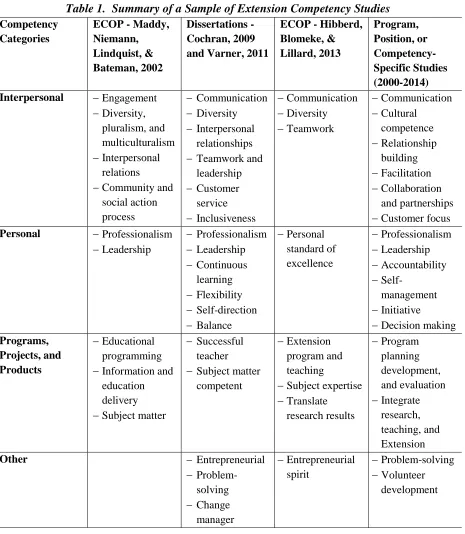
The majority of the findings provide a consistent framework (see Table 1) but do not focus on the distinctive competencies of professionals working in or influencing Extension’s work in urban communities. One study by Ritsos and Miller (1985) focused specifically on urban Extension professionals in Ohio and included similar competencies, such as public relations as an interpersonal competency, professionalism as a personal competency, organizational skills as a competency related to the business of Extension, and program management.
Table 1. Summary of a Sample of Extension Competency Studies Competency
Categories
ECOP - Maddy, Niemann, Lindquist, & Bateman, 2002
Dissertations - Cochran, 2009 and Varner, 2011
ECOP - Hibberd, Blomeke, & Lillard, 2013 Program, Position, or Competency-Specific Studies (2000-2014)
Interpersonal Engagement
Diversity, pluralism, and multiculturalism Interpersonal
relations Community and
social action process Communication Diversity Interpersonal relationships Teamwork and
leadership Customer service Inclusiveness Communication Diversity Teamwork Communication Cultural competence Relationship building Facilitation Collaboration and partnerships Customer focus
Personal Professionalism
Leadership Professionalism Leadership Continuous learning Flexibility Self-direction Balance Personal standard of excellence Professionalism Leadership Accountability Self-management Initiative
Decision making Programs,
Projects, and Products
Educational programming Information and
education delivery Subject matter
Successful teacher Subject matter
competent
Extension program and teaching
Subject expertise Translate research results Program planning development, and evaluation Integrate research, teaching, and Extension
Other Entrepreneurial
Purpose and Objectives of the Competency Framework Development Process
To better understand what it takes to serve as an Extension leader in urban or metropolitan designated areas, a competency study was conducted of county Extension directors working in large counties. County Extension directors were selected due to their critical role in navigating community and organizational complexity and the dynamic interaction between internal and external environments (Jamali, 2005). The present study aimed to systematically tap into the knowledge of practitioners – people who do the job, not those who write about it or instruct it. By establishing a structured set of assessable competencies, Extension leaders can evaluate and improve learning experiences and guide learners to relevant resources to meet their professional development goals. Results will inform Extension administrators, human resource professionals, and other leaders as they attract, hire, develop, and retain talent for Extension in large cities.
A secondary objective of the present study was to pilot test the Competency Framework Development (CFD) process available through eXtension, with the intention of conducting additional inquiry focused on other types of urban Extension positions, such as educators or agents, specialists and consultants, paraprofessionals, and volunteers. Beyond the scope of the research conducted at one point in time, the CFD framework allows Extension professionals accessibility to the data in order to continue refining, updating, and adding value related to the functions of an urban county Extension director.
Methods
A Competency Framework Development (CFD) for Urban County Extension Directors (UCEDs) included a multistage process to identify skills, knowledge, attitudes, and beliefs. For the
purpose of this study, the term county Extension director was used as a reference to any title used for local Extension leaders serving large cities or other geographic areas designated by the U.S. Census Bureau as urban or metropolitan. Prior to the applied research, The Ohio State
University’s Office of Responsible Research Practices determined the project was exempt from review by the Institutional Review Board. The study began with an analysis of existing
Competency framework development is a participatory process to identify a collective set of competencies that define the requirements for effective performance in a specific job, profession, or organization (Campion et al., 2011; Cummings, Andrews, Weber, & Postert, 2015).
Practitioners participated in the systematic process that included three facilitated online sessions, using interactive technologies that included Zoom videoconferencing for dynamic
communications and Google Docs for real-time data review. The first practitioner session included an introduction to the CFD process and clarification of terms, such as knowledge (what a UCED needs to know), skills (what a UCED actually does), assessments (what indicators demonstrate degree of ability), and UCED beliefs about what is important in his or her work. In the second session, practitioners suggested competencies through round robin discussion and open dialogue. During this session, the facilitator began developing an online spreadsheet that was used to clarify meaning. Before the third session, each practitioner independently reviewed the emerging competency framework spreadsheet to begin thinking about potential indicators for each competency. During the third session, assessment methods were identified for each
competency. All sessions were based on interviews and were consensus-driven. Following the online sessions, the spreadsheet was made available for participants to review.
Findings
Results of the Competency Framework Development process with Urban County Extension Directors included evidence that these professionals need specific knowledge, skills, attitudes, and beliefs with some being similar and others unique when compared to findings from previous studies (Table 1). The competencies identified by the practitioners included those outlined in Table 2. In addition to the summary, examples provide additional detail on the knowledge, skills, and beliefs linked to each of the nine competencies.
Table 2. Summary of Urban County Extension Director Competencies Competency
Categories
Competency Framework Development (CFD) http://eduworks.com/cfd/nuel-ced/#
Interpersonal Builds social and financial capital with foundations, corporations, government, and other local sources
Personal No personal competencies were identified as unique to urban environments
and the categories were intentionally not used as prompts Programs, Projects,
and Products
Implements and understands Extension programming in the complex urban context
Other Demonstrates sensitivity to the local socio-cultural context and community
history
Interpersonal Competencies
Building social and financial capital with foundations, corporations, government, and other local sources is something all county Extension directors accomplish. In large counties with multiple jurisdictions and thousands of public and private organizations, UCEDs need to exemplify this competency of engaging with existing and potential stakeholders. Those skills could include
serving on and leading community boards and committees; inviting and facilitating involvement in Extension programs; targeting specific outcomes in communications;
building an advocacy network of foundation, corporation, and government personnel; identifying emerging needs;
cultivating funding relationships; and
navigating complex external and internal funding systems.
UCEDs need to know the funding landscape of their county, expectations of funders, community benefits of Extension, and internal mechanisms and organizational structure. UCEDs are driven to provide local impact and recognizes that funders are investors in impacts. They value social capital and believe Extension brings intrinsic and extrinsic value to the community. Assessments of this competency would be evidence of the UCEDs participating on boards and in interest groups relevant to their constituents and obtaining funding for county Extension programs and personnel.
Personal Competencies
Previous Extension studies included various personal competencies, such as professionalism and leadership (Table 1). In the CFD process, categories were intentionally not used as prompts. In this study, no personal competencies were identified as unique to urban environments; however, this does not suggest that personal competencies are not perceived as important from the
practitioner perspective. Further inquiry could add clarification to the competencies, skills, knowledge, and assessment factors related to UCEDs’ personal competencies.
Business of Extension Competencies
UCEDs fulfill functions of a county Extension director and need to be knowledgeable about the history, mission, and practices of Extension. They know the role and responsibilities expected of a county Extension director. But while this might seem simple, this is especially important when hiring directors who are not familiar with Extension. They can discern when to preserve
Planning and organizing involves adaptive management, managing staffing capacity, abiding by grant requirements, addressing legal regulations, and administering a strategic plan of work. They utilize current best management and leadership practices as they align resources with priorities, collaborate with research partners, apply community appropriate solutions, and monitor organizational compliance. UCEDs are adaptive and knows the change process. Their implementation of planning tools that result in high-quality Extension programming is an assessment for this competency.
Management of finances, human resources, infrastructure, programming, and other resources is a core competency. UCEDs work with county government, state-elected officials, municipal government, and the university to forecast funding and resource needs; identify, pursue, and defend appropriate funding sources; and manage facilities, equipment, funds, and human resources. They continually manage the ever-shifting balance of resource capacity and
opportunity evaluation. They need to know the current language of and technology for fiscal and resource planning, best practices in budgeting and negotiations, government structure and
systems, and their university structure and systems. UCEDs are fiscally responsible and accountable to multiple internal and external stakeholders. UCEDs’ resource portfolios and business compliances are relevant assessments. With more diversified funding portfolios, personnel must invest more time and expertise in sourcing and managing multiple resources on various timelines beyond county, state, and federal fiscal cycles (Krofta & Panshin, 1989).
UCEDs understand the local market and optimizes the advantages of Extension through
competition for resources and collaboration with other programs. Skills include analyzing local programs and Extension strengths in target areas, identifying competitors and collaborators for funding and services, and generating and deploying resources to meet the needs of the target area. UCEDs know their local market, their competition, emerging trends in the community, and programming. It is more than knowledge as UCEDs see opportunities and challenges brought on by market change and how Extension programs can fill gaps and complement emerging trends. Assessmentgauges how UCEDs both competes and collaborates with local programs to leverage resources as needed. A larger, more competitive environment requires Extension to align human resource expertise to operate in a more specialized and complex environment.
documenting both the Extension impact and community change is paramount (National Extension Urban Task Force, 1996; Young & Vavrina, 2014).
Program, Project, and Product Competencies
Implementing and understanding Extension programming in the complex urban context is vital for UCEDs. They need to recognize the complexities of their urban county and understand how those complexities impact needs and delivery of Extension programming. UCEDs work with educators and partners to select applicable programs, identify delivery methods and costs, and align resources for relevance to their counties. Assessment of this competency includes metrics such as growth of specific audiences and capacity building to meet growing demand.
Other Competencies
UCEDs must be sensitive to local sociocultural context, community history, and Extension’s past performance in the county. UCEDs must be sensitive to the urban application of Extension programs and philosophy. Skills include
leveraging the strengths of diverse demographics;
reflecting community demographics in advisory groups; managing conflict resolution;
conducting situation and issue assessment; and
displaying an understanding of institutional and socially constructed racism, sexism, and classism.
UCEDs believe that cultural competence is a lifelong-learning process, value the many voices of their varied audiences, and know the histories and complexities of their communities. Due to the magnitude of diversity in metropolitan areas, cultural competence and ensuring inclusivity are essential for all personnel. While this is an expectation throughout Extension, the scope in urban areas intensifies the degree to which personnel apply related competencies (Krofta & Panshin, 1989; Webster & Ingram, 2007). Assessments could include new programs that are sensitive to local urban issues.
Reflections, Conclusions, and Recommendations
In large cities, diversity, complexity, scale, and other factors influence the extent to which Extension personnel apply related competencies such as
demonstrating interpersonal skills as they navigate multiple stakeholder agendas; exhibiting knowledge of the business of Extension as they manage multiple funding
streams, lead an inclusive team, and operate within internal and external parameters. displaying program and project expertise as they align external and internal resources
to service existing and new audiences; and
communicating with local sensitivity and respectful cultural competence as they reach a large and diverse audience.
The number and depth of competencies related to the business of Extension verify the value of investing in UCEDs who focus on leadership, management, and administration, rather than directly on programming. They still understand and are active players in market-driven program planning, but their primary focus remains on partner and resource development.
The Process
The CFD is a relatively new process based on a combination of instructional systems design and skills identification methods, such as the task analysis process for curriculum development (Norton, 1998). As used in this study, the process presented some challenges, such as
identifying qualified candidates who could commit the time required on dates that worked with other participants. The interactive technology, an exceptionally skilled facilitator, and the technology assistance supported an effective process. Although participants used different terms like urban, metro, city, county, or other labels to define their scope of work, they expressed how much they appreciated the opportunity to talk with others who were in a similar position. Collegial support increases retention (Benge et al., 2015)—a key factor in creating stable and sustainable urban Extension teams. Opportunities for regular and consistent communication among urban staff across the country can assist in developing important support networks necessary for effective urban programming (NUEL, 2015).
Future Research
With the progress of the National Urban Extension Leaders and support of the Extension
supplement this research with additional inquiry based on other perspectives, such as administrators, advisory group leaders, and educators, beyond UCED self-reports; expand the research to gain insight into personal competencies such as
professionalism and leadership;
conduct CFDs for other positions using the practitioner point of view of educators and agents from various program areas, specialists or consultants, and volunteers— all of whom are requisite resources in urban Extension with short- or long-term commitments;
consider variances based on stage of career with Extension, as some talents are new and temporary, and others are developed in later stages of a long-standing career; conduct multivariate analysis of Extension personnel competencies from various
programs, geographic location, tenure with Extension, and other demographic factors; and
test CFD process variables, such as number of hours and days of inquiry; types of interactive technologies; and pre-, post-, and mid-process activities.
Integrating Competencies into Extension Human Resource Practices
Competencies alone, while critical, are not enough. Findings from this study can be applied to a comprehensive integrated competency model that incorporates flexible staffing models for a varied set of positions; recruiting and hiring practices to attract talent that reflects the diversity and priorities of the community; and competency-based professional development. To
effectively work in metropolitan communities, Extension needs to develop the professional skills of faculty and staff at all levels in order to work in a highly complex and integrated nature
(NUEL, 2015). One CFD participant referred to this as “real learning for real life.” Instructional designers can develop competency rubrics for courses, map course components to competencies, modify courses, and update assessments.
A comprehensive integrated competency model could also include a staffing structure that supports UCEDs and their teams; competitive compensation; and recognition, retention, and succession planning to reduce the loss of social capital that results from staff turnover. The CFD can inform Extension’s recruiting and hiring practices as the next generation of professionals prepares to work on complex issues found in diverse urban areas. Hiring procedures need to be streamlined and improved to appropriately match faculty, staff, consultant, volunteer, and administrator skill sets to position descriptions and roles (Harriman & Daugherty, 1992). At times, it will be necessary to use a project-driven hiring model allowing for a greater mix of core personnel and additional professionals with specific expertise necessary to respond to the broad array of metropolitan issues. The next step for Extension leaders is to integrate core
Extension can learn alongside others through new research and the open source Competency and Skills System (CASS) project (www.cassproject.org) that provides competency portability to facilitate competency-based education, training, and credentialing. Extension leaders benefit from looking inward, as well as outward, to management literature to get the most from the science and practice of competency modeling (Russ‐Eft, Watkins, Marsick, Jacobs, & McLean, 2014; Stevens, 2013). Competency models are collective sets of competencies that define the requirements for effective performance in a specific job, profession, or organization (Campion et al., 2011).
Beyond Individual Competencies
Future investigation could focus on organizational competencies as well as interorganizational and organizational learning relevant to the urban context. This inquiry could begin with applied research with human resource professionals involved in various components of talent acquisition, development, and retention to explore how competencies can be integrated into practice.
Ultimately, findings would be incorporated into personnel structure, staffing plans, and
investment models in urban areas. New and existing urban Extension professionals would have access to competency-related learning modules to take control of their own professional
development and learning plans.
In a rapidly changing world, organizations need to continually identify new opportunities beyond existing competencies if they are to survive (Doz, 1996; Mintzberg, 1994). According to the NUEL (2015) national framework report, a simple retrofit or one size fits all approach with rural and urban staffing presents the challenge of aligning competencies with position descriptions, professional development opportunities, recognition, and retention strategies. It remains clear that Extension faculty and staff working in metropolitan areas need a set of competencies similar to those of Extension professionals in other geographic settings, along with some additional, modified, or enhanced skills and attributes based on the unique characteristics and priorities of large counties. A primary difference is that diversity, complexity, and scale in urban
communities influence the extent to which competencies are demonstrated. Extension personnel continue to be embedded in the community as trusted resources, serving in a unique position to function as neutral, trusted facilitators that bring people together to deliberate and deal with local issues (Kellogg Commission, 1999). The answer to whether Extension will remain important, in major part, lies within the competency of each of the Extension professionals (Bull, Cote,
Warner, & McKinnie, 2004).
References
Athey, T. R., & Orth, M. S. (1999). Emerging competency methods for the future. HUMAN RESOURCE Management, 38(3), 215–225. doi:10.1002/(SICI)1099-050X(199923)38:3< 215::AID-HRM4>3.0.CO;2-W
Benge, M., Harder, A., & Goodwin, J. (2015). Solutions to burnout and retention as perceived by the county Extension agents of the Colorado State University Extension system. Journal of Human Sciences and Extension, 3(1), 1–16. Retrieved from http://media.wix.com/ugd/ c8fe6e_349080f2854b41da902d89c15130d859.pdf
Brown, E. J. (1965). Adapting Extension to urban environment: Internal forces. Journal of Extension, 3(1), 11–18. Retrieved from http://www.joe.org/joe/1965spring/1965-1-a2.pdf Bull, N. H., Cote, L. S., Warner, P. D., & McKinnie, M. R. (2004). Is Extension relevant for the
21st century? Journal of Extension, 42(6), Article 6COM2. Retrieved from http://www.joe.org/joe/2004december/comm2.php
Campion, M. A., Fink, A. A., Ruggeberg, B. J., Carr, L., Phillips, G. M., & Odman, R. B. (2011). Doing competencies well: Best practices in competency modeling. PERSONNEL Psychology, 64(1), 225–262. doi:10.1111/j.1744-6570.2010.01207.x
Cochran, G. R. (2009). Ohio State University Extension competency study: Developing a competency model for a 21st century Extension organization (Doctoral dissertation). Retrieved from https://etd.ohiolink.edu/rws_etd/document/get/osu1243620503/inline Cummings, S. R., Andrews, K. B., Weber, K. M., & Postert, B. (2015). Developing Extension
professionals to develop Extension programs: A case study for the changing face of Extension. Journal of Human Sciences and Extension, 3(2), 132–155. Retrieved from http://media.wix.com/ugd/c8fe6e_c0bb0ab29c694347bfd4a50a112d38e1.pdf
Deen, M. Y., Parker, L. A., Hill, L. G., Huskey, M., & Whitehall, A. P. (2014). Navigating difference: Development and implementation of a successful cultural competency training for Extension and outreach professionals. Journal of Extension, 52(1), Article 1FEA2. Retrieved from https://www.joe.org/joe/2014february/a2.php
Doz, Y. (1996). Managing core competency for corporate renewal: Towards a managerial theory of core competencies. In G. Dosi & F. Malerba (Eds.), Organization and strategy in the evolution of the enterprise (pp. 155–178). London, England: Palgrave Macmillan UK. doi:10.1007/978-1-349-13389-5_7
Harriman, L. C., & Daugherty, R. A. (1992). Staffing Extension for the 21st century. Journal of Extension, 30(4), Article 4FUT1. Retrieved from http://www.joe.org/joe/1992winter/fut1. php
Haynes, B. R. (2000). Management skills of county Extension administrators: Are they sufficient to do the job? Journal of Extension, 38(2), Article 2RIB2. Retrieved from
Hibberd, C., Blomeke, C., & Lillard, A. (2013). The skills & attributes of 21st century Extension professionals. Retrieved from https://docs.google.com/file/d/0ByoN6X1gktFkVl8tNG14 ZGVZMms/edit
Jamali, D. (2005). Changing management paradigms: Implications for educational institutions. Journal of Management Development, 24(2), 104–115. doi:10.1108/02621710510579473 Kellogg Commission on the Future of State and Land-Grant Institutions. (1999). Returning to
our roots: The engaged institution. Washington, DC: National Association of State Universities and Land-Grant Colleges. Retrieved from http://www.aplu.org/library/ returning-to-our-roots-the-engaged-institution/file
Krofta, J., & Panshin, D. (1989). Big-city imperative: Agenda for action. Journal of Extension, 27(3), Article 3FEA1. Retrieved from https://www.joe.org/joe/1989fall/a1.php
Lado, A. A., & Wilson, M. C. (1994). Human resource systems and sustained competitive advantage: A competency-based perspective. Academy of Management Review, 19(4), 699–727. Retrieved from http://www.jstor.org/stable/258742
Lakai, D., Jayaratne, K. S. U., Moore, G. E., & Kistler, M. J. (2014). Identification of current proficiency level of Extension competencies and the competencies needed for Extension agents to be successful in the 21st century. Journal of Human Sciences and Extension, 2(1), 71–89. Retrieved from http://media.wix.com/ugd/c8fe6e_53ea61c582994033af7c96 1b1c4fcd7d.pdf
Maddy, D. J., Niemann, K., Lindquist, J., & Bateman, K., on behalf of Personnel and Organizational Development Committee (PODC) of the Extension Committee on Organization and Policy (ECOP). (2002). Core competencies for the Cooperative Extension System. Retrieved from http://www.msuextension.org/Jobs/forms/Core_ Competencies.pdf
McClelland, D. C. (1973). Testing for competence rather than for “intelligence.” American Psychologist, 28(1), 1–14. doi:10.1037/h0034092
Miller, J. R. (1973). Are new models for local Extension organization needed? Journal of Extension, 11(1), 57–66. Retrieved from https://joe.org/joe//1973spring/1973-1-a6.pdf Mintzberg, H. (1994). The fall and rise of strategic planning. Harvard Business Review, 72(1),
107–114. Retrieved from https://hbr.org/1994/01/the-fall-and-rise-of-strategic-planning Mirabile, R. J. (1997). Everything you wanted to know about competency modeling. Training &
Development, 51(8), 73–78.
National Urban Extension Leaders (NUEL): De Ciantis, D., Fox, J., Gaolach, B., Jacobsen, J., Obropta, C., Proden, P., . . . Young, A. (2015). A national framework for urban
Extension: A report from the national urban Extension leaders. Retrieved from http://media.wix.com/ugd/c34867_668cd0780daf4ea18cb1daddad557c72.pdf National Urban Extension Task Force. (1996). Urban Extension: A national agenda.
Washington, DC: United States Department of Agriculture. Retrieved from
Norton, R. E. (1998). Quality instruction for the high performance workplace: DACUM. Retrieved from http://files.eric.ed.gov/fulltext/ED419155.pdf
Prahalad, C. K., & Hamel, G. (1990). The core competence of the corporation. Harvard Business Review, 68(3), 79–90. Retrieved from https://www.profrandes.com.br/userfiles/37e2f78e 93b640608ec17b8de1b6d4b5.pdf
Ritsos, P. B., & Miller, L. E. (1985). Professional competencies needed by Extension employees in urban counties of Ohio [Summary of Research 43]. Retrieved from http://files.eric.ed. gov/fulltext/ED274822.pdf
Russ‐Eft, D., Watkins, K. E., Marsick, V. J., Jacobs, R. L., & McLean, G. N. (2014). What do the next 25 years hold for HRD research in areas of our interest? Human Resource Development Quarterly, 25(1), 5–27. doi:10.1002/hrdq.21180
Schaefer, J. M., Huegel, C. N., & Mazzotti, F. J. (1992). Expanding into the urban arena. Journal of Extension, 30(2), Article 2FEA2. Retrieved from http://www.joe.org/joe/1992summer/ a2.php
Stevens, G. W. (2013). A critical review of the science and practice of competency modeling. Human Resource Development Review, 12(1), 86–107. doi:10.1177/1534484312456690 Stone, B., & Rennekamp, R., in cooperation with the National 4-H Professional Development
Task Force. (2004). New foundations for the 4-H youth development profession: 4-H professional research, knowledge, and competencies study 2004. Washington, DC: National 4-H Headquarters, CSREES, USDA. Retrieved from http://extension.missouri. edu/hr/documents/PRKCStudy.pdf
Vakola, M., Soderquist, K. E., & Prastacos, G. P. (2007). Competency management in support of organisational change. International Journal of Manpower, 28(3/4), 260–275.
doi:10.1108/01437720710755245
Varner, D. L. (2011). A phenomenological study of millennial generation cooperative Extension educators’ development of core competencies (Doctoral dissertation). Retrieved from http://digitalcommons.unl.edu/cgi/viewcontent.cgi?article=1026&context=aglecdiss Webster, N., & Ingram, P. (2007). Exploring the challenges for Extension educators working in
urban communities. Journal of Extension, 45(3), Article 3IAW3. Retrieved from http://www.joe.org/joe/2007june/iw3.php
Yep, H. Y. (1981). Expanding urban programming. Journal of Extension, 19(3), 29–33. Retrieved from http://www.joe.org/joe/1981may/81-3-a4.pdf
Young, J., & Vavrina, C. (2014). Kentucky’s urban Extension focus. Journal of Extension, 52(3), Article 3IAW3. Retrieved from https://www.joe.org/joe/2014june/iw3.php
and mission. She has served on the Steering Committee for the National Urban Extension Leaders and the Board of Directors for the National Association of Community Development Extension Professionals.
Acknowledgements
This project was made possible through the generous investment of participants and support from five organizations. Ohio State University Extension leadership supports ongoing urban Extension developments, including this applied research. The eXtension organization advances competency-based education which helped accelerate this project (https://extension.org/tools-for-extension-professionals/competency-based-education). Eduworks served as exceptional
facilitators and guides for the Competency Framework Development process