.
Research Article
© 2019 Irina P. Gladilina. This is an open access article licensed under the Creative Commons Attribution-NonCommercial-NoDerivs License (http://creativecommons.org/licenses/by-nc-nd/3.0/).
Creative Thinking and Development of Professionalism by
Procurement Specialists in the Context of Digitalization
Irina P. Gladilina
Moscow Metropolitan Governance University, Moscow, Russia
Doi: 10.2478/ajis-2019-0033
Abstract
The paper presents the scientific idea that the problems of sustainable socio-economic development of the country as a whole and such an important segment as public procurement in particular, may be successfully addressed provided the theoretical validation, development and implementation in practice of training of the procurement specialists of technologies for development of creative thinking. Creative thinking, as one of the leading digital competencies, contributes to the solution of the problem of labour market saturation with the specialists ready to address the task of creating a new technological basis for the development of economy, social sphere, etc. Professional competences of procurement specialists built with reliance on creative thinking help to solve every day professional tasks at a new qualitative level.
Keywords: creative thinking, professional competences, digitalization, development, procurement
1. Introduction
own strategies for supply of highly professional human resources in the context of digitalization, but also to address in an integrated manner the problem of personnel for the digital economy in general.
Efficiency of technologies used to develop creative thinking of specialists in the system of public procurement is an indicator that is hard to measure as the notion of efficiency in relation to the management systems may be assessed only by the degree to which the goals have been achieved. The assessment of efficiency of the use of technologies for developing the creative thinking of specialists in the system of public procurement is a multifaceted process of a system nature. It consists of regularly recurring procedures of analyses and monitoring of procurement efficiency at each stage from the standpoint of its compliance with the objectives and indicators of procurement activities by public agencies. Such criteria as appropriateness of the measures, their economic efficiency and compliance with management objectives, as compared to the alternative ways of implementing the program and/or achieving the objectives, are examined.
Traditional indicators for validating innovations in management systems are the quantitative ones: economic and financial, various combinations and interrelations between which allow building analytical models. The necessary professional competencies of specialists in the field of public procurement are developed to a large extent by implementation of various educational programs (Egorova et al., 2017), that’s why development and inclusion in the content of educational programs of all levels of the technologies for developing creative thinking is a relevant scientific and practical task.
2. Literature Review
The analysis of scientific and methodical literature on the development of creative thinking allows us to assert that attention to this problem has continued unabated from antiquity to the present day. Creativity has always been and remains the scientific category continuously gaining new content (Bono, 2005). Scientists differently interpret the essence of this notion, but remain united in their understanding of the fact that creativity is one the most powerful drivers of transformations in a human and in the world as a whole. Digitalization has required everyone to be ready to generate new ideas both for solving everyday tasks and for meeting new challenges (Zeer, 2012; Strielkowski & Chigisheva, 2018). A specialist should have the ability to use the knowledge in new situations. And only by maintaining professional competencies up-to-date it becomes possible to apply new methods of creative thinking for effective addressing of professional tasks. But the question arises about the essence of the categories “professionalism” and “professional competences” - do we always speak the same language when talking about these concepts? Most often professionalism is regarded as the high level of preparedness to implement professional tasks which is manifested in the following indicators:
- systematic qualification improvement; - creative activity;
- ability to productively meet the increasing demands of the public production and culture
(Gladilina, 2010;Egorova et al., 2017; Chigisheva et al., 2017).
Today, it is common to consider professional competences and professional competency among the main components of professionalism. In this paper we will not dwell on commonalities and differences between the terms competence and competency - it is enough said both in the Russian and foreign literature. The analysis of author’s definitions of the essence of notions “professionalism”, “competence” and “competency” allows interpreting these terms as follows:
- Professionalism is the quality of employee to systematically, effectively and reliably perform the assigned duties;
- Competency is the characteristic given to the employee as a result of efficiency assessment of its activity directed at completion of the assigned tasks;
- Competence is the scope of authority of the employee where this employee is knowledge and experienced;
skills, ability to learn, evaluate, think logically, filter and use information.
We consider the concept of “professional competence” as a multifactor phenomenon characterizing a person's ability to productive professional activity with a deep understanding of the essence of the undertaken professional tasks, having a complex structure and including the following main structural components - motivational, cognitive, activity and reflexive.
Guided by this definition, let’s explore how development of creative thinking may facilitate efficient implementation of the requirements imposed on specialists in the field of procurement in respect of their education, knowledge, skills and practical experience, as well as their functional duties as anticipated by their profession both in Russia and abroad. A fairly comprehensive list of necessary knowledge laid down by professional standards includes a number of provisions that require the development of creative thinking. As concerns development of competences within the system of education in the Russian Federation, special attention should be paid to the Federal State Educational Standards of Higher Education for the Master's level in the areas of training 38.04.02 "Management" and 38.04.04 "State and Municipal Management". The competences acquired as a result of completion of the educational programs are directed at the efficient addressing of professional tasks in the field of organizational and managerial activity, strategic management in the interests of the society and the state, organization of interaction with the external environment, administrative and technological activity, development of administrative regulations, etc. Among the professional competences of managers we would like to highlight the mastery of personnel management technologies, the possession of skills and readiness to build teams to deal with the assigned tasks, the possession of organizational abilities, the ability to find solutions and make organizational management decisions, the ability to plan and organize the work of a public authority, to develop an organizational structure adequate to the strategy, goals and objectives, internal and external operational context of public authority, ability to analyze and plan activities in the field of state and municipal administration, the ability to develop systems of strategic, current and operational control, etc. (Zvonnikov & Chelyshkova, 2009; Coleman, 2001; Rodikov, 2010; Savina, 2012; Semenova et al., 2016).
Thus, the system of higher professional education in the field of procurement helps to develop only basic competences of specialists and managers, which does not allow achieving sustainable positive dynamics in social and economic efficiency of procurement (Shikalova, 2015). No fundamental research may be explained by multiple unresolved issues in this segment of socio-economic development of the country. Solution to the problem under research will help to identify and prevent many risks of the customers at all stages of procurement, which allows to consider the scientific task to be addressed, i.e. theoretical validation, development and implementation in practice of training of procurement specialists of a complex of key professional competences for meeting a challenge of human resources supply to the procurement sector through development of creative thinking in the structure of professional competencies, as one of the priorities.
3. Research Methodological Framework
The objective of the research: based on the analysis of the theory and practice of building a new technological framework of digitalization of economy and social sphere in part of procurement to validate the necessary and sufficient conditions of institutional character for the development of professionalism of procurement specialists by using technologies for creative thinking development in order to staff the digital economy with highly professional specialists with developed creative thinking, which allows to solve professional and personal problems in a flexible, prompt and non-standard manner.
The objectives of the research covered by this paper:
1. Analyze approaches to interpretation of the essence of the concepts of "professionalism", "professional competence", "creativity".
2. Examine domestic and foreign experience in the field of creative thinking development. 3. Reveal theoretical aspects beneath development of educational technologies for
developing creating thinking of procurement specialists.
through mastering educational programs at all training levels.
The methodological basis of the research is constituted by scientific approaches to economic and managerial substantiation of conclusions and recommendations, which offer solution to the scientific problem of the development of professionalism among customers, based on the system of key professional competences through the development of creative thinking as a priority digital competence. The research is relying on the analysis of the current procurement practices with a focus on the following methodological principles: objectivity, unity of theory and practice, consistency, purposefulness, efficiency.
4. Findings and Discussion
Technologies for developing creative thinking of specialists in the field of procurement are built upon fundamental and applied works of Russian and foreign scientists (Zvonnikov & Chelyshkova, 2009; Coleman, 2001; Ponomarev, 1976; Tikhomirov, 1984; Acar, 2014; Brabazon, 2017; Britto et al., 2014; Gladilina, 2017; Goetsch & Davis, 2014; Johns, 2017; Thomas et al., 2017; Zenasni & Lubart, 2002).
Modular training technology implies a wide use of creative potential in professional activities. Modular technology is underpinned by the idea that each employee is capable of independent and efficient handling of the arising issues which makes it possible to build an individual educational trajectory of creative approach to professional tasks for each trainee. A graduate of the educational program may receive individual consultation and take part in the training even after completion of the program. Obviously, this approach requires completely different content and organization of educational activities, creation of crossdivisional centers performing huge amount of analytical work. But as the author’s experience shows, today this is a crucial factor for effective training of personnel for the digital economy in general and for the procurement sector in particular. Activities need to be readjusted not only by those who receive training but also by those who deliver training. Otherwise, the drastic changes in the human resources across all spheres of economy and social development fall out of question. Flexibility of thinking as a key factor of creative thinking is the most demanded characteristic of a successful person today and in future. Meanwhile the modular technology for creative thinking development works not only in the educational process, but also in the organization of professional development for dealing with the professional tasks in procurement.
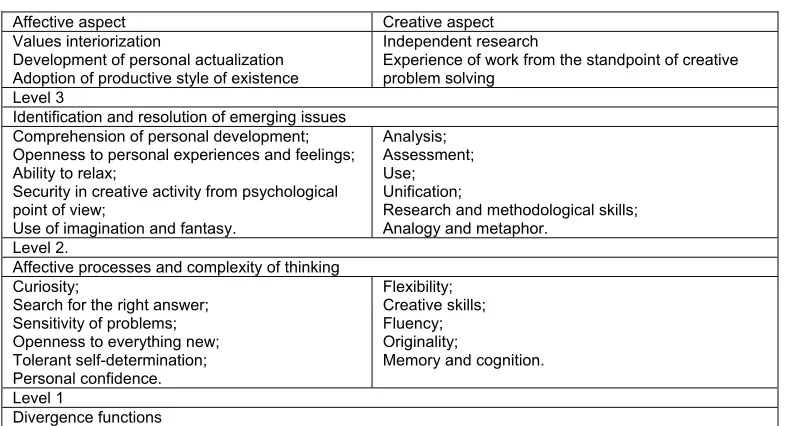
Let's consider in more detail the model for development of creative thinking developed by D. Treffinger (1995). This model is relevant for modern tasks, because it contains three basic stages relevant for other models for development of creative thinking as well. This model is represented by a hierarchical structure that is divided into three levels, and each level has efficiency and cognitive components. Emergence of self-fulfillment at the highest (third) level of the creative component from the perspective of separate definition and completion of tasks is impossible unless other levels are surmounted.
The first stage in the hierarchy implies the expansion of affective and cognitive parameters of the individual, which are also his divergent features. Originality, fluency and creativity are the main properties of human thinking, the development of which is the basic parameter for surmounting the first stage. The affective sphere is made up of human curiosity, urge to find answers, desire to gain new experience, etc. There are many techniques that help to develop these aspects.
The second stage is centered on the process of affectivity and complexity of human thinking. Using assessment, synthesis, analysis and ability to transform the personal understanding and thinking, which contains metaphorical and similar paradigms, the research and methodological skills are combined within the cognitive aspect of the Treffinger model, i.e. they are the focus of development at the second stage. The affective aspect contains understanding of the developmental process, openness to complex experiences and feelings, ability to relax, understanding of the level of psychological stability in the surrounding world, extensive use of fantasy and images, etc.
most relevant during the development of creative thinking of an individual. It can also be called
synthetic, because most of the technical means and techniques, which are relevant for both the 2nd
and the 1st stage, belong to the elements of creative problem solving.
Table 1: Structural Model of Individual Creative Development (according to D. Treffinger (1995))
Affective aspect Creative aspect
Values interiorization
Development of personal actualization Adoption of productive style of existence
Independent research
Experience of work from the standpoint of creative problem solving
Level 3
Identification and resolution of emerging issues Comprehension of personal development; Openness to personal experiences and feelings; Ability to relax;
Security in creative activity from psychological point of view;
Use of imagination and fantasy.
Analysis; Assessment; Use; Unification;
Research and methodological skills; Analogy and metaphor.
Level 2.
Affective processes and complexity of thinking Curiosity;
Search for the right answer; Sensitivity of problems; Openness to everything new; Tolerant self-determination; Personal confidence.
Flexibility; Creative skills; Fluency; Originality;
Memory and cognition.
Level 1
Divergence functions
Source: Treffinger (1995).
The analysis of scientific and methodical literature allows to distinguish 5 stages, characteristic for creative problem solving:
1. Search for facts. 2. Problem identification. 3. Search for the main idea. 4. Identification of optimal solution.
5. Adoption and verification of identified solution.
The above stages describe specificity of productive thinking, i.e. the full cycle of the thinking process (Bicheva, 2016; Yakubov, 2010). The first stage in creative problem solving is examination of the situation which sparked our professional interest for a clearer understanding of the available information. For better understanding of the problem, it should be explored from all angles. At the second stage, it is requires to clearly define the problem. In order to do this, you need to ask yourself a question “Why?” and examine the situation as comprehensively as possible, and identify the optimal solutions for the problem. Instead of assertions, a list of open questions should be made stemming from key parameters of the problem.
During the third stage, the search for idea takes place. The most critical problem and possible ways for its solution need to be identified. For convenience, a list of solutions can be made. The next step is to identify the optimal solution. This stage is characterized by the assessment of all possible ways to solve the problem. For this, the main assessment criteria need to be clarified.
5. Conclusion
The novelty of the presented materials consists in setting the objective to develop methodological framework for increasing the efficiency and professionalism of procurement specialists based on the system of key professional competences, the development of which includes, as a mandatory element, development of creative thinking, assessment of the efficiency of public procurement on the basis of the classical economic school, models of economic growth in the modern theories of development, state requirements to meeting the challenges of the Russian economy (deficit of investment resources, modern technologies, professional human resources; insufficient competition; flaws in the business climate; development of the system program of economic development of the new technological generation, etc.). The proposed approach to solving the problems is based on such principles identified by the author as:
- supply of human resources to the procurement sector through development of creating thinking in the structure of professional competences of specialists in the field of procurement will facilitate implementation of the main principles of contracting system in procurement; will help to prevent risks of corruption, identify other risks and make the informed managerial decisions to prevent the risks of the customers during procurement. Thus, it is a matter of staffing the procurement sector in the conditions of digitalization on the basis of the competence approach as the backbone of methodological support of procurement activities, which is new, since earlier this scientific problem was not considered in a comprehensive way. In order to develop the creative thinking of procurement specialists, it is necessary to create a cross-divisional center that will coordinate the development and supervision over implementation of the training programs for specialists and managers in the field of procurement, not only during training, but also in the future, by involving graduates for participation in the experience sharing between representatives of the professional community, in discussion platforms, training sessions, individual consultations, etc.
6. Acknowledgements
The reported study was funded by RFBR according to the research project N 19-010-00014/19.
References
Acar, A.D. (2014). Do intrinsic and extrinsic motivation factors differ for Generation X and Generation Y.
International Journal of Business and Social Science, 5, 12–20.
Bicheva, I.B. (2016). Development of creative thinking of students as a condition of continuous cognition and
professional development. Modern Research and Innovation, 6. Retrieved from
http://web.snauka.ru/issues/2016/06/67897 on February 10, 2019. Bono, E. (2005). Serious creative thinking. Minsk: LLC “Popurri”.
Brabazon, T. (2017). From revolution to revelation: Generation X, popular memory and cultural studies. Routledge.
Britto, P.R., Oketch, M., & Weisner, T.S. (2014). Nonformal Education and Learning. Learning and Education in Developing Countries: Research and Policy for the Post-2015 UN Development Goals (pp. 74–90). New York: Palgrave Pivot.
Chigisheva, O., Soltovets, E., & Bondarenko, A. (2017). Internationalization impact on PhD training policy in
Russia: Insights from the comparative document analysis. Journal of Social Studies Education Research,
8(2), 178-190.
Coleman, J. (2001). Social capital and human capital. Social Sciences and Modern Times, 3, 122–139.
Dyogtev, G.V., Akimov, N.A., Gladilina, I.P., & Yashchenko, V.V. (2018). Issues of informational security in the
field of procurement. Legal Science, 4, 59–63.
Egorova, L., Trofimovskaya, A.V., & Fatin, M.V. (2017). Development of the principle of professionalism of the
customer on the basis of the competence approach. Economics and Entrepreneurship, 9(3), 706–709.
Gladilina, I.P. (2017). Theory and Practice of Managing Public Procurement Based on Key Professional
Competencies. European Research Studies Journal, XX(4B), 439–452.
Goetsch, D.L., & Davis, S.B. (2014). Quality management for organizational excellence. Upper Saddle River, NJ: Pearson.
Johns, K.J. (2017). Exploring the Motivational and Hygiene Factors of Baby Boomers, Generation X, and Millennials in the Workplace. Northcentral University.
Ponomarev, Ya.A. (1976). Psychology of Creativity. Moscow: Publisher “Nauka”.
Rodikov, A.S. (2010). About values of competence approach in pedagogy. Bulleting of the Vyatka State
University, 4, 25–30.
Savina, N.V. (2012). Leadership competence of the manager: Problems of nurturing and development. Materials of the International Research and Practice Conference "Problems of Economy, Organization and Management in Russia and Worldwide"(pp. 412–414). Prague.
Semenova, F.Z., Borlakova, M.B., & Botasheva, L.S. (2016). Foreign experience in organizing public
procurement. Fundamental Research, 6-2, 465–469.
Shikalova, E.V. (2015). Assessment of efficiency of the public procurement system in the form of a contracting
system as a new institutional environment. Urgent Issues of the Modern Times: Science and Society, 2(7),
30–32.
Sokolov, A.V., & Chulok, A.A. (2012). Long-term forecast of scientific and technological development of Russia
up to 2030: Key features and first results. Foresight, 1, 12–25.
Strielkowski, W., & Chigisheva, O. (2018). Research Functionality and Academic Publishing: Gaming with
Altmetrics in the Digital Age. Economics & Sociology, 11(4), p. 306-316.
Thomas, E.F., McGarty, C., Stuart, A., Lala, G., & Pedersen, A. (2017). Education and social participation: civic identity and civic action in formal and informal education contexts. In K.I. Mavor, M.J. Platow, & B. Bizumic (Eds.), Self and Social Identity in Educational Contexts (pp. 141-155).
Tikhomirov, O.K. (1984). Psychology of thinking. Moscow: Moscow State University.
Treffinger, D.J. (1995). Creative problem solving: Overview and educational implications, Educational
Psychology Review, 7(3), 301–312.
Yakubov, M.R. (2010). Creative management: Practical aspect. Creative Economy, 4(11), 19–24.
Zeer, E.F. (2012). Concept of professional development of a person in the system of continuous education.
Pedagogical Education in Russia, 5, 122–127.
Zenasni, F., & Lubart, T.I. (2002). Effects of emotional states on creativity. Current Psychology Letters:
Behaviour, Brain and Cognition, 8, 33–50.
Zvonnikov, V.I., & Chelyshkova, M.B. (2009). Assessment of creative thinking in the context of the competence