International Doctorate School in Information and Communication Technologies
DISI - University of Trento
Service Composition in Dynamic
Environments:
From Theory to Practice
Heorhi Raik
Advisor:
Prof. Marco Pistore
Fondazione Bruno Kessler
While recalling the four years of work that eventually resulted in this dissertation, I realize how lucky I was to meet and deal with so many
nice people. First of all, I would like to thank my adviser Marco Pistore for providing invaluable support and readily sharing his knowledge and experience. Marco made a lot of effort to make me a researcher (hopefully, a good one) and was constantly bringing to me his unprecedented (but always
well-grounded) optimism about the things we were working on together. I would also like to express my great appreciation to Raman Kazhamiakin who, through our daily discussions and collaboration, accompanied me in my first steps in research and helped me a lot in understanding various
aspects of service-oriented computing (and research in general).
My grateful thanks are also extended to all the members of the SOA unit of the Fondazione Bruno Kessler who made up the creative environment in which the content of this dissertation was produced. In particular, I would
like to mention Antonio Bucchiarone and Annapaola Marconi (for our joint work concerning process adaptation and for their valuable feedback on the first draft of this manuscript); Piergiorgio Bertoli (for our endless discus-sions of AI planning issues); Nawaz Khurshid and Claudio Antares Mezzina
(for our collaboration in the development of ASTRO-CAptEvo platform). Moreover, I wish to say a lot of good words about the other two PhD stu-dents of our group, Adina Sirbu and Asli Zengin, who, after four years of
nich, Germany), and in particular Massimo Paolucci and Matthias Wagner,
for giving me a great opportunity to have a three-month internship in the company and making it possible for me to gain an extremely important experience of doing research in close vicinity to the industry.
Of course, I would like to express my deep gratitude to the dissertation
reviewers Luciano Baresi, Paola Inverardi, Maurizio Marchese and Massimo Paolucci for taking the responsibility and spending their time on reading the thesis and preparing many excellent questions and comments. Without
them, the last step of my PhD adventure would not have been possible. Finally, I wish to thank my fianc´ee Dina Shakirova for her endless sup-port, love and patience, and my best friends Siarhei Bykau, Maksim Khad-kevich, Ivan Tankoyeu and Yury Zhauniarovich for greatly contributing to
In recent years, service-oriented architecture (SOA) has become one of
the leading paradigms in software design. Among the key advantages behind
SOA is service composition, the ability to create new services by reusing
the functionality of pre-existing ones. Despite the availability of standard
languages and related design and development tools, “manual” service
com-position remains to be an extremely error-prone and time-consuming task.
No surprise, the automation of service composition process has been and
still is a hot topic in the area of service computing.
In addition to high complexity, modern service-based systems tend to be
dynamic. The most common examples of dynamic factors are constantly
evolving set of available services, volatile execution context, frequent
revi-sion of business policies, regulations and goals, etc. Since dynamic changes
of the execution environment can invalidate service compositions predefined
within a service-based system, the cost of software maintenance in this case
may increase dramatically. Unfortunately, the existing automated service
composition approaches are not of much help here. Being design-time by
their nature, they intensively involve IT experts, especially for analysing
the changes and respecifying formal composition requirements in new
con-ditions, which is still a considerable effort. To make service-based systems
more agile, a new composition approach is needed that could automatically
perform all composition-related tasks at run time, from deriving
that (i) handles stateful and nondeterministic services that interact
asyn-chronously, (ii) allows for rich control- and data-flow composition
require-ments that are independent from the details of service implementations (iii)
exploits advanced planning techniques for automated reasoning and (iv)
ex-ploits modeling methodology that is applicable in dynamic environment.
The corner stone of the framework is the explicit context model that
ab-stracts composition requirements and constraints away from the details of
service implementations. By linking services to the context model on the
one side, and by expressing composition requirements and constraints in
terms of the context model on the other side, we create a formal setting in
which abstract requirements and constraints, though being
implementation-independent, can always be grounded to available service implementations.
Consequently, we show that in such framework it is possible to move most
human activities to design time so that the run-time management of the
composition life cycle is completely automated. To the best of our
knowl-edge, it is the first composition approach to achieve this goal.
A significant contribution of the dissertation is the investigation of the
problem of dynamic adaptation of service-based business processes. Here,
our solution is based on the composition approach proposed. Within the
thesis, the problem of process adaptation plays the role of the key motivator
and evaluation use case for our composition-related research.
The most part of the ideas discussed in the thesis are implemented and
evaluated to prove their practical applicability.
Keywords
1 Introduction 1
1.1 Context-Aware Service Composition . . . 5
1.2 Dynamic Process Adaptation . . . 10
1.3 Structure of the Thesis . . . 12
1.4 Thesis Context . . . 14
2 State of the Art 15 2.1 Service-Oriented Architecture . . . 16
2.1.1 SOA with Web Services . . . 18
2.1.2 Composition of Web Services . . . 21
2.2 Automated Service Composition . . . 24
2.2.1 Existing Approaches . . . 29
2.2.2 Discussion . . . 36
2.3 Adaptation of Service-Based Business Processes . . . 40
2.3.1 Existing Approaches . . . 44
2.3.2 Discussion . . . 48
2.4 Problem Statement . . . 51
3 Process Adaptation in Dynamic Environments 55 3.1 Motivating Example . . . 57
3.2 Approach Overview . . . 59
3.2.1 Application model . . . 59
3.2.2 Adaptation Mechanisms . . . 64
3.4 Discussion . . . 72
4 Context-Aware Composition of Fragments 75 4.1 Overview . . . 76
4.2 Composition Model Elements . . . 78
4.2.1 Context . . . 78
4.2.2 Annotated Fragments . . . 82
4.2.3 STS to APFL . . . 89
4.2.4 Context-Aware System and Annotation Semantics . . 91
4.2.5 Composition Requirements . . . 94
4.3 Problem of Context-Aware Fragment Composition . . . 94
4.4 Composition Problem as Planning Problem . . . 102
4.4.1 Grounded Context . . . 104
4.4.2 Context-Aware Execution Domain From Grounding . 109 4.5 Algorithm . . . 110
4.6 Discussion . . . 117
5 Composition in Dynamic Environment 119 5.1 System Operation . . . 119
5.1.1 General Adaptation Problem . . . 122
5.1.2 Evolution of System Configuration . . . 123
5.1.3 Managing Adaptation Strategies . . . 130
5.2 Fragment Composition in Dynamic Environment . . . 132
6 Context-Aware Composition of Services 139 6.1 Motivating case study . . . 140
6.2 Composition Model Overview . . . 145
6.3 Context Model . . . 148
6.4 Services and Service Orchestration . . . 150
6.4.1 Service Model . . . 150
6.4.4 Services as Fragments . . . 159
6.5 Service Annotations . . . 162
6.6 Problem of Context-Aware Service Composition . . . 164
6.7 Discussion . . . 165
7 Advanced Topics in Service Composition 169 7.1 Control-Flow Requirements . . . 170
7.1.1 Language and Semantics . . . 170
7.1.2 Requirements as STS . . . 176
7.1.3 Problem of Continuous Composition . . . 186
7.1.4 Approach Architecture and Prototype Algorithm . . . 191
7.2 Data-Flow Requirements . . . 204
7.2.1 Datanet Overview . . . 205
7.2.2 Context-Aware Datanet . . . 212
7.3 Discussion . . . 215
8 Implementation and Evaluation 219 8.1 Composer . . . 219
8.1.1 Implementation . . . 219
8.1.2 Evaluation . . . 222
8.2 ASTRO-CAptEvo . . . 228
8.2.1 Implementation . . . 229
8.2.2 Evaluation . . . 237
9 Conclusions and Future Work 247 9.1 Future Work . . . 249
3.1 Basic and structured activities of APFL . . . 72
4.1 Translation of basic APFL activities into STSs . . . 86
4.2 Translation of structured APFL activities into STSs . . . 87
6.1 Translation of basic WS-BPEL activities into STSs . . . 152
6.2 Translation of structured WS-BPEL activities into STSs . . 153
2.1 Web Services stacks . . . 19
2.2 SOA with Web Services . . . 20
2.3 Choreography and orchestration . . . 23
2.4 Automated service composition . . . 25
2.5 Adaptation concepts . . . 41
2.6 Architecture of adaptable system . . . 42
3.1 Process chain of the car logistics scenario . . . 58
3.2 Artifacts of application model . . . 60
3.3 Examples of context properties in car logistics scenario . . . 62
3.4 Adaptation mechanisms in car logistics scenario . . . 63
4.1 Fragment composition model . . . 76
4.2 Context property for car status . . . 79
4.3 Fragment model of “Car Repair” fragment . . . 83
4.4 Fragment annotation of “Car Repair” fragment . . . 85
4.5 Annotated APFL process of Landing Manager . . . 88
4.6 Landing Manager process as STS . . . 89
4.7 Fragment composition approach . . . 103
4.8 Search algorithm . . . 111
6.1 Flight Booking Service . . . 141
6.2 Flight Notification Service . . . 141
6.3 Flight Cancellation Service . . . 142
6.6 Service composition model . . . 146
6.7 Context properties in virtual travel agency scenario . . . 148
6.8 Flight Booking Service as STS . . . 154
6.9 Observable behavior of services from virtual travel agency scenario . . . 158
6.10 Services with undecidable observable behaviour . . . 159
7.1 Requirements as STS . . . 182
7.2 Continuous composition approach . . . 192
7.3 Goal filtering algorithm . . . 196
7.4 Algorithm for deriving state-action tables . . . 198
7.5 Main planning routine . . . 200
7.6 Original Datanet . . . 208
7.7 Architecture of context-based Datanet . . . 213
7.8 Context-based datanet for virtual travel agency scenario . . 216
8.1 Planning procedure overview . . . 222
8.2 Solution for virtual travel agency scenario . . . 224
8.3 Performance scalability charts . . . 226
8.4 ASTRO-CAptEvo architecture . . . 229
8.5 Scenario Viewer . . . 235
8.6 Process Viewer . . . 237
8.7 Adaptation Viewer . . . 238
8.8 Dependency between performance and number of services com-posed . . . 242
Introduction
Service composition is one of the cornerstone technologies within
service-oriented architecture. It consists in reusing the existing services as building blocks for new services (applications) with higher-level functionality. Due to the fact that, according to the main SOA principles, services are designed to be platform-independent, loosely-coupled, abstract, autonomous and
self-describing, service composition is an extremely powerful technique in hands of software engineers. First of all, it allows for rapid development of new applications, especially when all the necessary components are already available. Second, it promotes high reusability of the development results:
composite services can further be used as building blocks for even more high-level services. Finally, service-based applications obtained as a result of service composition are very and can be quickly tuned and adjusted to
new business requirements and changes in the service infrastructure. Despite all the advantages service composition brings to software engi-neers, when performed manually it is still a very complex, time-consuming and error-prone task. Such complexity mostly comes from the fact that
of this complexity). Moreover, while developing the composition, a lot of easy-to-miss but critical technical aspects have to be reflected. Finally,
languages used for describing both services and their composition, though standardized, are not at all easy to read and write (the XML-languages used here are rather machine-readable than human-readable). All this re-quires profound technical skills and knowledge, and takes a lot of effort
and time to produce a composition; but even in this case the probability of errors is still quite high.
Such complexity becomes a real problem when we start to use SOA in
dynamic application domains. For example, if we do business that requires frequent revision of partners (service providers) and constant correction of business policies and goals (composition requirements), it is very likely we would have to change/adapt our composition-based applications again and
again. That would result in a higher cost of software maintenance and this is what we, as a business owner, would prefer to avoid. The solution lies in creating automated service composition techniques.
From the very origin of service composition, it was recognised as a
good candidate for automation. First, services are self-descriptive and are supposed to provide complete information about themselves in machine-readable standard format (e. g., WSDL [120] and WS-BPEL [91]). Second,
the behaviour of services and their composition can be described using the well-established mathematical models, such as state transition systems, Petri nets, etc. As a result, a lot of interest has been recently demon-strated in the field of automated service composition. Unfortunately, we
have to admit that many approaches suffer from oversimplification and can only be applied to a very restricted set of composition problems. At the same time, some approaches have gained enough maturity to be used
project [4] and published in [103, 79, 18] performs service composition of stateful, nondeterministic and asynchronous services using planning tech-niques. The approach elaborates both control- and data-flow requirements
and can work with standard service specifications: the input is provided in form of WSDL and Abstract WS-BPEL service descriptions and the output is an executable orchestration expressed in WS-BPEL. To give an idea about to what extent automated tools may speed up the composition
process, in [77] the authors tried to solve a real composition problem both manually and using the ASTRO technique. It turned out that the manual composition took around 20 hours, while using the automated approach the
result was produced in around 1 hour. It was a strong evidence automated service composition really makes difference. However, what was impor-tant for us about this experiment is that in case of automated composition three quarters of time were spent on human operations such as analysing
service description and formalizing composition requirements. Although such overhead was not a problem for the case study examined, in modern applications featuring unprecedented level of dynamicity, even the fact of human involvement may become a hurdle on the way to success.
While surveying application domains where modern SOA is used, we can notice that it often operates in so extremely dynamic setting, that service composition is considered to be a kind of “every-minute” routine
activity. We can mention at least two examples of such systems that be-come extremely important in modern information technology. The first one is pervasive systems ([57]), which are mobile systems operating in close connection with the information about their surrounding (context). Once
service composition is exploited in such a system, it has to be flexibly and quickly adapted to the rapidly changing environment. For instance, let us imagine there is a car that has to regularly perform some activity
services (e.g., car parking assisted by various parking services). Depending on the current surrounding (i.e., on the set of available services and on the context) the solution composition, though targeting conceptually the same
objective, will always have different implementation. If a car has to repeat this activity once an hour under different conditions, it would really be unaffordable to involve a human to compose services, even if assisted by conventional composition tools. Another example is user-centric systems
([59]), whose operation evolves around the needs and constraints of a spe-cific user. For instance, it could be a mobile application that allows the user to integrate (compose) multiple mobile services (local phone services,
Internet services, near-field communication services etc.) and execute them consistently. In this case, the choice of services and the composition objec-tives are determined by user’s surrounding and personal preferences/con-straints/goals. Moreover, the need for such composition may arise at any
point in time. Obviously enough, it is not feasible to involve an IT expert to produce this kind of composition. Unfortunately, predefined solutions are not of much help here either, since each user has her own idea about how the composition has to accomplish her tasks.
In this dissertation, we come up with a novel approach to automated service composition that is specifically designed to be used in dynamic exe-cution environments (like the ones discussed above). In very general terms,
the idea of the approach consists in organizing the composition life cycle is such a way that the most part of human activities can be accomplished at design time. As a consequence, the run-time composition management, from the derivation of composition requirements to the composition
syn-thesis to the deployment of executable processes, requires no (or minimal indeed) human involvement. The approach works with a realistic service model and allows for rich control- and data-flow requirements. This makes
Along with the problem of service composition, we also investigate the problem ofdynamic adaptation of service-based business processes and pro-pose a solution based on our composition technique. Within this part of
our research, not only do we show how to exploit service composition for the purposes of process adaptation, but also 1) propose an adaptable pro-cess model, 2) identify various adaptation strategies and 3) consider the problem of automated selection and enactment of adaptation strategies at
run time. Being an important research problem per se, dynamic process adaptation is also a strong motivating case study and a realistic testing platform for our service composition approach.
As such our approaches to service composition and process adaptation make up the two major contributions of the thesis. In the following two sections we discuss them in more detail. After that, we outline the dis-sertation structure and briefly overview the publications and collaboration
related to this PhD activity.
1.1
Context-Aware Service Composition
To gain some background for our composition approach we carefully
ex-amined the aforementioned ASTRO approach. In particular, we adopted with some changes the service model where services were modeled as state transition systems with different types of actions (in our case,
control-lable and uncontrolcontrol-lable). We found this model successful since it allowed us to work with stateful, nondeterministic services with asynchronous be-haviour. We also generally took over some of the composition-as-planning principles proposed in ASTRO. At the same time, ASTRO was extremely
the strong dependency between composition requirements and details of service implementation. It became the starting point in our research.
The central idea of our composition approach consists in detaching
com-position requirements from service implementations so that the former does not include any details about the latter. At the same time, we provide a mechanism for run-time linkage of such conceptual requirements with particular service implementations. As a result, the same group of
re-quirements can be used with various sets of service implementations. We show that in this case a bigger part of the composition modeling effort can be shifted to design time so that composition life cycle is managed at
run time automatically. In our approach, in addition to other technical details, we specifically elaborate control-flow and data-flow requirements. For control-flow requirements, we propose our own simple yet expressive abstract language that is able to express goals with preferences,
proce-dural goals and reactive goals. For data-flow requirements, we adopt the approach of [79] and deeply modify it in order to make it compliant with our modeling methodology.
Services and Fragments
Through the dissertation we use two different types of reusable compo-nents: services and process fragments (or simply fragments). Services are conventional web services described by their interface (WSDL) and
pro-tocol (WS-BPEL). Process fragments ([39]) is a way to represent reusable process knowledge in process composition. To keep it simple, process frag-ments can be considered as an analogue of services in the world of business processes. In fact, process fragments encode elementary subprocesses that
The difference between a service protocol and a service-based process fragment can be described as follows. First, service protocols describe communication between the service and the client from the perspective
of the service, while process fragments use the perspective of the client. This makes process fragments suitable not only for specifying the com-munication model but also for indicating internal operations (e.g., human operations, data manipulations) to be performed on the client side (which
may sometimes be a big advantage). Second, process fragments may ad-ditionally include activities that are not directly related to services: for example, APFL fragments may include concrete activities (to model any
custom activity, e.g., human operation) and abstract activities (to model complex activities whose implementation is to be refined at run time). This makes process fragments much more expressive and much more suitable for the purposes of process adaptation (this is essentially why we consider
pro-cess fragments along with conventional service protocols). Finally, service protocol is associated with a single service, while a single process fragment may describe interaction with a group of services, which generally also makes fragments more flexible.
In the thesis, we first present the composition of fragments. Later, while considering service composition, we show that fragments can be effectively exploited to deal with partial observability of service behaviour. In brief,
for each service protocol we define an APFL-like fragment (we call it com-plementary fragment) that contains only service communication activities and that reflects the acceptable behaviour of the client while communicat-ing to this service. As such, service composition can be essentially reduced
to the composition of respective complementary fragments and so the same composition technique can be used for both fragments and services.
In the rest of this chapter we predominantly use term “service” while
Context as Abstraction Layer
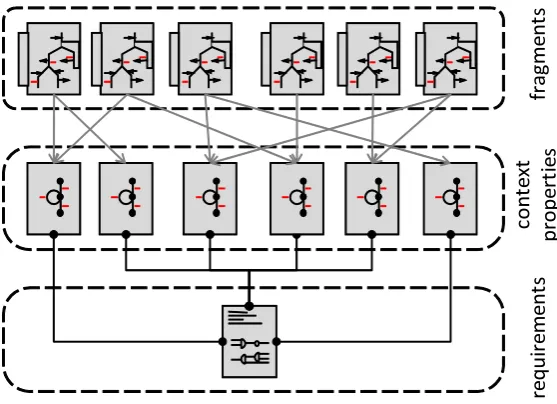
We indicated that the central idea of our approach consists in abstract-ing composition requirements from details of service implementations. We use explicit context model as such abstraction layer. The context is
mod-eled using special state transition systems (context properties). They re-flect possible context situations (states) and context events (transitions between states). Composition requirements are specified in terms of con-text model (for example, to reach some concon-text state or to trigger some
context event), which makes them service-independent. In turn, service specifications are equipped with special annotations connecting them to context model. Consequently, through service annotations context-based
requirements can always be grounded on specific service implementations and, as such, can be combined with them into a composition problem.
Control Flow
To manage control flow of the composition, we introduce 1) a context-based (abstract) language for control-flow requirements and 2) control-flow annotations in service specifications. Our control-flow language allows for
reachability goals (context states to be reached), procedural goals (context events to be triggered) and the mixture of them. In addition to that, it is possible to define a number of alternative goals ordered according to
their preferences (goals with preferences). Finally, we introduce a way to specify reactive requirements, e.g., to achieve some goal in reaction to some context situation (e.g., context event). A lot of attention is paid to formally defining the semantics of this language.
preconditions are used to indicate that an activity can be executed only in certain context situations (states). In fragments, abstract activities are ad-ditionally annotated with contextual goals indicating their abstract
objec-tives. Annotations are used to ground abstract control-flow requirements on service implementations.
Data Flow
Although in this work data flow receives less attention than control flow, realizing its importance we develop a prototype solution for managing data flow. It relies on the Datanet technique presented in ([79]), which is signif-icantly modified in order to be compliant with our modeling methodology.
The idea of the Datanet technique is very intuitive: it explicitly links various data parts of service ports in order to show how the composition can calculate the data of outgoing messages from the data of incoming messages. However, the Datanet is implementation-dependent (it depends
on concrete service ports). To tackle this problem, we modify the Datanet approach so that it conceptually follows th modeling methodology used for control-flow requirements: an implementation-independent (abstract)
part of requirements is specified at design time while services are provided with annotations linking them to the abstract requirements. Our data-flow requirements can generally be handled in planning using the same principles as in [79].
Composition as Planning
A significant amount of this dissertation is devoted to the problem of trans-forming a formal composition problem comprising services, context and
requirements in such a way that in the resulting planning domain for each state it is possible to say if requirements are satisfied in it (and with which preference) or not. Consequently, the states where requirements are
satis-fied become goal states of a planning problem.
Implementation and Evaluation
As a planning technique, our approach uses planning via model checking.
We show that even in the presence of context, for simple cases of control-flow composition requirements (reachability of context states) it is possible to reuse the existing algorithm introduced in ASTRO ([18]). However, when we express control-flow requirements using our new language, it is
necessary to build a conceptually new type of plans, so called continuous plans. Differently from a conventional plan, a continuous plan not only indicates how to reach goal states from the initial state, but also shows how to bring the system back to goal states ones it is forced to leave the
goal state already reached. Moreover, our new algorithm is implemented in the presence of goals with preferences. The correctness of the new plan-ning algorithm is evaluated on the complex Virtual Travel AGency case
study. Moreover, we evaluate the performance scalability using a number of artificial scalable scenarios.
1.2
Dynamic Process Adaptation
Adaptation Strategies
Adaptation strategy indicates how the original process has to be changed in order to adapt to certain situations. We show that many adaptation strategies for process adaptation can be defined. For example, one strategy
may consist in trying to solve a problem without “touching” the original process so that the execution of the latter can be resumed as if nothing happened (local adaptation). Another strategy may imply process rollback
with compensation of the effects of the activities already executed.
We demonstrate that having APFL processes and process fragments with context annotations, it is possible to define a compact set of adapta-tion strategies that can effectively cover a large poradapta-tion of problems that
may happen during the execution. We also show that our context-based formal framework allows for efficient mechanisms for problem detection. A special discussion is devoted to the problem of proper selection of
adapta-tion strategies to be used in certain situaadapta-tions.
Adaptation as Composition
Despite the diversity of the adaptation strategies used in our approach, all of them are realized through context-aware composition of fragments. In
this regard, the difference between the strategies consists in 1) how many compositions a strategy requires to be implemented, 2) how the compo-sition goal is derived from the specification of the process to be adapted and from the current status of the execution environment and 3) how the
Implementation and Evaluation
In order to demonstrate our adaptations ideas in action, we implement the
demo platform ASTRO-CAptEvo based on the car logistics scenario. In fact, the platform realizes a very simple custom SOA infrastructure that is additionally equipped with facilities for dynamic adaptation. The platform
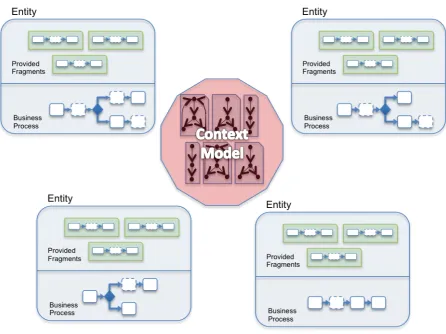
is organized as a set of entities operating within the scenario and collabo-rating with each other in order to achieve their business objectives. Each entity follows its own business process, which can be adapted in case of problems. Moreover, an entity exposes process fragments that can be used
by other entities in order to collaborate with it. We can say that ASTRO-CAptEvo models a pervasive environment. It allows us to demonstrate the possibilities of APFL language with context annotations, the effectiveness of adaptation strategies and mechanisms introduced, the applicability of
our composition techniques to the problem of process adaptation and the flexibility of our modelling methodology. We use the platform to evaluate most of the ideas presented in the thesis, both qualitatively and
quantita-tively.
1.3
Structure of the Thesis
In the context of the thesis, the two main topics (automated service com-position and process adaptation) are very much connected to each other
and interweave a lot. As a result, it was not always easy to decide on the order in which different elements of the thesis should be presented. We hope that the final structure we came up with makes the dissertation a single story that is easy to follow.
of the state of the art in the areas of automated service composition and process adaptation. The chapter also identifies some important open issues in the respective areas. These issues make up the problem statement of the
dissertation. Chapter 3 provides an overview of our approach to dynamic adaptation of service-based business processes. We cover this topic first because 1) it is the key motivator for our research on run-time automated service composition, 2) it gives a nice example of what we mean by
dy-namic execution environment and 3) it introduces some concepts that are important to understand the chapters to come (e.g., APFL fragments). In Chapter 4 we introduce our approach to the composition of process
frag-ments. In Chapter 5 we show how the fragment composition approach of Chapter 4 can be integrated into the adaptation framework of Chapter 3. Here, we also consider the issues related to the execution of compositions in dynamic environment. In Chapter 6 we discuss the relation between
process fragments and services. We show that the partial observability of services can be successfully treated by replacing services with fragments. In this case, the approach of Chapter 4 can be applied to services practically unchanged. Chapter 7 explains how the service composition approach of
Chapter 6 can be extended with advanced control- and data-flow compo-sition requirements. Here we also present the modified planning algorithm that supports these requirements. Chapter 8 is devoted to the
implemen-tation and evaluation of the ideas proposed in the thesis. Finally, Chapter 9 contains concluding remarks and ideas for future work.
We would like to mention, that many concepts presented in the the-sis are demonstrated in action in our platform ASTRO-CAptEvo, that is
described in Chapter 8 and that is freely available on the Web1.
1
1.4
Thesis Context
In this section, we briefly describe research activities and publications
re-lated to this dissertation.
Most of the ideas presented in Chapter 4, 6 and 7 were originally de-veloped in the scope of the YourWay! project. YourWay! was a three-year bilateral collaboration between the Service-Oriented Research Unit
of FBK-IRST and DoCoMo Euro-Labs (Munich, Germany). The project aimed at developing new resource-driven service composition approach for user-centric service provisioning in mobile environments. The related
pub-lications covered context model as abstraction layer and the novel context-based language for control-flow requirements (ICWS 2009, [17]), the cor-responding planning algorithm for continuous composition (ICAPS 2009, [16]) and the user-centric aspects of the composition (CoopIS 2010, [60]).
The development of our approach to dynamic process composition (Chap-ters 3 and 4) was initiated in the scope of the two research projects funded by the European Commission under the 7th Framework Programme. The
S-Cube project [2] was the European Network of Excellence in Software, Services and Systems and the ALLOW project [1] was a research project with the goal of developing a new, flow-based programming paradigm for adaptable pervasive systems. The related publication described the basic
principles of our adaptation framework (SOCA 2011, [26]) and the proto-type implementation of the ASTRO-CAptEvo framework (demo track at ICSOC 2011, [24]).
The further development of the approach included the investigation of
a realistic scenario from the car logistics domain (PESOS 2012, [22]), elab-oration of adaptation strategies (Best Paper Award at ICWS 2012, [25]) and the demonstration of a new edition of the ASTRO-CAptEvo platform
State of the Art
In this chapter we discuss the most significant and recent advances in the areas of service-oriented computing that are central to the
disserta-tion. The first section (Section 2.1) provides the overview of the principles of service-oriented architecture, introduces important definitions and de-scribes the main standards currently in use. The remaining sections of the chapter are devoted to the current progress in two areas of interest. In
particular, in Section 2.2 we explain the general idea of automated ser-vice composition and present the main existing approaches addressing this important problem. Section 2.3 surveys the most important works in the
area of adaptation of service-based business processes. In addition to the critical assessment of the existing works, each area-specific section features a brief discussion where we identify important problems that have not or have weakly been addressed by the existing approaches and, as such, have
2.1
Service-Oriented Architecture
Service-oriented architecture (SOA) is a software engineering paradigm in
which software is designed and developed in form of interoperable ser-vices. The creation of SOA was inspired by the necessity to develop and support complex cross-enterprise information systems that can be quickly and cost-efficiently adapted to the changes in the operational environment.
Conceptually, SOA is the next step in the evolution of distributed com-puting, whose development has chronologically gone through the steps of client-server systems [41], multi-tier systems [40] and RPC-based systems
such as CORBA [93].
The basic intuition of SOA is to construct business applications of loosely-coupled, autonomous and reusable components called services. How-ever, behind this simple idea there is a bunch of principles that have to be
followed by SOA implementations in order to release the SOA potential. The very core of them are as follows [45]:
• Standardized service contract. Services adhere to a communication
agreement (or service contract) as defined by service description doc-uments. Within the same service inventory, services use the same
service description standards;
• Service loose coupling. Service contract is not tightly coupled with
customer requirements nor with service implementation. In this case the contract can evolve without affecting service consumers and service implementations;
• Service abstraction. Besides the details in the service contract, services
hide their internal logic;
• Service reusability. Service logic is arranged so that to promote its
• Service autonomy. Services have a high level of control of the
under-lying run-time execution environment;
• Service statelessness. Services should be maximally freed up from the
management of state data.
• Service discoverability. Services are equipped with communicative
meta data by means of which they can be discovered by consumers;
• Service composability. Services can be effectively composed into new
services with the functionality of arbitrary complexity.
The analysis of service-oriented systems suggests that the above prin-ciples make business applications much more flexible and significantly
de-crease the cost of their initial development (especially, when new applica-tions are “composed” on top of existing services) and further support. The high level of abstraction of service contracts makes it possible to efficiently
integrate and manage services on the level of business functionality, no matter which underlying platforms they use. Finally, such features as dis-coverability and composability allow for applications with unprecedented level of adaptability to environmental changes.
The implementation of SOA is a complex task that involves such sub-jects as networking, knowledge representation and semantics, artificial in-telligence, security, data management and others [95]. Moreover, to enforce
the compliance with the core principles, and to cover various aspects of in-formation systems from the perspective of service orientation, SOA often relies on numerous standards.
Service-oriented architectures can be implemented using a wide range of
SOA implementations, in the rest of this dissertation, we agree to use Web Services and their related terminology, standards and specifications for the demonstration and explanation purposes.
2.1.1 SOA with Web Services
In very general terms, Web Services can be considered as a method of communication between two partners via the Web. The development and standardization of Web Services technology is coordinated by the World Wide Web Consortium (W3C) in the framework of Web Services Activity
[127]. The Web Services Glossary by W3C [124] succinctly defines Web Services as follows:
A Web service is a software system designed to support
inter-operable machine-to-machine interaction over a network. It has an interface described in a machine-processable format (specif-ically WSDL). Other systems interact with the Web service in
a manner prescribed by its description using SOAP-messages, typically conveyed using HTTP with an XML serialization in conjunction with other Web-related standards.
In the Web Services Activity Statement, it is also explicitly stated that Web Services only define the way components interact and do not impose any restrictions on the underlying implementation technologies and
plat-forms. It is also mentioned that one of the important aspects of Web Services is the ability to combine services “in a loosely coupled way in order to achieve complex operations”. As a result, “programs providing simple services can interact with each other in order to deliver sophisticated
The success of Web Services is based on the set of specifications that standardize all important aspects of the technology, from service commu-nication interface and protocol to coordination within service-based
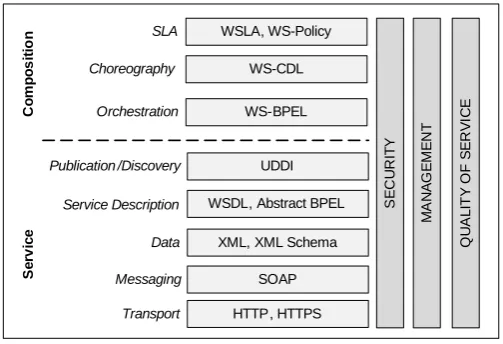
appli-cations [70]. The simplified stack of Web Services standards is given in Fig. 2.1 (the complete version can be found in [55]). As one can see, the stack covers various levels of Web Services infrastructure. The message trans-portation relies on standard Web protocols such as HTTP and HTTPS.
The format of messages is standardized by Simple Object Access Protocol (SOAP) [119], where the data format is defined using XML.
HTTP, HTTPS SOAP XML, XML Schema WSDL, Abstract BPEL
UDDI WS-BPEL WS-CDL WSLA, WS-Policy S E C U R IT Y M A N A G E M E N T Q U A L IT Y O F S E R V IC E Transport Messaging Data Service Description Publication /Discovery Orchestration Choreography SLA S e rv ic e C o m p o s it io n
Figure 2.1: Web Services stacks
In order to let the customer know how a web service can be exploited, web services provide unified description documents. The most important of
them concern service interface (a set of operations supported) and service protocol (valid operation sequences). Web Service Description Language (WSDL) [120] is a standard for specifying web service interfaces. Here a service interface is a set of operations, each defining its input and output
service protocol can be defined using any workflow language. Neverthe-less, there are languages specifically created for Web Services, and that are compliant with other related standards (e.g., WSDL). One of them is
Ab-stract BPEL, which is a part of Web Service Business Process Execution Language (WS-BPEL) [91], a language for executable service-based busi-ness processes. It is worth to mention that description standards are not limited to the two aforementioned. There are numerous standards for
cov-ering various other aspects of web services. For example, OWL-S [121] and WSMO [126] are attempts to provide rich service descriptions for Semantic Web.
The centralized storage and advertising of service descriptions is neces-sary to provide discoverability of services. For that purpose, the Universal Description Discovery and Integration (UDDI) [90] specification has been proposed. UDDI standardizes registries that services can exploit to
adver-tise themselves on the Web. In turn, the customer can use the registries to discover, locate and execute services.
t^> t^>
h/
^KW ^ĞƌǀŝĐĞ ZĞŐŝƐƚƌLJ
^ĞƌǀŝĐĞ ZĞƋƵĞƐƚŽƌ
^ĞƌǀŝĐĞ WƌŽǀŝĚĞƌ
Figure 2.2: SOA with Web Services
ser-vice and accompanies it with serser-vice description documents (e.g., a WSDL document). Service description comprising the WSDL document and other information is submitted to aservice registry (UDDI registry) and becomes
available to potential customers. A service requester (i.e., the customer) uses the service registry to discover available services and obtain their descriptions. Having a service description, the service requester can com-municate to the service by means of SOAP messaging.
The Web Service Architecture [122] shows that this basic model can be extended in different directions. For example, the architecture does not impose any particular restrictions on the service descriptions accessible via
UDDI repository (though they should be machine-readable), the binding of services may be dynamic or static, the process of service selection and dis-covery “may be performed by an agent, or by an end-user” using different selection criteria etc.
Substantial extensions of the basic model origin from the necessity to coordinate the execution of multiple services. In fact, the full potential of Web Services is released only when we speak about an ecosystem of numerous service providers and service consumers collaborating with each
other in order to achieve certain business goals. In this situation, services are combined into business applications (orservice compositions) that pro-vide coordinated execution of multiple services driven by complex business
logic. No surprise, a significant amount of technologies and standards in SOA address the problem of service composition.
2.1.2 Composition of Web Services
One of the driving ideas of SOA is service composition [62], which is the
not provide the needed functionality or when coordinated execution of ex-isting services is required in the context of some business objective. Very often the process of service composition is recursive, i.e., the newly
cre-ated composite service can consequently be used as a component in future compositions.
Service composition is a complex problem that generally consists of a few steps. First, based on the business requirements, suitable services have
to be selected from those available on the Web [73]. Then, service compo-sition has to be formally specified using one of standard languages (e.g., WS-BPEL [91] or WS-CDL [123]). This may involve automated synthesis
algorithms [103]. Finally, the service composition has to be verified against the compliance with business and composition requirements [61], executed, monitored [100] and, if needed, adapted [78].
One might notice that any of these steps is by itself a complex research
problem. For instance, the problem of requirements engineering for service composition often has to consider such aspects as functionality, quality of service, security, business policies and others. Similar set of features have to be taken into account while selecting services. Moreover, to allow for
intelligent selection, services have to be properly annotated with relevant information. The same high level of complexity is attributed to the steps of composition specification, verification, monitoring and adaptation.
There exist two conventional ways two compose services: choreography
and orchestration [98]. The difference in the interaction model of these composition types is explained in Fig. 2.3. Choreography describes inter-action protocols between different participants of the composition from the
global perspective. As such, the composition logic is distributed among all participants. Orchestration is characterized by the existence of a central component (orchestrator) that has full control of the composition logic and
Service 1
(Collaborator )
Service 2
(Collaborator )
Service 3
(Collaborator ) WS-CDL specification
Service 1
(Component )
Service 2
(Component )
Service 3
(Orchestrator )
WS-BPEL specification
Choreography Orchestration
Figure 2.3: Choreography and orchestration
components are normally not aware of the composition. It is worth to mention that two types of composition may co-exist within one service-based application, e.g., a choreography of orchestrations. In addition to
that, from the choreography specification it is always possible to derive a number of orchestrations, where choreography participants play a role of orchestrators [83]. In [3], very specific minor composition models are
additionally distinguished (service coordination and service assembly). One of the main standards for specifying choreographies is Web Services Choreography Description Language (WS-CDL) [123]. This language is used to describe peer-to-peer collaborations between parties through the
definition of their observable behaviour (message exchange) from the global perspective. When the message exchange between the partners is organized according to the WS-CDL specification, a certain business goal is achieved.
The standard languages for orchestrations are represented, first of all, by Business Process Execution Language (BPEL). The part of this standard devoted to the description of executable service-based business process is called Executable BPEL. It is used to define workflows comprising such
execution, loops, conditional branching etc.) in order to define workflows of arbitrary structure and complexity. The process specification can intro-duce variables and perform various manipulations on them. There exist
numerous engines for the direct execution of BPEL processes (e.g., Apache ODE [47], ActiveVOS [44]).
Speaking about BPEL, it is also worth to mention Business Process Model And Notation (BPMN) [92], a powerful approach to defining
busi-ness processes on conceptual level. Although there is no one-to-one cor-respondence between BPEL and BPMN [71], BPMN is frequently used for specifying service-based business processes. No wonder a number of
middleware vendors have recently added direct support for BPMN to their process engines [44].
On the basis of BPEL, a number of extensions have been created to bring aspects that are not present in the original BPEL. For instance,
WS-BPEL Extension for People (WS-BPEL4People) [54] aims to introduce human activities to BPEL in order to let it define general purpose business pro-cesses rather that orchestrations of web services. Of special interest for us is an Adaptable Pervasive Flow Language (APFL [23],[78]) that facilitates
the definition of highly adaptable business processes operating in dynamic execution environments. In addition to conventional BPEL activities, the language introduces internal activities, human activities, context events
and abstract activities (i.e., activities whose final specification is postponed to run time).
2.2
Automated Service Composition
effort in service computing community aims at creating tools that automate this process.
COMPOSER
composition requirements
service specifications
executable composition
Figure 2.4: Automated service composition
The conceptual model of automated service composition is shown in Fig. 2.4. The composer automatically derives executable composition from ser-vice descriptions andcomposition requirements. For different solutions, the
structure of the inputs and output of the composer may widely vary. Ser-vice description normally includes specifications of serSer-vice interface and/or protocol. They are sometimes supplemented with additional annotations,
e.g., semantic annotations [64], non-functional property annotations [131], etc. As a rule, custom annotations enable richer composition requirements [17]. The composition requirements express the user’s expectations about the service composition. Although they can also be quite diverse, to enable
automated reasoning they must be expressed in terms of service descrip-tions. In the literature, two types of composition requirements are often distinguished: control-flow requirements and data-flow requirements [11].
Control-flow requirements impose restrictions on the order of message ex-change within a composition. Data-flow requirements regulate the handling of message data. For many approaches, it is not possible to clearly sepa-rate these two since rules on data manipulation may affect the control flow
and vice versa [79]. Finally, the outcome of the composer may be either orchestration (in the vast majority of cases) or choreography.
a composer that could deal with realistic and general enough service com-position tasks is an extremely complex research problem. Let us outline some of the major issues that an industry-ready automated composition
solution should address. First of all, real services may be stateful rather than atomic and are described by complex workflows (e.g., following the re-cursive model of BPEL, some of the components can themselves be service orchestrations with complex behaviour). Consequently, stateful services
may be asynchronous, nondeterministic (with unpredictable outcome of some operations) and partially observable (the full real status of a service is hidden and only partially accessible through interactions). To this, we
have to add a need for an expressive enough requirements language (and, if needed, service annotation language), that reflects both control- and data-flow requirements and can be processed by the composer.
The experts distinguish two different strategies in synthesizing service
compositions: top-down and bottom-up [3]. In top-down approaches, the composition is first defined at a higher level of abstraction (e.g., as a UML model [114], or as an abstract process model with QoS constraints [131]) and then is converted to an executable composition specification. The
con-version usually consist of 1) discovery and selection of suitable services and 2) final synthesis based on selected services and the initial abstract defini-tion. In bottom-up approaches, the services are composed based on their
definitions (often, extended compared to standard documents like WSDL and Abstract BPEL) and abstract composition goals using an automated reasoner (e.g., AI planning [103]). We remark that sometimes it is not easy to distinguish a strategy used by a certain approach. As an example, an
abstract process defining desired interaction model for a composite service can be considered both as a composition requirement and as an abstract model to refine.
solutions is complicated by the existence of numerous classification criteria and by the fact that many approaches are hardly comparable to each other because they differently perceive a composition problem. Several works
concerning the classification of automated service compositions approaches can be found in the literature ([3], [106], [7], [75]). Using them, we can enumerate the main classification criteria as follows:
• Orchestration/Choreography. In the first case, the goal is to create
a centralized orchestrator that fulfills the composition requirements. In the second case, the result is usually a number of orchestrations attached to services that form a choreography fulfilling the
compo-sition requirements. It is also worth to mention approaches [9] and [86], that involve the distribution of a centralized orchestrator among participants, thus transforming an orchestration into a choreography. In [9], for instance, to that purpose WS-BPEL processes are converted
into attributed graphs and special rules for graph transformation are used to split them into a set of related graphs (distributed pieces of the orchestration). Graph analysis is also used in [86], but the authors also
consider dependencies among the parts obtained to minimize commu-nication costs and maximize the throughput of the composition.
• Static/Dynamic. Static approaches are supposed to produce
com-position using statically predefined set of services and comcom-position
requirements. On the contrary, dynamic approaches can “monitor” the execution environment and once the need for composition/re-composition emerges, they can derive all necessary input data (ser-vice descriptions and composition requirements) automatically. To
requires to perform compositions at run time. Since the problem of dynamicity is one of the central in the dissertation, we have to agree that with respect to composition we use terms static/design-time and
dynamic/run-time interchangeably.
• Data-flow/Control-flow. The criterion shows to what extent data and
control aspect can be reflected in composition requirements and re-sulting composition. It is possible to find polar cases here. On the one hand, there are quite many approaches that ignore the data flow. On
the other hand, mashup-like approaches ([72]) provide data integra-tion of informaintegra-tion-producing services and cannot work with stateful services. Finally, a large amount of solutions consider to different
extent both data and control flows.
• Requirements expressiveness. The expressiveness of requirement
lan-guage determines a range of composition problems that can be en-coded with them. For instance, desirable control-flow can be expressed
through termination conditions, event handlers, constraints, transac-tionality requirements etc. Requirements can also consider functional and non-functional properties of the composition.
• Service Model. The difference between a service model and real
prop-erties of services may substantially affect the applicability of the
ap-proach to real composition problems. For example, if services are con-sidered to be atomic the approach will not be able to work with state-ful services which is a serious limitation. Other details may include
determinism/nondeterminism, synchronicity/asynchronicity etc.
2.2.1 Existing Approaches
To structure the survey, we grouped approaches according to the reasoning mechanism they exploit. From this perspective, we clearly distinguished two groups: approaches that do not exploit AI planning (non-planning
ap-proaches) and approaches that exploit AI planning (planning approaches). Such division is justified by a large amount and diversity of approaches us-ing plannus-ing, which by quantity can be compared to all other approaches joined together. Planning approaches transform a composition problem
into a planning problem and apply planning algorithms to resolve it. Simi-larly, non-planning approaches reduce composition problems to other well-known models (e. g., graphs) and apply appropriate techniques to resolve
them.
We remark that the presence of numerous approaches to service com-position does not allow us to mention all of them here. That is why we primarily chose those that, from our point of view, are more mature,
rep-resent the diversity of composition methods and are interesting to be com-pared to our approach. For the broader survey of other service composition synthesis techniques (especially for model-driven composition, QoS-aware service composition, semantic web composition) we encourage the reader
to check out works [3], [106], [97], [38] and others.
Non-planning Approaches
In [13, 14] a logic-based approach is proposed. Component services are encoded as finite state machines (FSM) on the basis of their exported behaviours (i.e., protocols). The user specifies a desired behaviour of a
re-specting both the specified composite service behaviour and the behaviours of component services. If this is the case, it synthesizes a composition. A further extension of this work [12] allows for more advanced control flow
requirements relying on semantic-like annotations of web services in terms of effects on the real world (the world is modeled as a database). It also addresses basic data-flow requirements in terms of data pieces that services can receive and send. The problem of composition is transformed into a
Proportional Dynamic Logic (PDL) formula, and logical reasoning is used to derive an orchestrator satisfying it.
A more profound approach based on a graph search algorithm can be
found in [57]. Component services and composition requirements are mod-elled as directed graphs with rich semantic attributes. To make search more efficient, all services stored in the registry are joined into an aggre-gated graph representing collective behaviour of a service system. Once
a goal graph is specified, a search algorithm is used to find solution in the aggregation graph. The implementation also addresses the problems related to pervasive systems, such as dynamic recomposition of a solution in changing conditions and unevenness of resources available to different
devices (low performance devices rely on those with high performance for performance-demanding tasks like discovery and composition).
In [29], a simulation-based approach is proposed. Services (possibly, nondeterministic) are modelled as transition systems and a composition requirement is represented with a goal transition system sharing operations with component services. The goal transition system represents desirable interface of a composite service. Nondeterministic simulation is used to
find a transition system of all possible satisfying paths in an asynchronous product of service transition systems. The possibility to generate the best solutions with respect to non-functional properties is added in [30]. Here,
reflects the cost of operation execution. The path with minimal weight is taken as the best.
The approach of [20] provides a way to build service aggregations of
stateful services. Service aggregation is a special type of composition in which composition requirements are not expressed explicitly. The goal of service aggregation is to build a composite service that will expose all behaviours of a set of component services that are correct with respect
to their behaviours and inter-service dependencies. The approach uses a rich model of service contract reflecting both service protocol (encoded with YAWL language [118]) and its ontology-based inputs and outputs.
An aggregation algorithm analyzes control and data flow of services and comes up with a contract of a service aggregation.
A rule-based service composition system is described in [104]. In this work, services are modeled in terms of rules that specify what input data
is necessary for a service to produce certain output data. Having require-ments for the inputs and outputs of a composite service and rules for avail-able component services, a rule-based expert system checks whether it is possible to build a corresponding composition. The authors focus mainly
on data-flow requirements, while services are considered to be atomic, with-out observable complex behaviour. This is an example of the approach where control-flow requirements are not explicitly presented but partially
defined by data-flow requirements. The fact that one service can be ex-ecuted only when certain data is received from another service, imposes restrictions on the acceptable order of service executions. Although rules are used instead of semantic web services, the approach is conceptually
close to semantic service composition ([117]).
A similar approach of composition through data integration is de-scribed in [116, 115]. Here services are modelled as data sources and
desirable output and a set of query templates it has to support. An in-tegration plan is a number of queries to data sources respecting binding patterns. One of the focuses of the work is a solution optimization with
respect to the number of queries to data sources by eliminating redundant queries.
In workflow-based approaches, services are treated as workflows and advanced techniques for processing workflows are applied. For example,
[65] introduces a Transactional Workflow Ontology, in which service work-flows and composition workwork-flows are defined, and implements a process engine that can run ontology-based workflows. The composition consists
in finding services that match tasks in a goal workflow. The solution is inferred from definitions of a goal workflow and service workflows by a semantic reasoner (DAMLJessKB).
The authors of [84] present an interesting approach to service
composi-tion based on heuristic search. In this paper, the authors try to overcome the limitations of planning-based algorithms by using heuristic search as a reasoner. Since heuristic search algorithms have quite some limitations themselves, the authors aim to create a new heuristic search algorithm
that would better address the problem of service composition. In particu-lar, the authors require that the algorithm allows for parallel control flow, uncertainty in service effects and initial state of the execution
environ-ment, alternative control flow for the same problem. Services are modelled as atomic operations with input, output and ontology-based preconditions and effects. Composition requirements are specified as ontology-based ini-tial and goal states and a service domain containing all available services.
Planning Approaches
AI planning ([49]) is by far the most popular reasoning mechanism for auto-mated service composition. In general, planning based approaches consist
in converting a service composition problem into a planning problem so that the latter can be resolved using well-established planning algorithms. As a rule, service descriptions form a planning domain and composition requirements are transformed into planning goals. Despite all the works
below are based on AI planning, the way they exploit it may differ a lot from work to work.
The logic-based planning is exploited by the works [80, 87] by McIl-raith et al. The approach adopts high-level logic programming language
Golog [69] based on situation calculus. The authors show that Golog can be adapted for the purposes of semantic web service composition. The language is extended to allow for generic and customizable programs. The
central idea is to write generic Golog programs that encode certain tasks and, upon user’s request, can be customized with user constraints and can be bound to available services. The component services are originally described semantically using DARBA Agent Markup Language-Services
(DAML-S) [28] and are later translated into situational calculus to be com-patible with Golog-based reasoning. The authors also present an extended version of ConGolog (Concurrent Golog) [50] interpreter that implements
the novel ideas of their approach and allows for calling real web services. The translation of OWL-S semantic web services into ConGolog programs is proposed in [99].
In [96], the author encodes composition problems as planning problems
by introducing relation that express the “payload” of service operations, i.e., how operations affect the service state. To describe complex compo-sition goals that go beyond reachability, the approach uses Java programs
that encode goal logic (although problems with formal verification of com-positions may occur). In a similar way, nondeterminism is addressed. if during the execution unpredictable behaviour occurs, the fault handling strategy can be explicitly added to goal-specifying program. The approach
introduces a novel idea of using planning in combination with other rea-soning techniques.
In [6], the authors perform service composition by dynamically binding
services to an abstract process. As such, composition requirements are specified in form of abstract process whose activities have to be further as-sociated with services. To model abstract processes, WS-BPEL is extended with semantic annotations and a new process engine is implemented. The
dynamic binding takes into account inter-service dependencies and is real-ized using planning.
In [113], Sirin et al. present a semi-automated approach to semantic web service composition. In this approach the user firstly has to find a
service in a repository that can produce a needed piece of information. From the service semantic description in DAML-S [28] the system “un-derstands” what input information is necessary to run the service. Then
it explores the repository for services that can produce such information and let the user choose manually those of them that better fit the user’s needs. As such, the system guides the user through the iterative process of service composition that results in a composite service that satisfied the
requirements. To automate this method, the authors use a Hierarchical Task Network (HTN) planning techniques [46]. In particular, they ex-ploit SHOP2 HTN planner [88]. In [130], all service semantic descriptions
oper-ators and methods in order to build an HTN, i.e., a planning domain. The composition requirements are defined through a semantic description of a composite process and its inputs (this description has the same structure
as the descriptions of components in the repository). Such a description is further translated into a planning goal. After that, the algorithm delivers all the possible service workflows that satisfy the requirements.
The problem of bridging the gap between high-level user’s perception
of the composition goal and low-level service descriptions is addressed in [10]. Here, deterministic service protocols are expressed in YAWL. Service operations are additionally associated with abstract capabilities services
can provide and a hierarchical structure is defined to express how high-level tasks relate to various service capabilities. Finally, service operation parameters are linked to an ontology. Having a user’s need expressed as a task to accomplish, GraphHTN [74] planning engine is used to derive a
service composition that satisfies the user’s need. Hierarchical structure is used to figure out which capabilities have to be involved and linkage to data ontology provides mapping between service operations parameters.
The work of [35] proposes to model the knowledge about the domain in
the form of a state transition system, with transitions associated to service actions of available services. Such a domain reflects how the execution of service actions affects the domain. Being implemented as state transition
systems, services can be synchronously joined with the domain to form a large state transition system encoding all possible service orchestrations and their respective effect on the domain. In the approach, the goal is defined as a linear abstract process, where each action is a reachability goal
over the domain which can be resolved using standard planning algorithms. A complete approach to service composition has been gradually devel-oped in [102, 103, 76, 18] by Pistore et al. The approach was proposed
related to service composition life cycle (composition synthesis, verifica-tion, monitoring and adaptation). Concerning the composition synthesis, the framework provides automated assistance at all phases, from
specify-ing composition requirements to generatspecify-ing WSDL and Executable BPEL specification of a composite service, to deploying it. A service descrip-tion includes WSDL interface and Abstract BPEL protocol. A procedure for translating Abstract BPEL processes to state transition systems is
pro-vided. The formal model carefully reflects such aspects of services as partial observability, nondeterminism and asynchronous behaviour. The planning domain is obtained as asynchronous product of component state transition
systems. Control-flow composition requirements are defined as a reach-ability goal over the states in service protocols and can be additionally extended using CTL temporal logic formulas [43] or the language for ex-tended goals EaGLe [67]. Control-flow requirements ar