E X T E N D E D G E N O M E R E P O R T
Open Access
First high quality draft genome sequence
of a plant growth promoting and cold
active enzyme producing psychrotrophic
Arthrobacter agilis
strain L77
Ram N. Singh
1, Sonam Gaba
1, Ajar N. Yadav
1, Prakhar Gaur
1, Sneha Gulati
1, Rajeev Kaushik
1and Anil K. Saxena
1,2*Abstract
Arthrobacter agilisstrain L77, is a plant growth promoting and cold active hydrolytic enzymes producing psychrotrophic bacterium, isolated from Pangong Lake, a subglacial lake in north western Himalayas, India. Genome analysis revealed metabolic versatility with genes involved in metabolism and cold shock adaptation, utilization and biosynthesis of diverse structural and storage polysaccharides such as plant based carbon polymers. The genome ofArthrobacter agilis strain L77 consists of 3,608,439 bp (3.60 Mb) of a circular chromosome. The genome comprises of 3316 protein coding genes and 74 RNA genes, 725 hypothetical proteins, 25 pseudo-genes and 1404 unique genes.
Keywords:Arthrobacter, Psychrotrophic, PGPB, Cold-active enzymes, Pangong Lake, Himalayas
Abbreviations:AFCs, Anti-freeze compounds; EPS, Exopolysaccharides
Introduction
The microorganisms from extreme environments are of particular importance in global ecology since the major-ity of terrestrial and aquatic ecosystems of our planet are permanently or seasonally submitted to cold tempera-tures. Microorganisms capable of coping with low tem-peratures are widespread in these natural environments where they often represent the dominant flora and they should therefore be regarded as the most successful col-onizers of our planet. Members of the genus Arthrobac-ter [1, 2] are Gram-positive, show rods in exponential growth and cocci in their stationary phase, able to grow under aerobic as well as anaerobic conditions and be-long to the phylum Actinobacteria [3]. Different species of Arthrobacter [1, 2] have been implicated in plant growth promotion [4], production of industrially import-ant enzymes [5, 6] and as xeroprotectimport-ant [7, 8]. These reports suggest that species fromArthrobacter[1, 2] har-bor genes for coding enzymes that can be useful in the
industry, agriculture and biotechnology. Arthrobacter agilis [9] strain L77 was isolated from Pangong Lake, a subglacial lake in north western Himalayas, India and exhibit plant growth promoting attributes as well as pro-duction of hydrolytic enzymes. The culture was further characterized for production of EPS and anti-freeze compounds (AFCs). Here, we present the draft genome sequence ofArthrobacter agilis[9] strain L77 along with the description of genome properties and annotation.
Organism information
Classification and features
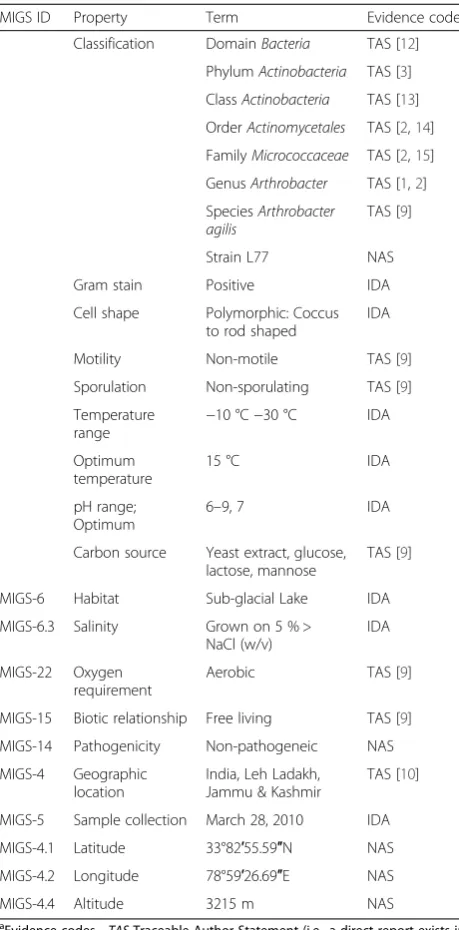
Arthrobacter agilis [9] strain L77 was isolated from fro-zen sub-glacial Pangong Lake (33°82′55.59″N and 78° 59′26.69″E) in north western Himalaya, India (Table 1). This psychrotrophic bacterium was isolated using stand-ard serial dilution method on Trypticase soya agar [10] plate and has been reported to possess plant growth pro-moting attributes and could produce cold active en-zymes and AFCs. It could solubilize phosphorus, zinc and could produce indole acetic acid and ammonia. It could produce cold active enzymes such as lipase, amyl-ase, proteamyl-ase, chitinase andβ-galactosidase.
* Correspondence:[email protected]
1Division of Microbiology, ICAR-Indian Agricultural Research Institute, New Delhi 110012, India
2Present Address: ICAR-National Bureau of Agriculturally Important Microorganisms, Kushmaur, Mau 275103, Uttar Pradesh, India
Strain L77 is a bright yellow colored (Fig. 1) Gram-positive, aerobic, non-motile bacterium exhibiting a rod-coccus cycle. The initial validation of bacterium was done by 16S rRNA gene sequencing using the universal
eubacterial primers pA (5′-AGAGTTTGATCCTGGCT
CAG-3′) and pH (5′
-AAGGAGGTGATCCAGCCGCA-3′) [11]. The 16S rRNA gene sequence places Arthrobac-ter agilisstrain L77 in the domainBacteria[12] (Table 1), phylumActinobacteria[3] and ClassActinobacteria[13],
orderActinomycetales[2, 14] and familyMicrococcaceae [2, 15] during homology search by BLAST [16]. Only few of the closely related species after reclassification [17] of genusArthrobacter[1, 2,] with validly published names: A. agilis DSM 20550T [9], A. woluwensis 1551T DSM 10495 [18], A. methylotrophusDSM 14008T [19], A. tecti LMG 22282T[20],A. parietisLMG 22281T[20],A. subter-raneus CH7T DSM 17585 [21], A. tumbae LMG 19501T
[20], Arthrobacter oryzae KV-651T DSM 25586 [22],
Arthrobacter alkaliphilus LC6T DSM 23368 [23], Arthro-bacter flavus JCM 11496T [24], A. cupressi D48T DSM 24664 [25],A. globiformisDSM 20124T[1, 2] were selected for drawing the phylogenetic position of strain L77.
A phylogenetic tree was constructed (Fig. 2) from the 16S rRNA gene sequence together with other Arthrobac-ter [1, 2] homologs using MEGA 6.0 software suite [26]. The evolutionary history was inferred by using the Max-imum Likelihood method based on the Tamura-Nei model [27]. The tree with the highest log likelihood (0.14495825) is shown. The percentage of trees in which the associated taxa clustered together is shown next to the branches. Initial tree(s) for the heuristic search were obtained automatically by applying Neighbor-Join and BioNJ algorithms to a matrix of pairwise distances esti-mated using the Maximum Composite Likelihood (MCL) approach, and then selecting the topology with superior log likelihood value. The tree is drawn to scale, with branch lengths measured in the number of substitu-tions per site. The analysis involved 13 nucleotide se-quences. All positions containing gaps and missing data were eliminated. There were a total of 1553 positions in the final dataset. Evolutionary analyses were conducted in MEGA6.0 [26]. According to the 16S rRNA gene
Table 1Classification and general features ofArthrobacter agilis
strain L77
MIGS ID Property Term Evidence codea
Classification DomainBacteria TAS [12]
PhylumActinobacteria TAS [3]
ClassActinobacteria TAS [13]
OrderActinomycetales TAS [2,14]
FamilyMicrococcaceae TAS [2,15]
GenusArthrobacter TAS [1,2]
SpeciesArthrobacter agilis
TAS [9]
Strain L77 NAS
Gram stain Positive IDA
Cell shape Polymorphic: Coccus to rod shaped
IDA
Motility Non-motile TAS [9]
Sporulation Non-sporulating TAS [9]
Temperature range
−10 °C−30 °C IDA
Optimum temperature
15 °C IDA
pH range; Optimum
6–9, 7 IDA
Carbon source Yeast extract, glucose, lactose, mannose
TAS [9]
MIGS-6 Habitat Sub-glacial Lake IDA
MIGS-6.3 Salinity Grown on 5 % > NaCl (w/v)
IDA
MIGS-22 Oxygen requirement
Aerobic TAS [9]
MIGS-15 Biotic relationship Free living TAS [9]
MIGS-14 Pathogenicity Non-pathogeneic NAS
MIGS-4 Geographic location
India, Leh Ladakh, Jammu & Kashmir
TAS [10]
MIGS-5 Sample collection March 28, 2010 IDA
MIGS-4.1 Latitude 33°82′55.59″N NAS
MIGS-4.2 Longitude 78°59′26.69″E NAS
MIGS-4.4 Altitude 3215 m NAS
a
Evidence codes -TASTraceable Author Statement (i.e., a direct report exists in the literature),NASNon-traceable Author Statement (i.e., not directly observed for the living, isolated sample, but based on a generally accepted property for the species, or anecdotal evidence). These evidence codes are from the Gene Ontology project [49]
similarity, the nearest phylogenetic neighbors of Arthro-bacter agilis strain L77 are Arthrobacter flavus JCM
11496T [24] (AB537168) with 97.8 %, A. tecti LMG
22282T [20] (AJ639829) with 97.13 %, A. parietis LMG 22281T [20] (AJ639830) with 97.41 %, A. subtrerraneus CH7T DSM 17585 [21] (DQ097525) with 97.66 % andA. tumbaeLMG 19501T[20] (AJ315069) with 97.68 % simi-larity. The 16S rRNA gene sequence also submitted to NCBI GenBank with the accession number KT804924.
Extended feature descriptions
Arthrobacter agilis strain L77, a psychrotrophic bacter-ium, forms bright yellow color colonies (Fig. 1) on TSA medium and could grow in a pH range of 6–9 and toler-ate 5 % NaCl. Growth studies showed that the isoltoler-ate
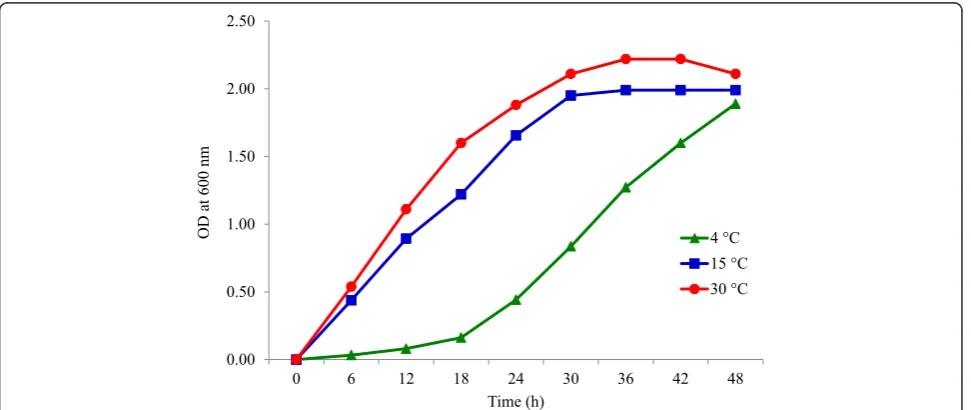
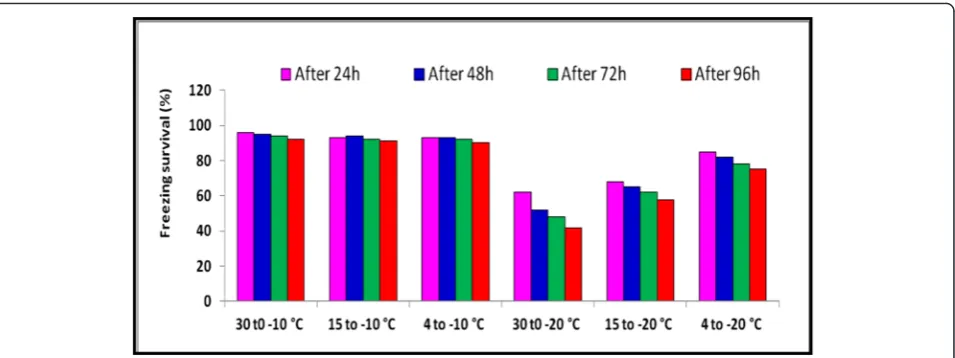
when incubated at 15 and 30 °C was in the exponential phase until 36 h, while at 4 °C, the exponential phase started after 24 h (Fig. 3). Freezing survival studies of Arthrobacter agilisstrain L77 revealed that when the cul-ture was initially grown at 4 °C prior to freezing at −10 and−20 °C, it showed significantly higher freezing survival rather than culture initially grown at 15 and 30 °C prior to freezing (Fig. 3).
Exopolysaccharide production was found to be higher at lower incubation temperatures (4 or 15 °C) in com-parison to the optimal growth temperature (30 °C) for Arthrobacter agilis(L77) (Fig. 4). EPS production by psy-chrophilic bacteria is one of the adaptations at low tem-peratures. The high polyhydroxyl content of EPS lowers the freezing point and ice nucleation temperature of
Arthrobacter subterraneus (T) CH7 (DQ097525)
Arthrobacter tumbae (T) (AJ315069)
Arthrobacter parietis (T) (AJ639830)
Arthrobacter tecti (T) (AJ639829)
Arthrobacter flavus (T) (AB537168)
Arthrobacter agilis L77 (KM878279)
Arthrobacter agilis (T) (X80748)
Arthrobacter methylotrophus (T) (AF235090)
Arthrobacter alkaliphilus (T) LC6 (AB248527)
Arthrobacter woluwensis (T) 1551 (X93353)
Arthrobacter cupressi (T) D48 (HQ657321)
Arthrobacter oryzae (T) KV-651 (AB279889)
Arthrobacter globiformis (T) (X80736)
100
97 78
53
54 98
60
88
0.005
Fig. 2Phylogenetic placements ofArthrobacter agilisstrain L77 between known species ofArthrobactergenus
water. In addition, EPS can trap water, nutrients and metal-ions and facilitate surface adhesion, cellular aggre-gation and biofilm formation and may also play a role in protecting extracellular enzymes against cold denatur-ation and autolysis [28, 29].
Remarkable variations in terms of accumulation of various organic acids, sugars, polyols and amino acids were detected through HPLC at three different incuba-tion temperatures (4, 15 and 30 °C) (Addiincuba-tional file 1: Table S1, Additional file 2: Table S2 and Fig. 5). Among the sugars, accumulation of mannitol and sorbitol was observed only at 4 °C. The amino acids expression pat-tern revealed that the most prominent increase was ob-served in the concentrations of glycine, cysteine and arginine at 4 °C (Additional file 2: Table S2). It has been reported that the cold active enzymes and efficient growth rates are used to facilitate and maintain the
adequate metabolic fluxes at near freezing temperature for cold-adaptation [30]. The development of freezing tolerance by producing cryoprotectant compounds or adaptation of cytoplasmic enzymes to cold conditions for protecting cytoplasmic components is one of the strategy used by microbial cells to survive in freezing conditions as these molecules depress freezing point for the protection of cells [31].
Enhanced EPS production by the psychrophilic bac-teria at low temperature suggests that EPS plays an im-portant role in desiccation protection or prevention of drying of bacterial cells from freezing temperature. It can be assumed that the strain L77 follows a cold evad-ing strategy to thrive in freezevad-ing conditions by synthesiz-ing various cryoprotectants (sugars, polyols and amino acids). These cryoprotectants are known to depress freezing point to evade crystallization [32].
Genome sequencing information
Genome project history
This organism was selected for sequencing on the basis of its environmental and agricultural relevance to help in plant growth and ability to provide inorganic phos-phate to crops at very low temperature. It also has bio-geochemical importance of producing AFCs, so helpful for soil aeration. The genome project is deposited in the online genome database (NCBI-Genome). Sequencing, assembly and annotations were performed at Division of Microbiology, Indian Agricultural Research Institute (ICAR-IARI), New Delhi, India. A summary of the pro-ject information is shown in the Table 2.
Growth conditions and genomic DNA preparation
A culture of L77 was grown in Trypticase soya broth, until they reached an OD(600 nm)> 1.0. The cells were Fig. 4The survival ofArthrobacter agilisstrain L77 subjected to freezing temperature (−10 and−20 °C) shifted from three different temperatures 4, 15 and 30 °C
pelleted from 5 ml culture, washed thrice with TE buffer (10 mM Tris and 1 mM EDTA, pH 8.0) and the pellet
was resuspended in 750 μl TE buffer. Genomic DNA
was extracted from the suspended pellet using Zymo Re-search Fungal/Bacterial DNA MicroPrep™ following the standard protocol prescribed by the manufacturer.
Genome sequencing and assembly
The draft genome of Arthrobacter agilis strain L77
(PRJNA270909) was generated at the Division of Micro-biology, ICAR-Indian Agricultural Research Institute
(ICAR-IARI), New Delhi, India using Illumina [33] tech-nology (Table 2). For this genome, we constructed and sequenced an Illumina MiSeq shotgun library which generated 1,568,654 reads totaling 321.8 Mb data. The raw fastq data was checked for quality using Fast QC [34]. Trimmomatic 0.32 [35] with Nextra adapter se-quences was used to hard clip reads. Assembly of trimmed reads was carried out using a5 pipeline version 2014 [36] (Table 2). In terms of N50 and total number of scaffolds, the a5 pipeline [36] was found to be better than other genome assemblers. CONTIGuator [37] was used to improve the assembly draft. The final draft was identified as Arthrobacter agilis L77, using megablast with RDP 16S database, release 11–1 [38]. This whole-genome project (Bioproject ID: PRJNA270909) has been registered and assembled sequence data sub-mitted at NCBI GenBank under the accession no. JWSU00000000.1-10.1. The version described in this paper is the first version.
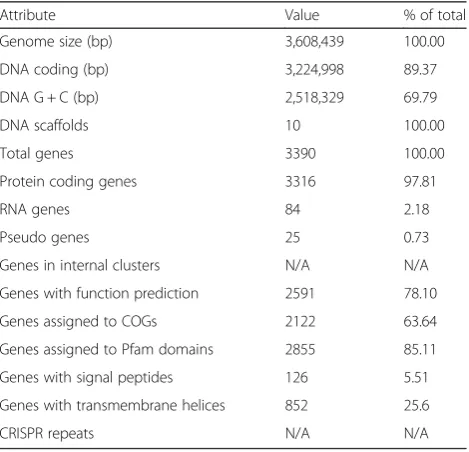
Table 3Genome Statistics forArthrobacter agilisstrain L77
Attribute Value % of total
Genome size (bp) 3,608,439 100.00
DNA coding (bp) 3,224,998 89.37
DNA G + C (bp) 2,518,329 69.79
DNA scaffolds 10 100.00
Total genes 3390 100.00
Protein coding genes 3316 97.81
RNA genes 84 2.18
Pseudo genes 25 0.73
Genes in internal clusters N/A N/A
Genes with function prediction 2591 78.10
Genes assigned to COGs 2122 63.64
Genes assigned to Pfam domains 2855 85.11
Genes with signal peptides 126 5.51
Genes with transmembrane helices 852 25.6
CRISPR repeats N/A N/A
Table 4Number of protein coding genes ofArthrobacter agilis
strain L77 associated with general COG functional categories
Code Value % agea COG category
J 184 5.54 Translation, ribosomal structure and biogenesis
A 1 0.03 RNA processing and modification
K 208 6.27 Transcription
L 109 3.28 Replication recombination and repair
B 1 0.03 Chromatin structure and dynamics
D 22 0.66 Cell cycle control, Cell division, chromosome partitioning
V 49 1.47 Defense mechanisms
T 113 3.40 Signal transduction mechanisms
M 124 3.73 Cell wall/membrane biogenesis
N 30 0.90 Cell motility
U 19 0.57 Intracellular trafficking and secretion
O 104 3.13 Posttranslational modification, protein turnover, chaperones
C 110 3.31 Energy production and conversion
G 213 6.42 Carbohydrate transport and metabolism
E 200 6.03 Amino acid transport and metabolism
F 71 2.14 Nucleotide transport and metabolism
H 114 3.43 Coenzyme transport and metabolism
I 88 2.65 Lipid transport and metabolism
P 118 3.55 Inorganic ion transport and metabolism
Q 38 1.14 Secondary metabolites biosynthesis, transport and catabolism
R 204 6.15 General function prediction only
S 166 5.00 Function unknown – 1030 31.06 Not in COGs a
The total is based on the number of protein coding genes in the annotated genome
Table 2Genome sequencing project information for
Arthrobacter agilisstrain L77
MIGS ID Property Term
MIGS-31 Finishing quality Unfinished, improved high quality draft
MIGS-28 Libraries used Paired End (insert size 250 bp)
MIGS-29 Sequencing platforms Illumina MiSeq
MIGS-31.2 Fold coverage 180×
MIGS-30 Assemblers A5 pipeline v jan-2014
MIGS-32 Gene calling method Prodigal
Locus Tag RY94
Genbank ID JWSU00000000.1-10.1
Genbank Date of Release
08-Jan-2015
GOLD ID Gp0117366
BIOPROJECT PRJNA270909
MIGS 13 Source Material Identifier L77
Genome annotation
Genes were identified using Prokka 1.8 [39] based on Prodigal [40] (Table 2) as part of the Oak Ridge National Laboratory genome annotation pipeline. The predicted CDSs were further annotated on Pfam [41], and (COGs) [42]. These data sources were combined to assert a product description for each predicted protein. Non-coding genes and miscellaneous features were predicted using tRNAscan-SE [43], RNAMMer [44], Rfam [45], TMHMM [46], and signalP v4.1 [47] (Table 3).
Genome properties
The genome is 3,608,439 bp in size, which has GC con-tent of 69.79 mol % (Table 3). There are 47 tRNA, 1 tmRNA, 6 rRNA and 20 ncRNA genes. Of the 3390 pre-dicted genes, 3316 are protein-coding genes (CDSs). Of the total CDSs, 63.64 % represent COG functional cat-egories and 5.51 % consist of signal peptides (Table 3). The distribution of genes into COG functional categor-ies are presented in Table 4. The genome map (Fig. 6) was visualized by CG view server [48].
Insights from the genome sequence
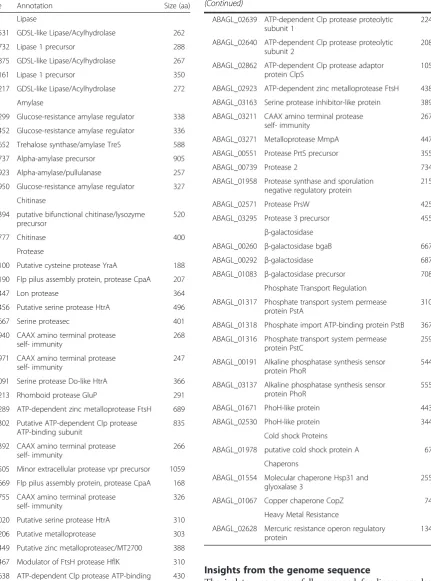
The isolate was successfully screened for lipase, amylase, protease, chitinase and β-galactosidase. Genome analysis
Table 5Candidate genes coding for putative lipase, amylase, chitinase, protease,β-galactosidase, phosphate transport regulation, cold shock proteins, chaperons and heavy metal resistance activities identified inArthrobacter agilisstrain L77 draft genome
Putative Gene Annotation Size (aa)
Lipase
ABAGL_00531 GDSL-like Lipase/Acylhydrolase 262
ABAGL_00732 Lipase 1 precursor 288
ABAGL_00875 GDSL-like Lipase/Acylhydrolase 267
ABAGL_01161 Lipase 1 precursor 350
ABAGL_03217 GDSL-like Lipase/Acylhydrolase 272
Amylase
ABAGL_00299 Glucose-resistance amylase regulator 338
ABAGL_01452 Glucose-resistance amylase regulator 336
ABAGL_01652 Trehalose synthase/amylase TreS 588
ABAGL_01737 Alpha-amylase precursor 905
ABAGL_01923 Alpha-amylase/pullulanase 257
ABAGL_01950 Glucose-resistance amylase regulator 327
Chitinase
ABAGL_01394 putative bifunctional chitinase/lysozyme precursor
520
ABAGL_01777 Chitinase 400
Protease
ABAGL_00100 Putative cysteine protease YraA 188
ABAGL_00190 Flp pilus assembly protein, protease CpaA 207
ABAGL_00447 Lon protease 364
ABAGL_00456 Putative serine protease HtrA 496
ABAGL_00667 Serine proteasec 401
ABAGL_00940 CAAX amino terminal protease self- immunity
268
ABAGL_00971 CAAX amino terminal protease self- immunity
247
ABAGL_01091 Serine protease Do-like HtrA 366
ABAGL_01213 Rhomboid protease GluP 291
ABAGL_01289 ATP-dependent zinc metalloprotease FtsH 689
ABAGL_01302 Putative ATP-dependent Clp protease ATP-binding subunit
835
ABAGL_01392 CAAX amino terminal protease self- immunity
266
ABAGL_01505 Minor extracellular protease vpr precursor 1059
ABAGL_01669 Flp pilus assembly protein, protease CpaA 168
ABAGL_01755 CAAX amino terminal protease self- immunity
326
ABAGL_02020 Putative serine protease HtrA 310
ABAGL_02206 Putative metalloprotease 303
ABAGL_02449 Putative zinc metalloproteasec/MT2700 388
ABAGL_02467 Modulator of FtsH protease HflK 310
ABAGL_02638 ATP-dependent Clp protease ATP-binding subunit ClpX
430
Table 5Candidate genes coding for putative lipase, amylase, chitinase, protease,β-galactosidase, phosphate transport regulation, cold shock proteins, chaperons and heavy metal resistance activities identified inArthrobacter agilisstrain L77 draft genome
(Continued)
ABAGL_02639 ATP-dependent Clp protease proteolytic subunit 1
224
ABAGL_02640 ATP-dependent Clp protease proteolytic subunit 2
208
ABAGL_02862 ATP-dependent Clp protease adaptor protein ClpS
105
ABAGL_02923 ATP-dependent zinc metalloprotease FtsH 438
ABAGL_03163 Serine protease inhibitor-like protein 389
ABAGL_03211 CAAX amino terminal protease self- immunity
267
ABAGL_03271 Metalloprotease MmpA 447
ABAGL_00551 Protease PrtS precursor 355
ABAGL_00739 Protease 2 734
ABAGL_01958 Protease synthase and sporulation negative regulatory protein
215
ABAGL_02571 Protease PrsW 425
ABAGL_03295 Protease 3 precursor 455 β-galactosidase
ABAGL_00260 β-galactosidase bgaB 667
ABAGL_00292 β-galactosidase 687
ABAGL_01083 β-galactosidase precursor 708
Phosphate Transport Regulation
ABAGL_01317 Phosphate transport system permease protein PstA
310
ABAGL_01318 Phosphate import ATP-binding protein PstB 367
ABAGL_01316 Phosphate transport system permease protein PstC
259
ABAGL_00191 Alkaline phosphatase synthesis sensor protein PhoR
544
ABAGL_03137 Alkaline phosphatase synthesis sensor protein PhoR
555
ABAGL_01671 PhoH-like protein 443
ABAGL_02530 PhoH-like protein 344
Cold shock Proteins
ABAGL_01978 putative cold shock protein A 67
Chaperons
ABAGL_01554 Molecular chaperone Hsp31 and glyoxalase 3
255
ABAGL_01067 Copper chaperone CopZ 74
Heavy Metal Resistance
ABAGL_02628 Mercuric resistance operon regulatory protein
showed two important genespstA andpstCwhich are re-quired for the translocation of phosphate across the mem-branes. Another important gene, PstB (an ADP binding protein), of the phosphate transport system is responsible for giving energy to the phosphate transport system of the organism. PhoR and PhoP were also found which are im-portant for regulation of phosphate operon. PhoH like protein has a probable ATPase which is induced when phosphate level decreases. Genome annotation also pre-dicted a putative cold shock protein which is supposed to play an important role in low temperature conditions. There are other proteins which shares evolutionary relation-ship with bacterial cold shock proteins such as Rhodanase and S1 RNA binding protein suggesting their role in low temperature conditions. In-depth analysis of the genome could give us better insight into mechanism of tolerance of this strain to low temperature. Other temperature respon-sive proteins were found such as molecular chaperone Hsp31 and glyoxalase 3 that influence the exposure of hydrophobic domains of proteins and stabilize the early unfolding under high temperature stress conditions to pro-vide stability to the isolate in temperature stress.
Genes of heavy metal resistance were also found in the annotation. Mercuric resistance operon regulatory protein activates the mercury resistance operon in the presence of mercury thus protecting the bacteria from harmful side-effects of mercury. Mercuric reductase is also present which is responsible for conversion of Hg2+to Hg0.copZ is a copper chaperone that replaces zinc with copper and releasescopYfrom the DNA which is a negative regulator ofcopYZABunder excess copper. Gene of nitrogen regu-lation, nitrogen regulatory protein P-II was found that reg-ulates the level of nitrogen by regulating glutamine. When the ratio of glutamine to 2-ketoglutarate decreases, uridine is added on a tyrosine of P-II to form P-II-UMP which in turn deadenylates glutamine synthase resulting in its acti-vation. Putative genes coding for these activities were identified in the genome based on annotation (Table 5).
Conclusions
The 3.6 Mb draft genome ofArthrobacter agilisstrain L77 was assembled and annotated. The isolate was successfully screened for production of EPS and AFCs with potential application in biotechnology. The candidate genes coding for hydrolytic enzymes and cold shock proteins were identi-fied in the genome.Arthrobacter agilisstrain L77 will serve as a source for antifreeze proteins, functional enzymes and other bioactive molecules in future bioprospecting projects.
Additional files
Additional file 1: Table S1.Quantitative analysis of organic acid and sugars/polyols fromArthrobacter agilisstrain L77 by HPLC. (DOCX 13 kb)
Additional file 2: Table S2.Quantitative analysis of amino acids content ofArthrobacter agilisstrain L77 by HPLC. (DOCX 15 kb)
Acknowledgments
The authors are grateful to the National Agricultural Innovation Project (NAIP), Indian Council of Agricultural Research, Govt. of India, New Delhi and Division of Microbiology, ICAR-Indian Agricultural Research Institute (IARI), Pusa, New Delhi and for providing the financial support facilities, to undertake the investigations.
Author’s contributions
RNS and SGa equally contributed to the work. RNS carried out the sample collection, participated in the strain identification, sequence alignment, assembly and annotation analysis and drafted the manuscript. SGa participated in the sequence assembly and annotation analysis. ANY and SGu carried out the bacterial isolation and performed the physiological assays. PG did the initial sequence assembly of the raw data. RK participated in sample collection and sequencing of 16S rRNA gene. AKS conceived of the study, and participated in its design, coordination and helped to finalize the manuscript. All authors read and approved the final manuscript.
Competing interests
The authors declare that they have no competing interests.
Received: 23 December 2015 Accepted: 15 August 2016
References
1. Conn H, Dimmick I. Soil bacteria similar in morphology toMycobacterium
andCorynebacterium. J Bacteriol. 1947;54(3):291.
2. Skerman V, McGowan V, Sneath P, Moore W, Moore LV. Approved lists of bacterial names. Int J Syst Bacteriol. 1980;30:225–420.
3. Garrity GM, Holt JG. The road map to the manual. Bergey’s Manual® of Systematic Bacteriology. Springer New York; 2001. p. 119–66.
4. Manzanera M, Narváez-Reinaldo JJ, García-Fontana C, Vílchez JI, González-López J. Genome sequence ofArthrobacter koreensis5J12A, a plant growth-promoting and desiccation-tolerant strain. Genome Announc. 2015;3(3):e00648–15. 5. Kallimanis A, LaButti KM, Lapidus A, Clum A, Lykidis A, Mavromatis K, et al.
Complete genome sequence ofArthrobacter phenanthrenivoranstype strain (Sphe3). Stand Genomic Sci. 2011;4(2):123.
6. Kiran S, Swarnkar MK, Pal M, Thakur R, Tewari R, Singh AK, et al. Complete genome sequencing of protease-producing novelArthrobactersp. strain IHBB 11108 using PacBio single-molecule real-time sequencing technology. Genome Announc. 2015;3(2):e00346–15.
7. Manzanera M, Santa-Cruz-Calvo L, Vílchez J, García-Fontana C, Silva-Castro G, Calvo C, et al. Genome sequence ofArthrobacter siccitolerans4 J27, a xeroprotectant-producing desiccation-tolerant microorganism. Genome Announc. 2014;2(3):e00526–14.
8. SantaCruz-Calvo L, González-López J, Manzanera M.Arthrobacter siccitolerans
sp. nov., a highly desiccation-tolerant, xeroprotectant-producing strain isolated from dry soil. Int J Syst Evol Microbiol. 2013;63(Pt 11):4174–80. 9. Koch C, Schumann P, Stackebrandt E. Reclassification ofMicrococcus agilis
(Ali-Cohen 1889) to the genusArthrobacterasArthrobacter agiliscomb. nov. and emendation of the genusArthrobacter. Int J Syst Bacteriol. 1995;45(4):837–9. 10. Yadav AN, Sachan SG, Verma P, Tyagi SP, Kaushik R, Saxena AK. Culturable
diversity and functional annotation of psychrotrophic bacteria from cold desert of Leh Ladakh (India). World J Microbiol Biotechnol. 2015;31(1):95–108. 11. Edwards U, Rogall T, Blöcker H, Emde M, Böttger EC. Isolation and direct
complete nucleotide determination of entire genes. Characterization of a gene coding for 16S ribosomal RNA. Nucleic Acids Res. 1989;17(19):7843–53. 12. Woese CR, Kandler O, Wheelis ML. Towards a natural system of organisms:
proposal for the domains Archaea, Bacteria, and Eucarya. Proc Natl Acad Sci U S A. 1990;87(12):4576–9.
13. Stackebrandt E, Rainey FA, Ward-Rainey NL. Proposal for a new hierarchic classification system, Actinobacteria classis nov. Int J Syst Bacteriol. 1997; 47(2):479–91.
14. Buchanan R. Studies in the nomenclature and classification of the bacteria: II. The primary subdivisions of the schizomycetes. J Bacteriol. 1917;2(2):155. 15. Pribram E. A contributionto the classification of microörganisms. J Bacteriol.
16. Altschul SF, Gish W, Miller W, Myers EW, Lipman DJ. Basic local alignment search tool. J Mol Biol. 1990;215(3):403–10.
17. Busee HJ. Review of the taxonomy of the genusArthrobacter, emendation of the genusArthrobactersensu lato, proposal to reclassify selected species of the genusArthrobacterin the novel generaGlutamicibactergen. nov.,
Paeniglutamicibactergen. nov.,Pseudoglutamicibactergen. nov.,Paenarthrobacter
gen. nov. andPseudoarthrobactergen. nov, and emended description of
Arthrobacterroseus. Int J Syst Evol Microbiol. 2016;66:9–37.
18. Funke G, Hutson RA, Bernard KA, Pfyffer GE, Wauters G, Collins MD. Isolation ofArthrobacterspp. from clinical specimens and description ofArthrobacter cumminsiisp. nov. andArthrobacter woluwensissp. nov. J Clin Microbiol. 1996;34(10):2356–63.
19. Borodina E, Kelly DP, Schumann P, Rainey FA, Ward-Rainey NL, Wood AP. Enzymes of dimethylsulfone metabolism and the phylogenetic characterization of the facultative methylotrophsArthrobacter sulfonivorans
sp. nov.,Arthrobacter methylotrophussp. nov., andHyphomicrobium sulfonivoranssp. nov. Arch Microbiol. 2002;177(2):173–83. 20. Heyrman J, Verbeeren J, Schumann P, Swings J, De Vos P. Six novel
Arthrobacterspecies isolated from deteriorated mural paintings. Int J Syst Evol Microbiol. 2005;55(4):1457–64.
21. Chang H, Bae J, Nam Y, Kwon H, Park JR, Shin K, et al.Arthrobacter subterraneussp. nov., isolated from deep subsurface water of the South Coast of Korea. J Microbiol Biotechnol. 2007;17(11):1875.
22. Kageyama A, Morisaki K,Ōmura S, Takahashi Y.Arthrobacter oryzaesp. nov. andArthrobacter humicolasp. nov. Int J Syst Evol Microbiol. 2008;58(1):53–6. 23. Ding L, Hirose T, Yokota A. Four novelArthrobacterspecies isolated from
filtration substrate. Int J Syst Evol Microbiol. 2009;59(4):856–62.
24. Reddy G, Aggarwal R, Matsumoto G, Shivaji S.Arthrobacter flavussp. nov., a psychrophilic bacterium isolated from a pond in McMurdo Dry Valley, Antarctica. Int J Syst Evol Microbiol. 2000;50(4):1553–61.
25. Zhang J, Ma Y, Yu H.Arthrobacter cupressisp. nov., a novel actinomycete isolated from the rhizosphere soil ofCupressus sempervirens. Int J Syst Evol Microbiol. 2012. doi:10.1099/ijs.0.036889-0.
26. Tamura K, Stecher G, Peterson D, Filipski A, Kumar S. MEGA6: molecular evolutionary genetics analysis version 6.0. Mol Biol Evol. 2013;30(12):2725–9. 27. Tamura K, Nei M. Estimation of the number of nucleotide substitutions in
the control region of mitochondrial DNA in humans and chimpanzees. Mol Biol Evol. 1993;10(3):512–26.
28. Nichols CM, Guezennec J, Bowman J. Bacterial exopolysaccharides from extreme marine environments with special consideration of the southern ocean, sea ice, and deep-sea hydrothermal vents: a review. Mar Biotechnol. 2005;7(4):253–71. 29. Poli A, Anzelmo G, Nicolaus B. Bacterial exopolysaccharides from extreme
marine habitats: production, characterization and biological activities. Marine Drugs. 2010;8(6):1779–802.
30. Shivaji S, Prakash JS. How do bacteria sense and respond to low temperature? Arch Microbiol. 2010;192(2):85–95.
31. Yamashita Y, Nakamura N, Omiya K, Nishikawa J, Kawahara H, Obata H. Identification of an antifreeze lipoprotein fromMoraxellasp. of Antarctic origin. Biosci Biotech Biochem. 2002;66(2):239–47.
32. Chattopadhyay M. Cold-adaptation of Antarctic microorganisms–possible involvement of viable but nonculturable state. Polar Biol. 2000;23(3):223–4. 33. Bennett EA, Massilani D, Lizzo G, Daligault J, Geigl E-M, Grange T. Library
construction for ancient genomics: Single strand or double strand? BioTechn. 2014;56(6):289.
34. Andrews S. FastQC: a quality control tool for high throughput data. Reference Source. 2010.
35. Bolger AM, Lohse M, Usadel B. Trimmomatic: a flexible trimmer for Illumina sequence data. Bioinformatics. 2014. doi:10.1093/bioinformatics/btu170. 36. Coil D, Jospin G, Darling AE. A5-miseq: an updated pipeline to assemble
microbial genomes from Illumina MiSeq data. Bioinformatics. 2014. doi:10.1093/bioinformatics/btu661.
37. Galardini M, Biondi EG, Bazzicalupo M, Mengoni A. CONTIGuator: a bacterial genomes finishing tool for structural insights on draft genomes. Source Code Biol Med. 2011;6:11.
38. Cole JR, Wang Q, Cardenas E, Fish J, Chai B, Farris RJ, et al. The Ribosomal Database Project: improved alignments and new tools for rRNA analysis. Nucleic Acids Res. 2009;37 suppl 1:D141–5.
39. Seemann T. Prokka: rapid prokaryotic genome annotation. Bioinformatics. 2014. doi:10.1093/bioinformatics/btu153.
40. Hyatt D, Chen G-L, LoCascio PF, Land ML, Larimer FW, Hauser LJ. Prodigal: prokaryotic gene recognition and translation initiation site identification. BMC Bioinformatics. 2010;11(1):119.
41. Bateman A, Coin L, Durbin R, Finn RD, Hollich V, Griffiths‐Jones S, et al. The Pfam protein families database. Nucleic Acids Res. 2004;32 suppl 1:D138–41. 42. Tatusov RL, Koonin EV, Lipman DJ. A genomic perspective on protein
families. Science. 1997;278(5338):631–7.
43. Lowe TM, Eddy SR. tRNAscan-SE: a program for improved detection of transfer RNA genes in genomic sequence. Nucleic Acids Res. 1997;25(5):0955–64. 44. Lagesen K, Hallin P, Rødland EA, Stærfeldt H-H, Rognes T, Ussery DW.
RNAmmer: consistent and rapid annotation of ribosomal RNA genes. Nucleic Acids Res. 2007;35(9):3100–8.
45. Griffiths-Jones S, Bateman A, Marshall M, Khanna A, Eddy SR. Rfam: an RNA family database. Nucleic Acids Res. 2003;31(1):439–41.
46. Krogh A, Larsson B, Von Heijne G, Sonnhammer EL. Predicting
transmembrane protein topology with a hidden Markov model: application to complete genomes. J Mol Biol. 2001;305(3):567–80.
47. Bendtsen JD, Nielsen H, von Heijne G, Brunak S. Improved prediction of signal peptides: SignalP 3.0. J Mol Biol. 2004;340(4):783–95.
48. Grant JR, Stothard P. The CGView server: a comparative genomics tool for circular genomes. Nucleic Acids Res. 2008;36 suppl 2:W181–4.
49 Ashburner M, Ball CA, Blake JA, Botstein D, Butler H, Cherry JM, Davis AP, Dolinski K, Dwight SS, Eppig JT, Harris MA, Hill DP, Traver LIKasarskis A, Lewis S, Matese JC, Richardson JE, Ringwald M, Rubin GM, Sherlock G. Gene Ontology: tool for the unification of biology. Nat Genet. 2000; 25(1):25–29.
• We accept pre-submission inquiries
• Our selector tool helps you to find the most relevant journal • We provide round the clock customer support
• Convenient online submission
• Thorough peer review
• Inclusion in PubMed and all major indexing services • Maximum visibility for your research
Submit your manuscript at www.biomedcentral.com/submit