Complete genome sequence of
Desulfotomaculum
acetox-idans
type strain (5575
T)
Stefan Spring1, Alla Lapidus2, Maren Schröder1, Dorothea Gleim1, David Sims3, Linda
Meincke3, Tijana Glavina Del Rio2, Hope Tice2, Alex Copeland2, Jan-Fang Cheng2, Susan
Lucas2, Feng Chen2, Matt Nolan2, David Bruce2,3, Lynne Goodwin2,3, Sam Pitluck2, Natalia
Ivanova2, Konstantinos Mavromatis2, Natalia Mikhailova2, Amrita Pati2, Amy Chen4,
Krish-na Palaniappan4, Miriam Land2,5, Loren Hauser2,5, Yun-Juan Chang2,5, Cynthia D. Jeffries2,5,
Patrick Chain2,6, Elizabeth Saunders2,3, Thomas Brettin2,3, John C. Detter2,3, Markus Göker1,
Jim Bristow2, Jonathan A. Eisen2,7, Victor Markowitz4, Philip Hugenholtz2, Nikos C
Kyr-pides2, Hans-Peter Klenk1*, and Cliff Han2,3
1 DSMZ - German Collection of Microorganisms and Cell Cultures GmbH, Braunschweig, Germany
2 DOE Joint Genome Institute, Walnut Creek, California, USA
3 Los Alamos National Laboratory, Bioscience Division, Los Alamos, New Mexico, USA 4 Biological Data Management and Technology Center, Lawrence Berkeley National
Labora-tory, Berkeley, California, USA
5 Oak Ridge National Laboratory, Oak Ridge, Tennessee, USA
6 Lawrence Livermore National Laboratory, Livermore, California, USA 7 University of California Davis Genome Center, Davis, California, USA *Corresponding author: Hans-Peter Klenk
Keywords: sulfate-reducer, hydrogen sulfide, piggery waste, mesophile, motile, sporulating, obligate anaerobic, Peptococcaceae, Clostridiales, Firmicutes.
Desulfotomaculum acetoxidans Widdel and Pfennig 1977 was one of the first sulfate-reducing bacteria known to grow with acetate as sole energy and carbon source. It is able to oxidize substrates completely to carbon dioxide with sulfate as the electron acceptor, which is reduced to hydrogen sulfide. All available data about this species are based on strain 5575T, isolated from piggery waste in Germany. Here we describe the features of this organ-ism, together with the complete genome sequence and annotation. This is the first completed genome sequence of a Desulfotomaculum species with validly published name. The 4,545,624 bp long single replicon genome with its 4370 protein-coding and 100 RNA genes is a part of the Genomic Encyclopedia of Bacteria and Archaea project.
Introduction
Strain 5575T, also known as “Göttingen” strain (=
DSM 771 = ATCC 49208 = VKM B-1644 = KCTC 5769) is the type strain of the species Desulfoto-maculum acetoxidans [1]. Strain 5575Tis the only
strain of the species that is available from public culture collections. It was isolated from piggery waste in Göttingen, Germany. Widdel and Pfennig [2] reported the isolation of additional strains from animal manure, rumen content and dung-contaminated freshwater habitats and concluded that members of D. acetoxidans are primarily
in-testinal bacteria. Unclassified strains with rather high 16S rRNA gene sequence similarity to strain 5575T were reported from rice field soil
(AJ012600 and AJ012601, 98%) and from a freshwater sediment in The Netherlands [3]. A complete genome sequence of the strain ‘ Desulfo-tomaculum reducens’ MI-1 was recently
deter-mined by the DOE Joint Genome Institute (Gen-Bank accession number NC_009253). However, this strain is only distantly related with D. acetox-idans 5575T, both sharing a 16S rRNA sequence
similarity of only 86%, and has no taxonomic sta-tus, because the species epithet was never validly published. Here we present a summary classifica-tion and a set of features for D. acetoxidans strain
5575T together with the description of the
Classification and features
The genus Desulfotomaculum currently represents
a rather heterogeneous taxon. The available 16S rRNA gene sequences (GenBank accession num-bers AB294139 and NR_026409) of the type strain of Desulfotomaculum guttoideum, DSM 4024,
ap-pear to be unrelated to the type species of the ge-nus, but show high similarity to Clostridium sphe-noides and C. celerescens, which both belong to
cluster XIVa of the clostridia [4]. An investigation of the phenotypic traits of D. guttoideum strain
DSM 4024 indicated its affiliation to the species C. sphenoides, which was also confirmed by a
DNA-DNA reassociation value above 70% with the type strain of C. sphenoides (unpublished results). This
indicates that either the published species de-scription of D. guttoideum is erroneous or the
orig-inally described strain is not identical with the culture that was deposited in culture collections. Apart from this species, the genus Desulfotomacu-lum is paraphyletic and comprises several distinct
phenotypic types including mesophilic species, like D. acetoxidans, moderate thermophiles (e.g. D. thermosubterraneum), halophiles (D. halophilum)
and alkaliphiles (D. alkaliphilum). The type species
of the genus, D. nigrificans, is a moderate
thermo-phile and shares only 85% 16S rRNA gene se-quence similarity with D. acetoxidans, indicating
that the latter species might have been misclassi-fied. The members of the genus Desulfotomaculum
are affiliated to the family Peptococcaceae of the
order Clostridiales, within the phylum Firmicutes.
Figure 1 shows the phylogenetic neighborhood of
D. acetoxidans strain 5575T in a 16S rRNA based
tree. The ten 16S rRNA gene copies in the genome of strain 5575T differ by up to 41 nucleotides
(2.6%) from each other, and by up to 35 nucleo-tides (2.2%) from the previously published 16S rRNA sequence generated from DSM 771 (Y11566). D. guttoideum, DSM 4024, has not been
included in the phylogenetic analysis for reasons given above.
Vegetative cells of D. acetoxidans 5575T are
straight to slightly curved rods with pointed ends and dimensions of 1.0-1.5 µm ×3.5-9.0 µm (Table 1
and Figure 2). Motility is conferred by a single polar flagellum [1]. Cells were originally described to stain Gram-negative [1], which is a typical trait among Desulfotomaculum species, but all Desulfo-tomaculum strains examined so far by electron
microscopy have a cell wall structure of the Gram-positive type [20]. Spherical spores of 1.5 µm di-ameter are located in a sub terminal position and cause a swelling of cells resulting in a typical spin-dle shaped morphology. Spores are preferentially formed in agar colonies upon prolonged incuba-tion with acetate as substrate. Formaincuba-tion of spores is often accompanied by the production of gas va-cuoles that appear as conic refractile areas adja-cent to the spores in sporulating mother cells.
Growth occurs between 20 and 40°C with an op-timum at 36°C. The pH range for growth is 6.6–7.6, with an optimum at 7.1 [1]. The salinity optimum for growth of D. acetoxidans is 1 g/l NaCl and
growth is inhibited above 7 g/l NaCl, which is typ-ical for strains showing an adaptation to freshwa-ter habitats [2].
Substrates allowing good growth were found to be acetate and butyrate, whereas long chain fatty ac-ids or carbohydrates were not utilized [2]. In addi-tion, ethanol, butanol, iso-butyrate and n-valerate were identified as suitable substrates. With acetate as substrate, only sulfate was re-ported to be used as electron acceptor, but not sulfite, thiosulfate or fumarate [2]. No fermenta-tive growth on organic substrates in media with-out sulfate was observed [1]. Biotin was identified as sole growth factor in defined media [2].
Figure 2. Scanning electron micrograph of vegetative cells of D. acetoxidans strain 5575T (Manfred Rohde, Helmholtz Centre for Infection Research, Braunschweig)
Chemotaxonomy
Redox difference spectra indicate the presence of membrane bound b-type cytochromes, whereas
no cytochromes c or soluble cytochromes were
detected. The CO-difference spectrum of the so-luble cell fraction revealed presence of a dissimila-tory sulfite reductase of the type P582 [1,2]. D. ace-toxidans contains only menaquinones, mainly of
the MK-7 type and small amounts of MK-6 [21]. Dowling et al. [22] determined the whole-cell fatty acid pattern of D. acetoxidans strain 5575T and
found a dominance of straight-chain, even-numbered fatty acids, whereas neither 10-methyl nor cyclopropyl fatty acids were present. The
pre-dominant fatty acids this organism were 16:0
(34.0%), 16:1 ω7c (24.4%) and 18:1 ω7c (24.1%), followed by 16:1 ω9 (5.9%) and 16:1 ω5 (4.8%).
The abundance of distinct fatty acids in this spe-cies apparently depends strongly on the medium composition: It was found that supplementation of the growth medium with volatile fatty acids led to a decreased proportion of even-numbered fatty acids from 99 to 67% [22]; in addition, Londry et al. reported that under conditions of autotrophic
Table 1. Classification and general features of D. acetoxidans strain 5575T in accordance with the MIGS recom-mendations [9]
MIGS ID Property Term Evidence code
Current classification
Domain Bacteria TAS [10]
Phylum Firmicutes TAS [11]
Class Clostridia TAS [11]
Order Clostridiales TAS [12]
Family Peptococcaceae TAS [13,14] Genus Desulfotomaculum TAS [14-16] Species Desulfotomaculum acetoxidans TAS [1]
Type strain 5575 TAS [1]
Gram stain negative TAS [1]
Cell shape rod with pointed ends TAS [1]
Motility motile (single polar flagellum) TAS [1]
Sporulation spherical endospores TAS [1]
Temperature range 20-40°C TAS [1]
Optimum temperature 36°C TAS [1]
Salinity 1-7 g/l TAS [2]
MIGS-22 Oxygen requirement obligate anaerobic TAS [1]
Carbon source CO2, acetate TAS [1,17]
Energy source H2, acetate, n-butyrate, ethanol, n-butanol TAS [2,17]
MIGS-6 Habitat animal intestinal microflora, fresh water, mud, sea water sediment, soil TAS [2] MIGS-15 Biotic relationship free living
MIGS-14 Pathogenicity none TAS [18]
Biosafety level 1 TAS [18]
Isolation piggery waste TAS [1]
MIGS-4 Geographic location Göttingen, Germany NAS
MIGS-5 Sample collection time 1976 NAS
MIGS-4.1
MIGS-4.2 Latitude – Longitude +51.54 - +9.93 NAS
MIGS-4.3 Depth not reported
MIGS-4.4 Altitude 240 m NAS
Evidence codes - IDA: Inferred from Direct Assay (first time in publication); TAS: Traceable Author Statement (i.e., a direct report exists in the literature); NAS: Non-traceable Author Statement (i.e., not directly observed for the living, isolated sample, but based on a generally accepted property for the species, or anecdotal evidence). These evidence codes are from the Gene Ontology project [19]. If the evidence code is IDA, then the property was observed for a liv-ing isolate by one of the authors or an expert mentioned in the acknowledgments.
Genome sequencing and annotation
Genome project history
This organism was selected for sequencing on the basis of its phylogenetic position, and is part of the
Genomic Encyclopedia of Bacteria and Archaea
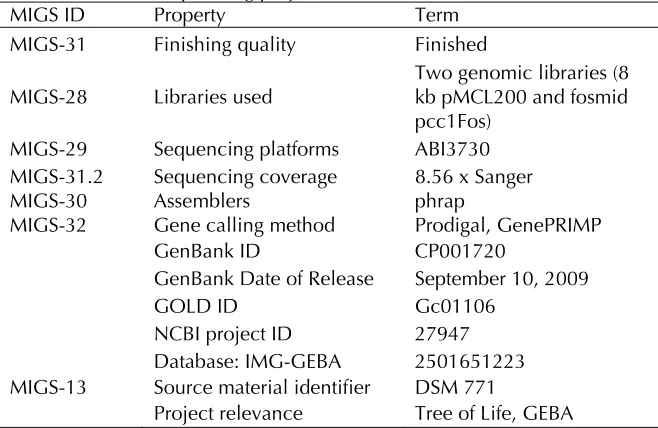
project. The genome project is deposited in the Genomes OnLine Database [8] and the complete genome sequence in GenBank. Sequencing, finish-ing and annotation were performed by the DOE Joint Genome Institute (JGI). A summary of the project information is shown in Table 2.
Growth conditions and DNA isolation
D. acetoxidans strain 5575T, DSM 771, was grown
Table 2. Genome sequencing project information
MIGS ID Property Term
MIGS-31 Finishing quality Finished
MIGS-28 Libraries used Two genomic libraries (8 kb pMCL200 and fosmid pcc1Fos)
MIGS-29 Sequencing platforms ABI3730 MIGS-31.2 Sequencing coverage 8.56 x Sanger
MIGS-30 Assemblers phrap
MIGS-32 Gene calling method Prodigal, GenePRIMP
GenBank ID CP001720
GenBank Date of Release September 10, 2009
GOLD ID Gc01106
NCBI project ID 27947 Database: IMG-GEBA 2501651223 MIGS-13 Source material identifier DSM 771
Project relevance Tree of Life, GEBA
Genome sequencing and assembly
The genome of D. acetoxidans strain 5575T was
sequenced using a combination of 8 kb and fosmid genomic libraries on a Sanger sequencing plat-form. The Phred/Phrap/Consed software package (http://www.phrap.com) was used for sequence assembly and quality assessment. Possible mis-assemblies were corrected with Dupfinisher or transposon bombing of bridging clones [26]. Gaps between contigs were closed by editing in Consed, custom primer walk or PCR amplification. A total of 3,281 Sanger finishing reads were produced to close gaps, to resolve repetitive regions, and to raise the quality of the finished sequence. The er-ror rate of the completed genome sequence is less than 1 in 100,000. Together all sequence types provided 9.2× coverage of the genome. The com-pleted genome sequences of D. acetoxidans
con-tains 46,605 reads.
Genome annotation
Genes were identified using Prodigal [27] as part of the Oak Ridge National Laboratory genome
an-notation pipeline, followed by a round of manual curation using the JGI GenePRIMP pipeline [28]. The predicted CDSs were translated and used to search the National Center for Biotechnology In-formation (NCBI) nonredundant database, Uni-Prot, TIGRFam, Pfam, PRIAM, KEGG, COG, and In-terPro databases. Additional gene prediction anal-ysis and functional annotation was performed within the Integrated Microbial Genomes Expert Review (IMG-ER) platform [29].
Genome properties
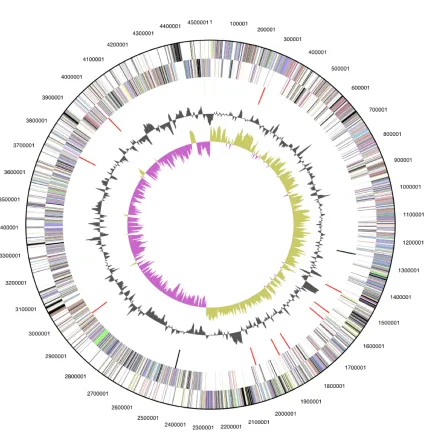
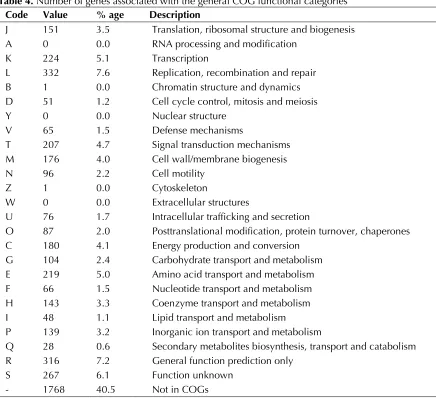
The genome is 4,545,624 bp long with a 41.6% GC content (Table 3 and Figure 3). Of the 4470 genes predicted, 4370 were protein coding genes, and 100 RNAs; 302 pseudogenes were also identified. The majority of the protein-coding genes (65.6%) were assigned with a putative function while the remaining ones were annotated as hypothetical proteins. The distribution of genes into COGs func-tional categories is presented in Table 4.
Table 3. Genome Statistics
Attribute Value % of Total
Genome size (bp) 4,545,624 100.00%
DNA coding region (bp) 3,870,017 85.14%
DNA G+C content (bp) 1,888,927 41.55%
Number of replicons 1
Extrachromosomal elements 0
Total genes 4470 100.00%
Table 3. Genome Statistics (cont.)
Attribute Value % of Total
rRNA operons 10
Protein-coding genes 4370 97.76%
Pseudo genes 302 6.76%
Genes with function prediction 2932 65.59%
Genes in paralog clusters 1045 23.38%
Genes assigned to COGs 2702 60.45%
Genes assigned Pfam domains 2814 62.95%
Genes with signal peptides 701 15.68%
Genes with transmembrane helices 791 17.70%
CRISPR repeats 11
Table 4. Number of genes associated with the general COG functional categories Code Value % age Description
J 151 3.5 Translation, ribosomal structure and biogenesis A 0 0.0 RNA processing and modification
K 224 5.1 Transcription
L 332 7.6 Replication, recombination and repair B 1 0.0 Chromatin structure and dynamics D 51 1.2 Cell cycle control, mitosis and meiosis Y 0 0.0 Nuclear structure
V 65 1.5 Defense mechanisms
T 207 4.7 Signal transduction mechanisms M 176 4.0 Cell wall/membrane biogenesis N 96 2.2 Cell motility
Z 1 0.0 Cytoskeleton
W 0 0.0 Extracellular structures
U 76 1.7 Intracellular trafficking and secretion
O 87 2.0 Posttranslational modification, protein turnover, chaperones C 180 4.1 Energy production and conversion
G 104 2.4 Carbohydrate transport and metabolism E 219 5.0 Amino acid transport and metabolism F 66 1.5 Nucleotide transport and metabolism H 143 3.3 Coenzyme transport and metabolism I 48 1.1 Lipid transport and metabolism
P 139 3.2 Inorganic ion transport and metabolism
Q 28 0.6 Secondary metabolites biosynthesis, transport and catabolism R 316 7.2 General function prediction only
S 267 6.1 Function unknown - 1768 40.5 Not in COGs
Insights from the genome sequence
Heterotrophic substrate utilization
It has been shown that in D. acetoxidans acetate is
oxidized to CO2via the acetyl-CoA/carbon
monox-ide dehydrogenase (CODH) pathway [30] and all necessary genes required for this pathway have been annotated in the finished genome sequence. Interestingly, a core set of genes that is specific for this pathway shows the same arrangement in D. acetoxidans (Dtox_1269 to 1276) as in the
distant-ly related homoacetogenic bacterium Moorella thermoacetica (cooC/acsE) [31]. A cluster of genes (Dtox_1697 to 1703) that is probably required for growth with butyrate as substrate could be also identified. It has been reported that acetate accu-mulates upon growth on butyrate and that acetate is only further metabolized to CO2 under
condi-tions of carbon substrate limitation [2]. This could indicate that the acetyl-CoA/CODH pathway in this strain is only induced under conditions of
energy limitation. For the utilization of primary alcohols several putative alcohol dehydrogenases may be used that are encoded at various sites in the genome of D. acetoxidans.
Strain 5575T exhibits a prolonged lag phase upon
transfer from media with acetate or butyrate as carbon source to media supplied with other or-ganic substrates [2]. Hence, the identification of additional growth substrates might have been hampered by requiring elongated incubation times of several weeks. This could explain why the utilization of lactate is discussed controversially in the literature. According to Widdel and Pfennig [1,2] this strain is unable to use lactate, whereas
Pawłowska-Ćwięk and Pado have repeatedly
(Dtox_0988), which is however only distantly re-lated to genes encoding enzymes known to be in-volved in the respiration or fermentation of lac-tate. Hence, it is unclear if this enzyme could be involved in the utilization of lactate by D. acetox-idans. In our experiments strain 5575T did not
show any visible growth on lactate after an incu-bation period of four weeks.
It was also stated that glucose, fructose, maltose and cellobiose are unsuitable electron donors for this species [2]. However, all necessary genes en-coding enzymes of the Embden-Meyerhof-Parnas pathway for the conversion of sugars to pyruvate (glycolysis) were identified in the genome se-quence. Hence, it is possible that this pathway is used only for the internal metabolism of carbohy-drates and that a transport system for the efficient uptake of sugars is not expressed.
Autotrophic growth
Londry and Des Marais [17] reported that D. ace-toxidans can grow autotrophically with H2 as the
electron donor and CO2 as carbon source, which is
contradictory to the original species description [1,2]. Genes for several subunits of a putative Fe-only hydrogenase (Dtox_0168, Dtox_0169 and Dtox_0172 to 0178) and a [NiFe]-hydrogenase (Dtox_0791 to 0796) were detected in the genome of D. acetoxidans, which would confirm the finding
of H2 utilization in this species.
The acetyl-CoA/CODH pathway is fully reversible and it was shown that in D. autotrophicum it is
used for both the cleavage and formation of acetyl-CoA [33]. Hence, Londry and Des Marais [17] proposed that D. acetoxidans uses the
acetyl-CoA/CODH pathway for the fixation of CO2 under
lithoautotrophic growth conditions. They reported that during growth on H2/CO2 and sulfate, small
amounts of acetate were excreted, which would confirm that the reductive acetyl-CoA pathway is used as mechanism for CO2 assimilation.
Interestingly, a cluster of nitrogenase genes (Dtox_1023 to 1030) could be detected within the annotated genome sequence, so that D. acetox-idans likely has the capacity to use dinitrogen as
nitrogen source. However, the fixation of molecu-lar nitrogen has not been analyzed by laboratory experiments in this species so far.
Electron transport phosphorylation
The oxidation of carbon sources by dehydroge-nases leads to the formation of reduced pyridine
nucleotides that are most likely reoxidized in D. acetoxidans by a proton-translocating NADH
de-hydrogenase complex, which reduces menaqui-nones. The structure of the NADH dehydrogenase seems to be similar to complex I in the electron transport chain of E. coli and mitochondria. Most
genes for this complex are located in a single ope-ron (Dtox_1205 to 1215), but genes for the sub-units E, F, and G are located elsewhere in the ge-nome and often found in close proximity to genes involved in energy metabolism. Several genes en-coding heterodisulfide reductases were annotated and also found close to genes involved in electron transport. Hence, it can be assumed that besides the NADH dehydrogenase complex, heterodisul-fide reductases play a role in the generation of a proton gradient, as has been previously proposed for the homoacetogenic bacterium Moorella ther-moacetica [31]. An established proton gradient could then be utilized by an ATP synthase of the F0F1-type, which is encoded in a single gene clus-ter (Dtox_4164 to 4172).
Besides genes involved in sulfate reduction no other genes encoding known enzymes for alterna-tive pathways of anaerobic respiration were de-tected in the genome, so that in this species the utilization of electron acceptors seems to be stricted to oxidized sulfur species for sulfate re-duction and CO2 for the synthesis of acetyl-CoA. So
far, no homoacetogenic growth of D. acetoxidans
with H2 or organic compounds as electron donor
could be shown, so that apparently the reduction of CO2 is not coupled to the generation of energy
in this species.
Defense against oxidative stress
Widdel and Pfennig reported in the original spe-cies description of D. acetoxidans an inhibition of
growth in media that were not fully reduced [1], which would indicate a high sensitivity against oxygen. Most known sulfate-reducers tolerate ex-posure to oxygen for at least short intervals with-out any recognizable cellular damage. Aerobic respiration was identified as one principal me-chanism for the detoxification of oxygen in cul-tures of Gram-negative sulfate-reducers [34]. Ac-cordingly, quinol oxidases of the cytochrome bd
type that are characterized by a high-affinity to oxygen were identified in several Gram-negative sulfate-reducers [35-38] and ‘D. reducens’ (this
representing a second line of defense against reac-tive oxygen species were identified, for example superoxide dismutase (Dtox_4195) and catalase (Dtox_1104).
Thus, a peculiarity of the D. acetoxidans
metabol-ism could be its strategy against oxidative stress. In this species other reactions may be involved in the scavenging of oxygen, so that highly sensitive compounds within the cytoplasm are protected. A potential mechanism could be the chemical reac-tion of oxygen with ferrous iron or iron sulfides. It was shown that cells of D. acetoxidans produce
hydroxamic siderophores (probably deferox-amine) and accumulate large amounts of ferrous sulfide (FeS) or pyrite (FeS2) in their cell wall [39].
Previously, it was demonstrated in vitro that
freshly precipitated ferrous sulfide is highly effec-tive in the protection of strictly anaerobic cells against oxygen [40]. On the other hand, it was re-ported that large amounts of sulfide (above 7 mM) produced during sulfate-reduction can inhibit growth of certain Desulfotomaculum species [41], so that ferrous iron could also prevent toxic ef-fects of sulfide by precipitation at the cell exterior. Several genes encoding ferrous iron transport proteins as well as subunits of ABC-type transpor-ters specific for the uptake of Fe3+ siderophores
were annotated in the genome of D. acetoxidans,
which emphasizes the importance of iron in the metabolism of this species.
Acknowledgements
We would like to gratefully acknowledge the help of Susanne Schneider (DSMZ) for DNA extraction and quality analysis. This work was performed under the auspices of the US Department of Energy's Office of Science, Biological and Environmental Research Pro-gram, and by the University of California, Lawrence
Berkeley National Laboratory under contract No. DE-AC02-05CH11231, Lawrence Livermore National La-boratory under Contract No. DE-AC52-07NA27344, and Los Alamos National Laboratory under contract. Ger-man Research Foundation (DFG) supported DSMZ un-der INST 599/1-1.
References
1. Widdel F, Pfennig N. A new anaerobic, sporing, acetate-oxidizing, sulfate-reducing bacterium, Desulfotomaculum (emend.) acetoxidans. Arch Microbiol 1977; 112: 119-122
2. Widdel F, Pfennig N. Sporulation and further nu-tritional characteristics of Desulfotomaculum ace-toxidans. Arch Microbiol 1981; 129: 401-402
3. Scholten JC, Stams AJ. Isolation and characteriza-tion of acetate-utilizing anaerobes from a fresh-water sediment. Microb Ecol 2000; 40: 292-299
4. Stackebrandt E, Spröer C, Rainey FA, Burghardt J, Päuker O, Hippe H. Phylogenetic analysis of the genus Desulfotomaculum: evidence for the mis-classification of Desulfotomaculum guttoideum and description of Desulfotomaculum orientis as Desulfosporosinus orientis gen. nov., comb. nov. Int J Syst Bacteriol 1997; 47: 1134-1139 5. Lee C, Grasso C, Sharlow MF. Multiple sequence
alignment using partial order graphs. Bioinformat-ics 2002; 18: 452-464
6. Castresana J. Selection of conserved blocks from multiple alignments for their use in phylogenetic
analysis. Mol Biol Evol 2000; 17: 540-552
7. Stamatakis A, Hoover P, Rougemont J. A rapid bootstrap algorithm for the RAxML web-servers. Syst Biol 2008; 57: 758-771
8. Liolios K, Mavromatis K, Tavernarakis N, Kyrpides NC. The Genomes OnLine Database (GOLD) in 2007: status of genomic and metagenomic projects and their associated metadata. Nucleic Acids Res 2008; 36: D475-D479
9. Field D, Garrity G, Gray T, Morrison N, Selengut J, Sterk P, Tatusova T, Tompson N, Allen MJ, An-giuoli SV, et al. Towards a richer description of our complete collection of genomes and metage-nomes: the “Minimum Information about a Ge-nome Sequence” (MIGS) specification. Nat Bio-technol 2008; 26: 541-547
10. Woese CR, Kandler O, Wheelis ML. Towards a natural system of organisms: proposal for the do-mains Archaea, Bacteria, and Eucarya. Proc Natl Acad Sci USA 1990; 87: 4576-4579
Syste-matic Bacteriology 2nd ed. (D.R. Boone and R.W. Castenholz, eds.), Springer-Verlag, New York 2001; 1:155-166.
12. Prévot AR. Dictionnaire des Bactéries Pathogènes. 2nd ed. Edited by: Hauderoy P, Ehringer G, Guil-lot G, Magrou. J., Prévot AR, Rosset D, Urbain A. Masson et Cie, Paris; 1953; 692 pages.
13. Rogosa M. Peptococcaceae, a new family to in-clude the Gram-positive, anaerobic cocci of the genera Peptococcus, Peptostreptococcus and Ruminococcus. Int J Syst Bacteriol 1971; 21: 234-237.
14. Skerman VBD, McGowan V, Sneath PHA. Ap-proved Lists of Bacterial Names. Int J Syst Bacte-riol 1980; 30: 225-420.
15. Campbell LL, Singleton R, Jr. Genus IV. Desulfo-tomaculum Campbell and Postgate 1965, 361AL. In: Bergey's Manual of Systematic Bacteriology, vol. 2. 1st ed. Edited by: Holt JG. The Williams and Wilkins Co., Baltimore; 1986; pp 1200-1202. 16. Campbell LL, Postgate JR. Classification of the
spore-forming sulfate-reducing bacteria. Bacteriol Rev 1965; 29: 359-363.
17. Londry K, Des Marais D. Stable carbon isotope fractionation by sulfate-reducing bacteria. Appl Environ Microbiol 2003; 69: 2942-2949
18. Anonymous. Biological Agents: Technical rules for biological agents (TRBA 466)
19. Ashburner M, Ball CA, Blake JA, Botstein D, But-ler H, Cherry JM, Davis AP, Dolinski K, Dwight SS, Eppig JT, et al. Gene ontology: tool for the un-ification of biology. Nat Genet 2000; 25: 25-29
20. Liu Y, Karnauchow TM, Jarrell KF, Balkwill DL, Drake GR, Ringelberg D, Clarno R, Boone DR. Description of two new thermophilic Desulfoto-maculum spp., DesulfotoDesulfoto-maculum putei sp. nov., from a deep terrestrial subsurface, and Desulfo-tomaculum luciae sp. nov., from a hot spring. Int J Syst Bacteriol 1997; 47: 615-621.
21. Collins MD, Widdel F. Respiratory quinones of sulphate-reducing and sulphur-reducing bacteria: a systematic investigation. Syst Appl Microbiol 1986; 8: 8-18.
22. Dowling NJE, Widdel F, White DC. Phospholipid ester-linked fatty acid biomarkers of acetate-oxidizing sulphate-reducers and other sulphide-forming bacteria. J Gen Microbiol 1986; 132: 1815-1825.
23. Londry KL, Jahnke LL, Des Marais DJ. Stable car-bon isotope ratios of lipid biomarkers of sulfate-reducing bacteria. Appl Environ Microbiol 2004; 70: 745-751
24. List of growth media used at DSMZ:
25. Wu D, Hugenholtz P, Mavromatis K, Pukall R, Dalin E, Ivanova N, Kunin V, Goodwin L, Wu M, Tindall BJ, et al. A phylogeny-driven genomic en-cyclopedia of Bacteria and Archaea. Nature (In press).
26. Sims D, Brettin T, Detter JC, Han C, Lapidus A, Copeland A, Glavina Del Rio T, Nolan M, Chen F, Lucas S, et al. Complete genome sequence of Kytococcus sedentarius type strain (541T). Stand Genomic Sci 2009; 1: 12-20 27. Anonymous. Prodigal Prokaryotic Dynamic
Pro-gramming Genefinding Algorithm. Oak Ridge Na-tional Laboratory and University of Tennessee 2009
28. Pati A, Ivanova N, Mikhailova N, Ovchinikova G, Hooper SD, Lykidis A, Kyrpides NC. GenePRIMP: A Gene Prediction Improvement Pipeline for mi-crobial genomes. (Submitted) 2009.
29. Markowitz VM, Szeto E, Palaniappan K, Grechkin Y, Chu K, Chen IM, Dubchak I, Anderson I, Lyki-dis A, Mavromatis K, et al. The integrated micro-bial genomes (IMG) system in 2007: data content and analysis tool extensions. Nucleic Acids Res 2008; 36: D528-D533
30. Spormann AM, Thauer RK. Anaerobic acetate oxidation to CO2 in Desulfotomaculum acetox-idans. Demonstration of enzymes required for the operation of an oxidative acetyl-CoA/carbon mo-noxide dehydrogenase pathway. Arch Microbiol
1988; 150: 374-380
31. Pierce E, Xie G, Barabote RD, Saunders E, Han CS, Detter JC, Richardson P, Brettin TS, Das A, Ljungdahl LG, Ragsdale SW. The complete ge-nome sequence of Moorella thermoacetica (f. Clostridium thermoaceticum). Environ Microbiol 2008; 10: 2550-2573
32. Pawłowska-Ćwięk L, Pado R. Growth and anti-oxidant activity of Desulfotomaculum acetoxidans DSM 771 cultivated in acetate or lactate contain-ing media. Pol J Microbiol 2007; 56: 205-213
33. Schauder R, Preuß A, Jetten M, Fuchs G. Oxida-tive and reducOxida-tive acetyl CoA/carbon monoxide dehydrogenase pathway in Desulfobacterium au-totrophicum. 2. Demonstration of the enzymes of the pathway and comparison of CO dehydroge-nase. Arch Microbiol 1989; 151:
84-89
34. Cypionka H. Oxygen respiration by Desulfovibrio species. Annu Rev Microbiol 2000; 54: 827-848
35. Lemos RS, Gomes CM, Santana M, LeGall J, Xavier AV, Teixeira M. The 'strict' anaerobe De-sulfovibrio gigas contains a membrane-bound oxygen-reducing respiratory chain. FEBS Lett
2001; 496: 40-43
5793(01)02399-7
36. Rabus R, Ruepp A, Frickey T, Rattei T, Fartmann B, Stark M, Bauer M, Zibat A, Lombardot T, Becker I, et al. The genome of Desulfotalea psyc-hrophila, a sulfate-reducing bacterium from per-manently cold arctic sediments. Environ Micro-biol 2004; 6: 887-902
37. Heidelberg JF, Seshadri R, Havemann SA, Hemme CL, Paulson IT, Kolonay JF, Eiden JA,
Ward N, Methe B, Brinkac LM, et al. The genome sequence of the anaerobic sulfate-reducing bacte-rium Desulfovibrio vulgaris strain Hildenborough. Nat Biotechnol 2004; 22: 554-559
38. Strittmatter AW, Liesegang H, Rabus R, Decker I, Amann J, Sönke A, Henna A, Fricke WF, Marti-nez-Arias R, Bartels D, et al. Genome sequence of Desulfobacterium autotrophicum HRM2, a ma-rine sulfate reducer oxidizing organic carbon completely to carbon dioxide. Environ Microbiol 2009; 11: 1038-1055
39. Pado R, Pawłowska-Ćwięk L. The uptake and ac-cumulation of iron by the intestinal bacterium Desulfotomaculum acetoxidans DSM 771. [Kra-kow]. Folia Biol 2005; 53:
79-81
40. Brock TD, O'Dea K. Amorphous ferrous sulfide as a reducing agent for culture of anaerobes. Appl Environ Microbiol 1977; 33: 254-256 41. Widdel F. The genus Desulfotomaculum. The


![Table 1. Classification and general features of mendations [D. acetoxidans strain 5575T in accordance with the MIGS recom-9]](https://thumb-us.123doks.com/thumbv2/123dok_us/662977.2065451/4.612.65.552.83.500/table-classification-general-features-mendations-acetoxidans-strain-accordance.webp)